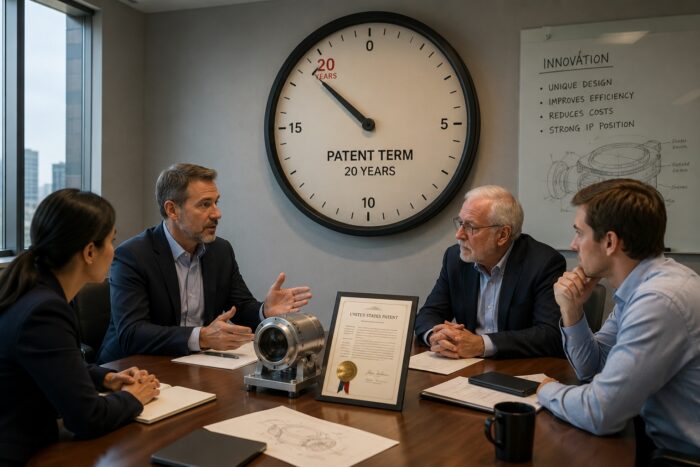
When do patents expire? Most United States patents follow a twenty-year term measured from a controlling filing date, but the actual expiration date may change because the application is part of a patent family with multiple related applications, maintenance fees, Patent Term Adjustment, Patent Term Extension, or a terminal disclaimer. The patent begins providing enforceable exclusive rights when the patent issues as provided in 35 U.S.C. § 154(a). At patent expiry, the patented invention generally enters the public domain as to that patent’s claims.
This article explains the U.S. rules for utility, plant, and design patents, maintenance-fee lapses, patent term adjustments (PTA), Patent Term Extensions (PTE), and terminal disclaimers. The article provides a thorough overview for inventors, entrepreneurs, and business owners, allowing them to understand patent term and what patent expiration means.
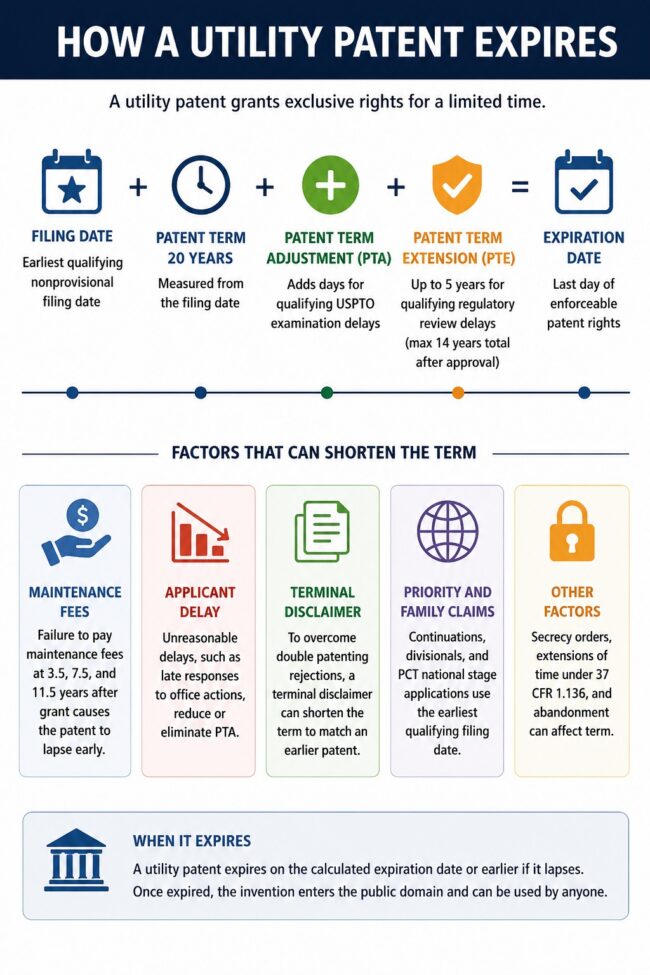
A utility patent is the kind of patent that protects new and useful processes, machines, manufactures, and compositions. A U.S. utility patent lasts 20 years from the filing date. The term of a patent begins when the patent issues and generally ends 20 years from the earliest qualifying non-provisional filing date. This means that the patent is not enforceable until it is examined and issued and the 20-year patent term is diminished by the time spent in the examination process. Thus, no patentee ever enjoys the full 20-year term of patent rights (the term can be extended in special circumstances discussed below). And once the 20-year term ends, the patent rights lapse and the patent cannot be renewed. However, it should be noted that a pending application may provide conditional provisional rights under 35 U.S.C. § 154(d) after publication, which are dependent on the patent eventually issuing.
A patent application may be part of a patent family, where there are patent applications filed after the initial application that claim priority to the initial application. A later child or grandchild application, such as a continuation, divisional, or continuation-in-part application, usually does not receive a new 20-year patent term. If it claims benefit under 35 U.S.C. §§ 120 or 121 to the filing date of an earlier application, its term is measured from the filing date of the earliest qualifying non-provisional ancestor, even when the child was filed later. Priority to a provisional application under 35 U.S.C. § 119(e), however, does not start the running of the 20-year term. See 35 U.S.C. § 154(a)(2)–(3).
Plant patents also last 20 years from the filing date and follow the same family-chain rules. They protect distinct and new asexually reproduced plant varieties under 35 U.S.C. § 161. Plant patents do not require maintenance fees, although patent term adjustment may add days for qualifying USPTO delay. See 35 U.S.C. §§ 154(a)(2), (b).
Because the patent term runs during the patent examination process, lengthy patent prosecution can reduce post-grant life unless lawful term adjustments apply.
The “earliest filing date” requires a review of the patent family where there is more than one related patent filing and claims for priority to earlier patent filings under 35 U.S.C. §§ 120, 365. A provisional application is not a patent, despite the common phrase “provisional patents”, and provisional applications do not start the 20-year clock per 35 U.S.C. § 154(a)(3). The clock begins with the earliest filed non-provisional application.
For a continuation, divisional, or continuation-in-part claiming benefit under 35 U.S.C. § 120, the term may run from an earlier filed parent. Thus, if a second application for the same invention is filed as a continuation or divisional of a previously filed patent application, the second application will expire on the same day as the original patent filing, unless there are patent term adjustments for one or both of the applications.
In the case of an international patent application under the Patent Cooperation Treaty (PCT), a United States patent application claiming priority to the international application and entering the national stage ordinarily measures its term from the international filing date to which the U.S. application claims priority under 35 U.S.C. § 365(c). An international application can pend for 30 months before a national stage application claiming priority to the international application (PCT) must be filed in the United States per 35 U.S.C. § 371 . If the applicant takes advantage of the full 30-month pendency, the U.S. application will not be filed for 2.5 years from the filing of the priority application, thereby reducing the patent term significantly.
Patent term adjustment (PTA) compensates for USPTO delays and adds days to the standard 20-year patent term. Under 35 U.S.C. § 154(b) and 37 C.F.R. §§ 1.702, 1.703, , PTA may arise from missed United States Patent and Trademark Office deadlines, failure to issue within three years, certain patent appeals, and/or secrecy orders.
These delays caused by the USPTO may extend utility and plant patents, but not design patents. Any applicant delay, including an untimely response to an office action, will reduce any PTA under 37 C.F.R. § 1.704. Patent owners should check the PTA calculation when a patent issues to determine their adjusted patent term.
Patent term extension (PTE) under 35 U.S.C. § 156 compensates eligible patents covering certain regulated products such as food additives, pharmaceuticals, and medical devices for regulatory delays before approval by, e.g., the Food and Drug Administration (FDA). See also 37 C.F.R. § 1.710. A patent owner or agent must apply to the USPTO during the nonextendable 60 days beginning on the first commercial-marketing approval date by the FDA. See 37 C.F.R. § 1.720. The patent must claim the approved product, use, or manufacture. One patent may be extended per regulatory review period. The reviewing federal agency (FDA) determines the review period, and the USPTO determines eligibility for a PTE. See 37 C.F.R. § 1.750. PTE can extend the original expiration date by up to five years, but the post-approval effective patent life, including the extension, cannot exceed 14 years.
PTE differs from supplementary protection certificates available in some foreign systems. In the EU, an SPC is a separate patent-based right effective after the basic patent expires and generally adds up to five years for a qualifying medicinal or plant-protection product.
Utility patent owners must pay maintenance fees at 3½, 7½, and 11½ years after patent grant to keep a patent in force per 35 U.S.C. § 41(b). Each fee may be paid during a six-month window before its due date. If missed, a further six-month grace period permits payment with a surcharge. Failure to pay maintenance fees before the grace period ends causes the patent to expire on the fourth, eighth, or twelfth anniversary of the grant date. See 37 C.F.R. § 1.362(d)–(g). Maintenance fees apply to utility patents, but not design or plant patents.
A patent that has lapsed for failure to pay maintenance fees may, in certain circumstances, be reinstated for unintentional delay under 37 C.F.R. § 1.378. The petition must include the overdue maintenance fee, the petition fee, and a statement that the delay was unintentional. The USPTO may require additional information. If accepted, the patent is treated as not having expired, subject to intervening rights for third parties for certain activities undertaken during the lapse. See 35 U.S.C. § 41(c)(2).
A terminal disclaimer can shorten a patent’s term by disclaiming any portion extending beyond a specified date, usually the expiration date of an earlier related patent. It is commonly filed to overcome an obviousness-type double patenting rejection by preventing patentably indistinct claims from creating an unjustified later period of exclusivity. See 35 U.S.C. § 253. A terminal disclaimer can therefore override the expected expiration date and generally requires the disclaimed and referenced patents to remain commonly owned for enforceability under 37 C.F.R. § 1.321.
Patent term adjustment (PTA) and patent term extension (PTE) are treated differently. Section 154(b)(2)(B) provides that PTA cannot extend a patent beyond the date stated in a terminal disclaimer. Claims that are patentably indistinct from a parent application may be subject to an obviousness-type double patenting rejection if no terminal disclaimer has been filed. Patent holders and applicants should evaluate their pending patent claims for relatedness to their earlier patents in the same patent family for obviousness issues before the pending application issues as a patent, after which a curative terminal disclaimer may be unavailable.
By contrast, Merck & Co. v. Hi-Tech Pharmacal Co., 482 F.3d 1317 (Fed. Cir. 2007), held that qualifying PTE under 35 U.S.C. § 156 may extend a patent shortened by terminal disclaimer. The disclaimer fixes the ordinary date of expiration, but PTE is calculated from that shortened date. Merck confirms that the disclaimer does not bar a statutory § 156 PTE extension.
Design patents are distinct from utility patents, protecting the ornamental design of an article rather than its utility or function. See 35 U.S.C. § 171. Design patents filed on or after May 13, 2015, last 15 years from their issue date under 35 U.S.C. § 173. Design patents filed prior to May 13, 2015, last 14 years from the date of the patent grant. These older design patents will be irrelevant around 2031, which is roughly the timeframe in which the last of these older filings will expire.
Design patents do not require maintenance fees per 37 C.F.R. § 1.362(b). Their expiration therefore depends only on the grant date and statutory term.
Patent expiration is the scheduled end of patent protection. Patent invalidation is a judicial or administrative determination that a patent claim is invalid. A district court or the Federal Circuit may determine whether a patent is invalid or unenforceable, while the Patent Trial and Appeal Board may cancel claims before the expiration date.
When the patent expires and the invention enters the public domain, the public generally may make, use, sell, offer to sell, or import the formerly patented invention without permission under that patent. See 35 U.S.C. § 154(a). This is part of the quid pro quo of the patent system: the inventor publicly discloses the invention in exchange for temporary exclusive rights and then the public is allowed to practice the invention after the patent term ends.
However, it should be understood that overlapping patents, trade secrets, trademarks, contracts, or other forms of intellectual property may still restrict particular conduct related to the invention. A thorough freedom to operate analysis should be conducted prior to practicing the invention disclosed in an expired patent.
A business's patent strategy is primarily focused on the scope of the patent rights provided by a patent and whether those rights sufficiently protect the business from competing products and services. However, a patent applicant, owner, or holder should track the earliest non-provisional or international filing date, issue date, maintenance-fee deadlines, PTA, PTE, and disclaimers so that they have an accurate understanding of when their patent rights are scheduled to expire. These additional factors must be considered and the patent term must be accurately calculated and tracked in order to manage and understand a patent portfolio and plan for the business's future market position.
These concepts should also be understood in order to assess competitor and third party patent rights and predict when a third party patent expires and the protected invention may be practiced without fear of patent infringement.
Utility and plant patents typically expire 20 years from the controlling filing date, while design patents expire 14 or 15 years from grant, depending on filing date. The actual expiration date, however, may be earlier or later because of maintenance-fee lapse, patent term adjustment, patent term extension, a terminal disclaimer, or the filing history of related applications. Patent expiration ends the exclusive rights provided by that patent, and the disclosed invention generally enters the public domain as to the expired claims. However, other patents or other forms of intellectual property may continue to restrict particular conduct. For that reason, sound freedom to operate analysis reconstructs the complete family and prosecution history rather than relying only on the face of the patent. Businesses should confirm both the patent’s expiration date and any overlapping rights before launching a competing product or process.
© 2026 Sierra IP Law, PC. The information provided herein does not constitute legal advice, but merely conveys general information that may be beneficial to the public, and should not be viewed as a substitute for legal consultation in a particular case.

"Mark and William are stellar in the capabilities, work ethic, character, knowledge, responsiveness, and quality of work. Hubby and I are incredibly grateful for them as they've done a phenomenal job working tirelessly over a time span of at least five years on a series of patents for hubby. Grateful that Fresno has such amazing patent attorneys! They're second to none and they never disappoint. Thank you, Mark, William, and your entire team!!"
Linda Guzman


Sierra IP Law, PC - Patents, Trademarks & Copyrights
FRESNO
7030 N. Fruit Ave.
Suite 110
Fresno, CA 93711
(559) 436-3800 | phone
BAKERSFIELD
1925 G. Street
Bakersfield, CA 93301
(661) 200-7724 | phone
SAN LUIS OBISPO
956 Walnut Street, 2nd Floor
San Luis Obispo, CA 93401
(805) 275-0943 | phone

SACRAMENTO
180 Promenade Circle, Suite 300
Sacramento, CA 95834
(916) 209-8525 | phone
MODESTO
1300 10th St., Suite F.
Modesto, CA 95345
(209) 286-0069 | phone
SANTA BARBARA
414 Olive Street
Santa Barbara, CA 93101
(805) 275-0943 | phone
SAN MATEO
1650 Borel Place, Suite 216
San Mateo, CA, CA 94402
(650) 398-1644. | phone
STOCKTON
110 N. San Joaquin St., 2nd Floor
Stockton, CA 95202
(209) 286-0069 | phone
PORTLAND
425 NW 10th Ave., Suite 200
Portland, OR 97209
(503) 343-9983 | phone
TACOMA
1201 Pacific Avenue, Suite 600
Tacoma, WA 98402
(253) 345-1545 | phone
KENNEWICK
1030 N Center Pkwy Suite N196
Kennewick, WA 99336
(509) 255-3442 | phone
2023 Sierra IP Law, PC - Patents, Trademarks & Copyrights - All Rights Reserved - Sitemap Privacy Lawyer Fresno, CA - Trademark Lawyer Modesto CA - Patent Lawyer Bakersfield, CA - Trademark Lawyer Bakersfield, CA - Patent Lawyer San Luis Obispo, CA - Trademark Lawyer San Luis Obispo, CA - Trademark Infringement Lawyer Tacoma WA - Internet Lawyer Bakersfield, CA - Trademark Lawyer Sacramento, CA - Patent Lawyer Sacramento, CA - Trademark Infringement Lawyer Sacrament CA - Patent Lawyer Tacoma WA - Intellectual Property Lawyer Tacoma WA - Trademark lawyer Tacoma WA - Portland Patent Attorney - Santa Barbara Patent Attorney - Santa Barbara Trademark Attorney
