Trademark counterfeiting is the unauthorized use of a counterfeit mark, essentially unauthorized use of a business's exact trademark on goods or services not provided by the company, with the intent to deceive consumers into believing they are buying genuine products. This form of trademark infringement is a growing problem in global commerce, harming legitimate businesses and consumers alike. Counterfeit goods are often sold at low prices and can be dangerous or substandard, damaging a company's reputation and funding organized crime or even child labor operations. This article provides an overview of U.S. laws against trademark counterfeiting, explains the differences between counterfeiting and ordinary infringement, and outlines the civil remedies and criminal penalties that trademark owners and authorities can pursue.
Under U.S. law, a “counterfeit” is defined as “a spurious mark which is identical with, or substantially indistinguishable from, a registered mark.” In simpler terms, a counterfeit mark is a fake trademark that is nearly identical to a real, registered trademark or service mark owned by someone else. The counterfeit mark is typically used on the same goods or services for which the genuine mark is registered, in order to deceive consumers. For example, applying a fake Louis Vuitton logo to a purse and selling it as a Louis Vuitton product is trademark counterfeiting. The Lanham Act (federal trademark law) makes it clear that counterfeiting applies only to marks registered on the U.S. Patent and Trademark Office’s Principal Register. If a mark is not registered, the unauthorized use may be trademark infringement or unfair competition, but not trademark counterfeiting under the statutory definition.
To qualify as a counterfeit, the fake mark must be used in connection with the sale, offer for sale, or distribution of goods or services. The goods or services bearing the counterfeit mark also must be identical or virtually identical to the genuine article. Using a famous mark on completely different goods might be infringement, but it wouldn’t meet the definition of a counterfeit trademark if the product is not the same or substantially indistinguishable from the real one. The goal of a counterfeiter is to make a product that so closely imitates the genuine product, including copying the packaging and trademarks, that consumers will be deceived or confused into thinking they are buying the real thing. In trademark counterfeiting cases, unlike ordinary infringement, courts often presume a likelihood of confusion because the counterfeit mark is identical to the real mark by design.
It is important for business owners and entrepreneurs to understand the distinction between standard trademark infringement and the more egregious act of trademark counterfeiting. Trademark infringement can involve any unauthorized use of a mark that is likely to cause confusion about the source or sponsorship of goods or services. In typical infringement cases, courts examine factors such as similarity of the marks and evidence of actual confusion. Counterfeiting, by contrast, is a subset of infringement where the defendant’s mark is not just similar, but a virtually exact copy of the genuine mark, used on the same type of product with an intent to pass off the goods as genuine. Because a counterfeit mark is intended to be indistinguishable from the real mark, proof of consumer confusion is almost inherent. The law assumes that a customer buying a “Rolex” watch with Rolex’s exact trademarks will be confused, so lengthy analysis of confusion factors is usually unnecessary.
In essence, all counterfeits infringe, but not all infringements are counterfeits. For example, if an unrelated company uses a similar name that leads to confusion, it’s infringement; but if they use your exact registered trademark on knockoff goods, that is counterfeiting. This distinction matters because counterfeit trademark offenses carry stronger remedies and penalties than ordinary infringement. The Lanham Act was amended in 1984 to arm trademark owners with these stronger tools when dealing with intentional use of counterfeit marks in commerce. In civil cases, the law mandates or encourages higher damages and attorney fee awards for willful counterfeiting, and in criminal law, counterfeiting is explicitly a crime, whereas ordinary infringement is generally a civil matter.
Congress addressed the growing problem of trademark counterfeiting with the Trademark Counterfeiting Act of 1984, which amended federal law to provide both civil remedies and criminal penalties for counterfeiting. Under the Lanham Act (15 U.S.C. § 1114), a trademark owner can file a civil lawsuit for trademark counterfeiting. To succeed, the owner must prove that the defendant intentionally used a counterfeit of the plaintiff’s mark that is registered on the USPTO Principal Register, in connection with the sale or distribution of goods or services, and that such use is likely to deceive or cause confusion among the public.
The 1984 Act also added powerful new provisions to the Lanham Act. Courts were given authority to issue ex parte seizure orders, meaning the trademark owner can, without prior notice to the defendant, get a court order to seize counterfeit materials (the fake goods, labels, packaging, etc.) to prevent their concealment or transfer. This extraordinary remedy is available in civil cases involving counterfeits because counterfeiters often conceal or quickly dispose of fake goods if warned in advance. To get such an order, the trademark owner must satisfy strict requirements to show that an immediate seizure is necessary and all statutory conditions are met: proof of location of goods, risk of destruction, likelihood of success on the merits, and irreparable harm would occur to plaintiff that outweighs the harm to the defendant.
Under the Lanham Act’s civil provisions, trademark owners can seek injunctive relief (court orders to stop the unauthorized use of the mark) and monetary damages. Civil remedies for counterfeiting are notably harsher than for normal infringement. The law provides for mandatory treble damages and an award of attorney’s fees for intentional counterfeiting in many cases. 15 U.S.C. § 1117(b) requires courts to award three times the profits or damages, plus reasonable attorney fees, if the court finds the defendant’s use of the counterfeit mark was willful, unless the defendant can prove “extenuating circumstances”. Extenuating circumstances is a narrow exception meant for truly extraordinary situations, such as an infringer’s extreme hardship. By contrast, ordinary infringement remedies under §1117(a) are subject to the court’s discretion and generally don’t mandate trebling or fees.
Additionally, a trademark owner may elect statutory damages specifically for counterfeiting instead of proving actual damages. The Lanham Act allows statutory damages ranging from $1,000 up to $200,000 per counterfeit mark, and up to $2,000,000 per mark if the infringement was willful. These high statutory damages provide a powerful deterrent and relieve the plaintiff from the burden of proving actual losses in cases where counterfeiters often hide or have no records of profits.
It is worth noting that a defendant cannot escape liability simply by claiming ignorance if the circumstances indicate deliberate avoidance of the truth. Courts have held that “willful blindness” to the counterfeit nature of goods is sufficient to satisfy the knowledge requirement. See Louis Vuitton S.A. v. Lee, 875 F.2d 584 (7th Cir. 1989) discussed below. A defendant who knew or should have known that they were dealing in counterfeits can be found liable for counterfeiting.
Trademark counterfeiting is not only a civil matter, it is also a crime under U.S. federal law. The Trafficking in Counterfeit Goods statute (18 U.S.C. § 2320) makes it a federal offense to intentionally traffic in goods or services while knowingly using a counterfeit mark on or in connection with those goods or services. In a criminal prosecution, the government must prove four elements: (1) the defendant trafficked or attempted to traffic in goods or services, (2) the trafficking was intentional, (3) the defendant used a counterfeit mark on or in connection with those goods or services, and (4) the defendant knew the mark was counterfeit. In other words, selling or distributing fake branded products with knowledge that the marks are counterfeit is a crime. The law also explicitly includes those who traffic in counterfeit labels or packaging: e.g., selling fake trademark labels separately with intent to attach them to products.
The maximum penalty under federal law for a first-time trademark counterfeiting conviction is up to 10 years in prison and up to $2,000,000 fine for an individual, or $5,000,000 for a company. For repeat offenders, penalties double to 20 years and $5,000,000, and up to $15,000,000 for companies. These severe penalties reflect that Congress views counterfeiting as a serious crime often linked to fraud and organized crime. Indeed, proceeds from counterfeit goods have been connected to criminal organizations, and counterfeit operations have involved exploitation, such as forced or child labor in manufacturing. Certain cases involving counterfeit goods that pose a threat to health or safety, like fake pharmaceuticals or automobile parts are punished particularly harshly, often receiving the upper end of penalties.
In addition to federal law, California explicitly criminalizes trademark counterfeiting. Under California Penal Code § 350, it is illegal to willfully manufacture, intentionally sell, or knowingly possess for sale any goods bearing a “counterfeit mark”. The law defines a “counterfeit mark” similarly to the Lanham Act: an unauthorized mark that is identical or confusingly similar to a trademark registered either federally (with the USPTO) or with the California Secretary of State. Notably, a violation requires a knowing state of mind: California interprets “knowingly” to mean the person knew or had reason to believe the mark was counterfeit.
California’s penalties for trademark counterfeiting depend on the scale of the operation and the value of the counterfeit goods. Small-scale offenses (involving fewer than 1,000 counterfeit items with a total retail value under $950) are typically charged as misdemeanors. But larger operations exceeding those thresholds can be prosecuted as felonies, with penalties including up to three years in state prison and very heavy fines. This graduated penalty scheme ensures that a small vendor selling a handful of fake handbags faces far lighter punishment than an organized ring trafficking in high-value counterfeit products. As in other states, California business owners should be aware that counterfeit activities can lead to state criminal charges, not just federal prosecution.
Other states have stricter penalties Texas law explicitly criminalizes trademark counterfeiting (Texas Penal Code § 32.23). Small-scale offenses are misdemeanors (goods are worth less than $100) while larger operations are felonies, up to a first-degree felony if the goods are worth $300,000 or more. A first-degree felony can mean 5 to 99 years in prison.
When a business discovers that counterfeit products bearing its trademarks are in the marketplace, it has several civil remedies at its disposal under the Lanham Act. First and foremost, the trademark owner can seek an injunction, or court order to immediately stop the counterfeit sales. Courts can grant temporary restraining orders and preliminary injunctions early in the case to halt the trafficking of fake goods. In fact, because counterfeiters often vanish or hide assets, trademark owners frequently proceed ex parte, without advance notice to the defendant to obtain a seizure order and freeze the defendant’s assets. An ex parte seizure order under 15 U.S.C. § 1116(d) allows U.S. Marshals to seize the counterfeit goods, inventory, and business records from the infringer’s premises, preventing the distribution of the fake goods and preserving evidence. This remedy is available only in counterfeiting cases, and the plaintiff must meet strict criteria to justify it, such as showing that an injunction alone is inadequate and the defendant would likely destroy or conceal the goods if given notice.
In the civil lawsuit, the trademark owner can also demand monetary relief. The Lanham Act gives several options: the plaintiff can seek actual damages (including the profits the counterfeiter made and the harm to the trademark owner’s sales and goodwill) or elect statutory damages as discussed earlier. Often, statutory damages are chosen in counterfeiting cases because calculating actual losses can be difficult when counterfeiters operate in the shadows. Additionally, if the counterfeiter’s conduct was willful, the court must award enhanced damages, which are typically treble the amount of actual damages or profits. Even if a counterfeiter claims they didn’t realize the goods were fake, that is not a defense to liability. However, a truly innocent infringer (i.e., did not have reason to know the goods were counterfeit) might avoid the willfulness finding, but they would still at least owe the trademark owner’s lost profits or damages for the infringement.
The court can also order the destruction of the counterfeit goods once the case is concluded, so they don’t re-enter the market. Under 15 U.S.C. § 1118, any counterfeit items and related materials (labels, packaging, etc.) in the defendant’s possession can be seized and destroyed by court order. This ensures that counterfeit goods are permanently removed from commerce. Furthermore, trademark owners might recover investigative costs and can seek to have the defendant pay for corrective advertising to restore the company’s reputation if it was tarnished by shoddy counterfeit products.
To appreciate how these laws work in practice, it’s helpful to consider a few examples. In Louis Vuitton S.A. v. Lee, 875 F.2d 584 (7th Cir. 1989), Louis Vuitton sued a retailer who sold fake Louis Vuitton and Gucci handbags. The court found the seller liable for counterfeiting and emphasized that willful blindness to the authenticity of the products did not excuse the infringement. Mrs. Lee had purchased designer-branded bags from an itinerant street peddler at extremely low prices, and the bags were of obviously poor quality (e.g., misaligned patterns and cheap linings). The court reasoned that any reasonable seller would suspect such “deals” as fakes, and it held that “willful blindness is knowledge enough” to meet the requirement that the defendant knew the mark was counterfeit. The result was that the defendants were ordered to pay trebled profits to Louis Vuitton and the plaintiff’s attorneys’ fees, as mandated by the anti-counterfeiting provisions. The case demonstrates that even retailers or middlemen can be held accountable if they know or should know they are dealing in counterfeit goods.
Another noteworthy example is the federal prosecution in United States v. Lundgren, No. 17-12466 (11th Cir. Apr. 11, 2018), where a distributor was criminally convicted for trafficking in counterfeit Microsoft software. In that case, evidence showed the defendant knowingly sold CDs with unauthorized Microsoft trademarks. He received a prison sentence under 18 U.S.C. § 2320, illustrating that knowingly trafficking in fakes is a serious felony. Mr. Lundgren was sentenced to 15 months in prison and $700,000 in restitution was ordered.
Civil courts have also imposed huge statutory damage awards in counterfeiting cases to deter counterfeiters. In Omega SA v. 375 Canal, LLC, 984 F.3d 244 (2d Cir. 2021), the defendant was found liable for $1.1 million for allowing the sale of counterfeit Omega watches on its property. 375 Canal leased its property with knowledge that the tenant was engaged in the sale of counterfeit goods.
It should be noted that federal courts will use the value of genuine goods to restrict statutory damages where appropriate. For example, in Coach, Inc. v. Treasure Box, Inc., 2014 U.S. Dist. LEXIS 28713, Coach was seeking $100,000 in statutory damages (half the maximum amount) per counterfeit mark, of which there were 15. The court found that the infringement was brief and trivial, amounting to little in the way of damage or profits. The court ultimately awarded $3,000/mark and attorney's fees of $14,780. This demonstrated that courts are willing to consider the actual impact of the counterfeit use in determining statutory damages. However, the penalty for even small or trivial counterfeiting was significant, amounting to $59,480.
Trademark counterfeiting is far from a victimless crime. Trademark owners suffer lost sales and erosion of brand value when counterfeiters flood the market with cheap imitations. It’s estimated that U.S. businesses lose billions of dollars annually due to counterfeit sales. Beyond the direct profits stolen, there is significant damage to a company’s goodwill and brand reputation. Consumers who unwittingly buy fake products and receive inferior or dangerous items may associate that poor quality with the real brand. As one intellectual property litigator noted, “the damage to a company's reputation that arises from consumers who attribute a faulty or low-quality counterfeit product to the trademark owner itself can be severe.” If a fake phone charger catches fire, for example, consumers might blame the genuine manufacturer, not realizing their charger was an imitation. This loss of trust can be devastating over time.
Consumers are also put at risk by counterfeits. Many counterfeit goods, from electronics to pharmaceuticals to cosmetic items, are produced without regard to safety standards, leading to hazards such as toxic ingredients or malfunctioning parts. Counterfeit luxury goods, while perhaps not life-threatening, still cheat consumers out of the quality they expected and support illicit enterprises. On a societal level, money from fake products may fund international organized crime, and the manufacturing of counterfeits overseas has been tied to sweatshop conditions, child labor, and even financing of other illegal activities. The International Anti-Counterfeiting Coalition (IACC) and other organizations lobby and work with law enforcement globally to combat these issues.
The proliferation of online commerce has made counterfeiting easier and enforcement harder. Online counterfeiters and infringers can set up transient websites or sell through online marketplaces, using anonymous accounts and false supply chain information to avoid detection. They often ship products directly to consumers, sometimes declaring them as “gifts” or using innocuous labels to slip past Customs. Enforcement agencies like U.S. Customs and Border Protection (CBP) are actively seizing counterfeit imports. Nearly 90% of counterfeits seized at U.S. borders originate from China or Hong Kong. Still, the sheer volume of small packages in e-commerce poses a challenge, as counterfeiters conceal themselves among legitimate sellers.
For all these reasons, U.S. law treats trademark counterfeiting as a serious offense, with stronger remedies and punishments intended to protect both businesses and consumers. Legitimate businesses can also take proactive steps to guard their brands, as discussed next.
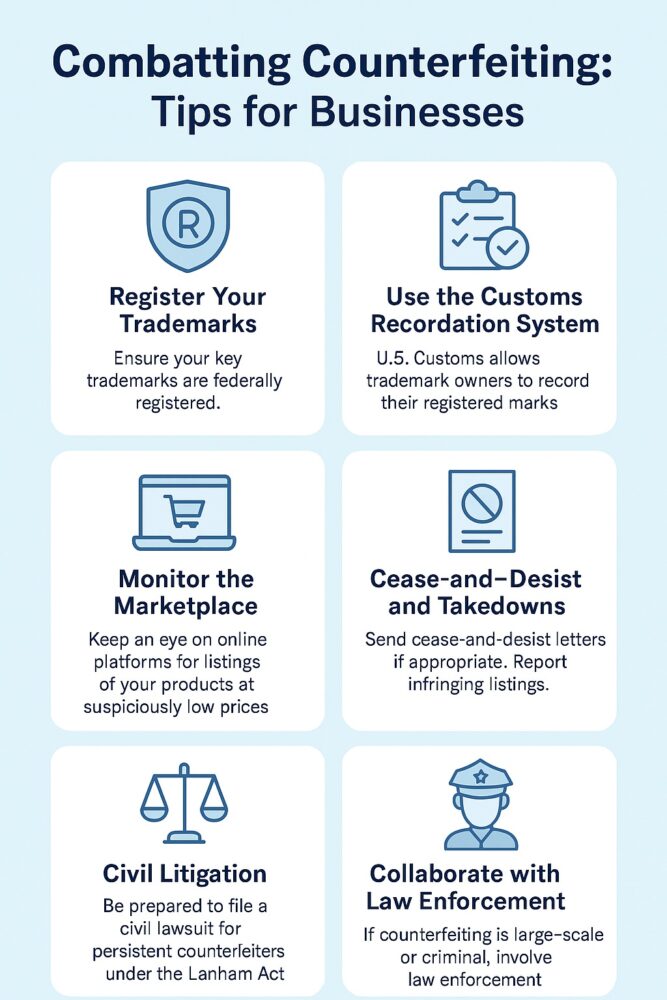
Every business with a valuable brand should be proactive about anti-counterfeiting efforts. Here are some strategies and remedies companies can use to prevent and respond to trademark counterfeiting:
By taking these steps, legitimate businesses can reduce the harm of counterfeiting and strengthen their position if legal action becomes necessary. While pursuing counterfeiters can be costly and complex, the civil and criminal remedies available – from damages and seizures to fines and imprisonment – provide a strong framework to combat this illegal activity and protect both the brand and consumers.
Trademark counterfeiting is a serious legal and economic issue, but U.S. law provides robust tools for trademark owners to protect their brands and for prosecutors to penalize offenders. Unlike ordinary trademark disputes, counterfeiting involves the intentional, fraudulent use of somebody else’s mark on identical goods, essentially a form of fraud on the public. The Lanham Act and the Trademark Counterfeiting Act (with its amendments to criminal law) establish that those who engage in this illicit trade may face everything from multi-million dollar statutory damages and trebled liability in civil cases to felony convictions with prison time in criminal cases.
If you have a trademark infringement or counterfeiting situation, contact our office for a free consultation.
© 2025 Sierra IP Law, PC. The information provided herein does not constitute legal advice, but merely conveys general information that may be beneficial to the public, and should not be viewed as a substitute for legal consultation in a particular case.
Patent agents are federally-licensed professionals who help inventors and companies secure patents. They are not attorneys, but they are licensed to prepare and prosecute patent applications before the United States Patent and Trademark Office (USPTO). We explain here what patent agents are, their qualifications, how they differ from patent attorneys, and the role they play in intellectual property services.
A patent agent is a person authorized to represent inventors and businesses before the USPTO in patent matters. Patent agents are not attorneys, but they are licensed by the USPTO after passing a special registration examination (the patent bar exam). Once registered, their name is added to the USPTO’s official roster of patent practitioners, which entitles them to practice before the USPTO only in patent matters. In practice, this means a patent agent can file patent applications and prosecute them, i.e., work through the patent application process with patent examiners. The USPTO’s regulations define “practice before the Office” in patent cases to include tasks like preparing, filing, and prosecuting patent applications, consulting with or giving advice to clients in contemplation of filing a patent application, and communicating with USPTO patent office examiners on patent application process issues.
Patent agents often have extensive technical training in science or engineering. In fact, a strong scientific background is required. Many patent agents hold at least a bachelor’s degree (many have advanced degrees) in fields like engineering, computer science, or hard sciences, like physics and chemistry. This technical expertise enables them to understand complex inventions and draft patent documents that accurately describe and claim the invention. For example, a patent agent with a degree in organic chemistry might work on pharmaceutical or chemical patent applications, leveraging their scientific knowledge to draft the patent and communicate with the USPTO examiner about technical details.
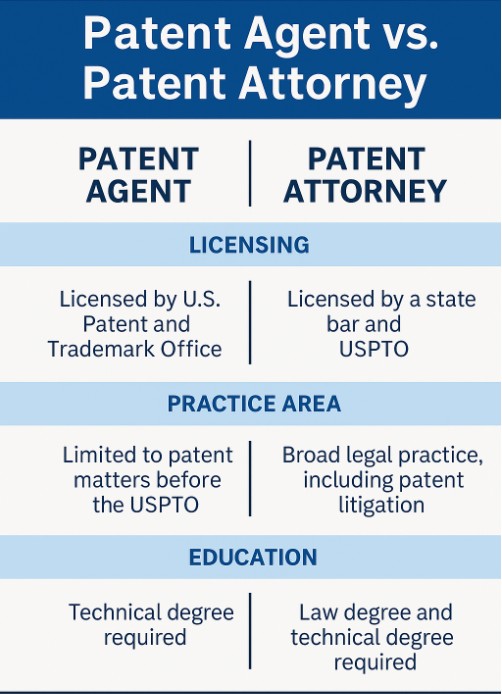
It’s important to distinguish patent agents from patent lawyers or attorneys. Both patent agents and patent attorneys must pass the USPTO’s patent bar exam and are collectively referred to as registered patent practitioners. The key difference is that a patent attorney has also attended law school, obtained a Juris Doctor (J.D.), and passed a state bar exam to become a licensed attorney at law. A patent lawyer is licensed to practice in any field of law, and can draft contracts, file lawsuits, and advise clients in any area of the law. A patent agent, by contrast, is not an attorney and is not a member of a state bar.
Despite these differences, both patent agents and patent attorneys can represent patent applicants before the USPTO. From the USPTO’s perspective, a patent agent can do anything a patent attorney can do in the patent application process: drafting the application, responding to USPTO actions, negotiating with examiners, and filing appeals within the Office. Law firms often employ patent agents for patent filings when they specifically need patent prosecution expertise and do not need broader legal services.
To become a patent agent, one must satisfy strict qualifications set by the USPTO. Generally, the requirements to sit for the USPTO’s registration examination include:
Only after meeting these requirements and passing the exam does an individual become a registered practitioner authorized to represent clients before the USPTO. The law specifically empowers the USPTO to register persons who are possessed of good moral character and the necessary qualifications to render applicants valuable service, advice, and assistance in the presentation or prosecution of their applications. This means patent agents must have both the technical expertise and integrity to provide valuable service in patent matters.
Patent agents play a critical role in helping inventors navigate the patent application process from start to finish. This process (often called patent prosecution) involves several steps where a patent agent’s expertise is invaluable:
Patent agents have complete practice authority before the USPTO to prosecute and negotiate patent applications, this includes applications for utility patents, design patents, and plant patents. They are also permitted to represent inventors in appeals and other post-examination proceedings before the Office, since these are part of the administrative patent process. However, patent attorneys typically handle these proceedings because there are areas of law, including rules of evidence, expert witness testimony, and oral argument, that come into play. These are areas of knowledge and skill that are within the skill sets of attorneys, but are not areas in which patent agents are typically trained.
Throughout this process, patent agents provide guidance strictly focused on patents. They advise clients on patent strategy, such as whether to pursue multiple applications, or how to claim the invention, and provide compliance with USPTO rules and regulations. However, they do not provide advice or services for intellectual property protection generally. Their work is limited to USPTO patent matters. Patent agents do not get involved in broader legal or business advice. They often work alongside attorneys that handle the broader business matters, taking on the work of capturing inventions patent applications to pursue strong patents that can be assets for the client's business. However, there are independent patent agents that can be hired for patent prosecution. Their services are typically sought out by solo inventors and small businesses.
Under U.S. law, patent agents’ ability to practice is grounded in federal statute and regulations. Congress has explicitly authorized the USPTO to regulate who may act as a patent practitioner. 35 U.S.C. § 2(b)(2)(D) empowers the USPTO to “govern the recognition and conduct of agents, attorneys, or other persons representing applicants” before the Office, and to require that practitioners be of good moral character and have the necessary qualifications to assist inventors in patent cases. In other words, federal law allows non-attorneys with the proper qualifications to practice patent law before the USPTO. Pursuant to this authority, the USPTO admits qualified individuals to practice via the patent bar exam and maintains the register of patent agents and attorneys.
There is important case law confirming a patent agent’s right to practice. In the landmark case Sperry v. Florida ex rel. Florida Bar, 373 U.S. 379 (1963), the U.S. Supreme Court held that Florida could not bar a registered patent agent from performing tasks “incident to the preparation and prosecution of patent applications” within the state. The Court acknowledged that drafting and prosecuting patent applications for others is considered the practice of law under state definitions. However, because a federal statute expressly permitted the U.S. Patent Office to authorize patent practice by nonlawyers, the Supremacy Clause of the US Constitution meant Florida could not treat that federally-authorized work as the unauthorized practice of law.
In short, a registered patent agent is federally licensed to practice patent law before the USPTO, and states must allow this limited practice even though the patent agent is not a member of the state bar. The Sperry case affirmed the legality of patent agent practice nationwide and confirmed that patent agents provide legal services in the patent field under the authority of federal law.
More recently, courts have also recognized that communications with patent agents in the scope of patent prosecution are confidential and may be covered by a form of attorney-client privilege. For example, the Federal Circuit in 2016 acknowledged a “patent-agent privilege” protecting client communications with patent agents when acting within their authorized role of obtaining patents, just as communications with attorneys would be. In re Queen’s University at Kingston, 820 F.3d 1287 (Fed. Cir. 2016). Likewise, in In re Silver, 540 S.W.3d 530 (Tex. 2018), the Texas Supreme Court ruled that registered patent agents are considered lawyers for purposes of privilege when they are doing USPTO patent work, because they are authorized to practice law within the limited scope of patent matters. These developments reinforce that patent agents, though not attorneys, occupy a legally recognized role in providing patent legal services under U.S. law.
While patent agents can handle patent applications, there are clear limits on what they can do. By law, patent agents’ practice is restricted to patent matters before the USPTO. Here are some important limitations to understand:
Despite these limitations, within the domain of obtaining patents, patent agents are fully qualified professionals. They adhere to the USPTO’s professional conduct rules and are subject to discipline by the USPTO’s Office of Enrollment and Discipline (OED) if they violate regulations or ethical standards.
Patent agents work in various professional settings and can handle a wide range of patent matters for different clients. Many patent agents are employed at law firms that specialize in patents or general intellectual property. In a law firm, patent agents often draft patent applications and manage prosecution for the firm’s clients under the supervision of the firm’s patent attorneys. This allows the firm to serve more clients efficiently. The agents handle the technical patent drafting while the attorneys handle legal strategy, opinion work (like infringement or validity opinions), and patent litigation. Clients of the firm benefit because the combination of attorneys and agents can cover all aspects of patent practice and process.
The presence of patent agents in a firm can also reduce cost for clients, as some work can be billed at the agent’s lower hourly rate. They typically charge professional fees for drafting and prosecution that are lower than those of patent attorneys, while still providing good value. They are not trained or licensed in all areas of patent law, but can be very effective when working with a patent attorney.
Also, many large corporations with substantial research and development activities hire patent agents in-house. These agents work alongside patent attorneys in the company’s IP department. For example, a big technology company might have patent agents to prepare and file dozens of patent applications on new inventions coming out of their R&D teams. The patent agents coordinate with engineers and scientists internally, draft the applications, and correspond with the USPTO. Meanwhile, the company’s patent attorneys might focus on portfolio management, licensing deals, or patent disputes. In this environment, patent agents help scale the patent filing process for the company and ensure high-quality patents by virtue of their technical focus.
Importantly, patent agents and patent attorneys are part of the same ecosystem governed by the USPTO. Both must adhere to the USPTO’s regulations and ethical rules in 37 C.F.R. § 11, and both are subject to disciplinary action for misconduct. Under 35 U.S.C. § 32, the USPTO can suspend or exclude practitioners for cause. Clients can verify a patent agent’s credentials by checking the USPTO’s public register of registered patent attorneys and agents. Whether you engage a patent agent or attorney, you should expect professional conduct, confidentiality, and competence in handling your patent work.
Most people do not fully understand what a patent agent is. Hopefully this article has explained that a patent agent is a USPTO-registered practitioner who can provide a valuable service by helping inventors and businesses obtain patents. Overall, patent agents serve as key partners in innovation, combining technical expertise with knowledge of patent law to turn new ideas into patented assets.
Whether you work with a patent agent or a patent attorney (or both), the goal is the same: effective intellectual property protection for your inventions within the framework of U.S. patent law. With their unique qualifications and federal license, patent agents can be a useful resource for anyone looking to secure a United States patent.
If you need assistance with pursuing a patent or some other patent matter, contact our office for a free consultation with one of our patent professionals.
© 2025 Sierra IP Law, PC. The information provided herein does not constitute legal advice, but merely conveys general information that may be beneficial to the public, and should not be viewed as a substitute for legal consultation in a particular case.
Patent owners have a legal incentive to mark their products with patent information to put the public on notice of their patent rights. Traditionally, this meant stamping or labeling products with patent numbers. However, virtual patent marking is a modern alternative that allows businesses to use a website to list associated patents for their products. This method was introduced by the Leahy-Smith America Invents Act of 2011 to simplify compliance with patent marking laws. Virtual patent marking is important because it provides the ability to recover damages from infringers and notice to the public in an efficient way.
Patent marking serves to give notice to the public that a product is protected by one or more patents. Marking a patented product (or its packaging) with the word “Patent” (or “Pat.”) and the patent number notifies others that the product is patented. Under U.S. law, this satisfies the constructive notice requirement, meaning that potential infringers are deemed aware of the patent, even if they are not actually aware of the patent. Constructive notice provides the patent owner with the ability to claim damages from the earliest possible date of infringement. Without proper marking, the patent owner may lose substantial damages for past infringement.
Before 2011, U.S. law only allowed physical marking: marking the product or its label with patent numbers. The America Invents Act (AIA) changed this by adding virtual marking provisions to 35 U.S.C. § 287, the patent marking statute. Virtual patent marking allows patent owners to use the internet for providing patent notice. Instead of listing long patent numbers on the product, a company can mark the product with the word “Patent” or “Pat.” followed by a URL (web address) of a publicly accessible webpage that lists the relevant patents. This amendment was intended to modernize the marking process for the digital age, making it easier to update patent information and handle products covered by multiple patents. By introducing virtual marking, the AIA enabled businesses to efficiently provide patent marking notice without repeatedly altering product molds or packaging every time patent information changes.
The U.S. marking statute, 35 U.S.C. § 287(a), now explicitly permits virtual marking. It states that a patentee may give notice that an article is patented “either by fixing thereon the word ‘patent’ or ‘pat.’ together with the number of the patent, or by fixing thereon the word ‘patent’ or ‘pat.’ together with an address of a posting on the Internet, accessible to the public without charge, that associates the patented article with the number of the patent”. In other words, you can either stamp the patent number on the product or simply mark the product with a web address where the patent numbers are listed. If marking the product itself is not possible, e.g., due to size or nature of the article, the statute allows marking the packaging in a similar way. The virtual patent marking notice on the product typically looks like: “Patent: www.YourCompany.com/patents” or some other format. As long as the referenced webpage clearly associates each product with its applicable patent numbers, this constitutes proper notice under the law.
Crucially, the statute also provides a practical penalty for not marking: “In the event of failure so to mark, no damages shall be recovered by the patentee in any action for infringement, except on proof that the infringer was notified of the infringement and continued to infringe thereafter.” In plain terms, if you don’t mark your patented product, either physically or virtually, you cannot recover damages for infringement that happened before the infringer received actual notice of the patent, such as by formal notice letter or being served in a lawsuit. Patent owners are wise to mark products, as doing so provides constructive notice and preserves the right to recover full damages for past infringement.
Adopting virtual patent marking is straightforward and cost-effective. Here’s how a business can implement a virtual marking program:
By following these steps, even companies with many patents or frequently updated patent portfolios can efficiently comply with the virtual marking provisions.
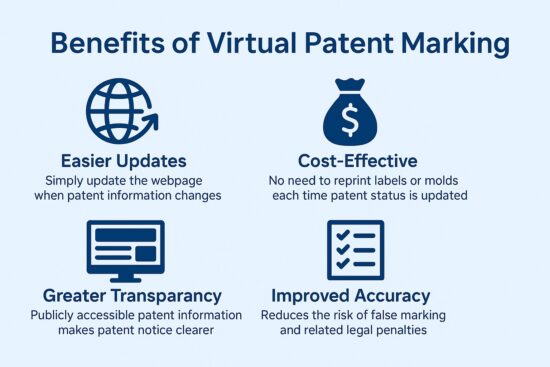
Virtual patent marking offers several key advantages over traditional marking:
Overall, virtual marking provides the same legal benefit of constructive notice under § 287 as physical marking with more convenience and clarity.
To get the most out of virtual patent marking, companies should follow some best practices to ensure the notice is effective and legally sound:
By adhering to these practices, patent owners can maximize the benefits of virtual marking and avoid pitfalls that could undermine their patent rights.
Over the years, several court decisions (especially in the Federal Circuit, which hears patent appeals) have addressed issues with patent marking – including virtual marking – reinforcing how important compliance is. Below are a few notable insights from case law:
These cases underscore that courts take the marking statute seriously. Proper marking, including via a virtual patent marking notice, is often a deciding factor in how far back you can recover damages in an infringement lawsuit. Patent owners should treat marking as an important part of their enforcement strategy, not an optional technicality.
What does a virtual patent marking page actually look like in practice? Typically, the page will start with a notice explaining its purpose, followed by a list of products and patents. Here is a sample format inspired by how companies implement virtual marking:
Patent Marking Notice (Pursuant to 35 U.S.C. § 287(a)):
The following products are protected by one or more patents in the U.S. and may be protected by patents in other jurisdictions. This website is provided to satisfy virtual patent marking provisions, including the virtual patent marking provisions of the America Invents Act. This page is intended to serve as notice under 35 U.S.C. § 287(a). The following list of products may not be all-inclusive – other products not listed here might also be protected by patents. Each product below is associated with at least one U.S. patent.
- Product A – U.S. Patent No. 9,876,543; U.S. Patent No. 10,123,456. (Additional patents pending.)
- Product B – U.S. Patent No. D555,555 (Design Patent); U.S. Patent No. 11,234,567.
- Product C – Protected by one or more of the following patents: U.S. Patent Nos. 8,111,111; 8,222,222; 8,333,333.
In the example above, the opening paragraph uses phrasing commonly seen on patent marking pages, fulfilling the virtual patent marking notice requirements. It mentions the America Invents Act and cites the statute to be explicit about providing legal notice. It also uses the phrases “one or more patents” and “various jurisdictions,” because often companies want to cover international patent rights and make clear that the list is not exhaustive. Each of the products listed is associated with specific patent numbers. Notice that even design patents (which have a “D” prefix) are included. Design patents should be marked too, in either the same list or a separate section, but the marking statute applies to patented articles of any kind (utility patents, design patents, and plant patents). Also, noting “patents pending” for a product does not give legal protection for those pending applications, but it informs readers that more patents might be coming. If any patent application later issues as a patent, that number should be added to the list promptly.
Virtual patent marking is a powerful tool for U.S. patent owners, combining legal compliance with maximized patent protection. Notice of patented products can be established via a simple website listing, thereby achieving constructive notice under the law without the downsides of lengthy physical markings. It is clear in cases like Arctic Cat and Rembrandt that failing to mark can be a costly mistake that is easily avoided through diligent marking.
If you have questions regarding virtual patent marking or other patent matters, please contact our offices for a free consultation.
© 2025 Sierra IP Law, PC. The information provided herein does not constitute legal advice, but merely conveys general information that may be beneficial to the public, and should not be viewed as a substitute for legal consultation in a particular case.
When a patent application faces repeated rejections at the United States Patent and Trademark Office (USPTO), the applicant has the right to appeal those decisions through the USPTO's patent appeals process. This process allows a dissatisfied patent applicant to seek review by an impartial appeal board: the Patent Trial and Appeal Board (PTAB). The appeal process can be critical for business owners and inventors seeking to secure patent rights when an examiner's rejections are in error or have questionable bases. This article provides an accessible explanation of the USPTO patent appeal process, addressing the major steps and requirements of an appeal. We focus on ex parte patent appeals (appeals of patent application rejections), rather than other PTAB proceedings like inter partes reviews or derivation proceedings, which involve third parties.
Under U.S. law, a patent applicant can appeal an examiner’s decision after the claims have been twice rejected. This “twice rejected” rule means that if any claim in the patent application has been rejected at least twice (e.g., in a first rejection and again in a final rejection), the applicant may appeal the rejection of the claim to the PTAB. It is not required that the rejections be final; even two non-final rejections suffice, as long as the applicant has been “twice denied a patent”, as provided in 35 U.S.C. § 134(a). Most commonly, appeals follow a Final Office Action, after which further prosecution with the examiner would require a formal request for continued examination and the payment of substantial UPSTO fees. The twice-rejected rule applies to both patent applicants and patent owners in reexamination proceedings.
Before deciding to appeal, an applicant might also consider alternatives like amending claims or filing a Request for Continued Examination to continue prosecution before the examiner. However, if prosecution has reached a final rejection and further arguments or amendments seem unlikely to persuade the examiner, an appeal can provide a fresh review of the legal issues and patentability arguments by a panel of experienced administrative patent judges.
The Patent Trial and Appeal Board is the appeal board within the USPTO that handles patent appeals. The PTAB is composed of administrative patent judges (APJs). Under 35 U.S.C. § 6, the Board acts as a quasi-judicial body to review adverse decisions of examiners on patent applications, as well as to conduct other proceedings, including inter partes reviews and post-grant review trials. For ex parte patent appeals, the PTAB panel includes three judges who will read the briefs, optionally hear oral arguments, and issue a written decision on the appeal. The Board’s decision may affirm or overturn the examiner’s rejections, in whole or in part. The PTAB operates under its own set of procedural rules (37 C.F.R. §§ 41.30–41.54). Notably, the Board is not a trial court. There is no jury, and no live witness testimony in ex parte appeals. Also, a patent appeal is ex parte, involving only the applicant (appellant) and the USPTO. There are no adverse third parties as in patent appeals before the PTAB. Rather than a trial, the appeal process is more like an appellate review of the examiner’s work based on the record of the patent application, including the prior art references, office actions, arguments, evidence submitted, and any other relevant matters in the application record. The Board gives fresh consideration to the issues, but applies the same broad standard used during examination: the claims are given their broadest reasonable interpretation. For the patent applicant, the PTAB is essentially an opportunity to have experienced patent law judges take a second look at whether the examiner erred in rejecting the claims. This can be especially valuable if the examiner’s rejections involve complex issues of law or claim construction that the applicant feels were not properly recognized or understood during prosecution. The PTAB’s role as an appeal board ensures that patentability decisions are not solely left in the hands of a single examiner but can be reviewed and corrected if mistaken.
The first formal step in the appeal process is filing a notice of appeal with the USPTO. The notice is a form document (form PTO/SB/31) that notifies the Office that you intend to appeal the examiner’s decision. It must be filed within the time allowed to respond to the last Office action: within 3 months after a final rejection, extendable up to 6 months with payment of extension fees. In practice, applicants often file the notice of appeal toward the end of the response period for a final rejection if they cannot overcome the rejection through an after-final response or pre-appeal brief request (discussed below). A USPTO fee is required for the notice of appeal. Once the notice is filed, the applicant is formally “appealing” and is henceforth referred to as the appellant. It’s important to note that filing a notice of appeal by itself does not immediately transfer the case to the Board; it merely secures your right to pursue the appeal. The appellant must follow up by filing an Appeal Brief within two months of the submission of the notice of appeal. If the appellant ultimately decides not to pursue the appeal, they can withdraw it or let it lapse, but failure to follow through will result in abandonment of the application once deadlines pass.

When filing the notice of appeal, the appellant has an option to also file a pre-appeal brief request for review. This triggers a quick review of the case by a panel of examiners, including the examiner and supervisors before a full appeal brief is filed. The pre-appeal conference panel will look for clear errors in the rejection. If they find a blatant error, such as a misinterpretation of prior art dates or a rejection that clearly overlooks a key claim limitation, they can reopen prosecution or allow the application without the need for a full appeal. If they do not find such an error, the applicant must then proceed with the full appeal. The pre-appeal process is a way to potentially avoid a long appeal by catching egregious mistakes early. Statistics presented by the USPTO indicate that a significant portion of appeals never proceed to a full brief because of resolutions at the pre-appeal or conference stage. Thus, for business owners, using the pre-appeal review can be a cost-effective tactic when the rejection seems clearly wrong on its face.
The appeal brief is a formal written brief in which the appellant (patent applicant) presents their arguments as to why the examiner’s rejections are incorrect. The USPTO rules (37 C.F.R. § 41.37) lay out the required format and contents of the brief, including sections such as a summary of the claimed subject matter, the grounds of rejection to be reviewed, an argument for each issue, and any evidence appendix. The brief must be filed within two months of the Notice of Appeal, but the due date is extendable with fees up to an additional five months. Notably, since 2013 the USPTO does not charge a fee for filing the appeal brief itself. In the Appeal Brief, the appellant should clearly explain each rejection, e.g., anticipation under 35 U.S.C. § 102, obviousness under 35 U.S.C. § 103, lack of patentable subject matter under § 101, etc., and then argue, using legal reasoning and evidence, why the rejection is not justified. This often involves discussing prior art in detail, pointing out distinctions between the claimed invention and the cited references, addressing the examiner’s arguments, and citing legal authorities (such as past Board decisions or court cases) that support the applicant’s position. For example, if the rejection is for obviousness, the brief might argue that the examiner failed to show a motivation to combine the references, citing Federal Circuit case law on obviousness standards.
The tone of an appeal brief should be professional and persuasive, focusing on facts and law. New evidence is generally not allowed in an appeal brief. The record on appeal is limited to what was already submitted during prosecution, and so the emphasis is on legal argumentation. It’s crucial that the brief address every ground of rejection for each appealed claim. Any issue not argued is waived. In fact, the Federal Circuit has cautioned that failing to contest a rejection in the brief means that rejection can be deemed conceded and such waiver may create problems in the review or later appeal before the Federal Circuit. Thus, completeness is critical. The brief is also an opportunity to clarify the construction or meaning of the claims, explaining what the claims cover and how the examiner may have misinterpreted them. A thorough and well-reasoned appeal brief provides the appellant the best chance of success on appeal.
After the appeal brief is filed, the ball is in the examiner’s court. The examiner must respond with either an examiner’s answer or another action. In many cases, the examiner will write an examiner’s answer to the appeal brief, usually within a few months. The examiner’s answer is effectively the examiner’s rebuttal. It will address the arguments raised in the appeal brief and may further explain the rationale for the rejections. The answer can also include new evidence or a new rationale, but if it raises a new ground of rejection, the rules require the examiner to explicitly label it as such. See 37 CFR § 41.39. New grounds are not common in answers, but it can happen. The examiner has two other options at this stage in lieu of an answer: (1) reopen prosecution or (2) allow the application.
Reopening prosecution means the examiner has decided that, in view of the arguments in the brief, the prior rejection should be withdrawn and a new search or new rejection is warranted. This requires approval from a supervisor and is often done if the brief exposed a flaw in the original rejection that can be fixed by altering the rejection. While reopening prosecution can be frustrating for an appellant, since it delays the appeal and forces them to address new rejections, it can sometimes lead to eventual allowance if the issues are resolved.
Alternatively, the examiner might decide the appellant’s arguments are persuasive and withdraw the rejection, thus allowing the application. In such a case, a formal examiner’s answer isn’t issued. Instead, the applicant would receive a notice of allowance.
Assuming the examiner does maintain the rejections and issues an answer, the appellant then has the opportunity to file a reply brief. The reply brief must be filed within two months from the Examiner’s Answer, but the due date is extendable by up to five additional months and should address any new points raised in the answer. The reply is the appellant’s last written word on the matter. It should be concise and directly responsive to the examiner’s answer, correcting any misstatements and reinforcing the strongest arguments. However, the reply brief cannot introduce new arguments that are not responsive to the examiner’s answer or new evidence, as doing so could be seen as raising new issues outside the scope of the appeal. If the examiner’s answer contained an unexpected new rationale, even if not labeled as a new rejection, the appellant can use the reply to argue against it. Per 37 CFR 41.39, the applicant's reply brief may include arguments addressing new points in the examiner’s answer. Once the reply brief is filed or the time for filing it expires, the briefing stage of the appeal is complete. At this point, jurisdiction over the case typically passes to the PTAB, meaning the appeal is formally docketed for a Board decision.
In ex parte patent appeals, the appellant has the right to request an oral hearing (oral argument) before the PTAB, although in practice many appeals are decided on the written briefs alone. An oral hearing must be specifically requested, usually by filing a request within two months of the examiner's answer. 37 C.F.R. § 41.47. If an oral hearing is requested, the case will be scheduled for an argument session and the appellant will have the opportunity to present their arguments in person or via teleconference to the panel of administrative patent judges. At the USPTO, an oral hearing is much like an appellate court argument: it is limited to 20 minutes per side. The USPTO gives the appellant 20 minutes, and the examiner will typically not argue, but the Office can have a patent attorney represent the examiner’s position. During the oral hearing, the appellant highlights key points from the briefs and answers questions from the judges. It’s an opportunity to clarify complex technology or legal points and to address any concerns the judges express. However, new evidence cannot be introduced, and any argument made must be within the scope of issues already raised in the briefs.
If an appellant requests an oral hearing and later decides it’s unnecessary, they can withdraw the request to have the case decided on briefs. Keep in mind that requesting a hearing can add some delay, although the PTAB tries to schedule them efficiently. Whether to request oral argument often depends on the case. If the appeal involves complicated facts or needs clarification beyond the written word, a hearing can be helpful. On the other hand, if the issues are straightforward (e.g., a single prior art reference dispute), oral argument may not significantly change the outcome and could simply prolong resolution. Business owners should discuss with their counsel whether an oral hearing is worth the additional effort and cost in their specific case. Importantly, if no hearing is requested, the Board will decide the appeal based on the briefs and the written record alone, which is a common practice.
After the briefing is complete and any oral hearing has taken place (or been waived), the panel of PTAB judges will confer and issue a written Board decision. This decision typically comes in the form of a reasoned opinion that addresses each ground of rejection on appeal. The timing for receiving a decision can vary. In recent years, the average pendency from when the Board receives the case (appeal forwarding fee paid) to a decision has been around 12 months on the regular track. In the Board’s decision, there are several possible outcomes for each rejection:
The Board’s written decision will include reasoning. For example, if the issue was obviousness, the decision will discuss the evidence and arguments regarding why the invention is or is not obvious in view of the prior art. The decision is mailed to the appellant and also published on the USPTO’s electronic docket. Overall USPTO data show that roughly 40% of ex parte appeals ultimately result in an outcome favorable to the applicant (reversal, allowance, or at least something other than a straight affirmance of the rejection). This suggests that appealing can be worthwhile. Of course, every case is unique, and these percentages can vary by technology area.
If the Board’s decision is a full reversal, the application returns to the examiner with instructions to allow the appealed claims. A reversal directed at all issues means the examiner cannot continue rejecting those claims on the same grounds. If the Board affirms the rejections, then the application remains rejected. If the Board’s decision is a mix of affirmed and reversed, the allowed claims will move forward (potentially issuing in a patent), while the rejected claims remain denied unless the applicant takes further action. An appellant who is dissatisfied with the Board’s final decision has further options, which we discuss next.
Upon receiving an adverse Board decision, the appellant’s first option is to stay within the USPTO by filing a request for rehearing with the PTAB. A request for rehearing must be filed within two months of the Board’s decision. This deadline is not extendable as a matter of right. In a rehearing request, the appellant must state with particularity the points the Board misapprehended or overlooked in its decision, as required under 37 C.F.R. § 41.52. Essentially, you are telling the same panel of judges that they made a mistake, e.g., that they misunderstood a key argument or overlooked important evidence. New arguments or evidence are generally not allowed. The request must be based on the existing record and issues already raised. Rehearings are granted infrequently. The Board will rarely change its decision unless a clear error is shown. However, sometimes a rehearing can succeed if, for example, a recent Federal Circuit or Supreme Court decision came out that impacts the case, or if the Board’s decision contained a factual mistake. The Board on rehearing can affirm its original decision, modify it, or even reverse itself. If the rehearing is denied or doesn’t fully resolve the issues in the appellant’s favor, the USPTO appeal process is concluded.
At that point, the administrative remedies within the USPTO are exhausted. The next step would be to seek judicial review in the courts, if desired. It should be noted that if the Board introduced a new rejection and the appellant chose to reopen prosecution instead of rehearing, the case goes back to the examiner and essentially the application is examined again on that new ground. The applicant can then potentially appeal again if the new rejection isn’t overcome. This sequence can prolong prosecution significantly.
Once the PTAB has issued a final decision on the appeal and any rehearing request is resolved, the applicant has the right to further appeal the decision to the judicial system. The most common route is an appeal to the U.S. Court of Appeals for the Federal Circuit. The Federal Circuit is a specialized appellate court in Washington, D.C. that hears all patent appeals from the USPTO (as well as patent infringement appeals from district courts). An appeal to the Federal Circuit must be filed within a strict time frame, currently 63 days from the PTAB decision. Notably, by choosing to appeal to the Federal Circuit, the applicant waives the alternative option of pursuing a civil action in district court. You must choose one path or the other, not both.
In a Federal Circuit appeal, no new evidence can be introduced. The court’s review is confined to the record that was before the USPTO. The issues on appeal typically revolve around whether the Board’s decision was correct as a matter of law and supported by substantial evidence. The appellant will file briefs in the court and there will likely be an oral argument before a panel of three Federal Circuit judges. The USPTO is represented by attorneys from the Office of the Solicitor who will defend the Board’s decision. The Federal Circuit gives deference to the PTO on factual findings and the court reviews the PTO’s factual determinations under the "substantial evidence" standard, rather than de novo. Dickinson v. Zurko, 527 U.S. 150 (1999). This means the court will uphold the Board’s factual findings if a reasonable mind might accept the evidence as adequate, even if the court might have reached a different conclusion on its own.
However, on questions of law like interpretation of statutes or claim construction if purely legal, though claim interpretation in PTO appeals is often treated as factual because of the usage of broadest reasonable interpretation, the Federal Circuit reviews without deference under a de novo standard. For example, whether the Board applied the correct legal test for obviousness is reviewed de novo, but whether a particular reference teaches a claim element is factual and is evaluated under the substantial evidence standard. If the Federal Circuit finds error, it can reverse the PTO’s decision or remand the case back to the PTO for further proceedings. If it agrees with the PTO, it will affirm. Keep in mind that Federal Circuit decisions can themselves be appealed to the U.S. Supreme Court. However, the Supreme Court accepts patent cases only on rare occasions. For context, the Supreme Court has weighed in on aspects of the patent appeal process in cases like Zurko and Kappos v. Hyatt (discussed below- dealing with evidence in civil actions against the USPTO), but it does not serve as a routine second appellate layer for most patent applicants.
In addition to (or instead of) appealing directly to the Federal Circuit, U.S. patent law provides an alternative civil action route for dissatisfied applicants. Under 35 U.S.C. § 145, an applicant can file a civil action to obtain a patent against the Director of the USPTO in the U.S. District Court for the Eastern District of Virginia, which is the federal trial court with jurisdiction over these cases. This option must be exercised within a time set by statute (63 days from the Board decision, similar to the Fed Circuit timeline). A key feature of the §145 civil action is that it is not limited to the existing record. It is essentially a fresh lawsuit where the applicant (now plaintiff) can present new evidence that was not submitted to the PTO. The court case proceeds like a normal civil litigation: there can be discovery, expert witnesses, summary judgment motions, and ultimately a trial (often a bench trial before a judge).
However, there are important considerations. First, pursuing a district court action is typically far more expensive than a Federal Circuit appeal. It is a full-blown litigation against the government. In fact, the statute requires that “[a]ll the expenses of the proceedings shall be paid by the applicant”, win or lose. This was interpreted to even include the USPTO’s attorney fees until the Supreme Court in NantKwest, Inc. v. Iancu, 140 S. Ct. 365 (2019) ruled that the American Rule against fee shifting prevented the PTO from recovering attorney fees as “expenses”. Still, the applicant will bear court costs and other expenses. Second, a §145 action is time-consuming; it can take years if it goes to trial.
The district court route is usually chosen only in unusual cases. For instance, where the applicant strongly feels that additional evidence will make a decisive difference or where there was some procedural issue at the PTO that a court might view more favorably. The district court will consider the new evidence alongside the PTO record and make its own findings of fact de novo if new evidence is introduced. This can be advantageous if the applicant has additional evidence (e.g. experimental data to rebut an obviousness rejection, or an expert affidavit on claim interpretation) that could not have been obtained earlier. The Supreme Court in Kappos v. Hyatt confirmed that there is essentially no special limit on new evidence in §145 actions beyond the usual rules of evidence. Kappos v. Hyatt, 566 U.S. 431 (2012). The applicant is free to introduce new testimonial or documentary evidence, and the district court will then make its own factual determinations without deference to the PTO on those new points. In Hyatt , the applicant introduced a new declaration in district court to bolster his position after the Board partially rejected his claims. The district court initially refused to consider the new evidence and granted summary judgment against the applicant, but the Federal Circuit and Supreme Court held that the new evidence must be considered and evaluated de novo.
In general, by choosing the district court path, the applicant is foregoing the quicker appellate review in favor of a do-over with the opportunity to strengthen the evidentiary record. If the district court ultimately rules that the applicant “is entitled to receive a patent”, it can authorize the USPTO to issue the patent. If it rules against the applicant, that judgment can be appealed to the Federal Circuit, but now with a full trial record. Given the cost, this option is seldom used except in high-value cases or where an applicant had difficulty getting evidence in front of the PTO. For most business owners, a direct Federal Circuit appeal is the more practical route if the Board appeal fails, but it is good to know that the civil action option exists as a backstop.
Appealing a patent rejection requires careful strategy and understanding of the legal issues. Typically, the grounds of rejection on appeal might include: novelty (35 U.S.C. 102), obviousness (35 U.S.C. 103), patent-eligibility (35 U.S.C. 101), or adequacy of disclosure (35 U.S.C. 112 written description), among others. Each type of rejection brings its own nuances. For example, an anticipation appeal will often boil down to whether the examiner correctly interpreted the prior art reference and the patent claim, whereas an obviousness appeal might involve arguments about whether the examiner provided a proper rationale for combining references and whether the combination would have had a reasonable expectation of success. On appeal, claim construction (how the claim language is interpreted) can be a pivotal issue. Appellants often argue that the examiner or Board interpreted a term too broadly or in a way inconsistent with the specification. Evidence like expert opinions or technical dictionaries, if they were made part of the record, can be brought to bear on these points. Another common issue is secondary considerations: objective indicia of non-obviousness such as commercial success or long-felt need. If an applicant presented such evidence during prosecution and the examiner dismissed it, the Board will consider on appeal whether that evidence was given proper weight. Throughout the appeal, the burden is technically on the USPTO to justify its rejections, but as a practical matter the appellant must convincingly show the rejection is in error.
It is also important to manage procedural issues. Some matters are not appealable but rather are petitionable. For instance, if the applicant believes the examiner made a procedural error, like introducing a new ground of rejection in a final action without designation, that issue may need to be addressed by petition to the USPTO under separate procedures, rather than by the Board on appeal. The appellant should ensure that the appeal brief sticks to the substantive merits of the rejections. If there were minor issues, like the examiner not considering an amendment or evidence, often those should be resolved before appealing because the Board typically will not decide those kinds of procedural disputes on the merits.
It’s worth briefly distinguishing ex parte patent appeals from other proceedings before the Patent Trial and Appeal Board to avoid confusion. The PTAB, as its name suggests, handles not only appeals from examiners, but also trial proceedings like Inter Partes Review (IPR), Post-Grant Review (PGR), and Derivation proceedings. These are adversarial proceedings usually initiated by a third party, such as a competitor challenging an issued patent’s validity, or a dispute where one party alleges another derived an invention from them. While these also involve panels of PTAB judges and have some superficial similarities, their processes and legal standards differ significantly from ex parte appeals of patent applications. For instance, inter partes reviews are more like mini-trials with an opposing party, limited discovery, and are typically rendered on issued patents, focusing mainly on prior art patents and printed publications. Derivation proceedings involve evidence to determine who was the true inventor when two patent filings claim the same invention, essentially involving two parties/two patent filings in dispute.
In contrast, an ex parte appeal involves only the patent applicant and the USPTO, and is about whether the examiner properly rejected the claims. The jurisdiction for decision-making in ex parte appeals lies first within the USPTO (the PTAB), with judicial review by the Federal Circuit or district court as described. Other PTAB trials also go to the Federal Circuit on appeal, but they cannot go to district court. By statute, IPR and PGR appeals may go only to the Federal Circuit.
A patent appeal is one of many patent prosecution tools that can be utilized in pursuing the issuance of a patent, but it is not always the right tool. You need the assistance of an experienced patent attorney to determine whether an appeal or another procedure is the right strategic step. If you need assistance with a patent appeal or other patent matter, contact our office for a free consultation.
© 2025 Sierra IP Law, PC. The information provided herein does not constitute legal advice, but merely conveys general information that may be beneficial to the public, and should not be viewed as a substitute for legal consultation in a particular case.
A domain name can be as important as a storefront. It is often the first impression many customers will have of your business. Trademark infringement occurs when a website address (a domain name) uses another party’s trademark or service mark in a way that confuses consumers on the internet about the source or affiliation of the site. A domain name is essentially the online “address” of a website and often incorporates a company’s name or brand. Under U.S. law, using a domain name identical or confusingly similar to another’s registered trademark can violate the federal Lanham Act. Trademark owners have exclusive rights in their marks, and U.S. courts generally hold that a domain name containing a trademark is likely infringing if Internet users might think the site is “used, approved, or permitted” by the trademark owner.
For instance, one court explained that adding generic terms or minor words to a domain name does not avoid infringement if the protected mark is still recognizable. Thus, domains like ford-trucks.com or 4fordparts.com that incorporate a trademark (e.g. FORD) without clear distinction have been held confusingly similar. The key test is whether an ordinary Internet user would be confused about the source of the goods or services offered on the website linked to the domain.
Domain names are essential business assets in the modern digital economy. In fact, they commonly serve as the domain name owner's most important brand asset. A web address can also function as a trademark or service mark, if consumers come to recognize it as identifying the source of the company’s products or services. The domain URL can become closely tied to a company’s brand identity and acquire exclusive trademark rights over time.
U.S. trademark law makes clear that a domain name registration is not just a technical step with a domain name registrar. Courts have repeatedly held that use of a web address in commerce can constitute trademark use under the Lanham Act. This means that a business owner who establishes trademark rights can rely on them to prevent others from using confusingly similar registered domain names that could mislead consumers or dilute the company’s brand reputation.
A trademark owner has the ability to enforce its trademark when another party uses a domain that is identical or confusingly similar to the trademark through a lawsuit or administrative proceeding, such as a Uniform Domain Name Dispute Resolution Policy (UDRP) petition. The principle is straightforward: if the domain name registrant of another site uses the same name or a mark that is confusingly similar to your trademark, and this could mislead internet users into believing that there is an affiliation with you, it may amount to trademark infringement. This is particularly important for protecting a company’s trademark from unauthorized use in online infringement through advertising, fraudulent websites, or cybersquatting schemes.
At the same time, owning a domain does not automatically or “necessarily establish trademark rights.” Cases like US Patent and Trademark Office, et al v. Booking.com B.V., 140 S. Ct. 2298 (2020) have established that a domain name itself can become a trademark or service mark. In order for a domain name to be registrable and establish trademark rights, it must function in commerce to distinguish the company’s brand from others, not merely serve as a technical internet address. Once that threshold is met, however, a domain name can carry all the benefits of registered trademarks and give the brand owner access to powerful legal remedies under U.S. law.
Domain name trademark infringement occurs when a domain name is identical or confusingly similar to a trademark or service mark owned by another party, in a way that causes consumer confusion about the source of goods or services. Under the Lanham Act (15 U.S.C. § 1114, § 1125), trademark infringement includes use of a mark that is “likely to cause confusion, mistake, or deception” among consumers.
Federal trademark law (the Lanham Act, 15 U.S.C. §§ 1051–1127) protects registered trademarks or service marks and also unregistered common-law marks against unauthorized uses that cause confusion. Under 15 U.S.C. § 1114, anyone who uses a registered mark in commerce without permission can be liable for infringement, and § 1125(a) covers “false designations of origin” (unfair competition) with unregistered marks. A trademark is generally a word, symbol, or name used to identify the source of goods or services, and a business’s exclusive trademark rights accrue from its use and (if obtained) federal registration. Registration is not strictly necessary to have rights, but owning a registered trademark (on the Principal Register) provides presumptions of validity and nationwide priority.
Domain name rights themselves are not limited to trademark registries; they are assigned on a first-come, first-served basis by registrars like GoDaddy, Network Solutions, etc.. Historically, registrars have required applicants to attest that a domain registration “does not infringe upon or otherwise violate the rights of any third party,” including trademarks. Nonetheless, many domain disputes arise after registration. If a domain name registrant (the person who owns a domain) uses a domain in a way that violates some other party’s trademark rights, the trademark owner can sue under the Lanham Act or challenge the registration through alternative dispute policies.
Initial interest confusion occurs when a competitor or other party draws a consumer to their website, social media, or other online presence through the use of adwords, keywords, or domain names that are the same or confusingly similar to a trademark owned by another. In an early example, West Coast Entertainment had registered the domain moviebuff.com and used it for a website offering a movie information database, which conflicted with Brookfield’s registered trademark “MOVIEBUFF” for its own film database product. Brookfield Communications, Inc. v. West Coast Entertainment Corp., 174 F.3d 1036 (9th Cir. 1999). The Ninth Circuit found that Brookfield had a valid, protectable trademark in “MovieBuff,” and that use of moviebuff.com by West Coast Entertainment to offer similar services would cause a likelihood of confusion. In other words, consumers might be diverted to West Coast’s site thinking it was affiliated with Brookfield’s MovieBuff product. The court enjoined West Coast from using moviebuff.com, and the case is important for recognizing “initial interest confusion” online. Generally, even if consumers realize their mistake before a purchase, the improper use of the trademark in a domain can unfairly draw them in.
Certain problematic uses of trademarks in domain names frequently lead to infringement claims:
Registering another’s trademark as a domain name with the intent to profit from it, typically by selling the domain back to the trademark owner or exploiting the name’s traffic. Cybersquatting is explicitly addressed by the Anti-Cybersquatting Consumer Protection Act (ACPA), 15 U.S.C. § 1125(d). For example, buying up a domain like bestnikeproducts.com and then offering to sell it to the brand owner (Nike) at an inflated price is cybersquatting. This bad-faith exploitation of a trademark in a domain can lead to liability under the ACPA.
Registering confusingly similar misspellings of a famous mark or domain to divert traffic. For instance, someone might register gooogle.com (with an extra “o”) to catch users who mistype google.com. Even though the spelling is slightly off, it is designed to be easily mistaken for the real site. Typosquatting is a variety of cybersquatting; it can confuse consumers and siphon off web traffic, and it likewise infringes the mark owner’s rights.
Using a trademark within a domain name to attract potential customers to an unrelated or unauthorized site, often monetized through ads or affiliate links. For example, a domain name like, e.g., bestnikeproducts.com could be used to draw in users looking for Nike products and then redirect them to competitors’ ads or counterfeit sales. Such use of the mark in a domain can mislead consumers into thinking the site is sponsored or approved by the trademark owner, which constitutes infringement or unfair competition.
Even if consumer confusion is not immediately likely, using a famous brand name in a domain can impermissibly weaken or tarnish the brand’s distinctiveness. U.S. law provides that famous marks have protection from dilution (15 U.S.C. § 1125(c)). For example, using a name like bestnikeproducts.com without authorization could be seen as taking unfair advantage of the famous mark’s recognition. Such uses can erode the uniqueness of the famous mark (called blurring) or harm its reputation (tarnishment), and the trademark owner can take action to stop it even if customers aren’t outright confused about source.
In one of the first cybersquatting-related cases, a known domain squatter (Dennis Toeppen) registered the domain panavision.com and tried to sell it to Panavision for $13,000. Panavision Int’l, L.P. v. Toeppen, 141 F.3d 1316 (9th Cir. 1998). The court held that this bad-faith registration of Panavision’s name violated trademark law under the Federal Trademark Dilution Act, as it diluted the value of the mark and constituted a commercial use of the trademark for profit. This case helped spur the adoption of the Anti-Cybersquatting Consumer Protection Act (ACPA) by illustrating the harm of someone “extorting” a brand by holding its domain name hostage.
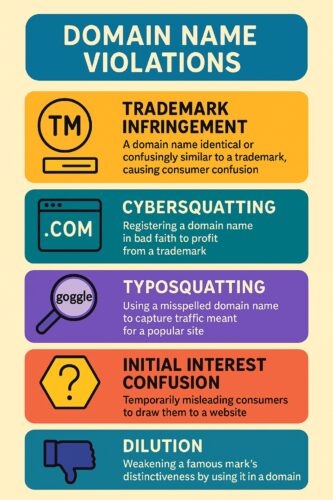
Under the ACPA, bad faith intent is a key element in determining whether a domain name use constitutes cybersquatting. In other words, the law looks at the registrant’s intent and purpose in registering the domain. ACPA lists several factors that courts consider to evaluate “bad faith intent to profit” from a mark in a domain name. These include, among others, whether the domain name registrant:
These and other factors, such as whether the registrant has any legitimate rights in the name, or is diverting consumers for commercial gain, help the court determine if the domain was registered in bad faith. No single factor is dispositive, and courts will weigh the overall circumstances. In essence, a good faith registrant might be someone who unknowingly registers a domain corresponding to another’s mark for some legitimate purpose or shares a name, etc., whereas a bad faith registrant is deliberately trying to exploit the trademark value of a name in which they have no rights.
Trademark owners often use the UDRP, a dispute resolution policy established by Internet Corporation for Assigned Names and Numbers (ICANN), to challenge infringing or squatting domains without filing a lawsuit in court. The UDRP is an administrative process that applies to most generic top-level domains (e.g., .com, .org, .net) and some country domains. A UDRP complaint allows a brand owner to seek a quick remedy if certain criteria are met, such as transfer or cancellation of the domain registration. To succeed under the UDRP, the trademark owner (complainant) must prove all three of the following elements:
The accused domain name is identical or confusingly similar to the complainant's mark. For example, deltaflyer.com vs. the trademark Delta Airlines. Minor differences like adding “.com” or other generic terms are generally ignored in this comparison.
The respondent (domain owner) has no rights or legitimate interests in the domain name. For instance, the domain is not the person’s own business name or being used for any fair or noncommercial use. Basically, the respondent has no legitimate reason to have that term as a domain.
If the complainant proves these elements, a UDRP panel can order the domain be transferred to the trademark owner or for the registration to be canceled. Notably, UDRP proceedings do not award money damages. The only UDRP remedies are domain cancellation or transfer. The UDRP process is generally faster and cheaper than litigation, often taking a few months or less for a decision. It’s a favored tool for small businesses because it avoids the cost of a full lawsuit. However, if either party is unhappy with the UDRP outcome, they can still take the dispute to court for a definitive resolution.
Owning a business name or registering a company name does not necessarily establish trademark rights. It is often assumed that registering a business entity in a state, obtaining a business license and DBA, and/or obtaining a domain registration, generates exclusive rights to use a name, but that’s not the case. Only use in commerce as a source-identifier secures enforceable trademark rights. A party using a business name in commerce can enhance and solidify their trademark rights by pursuing trademark registration with the USPTO, if they are engaged in interstate commerce. However, neither a business name registration, nor a domain name registration, by themselves, establishes enforceable rights in a trademark or brand/business name. Using a trade name or business name in commerce can develop common law trademark rights only if it functions to identify your goods or services to consumers. If it’s just a corporate name on paper and not used publicly as a brand, it will likely not establish trademark rights. Likewise, the U.S. Patent and Trademark Office advises that merely registering a domain name with a registrar does not confer any trademark rights, and you might later have to surrender the domain if it infringes someone else’s mark.
Small business owners should not assume that prior registration of a company’s name with a state or securing a matching domain will prevent another party from claiming trademark ownership over a corresponding name. Trademark rights depend on who used the mark first in commerce and whether consumers associate the name with a particular source. It’s quite possible, e.g., for two different businesses in different states to register the same company name or domain name. If one of them has actually been using the name as a brand in commerce and is issued a federal trademark registration, that party’s rights can trump a mere business filing or domain registration of the other. In practice, if you launch a business and grab a domain without checking for existing trademarks, you could discover that someone else already has trademark rights in that name, and you might be forced to change your branding or give up the domain.
Domain name infringement can significantly harm a company’s brand reputation and customer trust. If internet users are misdirected to another company’s website or a malicious site due to a confusingly similar domain name, the trademark owner can suffer several harms:
In short, domain name trademark infringement isn’t just a legal technicality, it has real-world business impacts. It can intercept customers on their way to your site, redirect them to competitors or bad actors, and ultimately undermine the hard-earned goodwill of your brand.
Preventing domain name trademark issues in the first place is far better than fighting over them later. Small business owners can take proactive steps to avoid infringing others’ marks and to protect their own:
By using these tools and practices, a small business can significantly reduce the risk of both infringing someone else’s trademark with its domain and of others infringing its trademark. In the online world, being proactive about trademark clearance and protection is part of smart business strategy.
When registering domain names for your business, keep the following best practices in mind to avoid legal issues and strengthen your brand’s position:
Think of domain registration as part of your overall brand strategy. It should be done carefully, with an eye toward both marketing and legal protection.
Choosing the right domain name is critical to building and protecting a company’s brand online. But failing to consider trademark law can expose you to costly disputes and loss of domain ownership. By conducting trademark searches, registering your marks, and avoiding confusingly similar domains, you can safeguard your company’s intellectual property and avoid legal pitfalls. If you need assistance with trademark and domain selection or other trademark matters, contact our office for a free consultation.
© 2025 Sierra IP Law, PC. The information provided herein does not constitute legal advice, but merely conveys general information that may be beneficial to the public, and should not be viewed as a substitute for legal consultation in a particular case.
The trademark opposition process is a legal procedure conducted at the Trademark Trial and Appeal Board (TTAB) of the United States Patent and Trademark Office (USPTO) that allows a third party to challenge a pending trademark application before it becomes registered. The TTAB is an administrative tribunal within the USPTO. It is a useful tool for businesses to understand how to oppose a trademark application. A trademark opposition is essentially a mini-lawsuit focused on whether a trademark application should be refused registration. The procedure is not trademark litigation and does not address infringement, only the right to register the mark. Oppositions are most often filed in order to prevent registration of mark that is highly similar to the opposing party's trademark or brand. It is a tool to protect the opposer's rights to its mark and branding from a newcomer with similar branding plans.
This article provides an overview of the trademark opposition proceeding, from the mark’s publication to final decision, including timelines and common issues.
A trademark opposition is a formal challenge to the registration of a trademark. After an examining attorney at the trademark office reviews a trademark application and approves it, the application is published in the USPTO’s Official Gazette for opposition. Publication is essentially a public notice that the USPTO intends to register the mark, unless an interested party files an opposition. There is a 30-day opposition period, and the opposition or a request for extension to file an opposition must be filed prior to the expiration of the opposition period. Any person who believes they would be damaged by the registration of the proposed trademark may file a Notice of Opposition within the allowed time. See 15 U.S.C. § 1063. In simple terms, if you own prior trademark rights or have another legitimate interest and you think a pending trademark registration will harm your business (for example, by causing consumer confusion with your brand), you can initiate an opposition.
Oppositions are filed with the TTAB, which acts as an appeal board within the USPTO to decide these disputes. The TTAB’s proceedings are adversarial, involving two parties: the opposer (the party challenging the mark) and the trademark applicant whose mark is being opposed. A trademark opposition proceeding shares some features with federal litigation, including pleadings, discovery, and trial phases. However, unlike litigation, it is generally handled through written submissions and evidence rather than live court hearings. The goal of an opposition is to determine whether the applied-for trademark should be refused registration on the Principal Register due to legal problems with the mark or the application.
Not just anyone can oppose a trademark; the opposer must have a real interest in the case. The law states that “[a]ny person who believes that he would be damaged by the registration of a mark upon the principal register… may, upon payment of the prescribed fee, file an opposition”. In practice, an opposer must show they are not a mere intermeddler: they need a legitimate stake in the outcome (often called “standing”). The TTAB and courts interpret this to mean the opposer must be within the “zone of interests” protected by the Trademark Act and have a reasonable belief that they will be harmed by the mark’s registration. For example, a company that owns an existing trademark can claim damage if a proposed mark is similar enough to cause market confusion, or an individual might oppose a mark that falsely suggests a connection to their identity or brand.
Importantly, the opposer does not need to prove actual damage; a belief in likely harm (such as loss of distinctiveness or reputation) is enough to initiate the case. The Federal Circuit has confirmed that a reasonable basis for his belief of damage is enough. A direct and personal stake in the outcome must be present. For instance, in Ritchie v. Simpson, 170 F.3d 1092 (Fed. Cir. 1999), the court allowed a consumer to oppose O.J. Simpson’s trademark applications, finding the consumer had a reasonable basis to believe the marks (related to Simpson) would damage him, thus meeting the standing requirement. In Ritchie v. Simpson, William B. Ritchie opposed registration of marks including O.J. SIMPSON on the grounds they were scandalous under § 2(a) or primarily merely a surname under § 2(e)(4). The TTAB dismissed his opposition for lack of standing, calling him a “mere intermeddler.” The Federal Circuit reversed, holding Ritchie met the statutory standard: he had a real interest in the proceedings and a reasonable basis to believe he’d be damaged by registration. That recognition affirmed broad statutory standing under 15 U.S.C. § 1063.
In summary, if you are a business owner or individual with prior rights or a legitimate interest that might be harmed by a mark’s registration, you have standing to file a trademark opposition.
Having standing is only the first step. The opposer must also plead one or more valid grounds for opposition. The Trademark Act provides various statutory grounds on which a trademark’s registration can be opposed. Below are some of the common grounds used in opposition proceedings. Each corresponds to a provision of the Lanham Act and has been recognized in TTAB cases:
In the Notice of Opposition, the opposer must clearly state the ground(s) being asserted and the factual basis for each ground, so the applicant is on notice of the claims. If even one ground is proven by the end of the case, the opposition will succeed and the trademark will not register.
An opposition proceeding follows a structured timeline set by the TTAB. Below is a breakdown of each stage in chronological order, starting from the trademark’s publication in the Official Gazette to the conclusion of the case. Understanding this timeline is vital, as missing a deadline can be fatal to an opposer’s case or an applicant’s defense. The standard process assumes no unusual delays or extensions beyond those normally allowed.
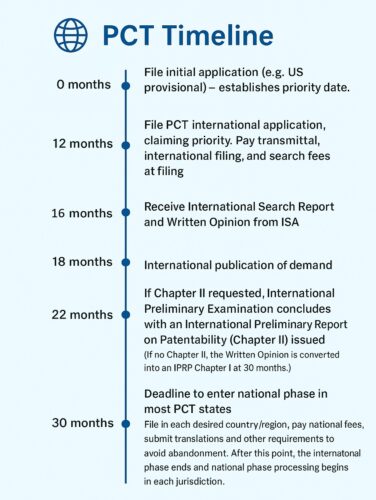
Once a trademark application clears the USPTO examining attorney’s review and is approved, it is published in the Official Gazette. Publication is a critical trigger point: it marks the beginning of a 30-day opposition period. During this window, anyone who believes they would be harmed by the registration can oppose the mark. The publication is essentially the USPTO’s way of asking, “Does anyone have a legal reason this mark should not be registered?” If no opposition or extension request is filed within this period, the application will proceed to registration after the 30 days or to a Notice of Allowance in the case of intent-to-use applications.
Because the opposition window is short, potential opposers should monitor the Official Gazette (which is published weekly) or use watch services to catch publication of potentially conflicting marks. If an interested party needs more time to decide or prepare an opposition, they can request an extension of time to extend the opposition deadline. By rule, an initial 30-day extension will be granted on request as long as the request is filed before the original 30-day period expires. Further extensions up to a total of 180 days from publication are possible with good cause or the consent of the trademark applicant. The TTAB allows a maximum of three extensions, capping the opposition period at 180 days from publication in total. For example, an opposer might first get a 30-day extension automatically, then request a 60-day extension for good cause, and perhaps a final 30 or 60 days with consent, not to exceed the 180-day limit. If no opposition is filed within the allowed time, the opportunity to oppose is lost. In that case, the only recourse for a third party would be to initiate a trademark cancellation proceeding after the mark registers or to file a letter of protest earlier during examination.
A Letter of Protest is an informal procedure separate from opposition. It allows a third party to submit evidence to the USPTO before publication, aiming to convince the examining attorney to refuse an application. However, once a mark is published, the formal way to object is through an opposition.
To kick off an opposition, the opposer must file a Notice of Opposition with the TTAB through the USPTO’s Trademark Center electronic filing system and pay the required filing fee. The fee is charged per class of goods/services in the application. As of 2025, the opposition fee is $700 per class for an opposition filed electronically. The Notice of Opposition is essentially the complaint in this legal proceeding. It should include the opposer’s identity and standing (their interest in the case), identification of the application being opposed, the grounds for opposition, and a clear statement of facts supporting those grounds. The Notice is usually formatted in numbered paragraphs like a lawsuit complaint. For instance, it might allege the opposer’s ownership of a prior trademark with registration or prior use details, and then allege that the applicant’s mark is confusingly similar to the opposer’s mark under §2(d) of the Act, among other claims.
Upon filing, the TTAB will institute the opposition proceeding. The TTAB assigns a proceeding number and issues an Institution Order. This order sets the schedule for the case, including the deadlines for the next steps: answer, discovery conference, etc. The TTAB also notifies the trademark applicant that its application is now opposed. If the opposition is filed via Trademark Center, the system will automatically serve a copy on the applicant or its attorney of record, and the Board will ensure the applicant is aware of the proceeding.
After an opposition is instituted, the ball is in the applicant’s court to respond. The trademark applicant, now effectively the defendant in the proceeding, must file an Answer to the Notice of Opposition, generally within 40 days of the TTAB’s notification of the opposition. The exact deadline will be given in the scheduling order. In the Answer, the applicant must respond to each allegation in the Notice, paragraph by paragraph, admitting what is true and denying what is contested. The applicant can also raise affirmative defenses, such as laches, estoppel, acquiescence, or that the opposer has no grounds/standing. If the applicant has a basis to do so, they may also file counterclaims, e.g., seeking to cancel the opposer’s trademark registration if relevant. The opposer would then need to answer any counterclaims in turn.
Failure to answer by the deadline is serious. If the applicant does not file an answer and doesn’t obtain an extension or otherwise respond, the TTAB can enter a default judgment, resulting in the opposition being sustained and the trademark application abandoned. Essentially, the opposer would win by default. The TTAB often sends a notice of default if an answer is late, giving the applicant a short window to show cause or file a late answer. But it’s best not to miss the deadline. Bottom line is that the applicant must respond in a timely manner to avoid losing the opposition automatically.
Once the pleadings (Notice and Answer) are on file, the case moves into the pre-trial stage. The TTAB rules require that the parties conduct a discovery conference early in the process, typically within 30 days after the answer’s due date. In this conference, the opposer and applicant and/or their attorneys discuss the case logistics: potential settlements, the scope of discovery, any agreements on procedures, and whether to pursue alternative dispute resolution. They also review the TTAB’s standard protective order, which automatically governs confidential information in the case, and can agree to any changes to it. The idea is to plan and simplify the upcoming discovery process. This meeting can be by phone or in person, and both parties are required to participate in good faith.
Shortly after the discovery conference, the parties exchange initial disclosures. Initial disclosures provide basic information on witnesses and documents each side may rely on, serving to jump-start the evidence exchange. These disclosures are due as set in the schedule, often 30 days after the discovery conference.
The discovery period is when each party gathers evidence to support its claims or defenses. In TTAB oppositions, the discovery phase typically lasts 180 days from the opening date set by the Board. During discovery, both the opposer and applicant (now effectively plaintiff and defendant) can use various discovery tools in an alternating fashion to obtain information:
Each side can pursue discovery to gather evidence of, for example, likelihood of confusion (surveys, evidence of actual confusion, details about use of the mark), the descriptiveness of a term, the intent of the applicant in adopting the mark, and so on. For instance, an opposer might serve interrogatories asking the applicant to explain the choice of its mark or to state whether it was aware of the opposer’s mark, which is relevant to a bad-faith adoption claim. The applicant might request documents showing the opposer’s use of its own mark to gauge strength or whether the opposer has actually been harmed.
The parties should respond to discovery requests within the time set by the rules (30 days from service). If a party believes the other is not providing proper responses, they can file a motion to compel with the Board. Parties can also stipulate to extensions of the discovery period or certain limits to streamline the case.
In some cases, either party may file a motion for summary judgment before trial if they believe there are no genuine disputes of material fact and that they are entitled to judgment as a matter of law. Summary judgment can avoid a full trial if, e.g., the opposer clearly lacks evidence on a required element. The TTAB allows summary judgment motions, but they must be filed before the party’s pre-trial disclosures are due. Notably, many TTAB oppositions settle or narrow during discovery. The parties might negotiate a coexistence agreement or an amendment to the application to resolve the conflict. Settlement can occur at any time; if a settlement is reached, the opposer may withdraw the opposition, ending the proceeding.
If the case isn’t disposed of on motion or settlement during discovery, it proceeds to trial, but “trial” at the TTAB doesn’t usually mean live courtroom battles. Instead, the TTAB trial phase is conducted through written testimony periods and evidence submission. The Board’s scheduling order will set sequential windows for each party to put in their evidence. The opposer, as the party with the burden of proof, goes first.
The standard schedule allocates:
These testimony periods happen in an alternating fashion without overlap. Each party must also serve pretrial disclosures shortly before their testimony period begins, identifying who will testify, etc., as required by the rules. Notably, live oral testimony in a TTAB hearing is rare. Evidence is typically submitted on paper (affidavits) or by deposition transcripts. This written record approach is a key difference between TTAB trademark trial procedure and a normal court trial.
All evidence submitted must comply with TTAB rules of evidence and procedure. For example, documents need to be properly authenticated or fall under a rule. Some documents can be submitted by notice of reliance, such as printed publications and official records. The TBMP provides detailed guidance on making evidentiary submissions.
After the testimony periods conclude and the evidentiary record is closed, the parties get to file trial briefs. Trial briefs are written arguments summarizing the facts and law, much like closing arguments in a trial. The briefing schedule, like the testimony, is sequential and staggered:
These briefs are critical, as they frame the case for the TTAB judges. The trial briefs should cite precedent, including TTAB decisions and Federal Circuit case law. For example, a brief on likelihood of confusion will likely cite the DuPont case factors and perhaps compare them to facts on record, and may cite past TTAB cases with similar mark comparisons to support its stance. Both sides might also cite the Trademark Act and regulations (e.g., 15 U.S.C. §1052(d) for confusion, §1052(e) for descriptiveness, etc.) to ground their arguments in law.
After briefing, either party may request oral argument before the Board, though this is not required. If an oral hearing is desired, a request must be filed. Oral hearings in TTAB cases are relatively rare: many cases are decided on the written record and briefs alone. When held, an oral hearing allows attorneys for both sides to present their arguments in person (or by video conference) to a panel of TTAB judges and answer the judges’ questions. The hearing is brief, typically allowing 30 minutes per side. It can be useful in complex cases, but for straightforward cases parties often waive it. If no oral argument is requested, the case will be decided on the papers.
If an oral hearing is held, no new evidence can be introduced at that stage. The hearing is limited to argument based on the record. The TTAB typically schedules the hearing a few months after briefing, if requested. Otherwise, once briefing (and any requested hearing) is done, the case is ready for decision.
The culmination of the opposition process is the TTAB’s decision. A panel of typically three administrative trademark judges will consider the evidence and arguments and issue a written decision. The decision will usually come several months after briefing is complete and any oral arguments are heard. On average, the TTAB aims to issue decisions around 3 to 6 months after the case is ready for decision, though complex cases can take longer.
In the decision, the TTAB will make findings on each claim. For example, if likelihood of confusion was alleged, the decision will analyze the DuPont factors and conclude whether confusion is likely or not. If multiple grounds were alleged, the Board might rule on each. The outcome will either be that the opposition is sustained, meaning the opposer wins and the trademark application is refused registration, or that the opposition is dismissed, meaning the applicant wins and the application can proceed to registration. The decision will also address any procedural or evidentiary issues raised.
Notably, the TTAB’s jurisdiction is limited to the registration issue. The Board cannot award damages, attorneys’ fees, or injunctions, and it does not decide the right to use a mark in commerce. So, if an opposer “wins,” the mark won’t register; if the applicant “wins,” the application can mature to registration, but that doesn’t grant the applicant the right to infringe on someone’s actual use. A decision favorable to the applicant just gives them the registration, which is evidence of their right to use. In other words, an opposition is about who gets a registration on the Principal Register, not about marketplace remedies.
Once the decision is rendered, the TTAB will send it to both parties. The losing party then has decisions to make about potential appeal or other actions.
If a party is dissatisfied with the TTAB’s final decision, they have the right to appeal. Under the Lanham Act (15 U.S.C. § 1071), there are two possible routes for appeal:
Importantly, if the losing party appeals to the Federal Circuit, they generally cannot later file a civil action on the same case, and vice versa. You get one choice of forum. However, a party who appealed an earlier TTAB decision to the Federal Circuit could still go to District Court on a later TTAB decision in the same case due to a remand. Snyder's-Lance, Inc. v. Frito-Lay North America, Inc., No. 19-2316 (4th Cir. 2021).
Business owners should note that a TTAB decision on likelihood of confusion or other grounds is not the same as a court ruling on infringement. However, TTAB findings can potentially be used in later litigation for issue preclusion in certain circumstances. In B&B Hardware, Inc. v. Hargis Indus., Inc., 575 U.S. 138 (2015), where the Supreme Court held that a TTAB decision on likelihood of confusion could preclude re-litigation of that issue in a subsequent trademark infringement lawsuit if the usages contested were materially the same.
The trademark opposition process provides a vital checkpoint in the trademark registration system, allowing businesses and individuals to protect their brands from potentially conflicting marks before those marks obtain the benefits of registration. If you are concerned about a competitor’s trademark application, it’s important to act promptly. If you do not file a trademark opposition during the allowed time, you will have to deal with a registered mark later. These proceedings often involve complex trademark law issues (likelihood of confusion analyses, evidentiary showings of use or fame, etc.). The experience of a seasoned trademark opposition attorneys to navigate opposition cases, as the rules and strategies can be nuanced and the outcome can significantly impact one’s branding rights. If you have a trademark opposition matter or other trademark issue, contact us for a free consultation.
© 2025 Sierra IP Law, PC. The information provided herein does not constitute legal advice, but merely conveys general information that may be beneficial to the public, and should not be viewed as a substitute for legal consultation in a particular case.
The Patent Cooperation Treaty (PCT) is an international treaty administered by the World Intellectual Property Organization (WIPO) that streamlines the process of seeking patent protection in multiple countries. Instead of filing separate patent applications in each country of interest, a PCT application allows an inventor to file one “international” patent application which has effect in over 150 PCT contracting states simultaneously. This system, often called the international patent system under the PCT, simplifies initial filing formalities and defers much of the cost and effort of pursuing patents in many countries. Importantly, the PCT does not itself grant an “international patent” (no such single global patent exists). The granting of patents remains under the control of each national or regional patent office during the “national phase” of the process. For U.S. applicants (e.g. businesses or inventors in the United States), the United States Patent and Trademark Office (USPTO) can act as a PCT receiving office to start the process, and the PCT framework is integrated into U.S. patent law. This article explains in accessible terms how the PCT works, its timeline and costs, and key requirements for U.S. applicants using the USPTO as the receiving office.
The PCT is used by companies of all sizes, universities, and individual inventors around the world when they seek international patent protection. It has become a cornerstone of international patent strategy. Every year there are hundreds of thousands of PCT international applications filed. For a business owner, the PCT is important because it provides a cost-effective and time-saving path to pursue patent rights in multiple countries. By filing one international application under the PCT, an applicant can essentially lock in a single earliest filing date (priority date) for an invention across many countries, and then delay the decision and expense of filing in each country by up to 18 additional months compared to the traditional route. This extra time can be invaluable for evaluating the invention’s commercial prospects and deciding in which countries to seek patents. In short, the PCT helps businesses seeking patent protection in multiple countries by simplifying the application process and giving them more time and information before entering numerous separate patent offices.
The Patent Cooperation Treaty is an international treaty first signed in 1970, now with more than 150 member countries (PCT contracting states). It created an international patent system that makes it possible to seek patent protection for an invention simultaneously in a large number of countries by filing a single “international” patent application. In essence, a PCT application is a unified initial filing that can later be pursued in many different countries. Any inventor or company who is a national or resident of a PCT contracting state can file a PCT application. U.S. applicants are eligible, as the United States has been a contracting state since 1978. A PCT application may be filed with your national patent office (the USPTO) or directly with WIPO’s International Bureau, which both act as PCT receiving Offices.
It is important to understand that the PCT itself does not grant a patent. Instead, it delays and coordinates the process of pursuing patents in the PCT contracting countries. The applicant must still enter the national phase in each country or region where protection is desired, and pursue the application under that country’s national law. The PCT thus provides a unified filing and preliminary examination process (the international phase), followed by separate patent applications in each country/region (national phase) where you want patent rights for the claimed invention.
By filing a PCT international application, an inventor effectively secures a filing date in all PCT member countries at once, and gains the benefit of a centralized search and preliminary examination, before deciding on separate national applications in individual countries. The system is administered by WIPO in Geneva, and is used worldwide as a standard route for international patent filings.
For business owners contemplating global markets, the PCT system offers several advantages over filing separate national patent applications in each country:
You file one application, in one language, and pay one set of initial fees, instead of filing many applications with different patent offices simultaneously. This simpler and more cost-effective approach reduces duplicate effort. WIPO handles a formality examination of the application, so if your PCT application meets the PCT’s form requirements, it cannot be rejected on formal grounds by any national office later.
As part of the PCT’s international phase, a qualified patent office will conduct an International Search and provide a report on relevant prior art along with a Written Opinion on the invention’s patentability. This happens early, before you spend money on multiple national filings. The search report and opinion give valuable insight into the strengths and weaknesses of your claimed invention, allowing you to make informed business decisions (e.g. whether to proceed in certain countries, or perhaps to modify your claims). You even have an option for an International Preliminary Examination (an additional, interactive examination – see below) to further assess or bolster your application before national phase entry.
Perhaps the biggest practical benefit is time. Under PCT, you usually gain an additional 18 months after your initial filing before you must incur the expenses of national filings. In a typical scenario, you have 12 months from your earliest patent application to file a PCT (this 12-month rule comes from the Paris Convention priority period), and the PCT gives you up to 30 months from the priority date (in most countries) to enter the national phase. That 30-month deadline is 18 months longer than the 12-month Paris Convention deadline would have been if you filed separate foreign applications directly. During these 18 extra months, the international search report and publication can help you gauge the invention’s patentability and market potential. You can use this time to seek investors, evaluate commercial interest, or decide to drop the application if prospects look unfavorable – thereby saving the cost of filings in many countries. In short, the PCT buys you time and information.
While the PCT application is pending, it maintains your rights in all designated states without further action. You do not have to pay separate filing fees or hire local attorneys in each country at the start. The international application is treated as a pending application in all PCT countries simultaneously. This global effect means no need to rush translations or incur local fees early on, and it preserves the option to proceed in any PCT country later.
When you do enter national phases, the PCT search report and any international examination report accompany your application into each patent office. National examiners consider these PCT work products, which often reduces duplication of effort. In some cases, if the PCT results are favorable, national phase examination may be accelerated or smoother. Many patent offices participate in the Patent Prosecution Highway (PPH), allowing you to fast-track examination by leveraging a positive PCT opinion or report. Essentially, the PCT centralizes the early search and (optional) examination, which can make the subsequent national phase more efficient.
At 18 months from the priority date, the PCT application is published internationally by WIPO. This publication puts the world on notice of your invention. Competitors and potential licensees can learn of your application by searching WIPO’s PATENTSCOPE database once it’s published. Early publication combined with the credibility of a WIPO search report may help attract partners or deter infringers, since third parties can evaluate the potential patentability of the claimed invention based on the PCT publication. You also have the option to indicate on PATENTSCOPE that you seek licensing opportunities, effectively advertising your invention to the world.
In summary, the PCT offers simplicity, time efficiency, and strategic advantages for applicants seeking patents in multiple countries. It is simpler, easier and more cost-effective than filing separate applications country-by-country, especially for U.S. businesses looking to expand their patent protection globally.
To navigate the PCT process, it helps to know some basic terminology and the entities involved:
This is the patent office where you file your PCT application. Each PCT member country’s patent office can act as a receiving Office for its own nationals/residents. For example, the USPTO is the receiving Office (RO/US) for U.S. applicants. WIPO’s International Bureau can also directly receive applications in some cases. The receiving Office checks that your application meets minimum requirements (e.g., that you’ve included at least a description and the applicant is entitled to file) and then assigns an international filing date if all formal requirements required by PCT Article 11 are met.
The date your PCT application is officially filed at the receiving Office. If the application meets the formality requirements, the international filing date is accorded and serves as the effective filing date for all designated countries. This date is very important; it’s equivalent to a filing date in each PCT country. If you are claiming priority from an earlier application (e.g., a US patent application), you must file the PCT within 12 months of that earlier application’s date to preserve your priority.
This is WIPO’s office in Geneva that centrally administers PCT applications. The IB acts as a clearinghouse: it publishes the applications, communicates documents to all designated countries’ patent offices, and keeps the master file. Once you file with a receiving Office, the application data is sent to the IB. The IB is also a possible receiving Office itself for applicants who choose to file directly with WIPO. The IB handles the international publication of PCT applications at 18 months and stores the application in its database.
This is the patent office that performs the international search on your PCT application. ISAs are major patent offices appointed to conduct PCT searches (for example, the USPTO, European Patent Office, JPO, and KIPO are ISAs). Not every ISA is available for every applicant, which ISA is competent can depend on where you filed your PCT. U.S. applicants filing at RO/US currently can choose the USPTO itself as ISA or one of several other offices, such as EPO, KIPO, Australia, Singapore, etc., subject to agreements. The ISA will search patent literature and technical publications to find prior art relevant to your invention.
This is the report prepared by the ISA listing prior art documents (patents, publications) that may affect the patentability of your invention. The ISR gives for each reference an indication of its relevance to novelty or inventive step. It’s essentially a focused prior art search result. The ISA aims to issue the ISR along with a Written Opinion typically within about 16 months from your priority date (or about 9 months from the PCT filing date). The ISR is later published by WIPO, usually together with your application at 18 months.
Along with the ISR, the ISA provides a written opinion analyzing whether your claimed invention appears to meet the criteria of novelty, inventive step (non-obviousness), and industrial applicability. This written opinion is preliminary and non-binding, but it’s very useful: it explains the examiner’s view on each claim’s patentability in light of the prior art found. As an applicant, you don’t have to respond to the written opinion during the international phase, unless you choose to request further examination, but you can use it to guide amendments. If you take no further action, this written opinion will later be converted into an “international preliminary report on patentability (Chapter I)” at the end of the international phase, which is communicated to all the national offices.
WIPO publishes the PCT application promptly after 18 months from the earliest priority date. The publication includes the description, claims, any drawings, and also the ISR (if it’s ready in time) and the applicant’s abstract. It is published in one of the 10 languages of publication. For example, if you filed in English, it publishes in English. After publication, the content is publicly available on WIPO’s PATENTSCOPE database. Prior to 18 months, the PCT file remains confidential, unless you request early publication or access. Publication at 18 months is a standard practice also for regular national applications in many countries, including U.S., aligning with the principle that patent applications are made public 18 months after filing.
If you decide to proceed with Chapter II, International Preliminary Examination, you will file a demand for examination and usually amend your application or argue against the ISA’s opinion. The IPEA is an office that conducts this second-round examination. Not all applicants use Chapter II, but it can be beneficial if the ISA’s written opinion was negative and you wish to improve the application before national phase. The International Preliminary Examining Authority will consider your amendments and arguments, possibly correspond with you or even hold an interview, and then issue an International Preliminary Report on Patentability (Chapter II).
IPRP Chapter I: If you do not request a Chapter II exam, the WIPO will issue an IPRP (Chapter I) which is basically a copy of the ISA’s final written opinion (translated into English if necessary) at the end of the international phase. This report, along with the ISR, is sent to all designated offices for their reference.
IPRP Chapter II: If you do file a demand for preliminary examination (Chapter II), the outcome is an International Preliminary Report on Patentability (Chapter II) issued by the IPEA. This report will state the examiner’s patentability opinion on each claim after considering any amendments you made. Like the Chapter I report, it is non-binding on national offices, but it provides a stronger basis if positive. A favorable Chapter II IPRP can significantly bolster your case going into national exams. National patent offices often give the IPRP weight, even though they will do their own examination. If the report is negative, it at least forewarns you of likely issues.
This refers to the stage after the PCT international phase where you actually pursue patent grants in individual countries or regions. “Entering the national phase” means filing the necessary documents and fees with a national or regional (e.g., the European Patent Office) patent office, based on your PCT application. The national phase deadline is typically 30 months from the priority date, though a few offices have 31 months or allow slight extensions. During national phase, each patent office examines the application under its own national law and requirements. The international stage PCT documents and analysis will be available to them to consider, but each office makes its own decision on granting a patent. Essentially, the PCT application splits into multiple “daughter” applications in the national phase, one in each desired country/region.
For clarity, we’ll consider a typical scenario for a U.S. applicant and outline the PCT process timeline with key milestones, requirements, and fees. Assume you have an initial U.S. patent filing (for example, a provisional or non-provisional application) and you want international protection:
Initial Application Filed. Often, applicants first file a national application in their home country to establish an initial filing date. For instance, you might file a U.S. provisional application or a U.S. non-provisional application. This date is the priority date for subsequent filings. Under the Paris Convention, you have 12 months from this date to file a PCT application to claim its priority. If you don’t have an earlier application, your PCT filing itself can be the first filing and the PCT filing date is the priority date.
Before 12 months from the priority date expires, you must file your PCT international application if you want to claim priority to the earlier national application. For US applicants, this PCT filing is often done via the USPTO as the receiving Office (RO/US). Requirements at filing: You need to submit the PCT Request form (which is basically a cover sheet with bibliographic data, inventor/applicant information, etc.), a specification (description, claims, drawings if any, abstract) – which can be a direct copy of your prior application or updated, and usually an abstract. You also must pay the international fees at this stage. Typically, there are three types of fees due upon PCT filing:
Transmittal Fee: a small fee for the receiving Office (USPTO) handling the filing. For example, the USPTO’s transmittal fee is a few hundred dollars (often around $240 for electronic filing; check current USPTO fee schedule).
International Filing Fee: a WIPO fee for processing the application internationally. This is a fixed fee for all applicants worldwide, denominated in Swiss Francs (CHF). As of the PCT Applicant’s Guide, the base international filing fee is 1,330 Swiss francs (about $1,400, but varies with exchange rates) for up to 30 pages. There is an additional fee per page if your application exceeds 30 pages. This fee is paid to the receiving Office, which is then forwarded to WIPO.
Search Fee: the fee for the International Searching Authority to perform the prior art search. This amount depends on which ISA is chosen and can range roughly from $150 to $2,000. For example, if the ISA is the USPTO, the search fee (per USPTO’s fee schedule) might be around $2200; if the ISA is the European Patent Office, it’s about EUR 1,775; some other ISAs are less costly. The applicant typically selects the ISA in the request form. The search fee is paid at filing to the receiving Office, which is forwarded to the ISA.
Optional Fees: If you file electronically using approved software (which most applicants do via ePCT or USPTO’s electronic filing system), you may receive a reduction in the international filing fee. Also, if you qualify as a small entity or reside in certain countries, fee reductions might apply (e.g., certain developing country applicants get 90% reduction in WIPO fees).
After filing, an international filing date is accorded (assuming all formal requirements are met). The USPTO (RO/US) will assign an international application number and confirm your international filing date, which, crucially, is the date that will count as the effective filing date in all PCT countries. If something is missing, the receiving Office may give you a chance to correct it and still get the date; the conditions for obtaining a filing date are set by PCT Article 11.
The receiving Office processes your application, confirms all parts are present, and then forward it to the International Searching Authority (ISA) you selected. The ISA will typically start the international search for prior art. You will receive an acknowledgment of your PCT filing (with the PCT number and filing date) and later possibly a notice if anything needs to be fixed (e.g., missing pages or fee issues). If all is in order, you mostly wait for the search results. The priority document (your earlier application) also needs to be provided to WIPO, and is often the receiving Office will handle transmitting an electronic copy if the priority application was, e.g., a US application, via the priority document exchange system. Otherwise you may need to furnish a copy or request retrieval).
The ISA aims to issue the International Search Report (ISR) along with the Written Opinion (WO) by about 16 months from the priority date or roughly 9 months after the PCT filing. The ISR is a list of prior art references (patents, publications) relevant to your claimed invention, with indications of their relevance. The Written Opinion is a detailed initial examination analysis of your claims against the prior art, essentially stating whether your invention is novel, non-obvious, and industrially applicable, and explaining any issues claim by claim. This written opinion is not public at this point and is not an official rejection, but it gives you a preview of what an examiner thinks. In response to the ISR and written opinion, you have the option to do nothing (e.g., if the report is favorable), or prepare and file claim amendments and/or submit arguments against any patentability issues raised in the report.
Whether or not you have the search report by then, at 18 months from your priority date, WIPO will publish your PCT application electronically. The publication (identified as “WO [year]/[#####]”) includes your application text and any figures, and if the International Search Report is ready, it is published as an appendix. If the ISR wasn’t ready by 18 months, the application still publishes, and the ISR will be published separately later when available. The publication is in the public domain via PATENTSCOPE. From this point on, your invention’s details are public worldwide, and you have “patent pending” status internationally. Third parties can now see the results of the search, which can inform their actions or interest.
Costs at this stage: There is no additional fee for publication itself, the filing fee covered WIPO’s processing. However, if your application was filed in a language not accepted by your chosen ISA, you might have paid a translation cost for search purposes earlier. Most U.S. applicants file in English, so that’s usually not an issue since USPTO or EPO as ISA accept English. Also, if you decide around this time that you want to withdraw the application (to avoid publication, perhaps because the invention is no longer pursued or the ISR was very negative), you must do so before the 18-month mark. Otherwise, publication will occur and the application will be public.
If you choose to use the optional Chapter II procedure and request an International Preliminary Examination, you need to file a demand by the later of 22 months from the priority date or 3 months from the transmittal of the ISR. In practice, since the ISR usually arrives by 16 months, you have until around 19–22 months to decide on Chapter II.
Why file a demand? This is useful if the Written Opinion from the ISA was negative or if you want to amend the claims and get a second opinion on patentability before entering national phases. By filing the demand, you get to engage with an International Preliminary Examining Authority (IPEA) and potentially argue your case or amend claims.
Requirements and fees for Chapter II: You must file a demand form (there’s a PCT form for Chapter II demand) and usually submit any claim amendments (Article 34 amendments) you want to make in light of the search report. You’ll need to pay:
Once the demand is filed and fees paid, the IPEA will perform an international preliminary examination. This can involve at least one office action in the international phase: the examiner will review your amendments/arguments in view of the objections raised in the written opinion, possibly raise new issues, and may communicate with you. You have a chance to respond, and there may even be an interview with the examiner. Chapter II provides the only opportunity to have dialogue with an examiner during the international phase. Many applicants skip Chapter II to save cost, but those who want a cleaner application going into national phase or who want to test amendments globally, often use it.
If Chapter II was used, the IPEA will issue the International Preliminary Report on Patentability (IPRP Chapter II) by around 28 months from the priority date. This report will state, for each claim, whether it meets the criteria of novelty, inventive step, and industrial applicability in the examiner’s opinion. It will be shared with all the elected Offices: the countries you intend to enter. If you did not file a Chapter II demand, then an IPRP Chapter I will be prepared, which is essentially a copy of the ISA’s written opinion. Either way, by 30 months at the latest, the international phase concludes with a dossier of search and examination documents that national offices can use.
Thirty months from your earliest priority date is the typical deadline to enter the national phase in each country or regional office you choose. “Entering national phase” means you must take action in each desired jurisdiction to continue prosecution of the application there. What must you do? According to PCT Article 22 and related national laws:
It’s important to meet the 30-month deadline. If you miss it in a given country, the application can lapse in that country, and be treated as withdrawn/abandoned. Some jurisdictions have grace periods or remedies, for example, the U.S. allows the acceptance of a late national stage entry after 30 months if the delay was unintentional, via petition and payment of a late fee under 35 U.S.C. § 371(d). But such leniency is not universal, many countries strictly bar late entry. Therefore, patent applicants should diarize the 30-month date and take action in time.
This is where the major expenses occur. You now must pay separate fees in each selected country. Costs include official filing fees (vary by office), translation costs (if needed), and local attorney fees for handling the filings. The national phase fees are the most significant pre-grant costs; they can far exceed the earlier PCT costs. However, some national offices offer reduced fees for PCT entries compared to direct filings, recognizing the work already done internationally. For example, if an office benefitted from the international search, they might charge a lower search/exam fee nationally. Nonetheless, applicants should budget carefully; entering, say, Europe, China, Japan, Canada, and Australia could collectively cost tens of thousands of dollars in filing and translation fees.
At the 30-month juncture, you effectively decide in which countries or regions you want to pursue actual patents. Many applicants will choose a handful of key markets based on business strategy. The PCT helped delay this big expense and decision until this point. Now, those national applications will be prosecuted individually in each jurisdiction’s patent office.
After entry, each patent office will process the application as a national application (often assigning it a local application number). They will usually refer to the PCT search report and may use the PCT examiner’s work as a starting point, but they will apply their own patent law standards. For example, the USPTO will have its examiners examine the application under U.S. law (35 U.S.C. §§ 101, 102, 103, 112, etc.), the European Patent Office will examine under the European Patent Convention, and so on. You or your local attorneys will correspond with each office, respond to rejections, and prosecute the application to grant as you would with any patent application.
The timeline and outcome now vary by country: some offices might grant a patent within a year or two, others might take longer. Each resulting patent is a separate patent, enforced in that country or region. Maintenance fees will have to be paid in each jurisdiction to keep those patents in force.
Below is a quick visual summary of key PCT timeline points using the earliest priority date as time zero:
Throughout this timeline, keep in mind specific national rules. For instance, some countries have slightly different deadlines: a few allow 31 months, like the EPO. You can consult the PCT Applicant’s Guide for any particular country’s requirements and time limits. WIPO provides detailed national chapters in the Guide outlining each state’s rules.
U.S. business owners filing via the USPTO should note a few specific points:
The Patent Cooperation Treaty (PCT) is a powerful tool for U.S. businesses and inventors looking to protect an invention in multiple countries. It provides a unified international patent application process that simplifies filing and delays the need to make expensive decisions about country-by-country patent filings in the over 150 PCT contracting states. By using the PCT, a company can seek patent protection in multiple countries simultaneously in a cost-effective manner.
It is important to remember that ultimate patent protection remains territorial. There is no international patent that is issued. You must pursue patents in each target country or region, under their laws and procedures, to actually get patents granted. The PCT greatly facilitates and coordinates this process, but it doesn’t eliminate it.
In planning an international patent strategy, business owners should consider the PCT’s benefits: one application, one search, delayed costs, and global reach. In virtually all cases where protection in multiple countries is desired, the PCT is the recommended route. It is a flexible, user-friendly international treaty that makes the complex world of international patents more accessible to innovators. If you are considering pursuing foreign patent rights, contact our office for a free consultation.
© 2025 Sierra IP Law, PC. The information provided herein does not constitute legal advice, but merely conveys general information that may be beneficial to the public, and should not be viewed as a substitute for legal consultation in a particular case.
Every business owner choosing a brand name or logo should understand the trademark concept of likelihood of confusion. This is the legal standard U.S. courts and the U.S. Patent and Trademark Office (USPTO) use to decide if two trademarks are too similar. If consumers would likely confuse the source of goods or services bearing two similar marks, then a conflict exists under trademark law. The underlying reason that trademark law prevents such confusion is to ensure consumers get accurate information about a product’s source. The law prevents such confusion primarily to protect consumers from being misled, while also safeguarding fair competition and business goodwill.
The principle of blocking confusingly similar marks has roots in 19th-century common law. Early trademark cases grew out of the law of unfair competition, particularly the doctrine of passing off, which essentially forbids one trader from misrepresenting their goods as someone else’s. As an English court famously stated in 1842, “A man is not to sell his own goods under the pretence that they are the goods of another man”. Perry v. Truefitt (1842) 6 Beav. 66, 73.
The fundamental goal is to keep the marketplace honest and efficient for buyers. Trademarks (brand names, logos, etc.) serve as source-identifiers: they tell you who made a product or provides a service. When you see a familiar brand on a package, you assume it comes from the same source as all other products with that brand (think of Nike shoes, Hilton hotels, and Toyota vehicles). This confidence lets consumers make quick, informed choices. In economic terms, a distinctive trademark reduces consumer search costs. Shoppers don’t have to investigate the origin or quality of every product anew; the brand name carries that information and the company’s reputation. Businesses, in turn, are motivated to maintain quality and consistency, since their name is what customers rely on. In short, strong, non-confusing trademarks make shopping easier and reward companies for building goodwill with consumers.
Under U.S. trademark law, "likelihood of confusion" refers to the probability that consumers will be misled into believing that two different products or services come from the same source. The core question is whether an ordinary prudent consumer in the marketplace would reasonably expect the two marks (e.g. brand names or logos) to come from one company or affiliated companies. If such consumer confusion is likely, the law deems the marks confusingly similar. The law does not require proof that consumers are actually confused; it only requires showing that confusion is likely to happen.
For example, imagine one coffee shop is named “Bean Bazaar” and another coffee shop opens nearby as “Bean Bizarre”. Even though the second name is spelled differently, they are phonetically similar and offer the same services. Customers could easily assume the two cafes are related. They might think the new cafe is a second location or a spin-off of “Bean Bazaar.” In this scenario, there is a strong possibility that consumer confusion would occur.
Likelihood of confusion is the linchpin of trademark infringement cases. Under the federal Lanham Act (the U.S. Trademark Act), a trademark owner can stop others from using a mark if that use “is likely to cause confusion or mistake or to deceive” consumers about the source of the goods. In an infringement lawsuit, the plaintiff must prove that the defendant’s allegedly infringing mark is likely to confuse consumers. If the plaintiff succeeds, the court can order the infringer to stop using the mark and potentially pay damages. If the trademark owner can show instances of actual consumer confusion, the law recognizes that damage to the brand may already be done.
Courts commonly articulate the test as whether the buying public would likely believe the two products or services came from the same source. For instance, in Bean Bazaar - Bean Bizarre example, a court would ask whether an average customer exercising ordinary caution think these products come from the same company? If yes, the trademark owner has a strong infringement case. If no, then infringement will not be found.
Likelihood of confusion also matters when you apply to register a trademark. The USPTO examining attorney will perform a trademark search of existing marks. If the examiner finds a previously registered mark (or pending application) that is confusingly similar to your proposed mark, your application will be refused on likelihood of confusion grounds. This is often called a “Section 2(d) refusal,” referring to the section of the Lanham Act that bars registration of a mark that is likely to cause confusion with an existing mark. You’ll receive an office action explaining the conflict and will have to argue why your mark is not confusingly similar or else your registration will not go through.
For example, if you try to register “Omega Electronics” and there’s an active trademark registration for “Omega Electric” selling related products, the Trademark Office will issue a likelihood of confusion refusal. Under 15 U.S.C. § 1052(d), no new mark can be registered if it “so resembles a mark registered in the Patent and Trademark Office… as to be likely, when used on or in connection with the goods of the applicant, to cause confusion, or to cause mistake, or to deceive.” In essence, the USPTO is trying to protect consumers and senior trademark owners by preventing look-alike or sound-alike marks from getting on the federal register.
Just like courts, the USPTO uses a multi-factor analysis to assess proposed trademarks. These are known as the DuPont factors, from the case In re E.I. du Pont de Nemours & Co. 476 F.2d 1357 (CCPA 1973). The examining attorney will compare the marks in appearance, sound, meaning, and commercial impression, evaluate the relatedness of the goods or services, and consider other relevant factors that might indicate potential confusion. If, after weighing the factors, the examiner believes confusion is likely, the application is denied. This is why conducting a thorough trademark search before filing an application and before choosing a trademark and brand is so important. Prudence can save you from investing in a name that the USPTO or courts would deem too close to an existing mark.
To decide whether confusion exists between two marks, courts and the USPTO use a multi-factor test. There is no single bright-line rule. Several important factors relating to trademark confusion are evaluated. A famous example is the Sleekcraft factors, originating from the case AMF, Inc. v. Sleekcraft Boats, 599 F.2d 341 (9th Cir. 1979), which set out a framework that many courts follow. Most U.S. jurisdictions have a similar list (the Polaroid factors in the Second Circuit , the Lapp factors in the Third Circuit, etc.), but all share common considerations. The USPTO’s analysis under the DuPont factors is largely similar to the court tests. It is critical to note that not all factors will be relevant in every case, and no one factor is dispositive. Decision-makers will look at the overall picture of whether the consumer confusion is likely.
Here are the primary factors (the “Sleekcraft” factors) that are typically considered in a confusion analysis:
These factors are a guide rather than a checklist. Next, we’ll explore each of the major factors in turn, along with examples and key cases, to see how they affect the confusion analysis.
Trademarks vary in strength. A unique, distinctive mark has a wider scope of trademark protection, while a common or weak mark gets a narrow scope. The law categorizes marks along a spectrum of distinctiveness:
A strong mark (arbitrary, fanciful, or well-known with secondary meaning) will typically enjoy greater protection, meaning it can stop others from using even somewhat similar marks on related goods. A weak mark (e.g., descriptive without secondary meaning, or a mark used by many others in the field) will have a harder time claiming exclusivity. For example, a hypothetical brand “National Electronics” would be considered weak if many companies use “National” in their names. By contrast, a unique brand like “Xybernaut” for electronics is inherently strong. In one case, a cleaning service branded “Maid in America” (a descriptive wordplay) was deemed too descriptive and lacking secondary meaning, and the owner failed to prove infringement on that basis. The bottom line: the more distinctive your mark, the easier it is to prevent confusingly similar imitations.
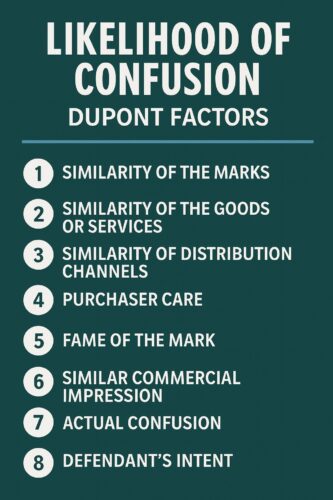
One of the most important factors in any likelihood of confusion case is how similar the two marks are. To determine this, the marks are compared in their entirety, focusing on their appearance, sound, connotation (meaning), and overall commercial impression. Minor differences often do not suffice to avoid confusion if the overall impression is similar.
When evaluating similarity, courts and the USPTO consider the marks as consumers would encounter them in the marketplace. This means even if two marks have slight spelling differences or additional words, they could still be deemed essentially the same mark in the minds of consumers. Pronunciation is especially influential: marks that sound alike can confuse listeners even if spelled differently. For instance, “SUN Bank” and “Son Bank” would be nearly indistinguishable when spoken aloud. The same goes for marks with similar meanings or images (connotation). If one brand is called “Valiantheart Beer” and another is “Braveheart Ale”, the shared concept of courage could create a similar mental image or impression for consumers.
Courts will typically compare the marks side by side on these aspects:
If the dominant portion of the marks is the same, confusion is more likely. For example, adding a common suffix or changing one letter usually won’t avoid confusion: “Magnavox” vs. “Multivox”, “Travel Planner” vs. “The Travel Planner”, or “Maternally Yours” vs. “Your Maternity Shop” were all found to be confusingly similar pairs. In the Maternally Yours case, a maternity clothing retailer named Maternally Yours stopped a competitor from using Your Maternity Shop, even though the phrasing was slightly different, the court noted the same words just rearranged still misled customers. Maternally Yours, Inc., v. Your Maternity Shop, Inc., 234 F.2d 538 (2d Cir. 1956). Likewise, simply adding a small prefix or suffix might not change the mark’s identity in consumers’ minds. If someone tried to sell coffee under the name “Starbucks Café” versus the famous “Starbucks”, the extra word doesn’t prevent consumer perception of a link to the Starbucks brand.
Even if two marks are very similar, confusion might not occur if they are used on completely different types of goods or services. This factor looks at how related the goods or services are and whether they occupy the same or overlapping market. The basic idea: the more the products compete or are marketed in similar channels, the more likely consumers will assume a common source.
Consider these scenarios:
A classic example: “Delta” is used as a mark by both an airline and a faucet manufacturer, but the goods and services contexts are so different that consumers don’t assume a connection. In contrast, when the fast-food giant McDonald’s objected to a hotel chain’s plan to open budget hotels under the name “McSleep”, a court agreed that consumers might assume McDonald’s (famous for the “Mc-” family of brands like McNuggets, McMuffin, etc.) was expanding into hotel services. Quality Inns International, Inc. v. McDonald's Corp., 695 F. Supp. 198 (D. Md. 1988). The federally registered McDonald’s mark was so well-known and strong that even a different service (motels) could trigger an association. This shows that a very famous mark have more brand reach across goods and services. People could believe McDonald’s had a hand in anything starting with “Mc.” So, the more closely related the product lines or the more expansive the senior brand’s reputation, the more a similar mark will create confusion.
Additionally, this factor examines the overlap in marketing channels and customer base. If both companies advertise in the same magazines, sell in the same department store chains, or target the same demographic, a consumer could encounter both products in the same context and mistakenly think they are connected. On the other hand, if one product is sold only in upscale boutiques and the other in discount stores, or one is B2B sales and the other retail, the separation may reduce confusion.
In sum, the closer the marketplace proximity, the greater the chance that consumers will assume a single source. Businesses should be cautious if they choose a name similar to another company that’s even tangentially related to their line of business, especially if that company might bridge the gap and enter your market.
While a plaintiff doesn’t need to show any instances of real-world confusion to win an infringement case, any direct evidence of actual confusion can be extremely persuasive. Actual confusion means customers truly have been misled. For example, mistaking one brand for another, misdirected phone calls or emails, or survey results showing a significant number of consumers believed the two companies were connected. If such evidence exists, it strongly supports the argument that the similarity of the marks constitutes likelihood of confusion. As one source explains, proof that the average reasonably prudent consumer is confused is powerful evidence of infringement.
Courts often say actual confusion is the best evidence of likelihood of confusion. However, it’s important to remember that it is not required to prove a case. Many infringement cases are decided without any documented instances of confused consumers. For example, a company might sue shortly after the junior user begins using the mark and there may not have been time for actual confusion to manifest. In such cases, the court will rely on the likelihood factors, expert testimony, and consumer surveys rather than waiting for customers to be misled in the real world.
In practice, companies sometimes commission consumer surveys in litigation to gauge actual confusion. These surveys ask a sample of target customers questions to see if they believe two products come from the same source. While survey evidence can be direct evidence of confusion, its reliability can be contested, and a poor survey can even hurt the plaintiff’s case. Nonetheless, actual confusion remains a crucial factor: if you receive reports that customers are truly mixing up your product with another brand, that’s a red flag that your marks are too close.
If a plaintiff is able to show actual confusion, it can tip the scales. Even a few incidents, such as a shopper returning a product to the wrong company, or consumers commenting “Oh, I thought your brands were the same”, can carry considerable weight. Large-scale evidence like survey results or a pattern of mix-ups is even more compelling. Conversely, the absence of any known confusion after a long time of coexistence might suggest that confusion is less likely. The concept of long-term co-existence without any consumer confusion is also a factor considered under the likelihood of confusion analysis.
Trademark law also looks at the intent of the junior user (the alleged infringer). If the defendant intentionally copied or chose a mark to create confusion with the senior user’s mark, courts view that as evidence that confusion is likely. After all, if someone tries to ride on the coattails of an established brand, it implies they believe consumers will mistake the two and that they will benefit from that misassociation. Deliberate adoption of a similar name, especially with evidence like internal emails or mimicry of logos/packaging, can strongly favor the trademark owner’s case.
For example, in the earlier Maternally Yours case, the defendant opened a store called “Your Maternity Shop” just blocks away from the plaintiff’s Maternity Shop, with knowledge of the plaintiff’s business. The defendant even imitated the plaintiff’s signage style, packaging, and advertising format: “all with the obvious intention of misleading the public and diverting trade from the plaintiff.” The court noted this bad faith and found it indicative that confusion was intended and likely. Evidence of defendant’s intent to cause customers to associate the two companies strongly weighs toward finding likelihood of confusion.
It’s worth noting that intent is not a required element for infringement. A well-meaning business can inadvertently infringe if their mark is confusingly similar, even if they had no knowledge of the other mark. However, when defendant’s mark choice is made in bad faith (e.g., a former employee of Company A starts Company B with a nearly identical name to siphon customers), courts will not hesitate to infer that confusion was not only likely but the very goal. On the flip side, if a defendant can show they acted in good faith, had no knowledge of the plaintiff’s mark, and picked their mark independently, that won’t necessarily avoid liability, but it will weigh against a finding of likelihood of confusion and may influence remedies. Defendant's intent mainly helps the court gauge how the marks came to be similar; a bad intent usually makes the court more skeptical of the junior user’s arguments.
Not all consumers are alike. The law recognizes that the likelihood of confusion can depend on the level of care or attention the typical buyer exercises for a given product. If the relevant consumers are very careful, highly educated, or making expensive, important purchases, they are less likely to be confused by similar marks. Conversely, if the goods are low-cost items bought on impulse by the general public, the risk of confusion goes up because buyers aren’t researching or deliberating over the purchase.
Courts typically apply the standard of a “typical purchaser exercising ordinary caution”. For everyday inexpensive products (like a snack food), an average buyer might not take much time to discern the brand. If two bags of chips have similar branding, a hurried shopper could grab the wrong one. Here, even slight similarities can confuse consumers who aren’t paying close attention.
On the other hand, consider very expensive or specialized goods, like industrial machinery or luxury real estate. Buyers of those tend to research thoroughly, often know the market players, and are more sophisticated. They are less likely to be misled by similar trademarks because they’ll notice subtle differences. For example, a company selling $50,000 laboratory equipment under the name “LabTech Innovations” might not be confused with “LabTech Instruments” if their customers are procurement experts who investigate each vendor. The degree of purchaser care is higher in that market. As one case noted, if the target buyers are careful, sophisticated purchasers, even marks that are somewhat alike may not cause confusion.
In evaluating this factor, courts consider the typical price of the goods, the conditions of purchase, and the buyer’s expertise. The law expects the purchaser of expensive, specialized goods and services to exercise a high degree of care, reducing the likelihood they’d be confused by mere trademark resemblance.
Beyond the primary factors above, there are other factors and nuances that can influence a likelihood of confusion analysis. Trademark law is flexible, and not all factors carry equal weight in every case. Here are a few additional considerations:
With all these factors, no single factor is dispositive. A strong showing on a few factors can outweigh others. The analysis is holistic: it looks at the totality of circumstances. This flexible approach is why advice from an intellectual property attorney or trademark attorney can be invaluable. They can assess how the factors stack up in your particular situation and compare it to past cases.
A familiarity with the likelihood of confusion standard is useful in the brand selection process. Business owners with a working knowledge of the standard also have a much better chance of avoiding trademark infringement. The key takeaways are: choose a distinctive mark, do your homework with a thorough trademark search, and be mindful if there are other brands in your industry so that you can anticipate and identify potential consumer confusion issues. The multi-factor analysis may seem complex, but it essentially asks the question "Will consumers likely be confused or think there’s an association between two brands?"
If you’re unsure about a new brand name or you receive a cease-and-desist letter alleging your mark is confusingly similar to another, consider consulting a trademark attorney. An experienced attorney can analyze the alleged infringement and advise you of your best course of action. Contact our office for a free consultation to discuss your trademark matters.
© 2025 Sierra IP Law, PC. The information provided herein does not constitute legal advice, but merely conveys general information that may be beneficial to the public, and should not be viewed as a substitute for legal consultation in a particular case.
Very few people outside of the copyright legal community understand the difference between a work’s copyright date and its publication date. It is an important distinction with significant legal implications under U.S. copyright law. In simple terms, a copyright date usually refers to the year the copyrights in the work came into being (this varies depending on when the work was created and published), while the publication date is the date the work was first made available to the public. This article breaks down the differences between a copyright date and a publication date, explains how U.S. copyright law treats each, and discusses the practical implications of each across the relevant U.S. copyright acts: the Copyright Acts of 1909, the Copyright Act of 1976, and the Berne Convention Implementation Act of 1988. The article's purpose is to help creators, publishers, and businesses better understand the importance of these dates and enable them to protect their creative works.
U.S. copyright law protects original works of authorship as soon as they are “fixed in a tangible medium of expression,” meaning the moment you write down your story, record a song, or save your painting to a canvas, it is automatically protected by copyright. Under current law, you do not need to publish the work or register it with the government for the copyright to exist; the act of creation itself grants the author exclusive rights over the work under copyright law. These exclusive rights include the right to reproduce the work, distribute it, create derivative works, publicly perform or display it, and license others to do the same. Any use of the work by others without permission that falls outside legal exceptions (such as fair use) may constitute copyright infringement, regardless of whether the work has been published or not. Thus, a creative work is protected from the moment of creation, long before any formal publication date or registration date. However, publication and registration are still very important in determining the legal standing and the scope of copyright protection for a particular work.
In everyday language, “publication” often means the publishing date or release date of a book, article, or other work. But in U.S. copyright law, publication has a specific technical definition. Publication is generally defined as “the distribution of copies or phonorecords of a work to the public by sale or other transfer of ownership, or by rental, lease, or lending”. Importantly, even offering to distribute copies to a group for purposes of further distribution or public performance constitutes publication, whereas a mere public performance or display (e.g., publicly displaying a painting in a gallery) does not, by itself, constitute publication. In practical terms, publication occurs on the date when copies of the work are first made available to the public without restrictions. For example, if you print and sell a batch of books or release a new song on a streaming service, that act typically counts as publication because copies are being distributed to the public by sale or other transfer. By contrast, if you simply show a painting in a private exhibition or perform an unpublished song live, those acts are not considered publication under copyright law’s definition.
Understanding what constitutes publication is crucial because many aspects of copyright law hinge on whether and when a work was “published.” The date of first publication triggers certain legal obligations and affects the rights of the copyright owner, as discussed below. We will examine how publication plays a role in copyright duration, registration, notice, and the work’s entry into the public domain, and how those implications have changed across different eras of U.S. copyright law.
The term “copyright date” is not explicitly defined in the statute, but it is commonly used to refer to the year associated with a work’s copyright. Typically, the copyright date and the date listed in the work’s copyright notice used to be the same thing, but with the changes that came with the US implementation of the Berne Convention for the Protection of Literary and Artistic Works in 1988, which amended the 1976 Copyright Act. As of March 1, 1989, the notice requirement to establish and maintain copyrights upon publication of a work. Copyright notice is now optional.
A copyright notice is the line that often begins with © (the copyright symbol) and is usually found on the copyright page or title page of a published work (for example, “© 2025 John Doe”). By convention, this year in the notice is the year of first publication of that work. For instance, if a novel was first published in 2025, its copyright notice would normally read “© 2025 [Author/Publisher Name].” The copyright date on the notice informs the public when the work was first released and who the copyright owner was at that time. Business owners should note that the copyright year is typically found in books, on websites, and other creative works to signal when the work was published and that it is protected by copyright law.
It’s important to understand that the copyright notice year is not necessarily the year the work was created. If an author finished writing a creative work (e.g., a manuscript) in 2024 but waited until 2025 to publish it, the publishing date (first publication date) is 2025. However, the copyrights were established in 2024. Sometimes, multiple dates are listed in a copyright notice because of changes to the content of the particular work. For example, if a website’s content is continually updated, the site might display a range of copyright years (e.g., “© 2018–2025”). The changes in the content do not result in the earlier content losing protection, it simply indicates the site includes material up to the current year. The copyright date in the notice serves as an informative date and helps in determining the term of protection for certain works, especially for works made for hire or anonymous works where the term is measured from publication. The copyright date, however, is complicated by changes to copyright law over the course of the twentieth century. Due to the long duration of copyright term and the relative recency of the changes in copyright law, there are currently co-existing works that are subject to different legal regimes based on when they were created and/or published. In older works, the publication date determines the copyright date. These nuances are discussed in further detail below.
Today, including a copyright notice and thus a visible copyright date on published copies is optional but recommended. U.S. law no longer requires a notice to obtain copyright protection. That requirement was eliminated in 1989, but using one has practical benefits. A proper notice informs the world that the work is copyrighted, names the copyright owner, and states the year of first publication, which can prevent an infringer from claiming they didn’t realize the work was under copyright: the “innocent infringement” defense. For works published before March 1, 1989, a valid copyright notice was mandatory, and publishing without a notice could cause the work to enter the public domain immediately. In summary, the copyright date on a work is a public identifier of the work’s first publication year and its claim of copyright. It is not necessarily the date the copyright registration was obtained, since copyright exists upon creation, and thus should not be confused with the date of registration or the exact calendar date of release.
The publication date of a work is the date when the work was first published, as defined by copyright law. In everyday usage, this might be the book’s release date, the date a website or article went live, or the day a music album was released to the public. Legally, the publication date is significant because it’s a fixed point in time that the law uses for several purposes. Generally, one can think of the publication date as the moment the copyright “goes public”: it’s when copies are first made publicly available without restrictions. This date can often be found in the front matter of a book (e.g., “First published in [Month Year]”) or in a record of the publisher. For a website or an online content piece, the publication date might be evident from the posted date or release notes.
It’s worth noting that for many works, the copyright notice year and the first publication year are the same, since the notice reflects the year of first publication. However, the actual full publication date (month and day, or at least month and year) can be important in certain legal contexts. For example, an application to register the work should be filed within three months of the publication date, and thus an accurate publication is needed to calculate a three-month window. Also, different editions or versions of a work can have different publication dates. For instance, if a particular work, such as a book, was first published in 2010, that is the key publication date for copyright purposes. A different book (e.g., a revised edition or a translation of the 2010 book) published in 2015 would have 2015 as its publication date and its own notice year, even if the underlying text was first created earlier. Business owners publishing content should always keep track of the exact first publication date of each work, as this date can affect the duration of copyright and certain legal rights and obligations.
In scenarios where a work was created but not immediately published, the creation date and the publication date diverge. For example, imagine a photographer took a photograph in 2015 but publicly released it for the first time in 2021. In this case, the copyright existed from 2015 (creation), but the publication date is 2021, and that 2021 date would be critical for the copyright application deadline. The publication date is essentially when the work “officially” enters the marketplace or public sphere, which has downstream effects on how the Copyright Office and courts treat the work.
Under the Copyright Act of 1909, which governed U.S. copyright law for works created before 1978, publication was of paramount importance. At that time, federal copyright protection typically began at the moment of publication, assuming the work was published with the proper notice. In fact, if a work was published in the United States without a proper copyright notice under the 1909 Act, the work could instantly fall into the public domain, meaning anyone could use it freely. By contrast, unpublished works were protected by state common law copyrights (a form of protection in equity) until they were published. Publication was the act that triggered federal statutory protection: an author would publish the work with a © notice, and from that date of publication the author had copyrights for a set period of years. Under the 1909 Act, the initial federal copyright term was 28 years from the date of publication with an option to renew for another 28 years. This means the publication date started the clock on the copyrights' duration. If the copyright owner wanted to extend protection beyond the initial term, they had to file a renewal registration in the final year; failing to renew would cause the work to enter the public domain at the end of the initial term.
To illustrate, suppose a book was first published with notice in 1940. Under the 1909 Act regime, its federal copyright would run 28 years from 1940 to 1968 and could be renewed to run for a second 28-year term until 1996. The key point is that the publication date was essentially “day one” of copyright protection under the old copyright law. An unpublished work prior to 1978 had no federal copyright term running because it wasn’t in the federal system until publication. This is a stark difference from modern law.
Also, the requirement of a notice on the published copies meant that the copyright date printed on works (e.g. © 1940) had real legal weight; it indicated that the work was properly claimed under the 1909 Act on that publication date. A missing or incorrect notice could be fatal. As a famous example, the publishers of the film Night of the Living Dead (1968) accidentally omitted the notice when the title was changed at release, causing that otherwise original film to enter the public domain immediately.
It’s also worth mentioning that under the 1909 Act, many works that were not published at all remained under perpetual common-law protection until they were eventually published. This changed with the 1976 Act, which we discuss next. But for our purposes here: if you are dealing with a work first published before 1978, the publication date and whether proper notice was used were critical in determining if the work was copyrighted, for how long, and whether it might have fallen into the public domain due to missed formalities. Attorneys handling legal disputes over older works often must research the publication history and notices of a work to determine its copyright status.
The Copyright Act of 1976, which took effect January 1, 1978, overhauled U.S. copyright law. One of the biggest changes was that copyright protection no longer depends on publication or registration. Instead, copyright protection is automatic from the moment of creation (fixation), and publication is not required to secure copyrights. This brought the U.S. closer in line with international norms, such as the Berne Convention. Under the 1976 Act, works created on or after January 1, 1978 are protected for the author’s life plus 70 years for individual authors, regardless of when or if the work is published. In terms of when the law says copyright protection starts, the copyright date is now the date of creation, not publication. You could write a story today and never publish it; it would still be a copyrighted work until it eventually expires many decades later.
In 1988, Congress passed the Berne Convention Implementation Act, which took effect on March 1, 1989. This legislation eliminated the requirement that published works include a copyright notice in order to receive federal copyright protection. Prior to that date, omission of a proper notice could result in immediate forfeiture of copyright protection for published works under the 1909 and 1976 Acts. After March 1, 1989, notice became optional, but still recommended, for works first published in the U.S. This amendment was essential for U.S. adherence to the Berne Convention, which prohibits signatory countries from conditioning copyright protection on compliance with formalities such as registration or notice.
The publication date still remains very significant under the 1976 Act and its amendments, but in different ways. For example, for works made for hire or anonymous/pseudonymous works, often owned by companies or published under a corporate name, the copyright term is defined as 95 years from publication or 120 years from creation, whichever expires first. In these cases, the year of first publication can indeed determine the length of protection. If a company creates a work and publishes it immediately, the clock runs 95 years from that publication year. If the company never publishes the work, the term would max out at 120 years from creation. Thus, even in the modern regime, knowing the exact first publication date is essential for calculating when a work will enter the public domain for certain types of works.
Additionally, the 1976 Act and subsequent amendments preserved special rules for works that were created before 1978 but not yet published by that date. Section 303 of the current law provided that pre-1978 unpublished works were given a default term lasting at least until 2002, and if such a work was first published between 1978 and the end of 2002, it wouldn’t expire before 2047. This was to ensure that older manuscripts, letters, or artwork that remained unpublished as of 1978 didn’t suddenly lose protection. In essence, Congress gave those works a window to be published without penalty. The details are complex, but the key takeaway is that for certain older works, the first publication date can affect whether the work is still under copyright today.
In summary, under modern U.S. law, the publication date does not start copyright protection, since protection starts at creation, but it does trigger other legal effects. Among these are the requirement to deposit copies with the Library of Congress, the timing of registration relative to publication, and the applicable duration for certain works. Also, as mentioned earlier, after 1978 the law gradually eliminated formalities like the notice requirement. So while you might still see a “© 2025” on a book’s title page as the copyright date, that is there to inform and deter infringers, not as a condition of protection. The copyright owner is still wise to include it, as it helps identify the owner and year for anyone who needs to seek permission to use the work, and it may ward off claims of innocent infringement. But if somehow the notice is omitted on a work first published after 1989, the work is still protected: omission no longer forfeits copyright.
It is important to distinguish copyright registration from publication. Registration is the process of filing a claim with the U.S. Copyright Office, and it results in a certificate with an official effective date of registration. This date is essentially when the Copyright Office received all required materials in the proper form. Many people casually refer to “registering a copyright” or getting a “copyright date” from the government. In reality, registration is optional for copyrights to exist, but it is mandatory if you want to enforce your rights in U.S. court and enjoy the full benefits of copyright protection. Think of registration as a way to strengthen and activate your copyright’s legal standing: you already have the copyright upon creation, but you cannot sue for copyright infringement in the U.S. until you have either registered the work or at least applied and been refused registration.
The copyright registration date does not need to coincide with the publication date. You can register an unpublished work, or you can register after publication. For example, a photographer might publish a photo on their website today, but wait to file an application to register copyrights in the photo with the Copyright Office next month. The application date becomes the effective date of registration, if the registration issues. Ideally, authors and businesses should register their works promptly, because registration timing has practical implications. If a work is registered before an infringement or within three months of publication, the copyright owner is eligible to seek statutory damages and attorney’s fees in an infringement lawsuit. If you wait longer than three months after first publication to register and someone infringes in the meantime, you might lose the chance to claim those enhanced remedies for that period of infringement. You could still stop the infringement and get actual damages, but statutory damages are a powerful remedy you’d forgo if registration was not timely.
To put it plainly: the publication date is when the world first sees your work; the registration date is when you officially record your claim with the U.S. government. The law rewards timely registration relative to publication. The Copyright Act provides a three-month grace period after first publication during which you can file for registration and still be able to recover full remedies (statutory damages and fees) even if the infringement began in that window. This is why you’ll hear advice such as “register your work within 90 days of publication.” It’s not because copyright protection would lapse, but because your legal remedies in court can be limited if you miss that window. In order to take advantage of the full benefits of copyright registration, your works should be registered at the earliest opportunity.
Another connection between registration and publication is evidentiary: if you register within five years of first publication, your registration certificate will serve as prima facie evidence of the validity of the copyright and the facts stated in it, in any court dispute. This means courts will presume your claims (e.g., authorship and ownership) are true, putting the burden on others to prove otherwise. Registering many years after publication can weaken that presumption. Thus, while the copyright date in the notice is mostly for informing the public, the registration date is crucial for legal enforcement.
The publication date of a work can also influence how long the work remains protected, i.e., when it enters the public domain. The rules differ based on the type of work and when it was created. As noted, for individual authors under today’s law, the term is life of the author plus 70 years, and publication date doesn’t change that. For example, if a company released a training video in 1980 as a work made for hire, the copyright would last through 2075 (95 years from 1980). If that video was created in 1980 but not published until 1990, then 95 years from 1990 (i.e., until 2085) would be the term, unless 120 years from creation (which would be 2100) comes first. In that case, 2085 is earlier, so the term ends 2085. The takeaway is that for certain works, both creation and publication dates are needed to determine the exact expiration.
Under older laws, as discussed, works had fixed terms from publication (28 years, renewable to 95). Laws passed in 1976 and 1998 extended those terms. As of today, any work first published in 1929 or earlier is definitely in the public domain in the United States due to expiration of term. For example, works published in 1929 entered the public domain on January 1, 2025, after their maximum 95-year copyright term expired. Each year on January 1st, another year’s worth of works (95 years old) fall out of copyright. This schedule is tied directly to the publication year for works from 1923 through 1977, because those works have a term of 95 years from publication (assuming they were properly renewed, etc.). Thus, knowing a work’s first publication date is essential when assessing if it might be public domain. Librarians and researchers often use publication dates as a guidepost for determining public domain status. For instance, as of now, a U.S. book first published in 1930 would be under copyright until the end of 2025 (95 years from 1930), entering the public domain on January 1, 2026, unless something like a missing notice already caused it to fall into public domain earlier.
Conversely, unpublished works were given special treatment so that many of them did not enter the public domain until recently. An unpublished manuscript from 1880, for example, which had never been published or registered, would have been protected by common law until 1978, then got at least until 2002 under the 1976 Act, and if the author was unknown or long deceased, it would have entered the public domain on January 1, 2003 if still unpublished. If it was first published before 2003, it got protection until at least 2047. These examples illustrate that publication dates can extend or limit protection for older works under the transitional provisions. In everyday practice, for works created now, publication date’s main impact on duration is (1) for those work-for-hire/anonymous cases, as noted, and (2) for works from the mid-20th century, the copyrights of which are tied to their publication year.
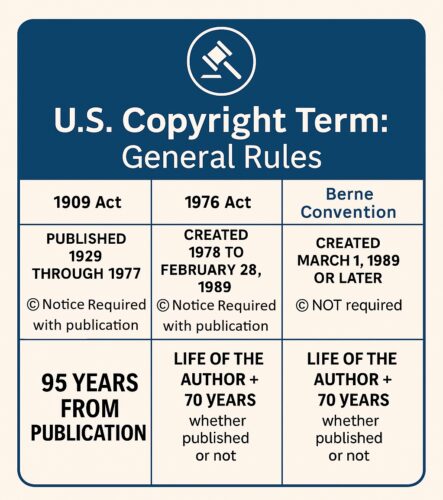
Beyond duration and formalities, whether a work is considered published or unpublished can affect certain uses and exceptions in copyright law. For example, the fair use doctrine under 17 U.S.C. §107 considers whether a work is unpublished as part of the analysis. Unpublished works get a bit more leeway in favor of the author in some court decisions, as authors have a right to control first publication. Likewise, Section 108 of the Copyright Act provides special rules for libraries and archives: libraries can make preservation copies of unpublished works more freely, since an unpublished work might not be commercially available at all. But for published works, libraries have a different set of rules for archiving and lending. Another example is the right to publicly perform sound recordings via digital audio transmissions (17 U.S.C. § 114); published versus unpublished status can matter for certain statutory licenses. The general theme is that the law sometimes distinguishes between published and unpublished works, granting unpublished works different treatment in certain contexts because distribution to the public has not occurred.
From the perspective of a business or creator, this means that choosing when and if to publish a work can have implications. Once a work is publicly distributed, it is considered published and those special considerations for unpublished works fall away. Additionally, the act of publication might involve other transfers of rights or ownership. For example, if you have a publishing contract, the publisher might become the copyright owner upon publication by transfer. The ownership and licensing arrangements often hinge on publication as well. For example, a photographer might license first publication rights to a magazine. While these issues go beyond just dates, it’s important to see that “publication” in copyright isn’t merely a formality; it is a status that can change how the law treats the work in various scenarios.
Understanding the distinction between copyright dates and publication dates is not just academic, it helps you manage your intellectual property strategically. Here are some practical takeaways and tips:
By following these practices, business owners and creators can ensure their works are properly protected and that they maximize the legal benefits available under copyright law. Always remember that copyright law, while federal and relatively uniform across the U.S., can be complex. The stakes (e.g., in legal disputes over infringement or ownership) can be high when valuable content is involved.
For U.S. business owners and creators, knowing the critical dates for copyright materials is a must to effectively manage intellectual property assets. For further information, the U.S. Copyright Office provides useful circulars and resources. Consulting with a qualified copyright attorney can help to effectively address copyright issues. If you have a copyright matter or other intellectual property issues to address, contact our office for a free consultation.
© 2025 Sierra IP Law, PC. The information provided herein does not constitute legal advice, but merely conveys general information that may be beneficial to the public, and should not be viewed as a substitute for legal consultation in a particular case.
Patent marking is the practice of labeling products with patent information, typically the word “Patent” or “Pat.” followed by a patent number, to notify the public that the product is protected by an issued patent. For business owners new to patent law, understanding patent marking is crucial. Proper marking serves multiple purposes: it provides notice to the public of a product’s patent protection, helps preserve the patent owner’s rights to recover damages for patent infringement, and can deter competitors from copying the patented invention. In the United States, while patent marking is technically optional, it is highly recommended as a best practice for anyone who sells a patented product and may need to enforce their patent rights. This article offers an overview of U.S. patent marking laws, the benefits of marking, how to mark products (including “patent pending” notices and virtual marking), and the pitfalls of false marking.
Patent marking—labeling products with “Patent” (or “Pat.”) and the patent number—alerts the public that an item is protected. While optional under U.S. law (35 U.S.C. § 287), it’s a best practice for businesses selling patented products. Proper marking provides constructive notice, deters competitors, and preserves the patent owner’s right to claim damages for infringement dating back up to six years.
If a product isn’t marked, damages are limited to infringement after actual notice (e.g., a lawsuit or cease-and-desist letter). Marking is especially important for physical products covered by apparatus or design patents. For method-only patents, marking isn’t required, but damages still depend on notifying infringers.
Two marking options exist:
Best practices include marking all units consistently, updating for new or expired patents, requiring licensees and manufacturers to mark, and keeping detailed records.
False marking, claiming “patent pending” without an application, or listing unrelated patents—can lead to legal exposure. Since 2011, penalties require proof of intent to deceive or competitive injury, but honest mistakes (like marking expired patents) are no longer penalized.
In short, marking patented products protects your rights, strengthens enforcement, and helps recover full damages in infringement disputes.
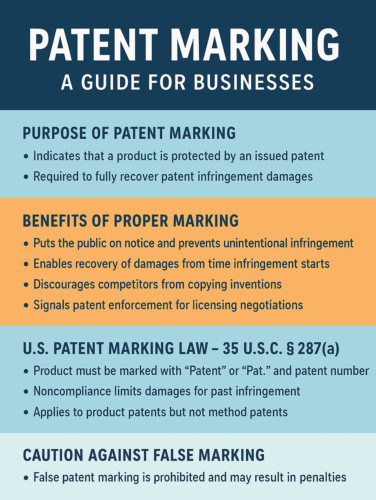
Patent marking exists primarily to give constructive notice of patent rights to the public. By marking patented articles, a patent holder effectively warns others that the product is under patent protection, thereby reducing accidental infringement by those who might unknowingly copy or use the invention. This advance notice can foster an atmosphere of respect for innovation and encourage competitors to design around the patent rather than infringe it. Marking also preserves the patent owner’s ability to claim damages from the earliest possible date of infringement. Under U.S. law, if products are properly marked, the patent owner may recover monetary damages for up to six years of past infringement (the maximum statute of limitations) prior to filing a lawsuit. Without marking, those monetary damages could be severely limited.
By contrast, not marking a patented product can result in lost opportunities to claim patent infringement damages and may invite uninformed parties to infringe, unaware of the patent. In summary, patent marking is a simple step that significantly bolsters a patentee’s patent rights enforcement and patent protection strategy.
The U.S. patent marking statute, 35 U.S.C. § 287(a), establishes the patent marking requirements and the consequences of non-compliance. In essence, the law encourages patentees to mark their products by limiting damages for unmarked products. The statute provides that patentees, and persons making or selling any patented articles, may give notice to the public that the item is patented by marking it accordingly. Specifically, the patent owner should either fix “Patent” (or “Pat.”) and the patent number to the product or, if the article’s size or nature makes physical marking impracticable, affix the information on the packaging in a manner that provides like notice. This marking serves as constructive notice to the public that the article is patented.
Under § 287(a), if a patent owner (or its licensee or manufacturer) fails to mark a patented product, no damages can be recovered for patent infringement that occurred before the infringer was given actual notice of the infringement. In other words, absent marking, the patentee’s damages are limited to infringement occurring after such notice is given to the infringer. Actual notice usually takes the form of a specific communication to the alleged infringer, such as a cease-and-desist letter or the filing of an infringement lawsuit. Importantly, the infringer’s actual knowledge of the patent is not a substitute for the patent holder’s compliance with the marking statute. The law imposes an affirmative duty on the patent holder to mark; even if an infringer knew about the patent, the patent owner still cannot claim damages for earlier infringement without either marking or proving they gave actual notice. As one court explained, the marking notice provisions focus on the patent holder’s conduct, not the infringer’s knowledge.
These marking requirements apply to physical products that are covered by patent claims. Notably, patents on processes or methods are treated differently under the law. For now, the key point is that U.S. patent law offers a carrot-and-stick approach: marking is not mandatory (the statute says a patentee “may give notice” by marking), but failing to mark a patented invention comes with the penalty of forfeiting certain patent rights – specifically, the right to collect past damages prior to notice. Companies seeking to fully enforce their patents and obtain monetary damages for infringement should pay careful attention to these patent marking laws.
You may have seen products labeled “Patent Pending” or “Patent Applied For.” This indicates that a patent application has been filed for the product but a patent has not yet been granted. Marking an item as “patent pending” is permitted during the application process and can serve as a deterrent to competitors by signaling that patent protection is being pursued. However, it is crucial to understand that patent pending status does not confer any enforceable patent rights, one cannot sue for infringement until the patent actually issues. The marking is purely a cautionary notice. Once the patent is granted, the product must be updated to display the patent number (either physically or via virtual marking) to meet the formal marking requirement. Continuing to use “patent pending” after a patent issues, or failing to switch to the actual patent number, can lead to non-compliance with marking regulations and a failure to provide constructive notice.
Equally important is the truthfulness of a patent-pending claim. U.S. law prohibits false claims of patent pending status. According to 35 U.S.C. § 292(a) (false marking statute), it is illegal to mark an article with “patent applied for” or “patent pending” or similar terms when no application is in fact pending, if done with intent to deceive the public. For example, a company should never label a product as “patent pending” if it has not filed a patent application, or if the application was abandoned, as that would constitute false marking. Violations can incur penalties. In practice, as soon as a patent is granted, the marking should be changed from “pending” to “Pat. [Number]”; and if a patent application is abandoned or rejected with no continuing applications, any patent pending labels should be removed to avoid misleading the public. Likewise, if a patent expires, the product should no longer be marked as patented. Continuing to mark an expired patent could be considered misleading.
Traditional physical marking involves affixing patent information directly onto the patented article or its packaging. The marking should include the word “Patent” or the abbreviation “Pat.” followed by the applicable utility patent numbers for the product. For example, a label might read “U.S. Patent No. 10,000,000” or simply “U.S. Pat. 10,000,000.” If multiple patents cover the product, it is common to list each relevant patent number (e.g., “Pat. 9,500,000; 10,000,000”). In the case of design patents, the format “Pat. D123,456” is often used (the “D” indicating a design patent). The goal is to clearly identify which patents cover that product.
Proper marking should be legible and placed where it can be readily seen by the consumer or anyone inspecting the product. The U.S. statute suggests marking the article itself “by fixing thereon” the required information, but it acknowledges that sometimes marking the product directly is not feasible. For instance, if the product is very small, has a surface that cannot easily be stamped or labeled, or if marking it would damage its functionality or aesthetics, then attaching the patent notice to the product’s packaging is acceptable. In those cases, fixing a label with like notice on the package is deemed sufficient as long as the product is sold with that packaging. Manufacturers should ensure the markings are durable (for example, etched, molded, or printed indelibly, if possible) and not easily removable or hidden. If the product is prone to wear or the marking could be worn off, marking the package might be preferred to maintain visibility. What matters is that someone looking at the product or its packaging will receive notice to the public that the item is patented.
Some practical tips for physical marking:
By following these practices for physical marking, companies can ensure effective patent marking, meaning the marking accomplishes its purpose of providing legal notice while also complying with the statute’s specifics.
Virtual patent marking is a modern alternative to stamping patent numbers on products. It was introduced by the America Invents Act (AIA) in 2011 to simplify marking in the digital age. With virtual marking, a product may be marked with an internet address (URL) that leads to a webpage listing the patents associated with that product, instead of listing out patent numbers on the product itself. For example, a label on the product might read: “Patents: www.company.com/patents”. The statute was amended to allow marking by “fixing thereon the word ‘patent’ or ‘pat.’ together with an address of a posting on the Internet” that associates the patented article with its patents. This approach provides flexibility, especially for products covered by many patents or when patents change frequently.
Requirements for a valid virtual marking are:
Virtual marking offers several benefits for companies. It allows quick updates: as soon as a new patent issues or one expires, the webpage can be edited, ensuring you always provide up-to-date information without having to retool a production line. It is also efficient for products that have dozens of patents – instead of trying to list all those numbers on a small device, the single URL covers all of them. Additionally, one URL can cover multiple products and multiple patents in a centralized place. This can save cost and effort, especially for high-tech products or software-related inventions. In fact, software and digital products often rely on virtual marking because there may not be a traditional “label” or physical medium to mark within the software interface itself. For example, software might display an “About” box or a section in settings with patent information, or provide a link to a patents webpage.
To implement virtual marking correctly, companies should create a dedicated patents page on their website, keep it organized (group patents by product or category), and ensure the URL on the product is permanent and easy to type. Using a simple URL or a QR code (with a short URL embedded) can be helpful, though courts have not definitively ruled on QR codes yet. Importantly, document your virtual marking efforts. Maintain dated archives of your patent webpage (even using web archive tools) so you can later prove in court what information was provided at a given time. This kind of evidence can be crucial to show you complied with marking requirements throughout the period of infringement.
In summary, virtual patent marking is a powerful tool that, when done properly, satisfies legal requirements and provides notice just as physical marking does. It’s particularly useful when dealing with many patents or when dealing with intangible products, but it requires diligence to set up and maintain.
Whether using physical or virtual marking (or both), a patent owner should follow best practices to ensure compliance and maximize the benefits of marking:
By adhering to these best practices, businesses can maintain an effective patent marking program. The payoff is twofold: you put the world on notice of your patents (strengthening your legal position and deterring infringement) and you ensure that you preserve your ability to collect full event damages should litigation arise (meaning you won’t leave money on the table due to a technical marking omission).
Not all patents are alike, and the marking rules reflect that. The statute refers to marking “patented articles,” which naturally covers patents that have at least one product or apparatus claim. Here’s how marking requirements break down by patent type:
In summary, apparatus claims (including system and design patents) demand marking of products, whereas method claims do not. If your patent has both, it’s wise to mark any related products to avoid complexity. Always err on the side of providing notice, the effort to mark is usually far less trouble than the complications and limits that arise from not marking.
Failing to comply with the patent marking requirements can significantly impact a patent owner’s enforcement rights. The primary consequence is the limitation on recoverable damages. As discussed, if a patented product was not marked, the patent holder cannot collect damages for infringement that occurred before the infringer received actual notice of the infringement. This can mean a drastic reduction in the compensation the patentee recovers. For example, imagine a competitor has been selling an infringing product for three years before the patent owner discovers it. If the patent owner’s own product wasn’t marked during that time, the owner might only be able to recover damages from the point they notify the infringer (say, via filing the lawsuit) onward, those first three years of infringement could be money lost forever. By contrast, had the product been marked, the patent owner could potentially claim damages for the full three years (and up to three more, since patent law generally allows up to six years of back-damages).
Another consequence is more strategic: not marking might embolden potential infringers. Without a marking, competitors or other parties might not realize your product is patented (no notice to the public), and thus they might inadvertently or even intentionally copy it, thinking it’s safe to do so. While ignorance of a patent is not a defense to infringement, it does remove liability for damages before notice and it also removes the threat of enhanced damages for willfulness in that early period. Essentially, not marking can lead to accidental infringement or surreptitiously intentional infringement by others and leaves you with fewer remedies against them. Marking, on the other hand, can prevent that scenario by making your rights visible from the start.
Courts have also clarified procedural aspects of the marking defense. Once an infringer raises a challenge that a patentee sold unmarked products, the burden can shift to the patent owner to prove compliance. The Federal Circuit in cases like Arctic Cat has outlined that an alleged infringer must first identify specific products that were unmarked and covered by the patent; then the burden shifts to the patentee to show those products were marked or that the patent owner made reasonable efforts to ensure marking. If the patentee cannot show consistent marking or efforts to mark, pre-notice damages will be disallowed.
It’s worth noting that if a patent owner never made or sold any product covered by the patent (for instance, a purely licensing entity or an inventor who hasn’t commercialized the invention), then § 287’s marking provisions do not apply. In such cases, the patentee can still collect damages for up to six years prior to filing suit, because the law only restricts damages when there was a product that could have been marked. Similarly, if infringement is of a method claim only (and no product to mark), the damages can accrue from infringement without marking (subject to actual notice requirements). But these are exceptions to the general rule. Most practicing entities (companies making products) should assume marking is necessary.
In sum, damages awarded for past infringement can be severely affected by a failure to mark. The patent marking requirement is thus not something to overlook. The relatively simple act of marking products can be the difference between recovering a full measure of damages versus losing out on potentially substantial sums of money.
While patent marking is encouraged, false marking is strictly prohibited. False patent marking refers to labeling products in a misleading way regarding patent protection, with intent to deceive the public. There are a few forms this can take, all addressed by 35 U.S.C. § 292:
Originally, false marking was considered a serious offense with steep penalties, historically up to $500 per offense, which courts interpreted as per falsely marked article. This led to a wave of false marking lawsuits around 2009-2011, where enterprising individuals (non-competitors) sued companies for marking products with expired patents or incorrect patent numbers, seeking massive fines. For instance, companies were sued for not removing old patent numbers from products after the patents expired (expired patents technically made those products “unpatented” in the eyes of the law). The Forest Group v. Bon Tool, 590 F.3d 1295 (Fed. Cir. 2009) case confirmed the per-article fine, incentivizing a cottage industry of “marking trolls.” Another notable case, Pequignot v. Solo Cup, 608 F.3d 1356 (Fed. Cir. 2010), involved a manufacturer that kept molding patent numbers into cup lids even after the patents expired, the court held that while the lids were falsely marked (expired patent = unpatented article), the manufacturer avoided penalty by proving it had no intent to deceive: they were trying to save cost on changing molds, not trick the public. This case established that intent to deceive is a required element: honest mistakes or continued use of old markings without deceptive intent are not penalized.
In response to the explosion of opportunistic lawsuits, Congress reformed the false marking law in the AIA of 2011. The changes, reflected in 35 U.S.C. § 292(b)-(c), are:
Even with these changes, false marking is something companies want to avoid. While the threat of random plaintiffs suing has gone away, a competitor could still bring a claim if they can show competitive injury. Moreover, false marking can also draw scrutiny under other laws, such as unfair competition or truth-in-advertising statutes. In a recent Federal Circuit case, Crocs, Inc. v. Effervescent, Inc., 119 F.4th 1 (Fed. Cir. 2024), the court allowed a claim to proceed under the Lanham Act, which governs false advertising, for a company’s marking of products with expired patents. Even though marking expired patents isn’t a § 292 violation anymore, the competitor in that case alleged that doing so was misleading to consumers, essentially a false advertising claim. The Federal Circuit’s decision suggests that blatantly misleading patent markings (e.g. using very old patent numbers to imply a product is patented when it’s not) could be challenged as false advertising, leading to competitive injury liability under the Lanham Act. The best practice is still to ensure your patent markings are truthful and up-to-date to avoid competitive injury claims or reputational harm.
Patent marking may seem like a minor detail in the grand scheme of patent strategy, but it has outsized importance in U.S. patent enforcement. For business owners and attorneys unfamiliar with the process, the key takeaways are: mark your patented products (physically or virtually) to put the world on notice of your rights; doing so preserves your ability to collect full damages if you have to sue for patent infringement. The purpose of marking is to provide public notice (constructive notice) of your patent, which in turn strengthens your hand against infringers and promotes respect for your innovation. Be mindful of the patent marking requirements under 35 U.S.C. § 287, they require marking as a condition to recover certain patent infringement damages. Always ensure your marking is accurate and up-to-date: use “patent pending” only when appropriate, switch to patent numbers once issued, and remove markings when patents expire or no longer apply. Improper marking not only jeopardizes damages but can lead to false marking liability if done with intent to deceive. The law has evolved (especially after the AIA) to curb abuse of false marking claims, yet honesty in marking remains the best policy to avoid any competitive injury claims by rivals.
By understanding and adhering to patent marking laws, patent holders can ensure their innovations are not only protected by patents on paper, but that their patent protection is practical and enforceable in the market. If you have questions about patent enforcement or other intellectual property matters, please contact our office for a free consultation.
© 2025 Sierra IP Law, PC. The information provided herein does not constitute legal advice, but merely conveys general information that may be beneficial to the public, and should not be viewed as a substitute for legal consultation in a particular case.

Sierra IP Law, PC - Patents, Trademarks & Copyrights
FRESNO
7030 N. Fruit Ave.
Suite 110
Fresno, CA 93711
(559) 436-3800 | phone
BAKERSFIELD
1925 G. Street
Bakersfield, CA 93301
(661) 200-7724 | phone
SAN LUIS OBISPO
956 Walnut Street, 2nd Floor
San Luis Obispo, CA 93401
(805) 275-0943 | phone

SACRAMENTO
180 Promenade Circle, Suite 300
Sacramento, CA 95834
(916) 209-8525 | phone
MODESTO
1300 10th St., Suite F.
Modesto, CA 95345
(209) 286-0069 | phone
SANTA BARBARA
414 Olive Street
Santa Barbara, CA 93101
(805) 275-0943 | phone
SAN MATEO
1650 Borel Place, Suite 216
San Mateo, CA, CA 94402
(650) 398-1644. | phone
STOCKTON
110 N. San Joaquin St., 2nd Floor
Stockton, CA 95202
(209) 286-0069 | phone
PORTLAND
425 NW 10th Ave., Suite 200
Portland, OR 97209
(503) 343-9983 | phone
TACOMA
1201 Pacific Avenue, Suite 600
Tacoma, WA 98402
(253) 345-1545 | phone
KENNEWICK
1030 N Center Pkwy Suite N196
Kennewick, WA 99336
(509) 255-3442 | phone
2023 Sierra IP Law, PC - Patents, Trademarks & Copyrights - All Rights Reserved - Sitemap Privacy Lawyer Fresno, CA - Trademark Lawyer Modesto CA - Patent Lawyer Bakersfield, CA - Trademark Lawyer Bakersfield, CA - Patent Lawyer San Luis Obispo, CA - Trademark Lawyer San Luis Obispo, CA - Trademark Infringement Lawyer Tacoma WA - Internet Lawyer Bakersfield, CA - Trademark Lawyer Sacramento, CA - Patent Lawyer Sacramento, CA - Trademark Infringement Lawyer Sacrament CA - Patent Lawyer Tacoma WA - Intellectual Property Lawyer Tacoma WA - Trademark lawyer Tacoma WA - Portland Patent Attorney - Santa Barbara Patent Attorney - Santa Barbara Trademark Attorney
