
If your product’s appearance is unique and attracts customers (e.g., it includes a sleek silhouette, ornate surface styling, etc.) it may be worthy of design patent protection under U.S. patent law. Even if a product design does not qualify as a technical invention, a novel and non-obvious product design that includes some ornamental features can be protected by a design patent. In this article, we provide design patent examples to show the kinds of designs and products that can be covered by a design patent, and what cannot be covered by a design patent. We also touch on the design patent application process from patent search through prosecution to patent issuance.
A U.S. design patent protects a “new, original and ornamental design for an article of manufacture" under 35 U.S.C. § 171. In plain terms, it protects the product’s ornamental appearance, the visual characteristics that make a product look the way it looks, rather than the functional aspects of the design. Thus, design patents are a way to protect product styling even though competitors may be able to copy the function. Because a design is “manifested in appearance,” design patent scope is keyed to what an observer sees: the overall visual impression created by the article’s contours, proportions, and decoration.
The United States Patent and Trademark Office (USPTO) explains that a design consists of visual ornamental characteristics “embodied in, or applied to, an article of manufacture,” and that design subject matter may relate to (i) configuration or shape, (ii) surface ornamentation applied to an article, or (iii) a combination of both. A design may be embodied in an entire product or only a portion of a product, useful when only some external features are distinctive. And if the design is only surface ornamentation, it is inseparable from the article. The ornamentation must be shown to be applied to the product, not as a standalone image. In drawings, the article can be distinguished from the ornamentation, such as by showing the article in broken lines to clarify what is and is not part of the claimed design.
Just as important is what a design patent does not cover. The Manual of Patent Examining Procedure summarizes the core distinction: in general terms, a utility patent protects the way an article is used and works, while a design patent protects the way an article looks. So a design patent cannot protect purely functional engineering choices, and a claimed design may fail to provide the protection you intended if there are no real ornamental choices and the appearance is dictated solely by function.
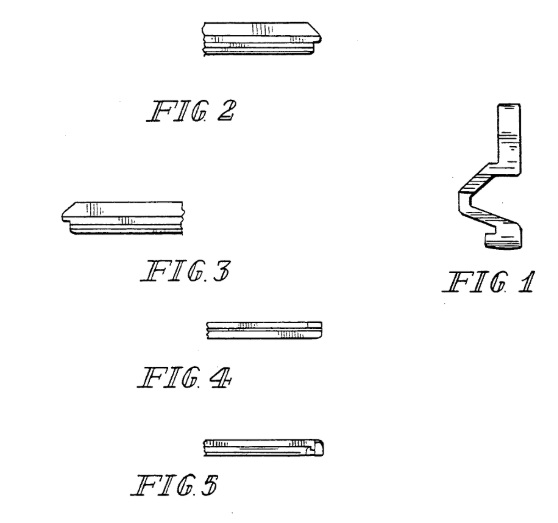
This issue was addressed by the Federal Circuit’s invalidity decision in Best Lock Corp. v. Ilco Unican Corp., 94 F.3d 1563 (Fed. Cir. 1996). There, the patent claimed the design of the operative portion of a key blade blank, but the court held the design invalid because the blade had to have that exact profile to fit the corresponding lock’s keyway. Best Lock argued that many lock-and-key designs were possible in the abstract, but the court focused on the claimed article as shown in the patent: this particular key blade. Because no alternative blade shape would work with the mating lock, the claimed appearance was deemed functional rather than ornamental, and the design patent failed under 35 U.S.C. § 171.
There are many categories of products and articles that can be protected by a design patent. A few examples of protectable product categories are discussed below to illustrate the breadth of design patent subject matter.
Design patents can protect jewelry and other accessories because they are articles of manufacture whose market value often turns on visual features and aspects. Jewelry is also a straightforward “article” for design purposes, making it a common category where inventors seek patent protection for unique designs.
Furniture is another classic category. Design patents can protect the ornamental design of chairs, tables, storage, and other home goods. Competitors may be able to legally copy your idea at a high level (“a chair with a curved back”), but a design patent can help protect the specific overall visual design you create.

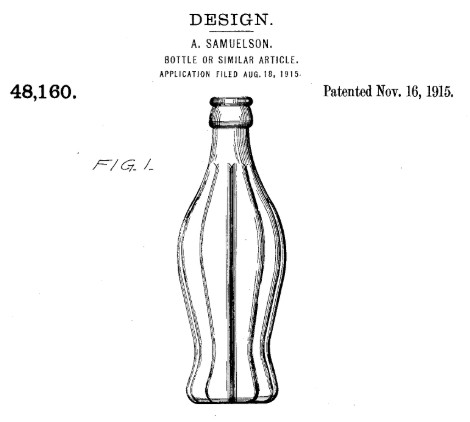
Beverage containers are frequently protected as designs. A famous example is the original Coca-Cola contour bottle: it was protected by U.S. Design Patent No. 48,160, issued Nov. 16, 1915. Over time, that container shape became source‑identifying and is now protected as a trademark/trade dress (e.g., U.S. Trademark Registration No. 696,147). This is a practical “lifecycle” example: a design can start as a time‑limited patent right and later provide protection as trade dress, e.g., through a federal trademark registration through the United States Patent and Trademark Office).
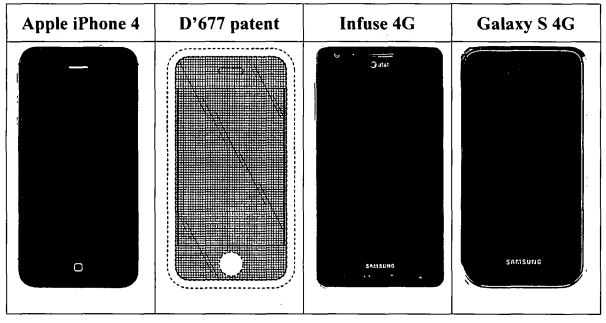
A well‑known example used in many design patent discussions is the Apple iMac. The design patent protects its distinctive “rounded triangle” shape, not its internal function as a computer. A more litigated example is the iPhone design, which was the subject of a billion-dollar lawsuit between Apple Inc. and Samsung. The case reached the U.S. Supreme Court on the issue of what constitutes the relevant “article of manufacture” for purposes of determining design‑patent damages under 35 U.S.C. § 289. Samsung Electronics Co. v. Apple Inc., 580 U.S. 53 (2016). Under § 289, a design-patent owner can recover an infringer’s “total profit” on the relevant article of manufacture. The dispute was what, for a multicomponent product like a smartphone, is the relevant article for which the design patent was issued. Is it the whole phone or just the screen? The Federal Circuit had treated the entire smartphone as the only permissible article of manufacture and therefore affirmed an award of Samsung’s entire profit on the phones. The Supreme Court unanimously reversed, holding that in a multicomponent product the relevant “article of manufacture” need not be the finished product sold to consumers. It may be only a component of that product that is covered by the design patent. The Court explained that § 289 requires two steps: first identify the article of manufacture to which the design was applied, and then calculate the infringer’s total profit on that article.
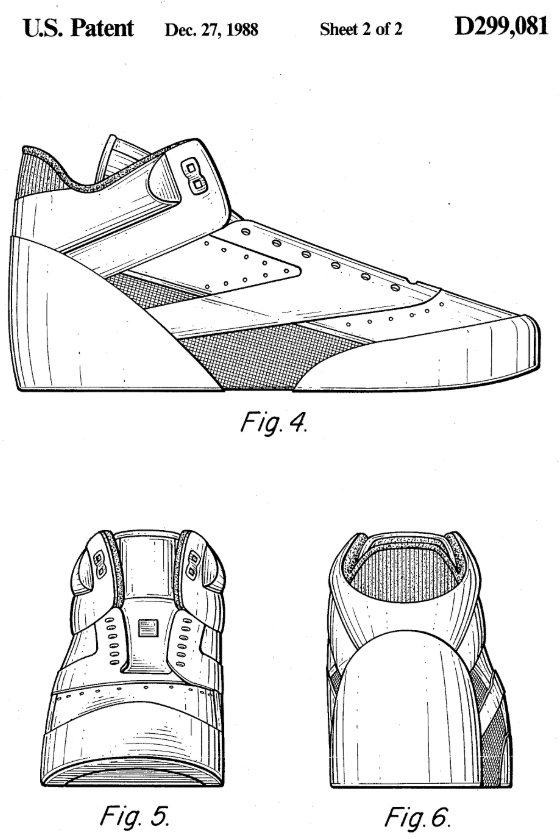
Design patents are routinely used in the fashion industry, including footwear, on novel aesthetic designs for fabric textures, fabric patterns, garment designs, shoe designs, and other innovations. In L.A. Gear, Inc. v. Thom McAn Shoe Co., the accused infringer argued that the asserted L.A. Gear’s design patent covering its “Hot Shots” athletic shoe was invalid because several visible features served functional purposes. The defendant pointed to elements such as the side mesh, and the rear “moustache” feature, contending that they were functional rather than ornamental because they provided support, reinforced the eyelets, and cushioned the Achilles area. The Federal Circuit rejected that argument. It explained that the right question is not whether individual features have utility in isolation, but whether the claimed design as a whole is dictated by function. Because the record showed that the same athletic-shoe functions could be achieved through many different shoe designs, the court agreed that the patented shoe design was primarily ornamental, not invalid for functionality. The court observed that, in the athletic-shoe market, “the primacy of appearance” cannot be ignored and the design features provided a unique look that was proper design patent subject matter.
Design patents can cover certain digital designs, including a computer icon or GUI, but the design must be claimed as embodied in an “article of manufacture”, commonly presented as a display panel with the icon or GUI. The USPTO’s 2023 supplemental guidance emphasizes that design protection is not for a mere image “per se”. Properly claimed icons and GUIs are treated as integral and active components of a programmed computer’s operation when displayed on a screen, and therefore can satisfy the article‑of‑manufacture requirement under 35 U.S.C. § 171.
The USPTO has also historically granted design patents “drawn to type fonts,” and USPTO guidance instructs examiners not to reject type‑font claims under § 171 simply because modern font creation is computer‑generated rather than cut from physical blocks.
The practical difference between a utility patent and a design patent is that a utility patent protects how an invention works, covering a new and useful process, machine, manufacture, or composition of matter, and a design patent protects the ornamental appearance of an article of manufacture. In other words, utility patents protect functional innovation; design patents protect ornamental appearance.
You can often seek patent protection under both regimes for the same product. Both design and utility patents may be obtained on an article if there is invention in its utility and ornamental appearance. This is a key planning point for companies launching products where the value of the product is found in both the way the product functions and its distinctive look.
Design patents are subject to the novelty and non‑obviousness standards under the U.S. patent law, even though the analysis is significantly different than in a utility patent for which the novelty and non-obvious standards were developed. The appearance of a design must be new and non-obvious over the prior art as of the effective filing date of the design patent application. This is conceptually similar to how utility patents are evaluated, but significantly different in practice. It is less intuitive to think about how a design might be obvious in view of multiple prior designs than contemplating the obviousness of, e.g., substituting a magnetic clasp for a slide bolt on a door.
A design patent contains only a single claim, and that claim typically reads: “The ornamental design for [the article], as shown and described.” Because of this structure, the title and claim language identifying the article of manufacture play an important role in defining the scope of the design claimed. Patent rules require that the title identify the article in which the design is embodied using the name generally known and used by the public. See 37 C.F.R. § 1.153; MPEP § 1503.01. Although design patent scope is primarily defined by the drawings, the identified article can affect how the public understands what the patent actually covers. As a result, applicants should take care when selecting the article description during the design patent application process, because it may influence how courts interpret the patent later.
The Federal Circuit highlighted this issue in Curver Luxembourg, SARL v. Home Expressions Inc., 938 F.3d 1334 (Fed. Cir. 2019). The patent at issue claimed a repeating decorative pattern shown in the design drawings. However, the patent’s title and claim described the design as “a pattern for a chair.” When Curver sued over baskets that used the same pattern, the defendant argued that the design patent was limited to chairs. The Federal Circuit agreed. Even though the drawings showed only the pattern itself and did not depict a chair, the court held that the claimed article of manufacture, chairs, limited the scope of the design patent. Because the accused products were baskets rather than chairs, there was no infringement.
The decision underscores an important practical lesson for inventors and applicants seeking patent protection. While the drawings remain the primary disclosure defining the ornamental appearance of a design, the article named in the claim can narrow the design patent’s reach in later design patent litigation. If the applicant had claimed the design more broadly, such as a “pattern for a surface,” or depicted the design applied to multiple articles, the scope analysis might have been different. Instead, the choice to identify the design as being “for a chair” effectively limited enforcement of the patent to that particular category of products.
Design patents do not require the design to be functional; they focus on ornamental features. But if the claimed appearance is dictated solely by utilitarian constraints, i.e., no alternative ornamental design choices, the design may be unprotectable or vulnerable, as reflected in Federal Circuit case law such as Best Lock Corporation v. Ilco Unican Corporation, 94 F.3d 1563 (Fed. Cir. 1996), where a key blade was found to be dictated purely by function.
When a company obtains a design patent, the key enforcement question is whether another product copies the ornamental appearance of the patented design. Under U.S. patent law, design patent infringement focuses on visual similarity rather than technical function. A design patent protects the ornamental aspects of an article of manufacture, meaning the visual shape, configuration, and surface decoration that give a product its unique appearance.
The traditional infringement framework asks whether, in the eye of an ordinary observer, the accused design is substantially the same such that the observer would be deceived into buying one supposing it to be the other. This standard was established by the Supreme Court in Gorham Co. v. White, 81 U.S. 511 (1871). In that case, which involved silverware patterns, the Court rejected a highly technical comparison of individual design features. Instead, it held that infringement should be evaluated from the perspective of an ordinary purchaser familiar with the relevant products. If the overall visual impression of the accused design is so similar that the ordinary observer would be deceived, the design patent may be infringed. This approach reflects the nature of design patents: they protect the overall ornamental design, not isolated details.
Over time, courts experimented with additional analytical frameworks for design patent infringement. One influential approach required the patentee to prove both the ordinary observer test and a separate “point of novelty” test, which asked whether the accused product appropriated the specific design features that distinguished the patented design from the prior art. However, this dual-test framework often proved difficult to apply because it encouraged courts and litigants to dissect the design claimed into individual components rather than evaluate the overall visual impression of the product.
The Federal Circuit addressed this issue in its en banc decision in Egyptian Goddess, Inc. v. Swisa, Inc., 543 F.3d 665 (Fed. Cir. 2008). The court rejected the separate point-of-novelty test and returned to a single ordinary observer standard, but with an important refinement. The court explained that the ordinary observer should evaluate the accused design in light of the prior art, meaning that similarities between the designs are more significant when the patented design is visually distinct from existing products. In practice, this framework focuses on the overall design, while still recognizing that the background of existing designs affects what an observer would perceive as substantially similar.
As discussed above, under 35 U.S.C. § 289, a design patent owner may recover an infringer’s “total profit” from the sale of the infringing article of manufacture. The Supreme Court clarified this remedy in Samsung Electronics Co. v. Apple Inc., the relevant “article of manufacture” may be either the entire product or a particular component to which the design is applied. The decision confirmed the strength of the statutory remedy while also recognizing that damages must be tied to the specific design-patented article.
These legal standards help explain why design patents protect valuable commercial assets and why companies increasingly seek patent protection for product styling. Because the infringement test focuses on the overall appearance of a product, competitors often attempt to design around existing patents. This may involve modifying the shape, adjusting visible features, or introducing new decorative aspects so that the final product creates a sufficiently different visual impression. The need to avoid infringement can lead competitors to develop more unique designs, particularly in industries where visual appeal drives consumer demand.
The patent enforcement value of design patents is particularly evident in aesthetics-driven markets such as smartphones, consumer electronics, jewelry, furniture, and fashion goods. In these industries, the visual design of a product often influences purchasing decisions as much as its technical function. A valid United States design patent covering a product’s ornamental appearance can therefore provide meaningful protection against competitors who attempt to imitate the look of a successful product.
Before a patent application, a patent search should be performed to understand likely prior art and refine the scope and object of what they’re trying to protect. A proper patentability search and analysis should research both prior patents, as well as non-patent prior art that can be publicly accessed, such as past and present products in the market. The prior art discovered in the patent search should be used to evaluate the patentability of the design prior to submitting an application. If the design is too close to the prior art, a design patent application should not be filed, as the investment of time and effort is likely to yield no benefit. A primary function of the United States Patent and Trademark Office (USPTO) in the examination of a design patent is to compare the claimed design to the prior art. If the prior art shows the design or highly similar designs, the application will likely be rejected.
If the decision to file an application is made, the design patent application must include (i) a brief specification, (ii) drawings or photographs, and (iii) a single claim in formal terms (e.g., “The ornamental design for [article], as shown and described.”). The USPTO rules require design drawings that comply with strict drawing standards, and rules address when photographs may be accepted.
The drawing section is critical because it depicts the design claimed. The USPTO warns that a design must be capable of being understood from the drawings, with nothing left to conjecture, and that poorly prepared drawings can lead to an incomplete disclosure that cannot become a patent. In practice, line drawings are common, and broken lines are used to show environment or boundaries that form no part of the claimed design, helping to define what you claim and what you leave as context.
A design patent application can be filed with the USPTO through its electronic filing systems, by mail, or by hand delivery. When the USPTO receives an application that includes at least a specification, a drawing, and a claim, it assigns an Application Number and a Filing Date, and issues a Filing Receipt that the applicant should promptly review for accuracy, including inventor names and any priority or earlier filing date benefit claims. During examination, the USPTO checks formal requirements, evaluates whether the design is understandable from the drawings, and compares it to prior art. If patentable, the application is allowed with instructions to complete issuance, and if not, the examiner issues office actions including objections and/or rejections that the applicant must respond to in a timely manner to continue prosecution.
Design patents have a defined, limited term: for applications filed on or after May 13, 2015, the term is 15 years from the date of grant. For applications filed before May 13, 2015, the term is 14 years from the date of grant. Currently, the filing fees for a design patent are around $500, and if you engage an attorney for assistance, you will need to also pay legal fees. Many companies use a patent attorney or patent agent to help determine filing strategy, including whether to file one or more related applications, and respond to office actions. Engaging a patent attorney can ensure that the patent application is prepared and filed properly.
Design patents protect the ornamental design of an article of manufacture, providing U.S. patent rights to exclude others from making, using, selling, offering for sale, or importing substantially similar designs during the patent term. Design patent examples can cover a wide variety of physical goods (e.g., jewelry, furniture, beverage containers), as well as digital products (e.g., icons, GUIs, and other graphical elements). Design patent success depends on careful planning, strong drawings, and disciplined prosecution. Once granted, the patent provides as valuable, enforceable property rights that can protect your product from competition.
If you need assistance with design patents or other intellectual property matters, contact our office for a free consultation.
© 2026 Sierra IP Law, PC. The information provided herein does not constitute legal advice, but merely conveys general information that may be beneficial to the public, and should not be viewed as a substitute for legal consultation in a particular case.

"Mark and William are stellar in the capabilities, work ethic, character, knowledge, responsiveness, and quality of work. Hubby and I are incredibly grateful for them as they've done a phenomenal job working tirelessly over a time span of at least five years on a series of patents for hubby. Grateful that Fresno has such amazing patent attorneys! They're second to none and they never disappoint. Thank you, Mark, William, and your entire team!!"
Linda Guzman


Sierra IP Law, PC - Patents, Trademarks & Copyrights
FRESNO
7030 N. Fruit Ave.
Suite 110
Fresno, CA 93711
(559) 436-3800 | phone
BAKERSFIELD
1925 G. Street
Bakersfield, CA 93301
(661) 200-7724 | phone
SAN LUIS OBISPO
956 Walnut Street, 2nd Floor
San Luis Obispo, CA 93401
(805) 275-0943 | phone

SACRAMENTO
180 Promenade Circle, Suite 300
Sacramento, CA 95834
(916) 209-8525 | phone
MODESTO
1300 10th St., Suite F.
Modesto, CA 95345
(209) 286-0069 | phone
SANTA BARBARA
414 Olive Street
Santa Barbara, CA 93101
(805) 275-0943 | phone
SAN MATEO
1650 Borel Place, Suite 216
San Mateo, CA, CA 94402
(650) 398-1644. | phone
STOCKTON
110 N. San Joaquin St., 2nd Floor
Stockton, CA 95202
(209) 286-0069 | phone
PORTLAND
425 NW 10th Ave., Suite 200
Portland, OR 97209
(503) 343-9983 | phone
TACOMA
1201 Pacific Avenue, Suite 600
Tacoma, WA 98402
(253) 345-1545 | phone
KENNEWICK
1030 N Center Pkwy Suite N196
Kennewick, WA 99336
(509) 255-3442 | phone
2023 Sierra IP Law, PC - Patents, Trademarks & Copyrights - All Rights Reserved - Sitemap Privacy Lawyer Fresno, CA - Trademark Lawyer Modesto CA - Patent Lawyer Bakersfield, CA - Trademark Lawyer Bakersfield, CA - Patent Lawyer San Luis Obispo, CA - Trademark Lawyer San Luis Obispo, CA - Trademark Infringement Lawyer Tacoma WA - Internet Lawyer Bakersfield, CA - Trademark Lawyer Sacramento, CA - Patent Lawyer Sacramento, CA - Trademark Infringement Lawyer Sacrament CA - Patent Lawyer Tacoma WA - Intellectual Property Lawyer Tacoma WA - Trademark lawyer Tacoma WA - Portland Patent Attorney - Santa Barbara Patent Attorney - Santa Barbara Trademark Attorney
