Inequitable conduct is an equitable defense that can render an issued patent unenforceable when a person involved in its prosecution intentionally deceives the U.S. Patent and Trademark Office (USPTO) by withholding or misrepresenting material information. The doctrine protects the integrity of patent examination while preventing accused infringers from converting ordinary mistakes into allegations of fraud. Modern law therefore requires demanding proof of both materiality and specific intent to deceive in order to find inequitable conduct.
This article is directed to non-attorneys and explains how inequitable conduct developed, what the duty of disclosure requires, how courts evaluate an inequitable conduct claim, and why a finding can affect the enforceability of the entire patent, related patents, infringement remedies, and, in some circumstances, antitrust liability.
Inequitable conduct is judge-made law rooted in the common law doctrine of unclean hands and is an unenforceability defense under 35 U.S.C. § 282(b)(1). Inequitable conduct occurs when an applicant breaches duty of candor to the United States Patent and Trademark Office (USPTO). It can arise when a patent applicant, inventor, or patent attorney deliberately withholds material prior art, makes a material misrepresentation, or submits false information to an examiner.
A violation of the duty of disclosure does not automatically prove that inequitable conduct occurred. The accused infringer must establish two elements: materiality and specific intent to deceive. Negligence, poor judgment, and even gross negligence are not enough.
Its antecedents reach back to the Patent Act of 1790, which authorized a district court to repeal a patent obtained “surreptitiously” or through “false suggestion.” The modern inequitable conduct defense developed from Supreme Court decisions involving fraud and suppressed evidence. The following cases illustrate the nature of inequitable conduct.
In Keystone Driller Co. v. General Excavator Co., 290 U.S. 240 (1933), the patent owner learned that Bernard Clutter’s earlier use of a ditching-machine feature threatened a patent’s validity. A company official obtained Clutter’s affidavit calling the use an abandoned experiment, plus promises to assign any rights, keep the prior use secret, and suppress the evidence. The company then obtained a favorable infringement decree and relied on it when seeking injunctions on related patents. Defendants exposed the arrangement through further examination of Clutter. The Court held that the corrupt bargain directly related to the requested relief and approved dismissal as to all related patents. The agreement, affidavit, testimony, and use of the tainted decree proved deliberate concealment.
In Hazel-Atlas Glass Co. v. Hartford-Empire Co., 322 U.S. 238 (1944), Hartford’s attorneys wrote an article praising its “gob feeding” invention, arranged publication under a labor leader’s name so it appeared independent, submitted it during patent prosecution, and later emphasized it on appeal. The appellate court quoted the article in finding the patent valid and infringed. Years later, correspondence, expense records, testimony, and payments to the nominal author exposed the scheme. The Supreme Court found fraud on both the Patent Office and the courts and ordered the prior judgment vacated.
In Precision Instrument Manufacturing Co. v. Automotive Maintenance Machinery Co., 324 U.S. 806 (1945), Automotive obtained a sworn statement indicating that a rival’s torque-wrench application and interference testimony used false invention dates and false inventorship. Instead of disclosing the suspected perjury, Automotive settled the interference, acquired the application, expanded its claims, and obtained a patent. Attorney memoranda, investigative reports, the sworn statement, and settlement documents proved its knowledge and suppression. The Court reinstated dismissal under unclean hands, emphasizing the duty to report possible fraud in Patent Office proceedings.
Under 37 C.F.R. § 1.56, each person substantively involved in filing or prosecuting a patent application, including inventors and individuals acting for the applicant, such as prosecuting patent attorneys or agents, owes the USPTO a duty of candor and good faith, including a duty to disclose known information material to patentability. Information material to patentability of any pending claim includes noncumulative prior art or other information that would establish a prima facie case of unpatentability or contradict a position taken before the patent examiner. The duty continues until the claim is cancelled or withdrawn, or the application is abandoned.
Because a patent is affected with a public interest, the rule seeks to give the examiner the evidence needed to evaluate the claimed invention. “Public interest” refers to the public’s stake in accurate patent examination because a patent grants a right to exclude others from practicing the claimed invention. Full disclosure helps prevent unwarranted exclusive rights while protecting qualifying inventions. It should be understood that a breach of the disclosure requirements becomes inequitable conduct only when the breach is done with intent to deceive and the breach is material to patentability of the claimed invention.
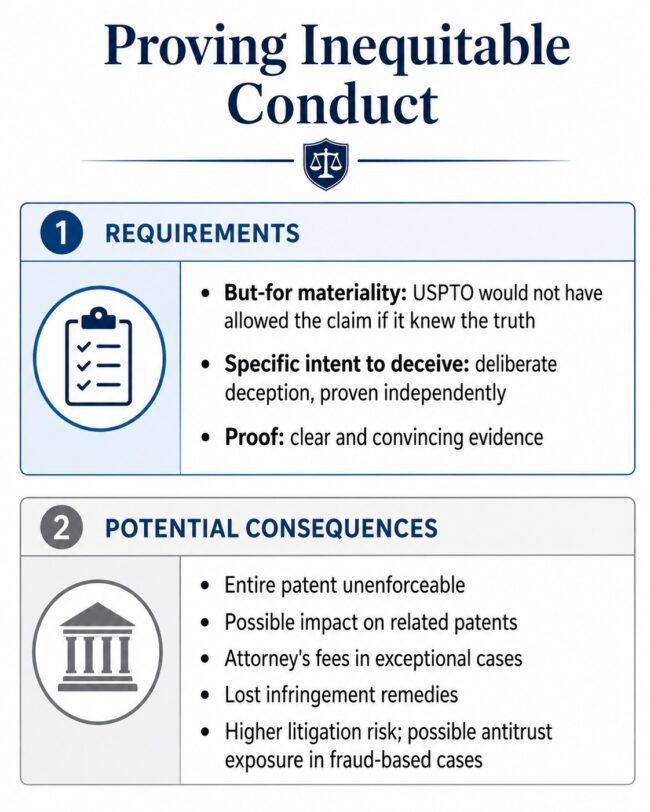
A modern major patent case, Therasense, Inc. v. Becton, Dickinson & Co., 649 F.3d 1276 (Fed. Cir. 2011) (en banc) established a but-for analysis test for cases of inequitable conduct. In the Therasense, case, the patent at issue claimed blood-glucose strips that tested whole blood without a protective membrane. The examiner viewed the same inventor's earlier patent as prior art disclosing that feature. The patentee responded that skilled artisans would understand the earlier patent to require a membrane for whole blood, supporting the argument with a research director’s declaration. However, the patentee did not disclose briefs submitted to the European Patent Office addressing the earlier patent, where the patentee had characterized the same membrane language as optional. The district court found the omission material and held the later patent unenforceable.
The Federal Circuit vacated and remanded. Its en banc opinion established the current, stricter but-for standard for proving inequitable conduct. Under the but-for test, information is material only when the USPTO would not have allowed a claim had it known the withheld or misrepresented information. The district court makes that hypothetical patentability determination under USPTO standards. A narrow exception presumes materiality for affirmative egregious misconduct, such as filing an unmistakably false affidavit.
Proving inequitable conduct requires the party asserting inequitable conduct to show by clear and convincing evidence that a specific person knew of the information, knew it was material, and made a deliberate decision to withhold or misrepresent it.
Intent cannot merely be inferred from materiality. It may be shown through circumstantial evidence, but deceptive intent must be the single most reasonable inference. A credible explanation consistent with good faith may defeat that inference. “Should have known” reasoning and gross negligence do not establish the required specific intent.
Because an inequitable conduct claim sounds in fraud, Federal Rule of Civil Procedure 9(b) applies. In Exergen Corp. v. Wal-Mart Stores, Inc., 575 F.3d 1312 (Fed. Cir. 2009), SAAT sought to add an inequitable conduct defense alleging that Exergen withheld two patents and website statements inconsistent with prosecution arguments. The district court, as trial court, denied leave, and the Federal Circuit affirmed. SAAT named only “Exergen, its agents and/or attorneys,” omitting the responsible person, affected claims, location of material teachings, why the references were noncumulative, and facts supporting knowledge and deceptive intent. Exergen requires the “who, what, when, where, and how,” plus facts supporting scienter. At trial, defendants must prove both elements by clear and convincing evidence. A judge makes the inequitable conduct determination; summary judgment is proper when proof is insufficient, and appeals go to the U.S. Court of Appeals for the Federal Circuit.
It is often said that inequitable conduct “invalidates all claims,” but that is technically imprecise. If the court concludes inequitable conduct occurred, the entire issued patent is rendered unenforceable: all the claims, not just the particular claims connected to the misconduct. A pending patent application has no enforceable patent claims, so inequitable conduct does not “invalidate” an application.
The taint can sometimes affect related patents or applications when they share an immediate and necessary relationship with the misconduct. The patent owner may also face an attorney-fee award under 35 U.S.C. § 285 in exceptional cases. Whether a case is "exceptional" and attorney fee awards are warranted is determined under discretion of the court.
A finding of inequitable conduct can eliminate infringement remedies. Intentional fraud in obtaining and enforcing a patent may also strip the patent holder’s antitrust exemption. Under 35 U.S.C. § 154(a)(1), a patent gives its owner the right to exclude others from making, using, offering to sell, selling, or importing the claimed invention during the patent term. Because Congress expressly created that right, a patent owner generally does not violate antitrust law merely by:
35 U.S.C. § 271(d) similarly provides that enforcing a patent or refusing to license it does not, standing alone, constitute patent misuse or an illegal extension of the patent right. In Walker Process Equipment, Inc. v. Food Machinery & Chemical Corp., 382 U.S. 172, 174–78 (1965), the Supreme Court held that if inequitable conduct is found, antitrust violations may be found if the other elements of monopolization are proven.
In Walker Process Equipment, Inc. v. Food Machinery & Chemical Corp., 382 U.S. 172 (1965), Food Machinery sued Walker on a sewage-treatment-diffuser patent. Walker alleged Food Machinery falsely swore it knew of no public use more than one year before filing, despite having participated in such public use. Lower courts dismissed the antitrust counterclaim. The Supreme Court reversed, holding that intentional fraud in obtaining and enforcing a patent may strip the patentee’s antitrust exemption. This permits Sherman Act § 2 liability and Clayton Act § 4 treble damages, but the claimant must prove the other elements of monopolization, including a relevant market, monopoly power, and anticompetitive injury. Ordinary inequitable conduct does not automatically establish antitrust liability.
These three Federal Circuit decisions discussed below illustrate the evolution of inequitable conduct law from a comparatively broad doctrine to the narrower, more disciplined framework applied today. THe McKesson case shows how courts evaluated nondisclosure and inferred intent under the pre-Therasense standards. Exergen addresses the threshold question of what a defendant must specifically allege before an inequitable conduct claim may proceed. Therasense then redefined the substantive proof required to prevail by separating materiality from intent and imposing stricter standards for each. Considered together, the cases explain both how inequitable conduct allegations must be pleaded and how they must ultimately be proven.
In McKesson Information Solutions, Inc. v. Bridge Medical, Inc., 487 F.3d 897 (Fed. Cir. 2007), one patent attorney prosecuted related applications before different examiners but did not disclose a prior-art patent cited in a related application, rejections of similar claims, or the allowance of overlapping claims. The Federal Circuit affirmed inequitable conduct because the omissions were material under the then-prevailing “reasonable examiner” test and the pattern of nondisclosure, coupled with no credible explanation, supported deceptive intent. McKesson therefore illustrates the broader pre-Therasense approach.
In Exergen Corp. v. Wal-Mart Stores, Inc., SAAT sought leave to add an inequitable conduct defense. The court affirmed denial because general accusations against a company and its attorneys were insufficient. The pleading failed to identify the responsible individual, affected claims, location of withheld information, or why it was material and noncumulative. Although knowledge and intent may be alleged generally, facts must support a reasonable inference that an identified person knew the information and deliberately withheld or misrepresented it. Pleading on information and belief also requires identification of its factual basis. Exergen therefore created a procedural gatekeeping rule.
A divided Federal Circuit panel initially affirmed unenforceability. The court then granted rehearing en banc, vacated the inequitable conduct judgment, and remanded under a new standard. The en banc court rejected the sliding-scale approach: strong materiality cannot compensate for weak intent. The accused infringer must prove materiality and specific intent independently by clear and convincing evidence; materiality ordinarily turns on the but-for test. Affirmative egregious misconduct creates a narrow exception to but-for materiality, but not to the intent requirement. Even after both elements are proven, the district court must weigh the equities. Together, Exergen governs pleading and Therasense governs proof.
Businesses seeking patent rights should be forthcoming with information relevant to their inventions during patent prosecution. A patent applicant must disclose known material information to the patent office, and should consult a patent attorney about their obligations during patent examination, such as the disclosure of potentially harmful prior art. Failure to do so could result in a loss of enforceable patent rights during patent litigation.
At the same time, defendants need strong evidence to prove inequitable conduct. The required showing generally includes materiality of the omitted information and a deliberate, specific intent to deceive, each established independently by clear and convincing evidence. But if proven, inequitable conduct does not merely eliminate one claim; it renders the entire patent unenforceable, and may affect related patents in appropriate circumstances. If the concealment or misrepresentation is egregious, the alleged infringing party may be awarded their attorney's fees. Careful disclosure practices and documented good-faith decisions provide the best protection against such an outcome.
© 2026 Sierra IP Law, PC. The information provided herein does not constitute legal advice, but merely conveys general information that may be beneficial to the public, and should not be viewed as a substitute for legal consultation in a particular case.

"Mark and William are stellar in the capabilities, work ethic, character, knowledge, responsiveness, and quality of work. Hubby and I are incredibly grateful for them as they've done a phenomenal job working tirelessly over a time span of at least five years on a series of patents for hubby. Grateful that Fresno has such amazing patent attorneys! They're second to none and they never disappoint. Thank you, Mark, William, and your entire team!!"
Linda Guzman


Sierra IP Law, PC - Patents, Trademarks & Copyrights
FRESNO
7030 N. Fruit Ave.
Suite 110
Fresno, CA 93711
(559) 436-3800 | phone
BAKERSFIELD
1925 G. Street
Bakersfield, CA 93301
(661) 200-7724 | phone
SAN LUIS OBISPO
956 Walnut Street, 2nd Floor
San Luis Obispo, CA 93401
(805) 275-0943 | phone

SACRAMENTO
180 Promenade Circle, Suite 300
Sacramento, CA 95834
(916) 209-8525 | phone
MODESTO
1300 10th St., Suite F.
Modesto, CA 95345
(209) 286-0069 | phone
SANTA BARBARA
414 Olive Street
Santa Barbara, CA 93101
(805) 275-0943 | phone
SAN MATEO
1650 Borel Place, Suite 216
San Mateo, CA, CA 94402
(650) 398-1644. | phone
STOCKTON
110 N. San Joaquin St., 2nd Floor
Stockton, CA 95202
(209) 286-0069 | phone
PORTLAND
425 NW 10th Ave., Suite 200
Portland, OR 97209
(503) 343-9983 | phone
TACOMA
1201 Pacific Avenue, Suite 600
Tacoma, WA 98402
(253) 345-1545 | phone
KENNEWICK
1030 N Center Pkwy Suite N196
Kennewick, WA 99336
(509) 255-3442 | phone
2023 Sierra IP Law, PC - Patents, Trademarks & Copyrights - All Rights Reserved - Sitemap Privacy Lawyer Fresno, CA - Trademark Lawyer Modesto CA - Patent Lawyer Bakersfield, CA - Trademark Lawyer Bakersfield, CA - Patent Lawyer San Luis Obispo, CA - Trademark Lawyer San Luis Obispo, CA - Trademark Infringement Lawyer Tacoma WA - Internet Lawyer Bakersfield, CA - Trademark Lawyer Sacramento, CA - Patent Lawyer Sacramento, CA - Trademark Infringement Lawyer Sacrament CA - Patent Lawyer Tacoma WA - Intellectual Property Lawyer Tacoma WA - Trademark lawyer Tacoma WA - Portland Patent Attorney - Santa Barbara Patent Attorney - Santa Barbara Trademark Attorney
