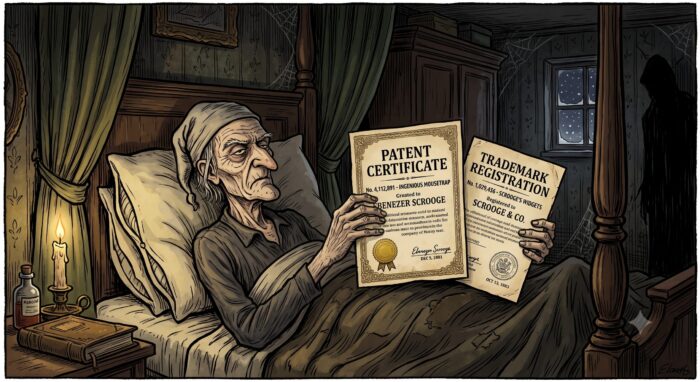
Entrepreneurs, inventors, artists, and other creators and owners of intellectual property assets need to have a succession plan for their valuable IP assets. The possibility of disposal of intellectual property in probate is a risk that should be avoided, if possible. In a probate estate, IP is generally intangible personal property that must be identified, valued, managed, and distributed. As a result, IP going through probate is subject to the probate court's judgment about the rightful recipient of the IP. If IP assets are owned by an individual, estate planning for the IP must be implemented to protect the intended beneficiaries, preserve income, and reduce disputes among heirs.
Intellectual property includes inventions, original works, literary works, music, art, designs, logos, and confidential information. The U.S. Patent and Trademark Office identifies four general types of IP: patents, trademark rights, copyrights, and trade secrets. These different types of IP provide creators with exclusive rights to their work. Ideas are not automatically protected, but documented ideas may support obtaining patent protection or, if secret, qualify as trade secrets. Examples of trade secrets include prototypes, chemical formulas, technical know-how, and business knowledge that are confidential and reasonable measures are taken to maintain secrecy, as required under 18 U.S.C. § 1839.
Original works of creativity, such as original writings, audiovisual works, graphical works, and music, are also protected by copyrights under 17 U.S.C. § 102. Trademarks and service marks are words, graphical logos, symbols, designs, and combinations of such elements that are associated with and identify a source of goods or services (e.g., the mark Nike is associated with quality athletic gear). See 15 U.S.C. § 1127.
Intellectual property can provide a substantial portion of the value of an estate or business. Thus, intellectual property can be an important source of wealth and value to businesses and individuals.
Intellectual property enters probate when the decedent owned it personally at death and did not previously transfer it to a trust, business entity, or other owner. As a result, the IP then becomes an asset of the estate and passes under the decedent’s will or applicable intestacy law. Federal law recognizes that copyrights and patents may be treated as personal property in probate proceedings. See 17 U.S.C. § 201(d)(1) and 35 U.S.C. § 261. Trademarks and trade secrets are also treated as intangible personal property in probate.
Trademarks enter probate when the decedent owns the mark and its associated business goodwill. Because a trademark generally cannot be assigned apart from that goodwill, the executor must consider whether the trademark should be transferred with the related business or product line. See 15 U.S.C. § 1060(a)(1).
When IP remains titled to the decedent, the executor should inventory related agreements, licenses, registrations, filing records, royalty statements, and confidentiality controls. Active management preserves value and because IP may lose value if patent maintenance fees, trademark renewal filings, quality controls, or confidentiality measures are neglected. Missing documentation can impair ownership, interrupt royalties, weaken exclusive rights, compromise trade secrets, or prevent an effective sale or distribution to beneficiaries. Careful administration during the probate process therefore protects beneficiaries and reduces disputes among heirs, licensees, and business partners.
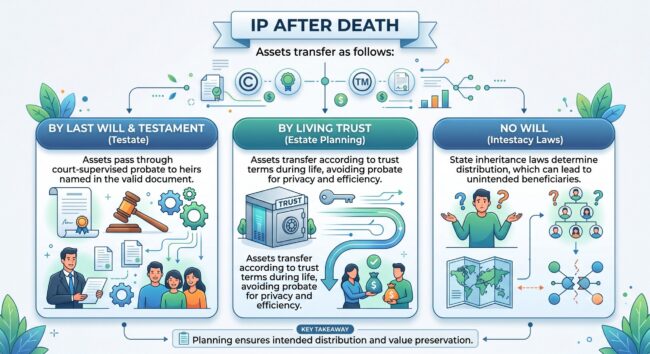
Who receives intellectual property in probate depends principally on the decedent’s will and the intestacy law of the state administering the estate. A valid will may make a specific gift of a patent, copyright, trademark, domain name, royalty stream, or related agreement to a named beneficiary. It may also transfer IP through a residuary clause covering property not otherwise specifically devised. The executor must identify the rights owned at death, determine whether they were previously transferred to a funded trust or business entity, and complete any assignments or recordations needed to place ownership in the beneficiary’s name.
If the owner dies without a valid will, or if the will does not dispose of particular IP assets, the rights generally pass to the heirs designated by state intestacy statutes. The applicable shares may depend on whether the decedent left a surviving spouse, descendants, parents, or more remote relatives.
Clear estate planning is important because divided ownership among multiple heirs can complicate licensing, enforcement, maintenance decisions, and distribution of royalties.
IP titled to the owner may require probate under state law. Avoiding probate requires a legally enforceable transfer of the IP assets. For example, an individual can transfer copyrights, patents, and trademark assets by a written assignment to a trust during their lifetime. Alternatively, the owner may assign IP to a corporation or LLC, leaving the entity interests to pass under the estate plan. Conveyances should identify registrations, applications, works, inventions, marks, licenses, and royalty rights. A pour-over will does not itself complete a lifetime transfer.
Copyright ownership may be transferred by written instrument prior to death (e.g., by trust) or by will. See 17 U.S.C. §§ 201(d), 204.To transfer copyrights voluntarily, an instrument or memorandum must be in writing and signed by the owner or authorized agent. Written copyright transfers may be recorded with the Copyright Office under 17 U.S.C. § 205.
Patent applications, patents, and patent interests are assignable by a written instrument under 35 U.S.C. § 261. Patent ownership may pass by operation of probate law, but confirmatory assignments should document the estate’s chain of title. See Akazawa v. Link New Technology International, Inc., 520 F.3d 1354, 1356–58 (Fed. Cir. 2008).
A trademark assignment must be written and transfer the goodwill connected with the mark. See 15 U.S.C. § 1060. Trade secrets and confidential information should transfer with repositories, access credentials, and confidentiality protections.
Patent and trademark documents may be recorded with the USPTO under 37 C.F.R. § 3.11. Timely recordation can provide notice, protect priority against later purchasers, and strengthen title documentation. It does not cure a defective conveyance or independently establish validity. See 37 C.F.R. § 3.54. Drafting and recordation reduce disputes over intellectual property in probate and help beneficiaries receive ownership.
When intellectual property remains in the probate estate, the executor must confirm authority under the will, court appointment, and state law before executing documents that legally transfer ownership to beneficiaries, a trustee, or buyer. The assignment should cover royalties, infringement claims, future enforcement and renewal rights, and related agreements for licenses, services, security, or confidentiality. Court approval will likely be required for a sale or distribution.
IP assets must be formally valued and distributed during probate. Federal estate tax includes tangible and intangible property, and Treasury rules generally use fair market value. Professional appraisal is critical for determining IP's value, estate and gift tax purposes, beneficiary division, and retain, license, or sell decisions. For example, an IP attorney can find valuation firms and coordinate income, market, and cost methods.
IP rights vary in duration, so the executor or trustee must treat deadlines as part of asset management, not paperwork. Copyright in many original works lasts for the author's life plus 70 years, often beyond the creator's lifetime, but ownership still must be tracked so beneficiaries can collect royalties, license works, or transfer copyrights. Utility patents generally end 20 years from filing, subject to patent-term adjustments and maintenance fees; design patents protecting an ornamental design last 15 years from grant. Federal trademark registrations require periodic maintenance and renewal filings: a Section 8 declaration is due between the fifth and sixth years, and Section 8/9 filings are due every ten years thereafter. Missed filings can cancel registrations, lapse patent rights, reduce fair market value, and invite disputes. The fiduciary should calendar fees, preserve registrations, maintain use in commerce, monitor infringement, and document every action for the estate.
Trade secrets may include formulas, client information, methods, technical knowledge, source code, pricing models, customer lists, manufacturing processes, and other confidential information that gives a business value because competitors do not know it. Federal law requires reasonable measures to keep the information secret and independent economic value that results from the confidentiality of the information. See 18 U.S.C. § 1839(3). Trade secrets are also property interests that can be owned, transferred, licensed, and inherited.
The key assignment issue is specificity without disclosure. A trade secret assignment should transfer ownership of “trade secrets, know-how, confidential information, inventions, formulas, methods, processes, customer data, documentation, and related agreements,” but identify the assets in a confidential schedule, not the public-facing instrument. That schedule can use categories, code names, product lines, repositories, file paths, custodians, dates, or document-control numbers, with access limited to the executor, trustee, attorney, valuation firm, buyer, or beneficiary who needs to know. The assignment should also transfer rights to sue for past and future misappropriation, existing licenses, nondisclosure agreements, and security records.
If trade secrets are subject to probate, the responsible person should preserve access controls, nondisclosure duties, electronic security, contractor confidentiality, and need-to-know limits. Avoid filing formulas or technical details in the probate record. Where court approval, appraisal, or sale documentation is required, counsel should seek sealed filings, redacted inventories, in camera review, or protective orders under applicable probate rules. Federal trade secret proceedings expressly contemplate confidentiality-preserving court orders. See 18 U.S.C. § 1835. Disclosure during appraisal, probate, or a sale can destroy protection and reduce value.
Patents, copyrights, trademarks, and trade secrets can generate ongoing revenue long after the original owner’s death. These assets may produce income through licenses, royalties, product sales, franchise arrangements, software subscriptions, merchandising, or enforcement against unauthorized users. During probate, the executor should audit all related agreements to confirm who owes payments, when renewals are due, whether termination clauses are triggered by death, and whether licensees created improvements that affect ownership or future value. The executor should also review royalty statements, trademark use requirements, patent maintenance fees, copyright registrations, confidentiality obligations, and any pending disputes. Because intellectual property can appreciate or decline depending on active management, the estate should avoid treating IP like ordinary property. A sound plan may benefit beneficiaries by preserving investments, continuing licensing income, protecting exclusive rights, and reducing disputes among heirs.
Transferring ownership of IP to a properly funded trust can avoid many probate complexities under state law, especially when the estate includes valuable intellectual property that may need immediate management after death. But merely listing “intellectual property” in a trust schedule is usually not enough. The owner should execute written assignments that clearly identify each asset, including patents, utility patents, design patents, trademark registrations, copyrightable original works, trade secrets, licenses, domain names, software, logos, formulas, confidential information, and related agreements.
For trust-owned IP, the trustee is responsible for managing assets posthumously for the benefit of beneficiaries. That role may include maintaining registrations, paying renewal or maintenance fees, preserving confidentiality and security for trade secrets, collecting income and royalties, enforcing exclusive rights, and deciding whether to license or sell the property. Because IP requires active management, the trust should give the trustee clear authority to protect, value, transfer, and commercialize the assets.
Professional guidance is crucial both before and after death. An IP attorney and estate-planning attorney can create an effective transfer plan, and help ensure that the estate or trust can preserve future commerce. By cataloging assets, obtaining an appraisal, executing transfers, and selecting a fiduciary capable of managing IP, business owners, artists, inventors, and other creators can protect intellectual property and maximize estate value.
An IP attorney and estate-planning attorney can create a transfer plan, assist with asset valuation, and coordinate clients' appraiser, accounting firm, and business advisers. Incorporating IP into estate planning maximizes estate value and protects future commerce.
Intellectual property may be a creator's most valuable asset, but it only retains that value if it is properly identified, documented, valued, and managed. As part of estate planning, intellectual property should be cataloged with enough detail to allow an executor, trustee, or attorney to understand what exists and how it should be handled. That documentation should list the inventor or author, current owner, registrations, renewal deadlines, licenses, royalties, related agreements, and original records.
A strong estate plan should expressly include IP assets and authorize the fiduciary to manage, protect, license, transfer, or sell them. Planning turns exclusive rights granted by law into durable value for beneficiaries, while neglect can create title gaps, lost protection, unpaid fees, tax risk, interrupted income, and conflict among heirs. For valuable intellectual property, a professional appraisal is often essential to establish fair market value and support estate, gift, or probate administration decisions.
© 2026 Sierra IP Law, PC. The information provided herein does not constitute legal advice, but merely conveys general information that may be beneficial to the public, and should not be viewed as a substitute for legal consultation in a particular case.

"Mark and William are stellar in the capabilities, work ethic, character, knowledge, responsiveness, and quality of work. Hubby and I are incredibly grateful for them as they've done a phenomenal job working tirelessly over a time span of at least five years on a series of patents for hubby. Grateful that Fresno has such amazing patent attorneys! They're second to none and they never disappoint. Thank you, Mark, William, and your entire team!!"
Linda Guzman


Sierra IP Law, PC - Patents, Trademarks & Copyrights
FRESNO
7030 N. Fruit Ave.
Suite 110
Fresno, CA 93711
(559) 436-3800 | phone
BAKERSFIELD
1925 G. Street
Bakersfield, CA 93301
(661) 200-7724 | phone
SAN LUIS OBISPO
956 Walnut Street, 2nd Floor
San Luis Obispo, CA 93401
(805) 275-0943 | phone

SACRAMENTO
180 Promenade Circle, Suite 300
Sacramento, CA 95834
(916) 209-8525 | phone
MODESTO
1300 10th St., Suite F.
Modesto, CA 95345
(209) 286-0069 | phone
SANTA BARBARA
414 Olive Street
Santa Barbara, CA 93101
(805) 275-0943 | phone
SAN MATEO
1650 Borel Place, Suite 216
San Mateo, CA, CA 94402
(650) 398-1644. | phone
STOCKTON
110 N. San Joaquin St., 2nd Floor
Stockton, CA 95202
(209) 286-0069 | phone
PORTLAND
425 NW 10th Ave., Suite 200
Portland, OR 97209
(503) 343-9983 | phone
TACOMA
1201 Pacific Avenue, Suite 600
Tacoma, WA 98402
(253) 345-1545 | phone
KENNEWICK
1030 N Center Pkwy Suite N196
Kennewick, WA 99336
(509) 255-3442 | phone
2023 Sierra IP Law, PC - Patents, Trademarks & Copyrights - All Rights Reserved - Sitemap Privacy Lawyer Fresno, CA - Trademark Lawyer Modesto CA - Patent Lawyer Bakersfield, CA - Trademark Lawyer Bakersfield, CA - Patent Lawyer San Luis Obispo, CA - Trademark Lawyer San Luis Obispo, CA - Trademark Infringement Lawyer Tacoma WA - Internet Lawyer Bakersfield, CA - Trademark Lawyer Sacramento, CA - Patent Lawyer Sacramento, CA - Trademark Infringement Lawyer Sacrament CA - Patent Lawyer Tacoma WA - Intellectual Property Lawyer Tacoma WA - Trademark lawyer Tacoma WA - Portland Patent Attorney - Santa Barbara Patent Attorney - Santa Barbara Trademark Attorney
