
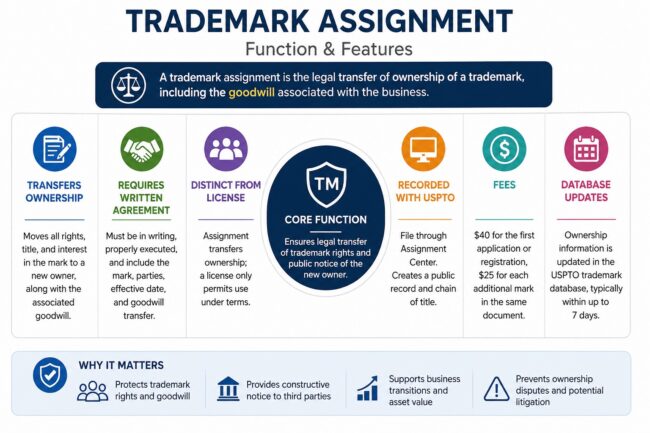
A trademark assignment is the legal transfer of trademark ownership from one party to another. Business owners use an assignment to move a brand, mark, trademark registration, or trademark application when selling a business, moving intellectual property assets into a new entity, or documenting ownership changes. Trademark assignments are governed primarily by the Lanham Act. Under 15 U.S.C. § 1060(a)(1). A registered mark or filed application may be assigned only with the associated goodwill of the business.
A trademark assignment agreement transfers the assignor’s right, title, and interest in a trademark to the assignee, who becomes the new owner and may enforce the trademark rights against unauthorized users. The transfer may cover a registered mark, a pending application, or both, and it includes the goodwill associated with the business connected to the mark. That goodwill is important because a trademark cannot ordinarily be assigned as an isolated symbol divorced from the products, services, reputation, and consumer recognition it represents.
This differs from a license agreement. Trademark licensing allows another person or company to use the mark under defined conditions, while the trademark owner remains the current owner and generally retains responsibility for controlling the quality of the licensed goods or services. By contrast, an assignment changes ownership itself.
A complete assignment agreement should identify the mark, registration number or application serial number, goods or services, assignor, assignee, effective date, and consideration. It should also state whether related applications, registrations, common-law rights, trademark enforcement, and associated goodwill are included in the transfer.
Trademark goodwill is the positive associations and consumer trust a trademark creates in connection with a product or service. Because a mark symbolizes source and reputation, every valid assignment must transfer the associated goodwill. A bare assignment is an “assignment in gross,” jeopardizing the validity of the mark and potentially causing loss of rights.
In Marshak v. Green, 746 F.2d 927, 929–30 (2d Cir. 1984), a judgment creditor bought the trade name VITO AND THE SALUTATIONS at auction for $100 without acquiring the group’s business or goodwill. The Second Circuit set aside the sale, holding that a trademark has no independent significance apart from goodwill and that another group’s use could mislead consumers about source, quality, and continuity.
In Sugar Busters LLC v. Brennan, 177 F.3d 258, 265–68 (5th Cir. 1999), the plaintiff acquired the SUGARBUSTERS service mark, used by an Indiana retail store for diabetic products, and asserted it against a competing diet-book title. The Fifth Circuit held the assignment invalid because the plaintiff’s publishing business was not substantially similar to the assignor’s retail-store services. Tangible assets need not accompany a trademark assignment, but sufficient continuity must preserve the goodwill symbolized by the mark and consumers’ expectations.
The Trademark Act requires a trademark assignment to be made through “instruments in writing duly executed.” The assignment agreement should be properly executed by the assigning owner and identify the parties, the mark, the application or registration number, and the effective date. The document should use definite language showing that the owner intends to assign and transfer all right, title, and interest in the trademark to the assignee. It should expressly state that all goodwill connected with the mark and associated business is transferred. This goodwill language is critical because an assignment that transfers only the symbol, without its related goodwill, may be challenged as an assignment in gross. The agreement should be signed by an authorized person and accurately reflect the ownership being conveyed. Ambiguous terms, missing signatures, or an incomplete description of the transferred rights can create disputes, cloud chain of title, undermine enforcement, and lead to litigation.
An intent-to-use application under Section 1(b) generally cannot be assigned before the applicant files an Amendment to Allege Use or Statement of Use. This rule includes an exception that permits transfer to a business successor that acquires the applicant’s ongoing and existing business, or the portion connected with the mark under 15 U.S.C. § 1060(a)(1). See also 37 C.F.R. § 3.16. However, an intent-to-use application is otherwise not assignable. The Trademark Manual of Examining Procedure (TMEP) used in the examining procedure of the United States Patent and Trademark Office (USPTO), addresses this restriction in TMEP § 501.01(a).
The application of the exception to the no-transfer rule is illustrated in Central Garden & Pet Co. v. Doskocil Manufacturing Co., 108 USPQ2d 1134 (TTAB 2013). All-Glass Aquarium filed an intent-to-use application for ZILLA and assigned it to its ultimate corporate parent, Central Garden, before filing an allegation of use. Although the assignment transferred the mark and goodwill and was recorded with the USPTO, no transaction transferred All-Glass or any part of its business. All-Glass continued producing and selling ZILLA-branded products.
The TTAB held that related-company status, continuity of use, actual use before assignment, and lack of bad intent did not satisfy Section 10. Because Central Garden was not a business successor, the assignment violated the statute, rendering the application void and requiring cancellation of the resulting registration.
A name change and a trademark assignment involve distinct legal events, although both may require updating USPTO records. If a legal entity changes its name but ownership does not change, the USPTO treats the filing as a name change, not an assignment. For example, if the same corporation changes from “OldCo, Inc.” to “NewCo, Inc.,” the owner remains the same entity, and title to the trademark remains with that entity. The filing simply updates the ownership information. By contrast, selling a brand, transferring the mark to an affiliate, or moving trademark rights to another company changes the legal owner and therefore constitutes a trademark assignment. This distinction matters because an assignment generally requires a written transfer document and the associated goodwill, while a name change is usually supported by corporate records showing continuity of the entity. Mischaracterizing the transaction can create chain-of-title problems, delay USPTO processing, and complicate later enforcement.
To record ownership changes, use the USPTO’s Assignment Center, the agency’s online portal for patent and trademark assignment submissions. Older materials may refer to the Electronic Trademark Assignment System or ETAS. However, the USPTO retired ETAS and EPAS in 2024 and replaced these systems with Assignment Center. The filer should identify the assignor, assignee, affected trademark application or registration, execution date, and nature of the ownership transfer. The filing also requires a cover form and supporting document. Under 37 C.F.R. § 3.25, the submission must include a cover sheet and a copy of the assignment, an extract, or a signed statement explaining how the conveyance affects title. Before submission, it is critical to confirm that names, serial numbers, registration numbers, and entity information match USPTO records to avoid delays or an inaccurate public chain of title.
The USPTO charges a fee for recording a trademark assignment: currently $40 for the first trademark application or trademark registration identified in the same document, plus $25 for each additional mark. These fees cover recordation only and do not confirm the assignment’s validity or correct errors in the agreement. Once recorded, the USPTO trademark database should be automatically updated to display the new ownership information. Owners should retain the Notice of Recordation and verify the database entry. The USPTO recommends waiting one week before checking because processing delays may occur, and ownership updates can take up to seven days to appear.
Recording with the USPTO creates a public record, helps provide public notice, and supports a public chain of title for the registration or application. Under 37 C.F.R. § 2.200, trademark assignment records are open to public inspection. Under 15 U.S.C. § 1060(a)(3)-(4), recordation is prima facie evidence of execution, and recording within three months of the assignment date protects the transfer against later purchasers for value without notice. This matters in financing, acquisition diligence, enforcement, and ownership disputes. Trademark transfers are also common: USPTO-associated research found that 21% of registrations issued from 1978–2013 were transferred to different parties.
A Trademark Assignment is the legal mechanism to transfer ownership of valuable assets while preserving consumer trust, goodwill, and enforceable trademark rights. The assignment process should be approached with care. The assignment should be a clear written agreement, include the goodwill of the business, and the information regarding the trademark(s), assignor, and assignee needs to be accurate. The assignment should be promptly recorded with the USPTO after execution.
© 2026 Sierra IP Law, PC. The information provided herein does not constitute legal advice, but merely conveys general information that may be beneficial to the public, and should not be viewed as a substitute for legal consultation in a particular case.

"Mark and William are stellar in the capabilities, work ethic, character, knowledge, responsiveness, and quality of work. Hubby and I are incredibly grateful for them as they've done a phenomenal job working tirelessly over a time span of at least five years on a series of patents for hubby. Grateful that Fresno has such amazing patent attorneys! They're second to none and they never disappoint. Thank you, Mark, William, and your entire team!!"
Linda Guzman


Sierra IP Law, PC - Patents, Trademarks & Copyrights
FRESNO
7030 N. Fruit Ave.
Suite 110
Fresno, CA 93711
(559) 436-3800 | phone
BAKERSFIELD
1925 G. Street
Bakersfield, CA 93301
(661) 200-7724 | phone
SAN LUIS OBISPO
956 Walnut Street, 2nd Floor
San Luis Obispo, CA 93401
(805) 275-0943 | phone

SACRAMENTO
180 Promenade Circle, Suite 300
Sacramento, CA 95834
(916) 209-8525 | phone
MODESTO
1300 10th St., Suite F.
Modesto, CA 95345
(209) 286-0069 | phone
SANTA BARBARA
414 Olive Street
Santa Barbara, CA 93101
(805) 275-0943 | phone
SAN MATEO
1650 Borel Place, Suite 216
San Mateo, CA, CA 94402
(650) 398-1644. | phone
STOCKTON
110 N. San Joaquin St., 2nd Floor
Stockton, CA 95202
(209) 286-0069 | phone
PORTLAND
425 NW 10th Ave., Suite 200
Portland, OR 97209
(503) 343-9983 | phone
TACOMA
1201 Pacific Avenue, Suite 600
Tacoma, WA 98402
(253) 345-1545 | phone
KENNEWICK
1030 N Center Pkwy Suite N196
Kennewick, WA 99336
(509) 255-3442 | phone
2023 Sierra IP Law, PC - Patents, Trademarks & Copyrights - All Rights Reserved - Sitemap Privacy Lawyer Fresno, CA - Trademark Lawyer Modesto CA - Patent Lawyer Bakersfield, CA - Trademark Lawyer Bakersfield, CA - Patent Lawyer San Luis Obispo, CA - Trademark Lawyer San Luis Obispo, CA - Trademark Infringement Lawyer Tacoma WA - Internet Lawyer Bakersfield, CA - Trademark Lawyer Sacramento, CA - Patent Lawyer Sacramento, CA - Trademark Infringement Lawyer Sacrament CA - Patent Lawyer Tacoma WA - Intellectual Property Lawyer Tacoma WA - Trademark lawyer Tacoma WA - Portland Patent Attorney - Santa Barbara Patent Attorney - Santa Barbara Trademark Attorney
