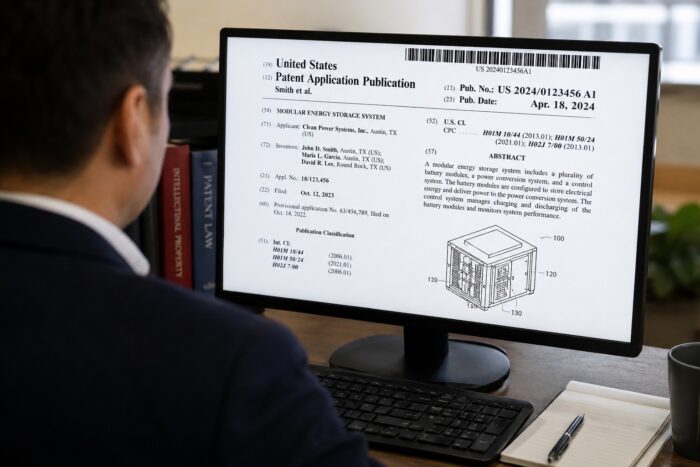
A patent application publication provides the public with access to a pending patent application to notify the public of the patent-pending status of new applications and make it aware of new innovations and technologies. It lets the public see the invention, drawings, and pending patent claims before the patent office decides whether to grant protection. Note that the publication does not establish that the invention is patentable or immediately provide enforceable patent rights.
This article is for non-attorneys and informs them of the reasons for and the effects of patent application publication. The reader will gain an understanding of what a patent application publication is and how it affects patent rights.
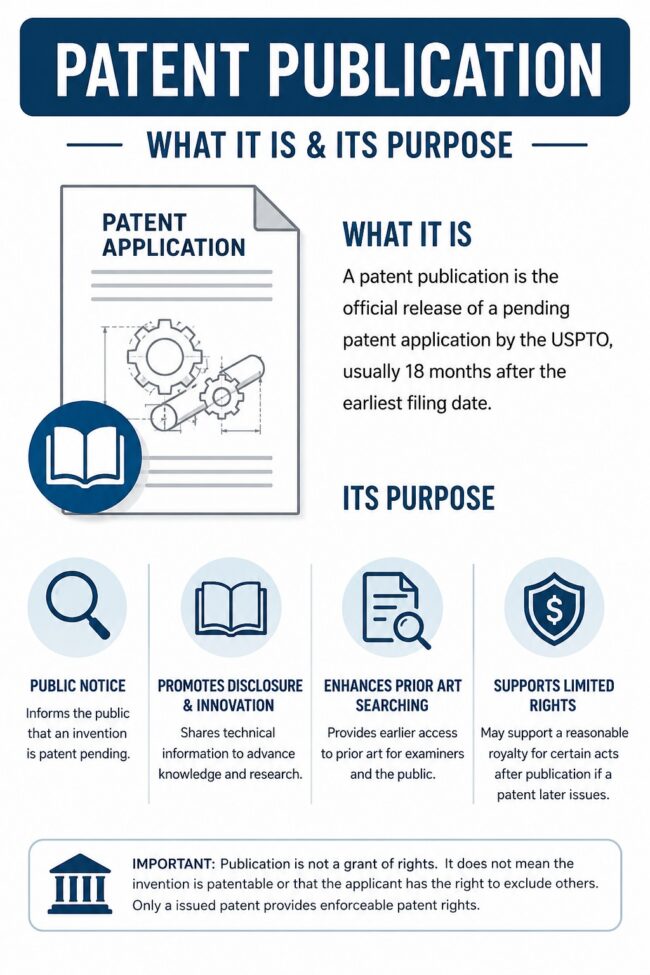
Most U.S. utility patent and plant patent applications are published by the USPTO 18 months after the earliest claimed filing date. A patent application is not published if it is provisional, design patent application, international design, or reissue; no longer pending; classified, under national security review, or subject to a secrecy order; issued early enough to stop publication; or covered by a valid non-publication request certifying no foreign or international filing requiring 18-month publication.
The published patent application is a patent document containing front-page data (i.e., title, inventors, publication and filing information, priority claims, classifications, and sometimes assignee information), an abstract, specification, patent claims, and drawings, generally as they were filed and sometimes reflecting timely amendments. A published application is not an issued patent and may later be granted, rejected, or abandoned. Publication establishes neither patentability nor an enforceable right to exclude, which are provided only by a granted patent. The invention is not protected against third-party use until a patent issues from the application.
U.S. patent applications generally publish 18 months after the earliest filing date for which priority is claimed. See 35 U.S.C. § 122(b)(1)–(2). A non-provisional application claiming the benefit of a provisional application normally publishes 18 months from the provisional filing date. Most applications publish before examination is completed, as patent examination may continue for years. Provisional patent applications themselves are not published or examined, but do become publicly accessible once a non-provisional application claiming priority to the provisional application is published.
An applicant may request earlier publication under 35 U.S.C. § 122(b)(1)(A). An applicant may also request non-publication of the application, which prevents the application from being published. See 35 U.S.C. § 122(b)(2)(B). This is a useful tool for maintaining the secrecy of an invention during the patent application process. With a non-publication request, the patent documents only become published if the application advances to a granted patent. Thus, the application may be maintained as a trade secret until a patent issues. However, the non-publication request can only be submitted if the applicant does not intend to seek foreign patent rights.
The USPTO publishes patent applications because Congress generally requires pregrant publication under 35 U.S.C. § 122(b). The requirement, adopted through the American Inventors Protection Act of 1999, replaced the former practice under which most U.S. applications remained confidential until a patent issued. Subject to statutory exceptions, nonprovisional utility and plant applications are published promptly after 18 months from the earliest filing date.
Publication serves several related purposes. It gives the public notice of technology for which patent protection is being applied, makes technical disclosures available earlier, facilitates prior-art searching, and allows businesses and researchers to evaluate potentially relevant pending claims before a patent issues. The USPTO identifies public notice, improved prior-art searching, and broader access to technical disclosures that promote innovation as principal policy goals of pregrant publication.
The system also brings U.S. practice closer to the 18-month publication systems used internationally. Publication balances public disclosure against the applicant’s interests by potentially allowing a reasonable royalty for certain post-publication conduct if substantially identical claims later issue and the statutory provisional-rights requirements are satisfied.
After the publication date, anyone can search USPTO databases and review the specification, drawings, abstract, and published claims. Publication informs others in the industry and publicly confirms that the application is patent pending. Patent-pending status begins when the application is filed. However, a patent publication grants no patent rights.
Claims may change during patent examination. Prior art and examiner objections often require amendments, so claims in issued patents are usually narrower or otherwise different than those in the published application. A patent application can therefore be published but never granted.
Published applications can serve as prior art against future patent applications even if they never mature into patents. Under 35 U.S.C. § 102(a)(1), a publication may be prior art beginning on its publication date and may anticipate a claim or support an obviousness rejection based on information made available to the public. A U.S. patent or published application naming another inventor also may qualify under 35 U.S.C. § 102(a)(2) as of its effective filing date, including an adequately supported priority date determined under 35 U.S.C. § 102(d), subject to statutory exceptions for certain inventor-originated disclosures, commonly owned subject matter, and joint research agreements.
The relevant inquiry is not whether the disclosed invention was ultimately patentable or whether the publication’s claims were allowed. A published patent application may be prior art for all that it discloses to a person of ordinary skill, including ideas, embodiments, drawings, examples, and technical teachings outside its claims. Conducting a thorough patentability search should therefore include searching published applications, patents granted, foreign patent databases throughout the world, and non-patent literature resources, not just U.S. patents.
A published application grants no immediate patent enforcement rights. Publication may nevertheless create potential provisional rights under 35 U.S.C. § 154(d) if a patent later issues with claims substantially identical to the published claims. Provisional rights allow applicants to seek royalties from infringers after publication. The owner may seek a reasonable royalty, but not an injunction or ordinary patent infringement damages, for qualifying acts between publication and issuance. However, the infringer must have had actual notice of the published patent application.
In Rosebud LMS Inc. v. Adobe Systems Inc., 812 F.3d 1070 (Fed. Cir. 2016), Rosebud relied on Adobe’s knowledge of a related grandparent patent, previous patent litigation proceedings involving the grandparent patent, alleged monitoring of Rosebud’s product, and the contention that Adobe’s counsel would have searched for related applications. The Federal Circuit held that this established, at most, constructive notice, and it was not shown that Adobe received notice of Rosebud's application publication. Actual notice may result from direct notification or independently acquired actual knowledge, but it cannot be imputed merely because an application is publicly searchable or the accused party should have discovered it. Because Adobe stopped using the accused technology before becoming aware of the patent application publication, Rosebud could not recover a pre-issuance reasonable royalty.
An applicant can request non-publication when filing a U.S. application. The non-publication request must accompany the application and certify that the invention has not been, and will not be, filed in another country or under an agreement requiring 18-month publication. See 35 U.S.C. § 122(b)(2)(B).
If the applicant later files a foreign or Patent Cooperation Treaty (PCT) application requiring publication, the applicant must rescind the request or notify the USPTO within 45 days. Failure to do so may cause abandonment. Applicants intending foreign protection therefore generally cannot prevent publication.
Other jurisdictions have similar patent publication rules that are required by international treaties (including the Patent Cooperation Treaty) to which nearly all foreign jurisdictions are parties. For example, the European Patent Office (EPO), the executive arm of the European Patent Organization, publishes a European patent application 18 months after filing or the earliest priority date. Earlier publication is available on request. PCT applications likewise publish 18 months from the priority date under PCT Article 21. Foreign patent publications also qualify as prior art under U.S. patent law, and thus must be searched as part of an effective patent search. European publications and patent application status can be searched and determined through the European Patent Register and Espacenet.
Patent application publication places an invention’s disclosure into the public record, alerts competitors, and may establish prior art against later patent applications. Although publication does not create an enforceable patent, it may support a later reasonable-royalty claim if a patent issues and the statutory requirements for provisional rights are satisfied. Applicants deciding whether to request or prevent publication should evaluate their foreign-filing plans, disclosure risks, likely claim changes, and competitive factors before filing. A valid nonpublication request may preserve confidentiality in appropriate cases, but it can restrict foreign-patent strategy and requires careful compliance if those plans change. Consulting a patent attorney early in the application process can help a business coordinate publication decisions with its broader patent rights, trade-secret protection, and commercialization objectives.
© 2026 Sierra IP Law, PC. The information provided herein does not constitute legal advice, but merely conveys general information that may be beneficial to the public, and should not be viewed as a substitute for legal consultation in a particular case.

"Mark and William are stellar in the capabilities, work ethic, character, knowledge, responsiveness, and quality of work. Hubby and I are incredibly grateful for them as they've done a phenomenal job working tirelessly over a time span of at least five years on a series of patents for hubby. Grateful that Fresno has such amazing patent attorneys! They're second to none and they never disappoint. Thank you, Mark, William, and your entire team!!"
Linda Guzman


Sierra IP Law, PC - Patents, Trademarks & Copyrights
FRESNO
7030 N. Fruit Ave.
Suite 110
Fresno, CA 93711
(559) 436-3800 | phone
BAKERSFIELD
1925 G. Street
Bakersfield, CA 93301
(661) 200-7724 | phone
SAN LUIS OBISPO
956 Walnut Street, 2nd Floor
San Luis Obispo, CA 93401
(805) 275-0943 | phone

SACRAMENTO
180 Promenade Circle, Suite 300
Sacramento, CA 95834
(916) 209-8525 | phone
MODESTO
1300 10th St., Suite F.
Modesto, CA 95345
(209) 286-0069 | phone
SANTA BARBARA
414 Olive Street
Santa Barbara, CA 93101
(805) 275-0943 | phone
SAN MATEO
1650 Borel Place, Suite 216
San Mateo, CA, CA 94402
(650) 398-1644. | phone
STOCKTON
110 N. San Joaquin St., 2nd Floor
Stockton, CA 95202
(209) 286-0069 | phone
PORTLAND
425 NW 10th Ave., Suite 200
Portland, OR 97209
(503) 343-9983 | phone
TACOMA
1201 Pacific Avenue, Suite 600
Tacoma, WA 98402
(253) 345-1545 | phone
KENNEWICK
1030 N Center Pkwy Suite N196
Kennewick, WA 99336
(509) 255-3442 | phone
2023 Sierra IP Law, PC - Patents, Trademarks & Copyrights - All Rights Reserved - Sitemap Privacy Lawyer Fresno, CA - Trademark Lawyer Modesto CA - Patent Lawyer Bakersfield, CA - Trademark Lawyer Bakersfield, CA - Patent Lawyer San Luis Obispo, CA - Trademark Lawyer San Luis Obispo, CA - Trademark Infringement Lawyer Tacoma WA - Internet Lawyer Bakersfield, CA - Trademark Lawyer Sacramento, CA - Patent Lawyer Sacramento, CA - Trademark Infringement Lawyer Sacrament CA - Patent Lawyer Tacoma WA - Intellectual Property Lawyer Tacoma WA - Trademark lawyer Tacoma WA - Portland Patent Attorney - Santa Barbara Patent Attorney - Santa Barbara Trademark Attorney
