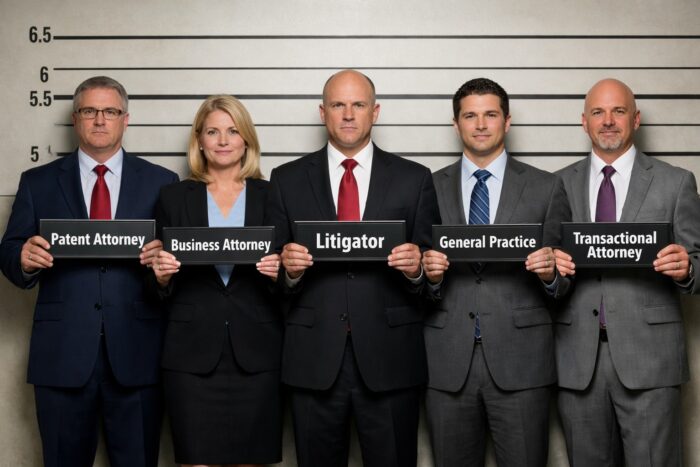
If you have developed an invention, built a technology-driven business, or are preparing to commercialize new technological innovations, you have likely encountered overlapping terms such as patent attorney vs lawyer, patent lawyer, intellectual property lawyer, and patent agent. The labels sound similar, but the underlying authority, training, and permitted scope of work can differ in ways that matter immediately to your strategy, budget, and risk profile.
This is not merely a terminology issue in intellectual property law. The distinction affects who can file patent applications, who can handle prosecuting patent applications before the patent office, who can provide legal advice beyond United States Patent and Trademark Office (USPTO) practice, and who can represent clients in court when a dispute becomes litigation. In practical terms, selecting the right professional impacts the strength of your patent rights, the enforceability of your intellectual property rights, and the quality of legal protection you ultimately obtain.
This article explains the key differences among these roles, how they fit into IP law and broader business needs, and how to match the right legal counsel to the specific legal matters you are facing.
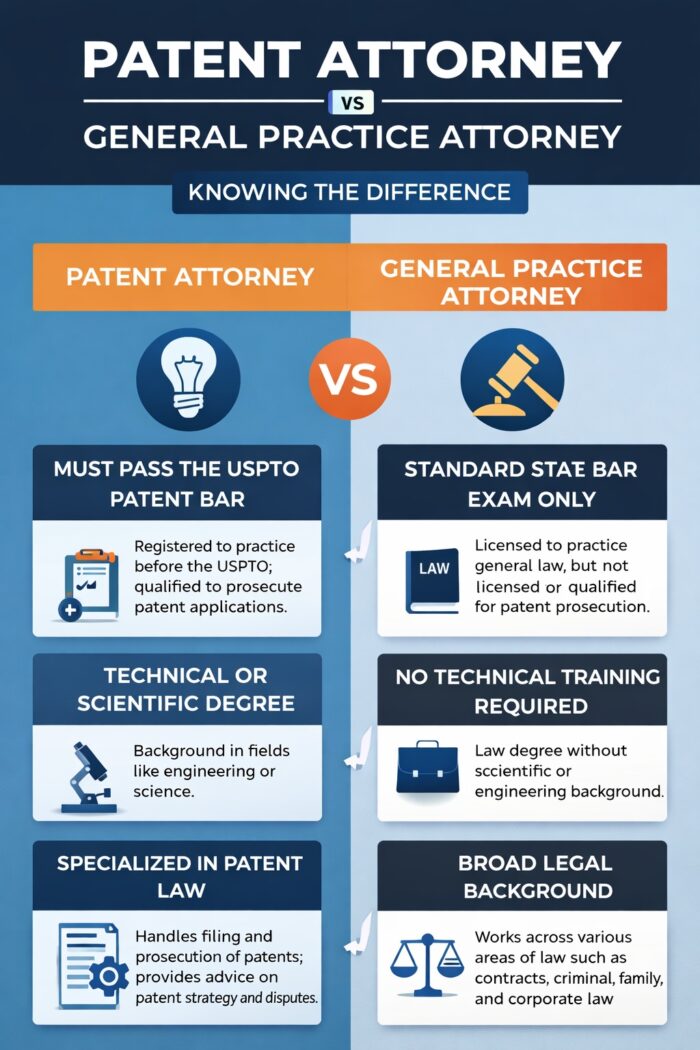
The simplest framing for patent attorney vs general attorney (non-patent attorney or lawyer) is this: all patent attorneys are attorneys (lawyers), but not all attorneys are qualified to handle patent matters.
A patent attorney is both (1) admitted to a state bar and authorized to practice law and (2) registered to practice before the USPTO after passing the patent bar exam, also referred to as the patent bar examination. That registration is what allows the practitioner to appear before the USPTO in patent prosecution and to engage in patent related matters before the agency.
By contrast, a general lawyer may have substantial legal expertise across corporate transactions, employment, privacy, contracts, or disputes, but without USPTO registration that lawyer generally cannot independently prosecute patent applications. In many startups and operating companies, that general attorney role is still essential because there is a broad range of business needs and legal issues beyond the patent pipeline.
This distinction is often misunderstood because the phrase “lawyer” is broad. A person may be an excellent commercial attorney with significant legal training and still be unable to draft and submit a patent application to the USPTO as a registered practitioner. When your next step involves patent prosecution, or patent advice and counseling, you need an attorney with the proper expertise and licensing.
“Patent attorney” and "patent lawyer" are used interchangeably. These professionals typically has:
Because of those credentials, a patent attorney can draft patent applications, communicate with the USPTO, and handle complex issues of patent law during patent examination. Importantly, patent attorneys can also provide legal advice in areas outside patent prosecution, including disputes, contracts, and strategy, subject to the rules of the jurisdictions in which they are admitted.
A patent agent is also registered to practice before the USPTO, but is not a licensed attorney. A patent agent generally has:
A patent agent can draft and prosecute patent applications before the USPTO. In other words, both patent agents and patent attorneys can handle USPTO patent prosecution work. The difference is that the patent agent is not licensed to practice law and generally cannot provide legal advice beyond the narrow scope permitted for USPTO practice.
An intellectual property lawyer (often called an IP lawyer) practices in the distinct areas of intellectual property, which may include patents, trademark law, copyright law, and trade secrets. In many organizations, the term IP attorneys signals a team that covers multiple IP disciplines and the various aspects of brand, content, technology, and confidentiality protection.
Not every IP lawyer is registered for USPTO patent practice. An IP lawyer may focus on trademarks and copyright and may collaborate with a registered patent practitioner when patent prosecution is needed. This division of work is common and often efficient.
A non-patent attorney may be a corporate lawyer, commercial attorney, employment counsel, privacy counsel, or trial counsel. That lawyer may provide broad legal counsel, draft and negotiate a wide array of agreements, and manage disputes. However, unlike patent attorneys, a general lawyer who is not registered with the USPTO typically cannot take primary responsibility for patent prosecution tasks such as drafting claims and responding to USPTO office actions.
Patent attorneys operate at the intersection of technology and law, translating inventions into enforceable rights. Their specialized knowledge is not limited to writing documents; it includes how the USPTO evaluates patent applications for novelty, obviousness, and formalities, how patent statutes and rules apply to the patent application process, and how claim language later performs in enforcement and licensing.
Key roles of patent attorneys include:
This is the heart of prosecuting patent applications, and it is often where technical understanding directly shapes outcomes. A practitioner with the right technical grounding can better describe the invention, anticipate examiner objections, and build a claim set that aligns with commercial objectives.
Patent prosecution is rarely a single filing. Companies often develop families of applications that mirror product roadmaps. Patent attorneys advise on portfolio architecture, including:
This is where patent strategy meets business strategy, and it is a common reason companies retain patent counsel even when they have strong in-house business counsel.
Patents are frequently monetized through contracts. Patent attorneys often provide transactional work involving:
In many cases, patent counsel drafts contracts that are closely tied to patent assets, particularly where the agreement depends on claim scope or prosecution history.
Patent rights are only as valuable as the ability to enforce them. Patent attorneys may advise on:
While many organizations distinguish between prosecution counsel and trial counsel, the technical and legal analysis underlying infringement and validity is often grounded in the prosecution record. For that reason, prosecution-oriented patent attorneys frequently play a meaningful role in infringement cases even when a separate litigation team leads court proceedings.
Many business needs surrounding innovation are not patent prosecution tasks. A general lawyer or IP-focused lawyer can be indispensable for commercial operations, compliance, employment, transactions, and dispute management.
A non-patent lawyer often handles:
These professionals often operate in-house within legal departments or externally through law firms, and they may manage the overall legal function while specialized patent counsel handles USPTO prosecution, intellectual property disputes, and IP licensing.
Many companies require an IP strategy beyond patents. An IP lawyer who focuses on non-patent areas may handle:
This broader scope is often described as a broader range of intellectual property ip work, especially for companies whose value includes brand identity, code, data, and proprietary processes.
General litigators can provide substantial value in disputes involving contracts, business torts, and complex commercial claims. They may also coordinate or co-lead matters that include IP components, particularly where the dispute spans multiple claims and forums. In many cases, patent-specific issues are handled by registered practitioners or specialized litigators, while the broader case is managed by a litigation team with deep courtroom experience.
People often search variations such as attorney vs patent or “patent attorney versus general lawyer.” Those searches reflect a real confusion: the term “attorney” identifies a legal license, but the patent system adds an additional layer of registration and technical eligibility.
In practical terms, the meaningful divide is not whether someone is called an attorney; it is whether that attorney is also registered to prosecute patents before the USPTO and whether that person has the technical literacy to draft a defensible patent application that aligns with the invention.
The right answer depends on the task in front of you. A professional, risk-based approach focuses on what you must accomplish, which rights are at stake, and which professional is legally authorized to deliver that outcome.
A patent attorney is usually the appropriate choice when you need patent-specific work that intersects with broader legal risk, such as:
Be prepared to discuss your invention with the patent attorney. Have a compete invention disclosure for the patent attorney's review, understand your goals, and have questions ready to ask the patent attorney regarding how to achieve your goals related to pursuing a patent.
An IP lawyer or general lawyer is often the best fit when the matter is primarily contractual, operational, or dispute-based outside patent prosecution, including:
Selecting counsel is not only about credentials. It is also about timing, budget, and the intended business outcome.
Timing and Disclosure Control
Patent rights can be sensitive to timing and disclosure. Coordinating product launches, publications, demos, and partnership discussions with filing strategy can materially impact the strength of your patent position and the scope of legal protection available later. This is one reason businesses treat patent filings as part of a broader commercialization plan rather than a standalone administrative step.
Deal Flow and Commercial Readiness
Where patents are central to the value of a business, the quality of the prosecution record and claim drafting can affect licensing value. At the same time, contract infrastructure matters. If your business is actively entering customer contracts or partnerships, the right legal coverage may be a general business lawyer who can quickly produce reliable commercial agreements, while patent counsel focuses on prosecution milestones.
Portfolio Economics
A patent portfolio is a long-term project. Beyond filing, prosecution includes office action responses, interviews, possible appeals, continuation practice, and coordination across jurisdictions. A strategic plan that matches prosecution activity to business milestones often produces better outcomes than reactive filings made at the last minute.
The practical takeaway is that the roles serve different functions, and those functions map to different risk profiles. Patent attorneys and patent agents provide USPTO-facing prosecution capabilities that are essential when you must draft and prosecute patent applications, respond to a patent examiner, and build enforceable patent rights. Patent attorneys also bring the ability to provide legal advice beyond prosecution and to coordinate enforcement strategy and dispute planning, including patent litigation, patent infringement, and patent transactions.
IP lawyers and general business lawyers deliver critical coverage across contracts, transactions, trademarks, copyright, and confidentiality programs. They protect the broader ecosystem of intellectual property, including brands and trade secrets, and they often support operational growth through reliable commercial contracting and dispute management.
Our firm handles all aspects of intellectual property law, including patents, trademarks, copyrights, trade secrets, and disputes and transactions in those areas. If you need assistance with a patent or other intellectual property matter, contact our office for a free consultation.
© 2026 Sierra IP Law, PC. The information provided herein does not constitute legal advice, but merely conveys general information that may be beneficial to the public, and should not be viewed as a substitute for legal consultation in a particular case.

"Mark and William are stellar in the capabilities, work ethic, character, knowledge, responsiveness, and quality of work. Hubby and I are incredibly grateful for them as they've done a phenomenal job working tirelessly over a time span of at least five years on a series of patents for hubby. Grateful that Fresno has such amazing patent attorneys! They're second to none and they never disappoint. Thank you, Mark, William, and your entire team!!"
Linda Guzman


Sierra IP Law, PC - Patents, Trademarks & Copyrights
FRESNO
7030 N. Fruit Ave.
Suite 110
Fresno, CA 93711
(559) 436-3800 | phone
BAKERSFIELD
1925 G. Street
Bakersfield, CA 93301
(661) 200-7724 | phone
SAN LUIS OBISPO
956 Walnut Street, 2nd Floor
San Luis Obispo, CA 93401
(805) 275-0943 | phone

SACRAMENTO
180 Promenade Circle, Suite 300
Sacramento, CA 95834
(916) 209-8525 | phone
MODESTO
1300 10th St., Suite F.
Modesto, CA 95345
(209) 286-0069 | phone
SANTA BARBARA
414 Olive Street
Santa Barbara, CA 93101
(805) 275-0943 | phone
SAN MATEO
1650 Borel Place, Suite 216
San Mateo, CA, CA 94402
(650) 398-1644. | phone
STOCKTON
110 N. San Joaquin St., 2nd Floor
Stockton, CA 95202
(209) 286-0069 | phone
PORTLAND
425 NW 10th Ave., Suite 200
Portland, OR 97209
(503) 343-9983 | phone
TACOMA
1201 Pacific Avenue, Suite 600
Tacoma, WA 98402
(253) 345-1545 | phone
KENNEWICK
1030 N Center Pkwy Suite N196
Kennewick, WA 99336
(509) 255-3442 | phone
2023 Sierra IP Law, PC - Patents, Trademarks & Copyrights - All Rights Reserved - Sitemap Privacy Lawyer Fresno, CA - Trademark Lawyer Modesto CA - Patent Lawyer Bakersfield, CA - Trademark Lawyer Bakersfield, CA - Patent Lawyer San Luis Obispo, CA - Trademark Lawyer San Luis Obispo, CA - Trademark Infringement Lawyer Tacoma WA - Internet Lawyer Bakersfield, CA - Trademark Lawyer Sacramento, CA - Patent Lawyer Sacramento, CA - Trademark Infringement Lawyer Sacrament CA - Patent Lawyer Tacoma WA - Intellectual Property Lawyer Tacoma WA - Trademark lawyer Tacoma WA - Portland Patent Attorney - Santa Barbara Patent Attorney - Santa Barbara Trademark Attorney
