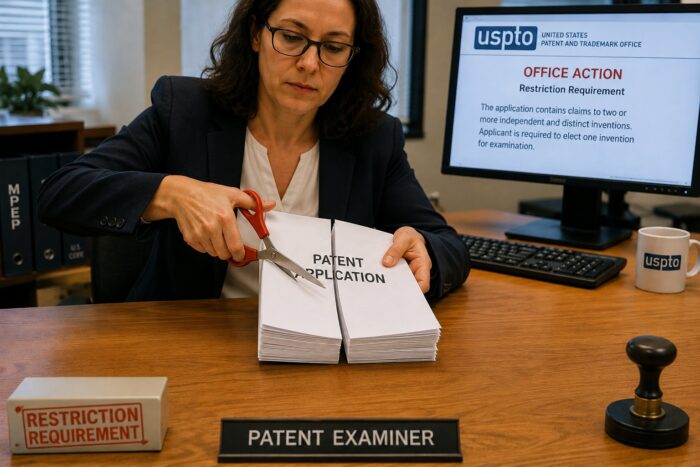
A restriction requirement is a procedural action in U.S. patent law. The United States Patent and Trademark Office (USPTO) issues it during examination when a single application appears to claim multiple patentably independent and distinct inventions. The examiner requires the applicant to elect one claim group for examination. This streamlines complex reviews and workload, but can affect cost, timing, claim scope, and multiple patents.
This article explains the purpose and procedure of restriction requirements, such that a person (e.g., business owner or inventor) who is new to the patent process may gain a general understanding of restriction practice.
Under 35 U.S.C. § 121, when “two or more independent and distinct inventions” are claimed in one patent application, the USPTO may restrict the application to one invention. Rules 37 C.F.R. §§ 1.141–1.142 implement that authority. The requirement for restriction usually appears in the first Office action, although the examiner may issue it any time before final action.
Restriction is procedural. It does not decide whether a claimed invention is novel or nonobvious over prior art. In In re Weber, the CCPA held that § 121 allows the USPTO to require restriction among independent and distinct inventions, but does not itself authorize rejection of a patent claim merely because it encompasses multiple inventions. 580 F.2d 455 (CCPA 1978). The court also warned that dividing a generic claim into fragments may not preserve the original claim. In In re Harnisch, the CCPA distinguished examination on the merits under §§ 101, 102, 103, and 112 from procedural restriction under § 121, and reversed an improper-Markush-grouping rejection because the claimed compounds had unity of invention, substantial structural similarity and common dye utility. 631 F.2d 716 (CCPA 1980).
A restriction requirement is proper only if two conditions are met. First, the claimed inventions must be capable of supporting separate patents and be either independent or distinct as claimed. “Independent” means that the inventions have no disclosed relationship in design, operation, or effect. “Distinct” inventions may be related, but, as claimed, are unconnected in at least one of those respects and at least one is patentable over the other. This authority derives from 35 U.S.C. § 121 and 37 C.F.R. §§ 1.141–1.142.
Second, a serious search or examination burden will result if all the claims remain together during patent examination. The examiner may show that burden through separate classifications, separate status in the art, different fields of search, or materially different non-prior-art issues under § 101 or § 112. The examiner must explain both why the inventions are independent or distinct and why the burden is serious. A conclusory statement is insufficient. Patent examiners must give reasons or examples to support conclusions. If all claims can be searched and examined without serious burden, restriction is improper and the examiner must address them on the merits, even if the examiner believes an invention is distinc. See MPEP §§ 802.01, 803, 808–808.02.
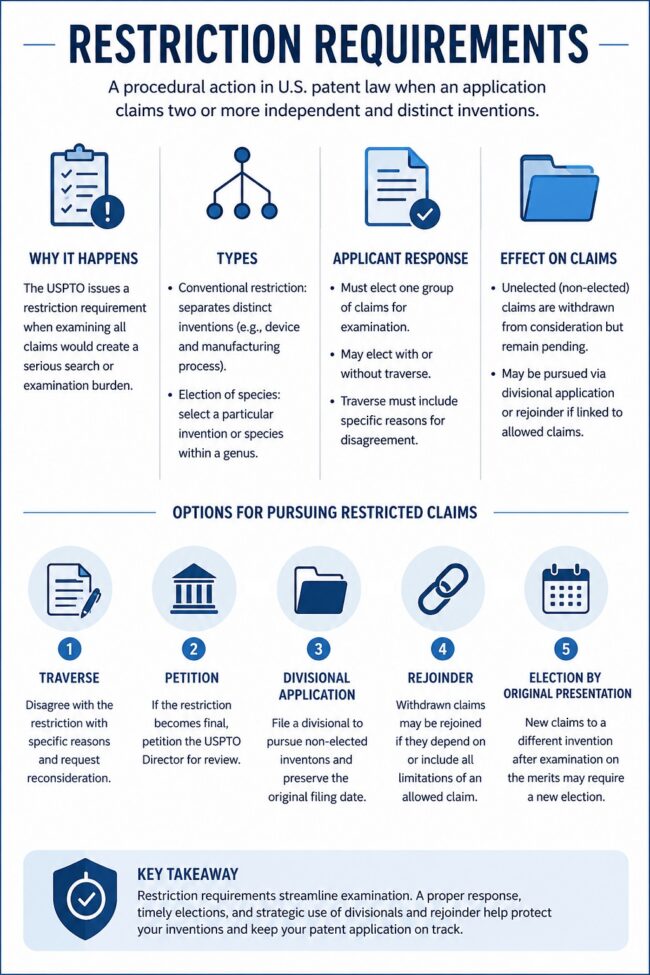
There are two types of restriction practices allowed by the US patent law and the USPTO rules. There are restrictions between two inventions (referred to as "restriction requirements"), and there are elections of species, which are directed to mutually exclusive species of an invention that are independent or distinct.
The examiner separates claims into groups directed to distinct inventions when examining all the claims together would create a serious search or examination burden. For example, a patent application may contain independent claims directed to a device and separate claims directed to a distinct manufacturing process. The applicant must elect one invention in the application, while claims to the non-elected invention are generally withdrawn from consideration but may be pursued in a divisional application.
An election of species requires the examiner to ask the applicant to select a particular invention or species within a genus for examination. A “species” is a specific embodiment that falls within a broader generic concept. For example, if a generic claim covers a fastener, separate species might include a screw, bolt, and rivet. Under 37 C.F.R. § 1.146, an election may be required when the claims encompass multiple patentably distinct species and no generic claim has been found allowable. The applicant’s election determines which species will be searched and examined. Dependent claims directed to other species may later qualify for rejoinder when they include all the limitations of an allowable generic claim that is broad enough to cover all of the identified species. See 37 C.F.R. § 1.141(a). Accordingly, an election of species may postpone examination of certain claims without requiring their immediate cancellation.
Applicants must elect one group of claims for examination. A response is incomplete without an election of claims, which may be made with or without traverse.
If the applicant believes the restriction is improper, the response must still make a provisional election and traverse with specific reasons and arguments as to why the election is improper under 37 C.F.R. § 1.143 and MPEP § 818. Once the elected claims receive an action on the merits, the election becomes fixed, and prosecution cannot shift to another invention.
Unelected claims, also called “non-elected claims,” are withdrawn from consideration in the current application under 37 C.F.R. § 1.142(b), but are not necessarily canceled. These withdrawn claims remain pending while the examiner considers the claims to the invention elected and may be reinstated if the restriction is withdrawn or overruled. The applicant may pursue restricted claims by timely traversing the restriction and petitioning if it becomes final, retaining eligible claims for possible rejoinder if linked to allowable elected claims, or filing a divisional application directed to the non-elected invention.
Claim amendments or new claims directed to an invention distinct from and independent of the originally claimed subject matter may trigger another restriction under 37 C.F.R. § 1.145. This is election by original presentation: after examination on the merits of the originally presented invention, that invention is constructively elected, and later-added claims to a different invention may be withdrawn. The applicant may cancel those claims, traverse the election, or pursue them in a divisional application.
If an applicant traverses a restriction and the examiner finds the applicant's arguments unpersuasive, the examiner may repeat the restriction as a final requirement and act on the elected claims. To preserve review, the applicant must timely traverse, request reconsideration, and distinctly identify every alleged error later relied upon.
After final restriction, the applicant may petition the USPTO Director under 37 C.F.R. § 1.144 while separately answering any remaining matters in the office action. The petition should state the relevant facts, identify the points to be reviewed, explain why the restriction is improper, specify the requested relief, and include supporting declarations or exhibits when factual proof is needed. It may be deferred until final action or notice of allowance, but must be filed no later than the notice of appeal. Restriction is reviewed by petition, not a patent appeal to the Trademark Trial and Appeal Board.
A divisional application can be filed for unelected claims after a restriction, allowing the applicant to pursue a particular invention separately while the current application continues. By claiming the benefit of the parent application under 35 U.S.C. § 120, the divisional preserves the original filing date. To invoke the safe harbor of 35 U.S.C. § 121, the divisional must result from the restriction and be filed before a patent issues on the other application.
The interaction with double patenting matters because related applications may otherwise face obviousness-type double patenting, which prevents an unjustified extension of patent exclusivity and may require a terminal disclaimer. Section 35 U.S.C. § 121 may instead prevent the parent and divisional patents from being used against each other, but the divided claim groups must maintain “consonance.” Gerber Garment Technology, Inc. v. Lectra Systems, Inc., 916 F.2d 683 (Fed. Cir. 1990), explains that consonance preserves the examiner’s line between restricted inventions. Boehringer Ingelheim International GmbH v. Barr Laboratories, Inc., 592 F.3d 1340 (Fed. Cir. 2010), confirms that the safe harbor may extend through successive divisionals when that boundary remains intact. If your application has been restricted, you should review the timing and scope of the restricted claims with a patent attorney before the parent patent issues.
Rejoinder allows certain unelected claims to be included later. If a claim to the invention elected becomes allowable, withdrawn claims to a linked invention may be rejoined when they depend from, or otherwise require, all the limitations of the allowed claim. See MPEP § 821.04(b). Well-planned dependent claims and timely claim amendments can preserve rejoinder. Amended or new claims that do not require all the limitations of an allowable claim may remain withdrawn.
For Patent Cooperation Treaty (PCT) applications, the comparable standard is the Unity of Invention Requirement: one invention, or a group linked by a single general inventive concept under PCT Regulations Rule 13.
The Unity of Invention Requirement permits a group of claims to varying embodiments of an invention that are linked by a single general inventive concept to be examined together by the International Search Authority. Unity exists when the inventions share the same or corresponding “special technical features,” meaning features that define each invention’s contribution over the prior art. If unity is lacking, the international authority may require additional search or examination fees for multiple inventions.
That differs from USPTO restriction practice. U.S. restriction generally asks whether claims cover independent or distinct inventions and whether examining them together would create a serious search or examination burden. PCT unity instead focuses on the technical relationship among the claimed inventions.
A restriction requirement is not an opinion on the merits and does not affect the patentability of the invention. It means the examiner has decided that not all of the claimed subject matter requires election of one invention or group for immediate examination. A proper response elects strategically, traverses with specific reasons when warranted, preserves divisional rights for unelected claims, and monitors rejoinder after allowance. Early review can protect filing dates, control cost, and preserve commercially important claims.
© 2026 Sierra IP Law, PC. The information provided herein does not constitute legal advice, but merely conveys general information that may be beneficial to the public, and should not be viewed as a substitute for legal consultation in a particular case.

"Mark and William are stellar in the capabilities, work ethic, character, knowledge, responsiveness, and quality of work. Hubby and I are incredibly grateful for them as they've done a phenomenal job working tirelessly over a time span of at least five years on a series of patents for hubby. Grateful that Fresno has such amazing patent attorneys! They're second to none and they never disappoint. Thank you, Mark, William, and your entire team!!"
Linda Guzman


Sierra IP Law, PC - Patents, Trademarks & Copyrights
FRESNO
7030 N. Fruit Ave.
Suite 110
Fresno, CA 93711
(559) 436-3800 | phone
BAKERSFIELD
1925 G. Street
Bakersfield, CA 93301
(661) 200-7724 | phone
SAN LUIS OBISPO
956 Walnut Street, 2nd Floor
San Luis Obispo, CA 93401
(805) 275-0943 | phone

SACRAMENTO
180 Promenade Circle, Suite 300
Sacramento, CA 95834
(916) 209-8525 | phone
MODESTO
1300 10th St., Suite F.
Modesto, CA 95345
(209) 286-0069 | phone
SANTA BARBARA
414 Olive Street
Santa Barbara, CA 93101
(805) 275-0943 | phone
SAN MATEO
1650 Borel Place, Suite 216
San Mateo, CA, CA 94402
(650) 398-1644. | phone
STOCKTON
110 N. San Joaquin St., 2nd Floor
Stockton, CA 95202
(209) 286-0069 | phone
PORTLAND
425 NW 10th Ave., Suite 200
Portland, OR 97209
(503) 343-9983 | phone
TACOMA
1201 Pacific Avenue, Suite 600
Tacoma, WA 98402
(253) 345-1545 | phone
KENNEWICK
1030 N Center Pkwy Suite N196
Kennewick, WA 99336
(509) 255-3442 | phone
2023 Sierra IP Law, PC - Patents, Trademarks & Copyrights - All Rights Reserved - Sitemap Privacy Lawyer Fresno, CA - Trademark Lawyer Modesto CA - Patent Lawyer Bakersfield, CA - Trademark Lawyer Bakersfield, CA - Patent Lawyer San Luis Obispo, CA - Trademark Lawyer San Luis Obispo, CA - Trademark Infringement Lawyer Tacoma WA - Internet Lawyer Bakersfield, CA - Trademark Lawyer Sacramento, CA - Patent Lawyer Sacramento, CA - Trademark Infringement Lawyer Sacrament CA - Patent Lawyer Tacoma WA - Intellectual Property Lawyer Tacoma WA - Trademark lawyer Tacoma WA - Portland Patent Attorney - Santa Barbara Patent Attorney - Santa Barbara Trademark Attorney
