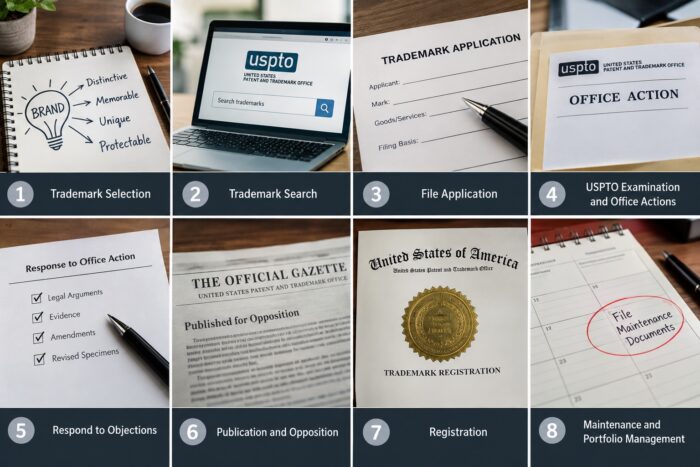
Trademark prosecution is the legal process of seeking trademark registration, from trademark selection and searching, to filing and application, trademark examination, publication, and registration. For a business, company, or product team, understanding what prosecution means makes it easier to evaluate risks, anticipate challenges, and craft a filing strategy that protects the brand without wasting time or money.
This article will break the process into practical stages so readers can learn how applications are prepared, examined, registered, and maintained. Effective prosecution supports strong trademark protection by ensuring that the applicant selects a protectable mark, accurately identifies its goods or services, and responds appropriately to the application requirements of the United States Patent and Trademark Office (USPTO). Although registration can strengthen a company’s rights, help consumers recognize the source of its products or services, and support sales, it should be understood that it does not guarantee success in later enforcement disputes.
Trademark prosecution involves administrative legal proceedings for trademark registration. In the United States jurisdiction, the Lanham Act governs domestic trademark usage and registration. Foreign jurisdictions each follow its own trademark law, commonly called a Trade Marks Act. “Trademark” includes a service mark, which identifies services. Trademark prosecution differs from trademark litigation in court.
Trademark prosecution includes several steps that need to be observed to sucessfuly navigate the entire process, including trademark selection, trademark search, application submission, examination, publication, registration, and maintenance.
Strong trademarks are distinctive from pre-existing trademark usage and are ideally unique. An effective trademark may be suggestive, arbitrary, or fanciful, but should not be generic or merely descriptive of the goods or services. The USPTO reviews trademark applications for distinctiveness and compliance with formal requirements. In USPTO v. Booking.com B.V., 591 U.S. 549 (2020), the examining attorney and TTAB deemed BOOKING.COM generic for online travel-reservation services, reasoning that “booking” named the services and “.com” denoted a commercial website. On de novo district-court review, Booking.com introduced consumer-perception evidence showing that the public understood BOOKING.COM as identifying one source rather than the class of reservation services. The court found the mark descriptive, not generic, and found acquired distinctiveness for hotel-reservation services. The Supreme Court affirmed and rejected a categorical rule that adding “.com” to a generic term necessarily yields a generic mark. Instead, compound marks must be considered as a whole, and genericness turns on the term’s primary significance to consumers in the relevant trademark usage situation.
Distinctiveness depends on how consumers understand the mark as a whole, and each trademark usage situation must be evaluated based on the relevant facts. There is no black-and-white rule with respect to whether a trademark is distinctive.
Prior to initiating the trademark prosecution process, the applicant should conduct a trademark search with the assistance of an experienced trademark lawyer. A trademark lawyer should check federal and state records and common-law use. The search results should then be compared to the proposed mark, looking for similarities between the sound, appearance, and meaning of the marks; the goods and services on which the prior marks are used; and the trade channels in which the prior marks are used. The mark must not be too similar to existing trademarks, because likelihood of confusion may cause refusal under 15 U.S.C. § 1052(d). See also In re E.I. du Pont de Nemours & Co., 476 F.2d 1357 (C.C.P.A. 1973).
Trademark applications must identify the correct owner, filing basis, mark, and goods or services and include the required verification and drawing. Precise descriptions of the goods or services are important because indefinite wording may trigger an objection, while the identification generally cannot be broadened after filing. See 15 U.S.C. § 1051. An applicant may file based on existing use in commerce under Section 1(a) or a bona fide intent to use the mark under Section 1(b). The applicant of an intent-to-use application must later establish qualifying use through submitting a statement of use before a trademark registration is issued.
For a use-based application, the applicant must provide dates of first use and a specimen of use for each class. Specimens must clearly show how the mark is used in commerce for the identified goods or services. A product specimen may include the goods, packaging, tags, labels, or an acceptable point-of-sale display. A service mark specimen may include advertising, website pages, or signage that creates a direct association between the mark and the services. See 37 C.F.R. §§ 2.34(a)(1), 2.56.
After filing, a USPTO examining attorney reviews the application for statutory and procedural compliance. The examiner evaluates conflicts, distinctiveness, other grounds for refusal, and formal requirements. Office actions are official letters from the trademark examiner identifying substantive “refusals” and procedural “requirements.” Minor issues may be resolved through an examiner’s amendment or direct communication, but significant refusals and objections generally require a written response.
A non-final office action allows the applicant to cure requirements or contest refusals. Trademark prosecution can include responding to office actions by revising descriptions, replacing specimens, disclaiming wording, submitting evidence, and presenting legal arguments. A complete response must address every outstanding issue. If the examiner remains unpersuaded, a final office action may issue. Depending on the issue, the applicant may request reconsideration, appeal to the Trademark Trial and Appeal Board to address substantive refusals, or petition the Director to address procedural issues. A reconsideration request does not extend the appeal or petition deadline. See 15 U.S.C. § 1070.
For most Section 1 and Section 44 applications, the office action response deadline is three months, with one paid three-month extension. Section 66(a) applications generally receive six months without extension. Failure to respond timely and completely can result in abandonment of the trademark application. A trademark attorney can protect your trademark rights by applying their skill and knowledge in the trademark process, and handle the trademark prosecution process, including preparing and submitting effective responses to USPTO office actions, communicating directly with the examiner, properly observing filing deadlines, and generally helping clients navigate the trademark registration process. Trademark attorneys use practical tools and strategies to avoid costly registration mistakes.
After approval by the examining attorney, the application enters the publication stage under 15 U.S.C. § 1062(a). Publication opens a 30-day period in which third parties who believe registration would damage them may oppose a trademark before the Trademark Trial and Appeal Board (TTAB) or request an extension. An opposition is an adversarial proceeding before the TTAB, with pleadings, discovery, evidence, and briefing. The Board decides registrability, not infringement liability, damages, or injunctions. See 15 U.S.C. § 1063.
After a final refusal, the applicant may appeal to the TTAB under 15 U.S.C. § 1070 and 37 C.F.R. §§ 2.141–2.145. Judicial review of the TTAB's decision by the U.S. Court of Appeals for the Federal Circuit is available under 15 U.S.C. § 1071. It may be critical to appeal TTAB decisions to the Federal Circuit because of the impact the Board's decision can have on the applicant's future trademark usage and potential disputes with third parties. To illustrate, in B&B Hardware, Inc. v. Hargis Industries, Inc., 575 U.S. 138 (2015) the TTAB sustained B&B’s opposition to a trademark application to register SEALTITE based on likely confusion with its SEALTIGHT mark. The Supreme Court held that the TTAB's ruling could preclude relitigation of the likelihood of confusion issue in a later court case when the issue-preclusion requirements were met and the trademark usages adjudicated were materially the same. Thus, a TTAB decision could be the final word on whether a mark is confusingly similar to a prior trademark filing, and that preclusion decision may then be leveraged in trademark litigation to establish trademark infringement.
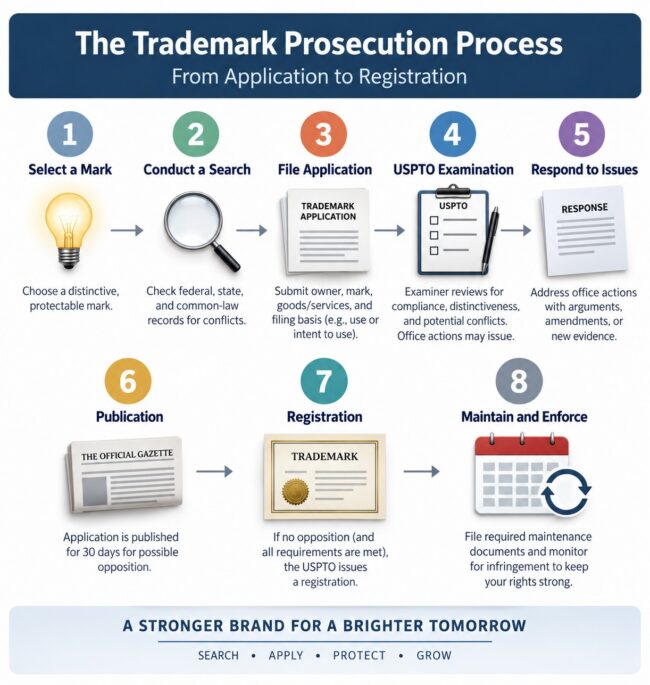
Federal registration on the Principal Register provides nationwide constructive notice of the registrant’s claim and prima facie evidence of validity, ownership, and the exclusive right to use the mark for the listed goods or services. See 15 U.S.C. § 1057(b). Registration may establish nationwide priority from filing, support federal-court remedies, and provide a basis for protection abroad. These benefits make registered trademarks easier to license, police, and value. However, a successful trademark prosecution does not guarantee success in trademark enforcement. Trademark infringement remains dependent on priority, defenses, and likelihood of confusion. It nevertheless helps secure trademark protection against similar marks and discourages confusingly similar marks.
Maintaining a trademark requires continued use and timely submissions of trademark renewals. Owners generally file an affidavit of use under Lanham Act Section 8 between the fifth and sixth anniversaries, then a renewal application including affidavits under Lanham Act Sections 8 and 9 must be filed between the ninth and tenth anniversaries and every ten years thereafter. See 15 U.S.C. §§ 1058–1059. Eligible owners may seek incontestability between the fifth and sixth years by filing a declaration of incontestability under Lanham Act Section 15. Attorneys can advise on the renewal requirements, including proper use, ownership changes, licensing controls, specimens, and renewal filings.
Trademark portfolio management includes monitoring competitors’ applications, marketplace conduct, deadlines, ownership changes, licenses, and trademark news. Watch services and audits help a business identify conflicts early and confirm that its trademark portfolios match its products, services, territories, and objectives.
Trademark rights are territorial, so portfolios should be built in the business’s relevant markets in the United States and abroad. A U.S. registration does not create rights in other countries. Every business has different markets, objectives, and situations. Counsel should prioritize countries based on sales, manufacturing, licensing, expansion plans, counterfeiting risk, and budget.
For protection across countries and the world, counsel should coordinate domestic and foreign strategies, deadlines, evidence, and ownership records. Depending on the brand, a long-term plan may combine national and international trademark filings.
Trademark prosecution involves much more than filing a few forms. It means making coordinated decisions about trademark selection, clearance, filing, responding to USPTO office actions, registration, maintenance, and enforcement. An expert lawyer can analyze the company’s objectives, break down legal and procedural challenges, craft practical strategies, and offer advice that helps secure, maintain, and enforce rights while avoiding preventable mistakes. Early guidance is especially valuable for ensuring that the application identifies the correct owner, mark, filing basis, and goods or services and that deadlines and objections are handled properly. Business owners who learn how the process works are better positioned to select a protectable mark, protect their brand, and decide whether domestic and international registration will provide benefits.
Contact our offices to connect with qualified trademark counsel to shape an effective trademark strategy before avoidable problems become costly.
© 2026 Sierra IP Law, PC. The information provided herein does not constitute legal advice, but merely conveys general information that may be beneficial to the public, and should not be viewed as a substitute for legal consultation in a particular case.

"Mark and William are stellar in the capabilities, work ethic, character, knowledge, responsiveness, and quality of work. Hubby and I are incredibly grateful for them as they've done a phenomenal job working tirelessly over a time span of at least five years on a series of patents for hubby. Grateful that Fresno has such amazing patent attorneys! They're second to none and they never disappoint. Thank you, Mark, William, and your entire team!!"
Linda Guzman


Sierra IP Law, PC - Patents, Trademarks & Copyrights
FRESNO
7030 N. Fruit Ave.
Suite 110
Fresno, CA 93711
(559) 436-3800 | phone
BAKERSFIELD
1925 G. Street
Bakersfield, CA 93301
(661) 200-7724 | phone
SAN LUIS OBISPO
956 Walnut Street, 2nd Floor
San Luis Obispo, CA 93401
(805) 275-0943 | phone

SACRAMENTO
180 Promenade Circle, Suite 300
Sacramento, CA 95834
(916) 209-8525 | phone
MODESTO
1300 10th St., Suite F.
Modesto, CA 95345
(209) 286-0069 | phone
SANTA BARBARA
414 Olive Street
Santa Barbara, CA 93101
(805) 275-0943 | phone
SAN MATEO
1650 Borel Place, Suite 216
San Mateo, CA, CA 94402
(650) 398-1644. | phone
STOCKTON
110 N. San Joaquin St., 2nd Floor
Stockton, CA 95202
(209) 286-0069 | phone
PORTLAND
425 NW 10th Ave., Suite 200
Portland, OR 97209
(503) 343-9983 | phone
TACOMA
1201 Pacific Avenue, Suite 600
Tacoma, WA 98402
(253) 345-1545 | phone
KENNEWICK
1030 N Center Pkwy Suite N196
Kennewick, WA 99336
(509) 255-3442 | phone
2023 Sierra IP Law, PC - Patents, Trademarks & Copyrights - All Rights Reserved - Sitemap Privacy Lawyer Fresno, CA - Trademark Lawyer Modesto CA - Patent Lawyer Bakersfield, CA - Trademark Lawyer Bakersfield, CA - Patent Lawyer San Luis Obispo, CA - Trademark Lawyer San Luis Obispo, CA - Trademark Infringement Lawyer Tacoma WA - Internet Lawyer Bakersfield, CA - Trademark Lawyer Sacramento, CA - Patent Lawyer Sacramento, CA - Trademark Infringement Lawyer Sacrament CA - Patent Lawyer Tacoma WA - Intellectual Property Lawyer Tacoma WA - Trademark lawyer Tacoma WA - Portland Patent Attorney - Santa Barbara Patent Attorney - Santa Barbara Trademark Attorney
