
This article explains whether entrepreneurs and business owners can trademark a name, the requirements and process involved, and special considerations for personal and business names.
Can you trademark a name, like Donald or Johnson? Yes, under certain conditions. In U.S. trademark law, a name can become a trademark when it identifies the source of goods or services, and not merely the person or family behind the business. A trademark differentiates a business’s products or services from others, protects brand identity from misuse, and helps build customer trust. A name can function in that way if properly used and understood by the relevant consumers to be a trademark.
The answer is usually yes, but not every personal name, own name, business name, or famous person’s name can be registered as a trademark. Under trademark law, a trademark can be a word, name, symbol, logo, or design used in commerce to identify and distinguish goods or services, as provided by 15 U.S.C. § 1127. The key question is whether the name functions as a source identifier, meaning the trademark identifies a particular business, product line, or service, not merely the person behind it. In the case of a trademark application that includes a person's name, the United States Patent and Trademark Office (USPTO), in addition to determining whether the applied-for mark conflicts with a similar trademark, will review the trademark application to determine whether the mark is primarily merely a surname, and whether consent is required for a living person’s name. See 15 U.S.C. § 1052. If those issues are satisfied, a federal trademark registration may be issued and provide legal protection and stronger trademark rights.
A key distinction in this area of trademark law is that given names and surnames are not treated the same. A first name can often be registered as a trademark without proof of acquired distinctiveness if it is used in commerce to identify goods or services and functions as a source identifier; in other words, the USPTO does not refuse a mark merely because it is a given name. A personal name such as a first name may still face ordinary trademark protection issues, including likelihood of confusion, descriptiveness, and consent if the mark identifies a living person. See 15 U.S.C. § 1052(c).
By contrast, under 15 U.S.C. § 1052(e)(4), a mark that is primarily merely a surname may be refused registration on the principal register unless the applicant proves acquired distinctiveness under 15 U.S.C. § 1052(f). The policy of treating last names as non-distinctive marks is due to the fact that surnames are shared by many people, so trademark rules are cautious about giving one business exclusive federal registration rights in a surname. The surname inquiry asks whether the mark’s primary significance to purchasers is a surname. Courts and the Trademark Office consider the rarity of the surname, whether anyone connected with the applicant has that surname, whether the term has another recognized meaning, and whether added wording or design creates a separate commercial impression. See In re Etablissements Darty et Fils, 759 F.2d 15 (Fed. Cir. 1985); In re Hutchinson Technology Inc., 852 F.2d 552 (Fed. Cir. 1988). Thus, JOHN may face different registrability issues than JOHNSON: the first is not refused merely because it is a given name, while the last name may need secondary meaning.
The courts and USPTO are primarily interested in avoiding consumer confusion by ensuring that trademarks (whether a surname, a fanciful name for a brand, or some other type of mark) are distinctive. Surnames are a special case because they are shared by many people and potentially may be used by many business owners (e.g., family-named businesses). The treatment of surnames as weak marks is to prevent the potential confusion that can arise from multiple businesses using the same surname.
In the case that the surname is denied registration on the principal register, it may be alternatively registered on the supplemental register. A supplemental registration provides a trademark registration, but without many of the presumptions and rights provided by a principal registration. The registrant can later re-apply for the principal register once the registrant can show that the mark has acquired distinctiveness amongst relevant consumers.
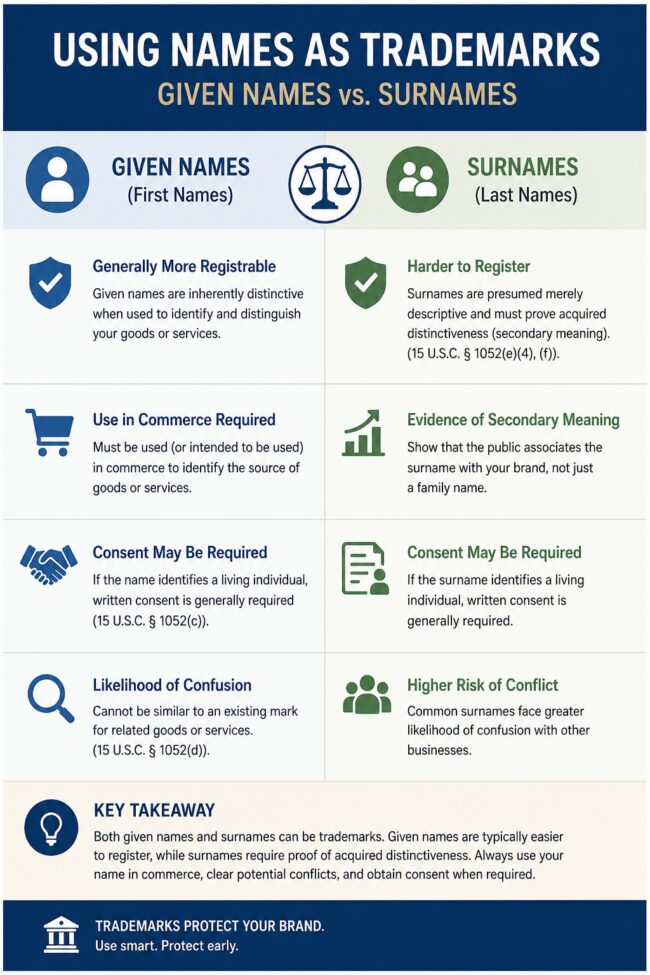
To register a living person’s name, portrait, signature, likeness, nickname, or pseudonym, the applicant generally must submit written consent if the mark identifies a living individual. The Lanham Act bars registration of a name, portrait, or signature identifying a particular living individual without written consent under 15 U.S.C. § 1052(c). This rule can apply even when the applicant has a legitimate business reason to use the personal name, including where a founder, designer, performer, or public-facing employee wants to use his or her name as a brand. If the mark includes a living person’s name, the applicant should include a consent statement or submit one during examination. The USPTO explains that consent must include a statement consenting to registration, the living person’s signature, and the date. Without consent, the application may be refused.
Federal trademark law gives additional protection to celebrity names and a famous person’s identity because consumers may assume that a mark using a famous person’s name, nickname, persona, or other identifying reference was approved, sponsored, or licensed by that person. Under 15 U.S.C. § 1052(a), a trademark application may be refused if the proposed mark falsely suggests a connection with a person, whether living or dead. This protection can apply even where the celebrity has not used his or her name as a trademark for competing goods or services. The key question is whether the name or reference points uniquely and unmistakably to the famous person and whether consumers would presume a connection without permission.
In In re Sauer, 27 U.S.P.Q.2d 1073 (TTAB 1993), the Trademark Trial and Appeal Board refused BO BALL because the evidence showed that purchasers would associate the mark with Bo Jackson, whose nickname “Bo” and athletic fame gave the phrase a recognized meaning tied to him. Because Sauer lacked consent, registration was refused. In Vidal v. Elster, 602 U.S. 286 (2024), the Supreme Court upheld the Lanham Act’s living-person “names clause,” confirming that Congress may require consent before another party obtains federal registration of a living person’s name.
A personal name will not be approved as a trademark if it closely resembles an existing trademark for related goods or services. The likelihood of confusion test asks whether consumers might believe two businesses are connected. 15 U.S.C. § 1052(d) authorizes refusal where a mark resembles a registered or previously used mark in a way likely to cause confusion. The key case is In re E.I. du Pont de Nemours & Co., 476 F.2d 1357 (C.C.P.A. 1973), whose factors are used by examiners and the appeal board. There is no mechanical test, and each case depends on its facts.
Trademarking a name involves a multi-step federal process through the USPTO. Before filing, a trademark search should be performed, including a search of the USPTO database for similar names. A new trademark application should identify the owner, mark, goods or services, filing basis, specimen if based on actual use, and any required consent statement. Current USPTO fees are generally $350 per class for a base electronic application. Current USPTO data shows average time to registration or abandonment around 9.9 months, while the USPTO says the overall process usually takes 12–18 months. Federal registration provides legal protection, a presumption of ownership, and nationwide protection subject to prior users and registration limits. See 15 U.S.C. §§ 1057, 1072, and 1115(a).
So, can you trademark a name? Yes, if the name functions as a trademark by identifying the source of specific goods or services, is distinctive enough for trademark protection, and does not create a likelihood of confusion with a similar trademark. Business owners should choose a name that supports a clear brand identity, vet the name before filing by performing a trademark search and analysis, and confirm that the mark will be properly used in commerce. However, it must be noted that the USPTO will likely treat a surname as a weak mark and require a showing of acquired distinctiveness before granting a registration on the principal register. When a name is successfully registered, the federal registration can strengthen trademark rights, provide nationwide protection, enable robust trademark enforcement against infringement, and protect the customer trust built into the brand.
If you need assistance with establishing trademark rights in a name or other trademark matters, contact our office for a consultation with one of our experienced trademark attorneys.
© 2026 Sierra IP Law, PC. The information provided herein does not constitute legal advice, but merely conveys general information that may be beneficial to the public, and should not be viewed as a substitute for legal consultation in a particular case.

"Mark and William are stellar in the capabilities, work ethic, character, knowledge, responsiveness, and quality of work. Hubby and I are incredibly grateful for them as they've done a phenomenal job working tirelessly over a time span of at least five years on a series of patents for hubby. Grateful that Fresno has such amazing patent attorneys! They're second to none and they never disappoint. Thank you, Mark, William, and your entire team!!"
Linda Guzman


Sierra IP Law, PC - Patents, Trademarks & Copyrights
FRESNO
7030 N. Fruit Ave.
Suite 110
Fresno, CA 93711
(559) 436-3800 | phone
BAKERSFIELD
1925 G. Street
Bakersfield, CA 93301
(661) 200-7724 | phone
SAN LUIS OBISPO
956 Walnut Street, 2nd Floor
San Luis Obispo, CA 93401
(805) 275-0943 | phone

SACRAMENTO
180 Promenade Circle, Suite 300
Sacramento, CA 95834
(916) 209-8525 | phone
MODESTO
1300 10th St., Suite F.
Modesto, CA 95345
(209) 286-0069 | phone
SANTA BARBARA
414 Olive Street
Santa Barbara, CA 93101
(805) 275-0943 | phone
SAN MATEO
1650 Borel Place, Suite 216
San Mateo, CA, CA 94402
(650) 398-1644. | phone
STOCKTON
110 N. San Joaquin St., 2nd Floor
Stockton, CA 95202
(209) 286-0069 | phone
PORTLAND
425 NW 10th Ave., Suite 200
Portland, OR 97209
(503) 343-9983 | phone
TACOMA
1201 Pacific Avenue, Suite 600
Tacoma, WA 98402
(253) 345-1545 | phone
KENNEWICK
1030 N Center Pkwy Suite N196
Kennewick, WA 99336
(509) 255-3442 | phone
2023 Sierra IP Law, PC - Patents, Trademarks & Copyrights - All Rights Reserved - Sitemap Privacy Lawyer Fresno, CA - Trademark Lawyer Modesto CA - Patent Lawyer Bakersfield, CA - Trademark Lawyer Bakersfield, CA - Patent Lawyer San Luis Obispo, CA - Trademark Lawyer San Luis Obispo, CA - Trademark Infringement Lawyer Tacoma WA - Internet Lawyer Bakersfield, CA - Trademark Lawyer Sacramento, CA - Patent Lawyer Sacramento, CA - Trademark Infringement Lawyer Sacrament CA - Patent Lawyer Tacoma WA - Intellectual Property Lawyer Tacoma WA - Trademark lawyer Tacoma WA - Portland Patent Attorney - Santa Barbara Patent Attorney - Santa Barbara Trademark Attorney
