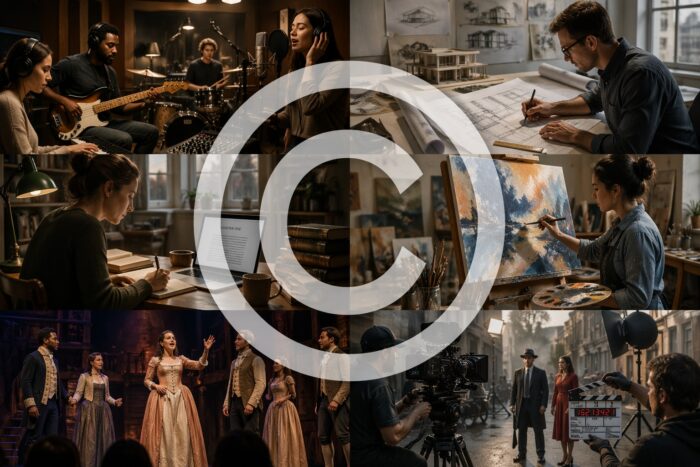
Sierra IP Law, PC provides copyright registration services for artists, writers, content creators, entrepreneurs, and business owners who want to protect their creative work. Our intellectual property attorneys help you identify protectable material, verify ownership, and prepare an accurate and complete copyright application. We walk you through the registration process, ensuring your work is properly submitted and examined.
With more than 60 years of combined intellectual property law experience, our firm connects registration with practical guidance on licensing, commercial use, and infringement. Mark D. Miller is AV Preeminent Peer Review Rated, and William K. Nelson was selected to Northern California Super Lawyers.
We assist with all forms of copyright works, including literary works (e.g., poetry, non-fiction, articles, and blogs), artistic works, drawings, and photographs, musical works and sound recordings, movies, software, and original content on websites. We are able to handle all forms of multimedia files, CAD files, and software code, and prepare and submit the files in a copyright registration application.
We begin the copyright process with an in-depth interview with you, the client, asking detailed questions about your work, its authorship, whether it has been published, whether there are any elements of others' works incorporated into the work, and other relevant questions. We also evaluate whether your works should be submitted in a group registration. Unpublished works, photographs, or other qualifying collections can be submitted in a single registration application under proper circumstances, which saves the applicant time and fees. The interview allows us to fully understand the creation and creative contributions to the work and how the application should be handled.
Review ownership. We assess who may claim ownership in the work. There are several legal rules that govern who owns contributions by employees or contractors and how those contributions can be properly transferred. We also assess whether the work qualifies as a work made for hire and whether a proper written assignment has been executed. If the work was created by another through commission, the copyrights may not have been transferred to the commissioning party. Thus, the history of the work must be well understood by counsel in order to properly handle the copyright registration process.
Review the Publication Status. We assess publication status and dates because they affect filing options, deposit requirements, and registration timing. In copyright law, publication generally means the authorized distribution of copies to the public through sales, gifts, rentals, leases, or lending. It also includes authorized offers to distribute copies to a group for further distribution, public performance, or public display. Merely displaying or performing a work publicly is not publication, such as posting online. However, distributing downloadable copies with the copyright owner’s permission can qualify as publication.
Prepare the filing. We complete the required copyright form, identifying the proper authorship, the proper type of work being claimed, any disclaimers of content by others or the author's previous work, and any assignments of the copyrights. We also prepare a quality deposit copy of the work that can be submitted to the copyright office. Some works require physical deposits even when filing online. We determine the deposit requirements for your application.
Submit and follow through. Once the application is ready for electronic filing, we provide a copy of the application for the client's review prior to filing. Upon client approval, we promptly file the copyright application with the required filing fees and deposit material. During copyright examination, the copyright office reviews the application and submitted work for copyrightability and compliance with registration requirements. We offer support with copyright office correspondence, including responding to examiner questions, clarifying authorship and ownership, addressing copyrightability concerns, and making appropriate corrections. We also review the certificate if registration is granted and advise on response options if registration is refused.
The registration process may take only a few weeks, but often takes several months to a year for the copyright office to complete the examination process. However, it should be understood that the effective date of the copyright registration will be the date the copyright office receives all required application, deposit, and fee components, not the certificate’s issuance date. We track the examination of your copyright application and make sure that it gets through the process.
Under U.S. copyright law, original works of human authorship fixed in a tangible medium, including digital files, receive copyright protection automatically. A work is “fixed” when it is captured in a sufficiently lasting form, such as writing saved on a computer, a recorded song, or a digital image. Eligible works include books, articles, software, music, videos, drawings, and photographs.
Copyright protects creative expression, excluding facts, ideas, and public domain material. For example, an original article may be protected, but the facts it reports remain available for others to use. Protection covers the author’s expression, not the underlying information or general concept.
Even family photos may qualify: a photograph can reflect creative choices in composition, lighting, and timing. Being the subject of a photograph does not establish copyrights. The author (the photographer) of the work (the photograph) generally owns the copyrights, subject to exceptions such as works made for hire, and may subsequently be transferred to another owner by copyright assignment. See 17 U.S.C. § 201.
Depending on the type of work and subject to exceptions such as fair use, copyright allows owners to control who may reproduce or distribute copies, create adaptations, or display or perform a work publicly. Permission may be required to use someone else’s protected expression. For example, you cannot assume that you can use or republish material you find online without permission. Often there is copyright management information associated with publicly available works that govern what you are allowed to do with a work (e.g., in movie credits, publication in books, etc.).
A company name or a product name generally calls for trademark protection rather than copyright protection. Trademark law protects names, logos, and other identifiers that distinguish the source of goods or services. A sufficiently creative logo may qualify for both: copyright can protect its original artwork, while trademark protection addresses its function as a brand identifier. Simple lettering or commonplace shapes alone may not satisfy copyright’s originality requirement. Understanding these differences helps businesses select the appropriate protection for their creative content and branding.
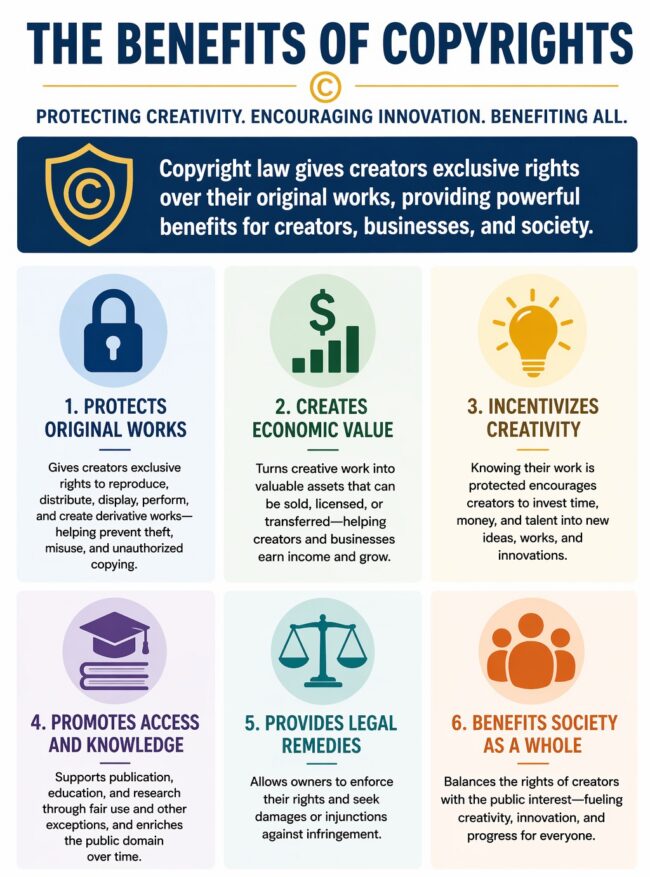
Formal copyright registration creates a public record of your work and claim. By making ownership information publicly available, registration can deter potential infringers and help discourage unauthorized reproduction. Registration provides several legal benefits:
Enforcement: For U.S. works, Copyright Office registration or refusal is generally required before filing a federal copyright infringement lawsuit. Submitting an application alone ordinarily is insufficient.
Financial remedies: Registering before infringement begins, or within three months after first publication for infringement beginning after publication, preserves eligibility for statutory damages and attorney fees.
Evidence: Registration before or within five years after first publication provides a rebuttable presumption of copyright validity and the facts stated in the certificate, helping prove ownership and support your claims.
Import protection: Registered copyrights can be recorded separately with U.S. Customs and Border Protection to help block imports of infringing goods, including counterfeit products reproducing your work.
Here are some answers to a few questions that are commonly asked about copyrights and the registration process:
Which intellectual property rights office handles registration?
U.S. copyright registration is completed through the U.S. Copyright Office. The United States Patent and Trademark Office handles patent and trademark matters.
How long does protection last?
For most individually authored works created since 1978, copyright lasts for the author’s life plus 70 years. Different rules apply to works made for hire and anonymous and pseudonymous works.
When can I use the © symbol?
You may use a copyright notice once your copyrightable work is fixed, before or after registration.
Can I discuss all my questions with an attorney?
You have access to a copyright attorney for guidance about your application and intellectual property rights, including ownership, licensing, and enforcement.
Our fees for copyright registration services include a flat fee for preparing and filing the application plus the government fees. Government fees vary by application type. We explain pricing and the scope of included services before work begins.
Whether you are preparing your first publication or managing a company’s creative portfolio, we help connect registration decisions with your business goals. Contact Sierra IP Law for a free consultation about your creation and copyright registration needs.
© 2026 Sierra IP Law, PC. The information provided herein does not constitute legal advice, but merely conveys general information that may be beneficial to the public, and should not be viewed as a substitute for legal consultation in a particular case.
"The team at Sierra IP Law was extremely professional, helpful and knowledgeable with regards to assisting me with my Trademark services! They were always quick to respond to emails and phone calls and I would highly recommend them for any of your trademark needs!"
David O.

Sierra IP Law, PC - Patents, Trademarks & Copyrights
FRESNO
7030 N. Fruit Ave.
Suite 110
Fresno, CA 93711
(559) 436-3800 | phone
BAKERSFIELD
1925 G. Street
Bakersfield, CA 93301
(661) 200-7724 | phone
SAN LUIS OBISPO
956 Walnut Street, 2nd Floor
San Luis Obispo, CA 93401
(805) 275-0943 | phone

SACRAMENTO
180 Promenade Circle, Suite 300
Sacramento, CA 95834
(916) 209-8525 | phone
MODESTO
1300 10th St., Suite F.
Modesto, CA 95345
(209) 286-0069 | phone
SANTA BARBARA
414 Olive Street
Santa Barbara, CA 93101
(805) 275-0943 | phone
SAN MATEO
1650 Borel Place, Suite 216
San Mateo, CA, CA 94402
(650) 398-1644. | phone
STOCKTON
110 N. San Joaquin St., 2nd Floor
Stockton, CA 95202
(209) 286-0069 | phone
PORTLAND
425 NW 10th Ave., Suite 200
Portland, OR 97209
(503) 343-9983 | phone
TACOMA
1201 Pacific Avenue, Suite 600
Tacoma, WA 98402
(253) 345-1545 | phone
KENNEWICK
1030 N Center Pkwy Suite N196
Kennewick, WA 99336
(509) 255-3442 | phone
2023 Sierra IP Law, PC - Patents, Trademarks & Copyrights - All Rights Reserved - Sitemap Privacy Lawyer Fresno, CA - Trademark Lawyer Modesto CA - Patent Lawyer Bakersfield, CA - Trademark Lawyer Bakersfield, CA - Patent Lawyer San Luis Obispo, CA - Trademark Lawyer San Luis Obispo, CA - Trademark Infringement Lawyer Tacoma WA - Internet Lawyer Bakersfield, CA - Trademark Lawyer Sacramento, CA - Patent Lawyer Sacramento, CA - Trademark Infringement Lawyer Sacrament CA - Patent Lawyer Tacoma WA - Intellectual Property Lawyer Tacoma WA - Trademark lawyer Tacoma WA - Portland Patent Attorney - Santa Barbara Patent Attorney - Santa Barbara Trademark Attorney
