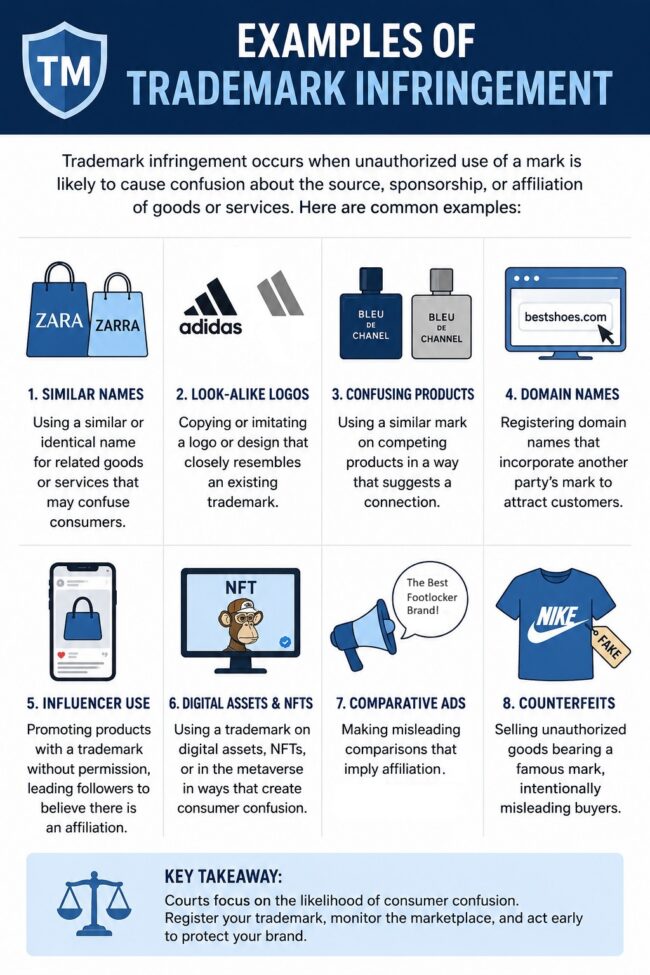
A trademark distinguishes a company’s products or services from those of others. It may be a word, symbol, design, color, package, or combination of branding elements. Trademark infringement occurs when unauthorized use is likely to cause consumer confusion about the source, sponsorship, or affiliation of goods or services. This article provides non-attorneys with examples of trademark infringement to demonstrate how infringement claims arise from the use of names, designs, domains, digital assets, and marketing. The examples will help you understand how trademark infringement occurs and how trademark rights are enforced.
The Lanham Act defines infringement by whether a use is “likely to cause confusion,” mistake, or deception. Courts compare the parties’ marks, the strength of the plaintiff’s mark, relatedness of the products, marketing channels, purchaser care, actual confusion, the defendant’s intent, and other factors. Similarity alone is insufficient. The trademark owner must establish a likelihood of confusion. Actual confusion is strong evidence, but is not always required for a finding of infringement.
Confusion can arise before purchase as initial-interest confusion, which diverts prospective purchasers, or after purchase as post-sale confusion, which affects public perception of the original brand. Contributory trademark infringement may also hold a party liable for inducing trademark infringement or knowingly continuing to supply an infringer.
Not every use of a pre-existing trademark owned by someone else is unlawful. Descriptive fair use, nominative fair use, and truthful comparative advertising may permit limited use of a competitor’s trademark or trademarked terms without suggesting sponsorship.
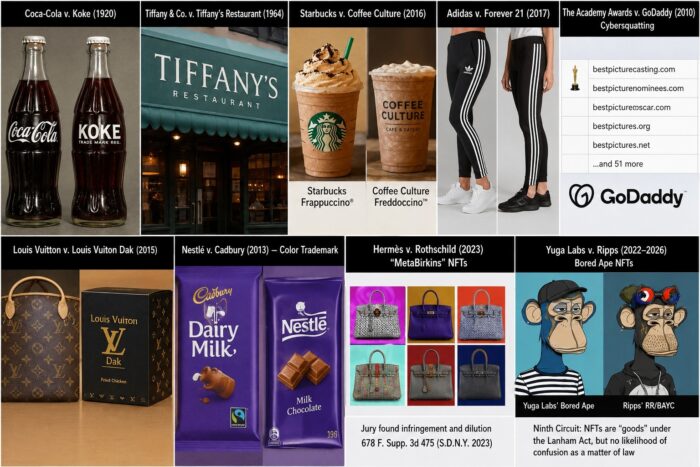
In The Coca-Cola Co. v. Koke Co. of America, 254 U.S. 143 (1920), competitors sold an imitation cola beverage under the name “Koke.” The Supreme Court found that the name was selected to benefit from Coca-Cola’s advertising and to sell the imitation as Coca-Cola’s goods. The Court held that the original trademark owner could enjoin the use of KOKE as trademark infringement and unfair competition. The case shows that changing the spelling, shortening a name, or substituting a phonetic equivalent may not avoid liability when the new designation is confusingly similar to a well-known trademark and the defendant’s goods closely resemble those sold under the famous mark. Although Koke predates the Lanham Act, its central lesson remains relevant to modern infringement claims: courts examine the probable effect on consumers, not merely whether the marks are technically identical.
International trademark infringement presents an additional territorial issue. In Abitron Austria GmbH v. Hetronic International, Inc., 600 U.S. 412 (2023), the Supreme Court held that the Lanham Act’s principal infringement provisions apply only to domestic “use in commerce.” Therefore, even when a U.S. trademark owner establishes that two marks are confusingly similar, the owner must identify actionable domestic conduct when pursuing U.S. infringement claims arising from foreign commercial activity.
In Tiffany & Co. v. Boston Club, Inc., 231 F. Supp. 836 (D. Mass. 1964), a federal court ruled that a Boston restaurant and lounge could not operate under the name “Tiffany’s.” Tiffany sold jewelry, silverware, and other luxury goods rather than restaurant services. Nevertheless, the restaurant selected the name because TIFFANY conveyed quality, promoted “Brunch at Tiffany’s” events at the restaurant, and prompted customers to ask whether Tiffany owned, operated, or sponsored the establishment. The court found a likelihood of confusion under the Lanham Act, concluded that the restaurant’s conduct also threatened dilution of Tiffany’s name, and permanently enjoined the restaurant from using TIFFANY in connection with its business.
This trademark battle demonstrates how famous trademarks can receive broader legal protection even when the parties operate in different industries. Famous trademark rights carry not only protection against trademark use that causes confusion (trademark infringement), but also protection against dilution. A business may face trademark infringement and unfair competition claims when it takes unfair advantage of a well known trademark, implies sponsorship or affiliation, or places the brand’s image and reputation in an unflattering light (i.e., by dilution). The same principle may protect a luxury fashion house, iconic retailer, or other owner of a famous mark. Fame alone, however, does not guarantee success: when pursuing an infringement claim, the trademark owner must still establish a likelihood of confusion under the applicable factors.
In 2016, Starbucks sued Obsidian Group, the parent company and operator of Coffee Culture cafés, over its “Freddoccino” frozen beverages. Starbucks Corp. v. Obsidian Group, Inc., No. 1:16-cv-00029-RJA, Complaint, ECF No. 1 (W.D.N.Y. Jan. 11, 2016). Starbucks alleged that FREDDOCCINO closely resembled its registered FRAPPUCCINO trademark in appearance, sound, and meaning: both began with “FR,” contained four syllables, ended in “CCINO,” and identified cold coffee drinks. Starbucks also alleged that the beverages’ appearance, similar cups, and circular branding in marketing materials could mislead consumers into believing Coffee Culture’s products were affiliated with, approved by, or comparable in quality to Starbucks products.
The dispute is commonly described as a settlement under which Coffee Culture stopped using the challenged name. The public docket, however, establishes only that Starbucks voluntarily dismissed the case before any court ruling on trademark infringement. Because the similar trademarks appeared on competing frozen coffee drinks sold through coffee shops, the alleged risk of consumer confusion was especially direct. The case illustrates that similar product names are evaluated by their overall commercial impression and likely source confusion—not spelling alone.
Adidas sued Forever 21 in 2017, alleging that apparel sold by the retailer displayed two-, three-, and four-stripe arrangements confusingly similar to Adidas’s registered three-stripe design. Adidas America, Inc. v. Forever 21, Inc., No. 3:17-cv-00377-YY (D. Or. filed Mar. 7, 2017). Adidas asserted trademark infringement, dilution, unfair competition, and breach of prior settlement agreements; Forever 21 argued that Adidas was trying to monopolize ordinary decorative stripes. The dispute illustrates that brand identity can reside in visual features. A design that closely resembles protected branding elements on competing products may confuse customers about source or sponsorship even when the alleged infringer uses a different company name. Courts examine the overall commercial impression, including the stripes’ number, placement, spacing, and orientation, rather than requiring exact duplication.
In Academy of Motion Picture Arts & Sciences v. GoDaddy.com, Inc., No. CV 10-03738 AB (CWx), 2015 WL 5311085 (C.D. Cal. Sept. 10, 2015), the Academy pursued legal action under the Anticybersquatting Consumer Protection Act concerning 293 customer-registered domains containing OSCAR or ACADEMY AWARDS. It alleged that GoDaddy’s parked-page program generated advertising revenue from traffic attracted by those marks. Before trial, the court had determined that 237 domains were confusingly similar and that GoDaddy used or trafficked in them as the registrants’ licensee. Fifty-six domains remained unresolved.
After a bench trial, the judge ruled for GoDaddy because the Academy failed to prove the required bad-faith intent to profit from its marks. The court also found GoDaddy protected by the ACPA’s good-faith safe harbor and therefore did not decide whether the remaining domains were confusingly similar.
The court’s decision shows why a confusing domain does not automatically establish intermediary liability. Although the case involved cybersquatting rather than an ordinary trademark infringement claim, every claim requires proof of the elements applicable to that defendant, including intent when the statute makes intent material.
Not all similar or identical trademarks result in infringement. Apple Corps, the Beatles’ music company, and Apple Computer, the computer and software company now known as Apple Inc., engaged in decades of legal battles over their identical “Apple” marks. Earlier agreements divided the parties’ trademark rights according to their different industries, rather than resolving a single trademark application or declaring every APPLE trademark owned exclusively by one party. The conflict intensified when Apple Inc. entered digital music, narrowing the separation between the goods or services offered by the two companies. In 2007, the parties settled: Apple Inc. became the trademark holder for the relevant marks and licensed certain rights back to Apple Corps. The dispute illustrates that identical trademarks may coexist until changing markets create a greater risk of consumer confusion.
Recent legal disputes and trademark infringement cases reflect evolving brand protection for digital assets. In Hermès v. Rothschild, Mason Rothschild created and sold a collection of “MetaBirkins” NFTs depicting digital versions of Hermès’s famous Birkin handbags covered in colorful faux fur. He promoted the project through social media and metabirkins.com. A jury found Rothschild liable for infringing and diluting Hermès’s BIRKIN marks and for cybersquatting, concluding that the project intentionally misled consumers about Hermès’s association with the NFTs. 678 F. Supp. 3d 475 (S.D.N.Y. 2023). In Yuga Labs, Inc. v. Ripps, defendants sold “RR/BAYC” NFTs tied to images identical to Yuga’s Bored Ape Yacht Club collection while presenting the project as criticism. The Ninth Circuit held Yuga’s NFTs are “goods” under the Lanham Act, but reversed summary judgment because likelihood of confusion remained factual. 144 F.4th 1137 (9th Cir. 2025). Traditional trademark principles govern; similarity alone is insufficient.
Trademark owners increasingly target individual influencers who do more than merely display counterfeit goods. In Nike, Inc. v. Tuinenburg, Nike alleged that sneaker influencer Nicholas Tuinenburg used social media, Discord communities, affiliate links, discount codes, and third-party sellers to promote and facilitate sales of replica Nike footwear. His company, Divide the Youth, also sold “Division Dunks” that copied the protected appearance of Nike’s DUNK shoes while replacing the Swoosh with its own star logo. The jury found willful trademark counterfeiting and infringement of Nike’s DUNK trademark and trade dress and awarded $11 million against Tuinenburg and Divide the Youth. Nike, Inc. v. Tuinenburg, No. 2:23-cv-10495-AB-AS (C.D. Cal. verdict Mar. 19, 2026). The verdict demonstrates substantial damages exposure in online trademark infringement cases involving counterfeit or infringing goods.
Parody is not automatically protected. In Jack Daniel’s Properties, Inc. v. VIP Products LLC, VIP sold a “Bad Spaniels” squeaky dog toy shaped and labeled like a Jack Daniel’s whiskey bottle, replacing “Old No. 7” and other wording with dog-waste jokes. The Ninth Circuit treated the toy as an expressive work entitled to heightened First Amendment protection. The Supreme Court disagreed that the expression in the toy avoided liability if it functioned as a source identifier. The court held that ordinary likelihood-of-confusion analysis applies when an alleged infringer uses the challenged designation as its own trademark, that is, as a source identifier for its goods. The Court also held that parody is not “noncommercial” merely because it comments humorously on another product. 599 U.S. 140 (2023). On remand, the district court subsequently found no trademark infringement because the parody was not likely to cause confusion, but found dilution by tarnishment and entered an injunction.
Before launching a brand, conduct thorough searches for federal and state trademark registrations, pending applications, common-law trademark uses, domains, and similar branding. A trademark or service mark must be vetted before it is used. The U.S. marketplace is very large and there are many overlapping trademark uses. So, a unique, fanciful or coined term should be selected in order to minimize the risk of overlapping with prior trademark use. Once a mark is selected, a search must be conducted for marks having similar sound, appearance, meaning, and commercial impression that would create a similar impression in the mind of the consumer. A trademark search for exact matches is far too narrow to identify all potential risks.
If the mark is sufficiently unique, a federal trademark application can be filed with the U.S. Patent and Trademark Office. The trademark registration process can take several months (e.g., 8-14 months), and so filing early is the best approach. Federal registration provides nationwide protection and enforcement tools. Distinctive marks are generally easier to register and enforce.
The marketplace should also be monitored regularly to identify potential infringements early. Trademark enforcement action (including cease and desist letters and possibly lawsuits) should be pursued early when infringements are identified. In order to maintain strong trademark protection rights, the trademark rights must be enforced. Failure to do so may weaken your rights and brand. A trademark attorney can assess risk and provide counsel on whether legal action is warranted in view of the potential harm to the trademark rights and brand, the potential monetary relief and outcome of a lawsuit, and costs and legal fees that result from pursuing a trademark infringement lawsuit.
These examples of trademark infringement show that similar names, product designs, packaging, domain names, digital assets, influencer promotions, and parody may create confusion about the source, sponsorship, affiliation, or approval of goods or services. Similarity alone, however, does not establish infringement. Courts evaluate the parties’ marks, their products and markets, purchaser care, evidence of actual confusion, intent, and other relevant factors. Qualifying famous trademarks may also receive separate protection against dilution even without direct competition or likely confusion. Businesses can reduce the risk of trademark disputes through careful trademark clearance, early registration through the U.S. trademark office, consistent brand use, marketplace monitoring, and proportionate enforcement. When a conflict arises, a trademark attorney can assess the parties’ rights, potential defenses and remedies, and the practical costs of pursuing or defending legal action.
© 2026 Sierra IP Law, PC. The information provided herein does not constitute legal advice, but merely conveys general information that may be beneficial to the public, and should not be viewed as a substitute for legal consultation in a particular case.

"Mark and William are stellar in the capabilities, work ethic, character, knowledge, responsiveness, and quality of work. Hubby and I are incredibly grateful for them as they've done a phenomenal job working tirelessly over a time span of at least five years on a series of patents for hubby. Grateful that Fresno has such amazing patent attorneys! They're second to none and they never disappoint. Thank you, Mark, William, and your entire team!!"
Linda Guzman


Sierra IP Law, PC - Patents, Trademarks & Copyrights
FRESNO
7030 N. Fruit Ave.
Suite 110
Fresno, CA 93711
(559) 436-3800 | phone
BAKERSFIELD
1925 G. Street
Bakersfield, CA 93301
(661) 200-7724 | phone
SAN LUIS OBISPO
956 Walnut Street, 2nd Floor
San Luis Obispo, CA 93401
(805) 275-0943 | phone

SACRAMENTO
180 Promenade Circle, Suite 300
Sacramento, CA 95834
(916) 209-8525 | phone
MODESTO
1300 10th St., Suite F.
Modesto, CA 95345
(209) 286-0069 | phone
SANTA BARBARA
414 Olive Street
Santa Barbara, CA 93101
(805) 275-0943 | phone
SAN MATEO
1650 Borel Place, Suite 216
San Mateo, CA, CA 94402
(650) 398-1644. | phone
STOCKTON
110 N. San Joaquin St., 2nd Floor
Stockton, CA 95202
(209) 286-0069 | phone
PORTLAND
425 NW 10th Ave., Suite 200
Portland, OR 97209
(503) 343-9983 | phone
TACOMA
1201 Pacific Avenue, Suite 600
Tacoma, WA 98402
(253) 345-1545 | phone
KENNEWICK
1030 N Center Pkwy Suite N196
Kennewick, WA 99336
(509) 255-3442 | phone
2023 Sierra IP Law, PC - Patents, Trademarks & Copyrights - All Rights Reserved - Sitemap Privacy Lawyer Fresno, CA - Trademark Lawyer Modesto CA - Patent Lawyer Bakersfield, CA - Trademark Lawyer Bakersfield, CA - Patent Lawyer San Luis Obispo, CA - Trademark Lawyer San Luis Obispo, CA - Trademark Infringement Lawyer Tacoma WA - Internet Lawyer Bakersfield, CA - Trademark Lawyer Sacramento, CA - Patent Lawyer Sacramento, CA - Trademark Infringement Lawyer Sacrament CA - Patent Lawyer Tacoma WA - Intellectual Property Lawyer Tacoma WA - Trademark lawyer Tacoma WA - Portland Patent Attorney - Santa Barbara Patent Attorney - Santa Barbara Trademark Attorney
