
A federal trademark search is a search of the database of prior trademark filings provided by the United States Patent and Trademark Office (USPTO). The search may involve searching for combined search terms, including keywords, specified goods and services, and classes of goods and services, to find prior related trademark filings that are similar to a proposed trademark or service mark. The search determines whether a desired trademark may conflict with a prior registration or trademark application for an existing brand before a business invests in packaging, advertising, or a trademark application. It can indicate whether a proposed trademark can be registered, identify potential infringement risks, and prevent expensive future rebranding.
This article provides an explanation of federal trademark searches and related topics for entrepreneurs and business owners. It aims to provide a greater understanding of the purpose and importance of conducting trademark searches before a committing to a mark.
A federal trademark search examines records maintained by the United States Patent and Trademark Office (USPTO), the federal trademark office responsible for administering federal trademark registrations. Although the USPTO handles both patent and trademark matters, each uses a separate system and database.
The USPTO database includes registered marks, pending applications, abandoned applications, and canceled or expired registrations. Each record may provide the mark’s wording or design, owner, serial number, filing date, registration status, identified goods or services, international trademark classes, and prosecution documents. Reviewing this information helps a searcher identify direct name matches as well as related marks that are similar in appearance, sound, meaning, or overall commercial impression.
A useful search therefore goes beyond entering the exact wording of a proposed mark. It may include spelling variations, phonetic equivalents, shortened forms, synonyms, dominant words, design elements, and related goods or services. The search results can reveal potential conflicts arising from earlier federal trademark applications or registrations and help determine whether further investigation is needed before a business adopts the mark or files its own application.
Section 2(d) of the Lanham Act permits refusal of a trademark application when a mark is likely to cause confusion with a prior mark. See 15 U.S.C. § 1052(d). Confusing use may also support trademark infringement claims under 15 U.S.C. §§ 1114(1) and 1125(a), potentially exposing a business to an injunction, monetary damages, attorneys’ fees in exceptional cases, and the loss of investments made in developing the brand.
A trademark search helps avoid lawsuits by evaluating whether customers may believe related goods or services come from the same owner, are affiliated, or have approved or sponsored one another. Identifying a potential conflict before launch gives a business the opportunity to select a different mark, narrow its services, modify its branding strategy, or seek consent from the prior owner. This can protect advertising expenditures, domain names, packaging, customer goodwill, and other investments that may otherwise be lost through forced rebranding.
A search cannot guarantee that no likelihood of confusion issues exists, but a careful search can save time and money and support a more informed decision. Businesses should document every query, date, result, and conclusion for future reference.
Use the official USPTO site and verify the “dot gov” address before entering any search information. The free trademark search tool provides direct access to the USPTO database. Begin with a basic search for the exact text of the desired trademark name. This “knock-out” search can quickly identify exact matches and obvious conflicts that may make further review necessary.
For each relevant record, open the complete entry rather than relying only on the summary displayed in the search results. Save a link or screenshot showing the search terms and date, and use the listed serial number to review the mark’s current status and documents in the Trademark Status and Document Retrieval system. Examine whether the record remains active and note any limitations in the identified goods or services. Real-time search results come directly from the USPTO search system, although newly filed documents may not appear immediately.
A complete trademark search must explore phonetic equivalents, alternate pronunciations, similar spellings, singular and plural forms, spacing changes, abbreviations, translations, and similar names. Search strong words separately and together, including any slogan, because minor differences may still create the same overall impression.
Likelihood of confusion is evaluated under the nonexclusive DuPont factors. Key considerations include the similarity of the marks in appearance, sound, meaning, or commercial impression; the relatedness of the goods or services; and whether they travel through overlapping channels of trade to the same customers. In re E.I. du Pont de Nemours & Co., 476 F.2d 1357 (C.C.P.A. 1973). Other factors may include the strength or fame of the prior mark, the number and nature of similar marks in use, purchaser sophistication, purchasing conditions, actual confusion, concurrent use without confusion, and agreements or other market interaction between the owners.
The factors are weighed according to the evidence. Not every factor applies in every situation, and one factor may be decisive. Similar trademarks therefore must be assessed as a whole rather than dissected into isolated components. In re Detroit Athletic Co., 903 F.3d 1297 (Fed. Cir. 2018).
Similar marks may coexist for unrelated products, so a conflict may not prevent trademark registration. Conversely, different classes do not eliminate risk because international class numbers are primarily administrative and do not determine whether goods or services are commercially related. Advanced tools can reveal similar names across different classes, but the searcher must compare the nature, purpose, users, and customary sources of the goods or services, along with the relevant customers and channels of commerce.
The identification of goods and services should be reviewed in each application or registration for similar marks. If an identification contains no restrictions on customers or trade channels, the USPTO may presume that the goods or services reach all ordinary purchasers through all normal channels for those offerings. The USPTO will treat such trademark registrations as broadly reaching all relevant consumers for the listed goods and services.
Treat trademarks not just as names but also as logos and design elements. The USPTO assigns six-digit design search codes to nonword features such as animals, shapes, plants, or a U.S. flag. The first pair of digits identifies a broad category, the second a narrower division, and the third a specific section.
To identify the proper codes, first list the prominent or significant features that would help a viewer recognize the logo or locate a similar design. Use the Trademark Design Search Code Manual’s alphabetical index to find a likely category, then review its divisions, sections, explanatory notes, cross-references, exclusions, and sample images. Do not rely solely on the ordinary name of an object.
Complex logos may require multiple codes for separately recognizable elements. Search each applicable six-digit code and broaden overly narrow results by searching at the division level without the final section digits with truncation syntax (e.g., DC:0301*). Also search the USPTO’s text descriptions and examine the codes assigned to visually similar marks for additional possibilities. Thoughtful code selection is essential. A word and a design can create similar commercial impressions even when they are not identical.
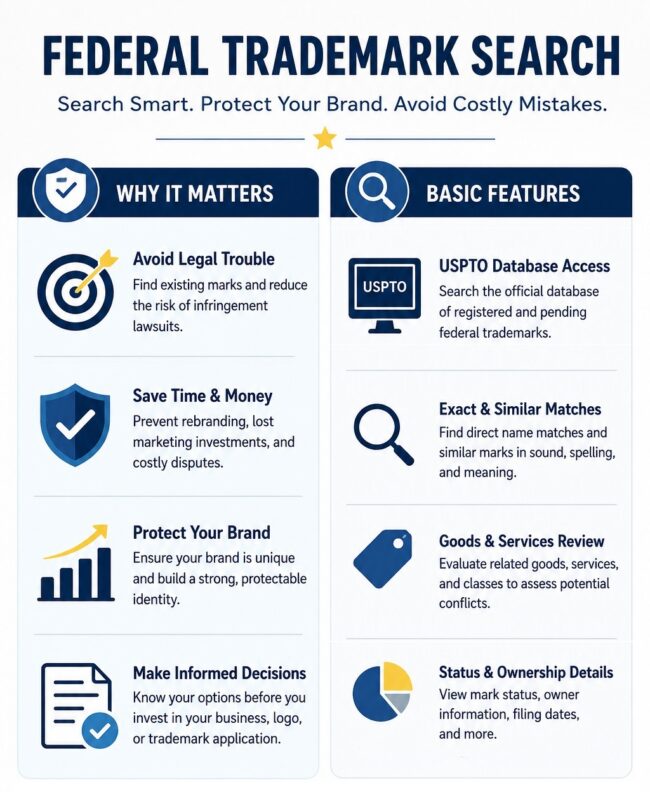
Conducting a federal trademark search helps check existing federal registrations, but it is not a comprehensive trademark search. Additional searches should be performed of state registries, business-name databases, websites, domain names, social media, marketplaces, app stores, trade directories, and industry publications.
A common law trademark may arise from use in commerce without federal registration. Common law trademark rights are limited to the geographic region in which the trademark is recognized by consumers. However, a senior common law trademark holder has superior rights to a later trademark registrant in that geographic region. A senior common law trademark holder may also challenge the registration of a confusingly similar mark filed by a junior user. Thus, common law marks require separate search efforts and can limit a later registrant’s ability to use or register a mark. See 15 U.S.C. § 1125(a).
A free trademark search or trademark engine can check basic brand availability, returning a list of similar marks in the USPTO database. Free searches provide useful exact-match answers and direct name matches. Advanced tools offer broader insights into similar marks and classes. Search tools, however, do not substitute for professional legal advice.
A professional comprehensive search can investigate federal and state records, common law use, ownership, related companies, and live, dead, pending, registered, or approved-for-publication records. Applicants should consider contacting a trademark attorney to perform the search, interpret matches, and assess registration and infringement risks.
The cost of a professional trademark clearance search varies significantly. There are online services that offer low-cost federal trademark searches (e.g., for $50~$200). However, these searches are generally just a search report identifying similar marks in the USPTO records without common law or state trademark searches, and without significant analysis or guidance. It is highly recommended that you seek the assistance of an attorney experienced in trademark law to conduct the search and analyze the results. An experienced trademark attorney can conduct a comprehensive search that does not miss potential sources of conflict with registered or unregistered marks, and can provide detailed guidance on the risks presented by your chosen trademark or service mark.
After the search results have been reviewed, you must decide whether to proceed, select another desired mark, or explore small alterations that may improve the chances of registration. A conflict does not always bar registration, but superficial changes may not resolve confusion.
If no material conflicts exist, file a USPTO trademark application through the online form at the USPTO's online Trademark Center. The applicant must identify the owner and filing basis, describe the mark, select the goods or services, submit the application, and monitor its status. Multiple classes require a fee for each class.
A federal trademark search is an essential part of selecting and protecting a brand, but it should not end with a search for exact matches in the USPTO database. Effective clearance requires evaluating similar marks, related goods and services, overlapping customers and trade channels, and potentially conflicting logos or design elements. Because relevant rights may also arise from state registrations and common law use, businesses should investigate sources beyond federal records and document the searches performed. The results should then be analyzed under the likelihood-of-confusion standard to determine whether to proceed, modify the proposed mark, seek consent, or choose a different brand. A careful, comprehensive search cannot guarantee registration or eliminate every infringement risk, but it can support informed decisions, reduce the likelihood of costly disputes, and help protect the business’s investment in its brand.
© 2026 Sierra IP Law, PC. The information provided herein does not constitute legal advice, but merely conveys general information that may be beneficial to the public, and should not be viewed as a substitute for legal consultation in a particular case.

"Mark and William are stellar in the capabilities, work ethic, character, knowledge, responsiveness, and quality of work. Hubby and I are incredibly grateful for them as they've done a phenomenal job working tirelessly over a time span of at least five years on a series of patents for hubby. Grateful that Fresno has such amazing patent attorneys! They're second to none and they never disappoint. Thank you, Mark, William, and your entire team!!"
Linda Guzman


Sierra IP Law, PC - Patents, Trademarks & Copyrights
FRESNO
7030 N. Fruit Ave.
Suite 110
Fresno, CA 93711
(559) 436-3800 | phone
BAKERSFIELD
1925 G. Street
Bakersfield, CA 93301
(661) 200-7724 | phone
SAN LUIS OBISPO
956 Walnut Street, 2nd Floor
San Luis Obispo, CA 93401
(805) 275-0943 | phone

SACRAMENTO
180 Promenade Circle, Suite 300
Sacramento, CA 95834
(916) 209-8525 | phone
MODESTO
1300 10th St., Suite F.
Modesto, CA 95345
(209) 286-0069 | phone
SANTA BARBARA
414 Olive Street
Santa Barbara, CA 93101
(805) 275-0943 | phone
SAN MATEO
1650 Borel Place, Suite 216
San Mateo, CA, CA 94402
(650) 398-1644. | phone
STOCKTON
110 N. San Joaquin St., 2nd Floor
Stockton, CA 95202
(209) 286-0069 | phone
PORTLAND
425 NW 10th Ave., Suite 200
Portland, OR 97209
(503) 343-9983 | phone
TACOMA
1201 Pacific Avenue, Suite 600
Tacoma, WA 98402
(253) 345-1545 | phone
KENNEWICK
1030 N Center Pkwy Suite N196
Kennewick, WA 99336
(509) 255-3442 | phone
2023 Sierra IP Law, PC - Patents, Trademarks & Copyrights - All Rights Reserved - Sitemap Privacy Lawyer Fresno, CA - Trademark Lawyer Modesto CA - Patent Lawyer Bakersfield, CA - Trademark Lawyer Bakersfield, CA - Patent Lawyer San Luis Obispo, CA - Trademark Lawyer San Luis Obispo, CA - Trademark Infringement Lawyer Tacoma WA - Internet Lawyer Bakersfield, CA - Trademark Lawyer Sacramento, CA - Patent Lawyer Sacramento, CA - Trademark Infringement Lawyer Sacrament CA - Patent Lawyer Tacoma WA - Intellectual Property Lawyer Tacoma WA - Trademark lawyer Tacoma WA - Portland Patent Attorney - Santa Barbara Patent Attorney - Santa Barbara Trademark Attorney
