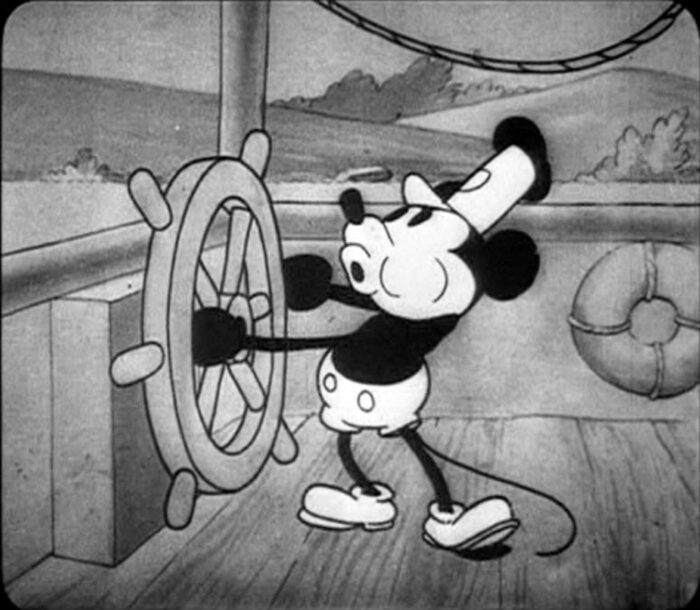
The expiration of the Steamboat Willie copyright became a popular issue when the 1928 cartoon entered the U.S. public domain on January 1, 2024. The lapse permits free use of the film’s original creative expression, but it did not release every version of Mickey Mouse. The Walt Disney Company still owns copyrights in many later iterations and retains extensive trademark rights related to the Mickey Mouse character. The subtleties of what versions and aspects of the Mickey Mouse character can be used without Disney's authorization are highly important to artists, filmmakers, businesses, and other creators planning new works that utilize the Steamboat Willie content.
We here explain what aspects of Steamboat Willie are in the public domain and what artists and authors can use in their own creative works.
Released in 1928, Steamboat Willie gave Mickey Mouse and Minnie Mouse their first widely distributed public appearance. Although the silent Plane Crazy was produced earlier, Steamboat Willie introduced audiences to Mickey through animation coordinated with synchronized sound. The film also featured Pete, historically called Peg Leg Pete. Its success marked a turning point for Walt Disney’s studio and established Walt Disney as a major force in animation. The value of the Steamboat Willie copyrights lay in both exclusive control and the film’s role in creating a durable character, brand, and intellectual property licensing platform.
Copyright law protects original creative works fixed in a tangible medium, including motion pictures, music, drawings, and other artistic works. Here, protection covered the film’s animation, visual designs, sequence, music, sound, and the creative expression embodied in the first versions of Mickey and Minnie. Disney’s copyright included rights to reproduce, distribute, perform, display, and prepare derivative works. Copyright does not protect the general idea of a cartoon mouse, but it can protect how the character is drawn and portrayed. See 17 U.S.C. §§ 102(a)–(b), 106.
The Steamboat Willie copyright was secured in 1928 under the Copyright Act of 1909. Works of that era generally needed publication with a copyright notice and timely renewal to receive the full copyright term. Those formalities differ from modern law, under which copyright protection generally begins when a work is created and fixed. Control over copying and unauthorized uses allowed Disney to develop the Mickey Mouse character without competitors duplicating their copyrighted work.
Congress lengthened copyright terms through the Copyright Act of 1976 and the Sonny Bono Copyright Term Extension Act of 1998. The latter, often mockingly referred to as the “Mickey Mouse Protection Act,” added 20 years and gave qualifying pre-1978 works a 95-year term. Under the pre-1978 renewal system, qualifying works had a 28-year initial term and 28-year renewal. The 1976 Act extended total protection to 75 years; the 1998 Act enlarged the renewal to 67 years, yielding 95 years total. Section 304(b) accordingly states that a copyright still in its renewal term when the 1998 Act took effect lasts 95 years from the date originally secured.
Disney supported the legislation along with a broader coalition. In Eldred v. Ashcroft, 537 U.S. 186 (2003), publishers relying on public-domain works challenged the Sonny Bono Copyright Term Extension Act, arguing that extending existing copyrights violated the Copyright Clause’s “limited Times” language and the First Amendment. The Supreme Court rejected both challenges. It held that a definite term remains “limited” after extension, relied on Congress’s historical practice, and ruled that no heightened First Amendment scrutiny was required because the idea-expression distinction and fair use safeguard speech.
The film remained protected through December 31, 2023. Because its copyright was secured in 1928, the applicable term ended at the close of 2023 after 95 years of protection under 17 U.S.C. §§ 304 and 305. Section 304 defines the copyright term length (95 years in this case) and Section 305 requires copyright terms to continue through December 31 of the year in which they would otherwise expire. The Steamboat Willie copyrights therefore expired automatically at midnight, and the film entered the U.S. public domain on January 1, 2024. No renewal, payment, or filing by Disney could extend the statutory maximum.
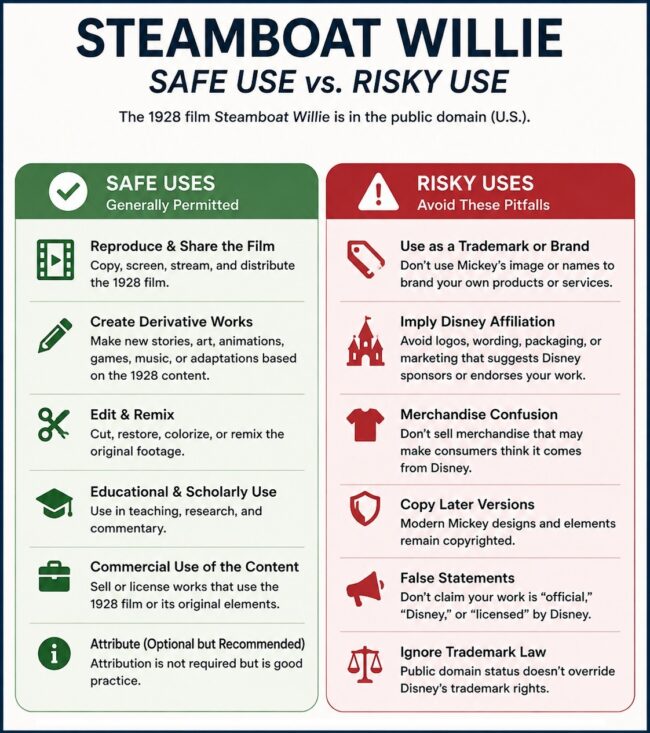
The 1928 film may now be copied, screened, restored, distributed through an archive, adapted, and remixed in the U.S. without the original creator’s permission or a copyright license. Creators may incorporate its public-domain expression into new works, while receiving copyright protection only for original material they add. Public-domain status does not erase authorship; it ends the former owner’s exclusive copyright rights in the work. This transition is a dramatic example of copyright’s intended balance between the creator's rights and public access: creators receive a substantial period of control, after which the public may preserve, study, and reinterpret the work.
The 2024 expiration placed only the expression in Steamboat Willie and other qualifying 1928 works, not the entire evolving Mickey Mouse character, into the public domain. The original version of Mickey is black-and-white, lacks gloves, has a long, thin tail, and looks rougher than the modern mouse. His signature gloves appeared in 1929, and his appearance changed significantly in later cartoons and movies.
There is an important current qualification. Qualifying 1929 Mickey works entered the U.S. public domain in 2025, and 1930 works followed in 2026. However, copyright infringement is analyzed on a work-by-work and version-by-version basis: the 2024 event freed the 1928 version of Mickey, while newer versions and later creative additions did not become free merely because Steamboat Willie did. Many familiar modern versions remain protected. An unauthorized use of a Mickey mouse -like character will be analyzed against both the public domain versions of mickey mouse and protected versions of Mickey, regardless of the author's intent. Thus, authors should be very careful about any derivative works based on Steamboat Willie.
Artists may reproduce the film and create derivative works based on its public-domain expression. A creator can make a new cartoon, book, game, play, artwork, or horror film using the original versions of Mickey and Minnie Mouse. Creative adaptations of the original Steamboat Willie were in development immediately after the copyrights expired. Projects in several genres were announced almost immediately, much as the public-domain arrival of Winnie the Pooh prompted unconventional adaptations. Public domain therefore encourages new creativity and reinterpretation of cultural works.
Klinger v. Conan Doyle Estate, Ltd., 755 F.3d 496 (7th Cir. 2014), reached a similar result in copyright litigation regarding Sir Arthur Conan Doyle's Sherlock Holmes character: once a story enters the public domain, its protected elements become fair game, but original additions from later copyrighted works remain protected. A new adaptation should rely on public-domain material or independently created expression, not copy Disney’s still-protected later versions.
Copyright and trademark protect different interests. Copyright protects creative expression for a limited time. Trademark law identifies the commercial source of goods and services and prevents consumer confusion about origin, sponsorship, or approval.
Disney retains trademarks for Mickey Mouse despite the copyright expiration. Trademark rights can last indefinitely while used in commerce and properly maintained through required trademark renewal filings. See 15 U.S.C. § 1059.
Disney’s trademark rights can limit use of Mickey Mouse as a brand, logo, or source identifier on merchandise consumers may believe comes from Disney. Branding that leaves consumers confused about whether Disney licensed, sponsored, or endorsed a product may be prohibited. Trademark law cannot, however, restore an expired copyright or bar copying public-domain expression because consumers associate it with the former copyright owner.
In Dastar Corp. v. Twentieth Century Fox Film Corp., 539 U.S. 23 (2003), Dastar copied and edited a public-domain television series, sold videos under its own name, and did not credit Fox. Fox alleged reverse passing off under § 43(a) of the Lanham Act, arguing Dastar falsely claimed to be the videos’ origin. The Supreme Court rejected the claim. It held that “origin of goods” means the producer of the tangible goods sold, not the author of ideas or creative content embodied in them. Because Dastar produced the physical videos, the Lanham Act did not require attribution. The Dastar holding prevents 15 U.S.C. § 1025(a)(1)(A) from becoming a perpetual right of attribution in the authorship of communicative content. It does not establish that public-domain imagery can never function as a trademark or that source-identifying use of such imagery is immune from infringement, false-association, or dilution claims.
That distinction is particularly important here. A creator may copy public-domain expression as expression, but using that same material prominently as a brand or product-source designation can implicate trademark law. Jack Daniel’s expressly distinguishes expressive use from use “as a mark.” A contrary interpretation, the Court warned, would create a “mutant copyright” of perpetual duration. Dastar therefore preserves claims based on misleading source, sponsorship, or affiliation while preventing trademark law from removing public-domain material from lawful use.
Free use does not mean risk-free use. Copying protected features from later versions of Mickey may create copyright infringement exposure, while using Mickey as the creator’s own trademark may create a likelihood of consumer confusion.
In Jack Daniel’s Properties, Inc. v. VIP Products LLC, 599 U.S. 140 (2023), VIP Products sold a “Bad Spaniels” dog toy that mimicked Jack Daniel’s bottle and label trade dress while adding parody. The Ninth Circuit applied the Rogers First Amendment test established in Rogers v. Grimaldi, 875 F.2d 994 (2d Cir. 1989) and treated the use as non-actionable parody. The Supreme Court vacated that decision. It held that Rogers does not apply when an expressive design serves as a source identifier for the defendant’s goods. Parody remains relevant because obvious mockery may reduce perceived affiliation. Rather, ordinary trademark analysis governs whether consumers are likely to be confused.
The boundary between copyright and trademark use is already producing legal challenges. In 2025, Disney sued over a “Mickey 1928 Collection” of jewelry, alleging that the seller used Mickey as a trademark and suggested an affiliation with Disney. Disney Enterprises, Inc. v. Red Earth Group Limited d/b/a Satéur, No. 2:25-cv-06469 (C.D. Cal.). Disney alleged that Satéur’s “Mickey 1928 Collection” used Mickey imagery, names, packaging, and branding to suggest affiliation with Disney. The case ended in a stipulated final judgment and permanent injunction. The allegations show why creators should identify their own company as the source and state clearly that a new creation is not produced, sponsored, licensed, or approved by Disney, avoid Disney-style branding, and be very cautious about using public domain images and content in the context of merchandise.
The lapse of the Steamboat Willie copyrights illustrates the balance at the center of intellectual property law that applies even in the case of hugely successful and popular creative works. Copyright protected Disney’s valuable film and character expression for the limited 95-year term. Public-domain status now allows creators to build on the 1928 work without Disney's permission. However, later versions of Mickey Mouse and other works remain subject to their own copyright terms, and Disney’s trademark rights still protect its characters and branding from consumer confusion. Creators may use what is in the public domain, but they should respect protected later expression and avoid presenting new works as being associated with the Walt Disney company.
© 2026 Sierra IP Law, PC. The information provided herein does not constitute legal advice, but merely conveys general information that may be beneficial to the public, and should not be viewed as a substitute for legal consultation in a particular case.

"Mark and William are stellar in the capabilities, work ethic, character, knowledge, responsiveness, and quality of work. Hubby and I are incredibly grateful for them as they've done a phenomenal job working tirelessly over a time span of at least five years on a series of patents for hubby. Grateful that Fresno has such amazing patent attorneys! They're second to none and they never disappoint. Thank you, Mark, William, and your entire team!!"
Linda Guzman


Sierra IP Law, PC - Patents, Trademarks & Copyrights
FRESNO
7030 N. Fruit Ave.
Suite 110
Fresno, CA 93711
(559) 436-3800 | phone
BAKERSFIELD
1925 G. Street
Bakersfield, CA 93301
(661) 200-7724 | phone
SAN LUIS OBISPO
956 Walnut Street, 2nd Floor
San Luis Obispo, CA 93401
(805) 275-0943 | phone

SACRAMENTO
180 Promenade Circle, Suite 300
Sacramento, CA 95834
(916) 209-8525 | phone
MODESTO
1300 10th St., Suite F.
Modesto, CA 95345
(209) 286-0069 | phone
SANTA BARBARA
414 Olive Street
Santa Barbara, CA 93101
(805) 275-0943 | phone
SAN MATEO
1650 Borel Place, Suite 216
San Mateo, CA, CA 94402
(650) 398-1644. | phone
STOCKTON
110 N. San Joaquin St., 2nd Floor
Stockton, CA 95202
(209) 286-0069 | phone
PORTLAND
425 NW 10th Ave., Suite 200
Portland, OR 97209
(503) 343-9983 | phone
TACOMA
1201 Pacific Avenue, Suite 600
Tacoma, WA 98402
(253) 345-1545 | phone
KENNEWICK
1030 N Center Pkwy Suite N196
Kennewick, WA 99336
(509) 255-3442 | phone
2023 Sierra IP Law, PC - Patents, Trademarks & Copyrights - All Rights Reserved - Sitemap Privacy Lawyer Fresno, CA - Trademark Lawyer Modesto CA - Patent Lawyer Bakersfield, CA - Trademark Lawyer Bakersfield, CA - Patent Lawyer San Luis Obispo, CA - Trademark Lawyer San Luis Obispo, CA - Trademark Infringement Lawyer Tacoma WA - Internet Lawyer Bakersfield, CA - Trademark Lawyer Sacramento, CA - Patent Lawyer Sacramento, CA - Trademark Infringement Lawyer Sacrament CA - Patent Lawyer Tacoma WA - Intellectual Property Lawyer Tacoma WA - Trademark lawyer Tacoma WA - Portland Patent Attorney - Santa Barbara Patent Attorney - Santa Barbara Trademark Attorney
