Two primary forms of intellectual property protection are trademark and copyright, each serving distinct purposes under U.S. intellectual property law. In essence, trademarks protect brand identity in commerce, while copyrights protect creative works and original expression. This article provides a clear comparison of trademark and copyright law in the United States. We explore the scope of each form of protection, how they are obtained, the legal benefits of federal registration, and practical examples illustrating how trademark and copyright law apply differently in real-world business scenarios.
A trademark is a type of intellectual property that protects brand identifiers: the names, logos, and other symbols that distinguish a company’s products or services in the marketplace. Under the Lanham Act (statutory federal trademark law), a trademark can include “any word, name, symbol, or device, or any combination thereof” used by a person “to identify and distinguish his or her goods…from those manufactured or sold by others and to indicate the source of the goods”. In short, a trademark is a legally protected brand indicator. Service marks are the same as trademarks except they apply to services rather than goods.
The primary purpose of trademark law is to protect brand identity and prevent consumer confusion. By ensuring that only the trademark holder can use a particular mark for certain goods or services, trademarks help consumers identify the source of products and services. As the U.S. Supreme Court explained, federal trademark law prevents competitors from copying a source-identifying mark, which reduces the customer’s costs of shopping and making purchasing decisions and ensures a producer will reap the financial, reputation-related rewards of its product’s goodwill. For example, a trademark registration for a business name or logo gives the company the exclusive right to use that name or logo for the registered classes of goods or services, so that other businesses cannot use a similar name or logo in a way that would confuse consumers about the source of the goods.
To qualify for trademark protection, a mark generally must be distinctive. This means it can identify the source of goods and distinguish them from others. Generic terms (the common name of a product) cannot be protected as trademarks, and descriptive terms are only protectable if they acquire secondary meaning associated with a particular source. By contrast, suggestive, arbitrary, or fanciful marks (like coined brand names or logos) are inherently distinctive and can function as a trademark and be federally registered under trademark law. For instance, “Apple” as a brand for computers is an arbitrary mark that does not describe the product and is thus protectable. In contrast, “Fresh Apple Juice” for a juice brand includes descriptive ("Fresh") and generic ("Apple Juice") elements for that product and is not eligible for trademark protection without secondary meaning.
Importantly, trademark rights in the U.S. arise from use in commerce. Simply being the first to coin a name or design a logo isn’t enough; the mark must be used to identify goods or services in the marketplace to create trademark rights. From the first actual use of a mark on goods or services, one obtains common law trademark rights in the geographic area of use, even without any formal registration. Such common law rights are governed by state and common law principles. Common law rights can be enforced to a degree, but they are limited. For example, common law rights are limited to the region where the mark is used and known.
Obtaining a federal trademark registration through the United States Patent and Trademark Office (USPTO) is highly recommended for broader protection. Federal registration creates a presumption of nationwide rights and gives significant legal advantages to the trademark owner that are not available under common law alone. We will discuss the trademark registration process and its benefits further below.
A copyright is a form of intellectual property that protects original creative works fixed in a tangible form. The U.S. Copyright Act provides that copyright protection subsists in original works of authorship fixed in any tangible medium of expression from which they can be perceived, reproduced, or otherwise communicated. In simpler terms, any creative work that an author produces and writes down or records is automatically subject to copyright protection. Original works include a wide range of creative works: literature, articles, websites and blog content, visual art, photographs, music, audio recordings, videos, films, sculptures, and computer programs (software code), among others. Even business materials like marketing content, product manuals, or software user interfaces can be protected by copyright if they contain original expression. Copyright covers both published and unpublished works, as long as they meet the originality and fixation requirements.
The purpose of copyright law is to protect and encourage creative expression by giving authors exclusive rights to their works. These exclusive rights are defined by statute (17 U.S.C. § 106) and include the right to reproduce the work, create derivative works (adaptations or modifications), distribute copies of the work, publicly perform or display the work, and, for sound recordings, to perform the work by digital transmission. For example, the author of a software code (which is treated as a literary work under copyright) has the exclusive right to make copies of that code, to create modified versions or improvements, and to distribute or license the software. Likewise, the creator of an original graphic or photo on a website has the exclusive right to reproduce or display that image. If someone else wants to use or copy a creative work, they generally need permission from the copyright owner, unless an exception like fair use applies.
Copyright arises automatically upon creation of the work in tangible form: there is no requirement to file or register a work to create copyrights. The moment you, for instance, write an original blog article or design an original graphic and save it (fix it in a tangible medium, whether on paper or digital file), you are the copyright owner of that work. This automatic protection is different from trademarks, which require use in commerce and benefit greatly from registration. However, while formal registration with the U.S. Copyright Office is not required to have a copyright, it does confer important legal benefits, especially if you ever need to enforce your rights in court. We will discuss the copyright registration process and its advantages shortly.
It is important to note the limits of copyright. Copyright law protects the original expression of ideas, not the underlying facts, ideas, processes, or systems themselves. The statute explicitly says no copyright protection extends to “any idea, procedure, process, system, method of operation, concept, principle, or discovery” regardless of how it is described. Courts have long held as a fundamental axiom that no one may copyright facts or ideas. For example, a list of facts or data (like a database of customer addresses) is not protected by copyright unless there is some creative selection or arrangement, and even then the facts themselves remain free for anyone to use. This principle was affirmed by the U.S. Supreme Court in Feist Publications, Inc. v. Rural Tel. Serv. Co., which denied copyright for a white-pages phone directory consisting of factual listings. 499 U.S. 340 (1991).
Similarly, short phrases, titles, and slogans are generally not protected by copyright because they lack sufficient creativity or are considered ideas. This is a key difference: a slogan or short phrase might be protectable as a trademark if it identifies a brand (e.g., a slogan like “Just Do It” is a registered trademark of Nike), but the same phrase would not get copyright protection due to lack of originality and length. Thus, copyright protects creative works, whereas trademark protects brand names, logos, and other identifiers. Both are forms of intellectual property, but they apply to very different subject matter.
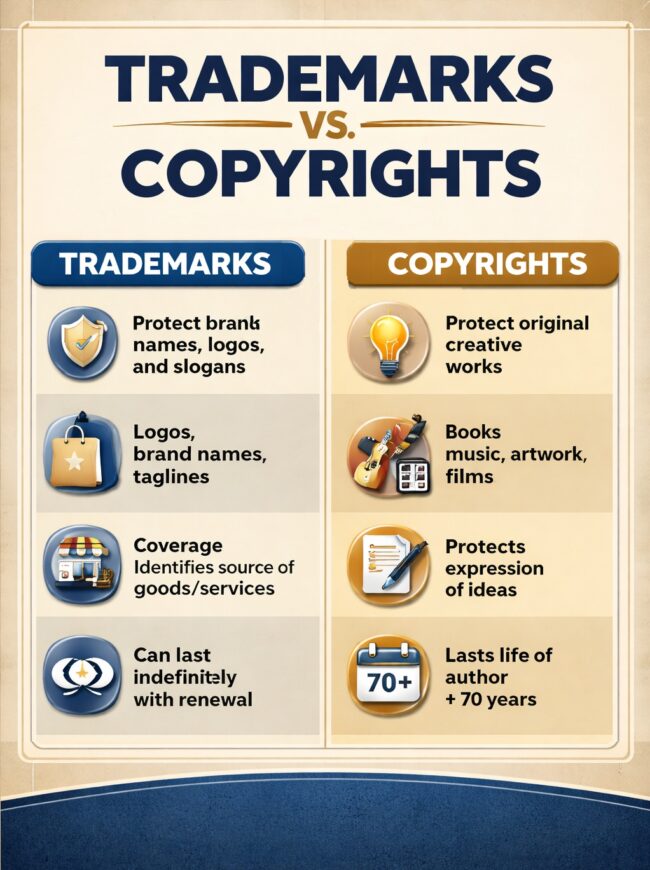
The most fundamental difference between trademark and copyright is the subject matter they protect. Trademark law protects symbols of brand identity: words, names, logos, slogans, colors, sounds, or even packaging and product designs (trade dress) that indicate the source of goods or services. Examples of trademarks include company names (e.g., Nike for athletic apparel), product names (e.g., iPhone for smartphones), brand logos (e.g., Apple’s apple-with-a-bite logo), taglines or slogans (e.g., Nike’s “Just Do It”), and even distinctive elements of product packaging or store appearance, referred to as trade dress (e.g., Tiffany & Co.'s blue box). Trademark rights protect against confusingly similar marks. The trademark owner has the right to prevent other businesses from using a name or mark that is so similar that it would likely confuse consumers about the origin of the goods or services. The focus is on consumer perception. Trademarks exist to identify and distinguish products in the marketplace.
In contrast, copyright law protects original creative expression in a work. This can be thought of as the actual content or substance that someone creates: the text of an article or book, the code of a software program, the design of a graphic, the composition of a song, etc. Copyright gives the creator exclusive rights to use and authorize use of the creative work. Unlike trademarks, the scope of copyright protection has nothing to do with consumer confusion or marketplace competition. It is solely about protecting the author’s expression from unauthorized copying or exploitation. Another key distinction in scope: trademark rights are generally limited to specific categories of goods or services. A trademark is registered in certain classes of goods/services, and another company might use a similar name in a totally unrelated industry without infringement if consumers aren’t likely to be confused (e.g., there is no meaningful consumer confusion between Delta Airlines and Delta faucets).
Copyright rights, however, are universal to the work. If you own the copyright to a photograph or a piece of software code, no one can reproduce it or make derivative works in any context without permission, regardless of industry or intent, unless the use qualifies as fair use or the work has fallen into the public domain after expiration.
Trademarks and copyrights also differ greatly in how long protection lasts. A trademark can potentially last forever. Trademark rights have no fixed term of years, but they require continuous use and periodic renewal. Under U.S. law, a federal trademark registration initially lasts 10 years and can be renewed indefinitely for additional 10-year periods, as long as the mark is still in use in commerce, and the registrant provides to the US Patent and Trademark Office proof of continued use and payment of renewal fees. The logic is that trademark rights persist as long as the brand is actively used to identify source and has not become generic. However, if a trademark owner abandons use of the mark (e.g., by non-use for three years with intent not to resume is deemed abandonment, per 15 U.S.C. § 1127) or if the mark becomes a generic term in the public’s eyes for the product, the trademark protection can be lost. Famous examples of marks that became generic and lost protection include “aspirin” and “escalator”: originally brand names that became the generic name of the product for the consumer. Generally though, a trademark can be maintained in perpetuity with diligent use and enforcement. For example, registered trademarks like Coca-Cola® or Microsoft® have been protected for many decades and will continue to be, as those companies actively use and defend their marks.
Copyright, by contrast, has a finite duration determined by statute. Modern U.S. copyright law (post-1978 works) provides that a copyright in an individual work lasts for the life of the author plus 70 years after the author’s death for works made by individual creators. For works made for hire or anonymous works (e.g., corporate creations), the term is 95 years from first publication or 120 years from creation, whichever expires first. After the copyright term ends, the work enters the public domain, meaning anyone is free to use it without permission. The expiration of copyright is a fundamental aspect. It ensures that creative works eventually become free for the public to build upon.
Trademark law has no analogous automatic expiration. The closest concept is that a trademark can effectively end if usage stops or it becomes generic, but there is no pre-set term as long as it is renewed and in use. This difference has real business implications. For example, the copyrights in classic novels like those by Jane Austen are expired and the works are in the public domain. Thus, anyone can publish or adapt them without permission. But a company’s brand name can remain legally protected forever if the company continues to exist and use the mark (think of long-lasting brands like Coca-Cola or Ford). Thus, failing to maintain use of a trademark could mean losing potentially perpetual rights, whereas failing to renew a copyright simply means eventually it will expire as scheduled by law.
A trademark owner’s primary right is to prevent others from using the same or a confusingly similar mark in commerce in a way that is likely to mislead consumers. Trademark infringement is defined generally as unauthorized use of a protected mark or a confusingly similar mark in connection with goods or services in a manner likely to cause confusion, mistake, or deception among the consuming public as to the source, sponsorship, or affiliation of those goods or services. 15 U.S.C. §§ 1114(1), 1125(a)(1). The trademark owner does not literally own a word or symbol in gross. They own it as a mark for specific goods/services. For instance, if you have a trademark on the brand name “Sunburst Electronics” for computer equipment, you can stop another electronics company from branding its products “Sunburst” because that would likely confuse customers. But you typically could not stop an unrelated business, say a “Sunburst Hotel,” unless your mark is famous and you are able to claim dilution.
Trademark law is mainly about preventing confusion in a particular market. Trademark law also provides causes of action for related violations like trademark dilution (blurring or tarnishing a famous mark’s distinctiveness, under 15 U.S.C. § 1125(c)) and false advertising/passing off under Section 43(a) of the Lanham Act. The trademark owner has the right to use the ® symbol once a mark is federally registered, and to sue for infringement in federal court with the benefits of registration, including potential recovery of infringer’s profits, damages, and even attorney’s fees in exceptional cases, per 15 U.S.C. § 1117(a). In summary, trademark protection gives you exclusive rights to your brand identity in commerce and legal tools to stop competitors from using branding that would confuse consumers or dilute your brand.
A copyright owner, on the other hand, holds a bundle of exclusive rights in the creative work as enumerated in 17 U.S.C. § 106. These include the right to reproduce the work, prepare derivative works (i.e., adaptations, translations, sequels), distribute copies to the public, perform the work publicly (for example, a play or film), and display the work publicly. Only the copyright owner or licensees may do these things; if anyone else does so without permission, it constitutes copyright infringement under 17 U.S.C. § 501. For example, if you write original content for your business’s website or code for a software application, you have the exclusive right to control who can copy that text or code or create new content derived from it. No one can lawfully copy and paste your website text onto their own site or incorporate your software code into their product without your permission, unless a specific exception like fair use applies.
Unlike trademark, consumer confusion is irrelevant in copyright infringement; the question is simply whether a protected expression was used without authorization. Even if someone copies your content and gives you credit (avoiding confusion about authorship), it’s still infringement unless it is authorized by you. Copyright also differs in that it does not protect any names or short phrases. So, if someone uses the same slogan or title as yours, that alone is not a copyright issue. Conversely, it could be a trademark issue if it identifies a product or service. Overall, copyright protection grants the creator broad control over the use of their original works, whereas trademark protection protects specific marks with respect to particular goods or services, and prevents marketplace confusion of the source of the particular goods or services.
While common law trademark rights can exist without registration, federal trademark registration with the USPTO is highly beneficial and is often crucial for nationwide brand protection. The trademark registration process involves filing an application with the USPTO, which includes details of the mark, the goods or services it’s used with, and often a specimen showing the mark in use, unless filing on an intent-to-use basis, in which case proof of use will be provided later. The USPTO will examine the application for compliance and check for conflicts with existing registered or applied-for marks.
A trademark search before filing is wise to ensure no other similar mark is out there that could bar your registration. If the application meets all requirements and no confusingly similar marks are found (or any such issues are resolved), the mark is published for opposition. If no trademark opposition is filed, the mark proceeds to registration. Upon registration, the owner may use the ® symbol. Federal registration confers significant legal advantages: nationwide presumptive rights as of the filing date, a legal presumption of the validity of the mark and the registrant’s ownership under 15 U.S.C. § 1057(b), the ability to sue in federal court and invoke certain statutory remedies, and the opportunity after five years to make the mark incontestable, which limits certain defenses against it, per 15 U.S.C. § 1065. It also allows recording the trademark with U.S. Customs to block importation of counterfeit goods.
The USPTO is the federal agency that administers trademark registration. It is part of the federal government (Department of Commerce) tasked with granting patents and registering trademarks. Federal registration is not free, there are filing fees per class of goods/services. If you skip registration and rely on common law trademark rights, you may still use “™” and can enforce your mark within your local area of use, but you could face challenges expanding nationally, and another party might register a similar mark and gain nationwide priority over you. Thus, failing to register a trademark can put your brand at risk.
Copyright protection is automatic, but there are compelling reasons to go through the copyright registration process with the U.S. Copyright Office. The process is generally simpler and cheaper than trademark registration. It involves submitting an application, a modest filing fee, and a copy or specimen of the work (the deposit) to the Copyright Office. The Office does not deeply examine the artistic merit. It mainly checks the application for completeness and that the work is subject to copyright. It may refuse registration for clearly uncopyrightable content like entirely blank forms or short phrases, etc., but there is not an extensive examination like trademarks.
Once the copyright application is processed and approved, a certificate of registration is issued. Importantly, under U.S. law, registration is a prerequisite to filing a copyright infringement lawsuit for works of U.S. origin under 17 U.S.C. § 411(a). The Supreme Court confirmed in Fourth Estate Public Benefit Corp. v. Wall-Street.com, LLC that one must have an issued registration or a refusal of registration before suing for infringement in federal court. 586 U.S. 881 (2019). So if your work is not registered at the time of infringement, you will need to register it and wait for the certificate before you can take legal action in court.
Moreover, if you register your work before an infringement happens (or within three months of first publication of the work), you gain access to special remedies: statutory damages and potential attorney’s fees under 17 U.S.C. § 412, § 504, § 505. Statutory damages mean you don’t have to prove actual losses. The law allows an award per work infringed, ranging generally from $750 up to $30,000 per work, and up to $150,000 per work for willful infringement. Attorney’s fees can also be awarded at the court’s discretion to a prevailing party, which can make pursuing a case more feasible. If you do not timely register, you are limited to actual damages and infringer’s profits, which can sometimes be hard to prove, and you cannot recover your attorney’s fees, making litigation more difficult and expensive to justify.
Thus, copyright registration provides significant legal advantages when enforcing your rights. It also serves as public record of your ownership and creates a presumption of validity of the copyright if done within five years of publication per 17 U.S.C. § 410(c). However, unlike trademark, you don’t need to register to put a notice on your work. You can use the copyright symbol (©), your name, and year on published works to inform the public of your claim. This notice is not mandatory under modern law but is still a good practice. In summary, formal registration of copyrights, while not required to be “legally protected,” is crucial if you ever foresee needing to take legal action to stop infringement or claim damages.
Both trademark and copyright protections discussed here are creatures of U.S. federal law, and they are generally territorial. A U.S. trademark registration gives rights in the United States and its territories, and a U.S. copyright likewise is enforceable in the U.S. with some international effect via treaties like the Berne Convention for international copyright protection, and Madrid Protocol for international trademark protection. The key point for business owners is that if you operate globally, you may need to secure rights in other countries separately. A U.S. trademark or copyright does not automatically grant international protection. You would need to file in other jurisdictions to protect your IP abroad.
Trademark owners are responsible for their own trademark enforcement, including policing their marks and stopping unauthorized uses that could harm their brand or confuse consumers. If another business uses a name, logo, or other mark that is identical or substantially similar to your trademark in a way that overlaps with your market or goods or services, you likely have a case for trademark infringement. The legal test for infringement is “likelihood of confusion”: would an average consumer be likely to believe that the infringer’s goods or services are coming from the trademark owner or are approved or affiliated with them due to the similarity of the marks and business context? To enforce rights, trademark owners often start by sending a cease and desist letter to the infringing party. If that fails, the owner can file a civil lawsuit in either state court or federal court. In federal court, the Lanham Act provides the causes of action for both infringement of registered marks (15 U.S.C. § 1114) and for unregistered marks (false designation of origin under 15 U.S.C. § 1125).
Remedies for trademark infringement can include:
Besides litigation, trademark owners should also monitor the USPTO’s Trademark Gazette for potentially conflicting applications and file oppositions or petitions for cancellation to prevent registration of confusingly similar marks by others. Common law rights can be asserted in state courts or as part of a federal unfair competition claim, but they lack the nationwide scope. For example, two businesses in different regions might each have common law rights to the same name until one expands or registers. This underscores the value of federal registration and early enforcement. Failing to enforce your trademark can lead to weakening of your rights or even loss. As a trademark owner, being proactive in enforcement is key to maintaining a strong brand.
Copyright infringement occurs when someone violates one of the exclusive rights of the copyright holder without authorization and without a valid defense. This typically means copying or using someone’s protected expression, whether by reproducing text, images, code, music, etc., or by distributing it, publicly displaying it, creating an unauthorized derivative, and so on. Unlike trademark, there is no requirement of commerce or consumer confusion. For example, if a competitor copies paragraphs from your website for their own site, or uses your photograph in their advertising, that is copyright infringement. If a former employee takes your software code and reuses portions in a competing program without permission, that’s infringement of your software copyright.
Copyright owners often enforce their rights by sending a cease and desist notice or a DMCA takedown request for online infringements, under the Digital Millennium Copyright Act’s notice-and-takedown system. To escalate enforcement, the copyright owner may file a lawsuit in federal court. As mentioned, you need a copyright registration in hand to file a suit for U.S. works.
If successful in a copyright infringement lawsuit, the owner can obtain an injunction to stop further infringement and, depending on the timing of registration, can seek either actual damages plus any profits the infringer made from using the work or statutory damages set by law. Statutory damages can be very potent. The court can also order the destruction or impounding of infringing copies. Attorney’s fees and costs can potentially be awarded to the prevailing party, which is a major benefit if you registered early, as it can deter infringers (they know they might have to pay your legal fees) and make it financially viable for you to pursue a case.
Criminal enforcement is rarer for copyright, but the law does criminalize willful commercial piracy (e.g. bootleg movie distribution) under certain circumstances. Generally, most business-related copyright disputes are handled civilly. As noted earlier, there are exceptions for certain unauthorized uses of copyright material, such as the fair use exception, which permits the use of copyright material for commentary, parody, news reporting, or other transformative uses. However, fair use is a complex defense that courts analyze case-by-case. Trademark law has limited trademark fair use defenses, including nominative fair use or descriptive fair use of marks in limited cases, and First Amendment defenses in parody cases.
Failure of the copyright holder to enforce a copyright does not cause loss of the copyright: you won’t lose ownership just because you didn’t sue an infringer. However, it can have practical downsides, such as the work might be widely exploited by others, diminishing its value, and you might be seen as acquiescing to some uses. In trademark, inaction can be more directly harmful because it might contribute to your mark becoming generic or losing distinctiveness, or you could be barred by laches (unreasonable delay) from seeking certain remedies against an infringing party. So both trademark and copyright owners should be vigilant, but trademark owners in particular must actively police the use of their brand to avoid dilution or genericide.
To illustrate how trademark and copyright protections apply differently, let’s look at a few real-world business scenarios:
Consider a startup software company that creates a new business name and a distinctive logo. The brand name (e.g., “TechNova Solutions”) is something they would protect through trademark for use on their services. They do a trademark search to ensure no one else has a similar name in the industry, then file a trademark application to register “TechNova Solutions” as a service mark for software development services. Once registered, this gives them the exclusive right to use that name for those services in the U.S., and to stop later companies from using confusingly similar names.
The company also has a logo composed of a creative graphic design. The logo can have dual protection: as a trademark and as a copyrighted work. The graphic itself is original artwork fixed in digital form, so the designer automatically has copyrights therein. Suppose a competitor starts using a very similar logo for related services: the company could sue for trademark infringement even if the competitor didn’t literally copy the graphic but came up with a lookalike. If another party outright copies the logo design and prints it on merchandise or uses it on a website without permission, that’s both copyright infringement (unauthorized copying of the artwork) and potentially trademark infringement if used to identify goods in commerce. The company should ideally have registered the logo as a trademark and also registered the copyrights in the logo with the U.S. Copyright Office for maximum protection.
Short phrases are often used as marketing slogans. For example, a bakery using the tagline “Baked Fresh, Served Warm” to promote its goods. Such a phrase likely does not have any copyrights; titles and short phrases are excluded from copyright protection for lack of originality. However, it can potentially be a trademark if it is distinctive enough and used consistently to identify the bakery’s services. If a competitor across town starts using the same slogan in their advertising, the original bakery’s recourse would be via trademark law. They might send a cease and desist citing their trademark rights.
A company’s website often contains various elements: text descriptions of the company and products, photographs or graphics, perhaps blog articles or videos. All of this creative content is protected by copyright as soon as it is created and posted, assuming the company or its employees/contractors created it and it is original. If another site or a competitor copies these creative elements (for instance, photos, blog posts, etc.), that is copyright infringement. The company can enforce its rights by sending DMCA takedown notices to the infringer’s web host or by suing for copyright infringement if necessary.
The website would also prominently feature the company’s brand name and logo, which are protected as trademarks if they are distinctive. If another business tries to use a confusingly similar website name, domain, or logo, the company would rely on trademark law to address that using Uniform Domain Name Dispute Resolution Policy action through the Internet Corporation for Assigned Names and Numbers (ICANN) for domain squatting, which is a trademark-based mechanism, or suing for trademark infringement and/or or Anti-Cybersquatting Consumer Protection Act (ACPA) violation over the logo use.
If the company has software code or a mobile app, the code is protected by copyright as a literary work and potentially by trade secret law if it’s kept internal and secret. If a competitor outright copies portions of the code or the software’s screen designs, that is a copyright issue. But if a competitor simply creates a competing software that does the same function with a different code and look, there’s no copyright issue. Ideas and functionality aren’t protected by copyright. Baker v. Selden, 101 U.S. 99 (1879). The name of the software, however, may be a trademark matter. Two software applications with the same or very similar name could confuse consumers. This scenario shows how a single product can involve multiple IP rights: the code and content (copyright), the branding (trademark), and confidential algorithms (trade secret).
A company selling a unique beverage might have a special bottle shape and label design. The label artwork (e.g., with creative graphics and text layout) would automatically carry copyrights as a pictorial work, if original. The bottle shape and label appearance could also function as trade dress: a type of trademark protection for the overall image of a product’s packaging, if it’s distinctive and not functional. Trademark law could prevent other drink companies from using a confusingly similar packaging that would mislead consumers. For instance, Coca-Cola’s famous contoured bottle is protected trade dress and no one else can lawfully use a bottle shape so similar that it would cause consumer confusion. In a famous Supreme Court case, Two Pesos, Inc. v. Taco Cabana, Inc., 505 U.S. 763 (1992), a Mexican restaurant chain’s distinctive interior decor (colors, murals, style) was protected as trade dress under trademark law without needing proof of secondary meaning, because it was inherently distinctive.
Copyright might protect any original graphic elements on the label, like a unique illustration, but copyright would not prevent someone from creating a bottle with a similar shape if that shape is not a copy of a sculptural artwork. This highlights that trademark and copyright can sometimes both apply to the same object in different ways: e.g., a product packaging can have trademark protection for its look and feel as a source identifier, and copyright protection for any original imagery or text on it. If you fail to secure trademark rights in your distinctive packaging, a competitor could imitate the look enough to confuse customers and you would have limited recourse.
A business name or the name of a product line is typically protected by trademark, not copyright. Many small businesses mistakenly think just registering a business name with the state or grabbing a domain name gives them exclusive rights. It does not confer trademark rights beyond perhaps some local trade name protections. To truly own rights in a name nationally, one should use it in commerce and ideally get a federal trademark registration. For example, if two entrepreneurs in different states both start restaurants called “Sunrise Cafe,” each will have local common law rights. The one who first files a federal trademark application and gets registration will gain nationwide priority, except possibly carving out the other’s existing local area. The other might eventually be forced to rebrand outside its original zone. Copyright offers no help for conflict over names. Names are generally not protected by copyrights. So the lesson is that trademark is the appropriate protection for brand names.
Domain names are not themselves IP, but knowingly using another's trademark in a domain can be addressed via trademark-based remedies. Knowingly adopting or owning a domain that is the same or similar to another's trademark for the purpose of profiting from the domain on that basis is cybersquatting and potentially trademark infringement through the use of the domain.
In all these examples, we see the key differences in trademark and copyright protection. Trademarks protect against confusing uses of similar marks by others (even if they didn’t outright copy you, if their use causes confusion, it’s forbidden). Copyright protects against any copying of your original expression by others (even if it doesn’t cause confusion or they credit you, it can be infringement unless it’s a permissible fair use). Trademarks require distinctiveness and are tied to commerce; copyrights require originality and fixation but not use in commerce. Trademark rights potentially last indefinitely but hinge on continued use and enforcement; copyright is time-limited but powerful during that term, and does not require use or enforcement to remain in force. Both provide federal protection of exclusive rights that can be enforced in federal court, but the types of harm addressed (consumer confusion vs. unauthorized copying) are different.
Many valuable assets might require both copyright and trademark considerations: e.g., a distinctive logo, a website full of original content, a proprietary software, etc. Often, securing one type of protection without the other could leave you exposed. Federal registration, through the USPTO for trademarks and through the Copyright Office for copyrights, is critical to maximize your legal rights and remedies. While it may take time and some investment, the legal benefits of copyright registration far outweigh the costs. If infringement issues do arise, you will be in a strong position to take legal action and protect your company’s interests, potentially recovering damages and attorney’s fees and obtaining injunctions to halt the unlawful use.
Always consider consulting with an intellectual property attorney to develop a comprehensive strategy tailored to your company. If you need assistance with a trademark or copyright matter, contact our office for a consultation.
© 2025 Sierra IP Law, PC. The information provided herein does not constitute legal advice, but merely conveys general information that may be beneficial to the public, and should not be viewed as a substitute for legal consultation in a particular case.

"Mark and William are stellar in the capabilities, work ethic, character, knowledge, responsiveness, and quality of work. Hubby and I are incredibly grateful for them as they've done a phenomenal job working tirelessly over a time span of at least five years on a series of patents for hubby. Grateful that Fresno has such amazing patent attorneys! They're second to none and they never disappoint. Thank you, Mark, William, and your entire team!!"
Linda Guzman


Sierra IP Law, PC - Patents, Trademarks & Copyrights
FRESNO
7030 N. Fruit Ave.
Suite 110
Fresno, CA 93711
(559) 436-3800 | phone
BAKERSFIELD
1925 G. Street
Bakersfield, CA 93301
(661) 200-7724 | phone
SAN LUIS OBISPO
956 Walnut Street, 2nd Floor
San Luis Obispo, CA 93401
(805) 275-0943 | phone

SACRAMENTO
180 Promenade Circle, Suite 300
Sacramento, CA 95834
(916) 209-8525 | phone
MODESTO
1300 10th St., Suite F.
Modesto, CA 95345
(209) 286-0069 | phone
SANTA BARBARA
414 Olive Street
Santa Barbara, CA 93101
(805) 275-0943 | phone
SAN MATEO
1650 Borel Place, Suite 216
San Mateo, CA, CA 94402
(650) 398-1644. | phone
STOCKTON
110 N. San Joaquin St., 2nd Floor
Stockton, CA 95202
(209) 286-0069 | phone
PORTLAND
425 NW 10th Ave., Suite 200
Portland, OR 97209
(503) 343-9983 | phone
TACOMA
1201 Pacific Avenue, Suite 600
Tacoma, WA 98402
(253) 345-1545 | phone
KENNEWICK
1030 N Center Pkwy Suite N196
Kennewick, WA 99336
(509) 255-3442 | phone
2023 Sierra IP Law, PC - Patents, Trademarks & Copyrights - All Rights Reserved - Sitemap Privacy Lawyer Fresno, CA - Trademark Lawyer Modesto CA - Patent Lawyer Bakersfield, CA - Trademark Lawyer Bakersfield, CA - Patent Lawyer San Luis Obispo, CA - Trademark Lawyer San Luis Obispo, CA - Trademark Infringement Lawyer Tacoma WA - Internet Lawyer Bakersfield, CA - Trademark Lawyer Sacramento, CA - Patent Lawyer Sacramento, CA - Trademark Infringement Lawyer Sacrament CA - Patent Lawyer Tacoma WA - Intellectual Property Lawyer Tacoma WA - Trademark lawyer Tacoma WA - Portland Patent Attorney - Santa Barbara Patent Attorney - Santa Barbara Trademark Attorney
