Trade dress can be registered with the United States Patent and Trademark Office (USPTO), just like a word mark like NIKE or a logo like the swoosh. Trade dress is the look and feel of product packaging, distinctive decor, or product configuration that creates a connection in the consumer's mind between a product or service and the source of that product or service. Proper, registrable trade dress is distinctive, providing a unique impression for the goods or services and must also be non-functional in nature. Businesses that create proper trade dress around their products and/or services register their trade dress rights to establish national protection of their branding. A trade dress registration is a powerful way to protect that branding and help deter trade dress infringement.
Trade dress includes the overall look that identifies the source of the product. It is not a single word mark or logo. It is the combined elements that create the market impression of the product or service. Courts describe trade dress as the “total image” of a business or offering. Two Pesos, Inc. v. Taco Cabana, Inc., 505 U.S. 763 (1992).
Trade dress can consist of such elements as size, shape, color combinations, texture, and graphics, plus how those features are arranged, so long as they constitute trade dress by functioning as a source-identifier rather than a product feature customers expect from a particular class of goods in a particular field. See TMEP § 1202.02. Trade dress can include packaging of goods, the décor of a restaurant, or the product design / 3D product configuration itself.
A protectable trade dress must be non functional. In trademark law, a feature is functional if it is “essential to the use or purpose” of the article or affects cost or quality, meaning the feature provides utilitarian advantages rather than brand identity. Inwood Labs., Inc. v. Ives Labs., Inc., 456 U.S. 844 (1982). Inwood arose in the context of pharmaceutical pill color and contributory trademark infringement. The functionality definition provided by the court has been broadly applied to trade dress claims involving product configuration, packaging, and design features. The test focuses on whether the claimed feature provides a utilitarian advantage, such as improved performance, lower manufacturing cost, or enhanced durability, rather than serving primarily as a source identifier. If a feature affects how well a product works, how cheaply it can be made, or how effectively it performs its intended function, trademark protection is inappropriate.
The functionality rule exists to maintain the separation between patent and trademark: functional features should be protected, if at all, by a utility patent (i.e., a United States patent), and cannot be extended or established under trademark rights. TrafFix Devices, Inc. v. Mktg. Displays, Inc., 532 U.S. 23 (2001). Trademark rights are intended to identify and protect the source of the product, not to grant exclusive rights in features that make a product work better, cost less to manufacture, or perform a utilitarian function. If functional product features could be protected indefinitely as trademarks or trade dress, companies could effectively extend monopolies beyond the limited term Congress allows under utility patent law.
The Supreme Court’s decision in TrafFix Devices is the leading authority on this principle and remains central to modern trade dress analysis. In TrafFix, the Court held that the existence of an expired utility patent covering a product feature is strong evidence, often dispositive, that the feature is functional and therefore ineligible for trade dress protection. The Court emphasized that when a feature is claimed in a utility patent, it is presumed to be essential to the article’s use or purpose, making trademark protection improper.
TrafFix also clarified that applicants cannot avoid a finding of functionality by arguing that alternative designs exist when the feature itself provides a utilitarian advantage. As a result, examining attorneys and courts routinely rely on TrafFix when rejecting or invalidating trade dress claims that attempt to protect functional product designs better suited for patent protection.
When the examining attorney at the trademark office assesses functionality, they consider the following factors:
A basic shape that is commonly adopted in the industry, a well known functional form, or a mere refinement that improves the performance of a device often fail to demonstrate non-functionality.
In the context of functionality, the Supreme Court’s decision in Wal-Mart Stores, Inc. v. Samara Bros., Inc., 529 U.S. 205 (2000) clarified a critical distinction between product packaging and product design trade dress. It held that product design trade dress can never be inherently distinctive as a matter of law. Instead, product design is viewed by consumers as decoration or a refinement of the product itself, not as a brand identifier. As a result, a business seeking to protect trade dress for its product configuration trade dress must affirmatively prove secondary meaning through evidence such as length and exclusivity of use, advertising, sales success, unsolicited media coverage, and consumer surveys.
The Wal-Mart decision significantly raised the evidentiary burden for businesses seeking trade dress protection for product design, reinforcing the principle that trademark law protects source identification, not product aesthetics.
Trade dress must be either inherently distinctive or have acquired distinctiveness, often referred to as secondary meaning or acquired secondary meaning. Inherent distinctiveness exists when the trade dress, by its nature, immediately signals source to consumers without the need for prior exposure. Many forms of product packaging or distinctive décor can qualify at the outset. By contrast, product design and product configuration almost never qualify as inherently distinctive and typically must rely on acquired distinctiveness to obtain protection.
To show secondary meaning, the trade dress owner must demonstrate that the primary significance of the claimed trade dress in the minds of relevant consumers is to identify a single source of goods or services, even if that source is anonymous. In other words, consumers must perceive the trade dress as a brand identifier, not merely as decoration, ornamentation, or an attractive design choice.
A trademark applicant can demonstrate acquired distinctiveness with several categories of evidence, including length and exclusivity of use, sales success, substantial advertising expenditures, unsolicited media coverage, and consumer studies (consumer surveys). The USPTO specifically allows applicants to submit evidence to claim acquired distinctiveness under Section 2(f) (15 U.S.C. § 1052(f) to supplement an application for trademark registration of a non-distinct or otherwise weak trade dress (or trademark). Weaker trade dress (or product trade dress) typically ends up on the USPTO's Supplemental Register, which has fewer benefits than the Principal Register. Submission of evidence of secondary meaning can allow an applicant to establish more robust trademark rights through a principal registration.
Such evidence can also be used to establish strong trademark rights in the context of trademark litigation. It is not uncommon for a trade dress or trademark owner to file a trade dress infringement lawsuit when they have only common law trademark rights and no registration. In such circumstances it is critical that the plaintiff is able to show that the consumer associates the asserted trade dress with the plaintiff. Establishing acquired distinctiveness can significantly increase the probability of success in the litigation context.
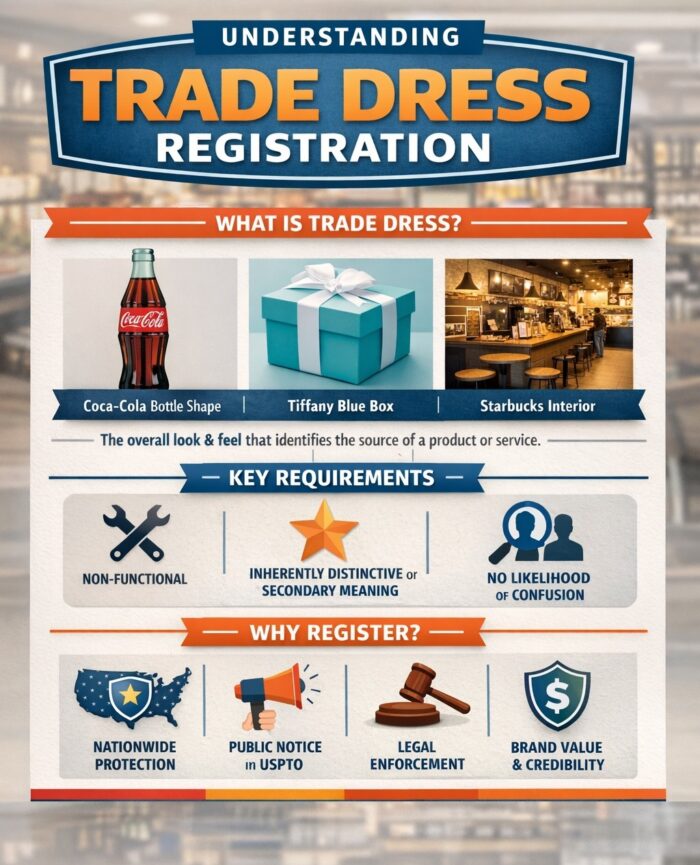
Examples of trade dress include the unique shape of a Coca-Cola bottle, the blue Tiffany & Co. gift box, and the specific interior layout of a Starbucks store. Restaurant concepts can also qualify: the Hard Rock Cafe restaurant chain uses distinctive decor often discussed as trade dress, similar to the restaurant décor analysis in the Two Pesos case. In the Two Pesos case, the plaintiff's trade dress was described as a "festive eating atmosphere" featuring a distinct combination of bright, festive colors, paintings, and murals. The design included interior dining and patios, with a stepped exterior, neon stripes, and vibrant awnings and umbrellas. Thus, distinctive and unique decor in a restaurant or other consumer services contexts can serve as proper trade dress.
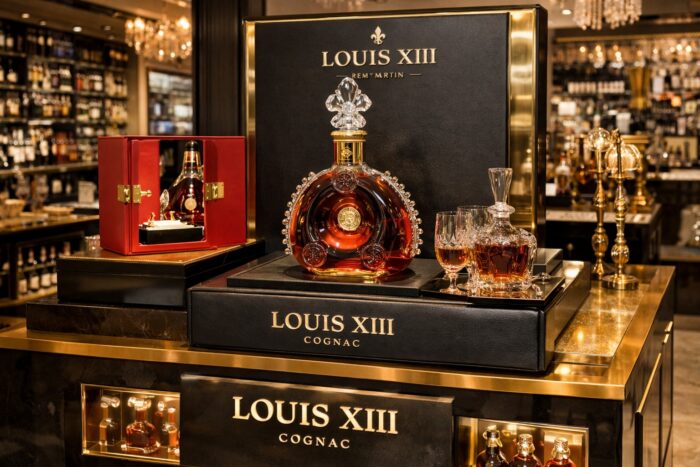
In the alcoholic beverage industry, an unusual bottle shape can sometimes be distinctive enough to indicate source. Maker’s Mark Distillery has registered (and enforced) trade dress for its wax-like coating covering the cap and trickling down the neck in a freeform irregular pattern (US Registration Number 1370465). Maker’s Mark Distillery, Inc. v. Diageo N. Am., Inc., 679 F.3d 410 (6th Cir. 2012). The court in the Marker's Mark case held that Maker's Mark's registered red dripping wax seal is a valid, non-functional, enforceable trademark and not merely functional, as it serves to identify the brand rather than provide a significant competitive advantage.
The primary difference between standard trademark and trade dress registration is the nature of what is protected. A conventional mark is often a word/design used on labels and ads. Trade dress focuses on the packaging, design, or environment that creates the brand’s overall appearance. Both are registered through the same trademark application system, with the requirements defined by 37 C.F.R. § 2.32.
A trade dress application is filed and examined as a trademark application, and it must satisfy the same core formal requirements. The applicant must clearly identify the relevant goods and/or services, submit an acceptable drawing, and provide a written description of the proposed mark or proposed trade dress that explains what the applicant is claiming and how it functions as a source identifier. See 37 C.F.R. §§ 2.32, 2.37, 2.52. In trade dress cases, the description is especially important because the “mark” is not a word or logo, but the overall appearance of packaging, product design, or décor.
The drawing is often the most critical, and most challenging, part of a trade dress application. The drawing must clearly and accurately depict the claimed trade dress so that the scope of rights is unmistakable to the USPTO, competitors, and the public. When the trademark consists of only a portion of a product or container, the rules require solid lines to show the elements that are claimed as trade dress, while broken or dotted lines are used to depict unclaimed features shown only for context. See 37 C.F.R. § 2.52(b)(4); TMEP § 1202.02(c)(i); TMEP § 807.08.
Failure to properly define the claimed versus unclaimed elements frequently results in an office action. A precise drawing and description help the examining attorney evaluate functionality and distinctiveness and can significantly streamline prosecution of a trade dress application.
After a trade dress application is filed, the USPTO examining attorney conducts a substantive review under the Trademark Act. In trade dress cases, the analysis almost always begins with functionality. Under TMEP § 1202.02, the examining attorney determines whether the claimed trade dress is essential to the use or purpose of the product, affects cost or quality, or provides utilitarian advantages that competitors would need. If the trade dress appears functional, such as a shape dictated by performance or manufacturing efficiency, the application will be refused registration on the Principal Register.
If the trade dress is deemed non-functional, the examining attorney then evaluates distinctiveness. For product configuration trade dress, this typically requires evidence of acquired distinctiveness under Section 2(f), such as sales success, advertising, unsolicited media coverage, or consumer studies. If the application has deficiencies, the USPTO will issue an office action requiring clarification of the claimed trade dress, revisions to the drawing or description, or submission of evidence supporting secondary meaning, consistent with 37 C.F.R. §§ 2.37 and 2.52.
In addition, the USPTO examines the application for likelihood of consumer confusion under Section 2(d). This analysis is guided by the DuPont factors, including the similarity of the trade dress in overall commercial impression, the relatedness of the goods or services, and the overlap in marketing channels. In re E.I. duPont de Nemours & Co., 476 F.2d 1357 (CCPA 1973). Even non-functional and distinctive trade dress may be refused if it is too close to an existing registration and likely to confuse consumers as to source.
Trade dress registration offers meaningful, long-term benefits for business owners who invest in a distinctive overall commercial image. Federal registration strengthens your ability to protect non-functional design features that identify the source of the product, whether packaging, décor, or product configuration.
A registration for trade dress can be attained if you define the claimed trade dress clearly and can prove three things: (1) non functionality, (2) distinctiveness (inherent or acquired distinctiveness / secondary meaning), and (3) no likely confusion with existing marks. Successful registration provides nationwide rights, public notice through the USPTO register, and powerful enforcement tools against trade dress infringement and consumer confusion.
If you need assistance with trade dress registration or other intellectual property matter, contact our office for a free consultation.
© 2026 Sierra IP Law, PC. The information provided herein does not constitute legal advice, but merely conveys general information that may be beneficial to the public, and should not be viewed as a substitute for legal consultation in a particular case.

"Mark and William are stellar in the capabilities, work ethic, character, knowledge, responsiveness, and quality of work. Hubby and I are incredibly grateful for them as they've done a phenomenal job working tirelessly over a time span of at least five years on a series of patents for hubby. Grateful that Fresno has such amazing patent attorneys! They're second to none and they never disappoint. Thank you, Mark, William, and your entire team!!"
Linda Guzman


Sierra IP Law, PC - Patents, Trademarks & Copyrights
FRESNO
7030 N. Fruit Ave.
Suite 110
Fresno, CA 93711
(559) 436-3800 | phone
BAKERSFIELD
1925 G. Street
Bakersfield, CA 93301
(661) 200-7724 | phone
SAN LUIS OBISPO
956 Walnut Street, 2nd Floor
San Luis Obispo, CA 93401
(805) 275-0943 | phone

SACRAMENTO
180 Promenade Circle, Suite 300
Sacramento, CA 95834
(916) 209-8525 | phone
MODESTO
1300 10th St., Suite F.
Modesto, CA 95345
(209) 286-0069 | phone
SANTA BARBARA
414 Olive Street
Santa Barbara, CA 93101
(805) 275-0943 | phone
SAN MATEO
1650 Borel Place, Suite 216
San Mateo, CA, CA 94402
(650) 398-1644. | phone
STOCKTON
110 N. San Joaquin St., 2nd Floor
Stockton, CA 95202
(209) 286-0069 | phone
PORTLAND
425 NW 10th Ave., Suite 200
Portland, OR 97209
(503) 343-9983 | phone
TACOMA
1201 Pacific Avenue, Suite 600
Tacoma, WA 98402
(253) 345-1545 | phone
KENNEWICK
1030 N Center Pkwy Suite N196
Kennewick, WA 99336
(509) 255-3442 | phone
2023 Sierra IP Law, PC - Patents, Trademarks & Copyrights - All Rights Reserved - Sitemap Privacy Lawyer Fresno, CA - Trademark Lawyer Modesto CA - Patent Lawyer Bakersfield, CA - Trademark Lawyer Bakersfield, CA - Patent Lawyer San Luis Obispo, CA - Trademark Lawyer San Luis Obispo, CA - Trademark Infringement Lawyer Tacoma WA - Internet Lawyer Bakersfield, CA - Trademark Lawyer Sacramento, CA - Patent Lawyer Sacramento, CA - Trademark Infringement Lawyer Sacrament CA - Patent Lawyer Tacoma WA - Intellectual Property Lawyer Tacoma WA - Trademark lawyer Tacoma WA - Portland Patent Attorney - Santa Barbara Patent Attorney - Santa Barbara Trademark Attorney
