Intellectual property (IP) is a critical asset for businesses of all types. Among the various forms of IP, patents and copyrights are often confused. Understanding patents vs copyrights is essential for business owners to ensure their innovations and creative works receive the proper legal protection. This article breaks down the main differences between patents and copyrights in clear terms, covering what each protects, how you obtain rights, their duration, and more. We’ll also briefly discuss trademarks (including service marks) and how they differ. The following table summarizes the information in this article.
The table below compares the key differences of patents vs. copyrights:
| Aspect | Patent (for Inventions) | Copyright (for Creative Works) |
|---|---|---|
| Subject Matter Protected | New, useful, and non-obvious inventions: processes, machines, chemical compositions, manufactured articles, or new and useful improvements to existing technologies. Includes functional and technical innovations (utility patents) and ornamental designs of articles (design patents). | Original works of authorship: e.g. literary works, music, motion pictures and other audiovisual works, sound recordings, software code, and art that are fixed in a tangible medium. Essentially, expressive creative works in tangible form (text, images, audio, etc.), not ideas or processes themselves. |
| Examples | A new machine or device; a new drug formula; a new and useful process for manufacturing; a functional invention like a software algorithm that improves computer performance; the unique ornamental design of a product. | A novel or article; a marketing brochure; a logo design or photo; a piece of music or video your company produced; computer programs (code); motion pictures or sound recordings; any original works of authorship (documents, artwork, etc.). |
| Requirements for Protection | Invention must be novel, useful, and non-obvious. Patent is granted only after formal examination by USPTO to ensure these criteria are met. Must be patent-eligible subject matter. Public disclosure before filing can forfeit rights. | Work must be original (independently created with a minimal level of creativity) and fixed in a tangible medium. Uniqueness or novelty is not required: two people can independently create identical works and each have copyright. The work cannot be merely an idea or procedure, it must be the expression of ideas. Examination limited to formal requirements and a minimum level of creative expression. |
| How Rights Are Obtained | By filing a patent application and successfully passing USPTO examination. The process involves filing a formal patent application and patent examination taking 1-3+ years. A patent is granted by the government, and no patent rights exist until issuance. | Automatically upon creation of the work in tangible form: “copyright protection subsists … in original works of authorship fixed in any tangible medium”. Registration with the U.S. Copyright Office is optional, but recommended for legal benefits. No government approval needed to have a copyright, it exists from creation of the work. But, registration is required to enforce in court. |
| Duration of Protection | Generally 20 years from filing for utility and plant patents; 15 years from grant for design patents. No extensions beyond the patent term. Maintenance fees must be paid at intervals to keep a utility patent in force. No maintenance fees for design or plant patents. | For individual authors: Life of the author + 70 years after death. For corporate/anonymous works: 95 years from first publication or 120 years from creation, whichever expires first. Long duration, and no maintenance fees or renewals required under current law. |
| Scope and Territoriality | Patent rights are territorial. A United States patent only gives rights within the U.S. To protect an invention in other countries, patents must be obtained in each desired country via foreign filings, and/or the Patent Cooperation Treaty process. | Copyright is also territorial in enforcement. Each country has its own copyright law, but international treaties ensure that most countries recognize basic copyright for foreign works. U.S. copyright protects against unauthorized use in the U.S. Generally, however, creative works are automatically protected internationally to an extent via treaties like the Berne Convention, without needing separate filings in every country. |
| Exclusive Rights Granted | Patent owner’s rights: the exclusive right to exclude others from making, using, selling, or importing the patented invention. In essence, a patent gives a monopoly on the invention’s commercial exploitation for the patent term. The patent holder can license these rights or sue infringers. | Copyright owner’s rights: the exclusive rights to reproduce the work, create derivative works, distribute copies, perform the work publicly, and display the work publicly, and for sound recordings, to perform via digital audio. The copyright owner can authorize others (license) or enforce these rights against infringers. |
| Enforcement & Remedies | Enforced by patent infringement lawsuits in federal court. Remedies include injunctions and monetary damages. Willful infringement can lead to enhanced damages. No criminal penalties for patent infringement. | Enforced by copyright infringement lawsuits (registration required) in federal court. Remedies include injunctions, actual damages or statutory damages, and possibly attorney’s fees. Willful large-scale infringement (e.g. piracy) can also carry criminal charges. Copyright law has defenses like fair use that may excuse certain infringements. |
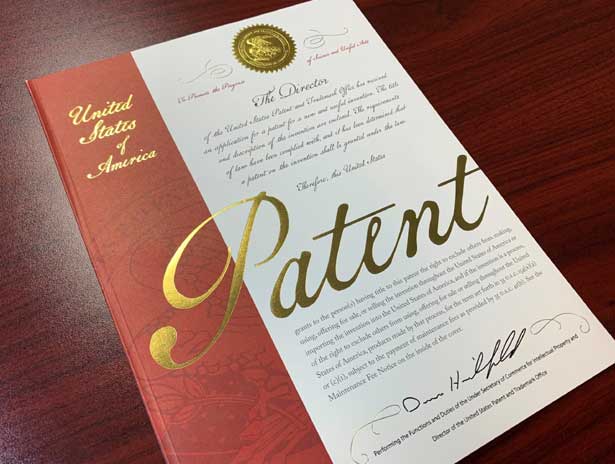
A patent is a form of intellectual property that protects inventions. In the United States, patent law is governed by federal statute (Title 35 of the U.S. Code) and administered by the U.S. Patent and Trademark Office (USPTO). A patent can be granted for any new and useful process, machine, manufacture, or composition of matter, or any new and useful improvement thereof. Patents encourage inventors to publicly disclose their inventions in exchange for certain exclusive rights.
There are three main types of patents under U.S. law, each protecting a different category of invention:
Patents protect inventions by granting the patent holder an exclusive right to profit from the invention for a limited time. In practice, a patent is a government-granted monopoly that allows the patent owner to exclude others from making, using, selling, or importing the patented invention without permission. For instance, if you obtain a patent for a new and useful process or machine, you can stop competitors from using that same process or selling a product using your patented invention. This exclusive right provides a competitive advantage and an opportunity to recoup R&D investments. However, the invention must be fully disclosed in the patent application, which becomes public. After the patent expires, the public is free to use the invention. The trade-off of the patent system is disclosure in exchange for temporary exclusivity.
A copyright is a form of intellectual property that protects original creative works of authorship. Copyright law is governed by federal statute (Title 17 of the U.S. Code) and, unlike patents, is administered by the U.S. Copyright Office. Copyright protection subsists automatically when an original work of authorship is fixed in a tangible medium of expression. In plainer terms, as soon as you create an original work and record it in some tangible form, such as writing it down, saving it as a computer file, etc., you have a copyright in that work. There is no requirement that the work be novel or unique; it just needs to be the author’s own original creation, independently created and not copied from others, and fixed in a tangible form. Unlike patents, copyright law does not require any inventive step or usefulness, it protects creativity rather than technical innovation.
Copyrights protect a broad range of creative and artistic works, often referred to as “original works of authorship”. The law explicitly lists categories of works that can be protected by copyright, including literary works, musical works and lyrics, dramatic works, choreographic works, pictorial/graphic/sculptural works, films and other audiovisual works (e.g. motion pictures), sound recordings, architectural works, and more. For instance, a software program’s code or a website’s written content can be protected by copyright as a literary work. Computer programs are expressly recognized in legislative history as copyrightable works. Likewise, a marketing video or training manual your business creates is protected by copyright as soon as it is created.
Importantly, copyright protects the expression of ideas, not the underlying ideas or functional concepts themselves. This principle, often called the idea–expression dichotomy, is codified in the Copyright Act: In no case does copyright protection for an original work of authorship extend to any idea, procedure, process, system, method of operation, concept, principle, or discovery. In other words, copyright can protect how an idea is expressed (the words, images, or music used), but cannot protect the idea. A famous case, Baker v. Selden, 101 U.S. 99 (1879), illustrates this point: the Supreme Court explained that a method or system described in a book is not protected by the book’s copyright. If exclusive rights to the method are desired, one must seek a patent. For example, if you write a book explaining a new chemical synthesis, your specific explanation and expression in the book are copyrighted, but the chemical synthesis method itself could only be protected by patent, not by copyright. This is a key difference: functional inventions or processes (including computer algorithms, industrial techniques, chemical formulas, etc.) are the realm of patent law, whereas creative expressions (text, visuals, audio, etc.) fall under copyright law.
When you own a copyright in a work, you hold a bundle of exclusive rights granted by law. These rights include the exclusive right to reproduce or copy the work, to prepare derivative works based on it (e.g. translations, adaptations, sequels), to distribute copies of the work to the public, and to perform or display the work publicly. For example, if your company created an original training video or software code, you, as the copyright owner, have the exclusive right to copy it, modify or update it, sell or license copies, and publicly show or perform it. No one else can lawfully do those things without your permission. These exclusive rights of the copyright owner are set forth in 17 U.S.C. § 106. By contrast, things that are not protectable by copyright (ideas, processes, facts) can often be freely used by others unless patented or kept secret.
It is worth noting that copyright arises automatically when the original work is created. No formal filing is required to have a copyright. However, as we discuss, registering the copyright with the U.S. Copyright Office provides important benefits and is required to enforce the copyright in court for U.S. works.
Obtaining a patent is a more complex process than obtaining a copyright. To get a patent, one must file a patent application with the USPTO and go through an examination process. The patent application is a detailed legal document that includes a detailed description of the invention, drawings, and a set of claims defining the legal scope of the invention. Preparing a strong patent application typically requires specialized knowledge. It is thus generally advisable to work with an experienced patent attorney for this process.
Often, a patentability search is conducted before filing to check for prior art that might anticipate the invention or render it obvious. Prior art can come from anywhere around the world. What matters is whether the prior art is sufficiently publicly accessible. It does not matter whether the prior art is in English or another language, or whether it has ever been made public in the US. Thus, a patentability search needs to be thorough and have a broad scope. A patent search limited to the records of the United States Patent and Trademark Office is insufficient.
The filing date of the patent application is very important: under the U.S. “first-to-file” system, generally the first inventor to file an application has priority to the patent. Inventors should also be careful about making any public disclosure of the invention before filing an application. Early disclosure can jeopardize patent rights. In the U.S. you have a one-year grace period to file after an inventor or applicant makes a public disclosure of their own invention, but in many countries any public disclosure before filing can bar you from getting a patent. Therefore, business owners should be careful to file a patent application or at least a provisional patent application before revealing an invention publicly or selling a product, to preserve patent rights.
During examination, the Patent Office ensures the invention meets all legal requirements: it must be patent-eligible subject matter - not a law of nature, abstract idea, or natural phenomenon; novel - not previously known or described; and non-obvious - not an obvious variation of what was already known. The application process involves significant filing fees and possibly months or years of prosecution of the application. The USPTO examiner will review whether the invention is truly new and non-obvious in light of existing patents, publications, or other publicly available knowledge, which is referred to as prior art. The examiner will issue one or more office actions providing the USPTO's opinion on whether the applied-for invention is patentable. If any rejections are issued based on the prior art or formal matters, you must respond to the rejections and overcome them with claim amendments and/or legal argument. Once all rejections are overcome, the examiner will allow the application to proceed as a patent and the patent will be granted. Once granted, the inventor becomes a patent holder (patent owner) and has enforceable patent rights as defined in the issued patent. It is important to note that a patent protects inventions only in the country where it is granted. A United States patent gives rights in the U.S. only. Separate patents must be obtained in other countries for international protection.
Copyright is much easier to obtain. Copyright protection is automatic from the moment an original work is created and fixed in a tangible form. There is no examination of the artistic merit or originality of your work by a government office. If it meets the basic criteria of originality and fixation, it is protected. This means if your business writes an original blog post, designs a marketing graphic, or records a training video, those works are copyrighted as soon as they are created and fixed in digital or physical form. No application or approval is needed to have a copyright.
However, while you have a copyright upon creation, U.S. law encourages creators to register their works with the U.S. Copyright Office. Copyright registration is a relatively simple process: it involves filling out a form, paying a fee, and depositing a copy of the work. The copyright office reviews the application for: (1) formal requirements - e.g., that the work is fixed in a tangible medium, it is in a proper category of copyright subject matter, and other formal requirements; and (2) a minimal level of creative expression. There is a limited examination process, if the reviewer notes any issues with regard to formalities (e.g., the work is not properly represented in the submission), or the reviewer does not perceive a minimum level of creative expression, the reviewer will issue a rejection letter. The applicant has the opportunity to respond with factual and legal arguments to the rejection letter. The applicant's letter will be considered by the reviewer in their final decision on registration. The review of the copyright application is limited to this exchange of letters, and is thus far less extensive than patent examination.
Because registration is a prerequisite to filing a copyright infringement lawsuit for works of U.S. origin, and it also enables the copyright owner to seek statutory damages and attorney’s fees in an infringement case, if the copyright application is filed in a timely manner. In short, registration strengthens your copyright enforcement but does not create the copyright. The copyright exists whether or not you register, though unregistered works have limited remedies. Fortunately, registering a copyright is a relatively inexpensive and short process compared to patenting. A copyright registration certificate can be issued within a few weeks or months.
In summary, obtaining a patent requires a formal application, examination, and grant by the government, whereas obtaining a copyright requires no approval, it’s automatically secured by the act of creation. The patent system is thus more complex and costly, reflecting the greater exclusivity and stronger monopoly granted.
Patents provide strong but relatively short-term protection. For utility patents and plant patents in the U.S., the standard term is 20 years from the application’s filing date. This term can sometimes be slightly adjusted for USPTO delays, but generally about two decades is the limit. Design patents have a shorter term. For U.S. design patent applications filed on or after May 13, 2015, the term is 15 years from the date of grant (design patents filed earlier last 14 years).
After a patent expires, the invention enters the public domain and can be used by anyone. Notably, patent rights cannot be extended indefinitely: once the term is over, the patent owner’s exclusivity ends. There are very limited exceptions, such as specific patent term extensions for certain pharmaceutical patents to compensate for FDA regulatory delays, but these are special cases.
Patent owners must also maintain their patents by paying periodic fees. In the U.S., maintenance fees are required for utility patents at 3.5, 7.5, and 11.5 years after grant to keep the patent in force. If a maintenance fee is not paid by the deadline, the patent expires early. These fees can be substantial, though small businesses and individual inventors often qualify for reduced small-entity or micro-entity fees. Design and plant patents are not subject to maintenance fees. Once granted, design and plant patents remain in force for their full term without additional payments.
Copyrights generally last much longer than patents. Under the current U.S. Copyright Act (for works created in or after 1978), a copyright in an individual work lasts for the life of the author plus 70 years after the author’s death. This means an individual creator’s works can be protected for several decades beyond their lifetime. In the case of works made for hire or anonymous works, the term is not based on a person’s life but instead is 95 years from publication or 120 years from creation, whichever comes first. Copyright applications are commonly filed anonymously by businesses for works created internally by the business. For example, if your company publishes an original training manual in 2025 as a work made for hire, the copyright would expire in 2120 (95 years from publication) unless it was not published, in which case it would expire 120 years from creation. These lengthy terms reflect the policy that creative works should eventually enter the public domain, but only after authors and their heirs have enjoyed a long period of exclusive rights.
Importantly, there is no requirement to file renewals or pay upkeep fees for copyright. Under past Copyright Acts, pre-1978 works had renewal formalities, but those have been phased out. Once a work is under copyright, it stays protected for its term as long as basic conditions are met. This means a business’s creative content can effectively be protected for generations, whereas patents protecting inventions will expire relatively early in comparison.
A patent grants the inventor the exclusive right to exclude others from exploiting the invention for the duration of the patent. Specifically, under 35 U.S.C. § 154, a patent confers the right to exclude others from making, using, offering for sale, or selling the patented invention in the United States, as well as importing it. This does not automatically give the patent owner the right to actually make or sell the invention. There could be other regulatory hurdles or overlapping patents, but a patent gives the right to stop others from doing so. In effect, a patent owner becomes the only one who can legally commercialize the invention or authorize others to do so.
For example, if your company holds a patent on a new and useful process for manufacturing, you can prevent competitors from using that process. If you patented a chemical composition (e.g., a new drug formulation), no one else can make or sell that composition without your permission during the patent term. Patent rights are enforced by filing patent infringement lawsuits in federal court against unauthorized users of the patented invention. Remedies for patent infringement can include money damages and injunctions (court orders to stop the infringing activity). Patent law does not require the owner to mark products with the patent number, but doing so can affect damages recovery. Marking puts the public on notice of the patent, eliminating the defense of innocent infringement. Also, once a patented product is sold by or with authorization of the patent owner, the patent rights are exhausted for that item, meaning the patent owner can’t control downstream resale or use of that particular item. This is analogous to the “first sale doctrine” in copyright.
A copyright grants a bundle of exclusive rights to the copyright owner, as defined in 17 U.S.C. § 106. These include the exclusive right to reproduce the work, prepare derivative works (adaptations) based on it, distribute copies of the work, perform the work publicly (for literary, musical, dramatic, and audiovisual works), display the work publicly (for literary, artistic, and pictorial works), and for sound recordings, to perform the work publicly by digital audio transmission. In everyday terms, if you own the copyright, you control copying, adaptation, distribution, performance, and display of your work. For instance, if your business created a promotional video, competitors cannot lawfully copy that video or play it publicly without permission. If you wrote original software code, others cannot copy or reuse that code in their products without your consent. Even clients cannot simply redistribute your business’s copyrighted report or training materials to the public without authorization, because that would violate your exclusive distribution right.
The copyright owner can license any of these rights to others: e.g., selling copies or broadcasting a performance. Copyright owners also have the right to authorize others to exercise these rights. Via copyright licensing you can contract with publishers, producers, and other parties to exploit the work on your behalf.
Enforcement of copyright is typically through infringement lawsuits in federal court. To sue for infringement of a U.S. work, the copyright must be registered with the Copyright Office. Remedies for copyright infringement can include injunctions, actual damages or statutory damages, and attorney’s fees. Statutory damages and attorney fees are available if application to register the copyrights is filed before the infringement occurs or within three months of the original publication of the work. Unlike patents, willful copyright infringement can lead to criminal penalties in egregious cases, such as large-scale piracy.
One limitation to note is the first sale doctrine under 17 U.S.C. § 109, which says once the copyright owner sells a particular copy of a work, the owner’s distribution right in that copy is exhausted. The purchaser can resell or give away the purchased copy without infringement. This is why, for example, used book sales are legal. However, making additional copies or public performances would still infringe if done without permission. Copyright law also has a fair use defense and other exceptions that allow limited use of copyrighted material without permission. The copyright fair use defense allows for the use of copyright materials under certain circumstances, such as criticism, commentary, education, and parody.
In summary, patents grant an exclusive right over functional inventions, allowing the patent owner to stop others from using the patented invention. Copyrights grant exclusive rights over creative works, allowing the owner to stop others from copying or exploiting the expression of the work. Both are powerful IP, but they apply to very different subject matter and have different enforcement mechanisms.
In discussing patents vs. copyright, it’s important not to overlook trademarks, which protect brand identifiers, a completely different aspect of intellectual property. A trademark is generally a word, name, logo, slogan, or other symbol that identifies the source of goods or services and distinguishes them from others. If it identifies services rather than goods, it’s specifically called a service mark, but the term “trademark” is often used broadly to include service marks. Examples include brand names like a company name or product name, logos, and taglines. For instance, your business name and logo can function as trademarks. Trademark rights, unlike patents and copyrights, are about consumer recognition and goodwill. Trademarks prevent others from using confusingly similar marks in commerce, thereby protecting your brand reputation.
Key points about trademarks for business owners:
In summary, trademarks safeguard your business’s identity in the marketplace, whereas patents and copyrights protect your business’s innovations and creations. All three are administered at the federal level: patents and trademarks through the United States Patent and Trademark Office, and copyrights through the U.S. Copyright Office. Each addresses a different facet of intellectual property.
A key takeaway is to understand what intellectual assets you may have and match them to the correct type of IP protection. If you have invented a valuable new process or product, you should consider patent protection. If you’ve created valuable original content or software, you should register the corresponding copyrights. By understanding the key differences and the exclusive rights each form of IP provides, you can make informed decisions and invest in the appropriate protections for your valuable creations. Understanding is first step. It is recommended that you seek the assistance of a patent attorney and/or copyright attorney to evaluate whether you should pursue patents and/or copyright registrations.
With the right protections in place, you gain exclusive rights that can secure a competitive advantage, and add significant value to your company’s portfolio. If you have an invention or creative work that you want to protect, contact our office for a free consultation.
© 2025 Sierra IP Law, PC. The information provided herein does not constitute legal advice, but merely conveys general information that may be beneficial to the public, and should not be viewed as a substitute for legal consultation in a particular case.
Trademark enforcement means taking steps to stop others from using your mark without permission. Strong enforcement preserves your goodwill and prevents consumer confusion. In the United States, trademark rights come from use in commerce, but they are strengthened by obtaining a federal trademark registration. This article outlines key enforcement strategies, both legal and practical, that trademark owners can use to protect their marks and business.
Under U.S. trademark law, you automatically have rights in a mark by using it. These "common law rights" are co-extensive with consumer recognition of your brand. Common law trademark rights are co-extensive with your brand's reach and recognition. However, a federal registration with the USPTO significantly strengthens your position. A federally registered trademark gives you nationwide rights and legal presumptions of ownership and validity. It also makes enforcement easier, e.g., by providing a presumption of rights and ownership and certain statutory remedies. By contrast, unregistered rights are limited to the geographic areas or markets where you’ve used the mark. While registration isn’t mandatory, it is a key factor in effective trademark enforcement.
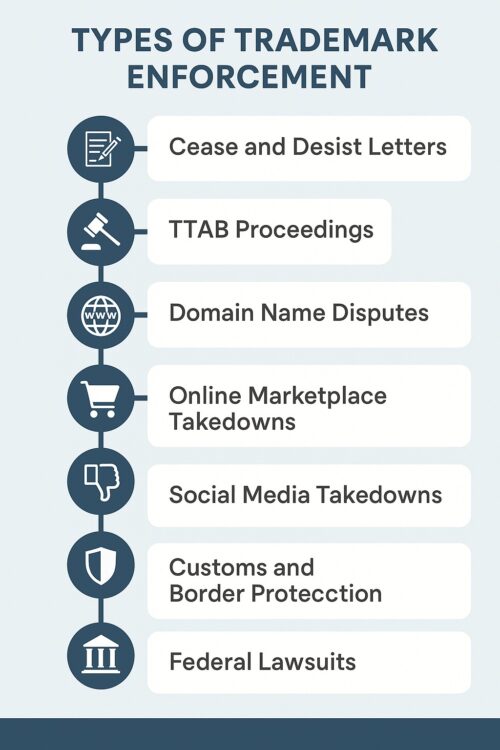
A common first step is a cease and desist letter. This formal notice, usually sent by your trademark attorney or law firm, tells the infringing party about your rights and demands that they stop using the allegedly infringing mark. A strong cease and desist letter will cite your trademark (and registration, if applicable), explain why the other party’s use is unlawful and likely to cause consumer confusion, and threaten legal action if the behavior continues. Many trademark disputes are resolved at this stage without a lawsuit. It is wise to have a lawyer draft the letter to ensure the proper tone and evidence are included.
If someone attempts to register a mark that conflicts with yours, you can oppose their application through the United States Patent and Trademark Office (USPTO)’s Trademark Trial and Appeal Board (TTAB). A trademark opposition is a proceeding to stop a pending application from registering, e.g., because the proposed mark is too similar to your trademark and likely to cause consumer confusion. Similarly, if a confusingly similar mark has already been registered, you can initiate a TTAB cancellation proceeding to try to remove that registration. TTAB proceedings are handled within the trademark office. The board can refuse or cancel a registration, but it cannot award damages or injunctions. This route helps trademark owners police the register by keeping conflicting marks from being granted federal rights.
If someone registers a domain name that includes your trademark, you have two main options. First, the federal Anticybersquatting Consumer Protection Act (ACPA) allows you to sue in federal district court to obtain the domain from a bad-faith registrant. In such cases, courts can transfer or cancel the infringing domain and even award damages. Second, you can use the Uniform Domain-Name Dispute-Resolution Policy (UDRP), a quicker arbitration process. In a UDRP proceeding, you must prove the domain is identical or confusingly similar to your mark and that it was registered in bad faith. A UDRP panel can order the domain transferred to you, but cannot award money. UDRP is faster and less expensive than a lawsuit, so many trademark owners try UDRP first and resort to an ACPA lawsuit if necessary.
To prevail in a UDRP proceeding, the trademark owner must prove three elements: (1) the disputed domain name is identical or confusingly similar to the owner’s valid mark, such as a federally registered trademark; (2) the registrant has no rights or legitimate interests in the domain; and (3) the domain was registered and used in bad faith, such as to sell the domain to the trademark owner, block the owner’s registration, or mislead consumers by creating confusion. A successful UDRP complaint results in the transfer or cancellation of the domain, but the panel cannot award monetary damages or legal fees. Because UDRP cases are typically resolved within about 60 days, many trademark owners use this route before considering an ACPA lawsuit.
To file a UDRP complaint, the trademark owner must select an approved dispute-resolution provider, most commonly the World Intellectual Property Organization (WIPO) Arbitration and Mediation Center. The complaint should identify the infringing domain name(s), the complainant’s trademark rights with registration numbers or evidence of use, the respondent’s lack of legitimate interests, and the circumstances evidencing bad-faith registration and use. Supporting documentation, such as trademark registration certificates, website screenshots, and WHOIS records, should be attached. Complaints may be submitted electronically to WIPO through domain.disputes@wipo.int along with the applicable filing fee, which varies based on the number of domains and whether one or three panelists are requested. After filing, WIPO notifies the registrar to lock the domain and invites the respondent to submit a response, typically within 20 days. The appointed panel reviews the evidence and issues a decision, and if transfer is ordered, the domain registrar implements it unless the respondent files a court action to block the transfer.
Incorporating the UDRP into your enforcement strategy gives you an efficient, cost-effective way to reclaim infringing domain names and reinforce your broader brand protection efforts.
E-commerce platforms like Amazon, eBay, and Alibaba have notice-and-takedown systems that enable trademark owners to act against unauthorized uses of their marks in listings. As a trademark owner you can report a listing that uses your mark without permission and request its removal, an effective tool for brand protection and enforcement in the online marketplace. For example, if you’re enrolled in Amazon’s Amazon Brand Registry, you have access to the “Report a Violation” tool and the general Amazon Report Infringement Form. This tool allows rights owners or their agents to report suspected infringement of trademarks, copyrights, patents or other intellectual property. You can join the Amazon Brand Registry if you have trademark registrations or pending federal trademark applications that cover the goods you wish to sell on Amazon. Once you submit a report identifying the infringing listing (e.g., ASIN, URL, screenshots), Amazon will review your submission and, if valid, remove or block the listing.
On eBay, the rights-owner mechanism is the VeRO Program (“Verified Rights Owner”) which is designed specifically for intellectual property owners to report infringing listings. The report form (Notice of Claimed Infringement) can be downloaded from eBay’s resources: Notice of Claimed Infringement (PDF) where you fill in item numbers, describe the infringing use, attach your trademark registration or rights evidence, and submit via email (vero@ebay.com). After eBay receives a complete VeRO submission, it will review and remove listings that violate rights owner trademarks or other intellectual property rights.
For Alibaba’s global group of e-commerce marketplaces, rights owners use the IPP Platform (Intellectual Property Protection Platform) to submit takedown requests for listings that use your trademark without authorization via the “Complaint Submission” page on the portal. The process typically requires you to register your brand, submit evidence of your trademark rights, verify your account, then select the infringing listing URLs and submit a complaint along with supporting screenshots and documentation. Once the listing is accepted as infringing, Alibaba may remove the listing or suspend the seller’s account.
By taking advantage of these online marketplace takedown tools, a brand owner can rapidly intervene against unauthorized use of the registered mark or other marks, reinforcing broader enforcement strategies and preventing consumer confusion, without immediately resorting to formal litigation.
Social media platforms offer procedures to address trademark misuse. If someone is using your trademark on Facebook, Instagram, X (formerly Twitter), or another network without authorization, you can file a trademark infringement report on that platform. You’ll need to provide evidence of your rights (your USPTO-registered mark) and show how the use is infringing. For instance, by posting your mark in a way that suggests it is the infringer’s own trademark or service mark. If the platform finds a violation, it may remove the offending content or disable the account. While you won’t obtain damages through this process, social-media takedowns let you promptly halt misuse of your mark and support your broader brand protection efforts.
To help you take action:
By using these procedures, you add a quick, practical enforcement tool to your process. This is a cost-effective solution in many situations that may allow you to avoid the expense of filing a civil action to enforce your trademark rights.
Another enforcement avenue is working with U.S. Customs to block counterfeit or infringing imports. Owners of federally registered trademarks can record their mark with CBP, putting customs officers on alert for imported goods bearing your trademark or a substantially similar mark, when those goods are not authorized. Under 15 U.S.C. § 1124, CBP can detain, seize, forfeit or destroy such shipments. If you register your trademark with CBP, you enlist a governmental enforcement partner at the border before the goods reach the U.S. marketplace. To be eligible, the mark must be a valid trademark registration, meaning it is registered on the Principal Register of the United States Patent and Trademark Office (not merely the Supplemental Register) and registered for use on goods.
The most powerful enforcement mechanism available to trademark owners is a federal trademark infringement lawsuit under the Lanham Act, codified at 15 U.S.C. §§ 1051 et seq. A civil action in federal district court provides the broadest remedies and establishes an authoritative record of enforcement. When a brand owner brings a trademark infringement claim, they may proceed under 15 U.S.C. § 1114(1) for infringement of a federally registered mark and under 15 U.S.C. § 1125(a) for unfair competition. These provisions allow trademark owners to pursue injunctive and monetary relief against parties who use confusingly similar marks in commerce without authorization.
To prevail on a federal infringement claim, the plaintiff must establish:
Proof of registration with the United States Patent and Trademark Office (USPTO) serves as prima facie evidence of validity, ownership, and exclusive rights to use the mark nationwide under 15 U.S.C. § 1057(b). However, even unregistered marks can be protected under § 1125(a) when they have acquired distinctiveness through use in commerce.
Courts evaluate likelihood of confusion using a multi-factor analysis that varies slightly among circuits but is conceptually consistent. Commonly considered factors include:
For example, the Polaroid factors from Polaroid Corp. v. Polarad Electronics Corp., 287 F.2d 492 (2d Cir. 1961) and the Sleekcraft factors from AMF Inc. v. Sleekcraft Boats, 599 F.2d 341 (9th Cir. 1979) remain leading articulations of this framework. While no single factor is dispositive, courts emphasize overall marketplace context: how consumers encounter and perceive the marks in commerce.
If the lawsuit is a success, the court may grant several forms of relief. The most common is an injunction under 15 U.S.C. § 1116, prohibiting further use of the infringing mark. Permanent injunctive relief is available upon a showing of likelihood of confusion and irreparable harm, and since the 2020 Trademark Modernization Act, courts now presume irreparable harm upon a finding of infringement.
Monetary remedies under 15 U.S.C. § 1117(a) may include:
The court may enhance damages or profits in instances of willful infringement or bad faith, particularly where the infringer intended to trade on the goodwill of the trademark owner. However, the U.S. Supreme Court in Romag Fasteners, Inc. v. Fossil, Inc., 590 U.S. 212 (2020) clarified that while willfulness remains a significant factor, it is not a prerequisite for recovering the defendant’s profits under § 1117(a).
Lastly, remember that trademark enforcement isn’t limited to federal law. State trademark and unfair competition laws provide additional avenues. Every state has its own trademark laws against confusing or deceptive business practices. You can assert state law claims for trademark infringement, unfair competition, and other types of claims with Lanham Act claims in the same case. Claims under state unfair competition law (e.g., Cal. Bus. & Prof. Code § 17200) often complement Lanham Act claims. State and federal trademark laws generally coexist. The Lanham Act does not preempt state law. Using state statutes or common-law claims can give you extra remedies for local disputes or other issues beyond the scope of federal law. You can also bring a trademark infringement suit in state court under both federal and state laws.
Beyond the immediate relief obtained, prevailing in a Lanham Act lawsuit strengthens a company’s overall brand protection strategy. Judicial findings of infringement reinforce the strength and distinctiveness of the mark, deter future infringers, and bolster the brand’s reputation for vigilance. In certain industries, courts also allow publication of injunctions or notices to third parties, further protecting consumers from confusion.
In short, while federal trademark litigation is a significant undertaking, it remains the cornerstone of trademark enforcement in the United States. It combines the authority of a federal court order with the full range of monetary and injunctive remedies, providing a decisive means to enforce and protect valuable trademark rights in commerce.
Willful trademark counterfeiting isn’t just a civil matter, it is also a crime. The Trademark Counterfeiting Act (18 U.S.C. § 2320) makes it a federal offense to intentionally traffic in goods or services bearing a counterfeit mark, with penalties including fines and prison time. While only government prosecutors can bring criminal charges, you can help by reporting egregious trademark counterfeiters to law enforcement. Criminal enforcement can lead to raids that confiscate fake goods and shut down illicit operations, deterring future infringers.
Protecting your trademarks requires vigilance and prompt action. Minor infringements might be handled through cease-and-desist letters or online takedowns, while major conflicts may require a lawsuit. What’s crucial is that you do not ignore unauthorized uses of your mark. If you allow infringement to go unchecked, your trademark rights can weaken over time. Consistent enforcement maintains your mark’s strength and helps avoid customer confusion. By using the enforcement tools available, you can enforce your rights effectively and keep your brand secure.
If you need assistance with a trademark enforcement matter or other intellectual property matter, contact our office for a free consultation.
© 2025 Sierra IP Law, PC. The information provided herein does not constitute legal advice, but merely conveys general information that may be beneficial to the public, and should not be viewed as a substitute for legal consultation in a particular case.
Patent infringement analysis is the process of determining whether a product or process infringes an existing patent. In the United States, patents grant inventors exclusive rights to their inventions for a limited time, and infringing those rights can lead to costly patent litigation and payment of damages to the patentee. Understanding how to analyze patent infringement risks is necessary for making informed decisions on product development and avoiding legal action. This article provides an overview of patent infringement analysis to help businesses identify potential infringement issues and manage infringement risks.
A patent gives its owner the right to exclude others from making, using, selling, or importing the patented invention. These exclusive rights are defined by the patent’s claims, which describe the scope of the patented invention. In essence, the claims set the legal boundaries of what the patent covers. An enforceable patent allows the patent holder to stop others from practicing the claimed invention. Under 35 U.S.C. § 271, patent infringement occurs when someone, without permission, makes, uses, sells, offers to sell, or imports a product or process that contains every element or an equivalent of each element of at least one patented claim while the patent is valid. This means a patent owner can assert infringement if an accused product or process falls within the scope of any claim of their patented invention.
Performing a patent infringement analysis is important due diligence for companies launching a new product or technology. By analyzing existing patents, businesses can identify patents that might pose potential infringement risks and design around them or seek licensing. This proactive approach helps companies avoid patent disputes and litigation, which can be expensive and disruptive. Likewise, patent holders conduct infringement analysis to determine if a competitor’s product falls within their patent scope. Early analysis allows businesses to make informed decisions. For example, conducting a patent infringement analysis can inform a business on whether to pursue a licensing deal, or implement design modifications to avoid infringing a patent. If there is significant risk of patent infringement, it is important to seek the legal opinion of an experienced patent attorney. In short, careful analysis helps manage risk and avoid unwelcome surprises.
U.S. patent law recognizes several types of infringement. The most straightforward is direct infringement, which can be either literal infringement or infringement under the doctrine of equivalents. Literal infringement means the accused product or process contains every claim element exactly as stated in the patent claim. If any limitation of the claim is missing in the accused product, there is no literal infringement.
However, even if a product does not copy the claim word-for-word, a patent owner might still prove infringement under the doctrine of equivalents. This doctrine prevents an alleged infringer from escaping liability by making only insubstantial changes. The Supreme Court in Graver Tank & Co. v. Linde Air Products Co., 339 U.S. 605 (US 1950) established that a product infringes under the doctrine of equivalents if it performs substantially the same function in substantially the same way to achieve the same result as the claimed invention. The doctrine of equivalents established by Graver Tank prevents trivial alterations from undermining a patent. In other words, if the differences between the accused product and the claim are minor or insubstantial to a person skilled in the art, the product may infringe via equivalence.
A patent owner's rights may also be violated through indirect infringement, which includes two flavors: inducement and contributory infringement. A party can be liable for infringement for encouraging or assisting another in infringing a patent, which constitutes inducement. Selling components with no substantial noninfringing uses and that are only operable to be used in an infringing device or system, constitutes contributory infringement. Both forms of indirect infringement require that the defendant must have known of the patent and intentionally or recklessly encouraged infringement by a third party.

Conducting an infringement analysis typically involves multiple steps, as discussed below.
Companies should conduct a patent search for existing patents in their product’s field to see if any patent holders have rights that cover similar technologies or features. This often involves reviewing patent databases (e.g., the patent office records) and prior art (earlier patents and publications) to pinpoint patents of concern.
The heart of infringement analysis is interpreting the patent claims – a process known as claim construction. One must understand each claim’s language and limitations in light of the patent’s specification and prosecution history, which is the record of proceedings in the patent office. This step should involve patent attorneys or other legal professionals, since determining the exact meaning of technical claim terms is critical.
Finally, the construed claims are compared to the product or process in question (often called the accused product or process). If at least one claim is met element by element by the product or equivalently met, under the doctrine of equivalents, then the product infringes that claim. The analysis must be meticulous. If the product omits or alters a key element such that it is not equivalent, the product may avoid infringement. By systematically determining which claim elements are present in the product, companies can identify potential areas of concern and gauge the likelihood of infringement.
Claim construction is the interpretation of the patent claims and is a crucial aspect of any infringement case. In U.S. patent litigation, claim construction is performed by judges, not juries, typically in a pre-trial hearing called a Markman hearing. The U.S. Supreme Court in Markman v. Westview Instruments, Inc. 517 U.S. 370 (US 1996) held that “the construction of a patent, including terms of art within its claim, is exclusively within the province of the court.” This means a judge determines what the patent claims mean, and then the fact-finder (judge or jury) decides if the accused product meets those claims as construed. This case led to the now-routine Markman hearings in patent litigation, demonstrating how crucial claim interpretation is in infringement cases.
Proper claim construction relies on intrinsic evidence, the patent’s text and prosecution history, and extrinsic evidence, such as expert testimony, dictionaries, and authoritative technical references. In pre-litigation analysis, the exercise is to anticipate how a court might interpret key claim terms. Understanding claim scope is critical. A broad claim interpretation might cover your product, whereas a narrow interpretation might not. Consulting experienced patent attorneys or law firms for claim construction analysis can provide clarity on whether a competitor’s patent actually covers your product’s features. By grasping claim scope, companies can better assess potential infringement risks and consider design modifications if needed to avoid falling within the claims.
It is worth reiterating the difference between literal infringement and infringement under the doctrine of equivalents, as this is a common source of confusion. Literal infringement requires that the accused product or process has each and every limitation of the patent claim present exactly (word-for-word). If a claim element is missing or altered, literal infringement does not exist. However, under the doctrine of equivalents, a product may infringe if the differences from the claim are insubstantial. Courts often apply the “function-way-result” test from Graver Tank: does the accused product’s element perform substantially the same function in substantially the same way to achieve the same result as the claimed element? If yes, it may be deemed an equivalent. That said, not every change can be swept in under this doctrine.
The Supreme Court in Warner-Jenkinson Co. v. Hilton Davis Chem., 520 U.S. 17 (US 1997) emphasized an “all-elements rule”: the doctrine of equivalents is applied element by element, meaning a substitute element is only equivalent if it matches the function/way/result of the specific claim element it replaces. Additionally, prosecution history can limit the doctrine: if a patent claim was narrowed during examination (e.g., to overcome prior art), the patent owner may be estopped or barred from later claiming the surrendered range as an “equivalent”, creating prosecution history estoppel. The Festo Corp. v. Shoketsu Kinzoku Kogyo Kabushiki Co., 535 U.S. 722 (2002) decision clarified prosecution history estoppel, holding that if a patentee narrowed a claim to get the patent granted, they may be barred from later claiming the narrowed-out equivalents. Festo provides a framework for when estoppel limits the doctrine of equivalents, giving more certainty to those who rely on prior art to design around patents. In practice, this means companies should look not only at the issued claims but also at the patent’s file history to see if the inventor gave up certain claim scope, which could provide leeway to design around and avoid infringement.

When a potential infringement risk is identified, there are several options to mitigate it. One common step is obtaining a legal opinion, a freedom-to-operate or clearance opinion, from a patent attorney. A written opinion analyzing the patent and the product can help show that the company conducted due diligence and in good faith believed it did not infringe. This due diligence can be important if litigation arises, particularly on the issues of willful infringement and monetary damages.
If the risk is significant, a company might choose to redesign the product by altering or omitting features that are problematic. Such design modifications may result in the product no longer performing the same function in the same way as the patented invention, thereby steering clear of the claims. Another strategy is obtaining a patent license by negotiating with the patent holder for permission to use the patented technology. Licensing allows use of the invention in exchange for royalties or a fee, avoiding conflict.
Companies also often monitor competitor patents to be aware of any new patented design or technology that could pose a threat. In some cases, if a competitor’s patent is broad and potentially invalid, a company might challenge the patent’s validity through proceedings at the USPTO (e.g., a Post-Grant Review), in which patent invalidity can be challenged based on prior patent publications, prior art products, or other public information that demonstrates that the patented invention was already known. Patent validity is a key aspect of liability risk analysis. A valid patent should be licensed or designed around, whereas pursuing invalidation of a weaker patent may be the most economical approach. Each situation is unique, and various factors will influence the course of action, including the potential business impact, the strength of the patent, the ease of design around, and the relationship with the patent owner. By proactively assessing potential areas of infringement risk and taking appropriate action, businesses can reduce litigation risk and make more confident choices about their product and service offerings.
U.S. law provides certain remedies for patent infringement. The primary categories of remedies are injunctions and damages. An injunction is a court order stopping the infringing activity, e.g., prohibiting the sale of the infringing product. However, after the Supreme Court’s decision in eBay Inc. v. MercExchange, L.L.C., 547 U.S. 388 (US 2006), injunctions in patent cases are not automatic. The patentee must satisfy the traditional four-factor equitable test by showing, among other things, irreparable harm and that monetary damages are inadequate. Courts will weigh the balance of hardships and the public interest before granting an injunction.
On the damages side, a patent owner is entitled to at least a “reasonable royalty” for the use of its invention, and potentially monetary damages for lost profits if the infringement caused lost sales. Under 35 U.S.C. § 284 enhanced damages up to treble damages (three times the amount) may be awarded to the plaintiff in the case of willful infringement. For example, if an infringer knew of the patent and deliberately copied the patented invention, they may be liable for enhanced damages. In Halo Electronics, Inc. v. Pulse Elecs., Inc., 579 U.S. 93 (US 2016), the Supreme Court clarified that district courts have discretion to award enhanced damages in cases of egregious misconduct by the infringer, making it easier to punish willful violators. Additionally, in “exceptional” cases, the court may award attorney’s fees under 35 U.S.C. § 285. These legal remedies underscore why businesses should take patent infringement analysis seriously. An infringing product or process can lead to substantial financial liability and injunctions that disrupt business.
Patent infringement analysis is an important exercise for any company navigating today’s technology and product landscape. The analysis allows companies to make strategic choices relating to product and service development. Patent infringement should be avoided whenever possible, as patent disputes are complicated and costly. With high stakes including monetary damages and injunctions on the line, a professional yet accessible approach to infringement analysis is indispensable. It is recommended that you consult with experienced patent attorneys when dealing with such issues. It is advisable to keep abreast of relevant patents in your field.
If you need assistance with patent issues or other intellectual property matters, contact our office for a free consultation.
© 2025 Sierra IP Law, PC. The information provided herein does not constitute legal advice, but merely conveys general information that may be beneficial to the public, and should not be viewed as a substitute for legal consultation in a particular case.
Business owners often wonder whether to form a limited liability company (LLC) or register a trademark, or both, to protect their new venture. These tools serve very different purposes in U.S. law. Generally speaking, an LLC is a business entity that provides personal liability protection, while a trademark is intellectual property that carries certain exclusive rights that protect your branding against third party use. Understanding the difference between a trademark vs LLC is crucial for small business owners, sole proprietors, and entrepreneurs looking to safeguard both their personal assets and their brand. We provide here an overview of LLCs and trademarks, their legal protections, the distinctions between them, and why you might need one or the other (or both).
An LLC (limited liability company) is a legal business structure created under state law that establishes a company as a separate legal entity. Forming an LLC is a common business formation step for small businesses because an LLC offers limited liability protection to its owners, called “members”. In practice, this means the LLC exists separately from its owners, and the members are not personally liable for the LLC’s business debts or legal obligations. For example, if the company incurs debt or gets sued, generally only the LLC’s assets are at risk, not the owners’ personal assets like their home or personal property. This liability protection shields owners’ personal wealth from business risks, a benefit not available to a sole proprietorship where the owner is personally responsible for all business liabilities. In essence, an LLC protects owners’ personal assets by creating a legal wall between the business and its members.
From a tax perspective, an LLC is very flexible. By default, a single-member LLC is a “disregarded entity” for tax purposes, meaning its profits and losses are reported on the owner’s personal tax return (Schedule C of Form 1040) rather than a separate business return. Multi-member LLCs typically file pass-through returns by default. However, LLCs can elect corporate taxation if desired. This flexibility, combined with personal liability protection, makes the LLC a popular business entity choice for small business owners.
A trademark is a type of intellectual property that consists of any name, word, logo, slogan, symbol, or combination thereof that identifies and distinguishes the source of goods or services of others. In other words, a trademark is tied to your business’s brand identity, it protects the names, logos, or designs that consumers associate with your products or services. Trademark rights are acquired by using a distinctive mark in commerce and are primarily governed primarily under federal law (the Lanham Act). Registering a trademark with the United States Patent and Trademark Office (USPTO) is not mandatory, but it provides significant legal protection and benefits. According to the USPTO, a registered trademark “provides legal protection for your brand” and gives you nationwide rights to that mark. By contrast, simply registering a business name with a state as an LLC or otherwise does not grant nationwide trademark rights.
A federal trademark registration with the USPTO grants the owner exclusive rights to use the mark nationwide in connection with the registered goods or services, subject to certain limitations. It also puts the public on notice that you are the trademark owner. Importantly, a trademark allows you to prevent others from using a name or logo in a way that is likely to confuse consumers. Trademark law prohibits uses that are “likely to cause confusion, or to cause mistake, or to deceive” consumers regarding the source of goods or services. This means your trademark provides brand protection: if another business adopts a similar name or logo for similar offerings, you could take legal action for trademark infringement to stop them. In short, a trademark protects your brand identity and customer loyalty, whereas an LLC protects your business’s owners from personal liability.
It is important to recognize that an LLC and a trademark serve entirely different roles. An LLC is a legal entity: a company that can own property, enter contracts, and assume debts in its own name. In contrast, a trademark is an intangible asset: a form of intellectual property that trademark law grants to the mark’s owner. The legal protection each offers is different. An LLC offers liability protection and a formal business structure, whereas a trademark offers brand protection and exclusive rights in a name or symbol. One does not automatically include the other. For example, you could form an LLC for your business and never register its name as a trademark, or you could register a trademark for a brand without forming a separate LLC. However, these tools often complement each other. Many small businesses use an LLC to shield the owners from liability and register trademarks to protect the business’s name and logo. Generally speaking, think of the LLC as protecting the business owners by separating the business from the owners and the trademark as protecting the brand by giving you rights against copycats and confusingly similar names.

The primary benefit of an LLC is personal liability protection. The LLC structure creates a liability shield often referred to as the “corporate veil.” As noted above, members of an LLC are not liable for the company’s obligations just by virtue of being owners. This limited liability protection means that if the LLC cannot pay its debts or faces a lawsuit, the owners’ personal assets (their personal bank accounts, real estate, or other personal property) are generally safe from creditors of the business. For example, if your LLC takes out a business loan and later defaults, the lender cannot come after your personal home or car to satisfy the debt, absent personal guarantees or fraud. Likewise, if the business is sued for something that happened in the course of business, the owners are typically not personally liable for any judgment. This is a key difference between operating as an LLC versus as a sole proprietorship or general partnership, where the owners have unlimited personal liability for business debts. Every state’s laws provide for this liability shield.
That said, limited liability is not absolute. Owners must properly maintain the LLC as a separate entity. The owners of the LLC must keep business finances separate from personal finances and follow required corporate formalities. Otherwise a court might “pierce the veil” and hold owners liable in cases of serious misconduct or commingling. If the LLC is managed and operated correctly, it offers protection for the owners’ personal assets from business debts and lawsuits against the business. This asset protection is a major reason business owners choose the LLC legal structure.
While an LLC protects the owners, a trademark protects the business’s brand identity in the marketplace. Your brand (business name, product names, logos, slogans, etc.) is often one of your most valuable assets. Trademarks are the legal mechanism to protect that asset. By using and federally registering a trademark, you obtain exclusive rights to use that mark for the goods or services listed in the registration, across the entire country. Federal registration with the USPTO gives a trademark owner a nationwide presumptive right to the mark and a legal presumption that you are the owner of the mark. This is critical for brand protection. It means if another business starts using a name or logo that is similar to yours in a way that could confuse customers, you have strong legal grounds to stop them, potentially through a trademark infringement lawsuit if they do not cease voluntarily. Trademark rights also allow you to register with U.S. Customs to block importation of infringing goods, and to use the federal courts to enforce your rights.
Importantly, simply forming an LLC or incorporating a business does not by itself create trademark rights in your business name. Trademark rights come from using the name or logo as a mark (i.e. to identify the source of your products or services in commerce) and are strengthened by trademark registration. Many small business owners assume that because they have an LLC or a registered business name, they automatically “own” that name for all purposes, but that’s not the case. You secure brand protection only by using the name as a trademark and, preferably, by obtaining a federal trademark registration. As the USPTO explains, registering a trade name (business name) with the state allows you to do business under that name, but it offers no protection against others using a similar name in other states or contexts. A trademark registration is what gives you the right to exclusive use of that name or logo in your field nationwide.
It is worth emphasizing the difference between an LLC’s name (or any business entity name) and a trademark. A business name, sometimes called a trade name, “DBA,” or "fictitious name”, is essentially the name you operate under. Registering a business name when you form an LLC, corporation, or file a DBA is done at the state’s office (e.g., the Secretary of State) and is only intended to ensure no two businesses in the state have the exact same name. This registered business name does not confer trademark rights. U.S. trademark law explicitly distinguishes trade names versus trademarks: “The terms ‘trade name’ and ‘commercial name’ mean any name used by a person to identify his or her business or vocation,” whereas a “trademark identifies and distinguishes… goods” or services. See 15 U.S.C. §1127. Simply put, your LLC’s name is an identifier of your company, while a trademark is an identifier of the source of your goods or services in commerce. It is possible that other businesses in different states might have identical or similar LLC names, and this often does not violate any law because each is registered only at the state level. However, if multiple parties try to market under that name nationally, the first to have a valid federal trademark registration could stop the others. This is why it’s important to conduct a thorough trademark search before settling on a business name. Using a name that conflicts with an existing federal trademark could lead to you having to rebrand or even being on the receiving end of a cease-and-desist letter or infringement suit. Conversely, if you secure a trademark, you gain the ability to prevent later adopters from using confusingly similar names in the market.
Another scenario to note is that your LLC and trademark names do not have to be the same. For example, your company might be registered as “ABC Enterprises LLC” but you market your product under a different brand name. The brand name is what you would register as a trademark. Many companies have an official corporate name and one or more trademarks for their products or services. Also, an LLC can own a trademark. If you have an LLC, it’s often wise for the LLC to own the trademarks rather than an individual owner, so that the brand value stays with the company.
The process for forming an LLC is separate from the trademark application process, and they involve different agencies. To create an LLC, you generally file Articles of Organization (or a similar formation document) with your state and pay the required filing fees. This is done through a state office, commonly the Secretary of State’s business registry. For example, California law requires filing Articles of Organization with the Secretary of State to validly form an LLC. The filing fees and requirements vary by state, but commonly you’ll provide an LLC name, a registered agent, business address, and sometimes an operating agreement. Once the state approves and files your LLC, your company is officially a legal entity. You would then typically obtain an Employer Identification Number (EIN) from the IRS for tax and banking purposes, and you’re ready to do business as an LLC.
Federally registering a trademark, on the other hand, is done through the United States Patent and Trademark Office (USPTO). The trademark application process involves submitting an application through the USPTO TEAS system that includes the mark itself, the goods or services it will be used for, and evidence of use (or an intent-to-use declaration). You must also pay a filing fee per class of goods/services. The USPTO will then have an attorney examiner review the application, possibly issue office action refusals. For example, if the mark is descriptive or there is a likelihood of confusion with an existing mark, the examiner will refuse registration and issue an office action. You can respond to the office action to address the examiner's refusals and try to resolve any issues in the application. If all goes well, the examiner will approve the mark for publication. The whole process can take several months to over a year to complete. Once registered, the trademark must be maintained with periodic filings and fees to keep the federal trademark protection active.
By contrast, forming an LLC is usually a faster process: many states approve LLC filings within days or weeks. There are ongoing maintenance requirements, including annual report filings and paying state taxes or fees. Note that states also offer their own state trademark registrations (e.g., California trademark registrations are filed with the California Secretary of State), but those only protect you within that state and generally carry fewer rights than a federal registration. Most businesses that plan to operate nationally or online prefer the federal trademark route for nationwide protection of their brand.
Because LLCs and trademarks fulfill different purposes, many businesses will benefit from having both an LLC and a trademark. The LLC (or corporation or other legal entity) is important for liability protection and organizing your business’s legal structure and tax setup. The trademark is brand protection that secures your name or logo so that you have exclusive rights and can build customer loyalty without fear of another company exploiting your brand. One is not a substitute for the other. If you only form an LLC but never register your trademark, you might have a shield against personal liability, but you could be forced to rebrand if someone else holds trademark rights to your business name. Conversely, if you only register a trademark but operate as a sole proprietorship or partnership, your brand might be protected, but your personal liability exposure remains, meaning your personal assets are at risk from business liabilities.
For most small business owners, it’s wise to consider both: forming an LLC (or other appropriate business entity) and registering trademarks for your key brand names or logos. They are complementary. The LLC establishes a legitimate business structure and can lend credibility to your business in the eyes of customers and partners, while the trademark establishes legal rights to your brand identity and provides a legal presumption of nationwide ownership. In fact, having a registered trademark can increase the value of your company. It becomes an asset the LLC owns.
In summary, an LLC and a trademark are two distinct legal tools every entrepreneur should understand. An LLC is a business structure that protects the owners by separating the business’s liabilities from personal assets, while a trademark is an intellectual property right that protects the brand by granting exclusive rights to use a name or logo and preventing others from using confusingly similar identifiers. For comprehensive protection of a new business, you would ideally leverage both the LLC for liability protection and the trademark for brand protection.
Finally, because every business is unique, it may be beneficial to consult with a qualified attorney about your specific situation. If you are starting a business and need guidance on forming an LLC and/or pursuing trademark protection, contact us for a consultation.
© 2025 Sierra IP Law, PC. The information provided herein does not constitute legal advice, but merely conveys general information that may be beneficial to the public, and should not be viewed as a substitute for legal consultation in a particular case.
Trademarks are a form of intellectual property that identify a source of goods or services: names, logos, slogans, and other brand elements that distinguish a business’s goods or services. In the United States, business owners commonly use two symbols with their trademarks: TM (™) and ® (R in a circle). Understanding the difference between TM and R is important for anyone looking to safeguard their brand. The trademark symbols you use signal the legal status of your mark and carry important implications for trademark protection and enforcement. We explain here the meaning of these two symbols, when to use each, and the legal consequences of their use or misuse under U.S. law.
The TM symbol (™) is a notification to the world that you consider a mark (such as a name, logo, or slogan) to be your trademark. Importantly, no registration is required to use the TM symbol. Any company or individual can add "TM" to their brand name or logo to stake a claim to trademark rights. Using TM with your brand signifies your intent to claim trademark rights, even though those rights are based on use (so-called common law trademark rights) rather than a government registration.
When you use the TM symbol, you are asserting that you own that mark within your market and are putting others on notice of your claim. This can deter competitors from adopting a confusingly similar name or logo, as it serves as a warning that you will defend your brand. However, the legal protection for a TM-designated mark is limited compared to a registered mark. Common law rights arise automatically when you create and use a mark in commerce, but they extend only to the geographic area or scope of market where the mark is actually used and known by consumers. For example, if your small business uses a business or brand name locally and has not registered it, you can use the “Name™” format and gain rights in your region. However, another company in a different state might use the same name without violating your trademark rights, if they are outside your established market.
It’s worth noting that service marks (marks for services rather than goods) are often also denoted by TM in practice. Technically, the SM symbol (℠) is available to indicate a “service mark” used for services like consulting or banking. In the same way as TM, SM notifies others of an unregistered service mark. For example, a law firm could use “XYZ Legal℠” for legal services. Both TM and SM have the same legal effect. They do not carry any government imprimatur, but they tell the public that the brand is claimed as a trademark. The Lanham Act and state laws protect unregistered marks against confusing uses by others, but as the trademark owner you will need to prove the validity and priority of your mark in any enforcement action, since you lack the automatic presumption that comes with registration.
The ® symbol is reserved for registered trademarks. In the United States, this means the mark has been officially registered with the federal USPTO. Using ® gives immediate visual notice that the mark is federally registered and enjoys the full legal protection of a U.S. registered mark. Many businesses pursue federal registration for important brands because registration provides the strongest protection available under U.S. law.
Legally, a federally registered trademark carries significant benefits. A registration on the Principal Register gives the owner a legal presumption that the mark is valid, that the registrant is the rightful owner, and that the registrant has the exclusive rights to use the mark nationwide for the goods or services listed in the registration. In other words, the burden shifts to others to try to challenge those facts. By contrast, without a registration, an owner has to prove those elements from scratch in court. Additionally, registration confers constructive notice to the public of the claim of ownership, meaning no later user can defend an infringement by claiming they didn’t know the mark was in use. See 15 U.S.C. § 1072. However, in order to recover monetary damages without actual notice, you must use the ® symbol next to your mark. The registered mark can also become “incontestable” after five years of continuous use post-registration, which even further strengthens its protection by cutting off certain defenses. See 15 U.S.C. § 1065. All of these advantages make ® a powerful symbol for a trademark owner.
From a practical standpoint, the ® tells consumers and competitors that your brand name or logo is not just a marketing claim but a legally protected asset. You will often see ® on established brand names (e.g., Coca-Cola®, Microsoft®) as well as on logos and even taglines. Using the ® symbol may also discourage potential infringers. Seeing the ® can make others think twice before using a similar name, for fear of legal action. As one law firm put it, the ® symbol “shows people that your trademark is safe and trusted by the law” and “scares off others who might try to copy it”.
You cannot legally use the ® symbol until your mark is actually registered with the USPTO. U.S. federal law forbids false or misleading claims about trademark registration. Using ® without a registration has been deemed a deceptive act, constituting fraud on the public. So, while consistent use of TM is encouraged for unregistered marks, using ® too soon (or on a mark that never was registered) can lead to serious legal problems, as discussed below.
How does a trademark go from TM to ®? The trademark registration process in the U.S. involves filing an application with the USPTO, examining and approving the mark, and ultimately issuing a registration certificate. Here’s a brief overview:
During this registration process, the trademark owner typically uses the TM symbol until the registration is granted. For example, a startup might brand its product as SuperCo™ after launch and throughout the application process. Once the registration is approved and issued, the company would update the marking to SuperCo® on its branding and materials to reflect the new registered status. This registration process can take anywhere from 9 months to 18 months (or more) depending on any legal hurdles, but it is a worthwhile process for many businesses because of the significant benefits of owning a federal registration.
Registering a trademark with the USPTO enables use of the ® symbol, and also grants concrete legal advantages that can be critical for protecting your intellectual property rights. Key benefits of a U.S. federal trademark registration include:
In short, a registered trademark carries a bundle of rights and legal protections that far exceed what you get under common law alone. This is why trademark attorneys urge business owners to register their key brand names and logos. It provides a much stronger legal foundation for building and defending a brand.
Knowing when and how to use trademark symbols is an important practical skill for anyone managing a brand. Here are some guidelines on appropriate symbol usage:
By following these practices, you maximize your legal protection and avoid miscommunication. The goal of using TM, SM, or ® is to clearly signal your rights in a brand. In fact, using the proper symbol can strengthen your position if you ever need to enforce your trademark, by showing you took care to notify others. As one guide explains, marking your trademark (especially with ® once registered) can even be a prerequisite for recovering damages in litigation.
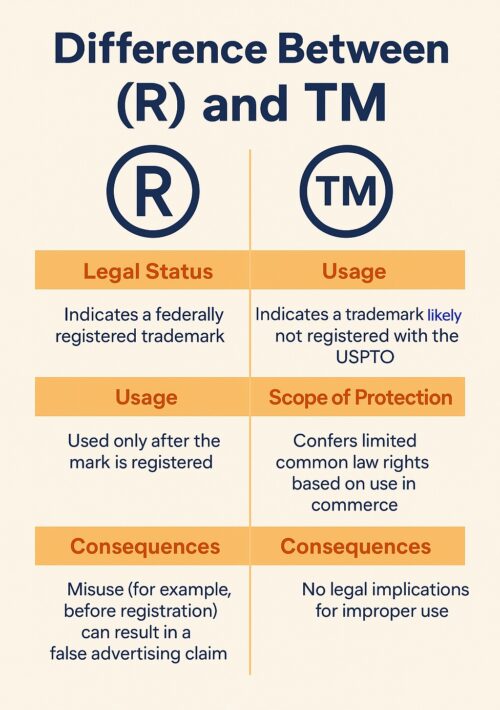
Using the wrong symbol, or using the right symbol in the wrong way, can have legal repercussions. Business owners should be aware of these pitfalls:
These guidelines and legal rules are specific to U.S. law. If your business operates internationally or sells products abroad, be aware that the treatment of trademark symbols can vary in other countries. Some countries recognize the ® and TM symbols similarly, while others have different practices or laws:
One universal principle across countries is the concept of giving notice. While the mechanics differ, it is always beneficial to clearly signal to competitors and the public that you claim international trademark rights in your brand. It helps avoid confusion and can strengthen your position if legal enforcement becomes necessary. Just remember that what works in the U.S. might not be acceptable elsewhere unless you hold a local registration in that jurisdiction.
In summary, “TM” is for claiming a trademark that is not registered, and “®” is for a trademark that is federally registered. The two symbols reflect different levels of legal protection: TM (and SM) symbols signal common law or unregistered rights, which are valid but limited, while the ® symbol signals the broader rights and legal presumptions that come with a federal trademark registration. Using these symbols properly can help protect your brand and put others on notice, whereas misuse can lead to legal troubles or weakened rights.
With the right strategy, your brand can safely grow from a local ™ to a nationally recognized ®, reaping the benefits of the U.S. trademark system along the way. If you need assistance with registering your trademark or other trademark matters, contact our office to schedule a consultation.
© 2025 Sierra IP Law, PC. The information provided herein does not constitute legal advice, but merely conveys general information that may be beneficial to the public, and should not be viewed as a substitute for legal consultation in a particular case.
Post-grant review (PGR) is an administrative trial proceeding at the United States Patent and Trademark Office (USPTO) that allows a third party to challenge the validity of a U.S. patent shortly after the patent’s issuance. Conducted by the Patent Trial and Appeal Board (PTAB), a PGR provides a faster, more specialized forum than litigation for resolving patent validity issues. This article explains PGR in clear terms for business owners and non-patent attorneys, covering how it works, who can use it, the time frame and process, and the advantages of PGR over other options.
A post-grant review (PGR) is a proceeding created by the America Invents Act (AIA) that became available in 2012 to review the validity of a patent after grant. It takes place before the Patent Trial and Appeal Board ("PTAB" - an appeal board within the USPTO) and is essentially a trial on a patent’s validity. Unlike the ex parte reexamination process, which involves a patent examiner only, PGR is an adversarial process between a petitioner (challenger) and the patent owner, overseen by a panel of administrative patent judges. The PGR proceeding allows parties to present evidence and arguments about whether the patent’s claims are unpatentable on various grounds. Importantly, PGR is available only for patents examined under the AIA first-to-file rules: patents with an effective filing date on or after March 16, 2013.
Any person other than the patentee may file a petition for post-grant review. In practice, the petitioner is often a business competitor or another party facing the patent. The petition must identify the real party in interest, meaning anyone who would benefit from the challenge. However, there are certain bars and prerequisites:
Timing is critical. A post-grant review petition must be filed within nine months of the patent’s issuance (grant) or reissue. This is a relatively short window. If a patentee obtains a reissue patent, a PGR can be filed any time prior to nine months from the reissue of the patent as well. However, if the reissue claims are identical or narrower than the original claims and the original patent was already beyond its 9-month window, then PGR is not available for those claims. In practice, this means potential challengers must act quickly after a patent grant, monitoring competitor patents and preparing a petition in the time period before the window closes.
After the 9-month window, PGR is no longer available. Instead, a challenger may resort to an inter partes review (a similar proceeding before the PTAB), which has a later timing window, or other options. But for newly issued patents, PGR is the first and broadest opportunity to challenge validity. Because of this strict timing, companies concerned about a new patent should evaluate whether to file a PGR within the nine-month timeframe. Once this window closes, certain validity challenges can no longer be pursued at the PTAB via PGR, including challenging whether the patent covers statutory subject matter under 35 U.S.C. § 101, and grounds under 35 U.S.C. § 112, including enablement, written description, and definiteness.
One major appeal of PGR is the broad range of grounds on which the patent claims can be challenged. In a PGR petition, a challenger may request to cancel one or more claims of the patent as unpatentable on any ground that could be raised as an invalidity defense in court. This includes:
By contrast, IPR is limited to Sections 102 and 103 grounds based on patents or printed publications. Thus, PGR offers the broadest possible grounds for challenging a patent, allowing petitioners to attack potentially weak patents on any theory of unpatentability. This means a petitioner can combine multiple grounds, e.g., argue some claims are anticipated by prior art, others are obvious, and others are invalid for lack of written description, all within one proceeding. The petitioner must explicitly identify each claim challenged and the specific grounds and evidence for each. All claims challenged in the petition will be scrutinized if review is instituted.
To initiate a post-grant review, the challenger (petitioner) files a petition at the USPTO. The petition is essentially a detailed request to institute post-grant review, and it must meet strict requirements. By statute, the petition must: (1) pay the required fee; (2) identify all real parties in interest; (3) identify each claim challenged, the grounds for each challenge, and supporting evidence for each ground; and (4) provide any other information the USPTO requires by rule. Supporting evidence typically includes copies of prior patents or publications relied upon, as well as affidavits or declarations from experts or witnesses to support factual assertions. In short, the petitioner must put forth its case upfront with particularity, essentially a mini trial brief with evidence to show why the patent claims are invalid.
Once the petition is filed and served, the patentee gets a chance to respond before any trial is instituted. The patent owner may file a preliminary response, within a three-month time frame set by the USPTO, explaining why no post-grant review should be instituted based on the asserted grounds. This is not the full defense on the merits, but rather reasons the petition fails to meet the threshold or has errors. For example, the patent owner’s preliminary response might argue that the prior art cited is not actually relevant or that the petition’s arguments are legally insufficient. As of recent rule changes, the patent owner can include testimonial evidence (e.g. an expert declaration) with the preliminary response to rebut the petition’s factual assertions. The Board will consider any preliminary response and evidence in deciding on institution, though factual conflicts at this stage may be resolved in favor of the petitioner for purposes of the board's decision.
Importantly, the patentee is not required to file a preliminary response. If the patentee chooses not to respond, or no such response is filed by the deadline, the PTAB will proceed to make an institution decision once the time for the preliminary response expires. The absence of a response won’t stop the process; the petition will be evaluated on its own. If no preliminary response is filed, the decision on whether to institute must be made no later than three months after the response deadline.
After the petition and any preliminary response are in, the PTAB will decide whether to institute post-grant review, i.e. whether the case will proceed to trial. The AIA sets a threshold that the petition must meet for a PGR to be instituted. The USPTO may not authorize PGR unless it determines that, considering the petition’s unrebutted evidence, “it is more likely than not that at least one of the claims challenged in the petition is unpatentable.” In other words, the PTAB needs to see a better than 50/50 chance that the petitioner will win on at least one claim. This “more likely than not” standard is a higher bar than the “reasonable likelihood” standard used for IPR institution, reflecting that PGR allows broader attacks. In addition, PGR has an alternate basis for institution: the threshold can be met if “the petition raises a novel or unsettled legal question that is important to other patents or patent applications.” This means if the case presents an issue of first impression (e.g., an unclear point of law in patentability) with broad impact, the PTAB may institute review even if invalidity is not plainly greater than 50% likely. In practice, most PGR institutions rely on the “more likely than not” unpatentability standard.
The PTAB must decide whether to institute the PGR fairly quickly. By statute, within three months after the patentee’s preliminary response is received or after the response period if no response is filed, the USPTO will issue a written decision either instituting the review on some or all challenged claims or denying the petition entirely. If the PTAB institutes post-grant review, the review is officially begun on the instituted claims and all challenged claims should be addressed in the final decision. If the threshold isn’t met, the petition is denied and the process ends without a trial. The decision on whether to institute is by law final and nonappealable, meaning the petitioner cannot challenge a denial in court, nor can the patentee appeal a decision to institute.
Sometimes multiple petitions or other proceedings involve the same patent. The USPTO has discretion to avoid duplicative efforts. For example, if a substantially similar validity challenge was already made in the USPTO (perhaps in a prior PGR/IPR petition or a reexamination), the Director may refuse to institute the PGR, noting that the same prior art or arguments were previously presented. If another USPTO proceeding, such as a matter involving a reissue or ex parte reexamination of the patent is ongoing, the Director can manage the situation by entering an appropriate order to stay, transfer, or consolidate the proceedings so they don’t conflict. These provisions help prevent multiple bites at the apple and inconsistent outcomes.

If a post-grant review is instituted, the review enters a trial phase before the PTAB. This phase operates somewhat like a court trial but on a tighter schedule and scope. Both the petitioner and the patent owner will have the opportunity to submit further briefing and evidence on the merits of the validity questions. Key aspects of the trial proceeding include:
Throughout the PGR trial, the burden of proof is on the petitioner to prove unpatentability of the challenged claims, and the standard is a preponderance of the evidence. This is notably a lower burden than in district court, where a patent is presumed valid and must be proven invalid by clear and convincing evidence. The PTAB judges will weigh the evidence and legal arguments from both sides under this lower standard when reaching a decision.
The post-grant review process not only allows cancellation of patent claims, but also provides the patentee a chance to amend the patent to overcome the challenge. Uniquely, in a PGR the patentee may file one motion to seek leave to amend the patent during the trial. Through this motion, the owner can cancel any challenged claims and/or propose a reasonable number of substitute claims to replace challenged claims. For example, if claim 1 is being challenged as obvious, the owner might propose a narrower substitute claim 1a that adds additional limitations, with the goal of overcoming the prior art.
However, amendments in PGR come with strict conditions and are relatively rare in practice. Any substitute claims cannot enlarge the scope of the original claims or introduce new matter (content that was not in the original application). In essence, you can only narrow or clarify claims, not broaden them. The patentee has a burden to show that the proposed new claims are supported by the original application and that they address the patentability raised in the petition. The petitioner gets to oppose the motion to amend, often by arguing the new claims are also unpatentable. The PTAB will then decide whether the amended claims should be allowed.
Only one motion to amend the claims is provided as a matter of right. Additional motions to amend are only permitted if the petitioner and patentee jointly request it (e.g., as part of a settlement) or if the patentee shows good cause. This ensures the proceeding is not delayed with endless claim changes. If the PTAB grants an amendment, either by allowing substitute claims or by the patentee canceling claims, and the new claims are found patentable in the PGR proceeding, the patent will be amended to include the new claims. The new or amended claims will have the same legal effect as a claim in a reissued patent, and can be enforced against any third party practicing the invention recited in the claims. However, third parties that were practicing the invention prior to the amendment to the patent may benefit from intervening rights protection. Intervening rights essentially shield third parties that were practicing the invention between the filing of the PGR proceeding and the amendment of the patent with the newly narrowed claims from liability.
At the end of the post-grant review trial, the PTAB issues a final written decision on the patentability of the challenged claims and any new claims added via amendment. This decision will explicitly determine, claim by claim, which claims are unpatentable and which are confirmed patentable. The PTAB’s decision is comprehensive: by statute, it must address every patent claim challenged by the petitioner and every new claim added in the proceeding. This requirement, reinforced by the Supreme Court’s SAS Institute decision, means you get a resolution on all issues raised, bringing clarity to the patent’s status.
Following a final decision, the USPTO will issue a certificate that formally documents the outcome: canceling any claims found unpatentable, confirming any claims that survived, and incorporating any amended claims that were allowed. If all claims are canceled, the patent is fully invalidated. If some claims survive, the patent remains in force with at least those claims.
Both parties have the right to appeal the final written decision. Under the law, an appeal from a PGR goes to the U.S. Court of Appeals for the Federal Circuit. For instance, a patent owner might appeal if their claims were canceled, arguing the PTAB erred in its analysis, or a petitioner might appeal if they feel a claim was wrongly upheld. The Federal Circuit will review the PTAB’s decision on legal issues, including claim interpretation or application of law, and the evidence on record, but giving deference to the PTAB’s fact-findings if it is supported by substantial evidence. This appellate review provides a check on the PTAB.
One of the most significant legal effects of a final PGR decision is estoppel. The AIA imposes estoppel to prevent a losing challenger from re-litigating the same issues in multiple forums. Specifically, after a final written decision, the petitioner and its real parties in interest and privies may not request or maintain any other proceeding in the USPTO on any claim that was raised or reasonably could have been raised in the PGR. This means the petitioner can’t turn around and file a new reexamination, an IPR, or another PGR on the same patent claims using invalidity bases or arguments that were available in the initial proceeding, but were not submitted. Likewise, the petitioner is estopped from asserting in civil litigation or in a proceeding before the International Trade Commission that the claim is invalid on any ground it raised or reasonably could have raised during the PGR. In short, PGR is a one-shot opportunity, you need to bring all your best prior art and arguments, because if you lose, you cannot try a different invalidity theory later in court, unless the grounds were genuinely unavailable to you during the PGR.
It’s worth noting that settlement is possible during PGR, and if a PGR is settled and dismissed before a final decision, estoppel typically does not attach to the petitioner. This allows parties to use PGR as leverage for a negotiated resolution without the harsh estoppel, as long as they settle in time. The PTAB will terminate the proceeding if both sides agree to settle and there is no public interest reason to proceed to a decision.
For those seeking to challenge a patent, post-grant review offers several compelling advantages over traditional litigation or other USPTO proceedings:
In summary, for a challenger, PGR offers a potent combination of comprehensiveness, speed, and a favorable forum that can increase the chances of invalidating a problematic patent efficiently. It effectively puts the patent on trial in front of experts, under rules that favor a thorough vetting of the patent’s merits.
It’s helpful to distinguish post-grant review from other post-grant validity challenges:
In summary, PGR is unique in combining broad grounds with a fast, adjudicative process, but it must be utilized shortly after a patent is granted. IPR is the fallback for later challenges on narrower grounds. Reexamination is a slower, limited tool that still exists for prior art-based challenges. And CBM is no longer available for new filings. A petitioner must choose the procedure that fits the timing and grounds of their case.
For business owners facing potentially troublesome patents, post-grant review provides an effective and efficient procedure for challenging a patent of questionable validity. The PGR proceeding places patents under close scrutiny by experienced patent judges, applying the more favorable preponderance-of-evidence standard. If a patent truly lacks novelty, is obvious, or fails to meet formal legal requirements, PGR provides a swift mechanism to invalidate the patent and remove the threat it poses. On the other hand, if the patent survives PGR, it emerges confirmed validity, which will inform business strategy going forward.
The advantages in terms of grounds, speed, and success rate make a PGR an attractive option in the right circumstances. It has become an integral part of U.S. patent strategy since the AIA. By instituting a post-grant review with sufficient grounds, a petitioner can often either knock out an invalid patent or at least clarify the landscape, thereby avoiding costly litigation down the road. In sum, post-grant review is a powerful tool in the U.S. patent system that helps to eliminate unworthy patents.
If you are looking for guidance on post-grant review proceedings or other patent matters, contact our office for a free consultation.
© 2025 Sierra IP Law, PC. The information provided herein does not constitute legal advice, but merely conveys general information that may be beneficial to the public, and should not be viewed as a substitute for legal consultation in a particular case.
Trademark parodies sit at the intersection of creativity and commerce. From dog toys mimicking famous whiskey bottles to pop songs referencing iconic dolls, parody uses of trademarks can be humorous, but are often legally tricky. When does a playful spoof cross the line into trademark infringement? There is a balance between trademark owners’ rights and free speech, and a fine line between a lawful parody and an infringing use. This article provides an accessible overview of trademark parody examples, the legal framework (including key statutes like the Lanham Act and First Amendment considerations), and highlights major court cases that have shaped the landscape.
In simple terms, a trademark parody is an unauthorized use of a well-known mark to create a humorous or satirical imitation. The parody juxtaposes an irreverent version of the mark with the original brand’s image. As one court explained, “A parody must convey two simultaneous, and contradictory, messages: that it is the original, but also that it is not the original and is instead a parody”. In other words, a successful parody will remind consumers of the famous mark while also signaling that it is making fun of it. The second message (that “this is a joke”) often involves some obvious difference or exaggeration that adds humor or commentary. For example, naming a dog chew toy “Chewy Vuiton” immediately calls to mind Louis Vuitton luxury handbags, but no one is likely to think a plush dog toy is actually a Louis Vuitton product. The contrast is the source of the joke.
Parodies are often used as social commentary or artistic expression, poking fun at the original work or what it represents. They thrive on the fame of the well-known trademark being mimicked: the bigger the brand, the easier it is for the public to “get” the joke. This means famous brands from fashion, food, entertainment, etc., are frequent targets of parody. While parody can be a form of free speech and protected artistic expression, it also treads on the trademark rights of the brand owner. This inherent tension sets the stage for legal disputes and has prompted courts to develop special rules for parody cases.
Under U.S. law (the Lanham Act), trademark owners have the right to prevent unauthorized use of their marks in a way likely to cause consumer confusion. The classic test for trademark infringement is whether the accused use creates a likelihood of confusion among consumers about the source, sponsorship, or approval of goods. Courts evaluate several factors (the Sleekcraft factors), including similarity of the marks, similarity of the products, strength of the original mark, evidence of actual confusion, and the defendant’s intent. In normal cases, a close imitation of a well-known trademark on similar goods would strongly suggest infringement. Trademark law also protects famous marks from dilution, blurring or tarnishment of their distinctiveness, even without confusion.
Parody complicates this analysis. On one hand, a parody by design uses a mark that is similar to the original, otherwise the joke falls flat. On the other hand, a true parody also deliberately differentiates itself in a way that consumers are not actually tricked into thinking it is the real thing. Thus, courts have recognized that the presence of parody changes how the usual infringement factors are applied. A successful parody can diminish the likelihood of confusion by making the differences (and the humor) obvious. An ineffective parody, however, might just look like a rip-off and still confuse consumers.
When dealing with parody, courts undertake the standard likelihood-of-confusion analysis, but they account for the parody’s nature within that framework. Importantly, parody is not an automatic defense that bypasses the analysis altogether. Instead, parody is a context that can influence certain factors, especially the defendant’s intent and the similarity of the marks in the overall impression. The Fourth Circuit, for example, noted that “an effective parody will actually diminish the likelihood of confusion” because consumers get the joke. Louis Vuitton Malletier S.A. v. Haute Diggity Dog, LLC, 507 F.3d 252 (4th Cir. 2007). They see the contrast between the parody and the original and understand the parodic character of the use.
For confusion to be avoided, the parody should be obvious enough that consumers can tell it’s not the real brand. As the Jack Daniel's Properties Supreme Court decision in 2023 pointed out, a true parody needs to both evoke the original and create contrasts so that the message of humor or ridicule becomes clear. If done well, “a parody is not often likely to create confusion”. Jack Daniel's Properties, Inc. v. VIP Products LLC, 599 U.S. 140 (U.S. 2023). Courts will ask: Would the typical consumer of these goods be confused into thinking the brand owner made or endorsed this parody product, or would they recognize it as a joke? In assessing this, factors like the difference in the goods and marketing channels can be crucial. For instance, selling a dog toy in a pet store versus a luxury bag in a designer boutique helped show no confusion in the Chewy Vuiton case, where the name CHEWY VUITON was used in connection with dog toys. By contrast, if a parody uses the mark on the same type of product as the original (e.g. a soft drink parody of another soda brand), the risk of confusion is higher and courts are less forgiving, since consumers might actually think it’s a variant or sub-brand.
Another key factor is the intent of the parody user. While intent to satirize or amuse is legitimate, intent to deceive consumers or trade off the brand’s goodwill is not. As one court put it, the “foremost concern” regarding intent is whether the defendant sought to capitalize on the trademark’s fame in bad faith, or to genuinely make a joke. A parody done in bad faith, for example, a sham “parody” used as a cover for counterfeiting or to confuse consumers, will find little sympathy in court. But when the evidence shows the intent was to create a humorous commentary (and not to trick buyers), that intent weighs against finding trademark infringement.
Aside from confusion-based infringement, trademark dilution is another legal claim that looms over parodies. Dilution law (15 U.S.C. § 1125(c)) protects famous brands from uses that harm their uniqueness or reputation, even if consumers are not confused. Two forms of dilution are recognized: blurring (weakening a mark’s distinctiveness) and tarnishment (harming the mark’s reputation by association with something unsavory). Parodies often raise tarnishment concerns, for example, if a parody makes the brand look ridiculous or vulgar, the brand owner might claim the parody dilutes the brand’s prestige or brand integrity.
However, U.S. law explicitly provides a parody exclusion in dilution cases. The Trademark Dilution Revision Act (TDRA) of 2006 built in a trademark fair use exception for parody and commentary: using a famous mark “other than as a designation of source” for the person’s own goods, to identify and parody, criticize, or comment upon the mark owner or its products, is not actionable as dilution. In plain English, if you are parodying a famous mark in a way that makes clear you’re not pretending your product is that brand, you may avoid liability for dilution.
But crucially, the parody must not be used as the brand for your own goods. If you try to register or claim trademark rights in the parody name itself, effectively treating the parody as your own mark, the dilution exemption likely will not apply. This nuance tripped up the dog toy maker in the Jack Daniel’s case, VIP Products labeled its toy “Bad Spaniels” as part of a product line and sought trademark protection for the name, meaning it was using it as a source indicator. The Supreme Court noted that Congress’s parody exclusion for dilution requires the mark not be used as a designation of source. Because VIP did use the mark to brand its goods, the noncommercial use safe harbor did not automatically shield it from dilution claims.
In practice, parody defendants often argue both no confusion and fair use for dilution. Courts may still scrutinize if the parody tarnishes the brand’s image. After all, not all jokes are appreciated, a parody can be in poor taste and arguably harm the brand’s reputation. For example, in the case of a poster that says “Enjoy Cocaine” in Coca-Cola’s script, the court found that the potential tarnishment of the Coca-Cola brand outweighed the defendant's First Amendment interests. Coca-Cola Co. v. Gemini Rising, Inc., 346 F. Supp. 1183 (E.D.N.Y. 1972).
That said, some judges have observed that a good parody might actually enhance a famous mark’s recognition. In the My Other Bag case (discussed below), the court found the spoof totes likely reinforced Louis Vuitton’s famous image rather than harming it. And even if a brand dislikes being the butt of a joke, that alone does not prove legal harm. Free speech allows commentary that trademark owners may find uncomfortable.
Because trademark enforcement can sometimes clash with free speech, courts have developed a test to protect artistic works that use a trademark in a way that does not indicate association or endorsement. Rogers v. Grimaldi, 875 F.2d 994 (2d Cir. 1989). The Rogers test basically asks two questions when a trademark is used in an expressive work like a movie, song, or book title:
If the work is expressive or creative, and its use has at least some artistic relevance and does not explicitly mislead consumers into thinking the trademark owner endorsed or produced the work, then the First Amendment interests prevail and no trademark infringement has occurred. This test is meant to give breathing room to creative expression. In the Rogers case, for instance, a film title “Ginger and Fred” referencing Ginger Rogers was allowed because it had artistic relevance and did not explicitly claim Rogers endorsed it.
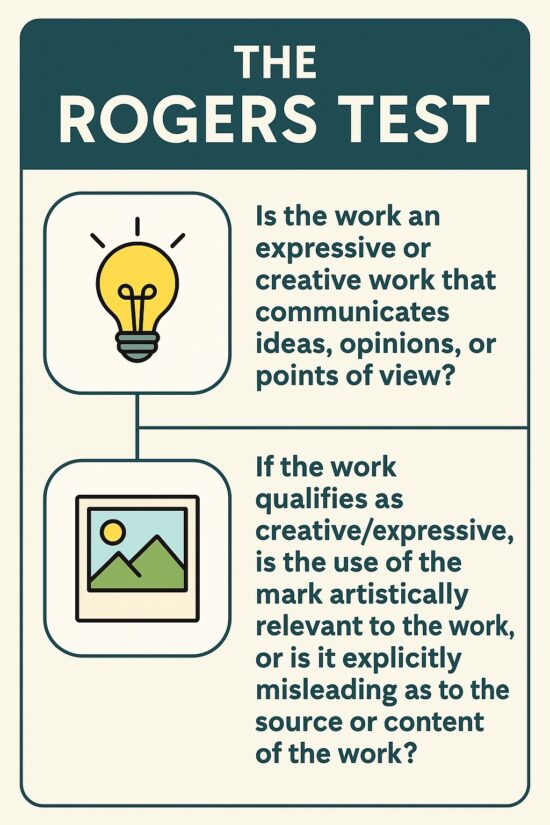
How does this apply to parody? Many parodies are expressive works, and may be protected by the Rogers test. For example, the “Barbie Girl” pop song by Aqua was a parody and commentary on the Barbie brand and was considered an expressive musical work, rather than a commercial product labeled “Barbie.” The Ninth Circuit applied the Rogers test and concluded that the First Amendment protected the song’s use of “Barbie” because it was artistically relevant to the song’s message and not explicitly misleading about Mattel’s involvement. Mattel v. MCA Records, 296 F.3d 894 (9th Cir. 2002). Mattel’s infringement claims failed, and the court memorably told the parties, “The parties are advised to chill”, underscoring that parody and pop culture commentary are forms of protected speech.
However, the recent 2023 Supreme Court ruling in Jack Daniel’s Properties v. VIP Products clarified that Rogers has limits. The Court unanimously held that Rogers does not apply when someone uses a mark as a trademark, as with the “Bad Spaniels” toy, which was branded like a product. In those cases, the defendant's use of a parody mark is analyzed under the standard infringement analysis with parody treated as a factor in the likelihood of confusion analysis, rather than under the Rogers test. The justices reasoned that trademarks used on commercial goods, even if humorous, are not automatically expressive works akin to artistic titles. They left the Rogers test intact for noncommercial artistic expression, but warned that simply adding a “humorous message” on a product does not trigger a heightened standard in every case. In short, selling a parody dog toy, T-shirt, or other merchandise featuring a spoof of a logo will be treated as a normal trademark use in commerce. The First Amendment protection of the Rogers test is not an absolute.
One of the most notable recent parody cases reached the U.S. Supreme Court in 2023. Jack Daniel’s Properties (the maker of the famous Tennessee whiskey) sued VIP Products LLC over a squeaky dog toy called “Bad Spaniels.” The toy is designed to look like a mini Jack Daniel’s whiskey bottle, with similar labeling and trade dress, but altered with humorous treatments of key features of the famous label, including a cartoon spaniel and the phrase “The Old No. 2 on your Tennessee Carpet,” as shown below. VIP made this and other parody products in its “Silly Squeakers” line, mimicking well-known liquor brands as dog toys.
Jack Daniel’s was not amused. The distiller sent a cease and desist letter to stop sales of the toy, and VIP preemptively sued for a declaratory judgment that its toy did not infringe. This kicked off a high-profile legal battle. Initially, a district court sided with Jack Daniel’s, finding trademark infringement and dilution by tarnishment, essentially agreeing that the toy could harm Jack Daniel’s brand by associating it with dog excrement. But on appeal, the Ninth Circuit Court of Appeals applied the Rogers test finding the toy as an expressive work because it conveyed a humorous message, and ruled for VIP. The Ninth Circuit held that Jack Daniel’s had to satisfy the Rogers threshold test first, which it failed, since “Bad Spaniels” was deemed an expressive, noncommercial use, it was shielded from both infringement and dilution claims.
Jack Daniel’s appealed to the Supreme Court, which resulted in a unanimous decision resetting the rules. The Supreme Court ruled in Jack Daniel’s favor and vacated the Ninth Circuit’s judgment. Justice Elena Kagan, writing for the Court, clarified that when a trademark is used as a trademark (i.e., to identify the source of a product), you do not skip the normal infringement analysis. The humorous nature of the use (“parody or not”) should be considered as part of the standard likelihood-of-confusion test, not as a legal threshold that short-circuits the test. In other words, VIP’s use of Jack Daniel’s trade dress on a product sold in commerce does not get a special First Amendment pass upfront; the case must be decided by asking whether consumers would likely be confused.
The Supreme Court also addressed dilution. The Ninth Circuit had treated the parody as “noncommercial” and thus immune from dilution by tarnishment, but the Supreme Court noted this was incorrect. Congress created a specific parody exclusion in the dilution statute, which only applies if the use is not as a designation of source. VIP’s use failed that condition because it was branding its own goods. Therefore, the dilution claim could proceed, rather than being tossed out as noncommercial speech.
After the Supreme Court’s guidance, the case was sent back down. The key takeaway is that the Supreme Court tightened the leash on the parody defense: parody is not a “safe harbor” against trademark infringement if the parody itself is being used to sell a product in a way that could confuse consumers. However, the Court hinted that a truly successful parody likely would not confuse people: “once the parody’s contrast with the original is clear, confusion is less likely”. The Bad Spaniels story thus highlights the fine line: the toy was funny, but not funny enough to avoid all legal scrutiny. Businesses planning parody-themed goods should note that overt branding of a parody product can undermine their parody defense. It is safer if the parody use is clearly decorative or commentary rather than functioning as a trademark for your own product.
On remand, incidentally, the district court in late 2024 found that Bad Spaniels did not cause confusion but did tarnish the Jack Daniel’s mark, indicating VIP’s parody was recognized as a joke by consumers but still harmed the brand’s reputation. This outcome shows that even a “win” on confusion might not end a parody case where there is also a dilution claim.
Before Bad Spaniels, there was “Chewy Vuiton.” Haute Diggity Dog, a Nevada pet products company, sold plush dog chew toys parodying luxury goods, including a tiny dog toy handbag labeled “Chewy Vuiton,” adorned with similar patterns as a Louis Vuitton purse. Louis Vuitton (LV), the famous French luxury brand, sued for trademark infringement, dilution, and even copyright infringement on the monogram design.
Both the trial court and the Fourth Circuit Court of Appeals sided with the parody maker, Haute Diggity Dog. The courts found that the “Chewy Vuiton” toys were successful parodies of Louis Vuitton’s handbags and marks. In analyzing confusion, the Fourth Circuit noted that LV’s marks are undeniably strong and famous, yet that fame cuts both ways in parody cases. A famous mark is a juicy target for parody, and its fame might actually help consumers realize that a parody is a parody. The court quoted an earlier decision: “In cases of parody, a strong mark’s fame and popularity is precisely the mechanism by which likelihood of confusion is avoided. The parody relies on the fame to make the joke, but its differences (often humorous) make it clear there’s no affiliation.”
In the Chewy Vuiton context, no reasonable buyer would think a plush dog toy (sold for ~$20 in pet stores) is actually a Louis Vuitton handbag. The juxtaposition of the cheap, comical dog toy with the expensive, exclusive image of LV created an unmistakable satire. The toy’s name sounded like Louis Vuitton, but also clearly not identical, and the context screamed “joke”: the product is something for a dog to chew on, whereas if the Louis Vuitton handbag were subject to the same treatment, the owner of handbag would likely be horrified.
Because the parody was obvious, the court ruled there was no likelihood of confusion. In fact, the decision observed that “There are confusing parodies and nonconfusing parodies. ... An effective parody will actually diminish the likelihood of confusion.” Chewy Vuiton was found to be an effective parody, so it reduced any confusion risk. Even though some elements were similar (the monogram pattern, the general look of the design), those were necessary to remind people of LV, but the differences in detail, quality, and presentation differentiated the chew toy. As the court put it, the product “conjures up the famous [Louis Vuitton] marks... but at the same time, it communicates that it is not the LVM product”. Consumers appreciate the point of parody because the contrast is clear.
On the dilution claim, the Fourth Circuit took a slightly different approach than the district court but still found for the defendant. The lower court had said parody meant no dilution. The appeals court clarified that while the district court’s reasoning was off, the result was right. Under the dilution analysis, Chewy Vuiton likely fell under the fair use parody exclusion as a non-source-identifying parody, now codified in 15 U.S.C. §1125(c)(3)(A). And the court even mused that the parody might enhance Louis Vuitton’s brand by reinforcing its fame in a tongue-in-cheek way. Certainly, the evidence did not show that people thought less of the LV mark because of the dog toy joke. So, Louis Vuitton lost on all counts, a well-known early example of the parody serving as a strong defense in trademark law.
The Jack Daniel’s Properties, Inc. v. VIP Products LLC (2023) and Louis Vuitton Malletier S.A. v. Haute Diggity Dog, LLC (2007) cases both involved dog toy parodies of famous luxury brands, but they diverge in both legal treatment and procedural posture. In Chewy Vuiton, the Fourth Circuit treated the parody as an effective and obvious spoof that reduced the likelihood of confusion; consumers “got the joke,” and the toy’s differences and context (pet toy versus luxury handbag) made confusion implausible. The court found that the parody both avoided infringement and qualified for the dilution fair use exclusion because it was not used as a source identifier. By contrast, in Jack Daniel’s, the Supreme Court emphasized that when a mark is used as a source identifier for the parody product itself (i.e., as a trademark), the ordinary likelihood of confusion analysis under the Lanham Act applies, and the defendant cannot automatically invoke First Amendment protections under the Rogers test.
In light of Jack Daniel’s, the outcome of Chewy Vuiton would likely remain the same. The parody in Haute Diggity Dog was not used as a mark to designate the source of a line of products; it was a humorous take on a famous brand, clearly non-confusing, and sold in a distinct market. Even if the traditional likelihood of confusion analysis were applied, the Chewy Vuiton parody would still likely be found non-infringing or diluting, since the Fourth Circuit already found no likelihood of confusion or dilution.
In the late 1990s, the pop group Aqua released “Barbie Girl,” a dance song that playfully mocked the Barbie doll’s image: “I’m a Barbie girl, in a Barbie world, life in plastic, it’s fantastic!”. Mattel, the maker of Barbie, sued MCA Records for trademark infringement and dilution, claiming the song’s use of “Barbie” cast their doll in a bad light: the lyrics call Barbie a “blonde bimbo”. Mattel argued that consumers might think the song was authorized or that Barbie’s brand was tarnished by the adult-themed joke.
The Ninth Circuit Court of Appeals, however, firmly sided with the songwriters. The court found Barbie Girl to be a parody or commentary on the Barbie image and thus protected speech. Because this was a song (an artistic work), the court applied the Rogers test for expressive uses. The use of “Barbie” was clearly artistically relevant and nothing about the song explicitly misled listeners to think Mattel produced or endorsed it. In fact, the album had a disclaimer that “The song is a social commentary and was not created or approved by the makers of the doll,” showing lack of intent to confuse. The Ninth Circuit also characterized the use as a type of nominative fair use. Aqua had to use the name “Barbie” to effectively target what they were parodying. The court concluded that trademark law shouldn’t be used to stifle artistic expression or comedic commentary. The First Amendment protection prevailed, and Mattel’s claims were dismissed.
The Barbie Girl case is often cited as a victory for free speech, illustrating that even a famous children’s toy brand cannot suppress a tongue-in-cheek critique of its image. It underscores that when the alleged infringing use is part of an artistic work and not a directly competing product, courts are very reluctant to find trademark infringement. The risk of consumer confusion was practically nonexistent here. No one buying the dance music CD would believe it was actually a Mattel product or officially endorsed. And on the dilution front, the court found the song to be noncommercial use, since it was artistic and not a traditional product advertisement. Thus, Mattel’s tarnishment claims failed as well.
For business owners, Barbie Girl exemplifies that using a trademark in commentary or satire, especially in media like music, art, or literature, has strong First Amendment safeguards. Trademark owners should also note that attempting to litigate in such scenarios may be an uphill battle, and might generate negative PR. Sometimes it is better to “accept the implied compliment in a parody and to smile or laugh than it is to sue” . Louis Vuitton Malletier, S.A. v. My Other Bag , Inc., 156 F. Supp. 3d 425 (S.D.N.Y. 2016).
Louis Vuitton appears again, this time against a small company called My Other Bag (MOB). MOB sold inexpensive canvas tote bags with one side stating “My Other Bag…” and the other side depicting a cartoonish imitation of a luxury handbag. One version showed a design resembling Louis Vuitton’s signature monogram purse with the phrase “...is a Louis Vuitton!” implying the owner’s other bag (tongue-in-cheek) is an LV bag. It is both a pun on the old bumper sticker joke (“My other car is a ___”) and a parody of luxury fashion culture.
LV sued for trademark infringement and dilution, but the courts saw it differently. In a scathing and witty opinion, Judge Jesse Furman of the Southern District of New York held that MOB’s totes are obvious parodies unlikely to confuse consumers and not causing dilution. He reasoned that the totes comment on the very exclusivity and status of Louis Vuitton bags. The differences in product and market were stark: a cheap canvas tote sold for everyday use vs. a pricey designer handbag for upscale use. The judge even noted that a parody like this might reinforce the distinctiveness of LV’s brand by juxtaposing it with a casual alternative. In other words, seeing the joke “My Other Bag is a Louis Vuitton” could remind people how special a real LV is, rather than making it less special.
It is worth noting the difference between parody in trademark law and parody in copyright law. Under U.S. copyright law, parody is a well-established form of fair use. The Supreme Court’s famous Campbell v. Acuff-Rose Music case (1994) held that a commercial parody (2 Live Crew’s raunchy parody of “Oh, Pretty Woman”) can qualify as copyright fair use, and that making money from a parody does not disqualify it. The Court emphasized that parody, as a form of commentary or criticism on an original work, is often transformative and can be protected even if done for profit. In other words, the fact that the parody song was sold on an album did not strip it of First Amendment protection in the copyright context. It was protected speech to poke fun at Roy Orbison’s song.
Instead of a blanket defense, trademark parody serves as a possible defense within the standard infringement analysis. The idea is that if the parody is obvious and effective, it will likely mean no consumer confusion and thus no infringement. But if consumers are likely to be confused, then calling something a “parody” will not save it. Additionally, trademark law’s concept of nominative fair use is related but distinct. Nominative fair use allows references to trademarks when necessary to describe or compare, without implying sponsorship. Parody often involves nominative use (you have to refer to the mark you are parodying), but it goes a step further by altering the mark for humor. Courts require that even nominative or parody uses not be misleading about origin or endorsement.
In sum, copyright law gives parodists a stronger shield, whereas trademark parodists must carefully avoid causing confusion. Trademark owners can be more aggressive since any use of their mark by another can be seen as an unauthorized use, but the law tries to accommodate parody as a socially valuable form of expression, within limits.
Trademark parodies occupy a unique space in the legal landscape: they highlight the tension between brand protection and free speech. As we have seen through these examples, U.S. courts do allow room for parody, recognizing that a parody mark or reference, when done well, is a form of artistic and social commentary often deserving First Amendment protection. Key cases (Jack Daniel’s, Haute Diggity Dog, and Barbie Girl) each illustrate how courts analyze parody: is it expressive or just commercial? Does it confuse consumers or make the source of the joke clear? Does it tarnish a famous mark beyond good taste, or simply poke fun in a way the law can tolerate?
A parody that clearly distinguishes itself is often lawful, especially if it is commenting on the original. Conversely, if your “parody” could confuse consumers into thinking the brand is involved, or if it’s simply using the brand’s allure to sell a similar product, there is significant risk of liability. The First Amendment offers robust protection for artistic expression and social commentary, but it will not protect someone trying to use parody of a mark as its own mark or in a manner that does not quite function as a parody.
Going forward, we may see more guidance on how to handle new forms of parody, e.g., internet memes using brand logos, or parodies in the metaverse. But the fundamental lesson remains: parody must have some artistic value and cannot cause consumer confusion or brand dilution.
If you need guidance with respect to parody or other trademark issues, contact our office for a consultation.
© 2025 Sierra IP Law, PC. The information provided herein does not constitute legal advice, but merely conveys general information that may be beneficial to the public, and should not be viewed as a substitute for legal consultation in a particular case.
Copyright Management Information (CMI) is the identifying data that accompanies a creative work, such as title, author, copyright owner, and usage terms. This information is often embedded in metadata or displayed with the work. In the modern digital age, this information plays a crucial role in managing rights and preventing copyright infringement. U.S. copyright law, particularly the Digital Millennium Copyright Act (DMCA), provides legal protections for the integrity of CMI. Business owners and creators need to understand what CMI is, why it matters, and how U.S. law treats the removal or alteration of CMI. This article discusses the purpose of CMI, the legal claims related to it, enforcement and litigation trends, best practices for compliance, and a brief look at how foreign jurisdictions handle Copyright Management Information. The goal is a professional yet accessible overview for non-specialists, with relevant statutes and case law cited along the way.
Copyright Management Information is defined by law as certain information conveyed in connection with copies or performances of a work, including in digital form, that identifies the work or its rights holders. In practice, CMI can be found in visible notices or hidden metadata attached to creative content. For example, CMI may include:
This information is typically provided alongside the work to inform the public about who created it, who owns it, and how it can be used. A common example of Copyright Management Information is the © notice on a book or the metadata in a digital photo file that lists the photographer’s name and copyright details. In an audiovisual work, CMI may be embedded information in the file itself and there may be on-screen credits. It’s important to note that CMI specifically does not include any personally identifying information about a user of the work. In other words, the law is concerned with information identifying the work and its owners, not the identities of people who might access or use the work.
Copyright Management Information can appear in both analog and digital form, but it has become especially crucial in digital media. Metadata tags in MP3 files, EXIF data in images, watermarks on videos, QR codes or hyperlinks that link to license info, and other such information qualifies as CMI if they convey identifying information about the copyrighted work.

The primary purpose of CMI is to preserve the link between a creative work and its rightful owner or creator, thereby facilitating legitimate use and licensing of the work. By ensuring that a work’s origin and terms of use are clear, CMI helps users know how they can lawfully use the content and whom to contact for permissions. From a policy perspective, Congress enacted protections for CMI to uphold the integrity of copyright management and reduce infringement. If accurate CMI stays intact with the work, it becomes easier to manage rights, e.g., to locate the owner for licensing, and harder for others to infringe under the guise of ignorance.
In legislative history, officials emphasized two key goals of protecting CMI. First, requiring the preservation of CMI makes it more reliable and aids in the “administrability of copyright law”, meaning it’s easier to enforce rights when works are properly attributed. Second, it helps prevent copyright infringement that could occur when CMI is removed. The reasoning is simple: if a work is stripped of credit or copyright notice, people might assume it’s free to use or even try to pass it off as their own. For instance, if someone finds a photo online with no attribution or notice, such person might reuse it without realizing it’s protected. By discouraging the removal of CMI or penalizing it after the fact, the law aims to “induce, enable, [or] facilitate” the proper use of works and not to enable or conceal infringement. In effect, CMI protection serves as a form of damage control against potential copyright abuse. It safeguards the informational infrastructure that underpins licensing and enforcement.
In summary, CMI exists to inform and protect: it informs the public about ownership and allowed uses, and it protects creators by reducing anonymity of works. When used consistently (e.g. always including a copyright notice or metadata), CMI can help copyright owners maintain their brands and rights, and it can serve as evidence in court of willful infringement if someone deliberately removes or alters it.
In the United States, the Digital Millennium Copyright Act (DMCA) of 1998 introduced specific provisions to protect CMI as part of a broader effort to combat digital copyright abuse. Section 1202 of Title 17, U.S. Code (“Integrity of copyright management information”) is the key statute. It implements obligations from international treaties (the WIPO Copyright Treaty’s Article 12) by making it unlawful to falsify or tamper with CMI. This section is part of Chapter 12 of the Copyright Act, which deals with technological protection measures and rights-management information: hence the chapter’s name “Copyright Protection and Management Systems”.
Definition of CMI
As described earlier, §1202(c) defines “copyright management information” to include various identifying details about a work (title, author, owner, terms of use, etc.), including in digital form. The statute explicitly excludes any personally identifying information about users from the definition, focusing only on information about the work or its creators/owners. Notably, the definition even covers identifying numbers and symbols that refer to CMI, as well as links to such information. For example, a barcode or embedded link that, when scanned, provides the copyright details qualify as CMI.
False CMI (Section 1202(a))
The law prohibits providing false copyright management information or distributing false CMI, when done knowingly and with an intent to facilitate infringement. Specifically, no person shall knowingly and with the intent to induce, enable, facilitate, or conceal infringement:
In plain terms, this targets situations where someone might attach incorrect or fake ownership information to a work. For example, if a person removed an original watermark and added their own name (false CMI) to a photograph in order to claim it as theirs, that would violate §1202(a) by knowingly providing false CMI with intent to enable or conceal infringement. False CMI cases are less common, but the provision exists to punish attempts to mask infringement by falsifying the attribution or rights info of a work.
Removal or Alteration of CMI (Section 1202(b))
This is the heart of CMI protection and a scenario that frequently arises in practice. Section 1202(b) makes it unlawful to intentionally remove or alter CMI without authority, or to distribute works or CMI knowing that CMI was removed or altered without authority, if done knowing (or having reasonable grounds to know) that such actions will “induce, enable, facilitate, or conceal” copyright infringement. Breaking that down:
To illustrate, imagine a website operator knowingly strips metadata (which contains the photographer’s name and copyright notice) from images before posting them. If at the time of removal the operator has reasonable grounds to know that this act will make it easier for users to download and reuse those images without permission (thus infringing), the operator could be liable under §1202(b). The knowledge can be actual or inferred, and it covers acts that “enable or conceal” infringement. For example, removing CMI can conceal the infringement by making it harder to trace the work back to the owner, or enable infringement by removing warnings or watermarks that would otherwise deter copying.
It’s worth noting that the infringement in question need not be by a third party. Courts have confirmed that removing CMI to cover up one’s own infringing use counts. In one case, a media company published a photographer’s image without permission and replaced the photographer’s credit with a different name, thereby concealing its unauthorized use. The court held this satisfied the statute’s scienter requirement because the removal concealed the company’s infringement. No separate “future” infringer was required.
In short, if you intentionally remove or alter CMI on a copyrighted work without consent, and you know or should know that doing so could lead to copyright infringement, you are violating §1202(b).
While the law is strict about not removing or altering CMI, it provides some exceptions and safe harbors for certain activities and industries. These ensure that legitimate governmental or technical reasons for removing CMI are not wrongly penalized.
Law Enforcement and Government Activities
Section 1202 includes an exception for lawful investigative, protective, or intelligence activities by government officials or those contracted by the government. This means that if a federal or state law enforcement officer, or an agent engaged in national security or similar intelligence operations, removes CMI as part of an authorized investigation or security test, §1202 does not apply. For instance, a government cybersecurity team analyzing a breach might copy files and strip certain info for analysis. The statute explicitly says it “does not prohibit any lawfully authorized investigative, protective, information security, or intelligence activity” by government officers or those acting under government contract. The term “information security” include activities performed to identify or address vulnerabilities in government computers, systems, and/or networks. In short, bona fide government operations (law enforcement, national defense, cybersecurity) can involve removal of CMI without triggering liability.
Broadcast and Transmission Safe Harbors: The statute also creates specific safe harbors for broadcasters (like radio and television stations) and cable providers when transmitting works, acknowledging that inserting or retaining CMI in certain broadcasts may be technologically difficult or incompatible with broadcast standards. These are technical exceptions mostly relevant to broadcasting businesses:
Additionally, the law carves out certain content from the definition of CMI for broadcasters. Notably, §1202(c) excludes performer information from being treated as CMI in the context of live broadcasts by radio and television stations. For example, in the case of a publicly performed work in a live radio concert, the name of a performer isn’t considered protected CMI under this section to avoid burdening live broadcasters with adding credits for every performance in real-time. So, while a performer’s name is generally CMI for recorded works, the law doesn’t penalize radio and TV stations for not displaying or transmitting performer info during live public performances.
The key takeaway is that unless you fall into a narrow exception, like law enforcement or constrained broadcast scenarios, you should not remove or alter CMI without permission. The vast majority of commercial activities (e.g., posting images online, republishing articles, editing videos) are expected to preserve any CMI that comes with the content. If you have authorization from the copyright owner to remove CMI (e.g., a license allowing you to use a photo without credit), that constitutes “authority of the copyright owner” under the statutory language and is not a violation. But absent such permission or a specific legal exemption, removing metadata, watermarks, or notices is risky under the DMCA.
Under §1203 of the Copyright Act, anyone injured by a violation of 17 U.S.C. §1201 or §1202 can bring a civil lawsuit in federal court. This means if someone removed your work’s CMI or added false CMI and it harmed you (e.g., by making it easier to infringe your work or cause loss of licensing revenue), you can sue that person in an appropriate U.S. district court. Claims against such violations are often brought alongside direct copyright infringement claims, but they are distinct causes of action. You can sue for CMI removal even if the underlying use might have been licensed or at least even if no separate infringement claim is proven, as long as the statutory criteria are met.
When a court finds a violation, it has broad powers to redress the harm and deter further abuses. Key civil remedies available include:
Thus, while attorneys’ fees and costs can serve as powerful tools to make litigation viable for smaller rightsholders and as deterrents against willful violators, their availability is ultimately discretionary. Parties bringing or defending CMI-related claims should be mindful that the court will weigh the overall reasonableness and policy implications of awarding fees, rather than applying a bright-line rule.
In addition to civil remedies, there are criminal provisions for willful CMI violations. Under 17 U.S.C. §1204, if someone willfully violates §1201 or §1202 for purposes of commercial advantage or private financial gain, they can face criminal fines and even imprisonment. For a first offense, the penalty can be up to $500,000 in fines or 5 years in prison (or both); for repeat offenses, up to $1,000,000 or 10 years in prison. Nonprofit institutions are exempt from criminal liability. While criminal prosecutions under §1202 are rare, the presence of these penalties underscores the seriousness of CMI violations. For a business owner, this means that systematically removing CMI for profit (e.g., a scheme to scrape copyrighted images, strip metadata, and resell them) could potentially lead to federal criminal charges, not just civil lawsuits.
In real-world litigation, CMI claims have presented some challenges and evolving interpretations. Courts have grappled with exactly what a plaintiff must prove to succeed under §1202(b). Two major issues in enforcement are: (1) proving the knowledge/intent element (scienter), and (2) the scope of works covered (the “identicality” issue).
Knowledge (“Double Scienter”) Requirement
As noted, §1202(b) requires the defendant knew or had reasonable grounds to know that their removal or alteration of CMI would likely facilitate infringement. The argument that it should be enough to show the removal could make infringement easier in a general sense is not enough. Recent appellate decisions have set a higher bar. The Second Circuit, Ninth Circuit, and Eleventh Circuit all require an affirmative showing that the defendant was aware that removal of CMI would likely lead to specific infringing acts. In Stevens v. CoreLogic, Inc., 893 F.3d 648 (9th Cir. 2018), for example, a group of photographers claimed a software company stripped metadata (CMI) from their photos. The Ninth Circuit rejected the claim because the photographers failed to produce evidence showing that the defendant knew its software carried even a substantial risk of concealing infringement, let alone a likelihood of actual infringement resulting. The court held that §1202(b) requires a showing that the defendant knew the prohibited act would "‘induce, enable, facilitate, or conceal’ infringement,” and mere conjecture was not enough.
The defendant’s state of mind matters greatly. Innocent or purely technical removal is not the target, knowing removal that is oriented toward making infringement easier is. For plaintiffs (e.g. content creators enforcing their rights), this means gathering evidence not just that CMI was removed, but that the remover understood the significance. Evidence might include internal emails about scrubbing metadata to avoid “takedown notices,” patterns of removed CMI followed by widespread uncredited use, or admission that the remover knew permission was needed. For defendants, the “double scienter” standard is a shield against tenuous claims. If they truly didn’t think about infringement resulting, they may avoid liability, though pushing “ignorance” too far can be risky if a reasonable person would have seen the risk.
“Identicality” of the Work
A newer debate in CMI litigation is whether the statute only applies when the work distributed without CMI is exactly the same as the original work apart from the missing CMI. Some courts have imposed an “identicality requirement”, essentially requiring that the defendant distributed an identical copy of the copyrighted work with CMI removed, as opposed to a modified or partial version. Under this view, if the work was altered significantly or only a portion of the work was used, a §1202(b) claim might not lie because the statute speaks in terms of copies of works and removal of CMI from the work. For example, one court held that taking a photographer’s image and reproducing it in full without the metadata met identicality (the only change was removing CMI), whereas using snippets or creating a derivative might not.
Not all courts agree on this. Some have explicitly rejected the identicality requirement, arguing it isn’t found in the statutory text and would undermine protection: imagine a hacker could evade §1202 by altering one pixel of a photo and claiming it’s not identical. The issue has come up recently in cases involving AI-generated outputs: if an AI system trains on copyrighted data and produces pieces of it without attribution, is that an “identical copy” with CMI removed, or something new? Plaintiffs in those cases argue that §1202 should apply even if the output isn’t a verbatim copy, so long as CMI was removed from material that was copied in part. Defendants counter that the law was meant for complete copies and that applying it to partial use would overreach. As of now, federal courts are divided on identicality, and no circuit court has squarely ruled on it.
Practical Enforcement:
Many CMI cases in recent years involve photographers, graphic artists, or musicians whose digital files had metadata or watermarks removed by downstream users. For example, a photographer might license images to a client with attribution required in metadata, but an online platform used by the client automatically strips metadata (a common issue with social media or MLS real estate listings). If infringement then occurs (i.e., third party copying the image), the photographer may claim the platform violated §1202(b). These cases often hinge on proving the platform knew that removing metadata would likely lead to unlicensed copying. To enforce effectively, rightsholders should gather evidence such as industry knowledge that metadata is used to find infringements, the remover’s prior warnings or training about preserving CMI, or direct admissions.
Maintaining good CMI practices is not only a legal safeguard but also part of professional content management. Here are some best practices for business owners, content creators, and users of third-party content:
Always include CMI on your own works:
When you create content (articles, images, videos, software, etc.), attach identifying information. This could be a visible copyright notice (© [Year] [Name]) and contact info, or metadata tags (for digital files) with your name, the title, and any licensing terms. Including CMI from the outset strengthens your position if someone later removes it. It also puts users on notice that the work is protected, reducing accidental infringement. For photographs and graphics, consider embedding a watermark or caption with your name or company, something that marks ownership without overly detracting from the image. Even simple steps like naming digital files in an identifiable way help (e.g., “Acme_Corp_Design2025.jpg” instead of “image123.jpg”).
Preserve existing CMI when using others’ content:
If your business uses content created by someone else (e.g., stock photos, licensed text, or open-source code), do not remove or alter the CMI unless you have clear permission. This applies to both visible attributions and hidden metadata. For instance, if you download a stock photo that has the photographer’s name in the metadata, keep that metadata intact when you publish it, or provide the required credit visibly according to the license. Removing watermarks, cutting off credit lines, or deleting metadata fields can land you in legal trouble under §1202. Many content licenses, including open-source software licenses, actually require retaining copyright notices. Comply with those terms – not just to respect the creator, but because it is a legal requirement. If space is an issue (e.g., a short excerpt where a full credit is hard to include), consult the license or rights holder for how to give attribution in an acceptable way rather than omitting it entirely.
Train your team and configure your tools:
A lot of CMI removal can happen unintentionally. For example, some content management systems or image editing software might not preserve metadata by default. Make sure your employees, contractors, and the tools they use are configured to not strip out CMI by default. Many modern platforms have settings to retain EXIF data or to include attribution. If you run a website, check whether it’s stripping metadata from user-uploaded images; if yes, consider the implications and whether exceptions are needed. Educate anyone handling content on the importance of leaving CMI intact. A policy like “Never remove or edit copyright notices or metadata from third-party content without legal approval” can instill caution. This also applies to developers scraping or processing data; ensure they know not to remove copyright info or author credits from datasets or code.
Document permissions if you do remove CMI:
In some cases, you might have legitimate authority to remove or change CMI. For example, a license to use a photo might allow you to white-label it (replace the original credit with your company’s name), or a contract might let you anonymize content for confidentiality. If you do this, keep records of the contract or email from the copyright owner granting permission. If a question arises, you can demonstrate it was done with the authority of the copyright owner or the law, which is a complete defense.
Use technology to your advantage:
If you’re a creator, there are tools to embed CMI robustly, like metadata and/or digital watermarks. Some systems use information security techniques such as hidden identifiers, such as steganographic watermarks to track works. While not foolproof, these can complement legal CMI. Similarly, keep identical copies of your originals with full CMI. If someone distributes a version without CMI, having your original helps prove that the only difference is the missing information. Scan the web periodically for your works.
Enforce your rights consistently:
If you discover that your CMI was removed from a distributed work, consider taking action. This might start with a DMCA takedown notice under 17 U.S.C. § 512 if the content is online, or a cease-and-desist letter citing §1202. Often, pointing out the CMI removal and the DMCA’s penalties can prompt a quick settlement or correction. Because of the availability of statutory damages, you have leverage even if actual damages are small. The offending party faces up to $25,000 per violation, which can add up if multiple works or copies are involved. That said, be judicious: accidental or minimal CMI omissions might be resolved amicably, whereas willful and systematic removal (as part of piracy or plagiarism) merits a stronger response, potentially a lawsuit.
In essence, the best practice is transparency: let the attributions and notices flow with the content. From an ethical and business standpoint, it shows respect for creators, and legally it keeps you on the right side of the DMCA CMI rules. Businesses that proactively respect CMI not only avoid lawsuits but also build trust with content partners and audiences.
Copyright management information isn’t just a concern in the United States, it is part of a broader international framework for copyright in the digital environment. Many other countries have provisions analogous to §1202, largely due to the influence of international treaties and agreements. At the international level, the WIPO Copyright Treaty (WCT) (1996) obligates member countries to provide legal protections for “rights management information.” The U.S. implemented this via the DMCA.
Also, the European Union in its Information Society Directive (Directive 2001/29/EC) requires member states to prohibit the removal or alteration of electronic rights-management information. Article 7 of the EU Directive mandates “adequate legal protection” against the removal or tampering of Rights Management Information, and against distribution of works knowing that RMI has been removed. EU member states have implemented this in their national laws, so across Europe it is generally unlawful to knowingly strip off copyright notices or metadata from a work. The RMI concept is the same as CMI and the aim is to safeguard the identification of works and rightsholders in digital commerce.
Countries like Canada and Australia have also have similar provisions, often introduced in the early 2000s. For instance, Canadian copyright law makes it an offense to remove or alter RMI on a work, parallel to the DMCA’s approach. Generally, these laws around the world reflect a common principle: those who distribute copyrighted works in digital form must not meddle with the informational tags that identify the work’s creators, owners, and usage terms.
However, there can be differences in scope and enforcement. Some jurisdictions might not require the same level of scienter (knowledge of likely infringement) as U.S. law. The EU laws, for example, don’t explicitly include the double scienter language of “will induce, enable, facilitate, or conceal infringement.”
For a business operating internationally, the safe move is to treat CMI/RMI as something you should preserve regardless of jurisdiction. Removing metadata or notices can get you in trouble not just in the U.S. but abroad as well. There are also international initiatives and voluntary industry standards aiming to improve content identification. Participating in or adhering to these standards can help demonstrate good faith and compliance globally.
In summary, be aware that foreign jurisdictions also protect copyright management information in line with the WIPO treaty obligations. The core idea is to not remove or falsify the identifying info on a copyrighted work, and is a common thread worldwide.
Copyright Management Information may appear as small text or hidden data attached to a work, but it carries significant legal weight. The DMCA’s provisions on CMI underscore that tampering with this information is not a trivial matter. The takeaways are clear: always maintain accurate CMI with your works, and respect the CMI on others’ works. Doing so not only helps prevent infringement but also shields you from liability under laws like §1202.
If CMI is removed or altered without permission, U.S. law provides robust remedies, from injunctions and damages to potential criminal penalties for willful commercial violations. In practical terms, treating CMI properly is part of good copyright hygiene in the digital content world. It fosters a culture of attribution and accountability. A person acting pursuant to the law will avoid liability and contribute to an ethical creative culture.
If you have an issue relating to copyright management information or copyrights generally, contact our office for a free consultation.
© 2025 Sierra IP Law, PC. The information provided herein does not constitute legal advice, but merely conveys general information that may be beneficial to the public, and should not be viewed as a substitute for legal consultation in a particular case.
Trademark coexistence agreements are contracts that permit two parties to use similar or identical trademarks without interfering with each other’s business. Essentially, it’s a formal agreement between trademark owners to avoid conflict by dividing their rights, e.g., by splitting along regions or product lines. These agreements often come into play when businesses discover they have confusingly similar brand names or logos and want to avoid a trademark dispute or litigation. Rather than resorting to litigation, the parties can negotiate a coexistence agreement as a fair compromise. This approach allows each company to keep using its mark while minimizing confusion and clarifying the scope of each party’s rights.
Under U.S. trademark law, two similar marks cannot coexist if consumers would likely be confused about the source of the goods or services. Section 2(d) of the Lanham Act (15 U.S.C. §1052(d)) forbids registration of a similar trademark that is likely to cause confusion with an existing registered mark. In practice, if a new trademark application is too close to an existing trademark registration, the U.S. Patent and Trademark Office (USPTO) will issue a refusal for likelihood of confusion as part of the trademark prosecution process, putting the trademark applicant in a tough spot with potentially negative consequences.
The trademark applicant might have to abandon their application or be subject to a trademark infringement lawsuit filed by the trademark registrant. Often, the trademark applicant’s best option is to negotiate a trademark coexistence agreement, rather than risk their mark being unregistrable. Such an agreement, if accepted by the USPTO, can allow both to obtain registration and continue using their marks by clarifying each one’s field of use and preventing consumer confusion.
The terms trademark coexistence agreement and trademark consent agreement are related. A consent agreement usually refers to a simple contract where one party (often the senior user) formally consents to the other’s use or registration of the same or a similar trademark. It typically includes a statement that the parties believe confusion is unlikely. A consent agreement can allow the junior user to register their trademark if it provides sufficient detail about how and why consumer confusion will be avoided. The USPTO and courts look far more favorably on a detailed agreement than on a mere “naked” consent that lacks specifics.
By contrast, a trademark coexistence agreement is a more comprehensive arrangement. A trademark coexistence is an agreement that includes mutual restrictions about how the two marks will be used. For example, the agreement might split the market by territory, by product lines, or by related industries, so that each company’s use of the mark remains distinct. A formal trademark coexistence agreement documents these limitations and the parties’ mutual rights, providing clear divisions and guidelines on the parties' use of their respective marks and making it easier to convince courts and administrative agencies (e.g., USPTO, US Customs and Border Protection, etc.) that no public confusion will arise.
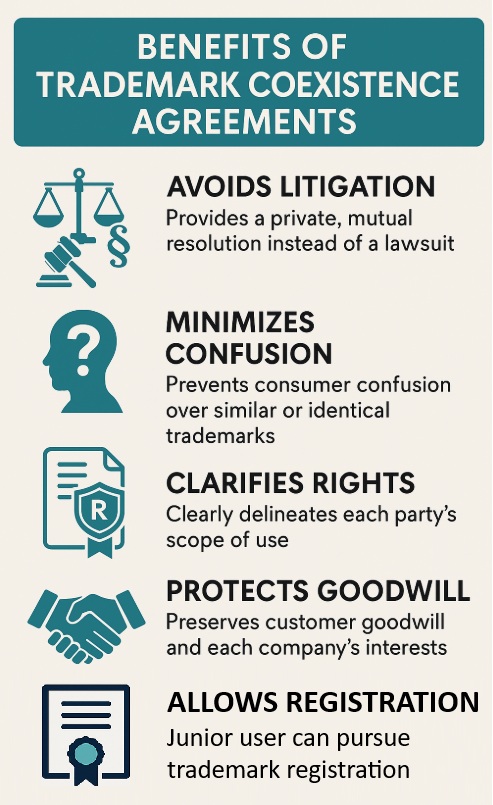
Signing a coexistence agreement is not a magic wand, but it can significantly influence legal outcomes. Under the familiar DuPont test for likelihood of confusion (a set of factors courts and the USPTO use to evaluate trademark conflicts), one factor is whether the parties have an agreement. Courts have indicated that a well-crafted coexistence agreement should be given considerable weight in the analysis. One court observed that when those closest to the marketplace agree there will be no confusion, it is difficult to insist otherwise. The Federal Circuit similarly instructs that the USPTO should not override the judgment of trademark owners who consent to coexist unless other factors clearly show confusion is likely.
However, if an agreement is too flimsy and doesn’t truly prevent confusion, the USPTO can still refuse registration. The Trademark Trial and Appeal Board, which handles appeals of refusals by the trademark office, has held that coexistence agreements that do not include sufficient terms to avoid consumer confusion are ineffective and will not support registration of confusingly similar marks. In re Bay State Brewing Company, Inc., 117 USPQ2d 1958 (TTAB 2016). In short, a comprehensive agreement that includes concrete provisions and evidence showing confusion is unlikely is much more likely to persuade courts and the USPTO.
Even if two companies are willing to compromise, their agreement cannot come at the expense of the public. Trademark law ultimately exists to protect consumers from confusion. If a coexistence deal would leave consumers likely to be dangerously confused, it may be against public interest for both to use that mark. For example, if two pharmaceutical companies used the same trademark for different drugs, that may endanger patients through the confusion and mistaken prescription fills.
Likewise, trademark coexistence agreements must be crafted to avoid violating antitrust regulations. Generally, such agreements do not violate antitrust regulations, but if the arrangement essentially carves up the market and harms competition, a court could strike it down. In general, these agreements are considered legitimate, good-faith solutions (a limited compromise on exclusivity, not an illegal restraint of trade) so long as they include enough detail to safeguard the public’s interest.
In Clorox Co. v. Sterling Winthrop, Inc., 117 F.3d 50 (2d Cir. 1997), Clorox challenged a trademark agreement that prohibited it from selling disinfectants under the mark PINE-SOL, arguing the restriction violated antitrust law by creating a barrier to entry. The Second Circuit rejected this claim, holding that the agreement did not restrain overall competition because Clorox remained free to sell disinfectants under other names, and a trademark confers only a right to a name, not a monopoly on a product. The court emphasized that antitrust laws protect competition as a whole, not individual competitors, and thus trademark agreements are generally valid unless they significantly harm market-wide competition.
A coexistence agreement is a practical solution when trademark use by two enterprises has a potential to cause consumer confusion. It allows concurrent use of similar marks by separate entities, effectively turning potential trademark litigation into a private, mutual resolution. It offers a way to find a fair compromise respecting both parties’ rights and customer goodwill, and provides a means of avoiding future disputes in connection with their similar marks.
However, a coexistence agreement must be carefully crafted, considering the nature of each party’s use and providing convincing division of trademark use, ownership, and domain that provides protection against consumer confusion. It should clearly delineate each party’s scope of use to eliminate any likelihood of confusion. Done properly and in good faith, coexistence agreements protect each company’s interests while also safeguarding the public.
If you need assistance with a coexistence situation or other issues relating to trademarks, please contact our office for a free consultation.
© 2025 Sierra IP Law, PC. The information provided herein does not constitute legal advice, but merely conveys general information that may be beneficial to the public, and should not be viewed as a substitute for legal consultation in a particular case.
When you apply for a U.S. patent, you can’t just claim an invention. You must also teach others how to use it. This concept is known as patent enablement, a core requirement in U.S. patent law. In simple terms, the patent’s specification and drawings must contain enough detail to enable a person with ordinary skill in the relevant field to make and use the claimed invention without undue experimentation. If the disclosure is insufficient, the patent may be rejected or later found invalid for failing the enablement requirement. We discuss here what enablement means in practice, why it matters, and how courts and the Patent Office evaluate whether an invention is properly “enabled”.
Under U.S. law, the enablement requirement is codified in 35 U.S.C. § 112(a). This statute requires that a patent application “describe its invention in such full, clear, concise, and exact terms as to enable any person skilled in the art … to make and use the [invention]”. In other words, the patent’s specification must provide an enabling disclosure, enough information so that a person of ordinary skill in the art could replicate and use the invention based on the patent’s teachings, without having to invent or guess the missing pieces. The “person of ordinary skill in the art” (POSITA) refers to a hypothetical technical expert in the relevant field with ordinary knowledge. This standard recognizes that you don’t have to educate a layperson; you can assume the reader has the baseline knowledge of the field.
However, everything claimed as your invention and the entire scope of your patent claims must be supported by the disclosure. A patent claim will be invalid if the specification does not enable the full scope of that claim. Notably, enablement is a separate requirement from the written description requirement (also under 35 U.S.C. § 112(a)). The enablement requirement is about teaching how to make/use the invention, whereas written description is about showing you actually possessed the invention at the time of filing. This is discussed further below.
Enablement lies at the heart of the patent system’s quid pro quo or “patent bargain.” In exchange for receiving a time-limited set of exclusive rights provided by a patent, the inventor must disclose to the public how to practice that invention. The U.S. Supreme Court recently re-emphasized the point, noting that “[i]n exchange for bringing 'new designs and technologies into the public domain through disclosure,' so they may benefit all, an inventor receives a limited term of 'protection from competitive exploitation.'". Amgen Inc. et al. v. Sanofi et al., 598 U.S. 594 (2023) (citing Bonito Boats, Inc. v. Thunder Craft Boats, Inc., 489 U. S. 141, 150 (1989)).
The enablement is the “quid,” and the patent grant is the “quo.” If a patent doesn’t adequately teach the public, it hasn’t upheld its side of the deal. As the Federal Circuit has explained, “Patent protection is granted in return for an enabling disclosure of an invention, not for vague intimations of general ideas that may or may not be workable.” Genentech, Inc. v. Novo Nordisk, 108 F.3d 1361 (Fed. Cir. 1997). In practical terms, this means you cannot claim more than you teach. The law prevents inventors from obtaining broad patent rights over a concept without giving sufficient disclosure in return. This ensures future innovators can read the patent and build upon it, instead of being blocked by a patent that "hides the secret sauce". Generally, a patent is only as strong as its disclosure. If you attempt to claim a broad invention but provide only sketchy details or a few examples, you risk an enablement rejection during examination or patent invalidity later on for insufficient disclosure.
The core question in any enablement analysis is: Can a person of ordinary skill in the art make and use the claimed invention without “undue experimentation”? The patent doesn’t have to spell out every minor detail or completely eliminate the need for any experimentation. Some routine testing or optimization is acceptable. The law only forbids undue (excessive) experimentation. As one court put it, a patent is not necessarily inadequate “just because it leaves the skilled artist to engage in some measure of adaptation or testing.”
The line is crossed when the amount of trial-and-error or research required is unreasonable in light of the invention and the state of the art. In fact, the Supreme Court has reaffirmed that a reasonable amount of experimentation can be allowed. As stated in Amgen Inc. et al. v. Sanofi et al., “[w]hat is reasonable in any case will depend on the nature of the invention and the underlying art.” For example, a small amount of testing to confirm a known technique might be fine, but if the patent basically says “figure it out for yourself” or requires a research program to fill in gaps, that likely falls on the wrong side of the line. The enablement requirement refers to enabling the full scope of the claims, not just one way of doing the invention or a subset of embodiments. If significant inventive effort or guesswork is still needed to practice parts of the claimed invention, the disclosure is not enabling.
Enablement is assessed as of the patent’s filing date. The patent must enable the invention based on knowledge available at the time of filing, considering what was already known in the prior art. You cannot rely on later discoveries to satisfy enablement; the question is whether, given the state of the art when you filed, a POSITA could practice the claimed subject matter without undue burden.
Because “undue experimentation” is a qualitative standard, courts have developed factors to evaluate enablement on a case-by-case basis. In the leading case In re Wands, 858 F.2d 731 (Fed. Cir. 1988), the Federal Circuit developed a now-famous list of considerations, commonly known as the Wands factors. These factors guide judges, juries, and patent examiners in determining whether a disclosure meets the enablement requirement. The Patent Office has confirmed that examiners should continue applying the Wands factors as their guide for determining compliance with enablement requirement, after the Supreme Court decision in Amgen Inc. et al. v. Sanofi et al. The Wands factors include:
These factors are not a rigid test but a useful framework. They are considered together to answer whether a POSITA would need to engage in undue experimentation to make and use the invention as claimed. In litigation, enablement is ultimately a question of law (did the patent meet the legal standard?) based on underlying factual findings about things like the amount of guidance, examples, predictability, etc.. Similarly, during patent examination, an examiner might raise an enablement rejection in an office action if, e.g., the claims are very broad but the application gives only a scant description or only a couple of disclosed embodiments. The applicant can then argue and/or provide evidence that a skilled artisan could nonetheless practice the invention without undue experimentation. For example, by pointing to well-known techniques in the underlying art, it may be demonstrated that a POSITA was enabled by the disclosure even though there are limited examples therein.

It’s easy to confuse the enablement requirement with the related written description requirement, since both are found in § 112 and both deal with what’s in the specification. However, they address different issues. In brief:
As discussed, this asks whether the specification teaches others to make and use the invention without undue experimentation. It is a forward-looking requirement: can someone reproduce the invention based on the disclosure of the patent application? Think of it as providing a recipe or instruction manual for the full scope of the claims.
This asks whether the specification demonstrates that the patent owner was in possession of the claimed invention at the time of filing. It’s more of a backward-looking, evidence-based inquiry: Does the patent’s text show that you actually invented what is being claimed? It often comes up when new or broad claims are added: is there support in the original disclosure for those claims?
Here is an illustration of the difference: a patent that teaches a method of making a composition C for treating a disease by first synthesizing compounds A and B, and combining A and B to yield composition C. The patent enables the synthesis of compound A, but it does not provide written description of compound A as a treatment for the disease. A claim for compound A as a treatment for the disease would be invalid under the written description requirement. Conversely, the inventor might describe a specific product in detail (meeting written description for that product) but fail to disclose how to make it, and thus fail to meet the enablement. Both the enablement and written description requirements must be met to properly claim a particular subject matter.
In the context of broad or generic claims, patent challengers often assert both grounds: that the patent doesn’t enable the full scope and that it didn’t demonstrate possession of the full scope. The key takeaway is that a good patent application should both teach how to practice the invention and show that the inventor truly had that invention in hand at filing.
One scenario where enablement issues frequently arise is when a patent claim is very broad. For example, a genus claim that tries to cover an entire class or category of products or methods, defined perhaps by a function rather than a specific structure. Broad claims are attractive because they provide wider protection (blocking more competition), but they are also vulnerable if the patent’s teaching doesn’t keep up with the breadth. U.S. law has long held that a patent must enable the full scope of what it claims, not just a subset or a few examples. “The more a party claims, the broader the monopoly it demands, the more it must enable.” Amgen Inc. et al. v. Sanofi et al., 598 U.S. 594 (2023). That holds true whether the case involves telegraphs devised in the 19th century, glues invented in the 20th, or antibody treatments developed in the 21st. In other words, the principle of full-scope enablement is technology-agnostic and timeless. An overly broad claim will fail enablement no matter what field, unless the patent provides commensurately broad teaching.
This principle can be illustrated by a few famous examples in early and prior enablement case law:
Morse’s Telegraph - O'Reilly v. Morse, 56 U.S. 62 (1853) : In O’Reilly v. Morse, Samuel Morse famously tried to claim any use of electromagnetism to transmit characters at a distance, far beyond the specific telegraph system he built. The Supreme Court struck down that broad claim because Morse had not enabled all ways of using electromagnetism for telegraphic communication. He only taught his particular system, not every possible system. This case established that you cannot claim a fundamental principle without enabling all applications of it that you claim. It’s often cited to warn against claiming an abstract result without sufficient implementation details.
The Incandescent Lamp Case , 159 U.S. 465 (1895): The early lightbulb patent by Sawyer and Man claimed the entire class of fibrous or textile materials carbonized for use as an electric light filament. Unfortunately for them, they had only tested certain materials (like carbonized bamboo) and did not identify any general quality common to all fibrous materials that would make them effective filaments. The Supreme Court invalidated the broad claim, explaining that a genus claim can be valid only if the inventor discloses some general quality running through the class that gives them their “peculiar fitness for the particular purpose.” In this case the inventors hadn’t done so. Most fibrous materials in fact wouldn’t work, and the patent gave no guidance to tell which ones would, amounting to little more than a hunt for a workable filament.
Holland Furniture Co. v. Perkins Glue Co., 277 U.S. 245 (1928): In Holland Furniture Co. v. Perkins Glue Co., a patent claimed a type of glue defined by its function, acting like animal glue for wood veneering, rather than by its composition. The Supreme Court found the patent invalid because it didn’t disclose how to make all such glues. It essentially told the public to find any glue that works as well as animal glue, without teaching the formula. This is another early example of a functional genus claim that failed for lack of an enabling disclosure. The Court cautioned that one cannot just claim a result (here, any glue that works) and leave it to others to figure out how to achieve it.
These historical cases set the stage for modern enablement law: broad functional claims are scrutinized to ensure the patent’s specification describes enough to actually achieve the breadth claimed. Otherwise, the patentee is attempting to cover more than they invented, which the enablement requirement prevents.
Today courts apply the same principles in high-tech fields. In the Amgen Inc. v. Sanofi case, Amgen had patents on a class of monoclonal antibodies defined by what they do: bind to a certain region on a protein, PCSK9, and block that protein’s function to lower cholesterol. The claims encompassed millions of potential antibodies meeting that definition, but the patent specification only disclosed the amino acid sequences of 26 antibodies and then provided two generalized methods to find more antibodies.
The methods were essentially a screening roadmap and a conservative substitution approach. The Supreme Court concluded that these claims were invalid for lack of enablement. The Court concluded that Amgen’s patents failed to enable the full scope of antibodies they claimed, because identifying the rest of the antibodies would require a painstaking experimentation process. Essentially, Amgen was telling scientists to perform significant research (trial-and-error screening) to discover other functional antibodies. The Supreme Court characterized those methods as mere “research assignments” and famously analogized the situation to the earlier examples: Amgen was seeking “sovereignty over an entire kingdom” of unexplored compounds.
The Federal Circuit had reached a similar conclusion, reasoning that the claimed functionality was broad, the art of antibody science is highly unpredictable, and the patent’s guidance (though containing some examples) fell short of enabling the full scope without undue experimentation. The Supreme Court affirmed that result. In doing so, it reaffirmed that there is “one universal enablement standard”, not a heightened standard for biotech per se, but that standard is applied with full scope in mind. In short, no matter the field, a patent must teach how to make and use every single embodiment of the claimed invention, or at least enough of them, plus a principle that lets skilled readers extrapolate the rest, while requiring only a reasonable degree of experimentation.
It’s worth noting that not all broad claims are doomed. If an inventor can articulate a unifying principle or common quality for the genus and provide sufficient examples or guidance, a broad claim can be enabled. For instance, if in the Incandescent Lamp case the inventors had discovered that the cellular structure of bamboo was the key to a successful filament and claimed the class of materials with that structure, that might have been a valid genus claim. The Supreme Court in Amgen also acknowledged this caveat: a genus might be enabled by disclosing a defining quality that all embodiments share, which makes them work. What doesn’t work is simply claiming all solutions to a problem and saying “trust me, you can find others using my general method” without providing enough detail or predictability.
The concept of enablement has direct practical implications when filing patent applications. If your patent claims are too broad for your disclosure, you may receive an enablement rejection from the USPTO. In litigation, broad claims that outrun the disclosure can be invalidated, as we saw in the Amgen case and others like Enzo Life Sciences, Inc. v. Roche Molecular Systems, Inc., 928 F.3d 1340 (Fed. Cir. 2019).
In Enzo, the patent concerned a method of detecting genetic material using non-radioactive probes. The claims were broad but the patent provided only one working example and minimal guidance, while covering “tens of thousands” of possible polynucleotide sequences in a highly unpredictable biotechnology field. The Federal Circuit concluded that undue experimentation would be required to make and use the full scope of the claims and invalidated the patent for lack of enablement. The court even quoted the earlier Genentech decision’s warning that patents are not rewarded for mere “vague intimations” of a general idea.
To avoid these pitfalls, here are a few practical takeaways when seeking patent protection:
Include Sufficient Detail and Examples: Make sure your patent application contains concrete examples or working prototypes of your invention whenever possible, especially if you plan to claim a broad concept. The more working examples spanning the breadth of your claim, the stronger your case for enablement. If you only have a few examples, consider whether your claims should be narrowed or supported by a clear general principle.
Consider the Predictability of Your Field: If you’re in an unpredictable field, like chemical compounds, biotechnology, or new materials, recognize that you’ll need to provide more guidance in your patent. For example, in biotech inventions (e.g., antibodies, gene therapies, etc.), small changes can have big effects, so your disclosure should guide a skilled scientist through those uncertainties. If the underlying art is unpredictable, err on the side of more disclosure. Apply the general aphorism “the broader the claim, the more detail you must provide.”
Draft Claims Strategically: One strategy to secure broad coverage while satisfying enablement is to pursue a mix of broad genus claims and narrower species claims. The broad claims stake out your territory, but you should also claim specific embodiments as fallback positions. Courts have noted that having robust species claims can be wise if a broad claim might be on shaky enablement ground. If a genus claim is later invalidated, at least your narrower claims might survive. Also be cautious about claiming purely by function. If you define something in your claim only by what it does (the “claimed function”) rather than what it is, be sure your spec teaches how to achieve that function across the full range.
Don’t Overclaim Early in the Process: In the rush to file a patent, especially in the modern first-to-file system, inventors might file on a breakthrough that isn’t fully fleshed out. However, filing too early with extremely broad claims and little data can lead to enablement problems. It can be better to file a provisional application or narrow claims first, then file follow-up applications as you develop more working examples or insights that enable broader claims. Balance the desire to claim a broad monopoly with the reality of what you can teach at the time of filing. Remember that enablement (and written description) is judged at time of the filing date. You can’t fix a non-enabled disclosure later except by filing a new application with additional matter, which won’t get the benefit of the earlier date.
Use Continuations to Add Details: The U.S. patent system allows filing continuation applications to add different claim scope while relying on the same disclosure. If you worry that some claims might be too broad, you can pursue narrower claims in one application and keep another application pending (a continuation) to later try broader claims, possibly after gathering more support. However, you cannot add new matter to an existing application. Any new example or detail would have to go in a fresh application (with a new date). So the best practice is to include as much enabling detail as you can in the first filing.
By understanding the enablement requirement, you can work with a patent attorneys to craft an application that satisfy the law and result in enforceable patents. An enabled patent disclosure not only helps you survive legal challenges but also adds credibility. It shows that you have actually figured out how to achieve the full scope of your invention.
Patent enablement is a foundational concept that ensures every patent earning exclusive rights has taught the public how to practice the invention. In U.S. law, this means the patent must enable a person of ordinary skill to make and use the claimed invention without undue experimentation. The enablement requirement, rooted in 35 U.S.C. § 112(a), prevents inventors from overreaching. You cannot claim a patent monopoly over more than you actually disclosed.
Courts use tools like the Wands factors to evaluate if a disclosure is commensurate with the claim scope, examining things like the number of working examples, the predictability of the field, and the breadth of the claims. Failing to do so can render patents invalid, as seen in cases from O’Reilly v. Morse to Amgen v. Sanofi.
The key lesson is that a patent is not just about staking a claim, it’s about contributing knowledge. By ensuring sufficient enablement, you not only increase the chances of obtaining a patent, but you also fortify that patent against future enablement challenges, e.g., by an accused infringer.
If you are considering a patent filing or you have another patent-related issue, please contact our office for a free consultation.
© 2025 Sierra IP Law, PC. The information provided herein does not constitute legal advice, but merely conveys general information that may be beneficial to the public, and should not be viewed as a substitute for legal consultation in a particular case.

Sierra IP Law, PC - Patents, Trademarks & Copyrights
FRESNO
7030 N. Fruit Ave.
Suite 110
Fresno, CA 93711
(559) 436-3800 | phone
BAKERSFIELD
1925 G. Street
Bakersfield, CA 93301
(661) 200-7724 | phone
SAN LUIS OBISPO
956 Walnut Street, 2nd Floor
San Luis Obispo, CA 93401
(805) 275-0943 | phone

SACRAMENTO
180 Promenade Circle, Suite 300
Sacramento, CA 95834
(916) 209-8525 | phone
MODESTO
1300 10th St., Suite F.
Modesto, CA 95345
(209) 286-0069 | phone
SANTA BARBARA
414 Olive Street
Santa Barbara, CA 93101
(805) 275-0943 | phone
SAN MATEO
1650 Borel Place, Suite 216
San Mateo, CA, CA 94402
(650) 398-1644. | phone
STOCKTON
110 N. San Joaquin St., 2nd Floor
Stockton, CA 95202
(209) 286-0069 | phone
PORTLAND
425 NW 10th Ave., Suite 200
Portland, OR 97209
(503) 343-9983 | phone
TACOMA
1201 Pacific Avenue, Suite 600
Tacoma, WA 98402
(253) 345-1545 | phone
KENNEWICK
1030 N Center Pkwy Suite N196
Kennewick, WA 99336
(509) 255-3442 | phone
2023 Sierra IP Law, PC - Patents, Trademarks & Copyrights - All Rights Reserved - Sitemap Privacy Lawyer Fresno, CA - Trademark Lawyer Modesto CA - Patent Lawyer Bakersfield, CA - Trademark Lawyer Bakersfield, CA - Patent Lawyer San Luis Obispo, CA - Trademark Lawyer San Luis Obispo, CA - Trademark Infringement Lawyer Tacoma WA - Internet Lawyer Bakersfield, CA - Trademark Lawyer Sacramento, CA - Patent Lawyer Sacramento, CA - Trademark Infringement Lawyer Sacrament CA - Patent Lawyer Tacoma WA - Intellectual Property Lawyer Tacoma WA - Trademark lawyer Tacoma WA - Portland Patent Attorney - Santa Barbara Patent Attorney - Santa Barbara Trademark Attorney
