
How much does a trademark cost? U.S. government filing fees are $350 per class, if you apply for a single class of goods or services and utilize the pre-approved descriptions provided in the Trademark ID Manual. However, there are additional costs that may be incurred in your application, such as additional fees for more than one class of goods or services, a statement of use if you file under an intent-to-use filing basis, attorney costs if you hire a trademark attorney, trademark search fees, and maintenance costs. There are also renewal fee requirements after five years of registration and renewal applications after every 10 years post-registration.
A properly prepared one-class trademark application may require only the base application filing fee, while multiple classes, custom descriptions, intent-to-use, or an office action can increase total costs. A good estimate of the cost of a simple trademark application (a mark in current use on a single class of goods or services), including fees for attorney services, is around $2,000 to $3,500.
This article provides basic cost information for non-attorneys, allowing them to understand the process before they commit to the trademark registration process.
The United States Patent and Trademark Office (USPTO) charges a $350 base filing fee per class for electronic applications under Trademark Act Sections 1 and 44. In 2025, the trademark office replaced the previous two-tier system, TEAS Plus and TEAS Standard, with one base application fee of $350. New applications are filed through Trademark Center, the USPTO's updated electronic filing system launched in 2025. The legacy Trademark Electronic Application System is still used for filing statements of use, extensions of time, responses to office actions, and other filings. The electronic filing system is generally accessible through a MyUSPTO account that can be set up by anyone and fee payments can be set up via electronic funds transfers. The USPTO also accepts credit card payments. However, it must be understood that a MyUSPTO account may only be used to file trademark applications on behalf of the account holder. Only licensed attorneys are authorized to file trademark applications on behalf of others.
Goods and services are divided into separate international classes in related categories. A trademark application that includes one class requires a single USPTO filing fee of $350 and each additional class adds another $350 filing fee. Thus, how many classes determines the amount of USPTO fees required to submit the application for examination. One trademark application may list multiple classes, but including multiple trademark classes in one application does not reduce the USPTO filing fees. In fact, including a wide array of goods and services in a single application can overly complicate the application process.
Having a complicated single application with multiple classes of goods or services can result in a complicated examination process. Often it is simpler and more organized to file a separate application for each class. This approach cabins the different goods and services categories and avoids the entire application from being rejected based on the similarity of one of the classes with a third-party trademark filing, or the potential need to later divide the application because some of the goods or services are being used in commerce and others are not. Careful consideration of planned goods or services can prevent unnecessary complications and costs while preserving trademark protection for all the relevant goods and services.
The application form submitted to the USPTO has formal requirements that must be met before the application will be examined. Detailed information must be included in the application regarding the applicant, the legal basis for the application, the nature of the mark (including whether and when it has been used in commerce), and the specific goods and services and their respective classes. An incomplete application can trigger processing fees of an additional $100 per class. Also, if the descriptions of the goods and services are not taken from the pre-approved descriptions provided in the Trademark ID Manual, and are instead free-form custom descriptions, the applicant will pay additional fees of $200 per class. There are also size fees for goods and services descriptions. Each additional 1,000 characters beyond the first 1,000 characters adds $200 for the affected class. These additional fees are in place to promote examination efficiency. It is highly advisable to use the pre-approved descriptions in the Trademark ID Manual whenever possible. However, the use of an inaccurate description of goods or services merely to avoid additional USPTO fees is never advisable.
A comprehensive trademark search should be performed prior to filing a federal trademark application. The USPTO provides a search tool for its internal trademark database, but it does not provide guidance to the applicant as to registrability of the applicant's trademark. A professional search may cost between about $300 and $1000. However, the more important service is the analysis of the search results and the guidance provided by an experienced attorney with regard to the likelihood that the mark can be registered and potential trademark infringement and dispute issues that may arise from the use of the proposed trademark. An effective trademark search and analysis includes related prior trademark filings in the federal trademark registers, state trademark registrations, active business names, internet domains, and unregistered, common-law use. DIY filing or self-filing can avoid attorney fees but create costly mistakes arising from filing trademarks that have little chance of success, misidentifying the ownership of the mark, misclassifying goods and services, submitting improper specimens, and various other matters. Applications filed by attorneys have a far higher success rate than DIY filings.
A trademark attorney does increase the cost of the application, but greatly increases the chances of success in a trademark application and can keep the applicant out of potential trademark infringement situations. Trademark attorneys handle billing for such services in different ways. Some may charge a flat-fee, hourly attorney fees, or separate fees for attorney services such as an initial consultation, search, preparation, and monitoring. Trying to save a few hundred dollars by pursuing a trademark application without experienced trademark counsel often leads to failure and can result in weakened brand protection. In fact, the USPTO recommends hiring a trademark attorney to conduct a clearance search and prepare the application, respond to correspondence, and help maintain trademark rights.
The trademark application process requires a valid filing basis. Under Section 1(a), the mark must be used in commerce at the time the application is filed. Under Section 1(b), the applicant must have a bona fide intent to use the mark in commerce. Intent-to-use applications incur later additional trademark costs, including a statement of use in which the applicant declares under penalty of perjury that the mark has been used in commerce in connection with the applied-for goods or services. The applicant must also provide a valid specimen of use for each class to which the statement of use relates. There are USPTO fees associated with each class for which the statement of use is filed: $150 per class. These filing options allow a business owner to file for trademark registration regardless of their current stage of trademark implementation.
The applicant can file an amendment to allege use during the examination process for the intent-to-use application. If no amendment to allege use is filed, there is a six-month period after a notice of allowance for the application is issued by the USPTO. If the applicant cannot establish use of the mark and submit a statement of use in that timeframe, the applicant can extend the time to file the statement of use another six months by filing an extension request and paying a fee of $125 per class. The applicant can extend the time to file the statement of use up to five times.
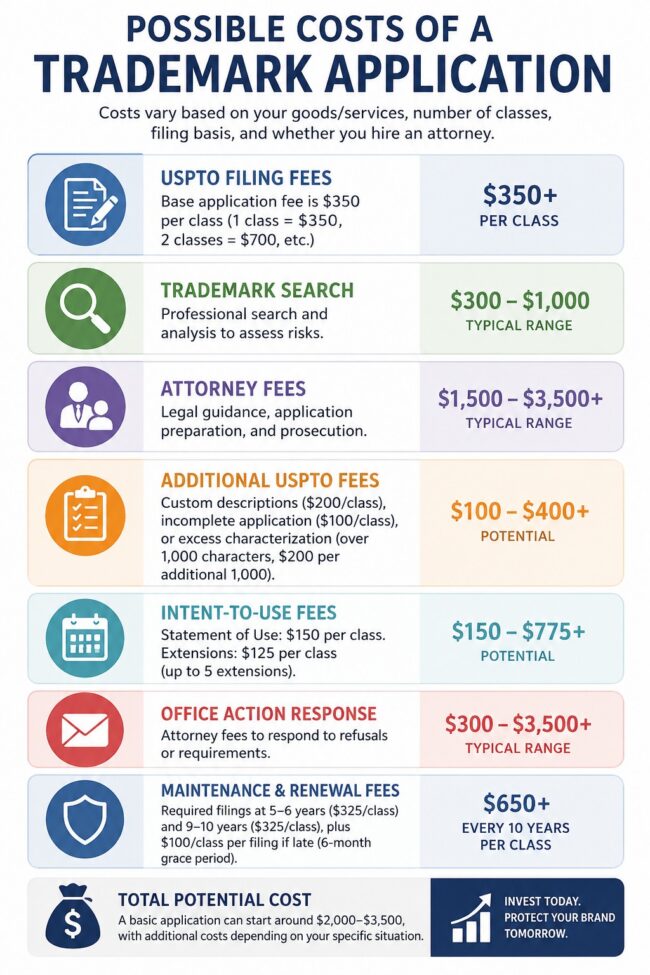
During the examination process, a USPTO examining attorney reviews the trademark filing for legal and procedural issues. An office action may be issued if the examiner finds likelihood of confusion issues with prior trademark filings under Section 2(d), descriptiveness issues under Section 2(e), or formal issues with the application, such as faulty classifications or descriptions of the goods and services. There is ordinarily no government fee required to file a response to the office action, but it is advisable to seek the assistance of a trademark attorney to analyze and respond to the issues in the office action. This legal work, of course, incurs attorney fees. For an office action that raises formal matters and/or descriptiveness issues, an attorney may bill a few hundred dollars. If the office action raises complicated refusals based on alleged confusion with prior-filed applications, responding to the office action can cost, e.g., $1,500 to $3,500.
The USPTO provides a three-month response window for an office action. The time to respond can be extended for a three-month period for a $125 electronic fee. If the applicant fails to timely respond to an office action and the applicant did not intend to abandon the application, the application can be revived. The petition to revive an unintentionally abandoned application carries a USPTO fee of $250. These additional costs involved in extending the timeline of examination are intended to promote efficient prosecution of trademark applications. It is recommended that applicants seek the assistance of trademark counsel in order to avoid costly mistakes in the application process.
Trademark rights can arise through use, but federal trademark registration offers important benefits. A Principal Register certificate is prima facie evidence of validity, ownership, and exclusive rights for the listed goods or services, and registration supplies nationwide constructive notice. See 15 U.S.C. § 1057(b).
The Supreme Court detailed registration’s legal benefits in Matal v. Tam, 582 U.S. 218 (2017). Although unregistered marks may receive protection, Tam explained that Principal Register registration provides nationwide constructive notice, prima facie evidence of validity, ownership, and exclusive use, potential incontestability after five years, and assistance against infringing imports. In B&B Hardware, Inc. v. Hargis Industries, Inc., 575 U.S. 138 (2015), B&B opposed Hargis’s SEALTITE application based on its registered SEALTIGHT mark. After the TTAB found a likelihood of confusion, the Court held that the determination could preclude relitigation in later infringement litigation when ordinary preclusion requirements are met and the usages adjudicated are materially the same. B&B Hardware thus shows that the USPTO provides not merely a registration process, but also an administrative court whose findings regarding trademark registrations may have a determinative effect on trademark enforcement. These statutory, evidentiary, and procedural advantages can make trademark registration central to comprehensive protection.
After the registration process, there are still actions that must be periodically taken to preserve the registration and the registrant's trademark rights. There are trademark renewal and maintenance requirements at 5 years and every 10 years after the registration is issued. A Section 8 declaration of continued use of the registered mark is due between the fifth and sixth anniversaries. The Section 8 affidavit of use carries a USPTO fee of $325 per class. The registrant may also file a declaration of incontestability under Section 15, which removes many of the bases for challenging the validity of a registration, including prior trademark use. The USPTO fee for the Section 15 filing is $250 per class. At the tenth anniversary, and every ten years thereafter, the Section 8 affidavit of use and Section 9 renewal application must be filed at a renewal fee of $650 per class. These additional trademark fees should be considered when estimating the cost of the entire process.
A six-month grace period is available for these trademark renewal filings, but USPTO surcharges of $100 per class are required.
Protection in multiple countries can be sought through an international treaty system called the Madrid System. An owner of a U.S. trademark registration may seek foreign registrations that claim priority to the U.S. application through the World Intellectual Property Organization (WIPO). If an international trademark registration application through the Madrid System is filed within six months from the filing date of the U.S. application, the international trademark registration application will have the same effective filing date as the U.S. application. The application is filed with WIPO, which charges a basic fee in Swiss francs plus country and class-based charges. Government fees vary by the countries selected and whether one or multiple basic applications or registrations are used. The filing fees for an application through the Madrid System vary based on the selected countries in the range of about $1,000 to about $3,000.
So, how much does a trademark cost? The total costs may include a comprehensive trademark search, filing fees, attorney fees, intent-to-use filings, custom descriptions, responses to an office action, maintenance filings, and international protection. Almost all trademark fees are nonrefundable, and the USPTO generally will not refund fees merely because registration is refused or an application is abandoned. The most reliable cost estimate therefore begins with careful consideration of the mark, owner, goods or services, number of classes, countries, and filing basis. A targeted trademark search and informed filing strategy can control trademark costs, strengthen federal registration, secure meaningful brand protection, and help avoid costly mistakes throughout the application and registration process.
© 2026 Sierra IP Law, PC. The information provided herein does not constitute legal advice, but merely conveys general information that may be beneficial to the public, and should not be viewed as a substitute for legal consultation in a particular case.

"Mark and William are stellar in the capabilities, work ethic, character, knowledge, responsiveness, and quality of work. Hubby and I are incredibly grateful for them as they've done a phenomenal job working tirelessly over a time span of at least five years on a series of patents for hubby. Grateful that Fresno has such amazing patent attorneys! They're second to none and they never disappoint. Thank you, Mark, William, and your entire team!!"
Linda Guzman


Sierra IP Law, PC - Patents, Trademarks & Copyrights
FRESNO
7030 N. Fruit Ave.
Suite 110
Fresno, CA 93711
(559) 436-3800 | phone
BAKERSFIELD
1925 G. Street
Bakersfield, CA 93301
(661) 200-7724 | phone
SAN LUIS OBISPO
956 Walnut Street, 2nd Floor
San Luis Obispo, CA 93401
(805) 275-0943 | phone

SACRAMENTO
180 Promenade Circle, Suite 300
Sacramento, CA 95834
(916) 209-8525 | phone
MODESTO
1300 10th St., Suite F.
Modesto, CA 95345
(209) 286-0069 | phone
SANTA BARBARA
414 Olive Street
Santa Barbara, CA 93101
(805) 275-0943 | phone
SAN MATEO
1650 Borel Place, Suite 216
San Mateo, CA, CA 94402
(650) 398-1644. | phone
STOCKTON
110 N. San Joaquin St., 2nd Floor
Stockton, CA 95202
(209) 286-0069 | phone
PORTLAND
425 NW 10th Ave., Suite 200
Portland, OR 97209
(503) 343-9983 | phone
TACOMA
1201 Pacific Avenue, Suite 600
Tacoma, WA 98402
(253) 345-1545 | phone
KENNEWICK
1030 N Center Pkwy Suite N196
Kennewick, WA 99336
(509) 255-3442 | phone
2023 Sierra IP Law, PC - Patents, Trademarks & Copyrights - All Rights Reserved - Sitemap Privacy Lawyer Fresno, CA - Trademark Lawyer Modesto CA - Patent Lawyer Bakersfield, CA - Trademark Lawyer Bakersfield, CA - Patent Lawyer San Luis Obispo, CA - Trademark Lawyer San Luis Obispo, CA - Trademark Infringement Lawyer Tacoma WA - Internet Lawyer Bakersfield, CA - Trademark Lawyer Sacramento, CA - Patent Lawyer Sacramento, CA - Trademark Infringement Lawyer Sacrament CA - Patent Lawyer Tacoma WA - Intellectual Property Lawyer Tacoma WA - Trademark lawyer Tacoma WA - Portland Patent Attorney - Santa Barbara Patent Attorney - Santa Barbara Trademark Attorney
