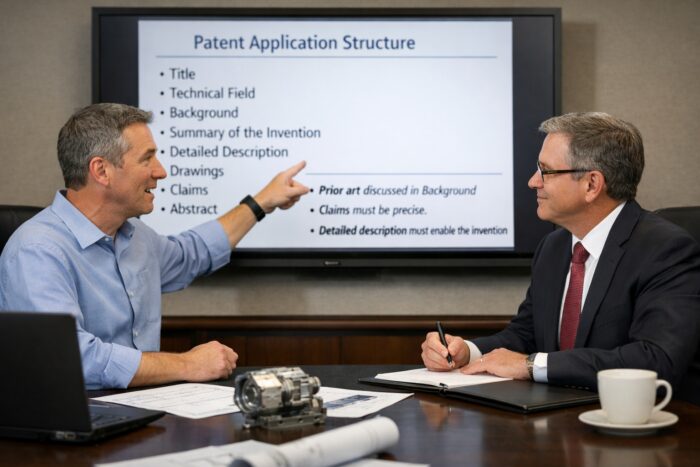
Business owners and entrepreneurs often develop new products that may or may not be patentable, and need to understand how to draft a patent application, and the key aspects of the patent application process. A well-drafted patent application is far more than simply describing an idea or invention. It is a carefully structured legal and technical document designed to comply with U.S. patent law while clearly defining what is being claimed and protected. When done correctly, a patent application can help you obtain enforceable patent protection, establish valuable intellectual property rights, and discourage competitors from copying or designing around your invention. The drafting process requires thoughtful organization, precise writing, and an understanding of how the claims and specification work together to define the scope of protection.
Below is a general explanation of how to draft a patent and the core requirements of U.S. patent law.
Before writing a patent, you should conduct a prior art search to evaluate whether your invention is truly patentable and to understand the landscape of existing technology. A patent must satisfy the requirement of novelty under 35 U.S.C. § 102, meaning the claimed invention must be new and not previously disclosed to the public, and be non-obvious to a person having ordinary skill in the art under 35 U.S.C. § 103. A well-executed patentability search and analysis helps identify similar devices, processes, or publications that may affect the patentability of your invention.
Beyond novelty, reviewing the prior art allows you to better define what is unique about your invention, refine your patent claim strategy, and draft claims that meaningfully distinguish over what already exists. This step can prevent costly mistakes, such as attempting to protect an idea that is already part of the prior art.
It is equally important to recognize that inventors can unintentionally create their own prior art. Public disclosure of your invention, through marketing, sales, presentations, or publications, before filing a patent application can destroy patent rights. While the United States provides a limited one-year grace period for certain inventor disclosures, many foreign jurisdictions require absolute novelty, making early filing critical.
One of the first strategic decisions in how to draft a patent is determining what type of patent application to file. A provisional patent application can be filed under 35 U.S.C. § 111(b) as a starting point because it allows inventors and companies to secure an early filing date while providing up to 12 months to further develop, test, and refine the invention before filing a non-provisional utility application claiming priority to the provisional application under 35 U.S.C. § 119(e). During this period, inventors can evaluate market interest, seek funding, or iterate on a device or process, all while preserving priority for the disclosed subject matter. However, a provisional application is not examined and never becomes a patent on its own, so it must adequately describe the invention to support later claims.
A non-provisional utility patent application, by contrast, is the formal filing examined by the USPTO. It must include all required sections, such as claims, a detailed description, and drawings where applicable, and it ultimately determines the scope of enforceable patent protection.
A non-provisional utility patent application is not an informal narrative; it is a highly structured legal document that must follow a recognized format to be effective. Under U.S. patent law, a non-provisional filing must include distinct, organized parts arranged in a standard sequence. This required structure is not just a formality, it directly affects how the United States Patent and Trademark Office (the USPTO) examines the application and how courts later interpret the scope of the patent.
As a practical drafting convention, a patent application generally consists of nine sections, presented in a logical order that moves from high-level context to precise legal boundaries:
Each section serves a specific and essential purpose. The early sections orient the reader by explaining what the invention is, the technological area it belongs to, and the problem it addresses. The middle sections, particularly the detailed description, must carefully describe the invention with enough specific details to enable someone skilled in the art to make and use it. The claims section, which comes near the end but carries the most legal weight, defines the precise boundaries of the claimed invention and the exclusive rights you seek to obtain.
Your overall submission package may also include drawings, inventor declarations, and other required documents, but the sections above are the drafting backbone of every non-provisional patent. Maintaining this standardized organization improves clarity, reduces examination issues, and ensures your application aligns with USPTO expectations.
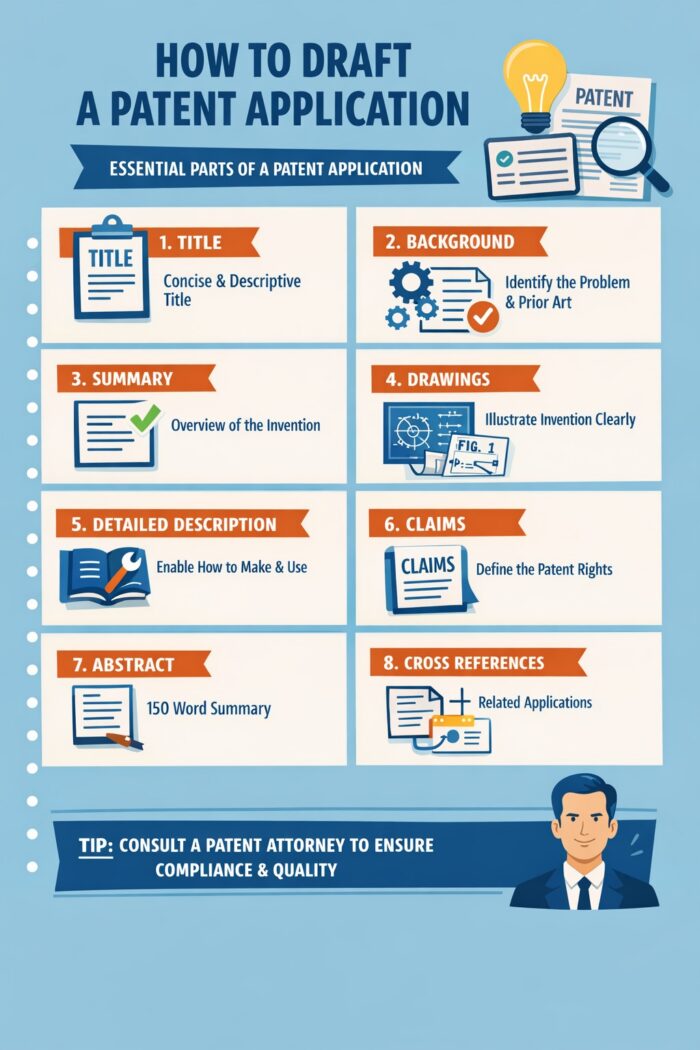
The title of a patent plays an important role in framing the invention for both the examiner and the public record, so it should be concise, technically precise, and descriptive of the subject matter. Under USPTO rules, the title should briefly summarize the nature of the invention without unnecessary detail or promotional language. See 37 C.F.R. § 1.72(a). When preparing your patent application, it is good practice to use title text that clearly reflects the core concept of the claimed invention, such as:
“Modular Thermal Management System for Battery Packs”
Avoid marketing terms or exaggerated language, as these can create ambiguity or confusion. A well-crafted title helps examiners efficiently categorize the application and allows later readers to quickly explain what the invention covers.
If you have related filings, such as a provisional patent application or an earlier non-provisional patent application, it is critical to include a clear cross reference section at the beginning of your application that properly claims priority or benefit to those earlier filings. Under 35 U.S.C. § 119(e) and 35 U.S.C. § 120, a valid priority claim allows the later-filed application to rely on the earlier filing date for the claimed invention, which can be decisive when determining novelty and assessing prior art.
The purpose of a priority claim is to protect your intellectual property rights by establishing the earliest possible effective filing date, reducing the risk that intervening publications, public disclosures, or competitor filings will be used against you. From a practical standpoint, this administrative front matter also creates a clear prosecution record and helps the patent examiner understand how the application fits within a broader family of related patent documents. Because errors or omissions in priority claims can permanently forfeit valuable patent protection, this section should be drafted carefully, with precise references to application numbers, filing dates, and relationships between the applications.
The background section should identify the problem your invention addresses and describe the area related to the claimed invention, including existing technologies and/or prior art. This is where you define the technical field and frame why the invention is needed, without an exhaustive narrative.
A good background:
The summary of the invention provides a high-level explanation of the invention and serves as a bridge between the background section and the claims section. Its purpose is to clearly explain the core concepts of the claimed invention by highlighting its key features, advantages, and intended operation that is broad enough to cover the embodiments described in the detailed description section, as well as additional embodiments. A well-written summary should read as a generalized overview that captures the essence of the invention in a way that aligns with, and supports, the eventual patent claim language.
Importantly, the summary should be broader than the particular example embodiments shown in the drawings or discussed later in the description, while still remaining faithful to what the claims define as the scope of protection. There is an important balance to strike in the Summary section. If the summary is too narrow, it may unintentionally limit how the invention is interpreted. If it is too abstract, it may fail to adequately support the claims. The goal is to describe what the invention is, what problem it solves, and why it is advantageous over existing solutions, all while staying consistent with the terminology used throughout the specification.
From a drafting perspective, the summary also helps frame the invention for the patent examiner at the USPTO and for future readers evaluating the strength of the patent protection. When done carefully, it reinforces the novelty and advantages of the invention and sets the stage for clear, enforceable intellectual property rights.
Planning drawings early is a critical step when drafting a patent application, because U.S. rules require drawings whenever they are necessary to understand the claimed invention. Under 37 C.F.R. §§ 1.81, 1.84, applications for mechanical devices, systems, or other tangible structures almost always must include drawings, while some method-based or chemical inventions may be understandable without them. An application that does not require drawings must still fully describe the invention in words alone, but if a visual depiction would aid understanding, omitting drawings can weaken the disclosure.
When drawings are required, they should clearly show all claimed features of the invention. Every element recited in a claim should appear in at least one figure, even if shown schematically. In the detailed description, each figure (for example, “FIG. 1” or “FIG. 2”) should be expressly referenced and tied to specific components or steps. This careful cross-referencing improves clarity, supports proper claim interpretation, and helps ensure the scope of the claims is fully supported by the specification.
The claims section defines the legal protection your patent provides and is the most important part of a patent application because the claims define the precise scope and boundaries of the patent rights. Under 35 U.S.C. § 112(b), each claim must particularly point out and distinctly claim the claimed invention, making claim drafting a careful balance between breadth and precision. Well-written claims clearly describe what the inventor owns, and just as importantly, what competitors are prohibited from doing, while poorly drafted claims can leave dangerous gaps in protection or invite costly disputes.
Drafting claims first is often a best practice because it helps lock in consistent terminology and ensures the specification, detailed description, and drawings fully support what you ultimately seek to protect. Since the claims are read in light of the specification, inconsistencies or missing support in the written description can later narrow claim interpretation or even render claims invalid.
In both patent litigation and patent licensing, the claims are central because a patent does not grant a general right to practice an invention. Instead, it grants the right to exclude others from making, using, selling, offering for sale, or importing the claimed invention, as set forth in 35 U.S.C. § 154(a)(1). As a result, carefully drafted claims, using clear language, appropriate transitional terms, and a strategic mix of independent and dependent claims, are essential for securing meaningful, enforceable patent protection that holds up under scrutiny.
The following guidelines and rules should be followed closely in the claim drafting process.
Claims should generally be a single sentence, as required by MPEP § 608.01(m). See also 37 C.F.R. § 1.75. They should start with a capital letter and end with a period. Each distinct component, feature, or step should be separated by indented line and be followed by a semicolon or comma for clarity.
Use open-ended transitions like “comprising” to avoid unintentionally narrowing coverage; “comprising” is typically interpreted as open-ended. In Genentech, Inc. v. Chiron Corp., 112 F.3d 495 (Fed. Cir. 1997), the Federal Circuit addressed the meaning of the transitional term “comprising” in patent claims and reaffirmed its well-established interpretation in U.S. patent law. The court explained that “comprising” is an open-ended term, meaning that a claim using “comprising” includes the listed elements but does not exclude additional, unrecited elements. As a result, an accused product or process can still infringe a claim that uses “comprising” even if it contains extra components beyond those explicitly recited in the claim.
By contrast, “consisting of” is a closed transition. When a claim uses “consisting of,” it is limited strictly to the elements listed in the claim and excludes any additional elements. If an accused product includes even one extra element, it typically does not infringe. This transition is therefore much narrower and is usually used only when the inventor intends to precisely define, and limit the claimed invention.
“Consisting essentially of” falls between these two extremes. It permits additional elements, but only if those elements do not materially affect the basic and novel characteristics of the invention. This transition is often used when some flexibility is needed, but the inventor wants to exclude changes that would alter the core functionality.
Because transitional language directly affects claim scope and infringement analysis, the choice among “comprising,” “consisting of,” and “consisting essentially of” is a critical strategic decision in claim drafting.
Using both broad and narrow claims provides flexibility during examination and patent enforcement. A broad independent claim is drafted to cover the core concept of the invention with minimal limitations, maximizing potential patent protection. For example:
This broad claim defines the essential structure of the claimed invention without specifying how the cooling element operates or what type of cooling is used. While this breadth is valuable, it also increases the likelihood of prior art rejections.
To address this risk, dependent claims add narrower limitations as fallback positions:
These narrower claims introduce specific details that may distinguish over prior art if the broad claim is rejected. Importantly, dependent claims do not replace the broad claim, they refine it. This layered approach preserves the possibility of broad protection while increasing the chances that at least some claims will be allowed, resulting in enforceable patent rights even if examination requires narrowing the scope.
Claims must define an apparatus, system, or method, not merely a desired outcome. In patent law, a result by itself is not an invention. Instead, a patent claim must clearly recite the concrete structure, components, or process steps that perform a function or achieve an intended result. This is a core principle of effective claim drafting and is essential for obtaining meaningful patent protection.
Each claim should therefore state how the claimed invention operates and/or is structured, not just what it accomplishes. Structurally grounded claims are far less vulnerable to rejection or later invalidation because they provide objective boundaries for the scope of the invention described in the specification. This requirement is rooted in 35 U.S.C. § 112(b), which mandates that claims “particularly point out and distinctly claim” the invention.
The Supreme Court’s decision in Nautilus, Inc. v. Biosig Instruments, Inc., 572 U.S. 898 (2014) reinforced this standard by explaining that claims must inform those skilled in the art, with reasonable certainty, of the scope of the invention. Vague, result-oriented language invites ambiguity and increases the risk that a patent claim is invalid. Clear structural or procedural limitations help ensure enforceability and reduce indefiniteness challenges under 35 U.S.C. § 112(b), and written description and enablement challenges under 35 U.S.C. § 112(a).
The detailed description section is the technical and legal backbone of a patent application. Its primary purpose is to enable the invention—meaning the disclosure must teach someone of ordinary skill in the art how to make and use the claimed invention without undue experimentation. This requirement comes directly from 35 U.S.C. § 112(a) and was articulated in In re Wands, 858 F.2d 731 (Fed. Cir. 1988), where the Federal Circuit explained that enablement depends on whether the specification provides sufficient guidance in view of the complexity of the technology and the predictability of the art. In practical terms, vague explanations or missing steps can undermine patent protection, even if the invention itself is novel.
In addition to enablement, the detailed description must satisfy the written description requirement by demonstrating that the inventor actually possessed the claimed invention at the time of filing. As clarified in Ariad Pharms., Inc. v. Eli Lilly & Co., 598 F.3d 1336 (Fed. Cir. 2010) (en banc), this is a separate and independent requirement under § 112(a). Merely describing a desired result is not enough, the specification must clearly describe the structure, process, or features that achieve that result. These requirements make clear that drafting a patent application is not just about explaining an idea, but about documenting a complete technical solution.
Consistency in the description of the invention also matters because, during enforcement or litigation, courts interpret claims in light of the specification. As emphasized in Phillips v. AWH Corp., 415 F.3d 1303 (Fed. Cir. 2005) (en banc), the intrinsic record, especially the detailed description, often controls how claim language is understood.
It is helpful to have and follow a practical checklist for preparing a detailed description of the invention to avoid the pitfalls of inadequate written description and enablement:
The abstract should provide a concise summary of the invention, typically no longer than 150 words, as required under 37 C.F.R. § 1.72(b). Its purpose is to quickly convey the technical field, core structure, and unique features of the claimed invention in a clear and descriptive manner. While the abstract helps patent examiners and the public understand the nature of the patent, it does not define the legal scope of protection, that role belongs to the claims section. Avoid marketing language or unnecessary detail, and do not attempt to argue novelty. Instead, focus on accurately explaining what the invention is and how it generally operates, using precise, neutral language that aligns with the specification and claims.
Before you file your patent application at the United States Patent and Trademark Office (USPTO), a careful final quality review is essential. This step helps ensure the application functions as a clear, enforceable legal document rather than a loosely connected technical write-up.
A carefully drafted specification is important because claims are interpreted in light of it during patent litigation, and sloppy drafting can materially affect outcomes.
Learning how to draft a patent means translating a technical invention into a disciplined legal narrative. Done well, a patent can protect your competitive advantage, support licensing, and strengthen your portfolio of intellectual property. Done poorly, it can lead to rejection, narrow protection, or expensive disputes. For most business-critical inventions, engaging a registered patent attorney is the most reliable way to maximize protection and navigate the requirements of law and USPTO practice.
This article provides general information only and does not constitute legal advice; and reading it does not create an attorney client relationship. If your goal is strong, defensible exclusive rights, consulting a registered patent attorney is often essential. Contact our office for a free consultation with an experienced patent attorney.
© 2026 Sierra IP Law, PC. The information provided herein does not constitute legal advice, but merely conveys general information that may be beneficial to the public, and should not be viewed as a substitute for legal consultation in a particular case.

"Mark and William are stellar in the capabilities, work ethic, character, knowledge, responsiveness, and quality of work. Hubby and I are incredibly grateful for them as they've done a phenomenal job working tirelessly over a time span of at least five years on a series of patents for hubby. Grateful that Fresno has such amazing patent attorneys! They're second to none and they never disappoint. Thank you, Mark, William, and your entire team!!"
Linda Guzman


Sierra IP Law, PC - Patents, Trademarks & Copyrights
FRESNO
7030 N. Fruit Ave.
Suite 110
Fresno, CA 93711
(559) 436-3800 | phone
BAKERSFIELD
1925 G. Street
Bakersfield, CA 93301
(661) 200-7724 | phone
SAN LUIS OBISPO
956 Walnut Street, 2nd Floor
San Luis Obispo, CA 93401
(805) 275-0943 | phone

SACRAMENTO
180 Promenade Circle, Suite 300
Sacramento, CA 95834
(916) 209-8525 | phone
MODESTO
1300 10th St., Suite F.
Modesto, CA 95345
(209) 286-0069 | phone
SANTA BARBARA
414 Olive Street
Santa Barbara, CA 93101
(805) 275-0943 | phone
SAN MATEO
1650 Borel Place, Suite 216
San Mateo, CA, CA 94402
(650) 398-1644. | phone
STOCKTON
110 N. San Joaquin St., 2nd Floor
Stockton, CA 95202
(209) 286-0069 | phone
PORTLAND
425 NW 10th Ave., Suite 200
Portland, OR 97209
(503) 343-9983 | phone
TACOMA
1201 Pacific Avenue, Suite 600
Tacoma, WA 98402
(253) 345-1545 | phone
KENNEWICK
1030 N Center Pkwy Suite N196
Kennewick, WA 99336
(509) 255-3442 | phone
2023 Sierra IP Law, PC - Patents, Trademarks & Copyrights - All Rights Reserved - Sitemap Privacy Lawyer Fresno, CA - Trademark Lawyer Modesto CA - Patent Lawyer Bakersfield, CA - Trademark Lawyer Bakersfield, CA - Patent Lawyer San Luis Obispo, CA - Trademark Lawyer San Luis Obispo, CA - Trademark Infringement Lawyer Tacoma WA - Internet Lawyer Bakersfield, CA - Trademark Lawyer Sacramento, CA - Patent Lawyer Sacramento, CA - Trademark Infringement Lawyer Sacrament CA - Patent Lawyer Tacoma WA - Intellectual Property Lawyer Tacoma WA - Trademark lawyer Tacoma WA - Portland Patent Attorney - Santa Barbara Patent Attorney - Santa Barbara Trademark Attorney
