
Intellectual property portfolio management is an important business tool for companies that are engaged in innovation or creative industries. Businesses that own patents, trademarks, trade secrets, and other intellectual property (IP) need management of their IP assets to maintain their enforceability and maximize their value. A strong IP portfolio can help you protect your innovation in the relevant markets, create barriers to entry for competitors, and open licensing opportunities that generate revenue. If your business produces innovations, creative works, and/or has strong branding, your intellectual property portfolio should be carefully managed by experienced intellectual property professionals such that it provides maximum protection and value. Such businesses need active management of their IP portfolio.
Intellectual Property (IP) portfolio management is the systematic approach to handling the intellectual property assets owned by an individual or an organization, across the full lifecycle from idea creation to registration, maintenance, monitoring, and eventual enforcement of IP rights. Effective IP portfolio management includes researching, filing, renewing, monitoring, and identifying value in IP assets to achieve business goals and maximize their value.
Intellectual property rights are incredibly valuable assets because they can create a legal moat around a company’s unique product space. For example, a patent grants the right to exclude others from making, using, selling, offering for sale, or importing the patented invention under 35 U.S.C. § 154(a)(1). Trademarks similarly protect brand identifiers by providing remedies against confusingly similar uses of registered marks and against certain unfair competition. See 15 U.S.C. § 1125(a). Copyrights prevent unauthorized publication, copying, and other unauthorized use of creative works, such as audiovisual works, graphical and pictorial works, and written works. See 17 U.S.C. § 106.
A comprehensive IP portfolio can also increase business value, increasing the total asset value reflected on a balance sheet. IP is an intangible IP asset that carries real value for a company or organization, just like real estate, machinery, and other assets owned by a business. Managing your IP brings invaluable rewards, such as maximizing return on investment and providing important protections in a competitive market.
Your IP strategy should start with business objectives. It should be coordinated with and be tailored to address the critical features of your business: what you sell, how you differentiate, where you plan to expand, and the potential risks that could disrupt your business. Aligning IP strategy with overall corporate goals should not be a one-time exercise. It should be an evolving strategic plan that keeps your portfolio aligned with shifting markets, competitors, and overall business goals.
A well-managed IP portfolio typically prioritizes (a) what supports current core services, (b) what protects future bets in new technology, and (c) what creates leverage against competitors. Strategic objectives often include: cost-effective protection where it matters, careful attention to renewal deadlines and maintenance, and capturing valuable insights about where your market is going.
A foundational step in IP portfolio management is conducting IP audits to inventory and evaluate the company’s intellectual property assets and related agreements. The World Intellectual Property Organization describes an IP audit as a systematic review of IP owned, used, or acquired to assess and manage risk, remedy problems, and implement best practices in IP asset management.
A comprehensive audit does more than list patents, copyrights, and trademarks. It helps you identify opportunities, uncover unused or underused intellectual property assets that cost money, spot gaps in IP protection, and confirm that you actually own the assets you think you own.
IP portfolio management should be an ongoing process, rather than a one-time intervention. IP portfolio audits are typically conducted as annual semi-annual reviews of the IP assets of the business and existing and upcoming projects likely to yield intellectual property assets, such as inventions, designs, software code, creative works, etc. Annual or semiannual audits allow companies to reassess their IP position in line with shifting markets and technologies, including whether to maintain, license, or abandon assets. Market analysis (including patent analytics and market data) can allow for informed decisions about which patents and other assets still serve strategic objectives, and which do not.
Such audits also facilitate assessment of your business value. Regular audits can help identify underused patents and trade secrets that may no longer justify fees or curation, and, conversely, underutilized assets that can generate revenue through licensing or strategic partnerships.
Effective intellectual property portfolio management starts with clean ownership. Clear ownership clauses in agreements help ensure the company owns IP created by employees or contractors during their tenure, and that the company can enforce or monetize those rights later. In particular, intellectual property assets are assignable only by an instrument in writing, and ownership issues can affect standing to sue for infringement. Abraxis Bioscience, Inc. v. Navinta LLC, 625 F.3d 1359 (Fed. Cir. 2010).
Because licensing is central to many monetization strategies, a business should work with counsel to keep licensing agreements organized, searchable, and consistent with your portfolio strategy. For example, field-of-use limits, territory, sublicensing, and audit rights should be carefully controlled in licensing agreements and closely managed. Educate employees to recognize and document new IP and reinforce confidentiality expectations early, not only after a product launches.
For patent holders, a proactive filing strategy means filing patents early, especially in a first-inventor-to-file framework where prior art and effective filing dates are important. A common cost-managed approach is to file a U.S. provisional patent application to secure an early filing date while you validate the product and market.
After issuance, there are required patent maintenance fee filings to keep the patent enforceable. For U.S. utility patents, maintenance fees are due in specific post-grant timeframes, and missing them can cause rights to lapse. IP portfolio management is necessary for patent holders to ensure these maintenance obligations are met and patent rights are not inadvertently lost. To illustrate the importance of patent maintenance, a patent licensing contract may become unenforceable if the underlying patent is allowed to lapse. Lapsed patents cannot be lawfully licensed.
Internationally, using the Patent Cooperation Treaty (PCT) can be cost effective by deferring national-phase expenses while you assess commercial traction and investors’ interest. Filing patent applications in individual countries (National Phase) based on a PCT application allows you to defer the cost of filing in individual countries for 30 months (31 months in some countries) after the earliest priority date. Thus, a PCT application is often used to stage costs and decisions on international patent filings.
Strong brand protection is often the fastest “day one” win for businesses because trademarks protect customer recognition and reduce confusion risk. U.S. law allows intent-to-use filings under 15 U.S.C. § 1051(b) for marks you intend to use, but have not yet launched, which can support early market entry planning.
Trademark portfolio management is deadline-driven. U.S. trademark registrations require periodic filings to remain active, and each registration can be renewed in successive 10-year periods when statutory requirements are met. Missing trademark renewal deadlines can be an expensive way to lose priority.
For international expansion, the Madrid Protocol is commonly used to file one streamlined international trademark application covering many member jurisdictions, supporting a centralized system for registrations and later renewals/changes. Where trademark licensing is part of your business model, you should be diligent about ensuring quality licensing structures and work closely with experienced trademark counsel. Poor quality control can result in poor enforcement mechanisms, low value, and risks of “naked licensing”, which can result in abandonment.
Trade secrets are often the highest-value IP assets for businesses whose advantage is process, data, know-how, or customer intelligence. Under federal law, trade secret protection depends in part on taking “reasonable measures” to keep information secret. Safeguard trade secrets by using strict access controls, encryption, and NDAs with all employees and partners, and by segmenting sensitive repositories so departing personnel cannot export or remove files containing your sensitive trade secrets and know-how.
Trade secret enforcement can be powerful: the Defend Trade Secrets Act provides a federal civil cause of action under 18 U.S.C. § 1836(b)(1) when the trade secret relates to a product or service used in interstate or foreign commerce. But trade secret cases also routinely turn on whether the company can articulate what the secret is and prove confidentiality measures, another reason the audit function and documentation discipline matter.
Copyright is the IP right most businesses accidentally ignore until a website redesign, marketing campaign, or software dispute. Copyright protects original works of authorship and grants exclusive rights (such as reproduction and distribution rights) to the owner. If your company depends on content, software, training materials, product photography, or UI/UX assets, copyright portfolio management is part of comprehensive IP portfolio discipline. A common mistake is to fail to acquire copyrights from contractors and vendors that create creative and technical materials for your business. An assignment of rights from the contractor or vendor is an essential IP management step.
Another common mistake businesses make is failing to pursue copyright registrations for their creative works. Copyright registrations are required to both pursue copyright infringement lawsuits and to be awarded statutory damages. Registration should be pursued early before third parties have the opportunity to infringe. If infringement occurs prior to registration, the opportunity to pursue statutory damages may be lost.
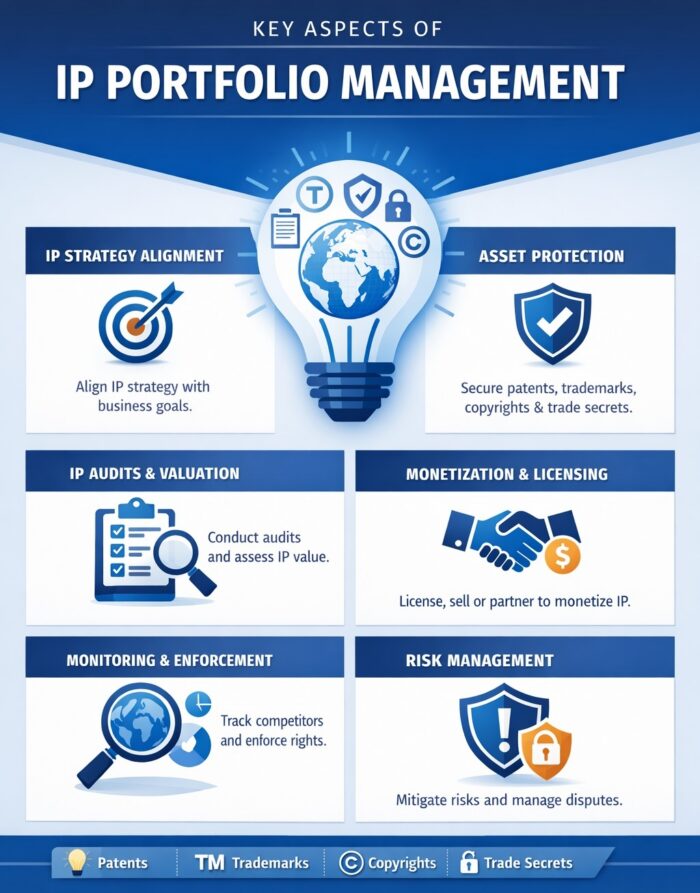
Regular maintenance and surveillance are necessary to keep your IP portfolio maintained and enforceable. This can be done by manual docket tracking through various docketing systems and diligent tracking. There are also third-party IP management software systems that specialize in monitoring your patent portfolio. These systems allow for automated tracking of filing statuses, deadlines for prosecution filings, and renewal deadlines. For example, businesses commonly use third-party IP management and docketing platforms such as Clarivate FoundationIP, Clarivate Docket, Anaqua PATTSY WAVE, AppColl, and Dennemeyer DIAMS iQ to automate monitoring of patent portfolios, track filing statuses, manage prosecution deadlines, and monitor renewal or maintenance obligations. For companies with trademark or mixed IP portfolios, systems such as Alt Legal may also be used to track trademark deadlines and related portfolio activity. These software systems help reduce the risk of missed deadlines, improve portfolio visibility, and support more consistent maintenance and enforcement of intellectual property rights.
There are also competitive intelligence tools and analytics systems to track patent and trademark filings and litigation in your particular market or field of technology. These systems can be used to monitor competitors to aid in determining when your intellectual property rights should be enforced and inform your product strategy and licensing opportunities. For example, platforms such as Clarivate Derwent Patent Monitor are designed to support competitor monitoring, freedom-to-operate review, portfolio benchmarking, and licensing-oriented patent analysis. Other commonly used patent analytics systems include LexisNexis PatentSight+ and Anaqua AcclaimIP/AQX, which can help companies perform competitive analysis on other companies in the market space, monitor technologies that overlap with your own, and identify possible licensing opportunities.
For trademark and brand-monitoring functions, companies may use Questel Markify Watch and Corsearch TrademarkNow/Trademark Watch, which monitor new trademark filings, confusingly similar marks, and competitor filing activity across large numbers of jurisdictions.
Competitor lawsuits remain a commercially immediate threat for many companies because disputes with operating competitors can directly target core products, customers, and partnerships. Without proper risk controls, litigation costs can spiral and settlements may erode business value. There are litigation intelligence tools that help monitor competitors and potential litigation threats, such as Clarivate Darts-ip which provides searchable global IP case-law data and analytics for patents, trademarks, and related rights, helping businesses track disputes, assess enforcement trends, and make more informed enforcement and licensing decisions.
IP portfolio management is also employed to enable IP owners to derive maximum value from their IP portfolios, including through monetization efforts. IP rights can be used defensively to protect your product and service space, and they can also be used aggressively to expand commercial activities via IP licensing, licensing opportunities, strategic partnerships, and attracting investors through your innovations.
To maximize IP value, businesses commonly evaluate (1) direct licensing, including royalty-bearing deals, cross-licenses, and platform licenses, (2) sales or assignments of non-core assets, and (3) strategic partnership opportunities where IP is a contribution to a larger distribution or co-development relationship. The commercial value of these opportunities is often easily demonstrated by new revenue streams, stronger negotiating positions with suppliers and partners, and improved attractiveness to investors during diligence.
Effective IP portfolio management is an important business practice, whether you have a modest or large portfolio of IP assets. Portfolio management should be continuous, systematic, and strategically executed to maximize business value. When you execute and align your IP portfolio management with your business strategy, you create additive strength and competitive value in your business that provides long-term value.
If you need assistance with IP portfolio management or other intellectual property matters, contact our office for a free consultation.
© 2026 Sierra IP Law, PC. The information provided herein does not constitute legal advice, but merely conveys general information that may be beneficial to the public, and should not be viewed as a substitute for legal consultation in a particular case.

"Mark and William are stellar in the capabilities, work ethic, character, knowledge, responsiveness, and quality of work. Hubby and I are incredibly grateful for them as they've done a phenomenal job working tirelessly over a time span of at least five years on a series of patents for hubby. Grateful that Fresno has such amazing patent attorneys! They're second to none and they never disappoint. Thank you, Mark, William, and your entire team!!"
Linda Guzman


Sierra IP Law, PC - Patents, Trademarks & Copyrights
FRESNO
7030 N. Fruit Ave.
Suite 110
Fresno, CA 93711
(559) 436-3800 | phone
BAKERSFIELD
1925 G. Street
Bakersfield, CA 93301
(661) 200-7724 | phone
SAN LUIS OBISPO
956 Walnut Street, 2nd Floor
San Luis Obispo, CA 93401
(805) 275-0943 | phone

SACRAMENTO
180 Promenade Circle, Suite 300
Sacramento, CA 95834
(916) 209-8525 | phone
MODESTO
1300 10th St., Suite F.
Modesto, CA 95345
(209) 286-0069 | phone
SANTA BARBARA
414 Olive Street
Santa Barbara, CA 93101
(805) 275-0943 | phone
SAN MATEO
1650 Borel Place, Suite 216
San Mateo, CA, CA 94402
(650) 398-1644. | phone
STOCKTON
110 N. San Joaquin St., 2nd Floor
Stockton, CA 95202
(209) 286-0069 | phone
PORTLAND
425 NW 10th Ave., Suite 200
Portland, OR 97209
(503) 343-9983 | phone
TACOMA
1201 Pacific Avenue, Suite 600
Tacoma, WA 98402
(253) 345-1545 | phone
KENNEWICK
1030 N Center Pkwy Suite N196
Kennewick, WA 99336
(509) 255-3442 | phone
2023 Sierra IP Law, PC - Patents, Trademarks & Copyrights - All Rights Reserved - Sitemap Privacy Lawyer Fresno, CA - Trademark Lawyer Modesto CA - Patent Lawyer Bakersfield, CA - Trademark Lawyer Bakersfield, CA - Patent Lawyer San Luis Obispo, CA - Trademark Lawyer San Luis Obispo, CA - Trademark Infringement Lawyer Tacoma WA - Internet Lawyer Bakersfield, CA - Trademark Lawyer Sacramento, CA - Patent Lawyer Sacramento, CA - Trademark Infringement Lawyer Sacrament CA - Patent Lawyer Tacoma WA - Intellectual Property Lawyer Tacoma WA - Trademark lawyer Tacoma WA - Portland Patent Attorney - Santa Barbara Patent Attorney - Santa Barbara Trademark Attorney
