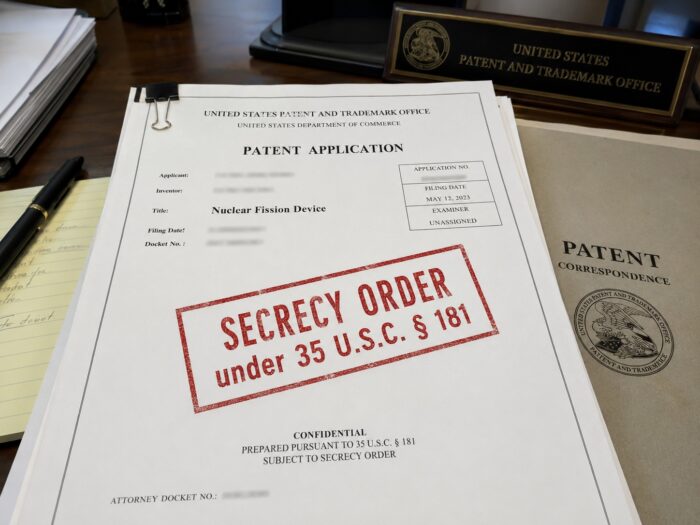
The Invention Secrecy Act of 1951 is a federal patent law that allows the government to keep certain inventions secret when publication or disclosure could be detrimental to national security. Sensitive technologies that relate to weaponry, cybersecurity and encryption, or other technologies that have potential national security implications may be subject to a secrecy order and prevented from being patented. In such cases, a United States patent application may be filed, examined, and even found allowable, but the patent therefor is not granted because of the risk the technology creates. This article covers the purpose, process, consequences, and practical implications of the Invention Secrecy Act of 1951, explaining how secrecy orders may affect your patent rights and commercialization plans.
The Invention Secrecy Act of 1951 is codified at 35 U.S.C. §§ 181–188 and creates a national security exception to the ordinary United States patent system. Under 35 U.S.C. § 181, when the Atomic Energy Commission, the Secretary of Defense, or a chief officer of a government designated defense agency determines that publication or disclosure of such invention, or the grant of a patent, would be detrimental to national security, that interested government agency must notify the Commissioner of Patents. The Commissioner will then issue a secrecy order, keep the patent application secret, and withhold publication and grant of the patent until the secrecy order is removed. In practical terms, the Act allows the government to delay patent rights and public disclosure when national security reasons outweigh normal patent-law transparency, while notifying the applicant thereof and preserving statutory procedures for later review.
The Act is meant to protect military, intelligence, atomic-energy, and other defense-sensitive technologies when public disclosure could create national security risks. Under 35 U.S.C. § 181, the legal trigger is not whether an invention is valuable, controversial, or commercially disruptive, but whether publication or disclosure would be detrimental to national security interests. The Invention Secrecy Act is not designed to shield existing industries from competition, nor to prevent new technologies from entering the market merely because they may disrupt such industries. Its purpose is governmental security, not economic protectionism.
The origins of U.S. invention secrecy trace to the 1910s, when Congress first authorized restrictions on patent disclosures during wartime. The practice expanded dramatically during World War II, when secrecy orders became a tool for controlling inventions relevant to weapons systems, communications, aviation, and the classified development of nuclear weapons. The Invention Secrecy Act of 1951 made this authority permanent, allowing secrecy orders to continue outside wartime where the national interest requires secrecy. In practice, the Act reflects a tension between two policies: encouraging inventors to disclose inventions through the patent system and preventing disclosure that could harm national security.
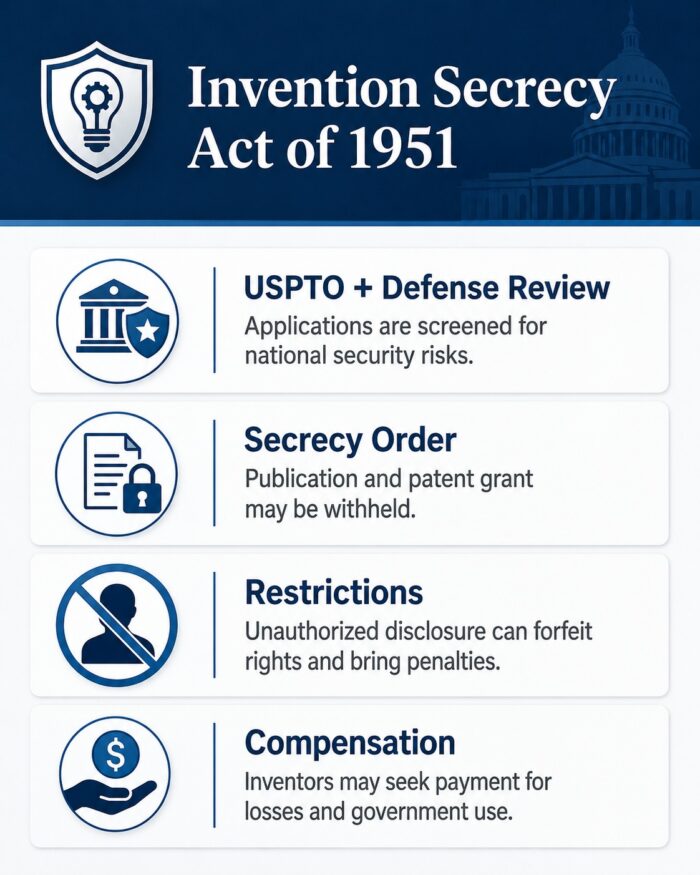
The screening process under the Invention Secrecy Act is usually a two-stage review. First, the USPTO reviews each new patent application filed (non-provisional and provisional applications) for subject matter that may implicate national security, including military, intelligence, nuclear, communications, encryption, aerospace, or other dual-use technologies. This initial review does not necessarily mean the invention is classified or that the applicant has done anything wrong; it means the application contains technical material that may warrant government review before publication.
Second, the USPTO forwards the flagged application to an interested government agency or defense agency with responsibility for the relevant technology. Under 35 U.S.C. § 181, the agency evaluates whether disclosure or publication of the invention would be detrimental to national security. The statute also contemplates controls over handling, including a dated acknowledgment by reviewing officials. If the agency makes the required determination, it recommends that the USPTO issue a secrecy order. The Commissioner then orders the invention kept secret and withholds publication or issuance of the patent. This means a commercially valuable patent application can move from ordinary patent examination into a restricted process where outside disclosure, licensing, fundraising, and commercialization may be sharply limited.
Under 35 U.S.C. § 181, the initial security decision is not made by the ordinary patent examiner. The USPTO screens the patent application, but the substantive national security judgment is made by the head of the interested government agency reviewing the technology. Section 181 refers to the Atomic Energy Commission, the Secretary of a Defense, or such other chief officer of some other department or agency designated by the President as a defense agency of the United States. In practical terms, the relevant chief officers decide whether disclosure of such invention to the general public would be detrimental to national security or whether the national interest requires continued secrecy.
The statute also imposes procedural safeguards. Each reviewer who receives the application must sign a dated acknowledgment, creating a record of access to sensitive patent material. Recent public data identify secrecy order sponsors as including the Army, Navy, Air Force, DOE, NSA, DTSA, and other defense-related agencies. The key point is that the secrecy order decision is driven by specialized national security agencies, not by ordinary commercial concerns or the concern that an invention might disrupt existing industries.
A secrecy order can place a patent application in a sealed condition, restrict access to material information, and keep the patent withheld even when the claims are otherwise allowable. Under 35 U.S.C. § 181, the USPTO must withhold publication and grant of a patent when an interested government agency determines that disclosure of the invention may be detrimental to national security. USPTO rules also require the applicant to continue prosecuting the application while the order remains in effect, but if the application is otherwise ready for allowance, the application is suspended until the secrecy order is removed. See 37 C.F.R. § 5.3.
In practical terms, the order can freeze the commercial usage of the invention. The applicant thereof, inventors, assignees, investors, employees, contractors, consultants, manufacturers, and potential licensees may be barred from receiving or using information about the restricted idea unless disclosure is authorized. That can prevent fundraising, product testing, licensing, manufacturing, publication, foreign patent filings, and ordinary commercialization. Also, while a secrecy order is active, inventors may be unable to sell, license, market, commercialize, or develop the technology with outsiders if doing so would require unauthorized disclosure.
A violation of secrecy orders under the Invention Secrecy Act can have severe consequences for inventors and businesses. Under 35 U.S.C. § 182, if a patent application subject to a secrecy order is published, disclosed, or filed abroad without proper authorization, the Commissioner of Patents may hold the invention abandoned. That abandonment is treated as occurring at the time of the violation and can forfeit all claims against the United States based on such invention, including potential compensation claims.
Under 35 U.S.C. § 186, a person who, with knowledge of the order and without authorization, willfully publishes or discloses the invention or material information about it may face criminal penalties. The same penalty applies to unauthorized Patent Cooperation Treaty or foreign patent application filing in violation of 35 U.S.C. § 184. Upon conviction, the violator may be fined up to $10,000, imprisoned for up to two years, or both. For startups, this risk can eliminate development and commercialization of their technology.
A peacetime secrecy order under the Invention Secrecy Act may last for a significant period. Under 35 U.S.C. § 181, an initial order may last no more than one year, but the Commissioner must renew the order at the end thereof, or at the end of any renewal period, for additional periods of one year when the interested agency gives notice that it has made an affirmative determination that the national interest continues to require secrecy. In practical terms, a patent application can remain pending, unpublished, and unavailable for normal commercialization year after year, even outside a declared war.
The statute also creates longer rules for extraordinary conditions. During war, the order remains effective for the duration of hostilities and one year after hostilities cease. If an order is in effect or issued during a national emergency declared by the President, it remains effective for the duration of the national emergency and six months afterward. The Commissioner may rescind the secrecy order only after notification from the relevant agency or chief officers that disclosure is no longer deemed detrimental to national security. A “temporary” secrecy order can function like an indefinite patent hold, delaying investment, licensing, enforcement, and market entry.
The law permits inventors to seek just compensation when a secrecy order causes economic losses or when the government uses the restricted technology. Under 35 U.S.C. § 183, an applicant whose patent is withheld may apply to the relevant agency for compensation based on damage from secrecy and any government use of the invention. However, compensation is not automatic. The inventor must make a proper showing that the secrecy order caused actual loss, which can be difficult because the inventor is often prohibited from disclosing, marketing, licensing, or commercializing the invention. If the agency does not agree to a full settlement, it may pay an amount not exceeding 75 percent of what the agency head considers just compensation. The inventor may then bring suit in the Court of Federal Claims or an appropriate district court to recover the balance. This framework recognizes a protected property interest, but it also leaves inventors with significant proof and valuation challenges.
Inventors face a practical proof problem: to show they suffered harm from secrecy, they often need market evidence, customers, licensees, expert analysis, or investment discussions. However, a secrecy order creates a Catch-22 because the invention cannot be freely disclosed and market evidence cannot be established. In Constant v. United States, 617 F.2d 239 (1980), the Court of Claims held that allegations of lost financing, lost licensing opportunities, and blocked demonstrations could properly state a claim under 35 U.S.C. § 183. But after trial, plaintiff was denied recovery because the damages evidence was speculative. In Hornback v. United States, 16 F.3d 422 (Fed. Cir. 1994), the court held § 183, not a Fifth Amendment taking theory, was the exclusive remedy for secrecy-order claims and actual damages, especially where the patent remained withheld from public issuance.
Secrecy orders have increasingly affected private technologies, not just traditional military inventions. For companies developing software, communications systems, sensors, aerospace tools, cryptography, energy, semiconductors, or public health technologies that may have defense implications, the Invention Secrecy Act can create serious business uncertainty. The Act may alter the basic patent bargain: inventors disclose inventions to obtain temporary exclusivity, but the government may take the disclosure while withholding commercial patent rights. That means a company may lose the ability to publish, license, sell, raise investment around, or openly develop a technology while the secrecy order remains in place. The risk is especially important for startups and research-driven businesses that depend on patent assets to attract funding or strategic partners. Even when compensation may theoretically be available, proving market value and lost opportunities can be difficult because the invention itself cannot be freely disclosed. As a result, innovators working in sensitive technical fields should consider secrecy-order risk early in their patent filing, funding, commercialization, and foreign filing strategies.
The Invention Secrecy Act of 1951 remains an important but often overlooked part of U.S. patent law. It gives the government broad authority to restrict inventions for national security purposes, require the applicant to maintain secrecy, delay patent issuance, and control disclosure for such period that national security interests are affected. At the same time, it provides limited compensation and appeal mechanisms. If a technology has military, intelligence, atomic-energy, or dual-use implications, patent strategy should account for the possibility that a secrecy order might be applied to the corresponding patent application.
If you have concerns about the Invention Secrecy Act or other intellectual property matters, please contact our office for a consultation with our skilled patent attorneys.
© 2026 Sierra IP Law, PC. The information provided herein does not constitute legal advice, but merely conveys general information that may be beneficial to the public, and should not be viewed as a substitute for legal consultation in a particular case.

"Mark and William are stellar in the capabilities, work ethic, character, knowledge, responsiveness, and quality of work. Hubby and I are incredibly grateful for them as they've done a phenomenal job working tirelessly over a time span of at least five years on a series of patents for hubby. Grateful that Fresno has such amazing patent attorneys! They're second to none and they never disappoint. Thank you, Mark, William, and your entire team!!"
Linda Guzman


Sierra IP Law, PC - Patents, Trademarks & Copyrights
FRESNO
7030 N. Fruit Ave.
Suite 110
Fresno, CA 93711
(559) 436-3800 | phone
BAKERSFIELD
1925 G. Street
Bakersfield, CA 93301
(661) 200-7724 | phone
SAN LUIS OBISPO
956 Walnut Street, 2nd Floor
San Luis Obispo, CA 93401
(805) 275-0943 | phone

SACRAMENTO
180 Promenade Circle, Suite 300
Sacramento, CA 95834
(916) 209-8525 | phone
MODESTO
1300 10th St., Suite F.
Modesto, CA 95345
(209) 286-0069 | phone
SANTA BARBARA
414 Olive Street
Santa Barbara, CA 93101
(805) 275-0943 | phone
SAN MATEO
1650 Borel Place, Suite 216
San Mateo, CA, CA 94402
(650) 398-1644. | phone
STOCKTON
110 N. San Joaquin St., 2nd Floor
Stockton, CA 95202
(209) 286-0069 | phone
PORTLAND
425 NW 10th Ave., Suite 200
Portland, OR 97209
(503) 343-9983 | phone
TACOMA
1201 Pacific Avenue, Suite 600
Tacoma, WA 98402
(253) 345-1545 | phone
KENNEWICK
1030 N Center Pkwy Suite N196
Kennewick, WA 99336
(509) 255-3442 | phone
2023 Sierra IP Law, PC - Patents, Trademarks & Copyrights - All Rights Reserved - Sitemap Privacy Lawyer Fresno, CA - Trademark Lawyer Modesto CA - Patent Lawyer Bakersfield, CA - Trademark Lawyer Bakersfield, CA - Patent Lawyer San Luis Obispo, CA - Trademark Lawyer San Luis Obispo, CA - Trademark Infringement Lawyer Tacoma WA - Internet Lawyer Bakersfield, CA - Trademark Lawyer Sacramento, CA - Patent Lawyer Sacramento, CA - Trademark Infringement Lawyer Sacrament CA - Patent Lawyer Tacoma WA - Intellectual Property Lawyer Tacoma WA - Trademark lawyer Tacoma WA - Portland Patent Attorney - Santa Barbara Patent Attorney - Santa Barbara Trademark Attorney
