
Patent valuation is the process of estimating the economic value of patents, patent portfolios, and related intellectual property rights. The process translates legal protection into practical business information for licensing, selling, patent acquisition, fundraising, mergers, joint venture planning, financial reporting, transfer pricing, and litigation. Because patents are intangible assets and may be assigned, licensed, pledged, or sold, their value can affect a company’s assets, negotiations, and investment strategy. Different purposes may require different methods, including the cost approach, income based method, market approach, Discounted Cash Flow, Relief-from-Royalty, or option-based analysis. Patent valuation is increasingly important as companies rely more on intangible assets, including intellectual property. This article explains how valuing patents works and why understanding patent value helps companies make informed decisions about their IP assets.
Patent valuation measures more than the money required to obtain a patent. It estimates the patent value created by exclusive rights in a patented invention, including the legal right to prevent others from making, using, selling, offering for sale, or importing the invention. It also evaluates the underlying invention’s expected business impact, such as revenue opportunities, cost savings, market leverage, licensing potential, and contribution to competitive advantage. Under 35 U.S.C. § 261, patents have attributes of personal property and are assignable, meaning they can be treated as intangible assets within a company’s assets. As a result, patents may be licensed, sold, pledged as collateral, contributed to a joint venture, or included in merger, acquisition, or financing transactions. A useful valuation therefore considers both legal enforceability and commercial usefulness, converting intellectual property rights into an estimated monetary value that business owners, investors, and buyers can use in negotiations and strategic planning.
Patent valuation helps companies translate intellectual property rights into practical business terms. In licensing and sales, it establishes a baseline for royalty rates and helps each side negotiate from a reasoned estimate rather than guesswork. In mergers and acquisitions, valuing patents helps determine fair purchase prices by identifying the contribution of intangible assets, including patented products, exclusive rights, and potential future cash flows. For fundraising, patents may support collateral for bank loans or strengthen a pitch for venture capital investment by showing that innovation has measurable patent value. Patent valuation also guides commercialization decisions, such as whether to manufacture, license, sell, enforce, or contribute a patent to a joint venture. Understanding patent economics helps define trading conditions when intellectual property rights are transferred, licensed, or bundled with technology assets, and it can reveal when companies are likely to overvalue patents or overlook low-value assets that should be sold or abandoned.
When an individual develops an innovation and a patent is granted, the legal value is in the exclusionary rights of the patent, including the ability to prevent others from making, using, selling, offering to sell, or importing the patented invention, as provided in 35 U.S.C. § 154(a)(1). In patent valuation, that right is a core driver of patent value because it defines the scope of commercial protection and the period during which the owner may capture patent licensing revenue, market share, or cost savings. U.S. utility patent term generally runs from issuance to 20 years from the relevant filing date, subject to fees and adjustments under 35 U.S.C. § 154. The type of patent (e.g., utility patents, design patents, plant patents, or utility models) also affects value because protection periods, claim scope, enforceability, examination standards, and internationalization possibilities differ. Thus, understanding patent rights requires reviewing ownership, priority, prosecution history, maintenance status, and remaining protection time before applying valuation methods.
Evaluating patents requires both legal and business analysis because patent value depends on more than the existence of a granted patent. The legal strength of a patent is found in:
A patent with narrow claims, unclear terminology, weak prior-art distinctions, or potential validity issues may have a lower value even if the underlying invention is promising.
Market potential is equally important. This factor examines the addressable market size, expected revenue growth, industry demand, and whether customers are likely to pay for patented products or services. The competitive landscape assesses the existence of competitors, substitute technologies, barriers to entry, and the possibility of market share gains. A patent that supports a durable competitive advantage generally has higher patent value.
When assessing patent value, commercialization status also matters: is the technology currently in use, licensed, sold, or producing profit? Technological validation is another key issue because investors and buyers want evidence that the invention works in practice. Patents lacking practical viability increase perceived investor risk and can significantly lower value, even when the legal rights appear strong.
The jurisdiction of the patent rights affects patent valuation because market potential, legal security, enforcement reliability, and access to financing vary by jurisdiction. A patent covering a large commercial market, or a country with strong remedies for infringement, may have greater patent value than protection in a smaller or less predictable market. The current state of the registration cycle also matters. A pending application may support business planning, fundraising, or patent acquisition, but it usually carries more uncertainty than an allowed application or granted patent. Patents approved after substantive patent examination may be viewed as stronger because the patent claims have survived closer review. Remaining protection time is equally critical: under 35 U.S.C. § 154, many U.S. utility patents generally expire 20 years from the relevant filing date, so fewer remaining years means less time to exploit the patented invention exclusively.
The cost approach estimates patent value by looking at the costs incurred to create, file, prosecute, maintain, or replace the asset. The cost approach estimates the value based on the costs incurred to develop the patent, including research and development expenses. In patent valuation, this method is often useful when the patented invention is early in development, has not yet generated revenue, or lacks reliable market transactions for comparable patents. The replacement cost method asks what money would be required to acquire or develop comparable IP with similar utility, while the reproduction method asks what it would cost to recreate the same technology in its current state. These costs may include research and development, engineering, testing, prototype development, patent drafting, USPTO filing fees, prosecution costs, patent maintenance fees, and related legal fees.
The key limitation is that costs do not necessarily equal patent value. A company may spend heavily on an invention that has little market potential, weak claims, or limited commercial use, causing the cost approach to overvalue patents. Conversely, a relatively inexpensive innovation may create substantial competitive advantage or generate significant future cash flows, meaning the method may undervalue breakthrough inventions. The cost method can be helpful for early-stage assets, but it does not directly measure future economic value, market demand, licensing potential, or the income that the patent may ultimately produce.
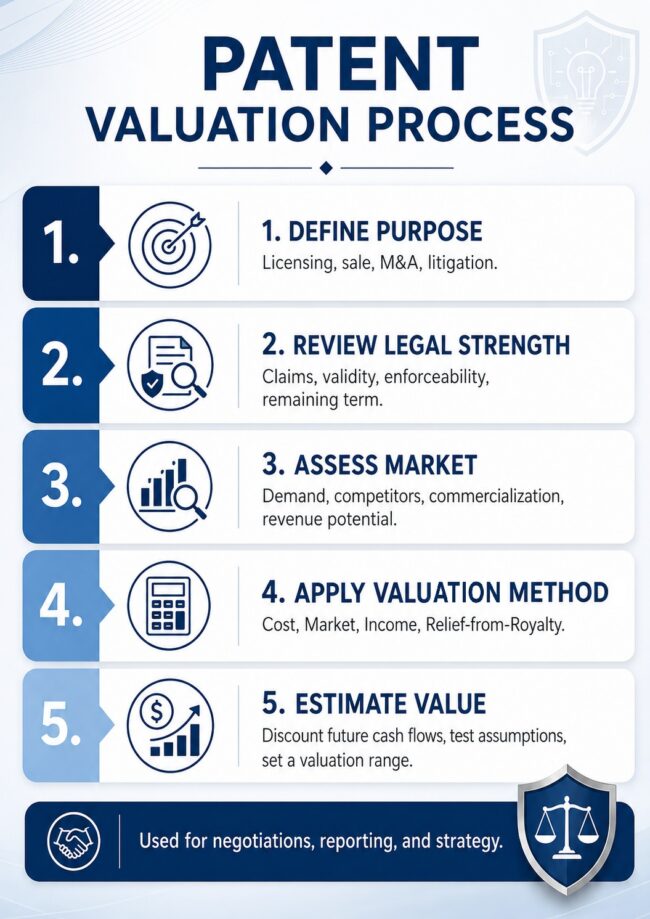
The income-based method is one of the most common approaches to patent valuation because it focuses on the economic benefits the patent is expected to produce. The income approach values a patent based on the present value of expected future cash flows that the patent will generate. Instead of asking only what the patented invention cost to develop, this method evaluates the future cash flows attributable to the patent, including expected licensing revenue, cost savings, premium pricing, increased market share, or additional sales of patented products.
A Discounted Cash Flow (DCF) analysis estimates patent value by projecting the specific cash flows that the patent is expected to generate during its remaining useful life. These cash flows may come from royalty income, increased sales of patented products, premium pricing, cost savings, or avoided licensing payments. The forecast should account for expected market adoption, commercialization timing, remaining patent term, potential design-arounds, and the likelihood that the patent can be enforced if infringement occurs. After the projected cash flows are identified, they are discounted to present value using a risk-adjusted discount rate. That discount rate should reflect commercial uncertainty, technology risk, litigation risk, competitive alternatives, regulatory or manufacturing barriers, and the legal strength of the patent rights. Because small changes in revenue assumptions, growth rates, or the discount rate can materially change the valuation, DCF analysis is usually tested through sensitivity scenarios to produce a more reliable valuation range.
The income approach values intellectual property based on expected future cash flows discounted to present value, but the analysis is highly sensitive to assumptions about revenues, timing, risks, market adoption, and remaining useful life. For that reason, companies should carefully separate income caused by the patent from income caused by branding, distribution, manufacturing capacity, or other business assets. When performed carefully, the income based method can provide a practical estimate of patent value for licensing, acquisition, investment, and strategic decision-making.
Relief-from-Royalty is an income based method of patent valuation that calculates the royalty payments a company avoids by owning the patent instead of licensing it from another owner. The basic valuation calculation starts by identifying the patented products, services, or technology that generate income, estimating expected revenue over the remaining protection period, and applying a supportable royalty rate. That rate is usually informed by comparable royalty data, similar licenses, industry norms, bargaining strength, exclusivity, territory, field of use, and the legal strength of the patent. After estimating the avoided royalty stream, the analysis typically adjusts for taxes or expenses and discounts the projected cash flows to present value using an appropriate discount rate.
This method is especially useful when the patented invention is already commercialized or can be tied to specific income. For example, if a patented component drives sales of a product, the analysis must determine how much of the revenue is actually attributable to the patent rather than branding, distribution, manufacturing quality, or other assets. Relief-from-Royalty can provide a practical estimate of patent value, but it depends heavily on accurate revenue forecasts, reliable comparable royalty data, and careful apportionment to avoid overstating the monetary value of the patent.
The market approach determines a patent’s value by comparing it to similar patents, comparable patents, similar property, patent prices, licenses, or sale transactions in an active market. In practice, this method asks what real buyers, licensees, or investors have paid for intellectual property rights with comparable legal, technological, and commercial characteristics. It is strongest when transactions involve similar patents, similar territories, similar fields of use, similar remaining lives, and comparable levels of commercialization. For example, a licensed patent covering a validated medical device in the United States may be a more reliable benchmark for another U.S. medical device patent than a software patent licensed in a different country or industry.
Market comparables can be powerful because they are grounded in actual transactions rather than purely theoretical assumptions. However, they can also be difficult to apply because IP is unique, deal terms are often confidential, and sufficiently similar comparables may be scarce. Reported patent prices may also reflect bundled assets, cross-licenses, litigation settlements, technical know-how, or strategic motivations that are not visible from the headline number. As a result, the market approach usually requires careful adjustments for patent strength, scope, enforceability, remaining protection time, revenue potential, and competitive advantage.
Qualitative methods are useful when patent valuation cannot rely solely on historical cash flows, comparable transactions, or patent prices. These methods typically involve scoring legal strength, technology readiness, market demand, competitive advantage, commercialization status, freedom-to-operate risk, and the remaining protection period. For example, a patent with broad, enforceable claims, strong technological validation, and clear market potential may receive a higher qualitative rating than a patent covering an unproven technology in a crowded field. However, qualitative methods depend heavily on subjective assumptions, so companies should document the factors, weighting, and evidence used in the analysis.
Option-based methods are often used when the patented invention is early-stage or when future business outcomes remain uncertain. An option-based method for patent valuation applies financial option pricing models to assess the value of the rights associated with a patent. Models such as Black-Scholes-style approaches, commonly used for stock options, treat patent rights like a call option: the patent owner has the right, but not the obligation, to invest later if the market improves or development milestones are met. In patent valuation, this approach may capture value that traditional income based method calculations miss, especially where future cash flows are speculative. Real options analysis is a way to measure strategic flexibility in uncertain technology development, making it helpful for startups, investors, and companies evaluating emerging innovation.
Patent valuation provides a financial basis for claiming damages in infringement litigation and for assessing the business risk of a patent conflict before filing suit or negotiating settlement. Under 35 U.S.C. § 284, damages must be adequate to compensate for infringement and cannot be less than a reasonable royalty for the infringing use. Under 35 U.S.C. § 285, courts may award legal fees in exceptional cases, which can materially affect the economic analysis of litigation.
Patent damages often fall into two categories: lost profits, where the patent owner proves it would have made sales or profits but for infringement, and reasonable royalty, where damages are measured by a hypothetical license between willing parties. In Panduit Corp. v. Stahlin Bros. Fibre Works, Inc., 575 F.2d 1152 (6th Cir. 1978), the 6th Circuit Court of Appeals articulated the familiar lost-profits framework: demand for the patented product, absence of acceptable non-infringing substitutes, capacity to meet demand, and the amount of profit the patentee would have made. Rite-Hite Corp. v. Kelley Co., 56 F.3d 1538 (Fed. Cir. 1995) further confirmed that lost profits require “but-for” causation and may account for market realities where infringement diverts sales.
For reasonable royalty, Georgia-Pacific Corp. v. U.S. Plywood Corp., 318 F. Supp. 1116 (S.D.N.Y. 1970) provides the traditional factors for reconstructing a hypothetical negotiation. Later Federal Circuit cases delineated evidentiary standards that require a disciplined approach to assigning royalty value. Lucent Techs., Inc. v. Gateway, Inc., 580 F.3d 1301 (Fed. Cir. 2009) vacated a royalty award where licenses and the royalty base were not sufficiently tied to the patented feature. Uniloc USA, Inc. v. Microsoft Corp., 632 F.3d 1292 (Fed. Cir. 2011) rejected the 25-percent rule and cautioned against using the entire market value of accused products unless the patented feature drives demand. A defensible valuation must take into account market demand, non-infringing alternatives, accused-product revenue, and the patented invention’s incremental contribution.
Strategic IP portfolio management uses valuation to identify patents for abandonment, sale, or non-renewal, directing investment toward those patents with the greatest return and potential. Patent valuation can also reveal where a company’s assets are concentrated, which patents support key products, and which intellectual property rights may create leverage in licensing, patent acquisition, fundraising, or a joint venture. For accounting purposes, patent valuation supports financial reporting for identifiable intangible assets, including purchase price allocation after mergers and acquisitions and impairment analysis when projected cash flows decline. In tax planning, valuation is important for transfer pricing regulations governing controlled transfers of intangibles, including patents, between related companies. Because accounting, tax, litigation, and transaction value may each require different approaches, companies should define the valuation purpose before selecting methods. This helps investors, companies, and inventors compare estimated outcomes and avoid overvaluing patents based on inconsistent assumptions.
Valuing patents is not a single formula; it is a process that combines law, technology, market evidence, income forecasts, development costs, and subjective assumptions. The best analysis uses different methods, cost, income, market, and qualitative or option-based methods, to determine true worth for the specific business purpose. Understanding patent valuation establishes intellectual property as a strategic asset that can support protection, commercialization, financing, transactions, and competitive advantage.
© 2026 Sierra IP Law, PC. The information provided herein does not constitute legal advice, but merely conveys general information that may be beneficial to the public, and should not be viewed as a substitute for legal consultation in a particular case.

"Mark and William are stellar in the capabilities, work ethic, character, knowledge, responsiveness, and quality of work. Hubby and I are incredibly grateful for them as they've done a phenomenal job working tirelessly over a time span of at least five years on a series of patents for hubby. Grateful that Fresno has such amazing patent attorneys! They're second to none and they never disappoint. Thank you, Mark, William, and your entire team!!"
Linda Guzman


Sierra IP Law, PC - Patents, Trademarks & Copyrights
FRESNO
7030 N. Fruit Ave.
Suite 110
Fresno, CA 93711
(559) 436-3800 | phone
BAKERSFIELD
1925 G. Street
Bakersfield, CA 93301
(661) 200-7724 | phone
SAN LUIS OBISPO
956 Walnut Street, 2nd Floor
San Luis Obispo, CA 93401
(805) 275-0943 | phone

SACRAMENTO
180 Promenade Circle, Suite 300
Sacramento, CA 95834
(916) 209-8525 | phone
MODESTO
1300 10th St., Suite F.
Modesto, CA 95345
(209) 286-0069 | phone
SANTA BARBARA
414 Olive Street
Santa Barbara, CA 93101
(805) 275-0943 | phone
SAN MATEO
1650 Borel Place, Suite 216
San Mateo, CA, CA 94402
(650) 398-1644. | phone
STOCKTON
110 N. San Joaquin St., 2nd Floor
Stockton, CA 95202
(209) 286-0069 | phone
PORTLAND
425 NW 10th Ave., Suite 200
Portland, OR 97209
(503) 343-9983 | phone
TACOMA
1201 Pacific Avenue, Suite 600
Tacoma, WA 98402
(253) 345-1545 | phone
KENNEWICK
1030 N Center Pkwy Suite N196
Kennewick, WA 99336
(509) 255-3442 | phone
2023 Sierra IP Law, PC - Patents, Trademarks & Copyrights - All Rights Reserved - Sitemap Privacy Lawyer Fresno, CA - Trademark Lawyer Modesto CA - Patent Lawyer Bakersfield, CA - Trademark Lawyer Bakersfield, CA - Patent Lawyer San Luis Obispo, CA - Trademark Lawyer San Luis Obispo, CA - Trademark Infringement Lawyer Tacoma WA - Internet Lawyer Bakersfield, CA - Trademark Lawyer Sacramento, CA - Patent Lawyer Sacramento, CA - Trademark Infringement Lawyer Sacrament CA - Patent Lawyer Tacoma WA - Intellectual Property Lawyer Tacoma WA - Trademark lawyer Tacoma WA - Portland Patent Attorney - Santa Barbara Patent Attorney - Santa Barbara Trademark Attorney
