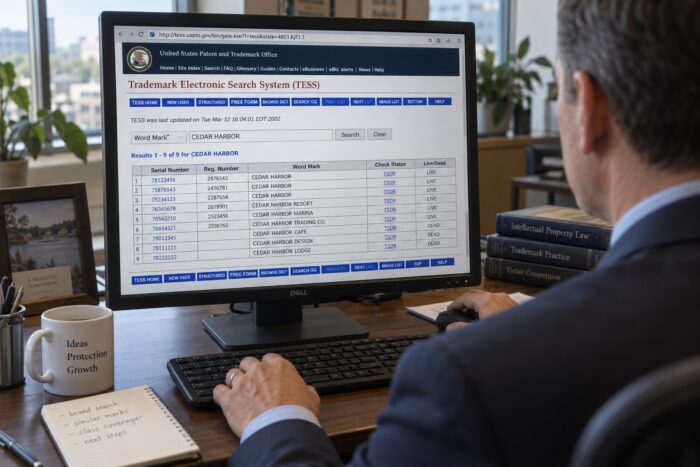
Trademark monitoring is the ongoing process of tracking unauthorized or confusingly similar uses of your brand. It alerts trademark owners to potential conflicts involving trademark filings and marketplace activity. Early detection supports brand protection by enabling quicker, potentially less costly responses before customer confusion between your brand and the infringer.
Registration alone does not automatically prevent others from using similar marks. The trademark office examines applications. Owners remain responsible for monitoring and enforcing trademark rights. Active trademark protection helps prevent competitors from establishing confusingly similar brand names.
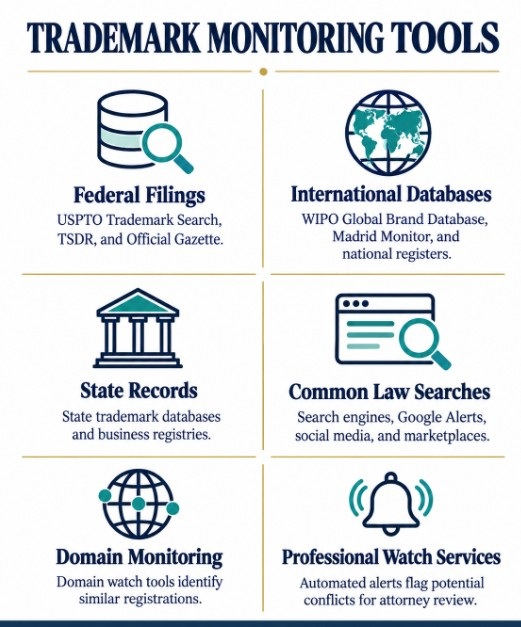
A trademark watch tracks new trademark filings, domain registrations, online sales, advertisements, and other uses that may conflict with your business name, logos, or product names. Searches should cover the USPTO database, relevant foreign registers, search engines, social media platforms, and marketplaces.
Monitoring must extend beyond registered trademarks because unauthorized use may occur without any filing. Effective searches identify spelling variations, similar sounds, and related goods or services, not merely identical marks.
Trademark owners should start trademark monitoring activities early in their branding. There are several trademark activities that can be monitored to provide high awareness of similar filings in the USPTO and similar branding activity and trademark usage in the the markets that are relevant to your business:
Automated systems regularly scan trademark databases for newly filed and registered trademarks, generating monitoring alerts. Many companies use specialized trademark monitoring services because manual checks are complicated and time consuming.
Effective monitoring services combine automated professional services, manual searches for applied-for and registered marks, and attorney review, and provide alerts promptly. A trademark watch service can provide broad global coverage, but confirm the countries, databases, online sources, and update frequency included. No monitoring service guarantees detection everywhere.
Compare cost, access to reports, and whether additional services include legal guidance or trademark enforcement action. Also, it is easy to lose focus on this function, and thus someone should be designated within your organization to review monitoring service alerts promptly.
An alert identifies concerns, not proven trademark infringement. An attorney should be consulted to assess the marks, the products and services offered under the mark, the likelihood of customer confusion, and whether you have a good position to enforce your rights against the potential infringer. Evaluation of trademark infringement under the applicable federal case law and statutes 15 U.S.C. § 1114; § 1125(a) is a complex analysis. To illustrate, the determination of trademark infringement is guided by a factor analysis provided by cases like AMF Inc. v. Sleekcraft Boats, 599 F.2d 341 (9th Cir. 1979), in which the court identified multiple factors for analyzing the likelihood of confusion between two marks, including the sound, appearance, and meaning of the marks, the relatedness of the goods and services, the channels of trade, the distinctiveness and strength of your mark, whether there is any evidence of actual consumer confusion, and other factors. Thus, it is highly recommended that you seek the assistance of an experienced trademark attorney if you are seriously considering pursuing enforcement of your trademark rights against a potential infringement.
If pursuing the potential infringer is legally supported and advisable, a cease and desist letter is typically the first step in the process. A cease and desist letter can often lead to resolution of trademark conflicts without litigation. If the exchange of letters and negotiations do not resolve the conflict, you may need to pursue trademark litigation to resolve the issue.
Failure to monitor and act can weaken your trademark protection and legal position. Failing to enforce your rights can result in an erosion of your brand and trademark strength. In Pinkette Clothing, Inc. v. Cosmetic Warriors Ltd., 894 F.3d 1015 (9th Cir. 2018), the plaintiff sought declaratory relief that it did violate Cosmetic Warriors' trademark rights. Cosmetic Warriors counterclaimed infringement and sought invalidation of Pinkette's trademark registration. A trademark watch service had notified Cosmetic Warriors’ outside counsel of Pinkette’s application, yet no opposition was filed. Pinkette’s registration subsequently supplied constructive notice, and Cosmetic Warriors waited nearly five years after registration to seek infringement claims and to petition for cancellation. Because Cosmetic Warriors had failed to promptly enforce its claim against Pinkette, Cosmetic Warriors' claims were barred by the doctrine of laches due to their unreasonable, prejudicial delay.
Another consequence of failing to enforce your trademarks is that the market becomes crowded with confusingly similar marks, thereby weakening the distinctiveness and strength of your trademarks. Missing enforcement against one infringer does not necessarily eliminate or significantly weaken your trademarks. Under 15 U.S.C. § 1127, a trademark may be abandoned through acts or omissions that result in the mark becoming generic or otherwise lose its significance as a mark. A consistent failure to take enforcement action can result in the evisceration of your rights. Monitoring followed by appropriate action also reduces the risk of brand dilution and consumer confusion.
Trademark monitoring should be conducted early on when adopting your brand, and should be continued as your business grows to protect the value in the brand and reputation that you are building. USPTO filings and marketplace activity should be regularly reviewed and analyzed. Staying informed is critical to protecting your valuable brands and goodwill. It is well worth devoting resources to monitoring potentially conflicting trademark use and providing timely responses. A consistent process helps your company protect its valuable intellectual property and preserve its trademarks.
© 2026 Sierra IP Law, PC. The information provided herein does not constitute legal advice, but merely conveys general information that may be beneficial to the public, and should not be viewed as a substitute for legal consultation in a particular case.

"Mark and William are stellar in the capabilities, work ethic, character, knowledge, responsiveness, and quality of work. Hubby and I are incredibly grateful for them as they've done a phenomenal job working tirelessly over a time span of at least five years on a series of patents for hubby. Grateful that Fresno has such amazing patent attorneys! They're second to none and they never disappoint. Thank you, Mark, William, and your entire team!!"
Linda Guzman


Sierra IP Law, PC - Patents, Trademarks & Copyrights
FRESNO
7030 N. Fruit Ave.
Suite 110
Fresno, CA 93711
(559) 436-3800 | phone
BAKERSFIELD
1925 G. Street
Bakersfield, CA 93301
(661) 200-7724 | phone
SAN LUIS OBISPO
956 Walnut Street, 2nd Floor
San Luis Obispo, CA 93401
(805) 275-0943 | phone

SACRAMENTO
180 Promenade Circle, Suite 300
Sacramento, CA 95834
(916) 209-8525 | phone
MODESTO
1300 10th St., Suite F.
Modesto, CA 95345
(209) 286-0069 | phone
SANTA BARBARA
414 Olive Street
Santa Barbara, CA 93101
(805) 275-0943 | phone
SAN MATEO
1650 Borel Place, Suite 216
San Mateo, CA, CA 94402
(650) 398-1644. | phone
STOCKTON
110 N. San Joaquin St., 2nd Floor
Stockton, CA 95202
(209) 286-0069 | phone
PORTLAND
425 NW 10th Ave., Suite 200
Portland, OR 97209
(503) 343-9983 | phone
TACOMA
1201 Pacific Avenue, Suite 600
Tacoma, WA 98402
(253) 345-1545 | phone
KENNEWICK
1030 N Center Pkwy Suite N196
Kennewick, WA 99336
(509) 255-3442 | phone
2023 Sierra IP Law, PC - Patents, Trademarks & Copyrights - All Rights Reserved - Sitemap Privacy Lawyer Fresno, CA - Trademark Lawyer Modesto CA - Patent Lawyer Bakersfield, CA - Trademark Lawyer Bakersfield, CA - Patent Lawyer San Luis Obispo, CA - Trademark Lawyer San Luis Obispo, CA - Trademark Infringement Lawyer Tacoma WA - Internet Lawyer Bakersfield, CA - Trademark Lawyer Sacramento, CA - Patent Lawyer Sacramento, CA - Trademark Infringement Lawyer Sacrament CA - Patent Lawyer Tacoma WA - Intellectual Property Lawyer Tacoma WA - Trademark lawyer Tacoma WA - Portland Patent Attorney - Santa Barbara Patent Attorney - Santa Barbara Trademark Attorney
