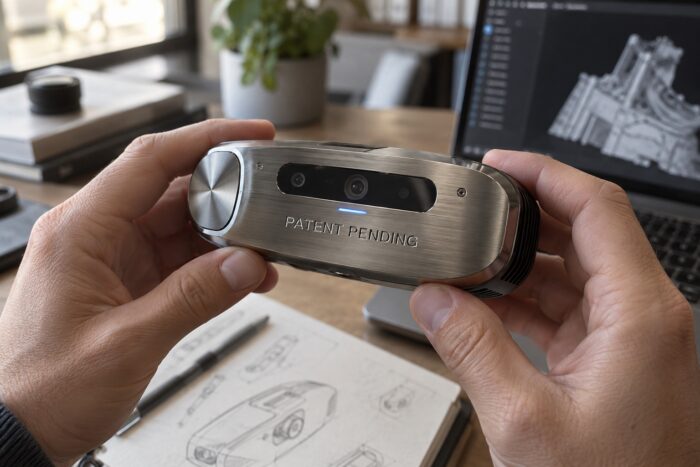
Patent pending means a patent application has been filed and remains pending (e.g., it hasn't lapsed or issued as a patent). It indicates the invention described in the patent application and/or marked "patent pending" is in the patent application process. However, it does not establish that the invention or design is patented or patentable, and it does not provide any enforceable patent rights.
This article explains the legal effect and business value of "patent pending" status for the benefit of non-attorney entrepreneurs, and also what it does not provide.
Patent pending status begins once a qualifying patent application is filed with the United States Patent and Trademark Office (USPTO). The phrase “patent pending” means patent protection is being sought. A patent search, prototype, or consultation with a patent attorney does not establish pending status. The patent pending designation does not begin until the patent application is actually filed with the United States Patent and Trademark Office (USPTO). A US patent application can only be filed with the USPTO. There are no state agencies or other federal agencies that can grant patent pending status.
Any patent application filing with the USPTO can establish patent pending status. A provisional patent application, a non-provisional utility patent application, a design patent application, and/or a plant patent application can establish patent pending status for the claimed invention, design, or plant variety.
It should be noted that, in any of these scenarios, the patent pending status does not establish or promise approval by the USPTO or any enforceable patent rights.
Provisional patent applications are available for utility patent applications and plant patent applications, but are not available for design patents. Provisional applications act as placeholder applications that do not get examined by the patent office, but can still establish patent pending status. A provisional application can establish an early effective filing date, or "priority date", for the subject matter disclosed in the provisional application. The provisional application pends for a 12-month provisional pendency period and then lapses. A non-provisional patent application claiming priority to the provisional application must be filed within the provisional period in order to preserve the priority filing date and have the claimed invention examined by the patent office. The non-provisional application must include a claim for the benefit of the filing date of the provisional application in order to benefit from the provisional application filing. See 35 U.S.C. § 119(e). An early filing date is important under U.S. patent law’s first-to-file system established by the America Invents Act, which took effect in 2013.
The provisional patent application provides up to one year for the patent applicant to evaluate commercialization, seek investors, further develop the invention, and conduct due diligence, such as patent searches, patentability analyses, and freedom to operate analyses. Continuing patent pending status requires a further pending application. Provisional filings may be less expensive than non-provisional patent filings (current basic fees are $325, $130 for qualifying small entities, and $65 for qualifying micro entities), but the non-provisional application must be filed within the 12-month period and must go through the patent examination process in order for a patent to be issued. Thus, a provisional application ultimately results in additional costs to the applicant. That said, provisional patent applications can create patent pending status and provide a useful evaluation period for the claimed invention.
Additionally, in practical terms, patent pending status can be established by a foreign or international patent filing. A Patent Cooperation Treaty (PCT) application is an international patent application that allows for a national stage patent filing in the U.S. Thus, an invention is practically patent-pending in the U.S. by virtue of the PCT application up until the deadline for filing the national stage application passes. Also, a U.S. patent application can claim priority to a foreign patent application if it is filed within one year of the foreign filing date. Thus, a foreign patent application filing provides practical patent pending status for the claimed invention for up to 12 months in the U.S. The same is true for international design applications through the Hague System, which allows for a design registration in the U.S. through the international design registration process. However, the distinction between the status of a pending U.S. patent application and a foreign filing is that you cannot lawfully use the "patent pending" notice based on a foreign application. There must be a pending U.S. patent application to lawfully use the "patent pending" notice.
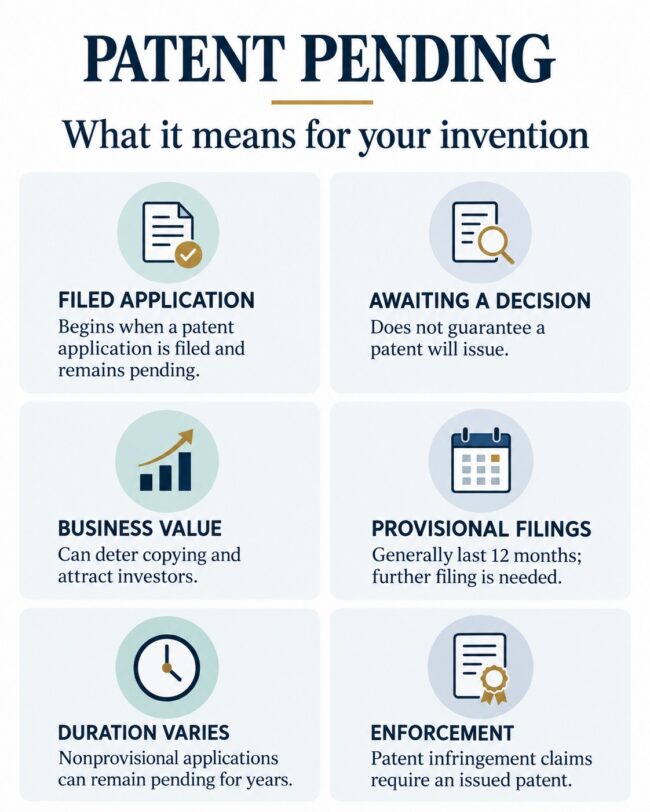
Patent applications are processed in the order they are filed, and there is a significant backlog at the patent office. Non-provisional patent applications undergo USPTO examination, which can take around 1-4 years, depending on the particular technology and art unit handling that technology, the number of office actions issued by the patent examiner, and how promptly the applicant responds to the office actions. See 35 U.S.C. § 131; MPEP § 708. The USPTO has stated that there is around a 22-month average, but the time taken for the patent process is highly variable and the final decision in a particular application is unpredictable. The examination time in some cases can exceed five years. Applicants must respond to each office action issued by the patent office in order to advance the pending application by amending claims and making factual and legal arguments against the prior art rejections in the office action. Non-provisional pending patent applications remain pending until issuance or abandonment, rather than automatically expiring after 12 months.
Most non-provisional utility applications publish approximately 18 months after the earliest claimed priority date, which may precede the actual patent application date due to a provisional application or foreign patent application filing. Publication does not complete the approval process or create immediately enforceable rights. See 35 U.S.C. § 122(b). If the applicant is not pursuing any foreign patent rights, they may submit a nonpublication request with the patent application, which will prevent publication of the application unless and until a patent issues from the pending application.
Provisional applications are not published, but may become publicly accessible if a later non-provisional application that claims priority to the provisional patent application is published or becomes a granted patent. In such circumstances, the provisional application is accessible through the patent office's Patent Center electronic filing and application management system. Design patent applications are not published, unless and until a design patent issues from the application.
You cannot sue for patent infringement based on patent pending status. Patent pending status provides no presently enforceable legal rights to sue for patent infringement. There must be a granted patent in order to bring an infringement claim. A granted patent gives the patent holder exclusive rights defined by its issued patent claims. 35 U.S.C. § 154(a).
After issuance legal action can taken against an infringing party, and a patent owner may seek a remedy for "patent pending infringement" that occurred during the period after the pending application was published and the date the patent was issued, if certain requirements are met. A patentee may seek reasonable royalties for post-publication, pre-grant infringement activity by a competitor if the accused party had actual notice of the published application and the issued claims are substantially identical to the claims that were published in the patent application publication. Recovery does not reach back to the filing date of the application. See 35 U.S.C. § 154(d). The infringing party may be put on actual notice of the patent application publication by a letter providing a copy of the patent application publication and explaining the risk of liability that they are facing.
A patent pending notice can deter competitors from copying your claimed technology, strengthen business credibility, attract investor interest, and support licensing agreements at an early stage. Marketing materials alert potential competitors to future infringement issues, but provide no assurance of the full legal protection of a patent. The patent application may ultimately be fatally rejected by the patent office due to prior art rejections or other patentability issues.
For a granted patent, virtual patent marking under 35 U.S.C. § 287(a) permits marking the product, or packaging when permitted, with a website address instead of a serial number on the product. The freely accessible webpage must associate the product with applicable patent numbers or may include patent applications that are pending approval. Virtual patent marking can provide a more easily managed central listing of patents and patents pending to better manage false marking issues that could result from abandoned applications, patents that have lapsed due to a failure to pay maintenance fees, or expired patents.
Falsely claiming patent pending without filing a patent application or after the relevant patent application has become abandoned is a risky act. If such false marking is done with intent to deceive, it is considered false marking under 35 U.S.C. § 292 and triggers civil liability. Legal consequences include fines up to $500 per offense and compensatory damages for competitive injury. Such conduct may be costly and can damage business reputation.
The Patent Cooperation Treaty (PCT) is an international treaty that gave rise to the Patent Cooperation Treaty filing system provided by the World Intellectual Property Organization (WIPO). The PCT system facilitates the filing and handling of international PCT applications. A PCT application provides patent pending status in 159 contracting states. See the WIPO contracting states list. There are countries that do not participate in the PCT system, such as Argentina, but nearly all major economies in the world participate in the PCT system. Thus, a PCT application provides broad international patent pending status. A U.S. provisional patent application or non-provisional patent application can serve as a priority application for a PCT application and any direct foreign patent application filing. The PCT application must be filed within 12 months of the U.S. patent application in order to have the benefit of the priority date of the U.S. application. Thus, a U.S. patent filing serves to practically provide patent pending status throughout the world for a 12-month period.
It should be noted that neither a U.S. patent application, nor a PCT application can create international patent rights without further filings. A PCT application must be followed by later national stage patent applications in each jurisdiction for which enforceable rights are desired (e.g., Europe, Canada, Japan, etc.), each of which must claim priority to the PCT application.
For foreign sales, tailor notices to local law and audience. The Munich Higher Regional Court found “patent pending” misleading to German consumers who could interpret it as a granted patent. In the United Kingdom, false patent-pending claims on goods sold when no qualifying application exists or it has been refused or withdrawn are penalized, subject to a reasonable period for correcting notices and a due-diligence defense. Businesses should identify the jurisdiction in which their patent pending goods or services are offered and observe the local rules on patent markings.
Filing a patent application initiates the patent process and provides patent pending status. Products and marketing materials can be marked as "patent pending" once a patent application is filed to deter potential competitors from copying the invention. Patent pending status can also support commercialization, investor discussions, and licensing agreements, even though patent protection is not yet established. However, the ultimate goal is securing an enforceable patent, and patent pending does not itself achieve a patent.
A skilled patent attorney can evaluate your patent filing strategy, prepare and guide the patent application through examination, and ensure patent status is properly identified on products and marketing materials. After grant, accurate patent number marking should be substituted for the patent pending marking. Treat patent pending as the beginning of a coordinated strategy for securing, maintaining, and enforcing valuable legal rights.
If you need assistance with a patent application or other intellectual property matter, please contact our office for a consultation with an experienced intellectual property attorney.
© 2026 Sierra IP Law, PC. The information provided herein does not constitute legal advice, but merely conveys general information that may be beneficial to the public, and should not be viewed as a substitute for legal consultation in a particular case.

"Mark and William are stellar in the capabilities, work ethic, character, knowledge, responsiveness, and quality of work. Hubby and I are incredibly grateful for them as they've done a phenomenal job working tirelessly over a time span of at least five years on a series of patents for hubby. Grateful that Fresno has such amazing patent attorneys! They're second to none and they never disappoint. Thank you, Mark, William, and your entire team!!"
Linda Guzman


Sierra IP Law, PC - Patents, Trademarks & Copyrights
FRESNO
7030 N. Fruit Ave.
Suite 110
Fresno, CA 93711
(559) 436-3800 | phone
BAKERSFIELD
1925 G. Street
Bakersfield, CA 93301
(661) 200-7724 | phone
SAN LUIS OBISPO
956 Walnut Street, 2nd Floor
San Luis Obispo, CA 93401
(805) 275-0943 | phone

SACRAMENTO
180 Promenade Circle, Suite 300
Sacramento, CA 95834
(916) 209-8525 | phone
MODESTO
1300 10th St., Suite F.
Modesto, CA 95345
(209) 286-0069 | phone
SANTA BARBARA
414 Olive Street
Santa Barbara, CA 93101
(805) 275-0943 | phone
SAN MATEO
1650 Borel Place, Suite 216
San Mateo, CA, CA 94402
(650) 398-1644. | phone
STOCKTON
110 N. San Joaquin St., 2nd Floor
Stockton, CA 95202
(209) 286-0069 | phone
PORTLAND
425 NW 10th Ave., Suite 200
Portland, OR 97209
(503) 343-9983 | phone
TACOMA
1201 Pacific Avenue, Suite 600
Tacoma, WA 98402
(253) 345-1545 | phone
KENNEWICK
1030 N Center Pkwy Suite N196
Kennewick, WA 99336
(509) 255-3442 | phone
2023 Sierra IP Law, PC - Patents, Trademarks & Copyrights - All Rights Reserved - Sitemap Privacy Lawyer Fresno, CA - Trademark Lawyer Modesto CA - Patent Lawyer Bakersfield, CA - Trademark Lawyer Bakersfield, CA - Patent Lawyer San Luis Obispo, CA - Trademark Lawyer San Luis Obispo, CA - Trademark Infringement Lawyer Tacoma WA - Internet Lawyer Bakersfield, CA - Trademark Lawyer Sacramento, CA - Patent Lawyer Sacramento, CA - Trademark Infringement Lawyer Sacrament CA - Patent Lawyer Tacoma WA - Intellectual Property Lawyer Tacoma WA - Trademark lawyer Tacoma WA - Portland Patent Attorney - Santa Barbara Patent Attorney - Santa Barbara Trademark Attorney
