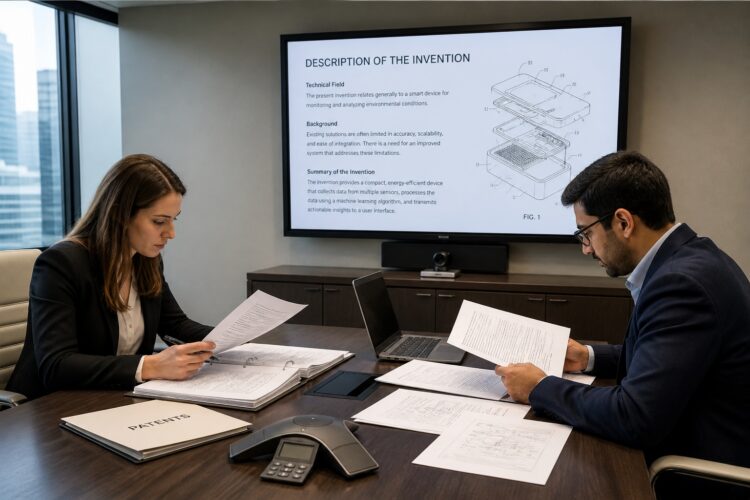
A patentability analysis is a practical first step for an inventor, entrepreneur, or business that wants to protect a new product, software feature, device, formulation, manufacturing process, or other invention. It helps determine whether a claimed invention may satisfy the legal requirements for a U.S. patent before they spend significant resources on the patent application process. A patent search and analysis is conducted to determine whether the invention is likely new, non-obvious, and directed to proper patentable subject matter. It is essentially the due diligence that needs to be conducted before investing resources in the patent process.
A patentability analysis is a structured review of an invention under the patentability requirements of U.S. patent law. It typically begins with a comprehensive prior art search, which may include both patent databases and non-patent literature, to identify relevant prior art references and prior art documents. A basic patent search identifies potentially relevant disclosures, but a full patentability assessment goes further by conducting a detailed analysis of how the invention differs from existing technology. This includes evaluating novelty, non-obviousness, and whether the invention falls within patentable subject matter.
In practice, the analysis considers whether multiple prior art references could be combined to render the invention obvious to a person having ordinary skill in the relevant art. The resulting assessment explains potential barriers to patentability and provides a reliable assessment of the likelihood of success. This deep analysis helps businesses avoid investing in inventions that may not meet patentability standards.
A patentability analysis typically considers three areas: patent eligibility under 35 U.S.C. § 101, novelty under 35 U.S.C. § 102, and non-obviousness under 35 U.S.C. § 103. In practice, these standards operate together within the broader patentability framework to determine whether an invention qualifies for patent protection. Under § 101, the claimed invention must fall within a statutory category to be patentable. It must be a process, machine, manufacture, or composition of matter, and must avoid judicial exceptions such as abstract ideas, laws of nature, and natural phenomena, unless additional claim elements transform the patent claim into a practical application. The Supreme Court’s decisions in Alice Corp. v. CLS Bank Int’l, 573 U.S. 208 (2014), and Mayo Collaborative Services v. Prometheus Labs., 566 U.S. 66 (2012), establish a two-step test for evaluating subject matter eligibility, requiring courts and patent examiners to determine whether claims are directed to an exception and, if so, whether they include an “inventive concept.”
Novelty under § 102 requires that no single prior art reference disclose all aspects of the claimed invention, as reflected in cases such as In re Gleave, 560 F.3d 1331 (Fed. Cir. 2009). By contrast, non-obviousness under § 103 evaluates whether a skilled person would find the invention obvious in view of one or a combination of prior art references. The Supreme Court in KSR Int’l Co. v. Teleflex Inc., 550 U.S. 398 (2007), emphasized a flexible, common-sense approach to determining whether an invention is obvious, including whether combining teachings from existing technology would have been predictable.
The invention must be directed to eligible subject matter to qualify for patent protection under 35 U.S.C. § 101, which limits patentable subject matter to processes, machines, manufactures, and compositions of matter. This statutory framework is the foundation of the patent system and serves as a threshold inquiry in determining patentability. However, courts have long recognized implicit judicial exceptions excluding abstract ideas, laws of nature, and natural phenomena. As reflected in USPTO guidance and practice, a claimed invention that merely recites one of these categories without meaningful application may fail the subject matter eligibility requirement.
The Supreme Court’s decisions in Mayo Collaborative Services v. Prometheus Laboratories, 566 U.S. 66 (2012), and Alice Corp. v. CLS Bank International, 573 U.S. 208 (2014), established a now-familiar two-step framework that governs modern patent eligibility analysis. First, courts determine whether the claims are directed to a prohibited concept, such as an abstract idea, law of nature, or natural phenomenon. This step often focuses on the “focus” or “character as a whole” of the claims, which can be particularly challenging in software and business method inventions. Second, if a judicial exception is implicated, the analysis turns to whether the claim elements, individually and as an ordered combination, contain an “inventive concept” sufficient to transform the claim into a patent-eligible application. This requires more than routine, conventional, or generic implementation.
As an example, in Association for Molecular Pathology v. Myriad Genetics, 569 U.S. 576 (2013) the Court clarified that naturally occurring DNA sequences are not patentable, but synthetically created DNA (cDNA) may qualify as patentable subject matter, reinforcing the boundary between discovery and invention. Subsequent Federal Circuit decisions have refined these principles. For example, Enfish LLC v. Microsoft Corp., 822 F.3d 1327 (Fed. Cir. 2016), held that claims directed to specific improvements in computer functionality were not abstract, illustrating that technological solutions to technical problems can satisfy § 101.
Together, these authorities demonstrate that determining patentability under § 101 requires a careful, fact-specific analysis of the invention’s technical aspects and whether the invention provides a technological advancement.
A novelty search asks whether a single prior art reference discloses every element of the claimed invention, either expressly or inherently. Prior art can include patent databases, published patent applications, issued patents, online databases, technical standards, product literature, conference papers, scientific journals, and other non-patent literature. Under 35 U.S.C. § 102, a person is not entitled to a patent if the invention was patented, described in a printed publication, in public use, on sale, or otherwise available to the public before the effective filing date, subject to limited statutory exceptions such as the one-year grace period for disclosures by the inventor.
Courts have clarified that a reference anticipates a claim if it discloses all elements arranged as in the claim. For example, in Verdegaal Bros. v. Union Oil Co., 814 F.2d 628 (Fed. Cir. 1987), the Federal Circuit held that anticipation requires that each and every element be found in a single reference. Similarly, In re Gleave confirmed that even a limited disclosure may anticipate if it enables the claimed subject matter. A thorough prior art search is therefore a crucial step in any patentability assessment, as undiscovered prior art documents can present significant potential obstacles to obtaining a patent.
An invention can be new but still unpatentable if a skilled person would find the invention obvious in view of the prior art. In U.S. law, this is non-obviousness under 35 U.S.C. § 103; internationally, it is often called inventive step. Seminal obviousness cases include Graham v. John Deere Co., 383 U.S. 1 (1966), and KSR Int’l Co. v. Teleflex Inc., 550 U.S. 398 (2007). In Graham, the Supreme Court established a framework requiring analysis of (1) the scope and content of the prior art, (2) differences between the prior art and the claimed invention, and (3) the level of ordinary skill in the art, along with secondary considerations such as commercial success. In KSR, the Court emphasized a flexible, common-sense approach, rejecting rigid formulas and allowing combinations of prior art references where there is a reason to do so.
As a result, even if no single reference discloses the invention, multiple prior art documents may be combined to support obviousness rejections. A simple example is joining two known components in a predictable way, which often renders an invention obvious. USPTO guidance reflects this flexible analysis, focusing on whether the claimed invention represents more than a predictable variation of existing technology.
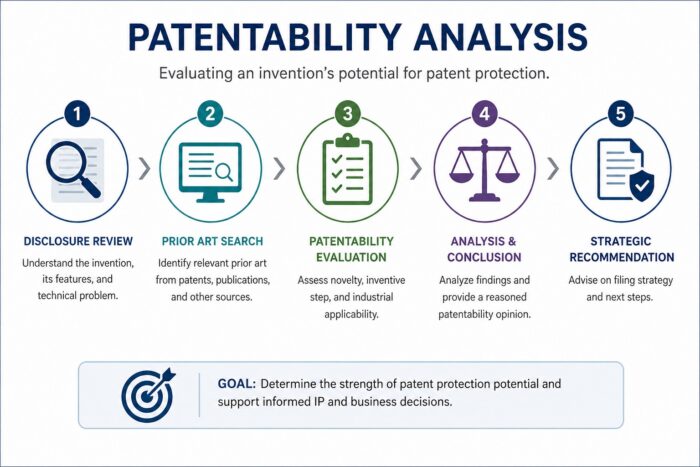
A strong search strategy does not rely only on obvious keywords, because relevant prior art is often described using different terminology, classifications, or technical language. Patent experts develop a structured search strategy that combines keyword searching with classification systems (such as CPC codes), assignee and inventor searches, and analysis of claim language from existing patents. They also review technical synonyms, product names, and alternative embodiments to capture variations of the same invention.
A comprehensive patentability search should extend beyond patent databases to include non-patent literature, such as scientific journals, technical standards, product manuals, and other publications that may qualify as prior art references. This broader approach is critical because non-patent literature can be just as relevant as issued patents in assessing novelty and non-obviousness.
The process typically begins with a broad search to capture a wide range of potentially relevant prior art documents, followed by iterative refinement based on initial search results. This narrowing process allows patent experts to focus on the most relevant references and conduct a more detailed analysis of how the claimed invention compares to existing technology. As part of a broader patentability assessment, this approach helps ensure a more reliable assessment of potential patentability issues.
A patentability report is usually a written report that summarizes the invention, identifies the closest search results, explains the relevant aspects of each reference, and assesses novelty, non-obviousness, subject matter eligibility, utility, and other patentability requirements. The goal is a detailed and reliable assessment, not a guarantee. A patentability opinion may also recommend whether to file, revise the invention disclosure, narrow the claims, or continue development.
Drafting a strong patent application requires understanding how the invention differs from existing technology. A patentability analysis helps a patent attorney or patent agent craft clearer claims, emphasize technical improvements over the prior art, and anticipate patent examiner concerns during patent prosecution. Known material references may also need to be disclosed to the United States Patent and Trademark Office under the duty of candor in 37 C.F.R. § 1.56, commonly through an information disclosure statement.
Even after a business performs its own analysis, the USPTO patent examiner conducts an independent examination. Under 37 C.F.R. § 1.104, the examiner studies the application and investigates available prior art relating to the claimed subject matter. That is why an early patentability assessment is best viewed as risk analysis: it helps identify potential obstacles before the Patent Office raises them. If the examiner identifies any prior art bases for rejection, an office action will issue providing the rejection and an explanation of the rejection. The patentability analysis will minimize the number of rejections. However, even with a thorough search and analysis, patent examiners often reject the application initially. Still, the patentability analysis places the application in the best posture for success.
No search can find every reference, and no analysis can guarantee allowance. New prior art may appear, claim scope may change, and the Federal Circuit may apply case law in ways that affect patentable scope. These risks notwithstanding, a patentability analysis is a critical initial step prior to filing a patent application. Even though the analysis cannot provide any guarantees of patentability, it can provide a valuable assessment of your chances of getting a patent and allow you to avoid pursuing a patent that has little prospect of success. As a practical note, the value of the assessment depends on the quality of the invention disclosure, the search, and the judgment of the trusted partner preparing it.
Patents are important assets in many industries, forming a core part of an enterprise’s intellectual property strategy. Strong patent protection can support fundraising, licensing opportunities, competitive positioning, and overall enterprise value. A reliable patentability assessment provides valuable insights before a product launch, during investor diligence, or when seeking funding, allowing businesses to make informed decisions about investing significant resources in the patenting process. It can also help control spend on intellectual property assets by identifying inventions that may not meet patentability requirements at an early stage. In addition, a thorough patentability analysis, including a prior art search and review of existing patents and non-patent literature, can provide insight into the technologies being pursued and protected by competitors. This type of detailed analysis enables companies to refine their innovation strategy, anticipate potential barriers, and better position their inventions within the marketplace.
A patentability analysis is a crucial step in determining the patentability of an invention before committing to the patent application process. It combines a prior art search with legal analysis of patent eligibility, novelty, and non-obviousness. The right patentability assessment can reveal potential barriers, guide claim strategy, reduce wasted spending, and improve the odds of building meaningful intellectual property around a commercially important invention.
If you need assistance with a patentability analysis or other intellectual property matter, please contact our offices for a consultation with one of our experienced patent attorneys.
© 2026 Sierra IP Law, PC. The information provided herein does not constitute legal advice, but merely conveys general information that may be beneficial to the public, and should not be viewed as a substitute for legal consultation in a particular case.

"Mark and William are stellar in the capabilities, work ethic, character, knowledge, responsiveness, and quality of work. Hubby and I are incredibly grateful for them as they've done a phenomenal job working tirelessly over a time span of at least five years on a series of patents for hubby. Grateful that Fresno has such amazing patent attorneys! They're second to none and they never disappoint. Thank you, Mark, William, and your entire team!!"
Linda Guzman


Sierra IP Law, PC - Patents, Trademarks & Copyrights
FRESNO
7030 N. Fruit Ave.
Suite 110
Fresno, CA 93711
(559) 436-3800 | phone
BAKERSFIELD
1925 G. Street
Bakersfield, CA 93301
(661) 200-7724 | phone
SAN LUIS OBISPO
956 Walnut Street, 2nd Floor
San Luis Obispo, CA 93401
(805) 275-0943 | phone

SACRAMENTO
180 Promenade Circle, Suite 300
Sacramento, CA 95834
(916) 209-8525 | phone
MODESTO
1300 10th St., Suite F.
Modesto, CA 95345
(209) 286-0069 | phone
SANTA BARBARA
414 Olive Street
Santa Barbara, CA 93101
(805) 275-0943 | phone
SAN MATEO
1650 Borel Place, Suite 216
San Mateo, CA, CA 94402
(650) 398-1644. | phone
STOCKTON
110 N. San Joaquin St., 2nd Floor
Stockton, CA 95202
(209) 286-0069 | phone
PORTLAND
425 NW 10th Ave., Suite 200
Portland, OR 97209
(503) 343-9983 | phone
TACOMA
1201 Pacific Avenue, Suite 600
Tacoma, WA 98402
(253) 345-1545 | phone
KENNEWICK
1030 N Center Pkwy Suite N196
Kennewick, WA 99336
(509) 255-3442 | phone
2023 Sierra IP Law, PC - Patents, Trademarks & Copyrights - All Rights Reserved - Sitemap Privacy Lawyer Fresno, CA - Trademark Lawyer Modesto CA - Patent Lawyer Bakersfield, CA - Trademark Lawyer Bakersfield, CA - Patent Lawyer San Luis Obispo, CA - Trademark Lawyer San Luis Obispo, CA - Trademark Infringement Lawyer Tacoma WA - Internet Lawyer Bakersfield, CA - Trademark Lawyer Sacramento, CA - Patent Lawyer Sacramento, CA - Trademark Infringement Lawyer Sacrament CA - Patent Lawyer Tacoma WA - Intellectual Property Lawyer Tacoma WA - Trademark lawyer Tacoma WA - Portland Patent Attorney - Santa Barbara Patent Attorney - Santa Barbara Trademark Attorney
