
A patent application must be filed with a standardized set of patent application forms provided by the United States Patent and Trademark Office (USPTO). The patent application forms include forms that identify the inventors, provide summary information about the patent application, identify any assignees or owners other than the inventors, and identify representation by a patent attorney, if one has been hired. This article provides a comprehensive guide to the documents that must be submitted with a patent application, how the submission process works, and why the patent application forms should be prepared with care to avoid introducing risk to your patent protection.
The United States Patent and Trademark Office (USPTO), which performs the patent examination process, supplies standardized administrative forms that are submitted with a patent application. However, there is no form for the patent application itself. The applicant or the applicant's patent attorney or patent agent must create the specification, drawings, claims, and abstract that constitute the patent application itself. Every application is unique: its written description and the drawings providing the visual representation of the invention must actually capture the invention in a manner that would allow a person having ordinary skill in the art (PHOSITA) to understand the invention. The patent application must provide a complete and clear disclosure of the invention, and no new matter can be added to the application later. See 35 U.S.C. §§ 111, 112, 113.
There are three types of patents. Utility patents protect new and useful processes, machines, manufactures, and compositions; design patents protect ornamental designs of articles of manufacture; and plant patents protect new varieties of asexually reproduced plants. See 35 U.S.C. §§ 101, 161, 171. You have the option of filing a provisional application, if you are filing a utility patent application or a plant patent application. However, provisional design patent applications are not available for a design patent. So, a design patent must be pursued at the outset through a nonprovisional design application.
A provisional patent application secures an early filing date and provides patent pending status for one year. It is not examined by the USPTO and expires after the 12 months. Fewer patent forms are required for a provisional application filing. A provisional application filing requires a specification, fee, and a provisional cover sheet. Neither claims, nor an inventor declaration is unnecessary. See 35 U.S.C. § 111(b); 37 C.F.R. §§ 1.51(c), 1.53(c). A Patent Cover Sheet, PTO/SB/16, is commonly used to satisfy the cover sheet requirement for provisional applications. However, an application data sheet form, PTO/AIA/14, may serve to satisfy the cover sheet requirement.
Nonprovisional applications require more detailed documentation. The patent application itself must include a specification explaining how to make and use the invention, at least one claim, and proper drawings when they are necessary for understanding the subject matter sought to be patented. The patent application forms must include a patent application data sheet providing the inventor information (including proper name, address, identification of the patent applicant, any claims for priority to prior-filed domestic or foreign patent applications, and identification of any patent assignees), inventor’s oath or declaration, an applicant statement of entitlement to apply for the patent, PTO/AIA/96, under 37 C.F.R. § 3.73(c), and a power of attorney, if a patent attorney has been engaged.
The application data sheet captures bibliographic data entered for inventors’ names, applicants, priority claims, and the correspondence address. Each inventor is required to sign a declaration stating that the filing was authorized and that the signer believes he or she is an original inventor of the claimed subject matter. A substitute statement may apply if an inventor is deceased, legally incapacitated, unavailable after diligent effort, or refuses to sign. See 35 U.S.C. § 115.
Declaration documents must be signed by the inventor, either by wet signature or e-signature in the form of a slash or “S-signature” under 37 C.F.R. § 1.4(d)(2). Almost all patent applications and patent application forms are now submitted electronically through the USPTO Patent Center electronic filing system, and so e-signatures are acceptable and convenient.
The application data sheet (ADS), generally prepared on USPTO Form PTO/AIA/14, places the application’s bibliographic information into the USPTO record and filing receipt. The applicant or patent attorney completes the applicable fields, verifies the data entered, and signs the ADS under 37 C.F.R. §§ 1.33(b) and 1.76(e). The signed document is normally submitted electronically with the application through Patent Center. If the ADS is incorrectly filled or must be changed due to other circumstances, the applicant must identify additions by underlining and deletions by strike-through or brackets. Special requirements apply to changes involving inventorship, priority, domestic benefit, or the correspondence address. See 37 C.F.R. § 1.76(c).
When an assignee that was not the inventor or original applicant seeks to act in a patent application, it must establish ownership through an Applicant Statement Under 37 C.F.R. § 3.73(c), PTO/AIA/96. The form identifies the assignee, application, and ownership basis, and provides either recorded assignment information, such as reel and frame numbers, or evidence of the chain of title submitted for recordation. Partial ownership interests must collectively account for the entire right, title, and interest. An authorized assignee representative or practitioner of record signs the form, which is submitted electronically through Patent Center. See 37 C.F.R. §§ 3.71(c), 3.73(c)–(d).
A power of attorney authorizes a registered patent attorney or patent agent to represent the applicant before the patent office. The power of attorney form (Form PTO/AIA/82) identifies the patent application and appoints either specifically named practitioners or practitioners associated with a Customer Number. See 37 C.F.R. § 1.32. The form is signed by the applicant, or an assignee that has established its authority to act in the application, and may be submitted electronically through Patent Center with the application or later in the examination process. A power of attorney does not automatically change the correspondence address, which may be the applicant's or representative's address.
Depending on the application and later events, applicants may need additional USPTO forms, including an Information Disclosure Statement, entity-status certification, fee transmittal, petition to make special, or request for prioritized examination. Each form should identify the application, supply the requested data, and include any required statement, signature, supporting document, and filing fees. Applicants should use the current form and follow its instructions because modified forms may omit required information. Most forms are fillable PDFs submitted electronically through Patent Center under the applicable document description.
Non-English nonprovisional applications additionally require an English translation, accuracy statement, and processing fee. Special rules govern non-English provisional applications. See 37 C.F.R. § 1.52(d).
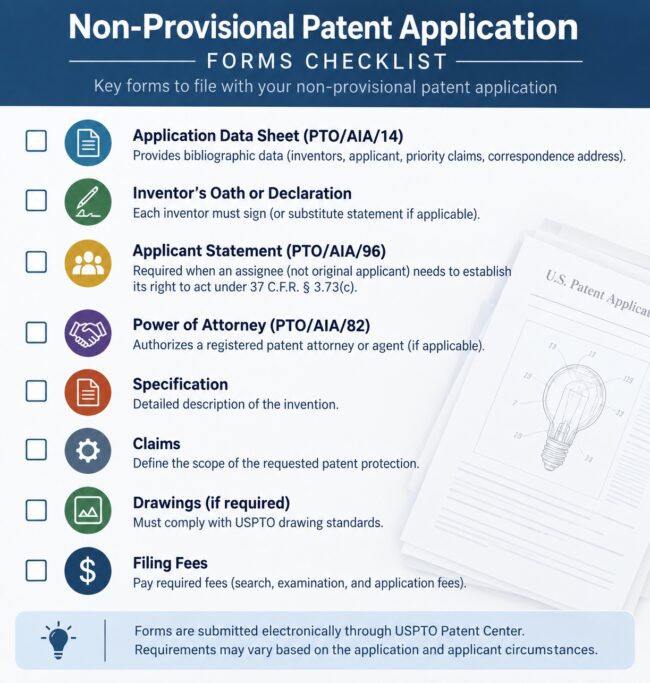
Most applications filed today are submitted electronically from a computer through Patent Center. All of the patent application forms and the patent application are submitted together in a single electronic submission. The electronic filing system immediately generates a filing acknowledgement receipt providing a list of the submitted documents, a timestamp for the filing, and a patent application serial number verifying a completed filing. The patent application can subsequently be accessed and tracked through the Patent Center system and the applicant can access and download notices and correspondence therefrom. The applicant can also download application documents.
The applicant is prompted to pay the application filing fees once the patent application forms and patent application are submitted. The patent application fees include a basic filing fee, a search fee, and an examination fee. The amount of the fees varies by entity size and application type. Small entities generally receive a 60% discount and micro entities an 80% discount on many fees. See 35 U.S.C. § 41(h).
The ownership of a patent application or patent can be transferred by a written agreement that includes a patent assignment of some or all of the patent rights. In order for the assignee to become an applicant in the patent application, the assignment terms must be submitted to the USPTO either as an attachment to an Applicant Statement Under 37 C.F.R. § 3.73(c) or through the assignment division (by assignment recordation) and then referenced in the Applicant Statement Under 37 C.F.R. § 3.73(c) by reel and frame numbers. Assignments are often recorded at the same time the patent application is filed. However, they may be filed at a later time. It is highly preferred that a patent assignment be recorded within three months of its execution in order to preserve all applicable legal rights. If it is filed within three months of its execution, it is deemed to be known and effective against all later assignees. So, if there is a mistaken or fraudulent later transaction purporting to assign rights in the patent a second time, a timely filed original assignment will control and define the ownership of the patent. The later mistaken assignment will be ineffective.
If a nonprovisional patent application is filed, the patent office will examine the application for compliance with all legal requirements. A patent examiner performs a prior art search, analyzes the application for patentability, and review the application for formal compliance. The analysis includes whether patent claims are adequately supported by the detailed description provided in the patent specification and drawings, and whether the patent claims are novel and non-obvious in view of the relevant prior art. See 35 U.S.C. §§ 102–103. The patent examiner may also raise objections to patent application forms that are improperly prepared or include inaccurate or faulty information. Such objections are typically handled by the Office of Initial Patent Examination (OIPE), but they may also be raised in an office action issued by the patent examiner. For example, the title of the invention provided in the application data sheet may not match the title provided in the specification document, or the inventor declaration submissions may not match the inventors listed in the application data sheet. Applicants are required to submit corrections, amendments, a petition, or other required response in order to advance the patent application.
In some cases, the USPTO does not catch errors in the patent application forms or errors may become evident at a later date. For example, it may be discovered that an inventor was inadvertently omitted from the original patent application. In such cases, the correction may be made in any still pending divisional or continuation applications, and in an already issued patent by filing a reissue application. A reissue application may be filed to address certain errors in an issued patent.
Providing patent application forms to the USPTO is a critical task in the patent filing process. All the forms must be accurately filled and submitted. Common mistakes involving inventor data, fees, signatures, or the asserted priority filing date can delay examination or affect the applicant's patent rights. Careful preparation and guidance from a patent attorney can help with proper preparation and filing of the patent application so that the applicant's patent rights can be fully established.
If you need assistance with a patent application or other intellectual property matter, please contact our offices for a free consultation.
© 2026 Sierra IP Law, PC. The information provided herein does not constitute legal advice, but merely conveys general information that may be beneficial to the public, and should not be viewed as a substitute for legal consultation in a particular case.

"Mark and William are stellar in the capabilities, work ethic, character, knowledge, responsiveness, and quality of work. Hubby and I are incredibly grateful for them as they've done a phenomenal job working tirelessly over a time span of at least five years on a series of patents for hubby. Grateful that Fresno has such amazing patent attorneys! They're second to none and they never disappoint. Thank you, Mark, William, and your entire team!!"
Linda Guzman


Sierra IP Law, PC - Patents, Trademarks & Copyrights
FRESNO
7030 N. Fruit Ave.
Suite 110
Fresno, CA 93711
(559) 436-3800 | phone
BAKERSFIELD
1925 G. Street
Bakersfield, CA 93301
(661) 200-7724 | phone
SAN LUIS OBISPO
956 Walnut Street, 2nd Floor
San Luis Obispo, CA 93401
(805) 275-0943 | phone

SACRAMENTO
180 Promenade Circle, Suite 300
Sacramento, CA 95834
(916) 209-8525 | phone
MODESTO
1300 10th St., Suite F.
Modesto, CA 95345
(209) 286-0069 | phone
SANTA BARBARA
414 Olive Street
Santa Barbara, CA 93101
(805) 275-0943 | phone
SAN MATEO
1650 Borel Place, Suite 216
San Mateo, CA, CA 94402
(650) 398-1644. | phone
STOCKTON
110 N. San Joaquin St., 2nd Floor
Stockton, CA 95202
(209) 286-0069 | phone
PORTLAND
425 NW 10th Ave., Suite 200
Portland, OR 97209
(503) 343-9983 | phone
TACOMA
1201 Pacific Avenue, Suite 600
Tacoma, WA 98402
(253) 345-1545 | phone
KENNEWICK
1030 N Center Pkwy Suite N196
Kennewick, WA 99336
(509) 255-3442 | phone
2023 Sierra IP Law, PC - Patents, Trademarks & Copyrights - All Rights Reserved - Sitemap Privacy Lawyer Fresno, CA - Trademark Lawyer Modesto CA - Patent Lawyer Bakersfield, CA - Trademark Lawyer Bakersfield, CA - Patent Lawyer San Luis Obispo, CA - Trademark Lawyer San Luis Obispo, CA - Trademark Infringement Lawyer Tacoma WA - Internet Lawyer Bakersfield, CA - Trademark Lawyer Sacramento, CA - Patent Lawyer Sacramento, CA - Trademark Infringement Lawyer Sacrament CA - Patent Lawyer Tacoma WA - Intellectual Property Lawyer Tacoma WA - Trademark lawyer Tacoma WA - Portland Patent Attorney - Santa Barbara Patent Attorney - Santa Barbara Trademark Attorney
