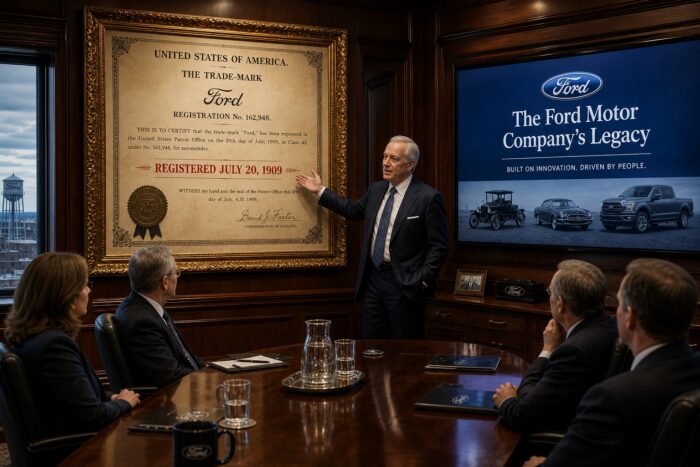
How long does a trademark last? In the United States, trademark rights can last indefinitely, but only if the trademark owner keeps using the trademark in commerce. Trademark rights can exist with or without a federal trademark registration. The proper use of a trademark in connection with goods or services results in common law rights in the trademark that are enforceable against third parties in the geographic area in which the trademark is recognized. Generally speaking, the common law rights will persist as long as the trademark remains in use. Trademark rights may be formally registered with the United States Patent and Trademark Office (USPTO), which provides broader geographic coverage (throughout the US), presumptions of rights and ownership, and other advantages. A federal trademark registration must be renewed periodically to be maintained and must be supported by continued use of the trademark in commerce. These concepts are discussed in further detail below.
A trademark is a word, phrase, symbol, design, or combination that identifies and distinguishes the source of goods or services. Under U.S. trademark law, trademark rights are established primarily from use in commerce, not merely from filing a trademark application. The trademark office (USPTO) makes clear that protection attaches only to the specific goods and services with which the mark is actually used, not to all conceivable uses of the same term or design. A service mark operates under the same principles but applies to services rather than physical products.
From a legal standpoint, trademarks are a form of intellectual property that embody goodwill, the intangible value associated with a brand’s reputation, customer recognition, and market presence. Courts have consistently recognized that trademark rights are inseparable from this goodwill.
A business can acquire a common law trademark simply by using its trademark in commerce. These rights arise automatically and can be enforced against competitors in the same geographic market. However, they are inherently limited. Without federal registration, a trademark owner may only have priority in the regions where the mark is actually used or known, making expansion riskier and trademark enforcement more complex.
This principle is illustrated in United Drug Co. v. Theodore Rectanus Co., 248 U.S. 90 (1918). In that case, two parties independently used the same mark in different geographic areas. The Supreme Court held that trademark rights are territorial and based on actual use, meaning a senior user in one region could not automatically exclude a good-faith junior user in a distant market. The case underscores that common law rights are limited in scope and tied to localized goodwill.
Obtaining a federal trademark registration significantly expands the scope of trademark protection. A registered mark provides nationwide constructive priority as of the filing date, subject to earlier users, meaning the trademark owner gains presumptive rights across the United States, even in areas where the mark is not yet in use. This is a critical advantage for growing businesses.
The importance of federal trademark registration is reinforced in Park ’N Fly, Inc. v. Dollar Park & Fly, Inc., 469 U.S. 189 (1985). There, the Supreme Court upheld the strength of a registered mark that had achieved incontestable status, ruling that the defendant could not challenge the mark as merely descriptive. The holding demonstrates how federal registration, particularly when combined with continued use and filings like a Section 15 declaration, strengthens exclusive rights and limits defenses available in a trademark infringement lawsuit.
Trademark rights are inseparable from goodwill. In Hanover Star Milling Co. v. Metcalf, 240 U.S. 403 (1916), the Supreme Court emphasized that a trademark is not property in the abstract but represents the goodwill of a business. The Court held that rights in a mark grow out of its use and the reputation it develops with consumers. This reinforces that a mark cannot exist independently of the business it identifies.
Because of this relationship, trademarks cannot be assigned or transferred without the associated goodwill. Any attempt to transfer a mark “in gross”, without the underlying business goodwill can invalidate the assignment.
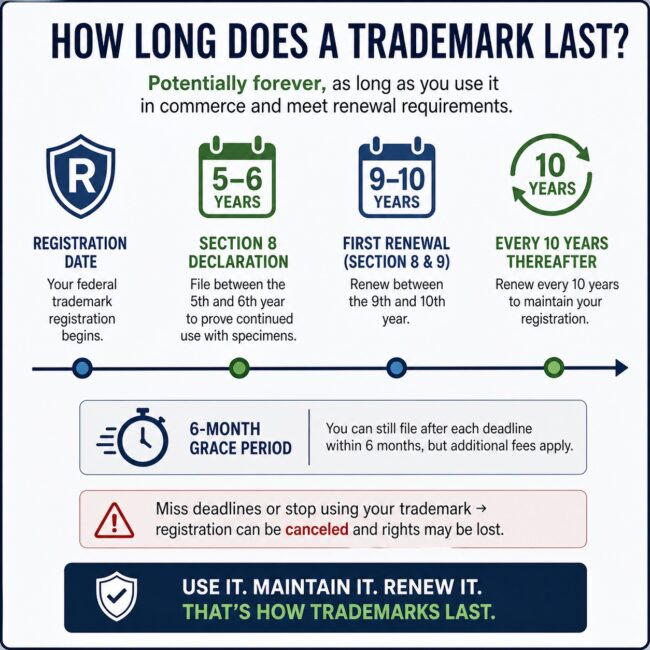
For a federal trademark, the practical answer is: potentially forever. Trademark duration is tied to continued use, not a fixed monopoly period. Unlike patents, which expire after a set period, trademark protection can continue as long as the mark remains distinctive, is actively used in commerce, and the trademark owner complies with all legal requirements. This includes timely filing of required maintenance documents, such as declarations and renewal forms, along with proper specimens and fees through the trademark office USPTO.
In other words, how long a trademark lasts depends less on a single expiration date and more on whether the owner continues using the trademark in connection with the listed goods or services and meets ongoing renewal requirements. A federal trademark registration does not automatically expire if properly maintained. Instead, it can provide continuous protection and exclusive rights for a brand over decades.
However, if the trademark owner stops using the mark, fails to submit required documents, or allows the mark to lose its distinctiveness, the trademark can expire or be canceled. Therefore, maintaining trademark protection is an ongoing process that requires attention to deadlines, continued use in commerce, and compliance with USPTO rules.
A federal trademark registration initially comes with an important six-year maintenance checkpoint. Although federal registration is structured around ten-year terms, the owner must file a Section 8 Declaration of Use between the fifth and sixth year after the trademark registration date. See 15 U.S.C. § 1058. If accepted, the registration continues for the remainder of the ten-year period.
This is why business owners often hear that the first renewal of a trademark is due between the fifth and sixth year. More precisely, the first required maintenance filing is due then; the first combined Section 8 and Section 9 trademark renewal is due later, between the ninth and tenth years. See 15 U.S.C. § 1059.
To maintain your trademark, you must file a Section 8 Declaration of Use, or a declaration of excusable nonuse, between the fifth and sixth year after the registration date. The declaration must show that the registered mark is still in use in commerce for the listed goods and services. The law requires the filing to identify the goods or services in use and include specimens of use showing current use in commerce.
Proof of use may include product labels, tags, packaging, website screenshots, or advertisements, depending on whether the mark covers goods or services. The USPTO states that a Section 8 filing must include one specimen per class and a signed declaration.
In addition to the Section 8 filing, a trademark owner may also file a Section 15 Declaration of Incontestability after five years of continuous use in commerce. This optional filing does not affect the trademark duration or renewal deadlines, but it significantly strengthens the owner’s trademark rights. Once accepted, the mark becomes “incontestable” for certain purposes under trademark law, meaning it is harder for third parties to challenge the validity of the registration.
To qualify, the owner must confirm that the mark has been in continuous use for five years and that there are no pending legal challenges. Filing a Section 15 declaration alongside the Section 8 maintenance documents is a common strategy to enhance protection while maintaining your trademark registration.
After the first Section 8 deadline, trademarks must be renewed every ten years to maintain a valid federal trademark registration and preserve ongoing trademark protection. The first full renewal period occurs between the ninth and tenth years after the trademark registration date, and this filing typically combines a Section 8 Declaration of Use with a Section 9 renewal application. After that, subsequent renewals are required every ten years, such as between years 19 and 20, 29 and 30, and so on, creating a repeating renewal period tied to the original registration date.
Section 9 of the Lanham Act provides that each registration may be renewed for additional ten-year periods if the trademark owner pays the prescribed fees and files the required maintenance documents. These filings must include proof of continued use in commerce, along with specimens showing how the mark is used with the listed goods or services. If the owner cannot demonstrate continued use, they must claim excusable nonuse with supporting evidence.
Failure to meet these renewal requirements can result in the trademark registration being canceled or considered abandoned. Once a registration expires, the owner generally cannot reinstate it and must file a new trademark application with the trademark office to regain federal registration and associated rights.
If a trademark owner misses a renewal deadline, there is a six-month grace period after each deadline under trademark law. During this six month grace period, the trademark owner can still file the required maintenance documents, such as a Section 8 Declaration of Use or a combined Section 8 and Section 9 trademark renewal, through the trademark office USPTO. A filing made during the grace period will generally be accepted, but additional fees apply, which can increase the overall cost of maintaining your trademark registration.
However, this grace period is strictly limited. If the trademark owner does not file before the end of the grace period, the federal trademark registration may be canceled or deemed expired, and the mark may be considered abandoned. The USPTO does send courtesy reminders, but the legal requirements place the burden on the owner to track deadlines and timely submit all required forms.
If a trademark owner fails to timely file required maintenance documents on time, the registration will be canceled by the USPTO. For example, missing a Section 8 Declaration of Use or a Section 9 trademark renewal deadline can cause the trademark to be deemed expired or canceled. The USPTO makes clear that it has no authority to waive or extend these statutory deadlines, even if the failure to file was unintentional. Although there is a limited six month grace period with additional fees, once that window closes, the registration is considered abandoned. At that point, the trademark owner cannot reinstate or revive the canceled registration and must restart the federal trademark registration process by submitting a new trademark application, paying new filing fees, and going through examination again.
Importantly, while federal trademark protection is lost, some common law trademark rights may still exist if the mark is still in use in commerce. However, those rights are narrower and limited in geographic scope. The loss of federal registration means losing the benefits of the registration (nationwide priority, presumptions of ownership, and certain enforcement advantages in an infringement lawsuit), significantly weakening overall trademark protection for the business.
Trademark law requires that a federal trademark registration accurately reflect how the mark is actually used in commerce. A trademark owner must ensure that the listed goods and services remain current throughout the life of the registration. If the owner stops using the mark for certain goods or services, those items should be deleted promptly to maintain compliance with USPTO rules. The USPTO instructs owners to file a Section 7 request to delete unused goods and services, and notably, there is no fee for deleting them between maintenance filings.
This requirement is critical because overstating use can seriously jeopardize the validity of the trademark registration. When filing maintenance documents, such as a Section 8 Declaration of Use or a combined renewal filing, the trademark owner must provide evidence showing current use of the mark for each listed class of goods and services. If the owner includes goods or services that are no longer in use, the declaration may be deemed false. This can expose the registration to cancellation, claims of fraud, or challenges in a lawsuit involving trademark infringement or ownership. In severe cases, the entire registration, not just the unused goods or services, can be at risk. Accordingly, each maintenance filing should carefully match actual, ongoing use, unless a properly supported claim of excusable nonuse applies.
After five years of continuous use in commerce, a trademark owner may be eligible to file a Section 15 Declaration of Incontestability with the USPTO. This filing is optional but can significantly enhance trademark protection by strengthening the presumption that the registered mark is valid and that the trademark owner has exclusive rights to use the mark in connection with the listed goods or services. While Section 15 does not affect the trademark duration, expiration date, or renewal requirements, it limits the grounds on which third parties can challenge the registration, such as claims that the mark is merely descriptive. To qualify, the mark must still be in use in commerce and must not be subject to any pending legal challenge or adverse decision. Filing this declaration is often a strategic step in protecting a brand and reinforcing long-term intellectual property rights.
Renewing is not enough to maintain strong trademark protection. A trademark owner must continuously monitor the marketplace and take action against potential infringement to preserve the distinctiveness of the mark. Failure to enforce rights can weaken trademark rights and, in some cases, support arguments that the owner has abandoned the mark under trademark law. This may include sending cease and desist letters or, if necessary, filing a lawsuit to protect the brand and its associated goods or services.
Equally important is avoiding genericide. A trademark can lose protection if it becomes the common, generic name for a type of product or service, rather than identifying a single source. Well-known examples illustrate how valuable intellectual property can be lost if the public begins using the mark generically. Under 15 U.S.C. § 1064, a registration can be subject to cancellation at any time if the mark becomes generic or is considered abandoned, making ongoing vigilance essential.
A federal trademark can last indefinitely, but only if the owner continues using the trademark in commerce. For federal trademark registrations, the registrant must file Section 8 maintenance documents, renewals under Section 9 every ten years, submit proper specimens of use, pay required fees, and keep the registration accurate in order to keep the registration active and enforceable. For any business that depends on a brand, maintaining its trademark use and registering the trademark are necessary to protect and maximize the value of your business and brand.
If you need assistance with trademark matters, contact our office for a consultation.
© 2026 Sierra IP Law, PC. The information provided herein does not constitute legal advice, but merely conveys general information that may be beneficial to the public, and should not be viewed as a substitute for legal consultation in a particular case.

"Mark and William are stellar in the capabilities, work ethic, character, knowledge, responsiveness, and quality of work. Hubby and I are incredibly grateful for them as they've done a phenomenal job working tirelessly over a time span of at least five years on a series of patents for hubby. Grateful that Fresno has such amazing patent attorneys! They're second to none and they never disappoint. Thank you, Mark, William, and your entire team!!"
Linda Guzman


Sierra IP Law, PC - Patents, Trademarks & Copyrights
FRESNO
7030 N. Fruit Ave.
Suite 110
Fresno, CA 93711
(559) 436-3800 | phone
BAKERSFIELD
1925 G. Street
Bakersfield, CA 93301
(661) 200-7724 | phone
SAN LUIS OBISPO
956 Walnut Street, 2nd Floor
San Luis Obispo, CA 93401
(805) 275-0943 | phone

SACRAMENTO
180 Promenade Circle, Suite 300
Sacramento, CA 95834
(916) 209-8525 | phone
MODESTO
1300 10th St., Suite F.
Modesto, CA 95345
(209) 286-0069 | phone
SANTA BARBARA
414 Olive Street
Santa Barbara, CA 93101
(805) 275-0943 | phone
SAN MATEO
1650 Borel Place, Suite 216
San Mateo, CA, CA 94402
(650) 398-1644. | phone
STOCKTON
110 N. San Joaquin St., 2nd Floor
Stockton, CA 95202
(209) 286-0069 | phone
PORTLAND
425 NW 10th Ave., Suite 200
Portland, OR 97209
(503) 343-9983 | phone
TACOMA
1201 Pacific Avenue, Suite 600
Tacoma, WA 98402
(253) 345-1545 | phone
KENNEWICK
1030 N Center Pkwy Suite N196
Kennewick, WA 99336
(509) 255-3442 | phone
2023 Sierra IP Law, PC - Patents, Trademarks & Copyrights - All Rights Reserved - Sitemap Privacy Lawyer Fresno, CA - Trademark Lawyer Modesto CA - Patent Lawyer Bakersfield, CA - Trademark Lawyer Bakersfield, CA - Patent Lawyer San Luis Obispo, CA - Trademark Lawyer San Luis Obispo, CA - Trademark Infringement Lawyer Tacoma WA - Internet Lawyer Bakersfield, CA - Trademark Lawyer Sacramento, CA - Patent Lawyer Sacramento, CA - Trademark Infringement Lawyer Sacrament CA - Patent Lawyer Tacoma WA - Intellectual Property Lawyer Tacoma WA - Trademark lawyer Tacoma WA - Portland Patent Attorney - Santa Barbara Patent Attorney - Santa Barbara Trademark Attorney
