
Micro entity status reduces patent fees for qualifying inventors and businesses at the United States Patent and Trademark Office (USPTO). It promotes the use of the patent system by independent inventors and entrepreneurs, and small business operations. Individuals and businesses can qualify for micro entity discounts if they meet the eligibility requirements discussed below. Innovation is one of the strengths of the U.S. economy and the reduction in fees provided by the micro entity discount for individuals and small businesses serves to encourage invention, stimulate economic activity, and bolster the future of industry in the U.S.
Small and micro entities pay reduced USPTO fees. The micro entity discount is an 80% reduction of the standard large entity fee rate. Eligible government fees include patent filing, search, examination, issuance, and patent maintenance fees. However, the discount does not apply to attorney charges or certain USPTO fees.
For example, the standard filing fees for a utility patent application (i.e., the basic filing fee, search fee, and examination fee) for a micro entity are $400, versus the standard filing fees of $1720. Also, the 11.5-year maintenance fee falls from $8,280 to $1,656 with micro entity status, saving the filer $6,624. See 37 C.F.R. § 1.20(g).
Individuals, including sole proprietors, and qualifying partnerships, LLCs, corporations, and nonprofit organizations may obtain USPTO micro entity status. Eligibility depends on satisfying small entity requirements and the additional criteria under 35 U.S.C. § 123 and 37 C.F.R. § 1.29. The particular business structure is not determinative. In broader business and legal contexts, micro entity describes the smallest business classification. Micro-businesses typically have very low startup capital and may operate as sole proprietorships or LLCs.
Patent-related micro entity status provides fee reductions in the patent application context. It does not have any direct implications for general business reporting exemptions. Likewise, qualification for micro entity status before the USPTO does not affect other business requirements.
To qualify as a micro entity, a patent applicant must first meet small entity status requirements. Every applicant, inventor, and rights holder in a patent application must qualify for small entity status in order to further qualify for micro entity status, whether they are an individual, qualifying small business concern, or nonprofit organization. For a business to qualify as a small entity, it cannot exceed 500 employees. Transfers or obligations to transfer patent rights to a non-small entity can defeat eligibility. See 37 C.F.R. § 1.27.
In addition to qualifying as a small entity, a micro entity must also have a gross income in the last calendar year below the income threshold. The maximum qualifying gross income is $262,380, effective September 15, 2026. This micro entity income threshold is adjusted on an annual basis with Census data and equals three times median household income (e.g., the prior threshold for 2025 was $251,190).
The gross income limit applies separately to each applicant, inventor, and rights holder, using the party's gross income for the preceding calendar year. Exceeding the gross income limit disqualifies the application from micro entity fees on this basis.
It is important that you apply the total gross income number, not adjusted gross income, under Internal Revenue Code § 61(a). Joint patent filers calculate individual income from their separate tax return. Each party that is an applicant or owner of the patent filing must qualify. In the case of a foreign applicant or owner, their foreign income can be converted for purposed of determining micro entity status using the Internal Revenue Service’s average currency exchange rate for that year. See 35 U.S.C. 123.
Neither the applicant nor the inventor nor a joint inventor may have more than four counted previously filed patent applications naming that person as an inventor. Each applicant and inventor must meet this application filing limit.
Not all forms of patent applications impact this limit. In determining the relevant previous applications, the following kinds of patent applications count: U.S. utility applications, design patent applications, plant patent applications, continuation applications, divisional applications, reissue applications, national stage applications claiming priority to a Patent Cooperation Treaty (PCT) application, and U.S.-designating International Hague Design filings. It does not matter if the prior applications filed were abandoned applications or filed under a different entity status. Provisional applications, foreign applications, and Patent Cooperation Treaty applications without a U.S. national stage filing do not count as a relevant prior filing. If all ownership rights in a previously filed application were assigned, or required to be assigned, by an inventor to a previous employer, that application is not a relevant prior filing for the inventor's status, as long as the assignee was not the inventor’s own business. See 35 U.S.C. § 123(b). Also, your prior employment with a patent applicant does not cause the patent application to be attributed to you. Later filings do not disqualify earlier eligible applications.
Ownership arrangements can determine whether an applicant qualifies for micro entity status under the gross income basis. The income test extends beyond the inventor to anyone receiving a license or other ownership interest in the patent application. Under 37 C.F.R. § 1.29(a)(4), an applicant is ineligible if the applicant or any inventor has transferred such rights to an entity whose gross income in the preceding calendar year exceeds the applicable income limit.
The restriction also applies to an obligation by contract or law to assign, grant, or convey rights, even before a transfer occurs. For example, an employment agreement requiring an inventor to assign inventions to an employer can affect eligibility. These arrangements matter even when unrecorded with the USPTO. The absence of a recorded assignment does not eliminate the underlying obligation.
Consequently, a high-income employer holding patent rights, or entitled to receive them, can defeat eligibility despite low inventor income. Applicants should review employment agreements, patent assignments, and patent licenses to identify existing ownership interests and transfer obligations before claiming micro entity status.
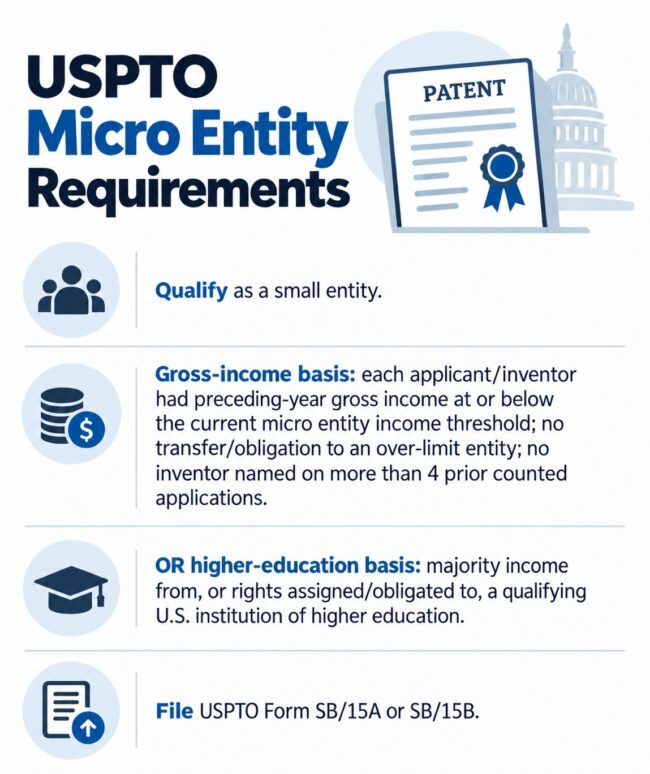
A patent application may also qualify for micro entity fees when the applicant’s employer is a qualifying institution of higher education from which the applicant obtains most of the applicant’s income, or when the applicant has transferred or must transfer rights to such an institution. See 35 U.S.C. § 123(d). For such micro entity status applicant qualifies even if the income basis is not met. However, the university itself as applicant does not qualify as a micro entity under this basis.
While this basis removes income and filing limits, it retains small entity requirements. Also, the educational institution must meet the requirements of the Higher Education Act § 101(a), including applicable location, nonprofit, accreditation, and degree-program requirements. Qualifying programs include bachelor’s degrees or two-year programs creditable toward such a degree. Employment by a foreign university does not allow an applicant or inventor to qualify under this basis. See 20 U.S.C. § 1001(a).
To establish micro entity status, an executed micro entity certification must be submitted in the patent application to the USPTO before or with the first discounted payment. The certification form is either PTO/SB/15A for the gross income basis or PTO/SB/15B for the higher education basis. The certification must identify the particular application, and each related application (e.g., a continuation application or divisional application) requires its own certification. See 37 C.F.R. § 1.29(e)–(f).
There is no requirement that tax returns be submitted or that the certification be notarized. However, in the case of LLCs and foreign-domiciled applicants, a registered patent practitioner must sign the certification and handle prosecution of the patent application.
Micro entity status must be reassessed when a new fee must be paid in the patent application, whether it is an extension of time, petition fee, or other fee. For example, if the application is allowed and you are ready to pay the issue fee, you must reassess whether all applicants qualify for micro entity fees. It must also be reassessed each time that you pay a maintenance fee. For applications filed under the gross income basis, it is advisable to conduct income verification annually using the preceding calendar year’s income and the applicable threshold. You do not need to file new certifications each year, but if you have lost eligibility at the time a fee is due (e.g., the issue fee or a maintenance fee), you can no longer benefit from the reduced micro entity amount. See 37 C.F.R. § 1.29(g). Loss of entitlement to micro entity status requires signed written notification to the USPTO before or with the next fee payment. Form SB/460 may be used to report the change. Simply paying the higher fees is insufficient. Regaining status after reporting its loss requires a new certification.
Good-faith errors can be corrected by submitting a separate, itemized fee deficiency payment for each affected application or patent. The deficiency payment requirement uses the correct small-entity or undiscounted rates in effect when the deficiency is paid in full, minus amounts previously paid. The submission must identify each underpaid fee, its original payment date and amount, the individual shortfall, and the total deficiency. See 37 C.F.R. § 1.29(k).
An attempt to fraudulently establish status in a patent application risks any resulting patent being ruled to be unenforceable. However, an incorrect designation does not automatically establish inequitable conduct that would result in unenforceability. In Outside the Box Innovations, LLC v. Travel Caddy, Inc., 695 F.3d 1285 (Fed. Cir. 2012), the Federal Circuit reversed a small-entity inequitable-conduct finding because deceptive intent had not been established by clear and convincing evidence.
Under 35 U.S.C. § 123(f), a false certification can trigger a fine of at least three times the amount not paid, unless the entity shows that the certification was made in good faith.
Micro entity status can make patent protection more affordable by substantially reducing USPTO fees. However, these savings depend on satisfying specific eligibility requirements. Before claiming the discount, you should verify that each patent applicant qualifies, reviewing income, filing history, and ownership contracts as appropriate. As the patent application progresses, you must review changes affecting eligibility before making payments to the USPTO. If your status changes, you must notify the USPTO, and promptly address any fee deficiencies. Careful attention to these requirements helps inventors and businesses secure available savings while avoiding payment errors during patent prosecution and maintenance.
© 2026 Sierra IP Law, PC. The information provided herein does not constitute legal advice, but merely conveys general information that may be beneficial to the public, and should not be viewed as a substitute for legal consultation in a particular case.

"Mark and William are stellar in the capabilities, work ethic, character, knowledge, responsiveness, and quality of work. Hubby and I are incredibly grateful for them as they've done a phenomenal job working tirelessly over a time span of at least five years on a series of patents for hubby. Grateful that Fresno has such amazing patent attorneys! They're second to none and they never disappoint. Thank you, Mark, William, and your entire team!!"
Linda Guzman


Sierra IP Law, PC - Patents, Trademarks & Copyrights
FRESNO
7030 N. Fruit Ave.
Suite 110
Fresno, CA 93711
(559) 436-3800 | phone
BAKERSFIELD
1925 G. Street
Bakersfield, CA 93301
(661) 200-7724 | phone
SAN LUIS OBISPO
956 Walnut Street, 2nd Floor
San Luis Obispo, CA 93401
(805) 275-0943 | phone

SACRAMENTO
180 Promenade Circle, Suite 300
Sacramento, CA 95834
(916) 209-8525 | phone
MODESTO
1300 10th St., Suite F.
Modesto, CA 95345
(209) 286-0069 | phone
SANTA BARBARA
414 Olive Street
Santa Barbara, CA 93101
(805) 275-0943 | phone
SAN MATEO
1650 Borel Place, Suite 216
San Mateo, CA, CA 94402
(650) 398-1644. | phone
STOCKTON
110 N. San Joaquin St., 2nd Floor
Stockton, CA 95202
(209) 286-0069 | phone
PORTLAND
425 NW 10th Ave., Suite 200
Portland, OR 97209
(503) 343-9983 | phone
TACOMA
1201 Pacific Avenue, Suite 600
Tacoma, WA 98402
(253) 345-1545 | phone
KENNEWICK
1030 N Center Pkwy Suite N196
Kennewick, WA 99336
(509) 255-3442 | phone
2023 Sierra IP Law, PC - Patents, Trademarks & Copyrights - All Rights Reserved - Sitemap Privacy Lawyer Fresno, CA - Trademark Lawyer Modesto CA - Patent Lawyer Bakersfield, CA - Trademark Lawyer Bakersfield, CA - Patent Lawyer San Luis Obispo, CA - Trademark Lawyer San Luis Obispo, CA - Trademark Infringement Lawyer Tacoma WA - Internet Lawyer Bakersfield, CA - Trademark Lawyer Sacramento, CA - Patent Lawyer Sacramento, CA - Trademark Infringement Lawyer Sacrament CA - Patent Lawyer Tacoma WA - Intellectual Property Lawyer Tacoma WA - Trademark lawyer Tacoma WA - Portland Patent Attorney - Santa Barbara Patent Attorney - Santa Barbara Trademark Attorney
