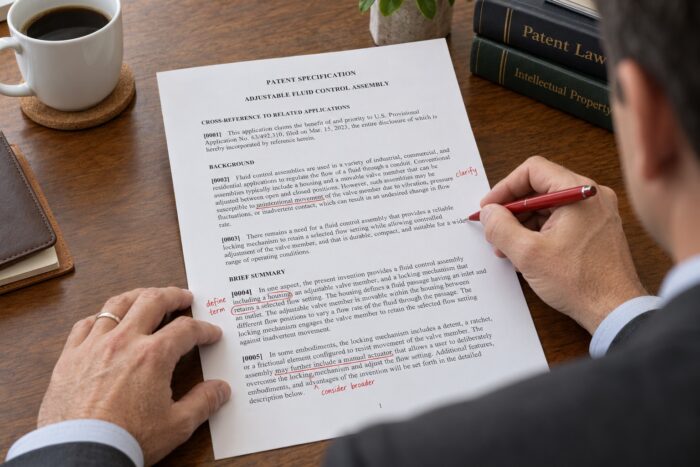
A patent specification is a legal and technical document submitted as part of a utility patent application to the United States Patent and Trademark Office (USPTO). It is the required written portion of a patent application that provides the public with the disclosure of the invention. The patent specification teaches others how to make and use the invention. It also must provide sufficient support for the patent claims defining the right to exclude others from practicing the invention. A patent specification must be carefully and thoroughly drafted. If it does not effectively cover all aspects of the claimed invention, the claims may be subject to invalidity challenges and other potential problems.
This article is for entrepreneurs and inventors that are seeking deeper knowledge of patent application requirements, including the patent specification. We explain the purpose of and best practices for the utility patent specification.
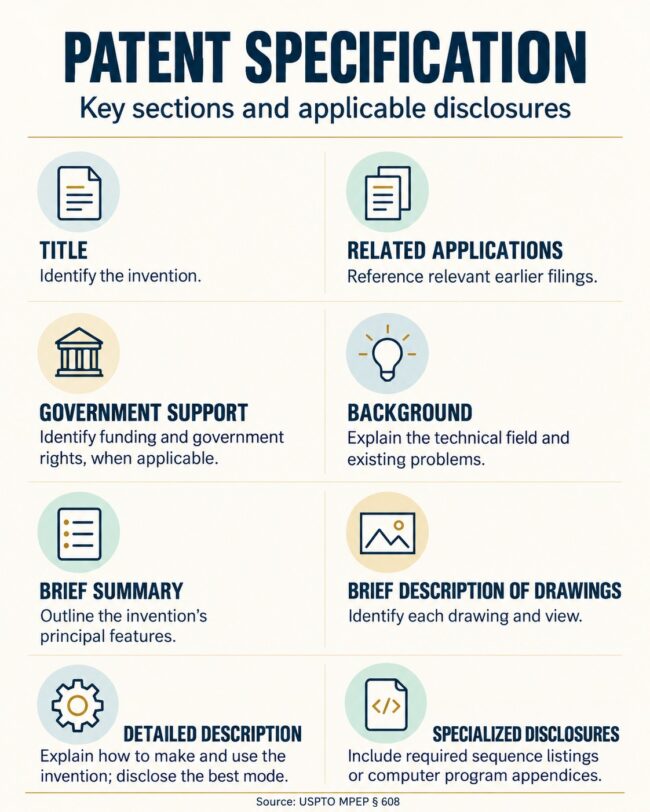
For a utility patent, the specification generally includes a title, background section, brief summary of the invention, brief description of drawings, and a detailed description of the invention. The United States Patent and Trademark Office recommends this structure per 37 C.F.R. § 1.77. The remaining patent application elements are the drawings, patent claims, and abstract of the invention.
An introductory portion stating applicant details may be included. However, this is no longer required because such information is now required to be submitted in an application data sheet. The specification may also require a statement regarding federally sponsored research identifying government support in the introductory section, if such report was provided.
Until recently, the specification generally included a title section identifying the inventors, title, and cross references to related applications (e.g., provisional applications, and prior non-provisional filings to which the application claims priority) on a separate page at the beginning of the specification. However, the patent office now has instituted new DOCX document filing requirements with specific preferred templates that exclude the title page. The title page information is now all covered in the application data sheet, and is not needed in the specification.
The background section explains the technical field to which the invention pertains. The background may also discuss the "pertinent art" (existing related technology) that has preceded the invention, including existing approaches and the problems or limitations they present. This discussion gives readers the context needed to understand the invention’s purpose and the practical issue it addresses.
The summary section builds on that context with a summary of the invention. It presents the inventive concept, identifies the principal features or steps, and explains how the current invention addresses the identified problems. The summary should describe the invention’s nature and operation while remaining consistent with the subject matter being claimed. There are different approaches to the summary of the invention. The conventional approach is to make a concise summary of the invention that provides the essentials of the invention in clear language. Some practitioners tend to draft lengthy summaries that include all possible iterations of the invention in order to provide written support for broad claims and several different forms of claims. The Manual of Patent Examining Procedure provides more specific guidance for preparing both sections, if you want a full explanation of the relevant rules. See M.P.E.P. §§ 608.01(c)–(d).
Written description and enablement are separate disclosure requirements under 35 U.S.C. § 112(a).
The specification's description of the invention in combination with the drawings must demonstrate that the inventor possessed the claimed invention when the application was initially filed. It must convey enough technical detail for a skilled reader to recognize the invention, including its relevant components, steps, or characteristics and how they relate to one another. In Ariad Pharmaceuticals, Inc. v. Eli Lilly & Co., 598 F.3d 1336 (Fed. Cir. 2010), the inventors discovered how the protein NF-κB regulates gene expression and sought broad claims covering methods of reducing its activity. Their specification proposed three classes of molecules as possible solutions. Although it disclosed specific DNA decoy structures, it inadequately described using them to perform the claimed methods. The Federal Circuit held the asserted claims invalid for inadequate written description and reaffirmed that this requirement is separate from enablement. The description of the invention must reasonably convey to a person of ordinary skill that the inventor possessed the claimed invention when initially filed.
An enabling disclosure must teach a person skilled in the relevant field, applying ordinary skill, how to make and use the full scope of the claimed invention without undue experimentation. Reasonable testing or adaptation is permissible when the disclosure provides sufficient guidance. Broader claims require correspondingly broader enabling support. In Amgen Inc. v. Sanofi, 598 U.S. 594 (2023), Amgen claimed a broad class of antibodies that bind to specified sites on the PCSK9 protein and block its interaction with LDL receptors, helping reduce LDL cholesterol. The specification identified 26 antibodies and described two methods for finding others: generating and screening candidates, and modifying known antibodies and testing the results. The claims extended well beyond the disclosed examples. Id. at 602–03.
The Supreme Court unanimously affirmed that the challenged claims were invalid for lack of enablement under 35 U.S.C. § 112(a). Although the 26 examples were enabled, the proposed methods left scientists to identify additional qualifying antibodies through extensive trial-and-error research. An enabling disclosure must teach a person skilled in the field to make and use the full scope of the claimed invention without undue experimentation.
To provide that support, the specification may include preferred embodiments, the favored implementations of the invention, and other forms of the invention. The specification should include disclosure of how components interact, how processes operate, and which materials, configurations, or operating conditions may vary. Representative examples, together with an explanation of the principles that make the alternatives work, may enable a broader range of implementations without separately describing every possible variation.
The disclosure must also explain the best mode contemplated by the inventor or joint inventor: the approach they considered best for carrying out the claimed invention at filing. The best mode should be described sufficiently for a skilled reader to practice it. Present the disclosure in full, clear, concise and exact terms. See 35 U.S.C. § 112(a).
The patent application should include drawings if necessary to understand the subject matter sought to be patented. If there are drawing sheets included, they generally must depict every claimed feature capable of illustration. The brief description of the drawings section of the specification describes the content of each of the drawings included in the patent application.
Claims define the protection granted by a patent. Thus, they are the most important part of the patent application. Moreover, the patent claims are required for a complete non-provisional patent application. At least one claim must be included in a non provisional application. The application must include an independent claim, which is a standalone claim that recites an embodiment of the invention. The application may also include dependent claims that are subordinate to an independent claim and incorporate every limitation of a referenced claim and add further limitations.
Claims should use generally accepted terminology consistently throughout the patent application, and the specification should define specialized or esoteric claim terms. The claim should avoid vague wording that obscures the invention claimed. Functional language can be used to describe what a component does, but in order to effectively distinguish the claim, it must help define the claim in a specific manner that is supported by the specification. Broadly recited functional outcomes do not provide meaningful limitations.
There are also other specialized disclosures that must be included in a patent application, if applicable. A nonprovisional application filed on or after July 1, 2022, that discloses qualifying nucleotide or amino acid sequences must include a sequence listing in XML format complying with WIPO Standard ST.26. See 37 C.F.R. §§ 1.831, 1.832, 1.833, 1.834.
If a submitted code listing exceeds 300 lines (up to 72 characters per line), a computer program appendix in ASCII plain text must be submitted in the patent application, and the specification must incorporate the computer program appendix by reference. The incorporation statement must identify the file’s name, creation date, and size in bytes.
A provisional patent application requires no claims, but the provisional application must adequately support later claims seeking its filing date. A provisional application should have a specification that is essentially equivalent to the non-provisional filing so that the provisional application has sufficient disclosure to support the claim language in the non-provisional in order to preserve the initial filing date. If the provisional application disclosure does not support the patent claims of the non-provisional application, the provisional filing date will not be attributed to the non-provisional application.
The same principle applies to a non-provisional application based on a foreign or international application. Any priority application must include sufficient disclosure to support a non-provisional application examined in the USPTO. So, you should be sure that your provisional application, your foreign patent application, and/or your Patent Cooperation Treaty (PCT) application includes a full and complete disclosure of the invention in clear, complete terms.
Amending the specification may clarify disclosed features, but amended claims must remain supported, as a whole, by the original description, claims, or drawings. Replacement drawings and new drawings may illustrate previously disclosed features; drawings that add unsupported content introduce prohibited new matter. See 35 U.S.C. § 132(a).
A continuation-in-part application is a separate filing that may introduce additional subject matter. Claims fully supported by the parent may retain its earlier filing date if the requirements for claiming that benefit are met. Claims relying on subject matter first disclosed in the continuation-in-part receive that application’s later filing date. Entitlement to the earlier date therefore depends on the disclosure supporting each claim. See 35 U.S.C. § 120.
While the specification should discuss the problem that the invention addresses, you should be careful about making admissions about what was previously known or other inventions that were previously created. Such admissions are not helpful, and may be treated as "admitted prior art". You should keep the discussion focused on the problem addressed and avoid unwarranted admissions. Identifying another party’s work as prior art can support anticipation or obviousness rejections.
Sources of information material to patentability that are known to the inventor and others involved in the patent application must be disclosed to the USPTO. However, these disclosures should be made in an information disclosure statement. An information disclosure statement lists patents and non patent literature that are relevant to the patentability of the claimed invention, but it is submitted without any admission as to whether the listed documents are proper prior art or that the listed prior art negatively affects patentability. 37 C.F.R. § 1.56.
A complete specification lays the groundwork for patent protection aligned with your commercial goals. It must satisfy patent laws and support the claims and any amendments used to address prior art rejections. A patent attorney can help a patent applicant prepare a complete application, coordinate the application papers, and respond effectively to a patent examiner throughout the patent application process. Careful preparation at the outset helps preserve options for protecting the invention’s commercially important features.
© 2026 Sierra IP Law, PC. The information provided herein does not constitute legal advice, but merely conveys general information that may be beneficial to the public, and should not be viewed as a substitute for legal consultation in a particular case.
"Mark and William are stellar in the capabilities, work ethic, character, knowledge, responsiveness, and quality of work. Hubby and I are incredibly grateful for them as they've done a phenomenal job working tirelessly over a time span of at least five years on a series of patents for hubby. Grateful that Fresno has such amazing patent attorneys! They're second to none and they never disappoint. Thank you, Mark, William, and your entire team!!"
Linda Guzman


Sierra IP Law, PC - Patents, Trademarks & Copyrights
FRESNO
7030 N. Fruit Ave.
Suite 110
Fresno, CA 93711
(559) 436-3800 | phone
BAKERSFIELD
1925 G. Street
Bakersfield, CA 93301
(661) 200-7724 | phone
SAN LUIS OBISPO
956 Walnut Street, 2nd Floor
San Luis Obispo, CA 93401
(805) 275-0943 | phone

SACRAMENTO
180 Promenade Circle, Suite 300
Sacramento, CA 95834
(916) 209-8525 | phone
MODESTO
1300 10th St., Suite F.
Modesto, CA 95345
(209) 286-0069 | phone
SANTA BARBARA
414 Olive Street
Santa Barbara, CA 93101
(805) 275-0943 | phone
SAN MATEO
1650 Borel Place, Suite 216
San Mateo, CA, CA 94402
(650) 398-1644. | phone
STOCKTON
110 N. San Joaquin St., 2nd Floor
Stockton, CA 95202
(209) 286-0069 | phone
PORTLAND
425 NW 10th Ave., Suite 200
Portland, OR 97209
(503) 343-9983 | phone
TACOMA
1201 Pacific Avenue, Suite 600
Tacoma, WA 98402
(253) 345-1545 | phone
KENNEWICK
1030 N Center Pkwy Suite N196
Kennewick, WA 99336
(509) 255-3442 | phone
2023 Sierra IP Law, PC - Patents, Trademarks & Copyrights - All Rights Reserved - Sitemap Privacy Lawyer Fresno, CA - Trademark Lawyer Modesto CA - Patent Lawyer Bakersfield, CA - Trademark Lawyer Bakersfield, CA - Patent Lawyer San Luis Obispo, CA - Trademark Lawyer San Luis Obispo, CA - Trademark Infringement Lawyer Tacoma WA - Internet Lawyer Bakersfield, CA - Trademark Lawyer Sacramento, CA - Patent Lawyer Sacramento, CA - Trademark Infringement Lawyer Sacrament CA - Patent Lawyer Tacoma WA - Intellectual Property Lawyer Tacoma WA - Trademark lawyer Tacoma WA - Portland Patent Attorney - Santa Barbara Patent Attorney - Santa Barbara Trademark Attorney
