
An information disclosure statement (IDS) brings prior art and other material information to the attention of the United States Patent and Trademark Office (USPTO) during the patent application process. Every patent applicant and all people associated with a patent application process, including patent attorneys, have a duty of disclosure to the USPTO. All persons owing a duty of disclosure must provide all prior art that is material to the patentability of the invention claimed in the patent application. An information disclosure statement is the form that is used to submit the material prior art. Providing complete information disclosure statements avoids potential accusations of inequitable conduct (e.g., by hiding relevant prior art) and strengthens any patent issuing from the patent application.
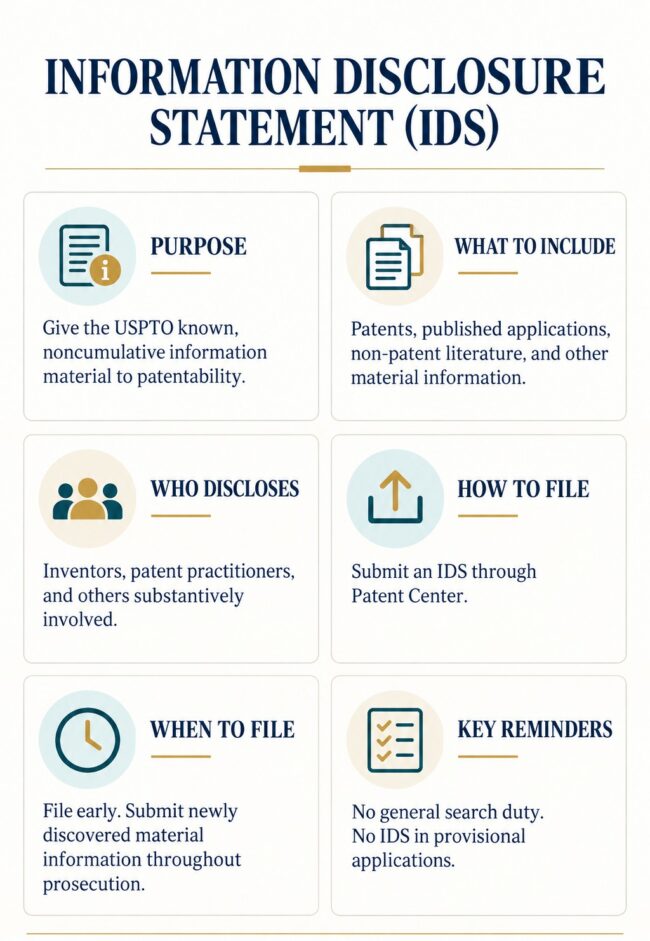
Patent applicants must disclose known, noncumulative information material to patentability when filing a non-provisional patent application. The information disclosure statement requirement applies to utility patent applications, design patent applications, and plant patent applications. However, IDSs are not submitted in provisional patent applications.
The IDS must include all known information that is material to patentability, even if the information undermines the claimed invention’s novelty or nonobviousness under 35 U.S.C. §§ 102 and 103, or contradicts patentability arguments made by the applicant or their patent attorney.
The duty of disclosure applies to inventors, patent attorneys, and other persons substantively involved in preparation or prosecution of the patent application who are associated with the applicant. Each of these persons has an ongoing duty of disclosure to the USPTO and any material prior art information they newly discover must be submitted in an updated information disclosure statement. There is no general duty to conduct a patent search prior to filing a patent application, and filing an information disclosure statement does not imply that a search occurred. See 37 C.F.R. § 1.56.
Submitting an information disclosure statement requires following the applicable provisions of 37 C.F.R. § 1.98. Each IDS must list all prior art information submitted for consideration, including all relevant patents, patent application publications, and non-patent literature. Prior art specifically includes the categories of U.S. Patents, U.S. Patent Application Publications, Foreign Patent Documents, and Non-Patent Literature (NPL), which may be any non-patent, public information that is relevant to the invention and has sufficiently detailed information to allow a person having ordinary skill in the art (PHOSITA) to understand that the NPL discloses some or all of the elements of the claimed invention.
The USPTO provides an IDS form (PTO/SB/08a) as a separate paper to be signed and submitted with the patent application specification, drawings, claims, abstract, and patent application forms, at the time of filing. See MPEP § 609.04(a). However, an information disclosure statement can be filed at any time during the patent examination process. Updated IDS forms should be submitted as anyone having a duty of disclosure for the patent application learns of additional material prior art.
The IDS form includes an IDS cover sheet where the eight-digit application number and filing date are entered to associate the information disclosure statement with the proper application, the prior art listing, and a certification and signature page. The prior art listing includes several segregated, categorized sections for different kinds of prior art citations, including US patents, US patent publications, foreign patent documents, and non-patent literature.
Each IDS must include a list of all relevant patents and publications. Under § 1.98(b), the IDS should properly identify:
Legible copies of each foreign patent document and non-patent literature must be provided with the information disclosure statement. U.S. patents and published U.S. applications do not need to be provided to the USPTO, as they are the USPTO's own publications. If two or more patent documents are substantively cumulative, identifying that duplication permits the applicant to provide a copy of only one of the cumulative references. See 37 C.F.R. § 1.98(c). In some cases, the applicant may be aware of an unpublished patent application that will become published prior art at some point. The applicant has the option to cite pending unpublished patent applications in an information disclosure statement to address the potential prior art issue of the unpublished patent application at an early point. However, it should be understood that the unpublished patent application does not qualify as prior art until it is published.
A cited pending application’s specification, claims, and drawings need not be copied when available in the image file wrapper.
If an IDS includes a non-English language document the applicant must provide a concise explanation of relevance unless a written English language translation is supplied. Oftentimes foreign language patent documents come to the attention of the patent applicant as a result of being cited in a foreign counterpart patent application being examined contemporaneously with a U.S. patent application. If a complete translation is not available, he explanation of relevance for the foreign language document may be supplied by an English international search report or foreign patent office search report in the counterpart foreign application. See 37 C.F.R. § 1.98(a)(3).
For an ordinary nonprovisional application, the initial submission avoids timing fees if filed within three months after filing or before mailing the first substantive office action, whichever is later. Thereafter, before a final office action, allowance, or other closure of prosecution, either a qualifying timing statement or fee is required; afterward, both ordinarily are required by issue-fee payment. The statement certifies compliance with three-month requirements governing first foreign citation or newly known information. Ordinary extensions of time are unavailable. 37 C.F.R. § 1.97(b)–(e).
If prior art that appears to be critical to patentability is discovered after a notice of allowance has been mailed and the issue fee has been paid, but before patent issuance, the applicant can submit the prior art through the Quick Path Information Disclosure Statement (QPIDS) process. QPIDS requires a petition to withdraw from issue, an IDS with a qualifying 37 C.F.R. § 1.97(e) timing statement, a conditional request for continued examination (RCE), and required fees. If information in the IDS necessitates reopening prosecution, the RCE is processed. Otherwise, the USPTO issues a corrected notice of allowability and refunds the RCE fee. It should be noted that QPIDS is only available for utility patent applications.
Every information disclosure statement requires a size-fee assertion stating that the appropriate fee accompanies the submission or that no fee is due. Size fees are separate from timing fees and apply when cumulative applicant-provided items across all IDS filings in the application exceed 50, 100, or 200, crediting previously paid size fees. The USPTO provides an explanation and guidance pamphlet on how the size fees are implemented.
For a subsequent application (e.g., a continuation application or divisional application) claiming an earlier filing date under 35 U.S.C. § 120, copies of previously cited information may be omitted if the prior application relied upon is identified properly and the information disclosure statement in that earlier application complies with 37 C.F.R. § 1.98(a)–(c). See 37 C.F.R. § 1.98(d).
Applicants submit application documents and information disclosure statements through the USPTO’s Patent Center electronic filing system. An IDS form should be carefully filled with the proper information in the form fields in order to promote proper treatment in the application record. Quality copies of the prior art documents should be submitted with the IDS form. Quality downloaded or scanned copies facilitate examination, allowing for optical character recognition of electronic downloaded or scanned documents.
Examiners evaluate information submitted in the information disclosure statement in the same manner as references in patent office search files. However, if the references are of low quality, the examiner may not consider the prior art reference. The applicant should check the examiner's consideration record for the prior art. If a prior art document's quality is too poor to allow for proper reading and analysis, the examiner will mark the prior art reference as unconsidered. The prior art reference may be resubmitted in a higher quality for consideration. Also, if a prior art reference was inadvertently omitted despite a bona fide attempt to submit it, the examiner may issue a form paragraph granting time to complete compliance pursuant to 37 C.F.R. § 1.97(f).
In U.S. patent applications, the documents cited in an information disclosure statement can guide examination and facilitate searching for additional relevant information. Any patent, patent application publication, or non-patent literature reference listed in the information disclosure statement may be used to support a rejection of the patent claims as anticipated if it discloses every limitation as claimed. See 35 U.S.C. § 102. The examiner may also combine the references cited in the information disclosure statement with other teachings to reject patent claims as obvious. See 35 U.S.C. § 103. However, filing an information disclosure statement also does not admit that the cited information is material to patentability. See MPEP § 609.06; 37 C.F.R. § 1.97(h). Moreover, consideration by the patent examiner does not mean that every reference supports a rejection.
All of the prior art cited in information disclosure statements submitted to the USPTO becomes part of the patent application record. All references cited in a compliant IDS form and considered by the examiner are included in the cited references section of the issued patent.
Submitting information disclosure statements in your patent application is critical to the strength and validity of your patent application. If the patent application file history (file wrapper) shows sparse disclosures of relevant prior art, your patent may be consequently challenged on multiple bases First, the prior art record of your patent application may be incomplete, and an opposing party may be able to find highly relevant prior art that was not considered by the patent examiner during the examination process. This will weaken the presumption of validity of the patent provided by 35 U.S.C. § 282. A court is much more likely to be convinced by a challenge to validity based on prior art that was not considered by the patent examiner than prior art that was considered.
Second, if it looks as though the applicant disclosed very little relevant prior art, an opposing party may pursue a defense of inequitable conduct by the applicant. Material nondisclosure with an intent to deceive the USPTO can make a patent unenforceable for inequitable conduct. However, Therasense, Inc. v. Becton, Dickinson & Co., 649 F.3d 1276 (Fed. Cir. 2011), generally requires but-for materiality (i.e., the claim would not have issued with disclosure) and specific intent to deceive, proven by clear and convincing evidence. An inadvertent omission alone is insufficient to result in a finding of inequitable conduct or unenforceability of the patent.
An Information Disclosure Statement helps ensure that the USPTO evaluates a claimed invention against known material information. Effective information disclosure statements identify the relevant art, provides quality copies of prior art references, and provides accurate application data, such that the prior receives proper treatment and consideration by the patent examiner. It is always recommended that you engage an experienced patent attorney to assist in the patent application process and that you communicate all potentially relevant prior art information to the patent attorney throughout the patent application process. Timely filing and confirmation of examiner consideration help avoid potential inequitable conduct claims and strengthen any patent that issues from the patent application. Although disclosure cannot guarantee validity, a complete examination record can reduce avoidable disputes and support more defensible patent protection. Treat the duty of disclosure and information disclosure statements as ongoing responsibilities within your patent process and strategy.
© 2026 Sierra IP Law, PC. The information provided herein does not constitute legal advice, but merely conveys general information that may be beneficial to the public, and should not be viewed as a substitute for legal consultation in a particular case.

"Mark and William are stellar in the capabilities, work ethic, character, knowledge, responsiveness, and quality of work. Hubby and I are incredibly grateful for them as they've done a phenomenal job working tirelessly over a time span of at least five years on a series of patents for hubby. Grateful that Fresno has such amazing patent attorneys! They're second to none and they never disappoint. Thank you, Mark, William, and your entire team!!"
Linda Guzman


Sierra IP Law, PC - Patents, Trademarks & Copyrights
FRESNO
7030 N. Fruit Ave.
Suite 110
Fresno, CA 93711
(559) 436-3800 | phone
BAKERSFIELD
1925 G. Street
Bakersfield, CA 93301
(661) 200-7724 | phone
SAN LUIS OBISPO
956 Walnut Street, 2nd Floor
San Luis Obispo, CA 93401
(805) 275-0943 | phone

SACRAMENTO
180 Promenade Circle, Suite 300
Sacramento, CA 95834
(916) 209-8525 | phone
MODESTO
1300 10th St., Suite F.
Modesto, CA 95345
(209) 286-0069 | phone
SANTA BARBARA
414 Olive Street
Santa Barbara, CA 93101
(805) 275-0943 | phone
SAN MATEO
1650 Borel Place, Suite 216
San Mateo, CA, CA 94402
(650) 398-1644. | phone
STOCKTON
110 N. San Joaquin St., 2nd Floor
Stockton, CA 95202
(209) 286-0069 | phone
PORTLAND
425 NW 10th Ave., Suite 200
Portland, OR 97209
(503) 343-9983 | phone
TACOMA
1201 Pacific Avenue, Suite 600
Tacoma, WA 98402
(253) 345-1545 | phone
KENNEWICK
1030 N Center Pkwy Suite N196
Kennewick, WA 99336
(509) 255-3442 | phone
2023 Sierra IP Law, PC - Patents, Trademarks & Copyrights - All Rights Reserved - Sitemap Privacy Lawyer Fresno, CA - Trademark Lawyer Modesto CA - Patent Lawyer Bakersfield, CA - Trademark Lawyer Bakersfield, CA - Patent Lawyer San Luis Obispo, CA - Trademark Lawyer San Luis Obispo, CA - Trademark Infringement Lawyer Tacoma WA - Internet Lawyer Bakersfield, CA - Trademark Lawyer Sacramento, CA - Patent Lawyer Sacramento, CA - Trademark Infringement Lawyer Sacrament CA - Patent Lawyer Tacoma WA - Intellectual Property Lawyer Tacoma WA - Trademark lawyer Tacoma WA - Portland Patent Attorney - Santa Barbara Patent Attorney - Santa Barbara Trademark Attorney
