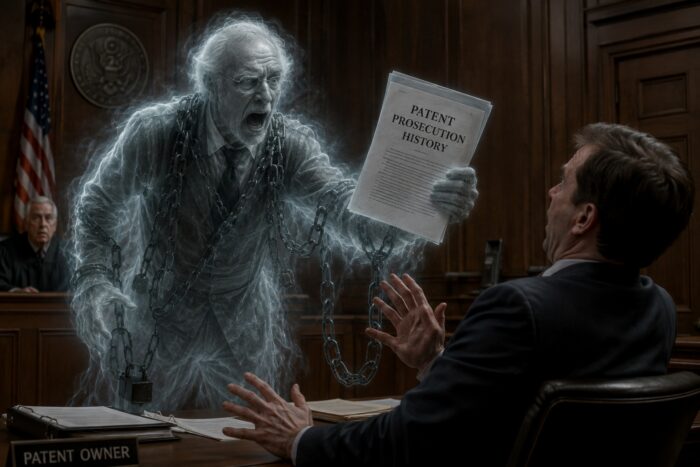
Patent claims are specialized formal descriptions of an invention that define the legal protection provided by the patent. However, the meaning of the words in the claims requires close evaluation of both the language of the claims, the detailed description of the invention provided in the specification of the application. During patent prosecution, which is the examination of a patent application by the United States Patent and Trademark Office (USPTO), an examiner may issue an office action rejecting the patent claims. The patent applicant has the opportunity to respond with statements or claim amendments. Those proceedings create the prosecution history, often called the file wrapper. In later patent litigation, that record can narrow the scope of the patent, making it easier to design around the patent claims.
This article provides a general overview to non-patent attorneys on how prosecution history estoppel is created during examination and how it affects the patent claims and the strength of the patent in later patent enforcement efforts.
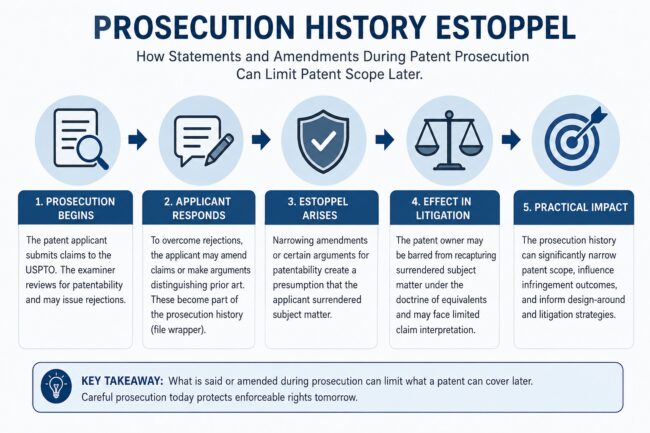
Prosecution history estoppel is a patent law doctrine that prevents a patentee from later reclaiming subject matter surrendered during prosecution to obtain a patent. The doctrine is rooted in fairness and public notice: if an applicant narrows or explains a claim to persuade the USPTO to allow it, competitors should be able to rely on that prosecution history when assessing the patent’s scope.
The doctrine most often limits the doctrine of equivalents, which can allow infringement even when an accused product avoids literal infringement. In Festo Corp. v. Shoketsu Kinzoku Kogyo Kabushiki Co., the Supreme Court addressed this balance directly. The patent owner had amended its claims during prosecution, and the accused infringer argued that the amendments barred the patent owner from asserting equivalents. 535 U.S. 722 (2002). The Court held that when an original claim is narrowed for reasons related to patentability, a presumption arises that the patentee surrendered the territory between the broader original claim and the narrower issued claim.
Importantly, Festo did not impose an absolute bar. Instead, the patentee may overcome the presumption by showing that the alleged equivalent was unforeseeable, that the reason for the narrowing amendment was only tangential to the equivalent, or that some other reason prevented the applicant from claiming it. Thus, a court may treat surrendered territory as outside the enforceable reach of the patent.
The USPTO examines patent applications by comparing the claims to the statutory requirements for patentability, including novelty, non-obviousness, written description, enablement, and definiteness. If the patent examiner determines that a claim is not allowable, the USPTO issues an office action explaining the reasons for rejection. The applicant then files a response and may amend the claims, and/or submit arguments that explain why the rejection is improper and the examiner's position is not supported by applicable patent law. See 35 U.S.C. §§ 131–132; 37 C.F.R. §§ 1.111, 1.121. This back-and-forth process is called patent prosecution with the USPTO. Because each claim amendment, argument, and explanation becomes part of the prosecution history, statements made to overcome a rejection may later affect the scope of the patent and enforcement of the patent.
Thus, the examination of a patent application creates a record of amendments and arguments that have a lasting effect on the strength and enforceability of the patent. Both the text of an issued patent and the underlying prosecution history must be analyzed to determine the precise meaning of the patent claims.
Amendments can create prosecution history estoppel during patent prosecution. A narrowing amendment made to overcome prior art rejections for anticipation under 35 U.S.C. § 102 or obviousness under 35 U.S.C. § 103, or another patentability problem, such as a lack of enablement or written description under 35 U.S.C. § 112, may surrender the difference between the original claim and the amended claim.
In Festo, the Supreme Court held that a narrowing amendment made to satisfy any Patent Act requirement may give rise to estoppel. Thus, amending claims in response to a rejection limits future claim interpretation and may prevent the patent owner from asserting a particular equivalent.
Argument-based prosecution history estoppel can arise without a formal claim amendment. When an applicant distinguishes prior art by arguing that the claimed invention lacks, requires, or operates differently with respect to a feature, those statements may surrender inconsistent interpretations later used to prove infringement under the doctrine of equivalents.
In Southwall Technologies, Inc. v. Cardinal IG Co., 54 F.3d 1570 (Fed. Cir. 1995), the Federal Circuit held that a patent owner cannot obtain allowance based on one interpretation and then enforce the patent using another. The court treated prosecution statements as limiting both claim construction and equivalents, and held that arguments about one claim can restrict other claims containing the same limitation. Thus, statements made to overcome an examiner’s rejection may narrow future enforcement even without amended claim language.
Claim construction is the process of determining the legal meaning and scope of the patent claims before deciding literal infringement. The judge, not the jury, performs claim construction, often through briefing by the parties and a Markman hearing. See Markman v. Westview Instruments, Inc., 517 U.S. 370 (1996). The court reviews the claim language, the specification, the prosecution history, and, when appropriate, extrinsic evidence such as technical dictionaries or expert testimony. See Phillips v. AWH Corp., 415 F.3d 1303 (Fed. Cir. 2005).
Claim construction is a preliminary step when determining literal infringement: after the court interprets the claims, the factfinder compares the construed claims to the accused product or process and asks whether every limitation is present.
Prosecution history estoppel factors into this analysis because statements and amendments made during prosecution limit what the patentee can later argue the claims cover. In Southwall Techs., Inc., the Federal Circuit noted that claims cannot be interpreted one way to secure allowance and another way against an accused infringer. Prosecution history estoppel limits equivalents after literal infringement fails, but the same prosecution statements can affect both analyses.
Challengers use prosecution history to identify concessions made by the patentee. The patent examination record will usually include assertions by the examiner that the original claims are anticipated, obvious, or unpatentable for some other reason. The record provides a guide for separate patent invalidity and non-infringement defenses. It may reveal close prior art, admissions about novelty and obviousness of the claims, and the differences between the claims and the prior art relied on to establish patentability and obtain allowance. See 35 U.S.C. § 282(b).
An opposing party will study the prosecution history thoroughly to determine the narrowing amendments and arguments that the patentee made during the examination process and use them to narrow the claims as much as possible during the claim construction process.
A district court determines the legal effect of the record, subject to Federal Circuit review on appeal.
The Supreme Court rejected an absolute bar but adopted a rebuttable, presumptive-bar approach. When prosecution history estoppel applies, the patentee is presumed to have surrendered all equivalents between the original and amended claims. This presumption is difficult to overcome. Under Warner-Jenkinson Co. v. Hilton Davis Chemical Co., an unexplained narrowing amendment is presumed to have been made for patentability. 520 U.S. 17 (1997).
Patent owners bear the burden to establish that the alleged equivalent was unforeseeable, that the amendment was only tangentially related to it, or that another reason prevented the applicant from claiming it. Festo, 535 U.S. at 740–41.
The Federal Circuit ruled that rewriting dependent claims into independent form, coupled with canceling the original independent claims, creates a presumption of estoppel. Honeywell International Inc. v. Hamilton Sundstrand Corp., 370 F.3d 1131, 1134 (Fed. Cir. 2004) (en banc).
In appropriate circumstances, prosecution history estoppel applies to related patents as well. A surrender tied to a common term or limitation can constrain a sibling or continuation claim. Courts describe this cross-patent effect as prosecution disclaimer. The application of prosecution history to related claims in other patents is not automatic. For example, when material wording differs between the claims in related patents, prosecution history estoppel may not apply. See Microsoft Corp. v. Multi-Tech Systems, Inc., 357 F.3d 1340 (Fed. Cir. 2004).
Foreign prosecution can also be relevant in limited circumstances. Caterpillar Tractor Co. v. Berco, S.p.A. considered statements from foreign proceedings while recognizing differences among jurisdictions. 714 F.2d 1110 (Fed. Cir. 1983).
Prosecution history estoppel varies across different jurisdictions. In China, Article 6 of the Supreme People’s Court’s Patent Judicial Interpretation II allows claim interpretation using prosecution files from the patent and related patents, particularly patents having a divisional relationship. Chinese courts can invoke prosecution history estoppel without a party’s argument.
Taiwan’s Patent Infringement Determination Guidelines also recognize file-wrapper estoppel for patentability-related amendments and responses. Taiwan ordinarily places the burden on the accused infringer to raise and prove it and generally does not use corresponding foreign files absent special circumstances. In that regard, Taiwan’s regulations and practices on prosecution history are less stringent than China’s. Businesses should not assume the same defense has the same scope in other jurisdictions.
For a patent applicant or patent holder, sound strategies include making only the amendment needed to overcome an office action, stating why it is limited, preserving meaningful other claims, and coordinating positions across related patents and jurisdictions. Administrative patent appeals under 35 U.S.C. § 134 should also be considered, rather than accepting an unnecessarily narrow claim.
For a company accused of infringement, the first step is to obtain and review the complete prosecution record, including related family files. Each amendment and response should be compared against the accused feature, the asserted claim, and any alleged particular equivalent. That review can reveal whether the patent applicant surrendered relevant claim scope, limited the meaning of a claim term, or distinguished prior art in a way that affects enforcement. In many cases, the prosecution history may support a strong claim-construction position, a doctrine-of-equivalents defense, or both.
Prosecution history estoppel can significantly affect the enforceable scope of a patent by turning statements and amendments made during prosecution into limits on later enforcement. Its effect depends on the claim scope surrendered, the reasons for the surrender, and how the relevant court applies the doctrine in litigation. For patent owners, applicants, and accused infringers, the file wrapper is therefore an important source of evidence for evaluating patent scope, potential design-around decisions, and litigation strategy. Reviewing the prosecution history early can help clarify the practical strength of a patent and identify issues that may affect claim construction, patent infringement analysis, and the doctrine of equivalents.
© 2026 Sierra IP Law, PC. The information provided herein does not constitute legal advice, but merely conveys general information that may be beneficial to the public, and should not be viewed as a substitute for legal consultation in a particular case.

"Mark and William are stellar in the capabilities, work ethic, character, knowledge, responsiveness, and quality of work. Hubby and I are incredibly grateful for them as they've done a phenomenal job working tirelessly over a time span of at least five years on a series of patents for hubby. Grateful that Fresno has such amazing patent attorneys! They're second to none and they never disappoint. Thank you, Mark, William, and your entire team!!"
Linda Guzman


Sierra IP Law, PC - Patents, Trademarks & Copyrights
FRESNO
7030 N. Fruit Ave.
Suite 110
Fresno, CA 93711
(559) 436-3800 | phone
BAKERSFIELD
1925 G. Street
Bakersfield, CA 93301
(661) 200-7724 | phone
SAN LUIS OBISPO
956 Walnut Street, 2nd Floor
San Luis Obispo, CA 93401
(805) 275-0943 | phone

SACRAMENTO
180 Promenade Circle, Suite 300
Sacramento, CA 95834
(916) 209-8525 | phone
MODESTO
1300 10th St., Suite F.
Modesto, CA 95345
(209) 286-0069 | phone
SANTA BARBARA
414 Olive Street
Santa Barbara, CA 93101
(805) 275-0943 | phone
SAN MATEO
1650 Borel Place, Suite 216
San Mateo, CA, CA 94402
(650) 398-1644. | phone
STOCKTON
110 N. San Joaquin St., 2nd Floor
Stockton, CA 95202
(209) 286-0069 | phone
PORTLAND
425 NW 10th Ave., Suite 200
Portland, OR 97209
(503) 343-9983 | phone
TACOMA
1201 Pacific Avenue, Suite 600
Tacoma, WA 98402
(253) 345-1545 | phone
KENNEWICK
1030 N Center Pkwy Suite N196
Kennewick, WA 99336
(509) 255-3442 | phone
2023 Sierra IP Law, PC - Patents, Trademarks & Copyrights - All Rights Reserved - Sitemap Privacy Lawyer Fresno, CA - Trademark Lawyer Modesto CA - Patent Lawyer Bakersfield, CA - Trademark Lawyer Bakersfield, CA - Patent Lawyer San Luis Obispo, CA - Trademark Lawyer San Luis Obispo, CA - Trademark Infringement Lawyer Tacoma WA - Internet Lawyer Bakersfield, CA - Trademark Lawyer Sacramento, CA - Patent Lawyer Sacramento, CA - Trademark Infringement Lawyer Sacrament CA - Patent Lawyer Tacoma WA - Intellectual Property Lawyer Tacoma WA - Trademark lawyer Tacoma WA - Portland Patent Attorney - Santa Barbara Patent Attorney - Santa Barbara Trademark Attorney
