
The differences in a service mark vs a trademark is simple: a trademark is a source identifier for goods, and a service mark is a source identifier for services. Some companies offer goods (e.g., Nike offers shoes and sports goods), some companies offer services (e.g., Bank of America offers banking services), and some companies offer both (e.g., car dealerships offer both vehicles and vehicle maintenance services). Regardless of the offerings, trademarks and service marks both function to prevent others from using a business’s name, logo, slogan, phrase, sound, shape, design, or other branding elements in ways that create confusion among consumers.
A service mark identifies and distinguishes the source of services rather than goods. In a service mark vs trademark comparison, the key difference is that a trademark generally protects a brand connected with a product, while a service mark protects a brand connected with activities performed for customers. For example, a company may use a service mark for retail services, airline services, consulting services, financial services, repair services, or software-as-a-service. Unlike a trademark that may appear on a product, label, or packaging, a service mark is often used in advertising, on a website, on business cards, in brochures, or in other materials showing a connection between the mark and the services offered.
Service mark protection helps prevent competitors from using a confusingly similar name, logo, slogan, phrase, symbol, design, or combination thereof for related services. A service mark offers legal protection by helping consumers identify the company responsible for the services and by protecting the goodwill associated with that brand. Under federal trademark law, the term “mark” can refer to both trademarks and service marks, including words, names, symbols, devices, or any combination used to identify and distinguish a source. See 15 U.S.C. § 1127.
A trademark identifies the source of goods, meaning it helps consumers determine which company made, sold, or stands behind a particular product in the marketplace. Under trademark law, a trademark may be a word, name, symbol, device, logo, phrase, sound, shape, color, design, or any combination thereof used to identify and distinguish goods from those offered by competitors. For example, Coca- Cola functions as a trademark for soft drinks because consumers associate the mark with a specific brand and expected level of quality. A trademark can appear directly on a product, on a box, label, tag, website listing, or product packaging. Trademark rights can arise through use in commerce, but federal trademark registration with the U.S. Patent and Trademark Office provides stronger legal protection, including a presumption of ownership and nationwide rights.
The practical difference in a service mark vs trademark analysis is the nature of what the company provides to customers. A trademark identifies and distinguishes the source of tangible goods or a particular product that a business makes, sells, or distributes in the marketplace. For example, a company name, brand name, logo, phrase, symbol, or combination thereof may function as a trademark when it appears on a product, product label, tag, box, container, or packaging. By contrast, a service mark identifies and distinguishes the source of services, such as retail services, consulting services, restaurant services, financial services, or airline services.
This distinction affects how the mark is used and how the registration application should describe the business activity. Trademarks typically appear directly on the product or packaging, while service marks usually appear in advertisements, websites, brochures, business cards, invoices, signage, or other materials showing a connection between the mark and the services offered. In practice, many companies use the same brand as both a trademark and a service mark, but the USPTO still requires the application to accurately identify the goods, services, or both. Correct classification helps avoid delays, refusals, and confusion during examination. See 37 C.F.R. § 2.56.
Although business owners may casually refer to “service marks trademarks” as separate categories, federal trademark law gives them the same legal protection once registered. The Lanham Act provides that service marks are registrable “in the same manner and with the same effect” as trademarks, meaning a registered service mark receives the same federal benefits as a registered mark used for goods. See 15 U.S.C. § 1053. In practice, this means the owner of a registered service mark may rely on the same statutory presumptions, enforcement remedies, and nationwide priority principles available to the owner of a registered trademark.
The key distinction between a trademark and a service mark is not the strength of the protection, but the nature of the offering identified by the mark. A trademark identifies the source of goods, while a service mark identifies the source of services. Once registration is obtained, both protect the commercial identity of the business and help prevent consumer confusion in the marketplace. Courts evaluate both trademarks and service marks using the same core principles, including whether the mark identifies a single source and whether another party’s use of a similar mark is likely to cause confusion among consumers.
Service marks and trademarks are enforced under the same Lanham Act provisions, including 15 U.S.C. § 1114 for trademark infringement of a federally registered mark and 15 U.S.C. § 1125(a) for false designation of origin or unfair competition. In a service mark dispute, the key issue is whether the defendant’s use of a similar mark in connection with services is likely to cause consumers to believe that the services come from, are sponsored by, or are affiliated with the service mark owner. For example, in Park ’N Fly, Inc. v. Dollar Park & Fly, Inc., 469 U.S. 189 (1985), the dispute involved directly overlapping services: both parties used similar names in connection with airport parking services for air travelers. The plaintiff owned the federally registered service mark PARK ’N FLY for its airport parking business, while the defendant operated an airport parking lot under the name Dollar Park & Fly. That overlap mattered because likelihood of confusion is strongest when similar marks are used for the same or closely related services, especially where the same types of customers encounter the marks in the same commercial context.
In Two Pesos, Inc. v. Taco Cabana, Inc., 505 U.S. 763 (1992), Taco Cabana operated Mexican fast-food restaurants with a distinctive overall presentation. Taco Cabana offered its restaurant services in connection with signage, interior layout, décor, menu, serving equipment, uniforms, colors, awnings, umbrellas, and related visual features (i.e., its trade dress) that were themed, distinctive, and unique to Taco Cabana. Two Pesos opened competing Mexican restaurants using a similar overall décor and motif in the same market, and the jury found that the similarity created a likelihood of confusion among ordinary customers as to the source or association of the restaurants’ services. Taco Cabana's trade dress was distinctive and found to be associated with its restaurant services in the mind of the consumer. The competitor’s use of similar décor and theme in connection with overlapping services resulted in a trade dress infringement.
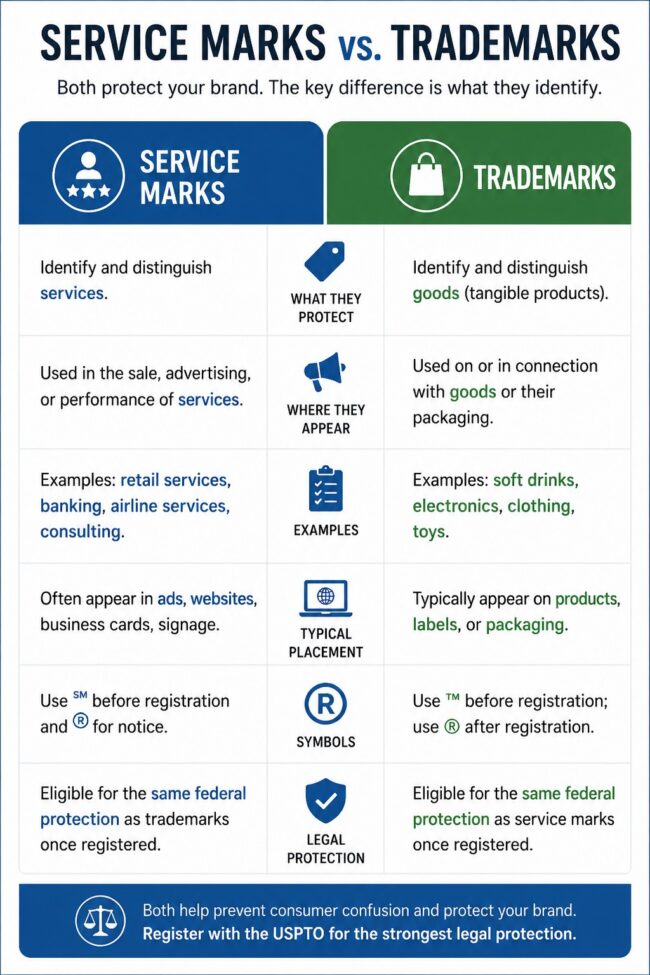
Before official registration, the ™ symbol can be used with a trademark and the ℠ symbol can be used for a service mark in connection with offered goods or services. The ™ symbol and ℠ symbol are used to put consumers and the public generally on notice that the word, phrase, logo, or other mark paired with the symbol is a mark that identifies the source of the goods or services. Once a trademark or service mark is registered with the USPTO, the ® symbol should be used. The ® symbol can be lawfully used only after the USPTO has approved federal registration.
Marking is important because it gives customers, competitors, and the marketplace notice that the business is claiming rights in the brand. Proper use of ™, ℠, or ® can help distinguish the company’s goods or services and support enforcement efforts, although the symbol alone does not complete the registration process or create all federal rights.
Federal trademark registration through the U.S. Patent and Trademark Office (USPTO) gives a service mark owner important advantages beyond ordinary common law rights. A federal registration provides public notice of the registrant’s ownership claim, a legal presumption that the registered mark is valid, that the owner owns the mark, and that the owner has the exclusive right to use the mark nationwide in connection with the registered goods or services under 15 U.S.C. § 1057(b). These benefits can make enforcement easier if competitors adopt a similar mark that may cause consumer confusion. Registration also creates a public record that can discourage later applicants, support refusal of confusingly similar service mark applications, and strengthen a company’s position in licensing, sale, investment, or expansion. For service marks and trademarks, federal trademark registration helps protect brand reputation and gives customers a clearer way to identify the source of the company’s products or services.
The service mark registration and trademark registration process is virtually identical. A complete application filed with the USPTO must identify the applicant, the mark, the goods or services, the filing basis, and a proper specimen of use showing how the mark is used in commerce. A use-in-commerce basis may apply when the business is already using the trademark or service mark with customers, while an intent-to-use basis may apply when the company has a bona fide intent to begin using the mark under 15 U.S.C. § 1051. For goods, the specimen may show the mark on a product, label, or packaging. For services, it may show the service mark in advertising, a website, or business materials connected to the services. It is crucial to correctly identify your trademark or service mark and avoid checking the wrong box, because a mismatch can cause delay or rejection.
Before you register, you should conduct a trademark search and vetting process. This research should include USPTO records, state trademark registrations, marketplace use, business names, domain names, social media handles, and secretary of state filings to determine whether another business has already filed for or established rights in a similar mark. The search should go beyond exact matches, because trademark conflict can arise from marks that are similar in sound, appearance, meaning, or commercial impression, especially when used for related goods or services. A company may have common law rights from actual use in commerce even without registration, so marketplace evidence can be just as important as trademark office records. Careful searching helps assess confusion risk, identify competitors, refine the application, and avoid investing in a brand that may need to be changed later.
After an application is filed, USPTO processing can take up to 12 months or more, and full registration often takes 12–18 months depending on the nature of the application, whether the trademark office issues an Office Action, and whether the applicant must submit additional evidence or amendments. Once approved and registered, a company can begin using the ® symbol to show federal legal protection for the registered mark. Trademark rights can last indefinitely if the mark remains actively used in commerce and the owner regularly files the required maintenance and trademark renewal documents under 15 U.S.C. §§ 1058, 1059. Companies that sell goods and provide services may need both a trademark and service mark to protect their brand assets effectively. For example, a company may register a trademark for a particular product sold in a box, while also owning a service mark for related installation, repair, retail services, or customer support services.
Trademarks and service marks help businesses build reputation and brand that signal that they are the source of products or services. A trademark generally applies to goods, such as a product name, logo, or slogan appearing on packaging, while a service mark applies to services, such as retail, financial, airline, consulting, or repair services promoted through advertising, websites, signage, or business materials. Although the distinction matters when preparing a USPTO application and submitting proper specimens, both types of marks receive federal protection once properly registered. Registration can provide public notice, presumptions of ownership and validity, and stronger enforcement tools against confusingly similar uses.
If you need assistance with protecting your service mark or other intellectual property law matters, please contact our law firm for a consultation with one of our experienced trademark attorneys. We are experienced intellectual property attorneys in the trademark field.
© 2026 Sierra IP Law, PC. The information provided herein does not constitute legal advice, but merely conveys general information that may be beneficial to the public, and should not be viewed as a substitute for legal consultation in a particular case.

"Mark and William are stellar in the capabilities, work ethic, character, knowledge, responsiveness, and quality of work. Hubby and I are incredibly grateful for them as they've done a phenomenal job working tirelessly over a time span of at least five years on a series of patents for hubby. Grateful that Fresno has such amazing patent attorneys! They're second to none and they never disappoint. Thank you, Mark, William, and your entire team!!"
Linda Guzman


Sierra IP Law, PC - Patents, Trademarks & Copyrights
FRESNO
7030 N. Fruit Ave.
Suite 110
Fresno, CA 93711
(559) 436-3800 | phone
BAKERSFIELD
1925 G. Street
Bakersfield, CA 93301
(661) 200-7724 | phone
SAN LUIS OBISPO
956 Walnut Street, 2nd Floor
San Luis Obispo, CA 93401
(805) 275-0943 | phone

SACRAMENTO
180 Promenade Circle, Suite 300
Sacramento, CA 95834
(916) 209-8525 | phone
MODESTO
1300 10th St., Suite F.
Modesto, CA 95345
(209) 286-0069 | phone
SANTA BARBARA
414 Olive Street
Santa Barbara, CA 93101
(805) 275-0943 | phone
SAN MATEO
1650 Borel Place, Suite 216
San Mateo, CA, CA 94402
(650) 398-1644. | phone
STOCKTON
110 N. San Joaquin St., 2nd Floor
Stockton, CA 95202
(209) 286-0069 | phone
PORTLAND
425 NW 10th Ave., Suite 200
Portland, OR 97209
(503) 343-9983 | phone
TACOMA
1201 Pacific Avenue, Suite 600
Tacoma, WA 98402
(253) 345-1545 | phone
KENNEWICK
1030 N Center Pkwy Suite N196
Kennewick, WA 99336
(509) 255-3442 | phone
2023 Sierra IP Law, PC - Patents, Trademarks & Copyrights - All Rights Reserved - Sitemap Privacy Lawyer Fresno, CA - Trademark Lawyer Modesto CA - Patent Lawyer Bakersfield, CA - Trademark Lawyer Bakersfield, CA - Patent Lawyer San Luis Obispo, CA - Trademark Lawyer San Luis Obispo, CA - Trademark Infringement Lawyer Tacoma WA - Internet Lawyer Bakersfield, CA - Trademark Lawyer Sacramento, CA - Patent Lawyer Sacramento, CA - Trademark Infringement Lawyer Sacrament CA - Patent Lawyer Tacoma WA - Intellectual Property Lawyer Tacoma WA - Trademark lawyer Tacoma WA - Portland Patent Attorney - Santa Barbara Patent Attorney - Santa Barbara Trademark Attorney
