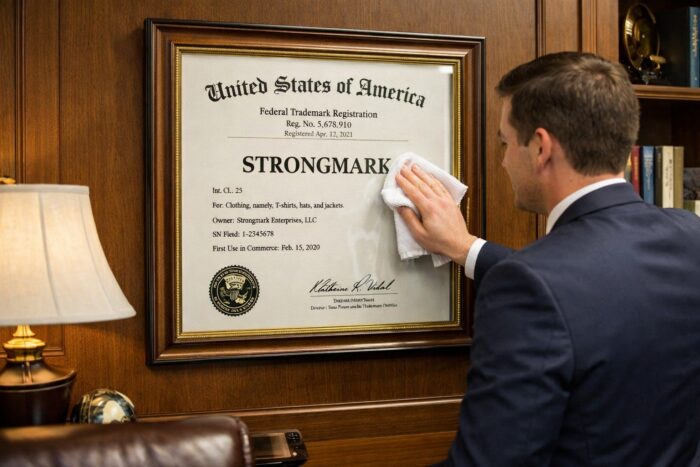
A proper, valid trademark or service mark must identify and distinguish your goods or services, be used in commerce, and be distinctive, allowing it to function as a source identifier. The purpose of a trademark is to provide a reliable indicator to a consumer that the product comes from a certain source and carries certain quality and characteristics associated with the source. Thus, a trademark can only be valid if it is being used in the marketplace in a manner that associates it with particular goods or services and the particular source of the goods or services. These are the basic requirements for establishing and maintaining trademark validity. Below we explore the specifics of valid trademarks and good trademark practice.
A mark is valid only if it can distinguish one seller’s goods or services from another’s. Trademark law evaluates this ability through a concept called distinctiveness, which determines whether a trademark can function as a source identifier. Inherently distinctive marks, such as fanciful, arbitrary, and suggestive marks, are the strongest and usually have the best chance of receiving federal registration. Below is a discussion of these different types of trademarks.
A fanciful mark is a completely invented word with no prior meaning, such as KODAK for cameras. Because the term has no dictionary meaning before its use as a brand, it immediately identifies the source of the goods or services.
An arbitrary mark uses a real word in an unrelated context, such as APPLE for computers. Although the word exists in ordinary language, it has no logical relationship to the product, making it highly distinctive.
A suggestive mark falls in the middle. It hints at qualities or characteristics of the product but requires some imagination to understand the connection. For example, COPPERTONE for sunscreen suggests a bronzed skin tone without directly describing the product. Suggestive marks are still considered inherently distinctive and typically qualify for trademark protection and federal trademark registration without proof of acquired distinctiveness.
By contrast, a descriptive mark directly describes a feature, quality, or characteristic of the goods or services, such as CREAMY for yogurt or FAST PRINT for printing services. Descriptive marks do not provide strong trademark protection and are not registerable with the United States Patent and Trademark Office on the Principal Register. See 15 U.S.C. § 1052(e). They can be registered on the Supplemental Trademark Register, which is different than the Principal Register and does not provide the same benefits. It should be noted that descriptive marks can acquire secondary meaning and become distinctive based on extensive use that creates an association of the mark with the goods in the mind of the consumer. If a descriptive trademark acquires secondary meaning, meaning consumers have come to associate the term with a particular business rather than the product itself, the trademark protection becomes stronger and the descriptive mark may be registered on the Principal Register under 15 U.S.C. § 1052(f).
Unlike the foregoing categories, generic terms, such as “computer” for computers, can never function as a trademark or provide any trademark protection. Understanding these distinctions is important because choosing a more unique mark significantly increases the likelihood of obtaining and maintaining a valid federal registration.
If a similar mark on similar goods or services was in use before you begin using your trademark, then your trademark may have limited value as a trademark. The earlier user will have better rights than you do, and may pursue trademark infringement claims against you. This can happen even if the prior user does not have a trademark registration. Moreover, the prior user may be able to enjoin you (prevent you from using) your trademark if they are successful in a trademark lawsuit.
Confusingly similar marks are also highly relevant in the trademark registration process. The USPTO closely examines every trademark application to determine whether the proposed mark is likely to cause confusion with an existing registered mark or an earlier filed application for a similar mark. This evaluation is required under Section 2(d) of the Lanham Act, which prohibits registration of a mark that is likely to cause confusion, mistake, or deception with a previously registered mark under 15 U.S.C. § 1052(d).
Importantly, the analysis does not ask whether two marks are identical. Instead, the question is whether the particular mark is so close to a confusingly similar mark that consumers would mistakenly believe the goods or services come from the same source. The USPTO compares marks based on their similarity in sound, appearance, meaning, and overall commercial impression. Small differences may not be enough to avoid confusion, if the marks create a similar overall impression in the marketplace.
Another critical factor is the relationship between the goods or services offered under each mark. Marks that are somewhat different may be refused registration, if they are used for closely related products or services that consumers would reasonably expect to come from the same business.
The USPTO evaluates these issues using a multi-factor test known as the DuPont factors, which examine the similarity of the marks, the relationship of the goods or services, trade channels, consumer sophistication, and other marketplace considerations. In re E.I. du Pont de Nemours & Co., 476 F.2d 1357 (C.C.P.A. 1973).
Because likelihood of confusion is one of the most common reasons a trademark application is refused, businesses should conduct careful trademark clearance searches before filing for trademark registration.
Trademark law does not protect a product feature that is functional. This comes into play in the context of trade dress, which can be product features, product packaging, store decorations, and other "look and feel" features that are used in branding. For instance, the contoured design of a Coca-Cola bottle is a form of trade dress that acts as a source identifier.
However, under U.S. trademark law, a feature is functional if it is an essential part of the product’s use or purpose, or if it affects the product’s cost or quality. When a feature is functional, it cannot serve as a valid trademark, even if consumers associate the feature with a particular owner or brand. The rule exists to prevent businesses from using trademark protection as a way to obtain perpetual rights over useful product features that should instead fall under patent law, which has limited terms. See 15 U.S.C. § 1052(e)(5).
For example, suppose Company A sells portable roadside signs supported by a dual-spring mechanism that allows the sign to bend in strong winds and then return upright. Because the spring design performs a mechanical function essential to the product’s operation, the company cannot claim exclusive rights to that feature as a registered trademark, even if drivers recognize signs with that spring configuration as coming from Company A. This was the scenario in TrafFix Devices, Inc. v. Marketing Displays, Inc., 532 U.S. 23 (2001). Marketing Displays had previously held a utility patent covering the dual-spring mechanism used in temporary road signs. After the patent expired, TrafFix began selling a competing sign stand using a similar dual-spring structure. Marketing Displays argued that the spring configuration functioned as a protectable trademark identifying the source of the product.
In rejecting Marketing Displays' arguments, the Supreme Court explained that a product feature is functional, and therefore not eligible for trademark protection, if it is essential to the use or purpose of the article or affects the article’s cost or quality. The dual-spring design allowed roadside signs to remain stable in windy conditions and quickly return upright, making it a useful mechanical feature rather than a source identifier. The Court also emphasized that the existence of a prior utility patent strongly indicates that the claimed feature is functional. Allowing trademark rights in such a feature after the patent expires would improperly extend the patent monopoly beyond its statutory term. As a result, the Court held that the dual-spring mechanism was functional and could not serve as protectable trade dress or a valid federal trademark registration for the trade dress.
The key question is whether protecting the particular mark would place competitors at a disadvantage unrelated to brand identification. If the feature provides a practical advantage in commerce, it must remain available for others to use, and therefore cannot qualify for trademark registration.
A business can rely on common law trademark rights, pursue state trademark registration, or seek federal trademark registration. But federal registration offers broader legal protection. A Principal Register registration provides the benefits of a presumption of validity and ownership, and the registrant’s exclusive right to use the mark in commerce for the identified goods or services. By contrast, common law rights are based on actual use in a particular geographic area.
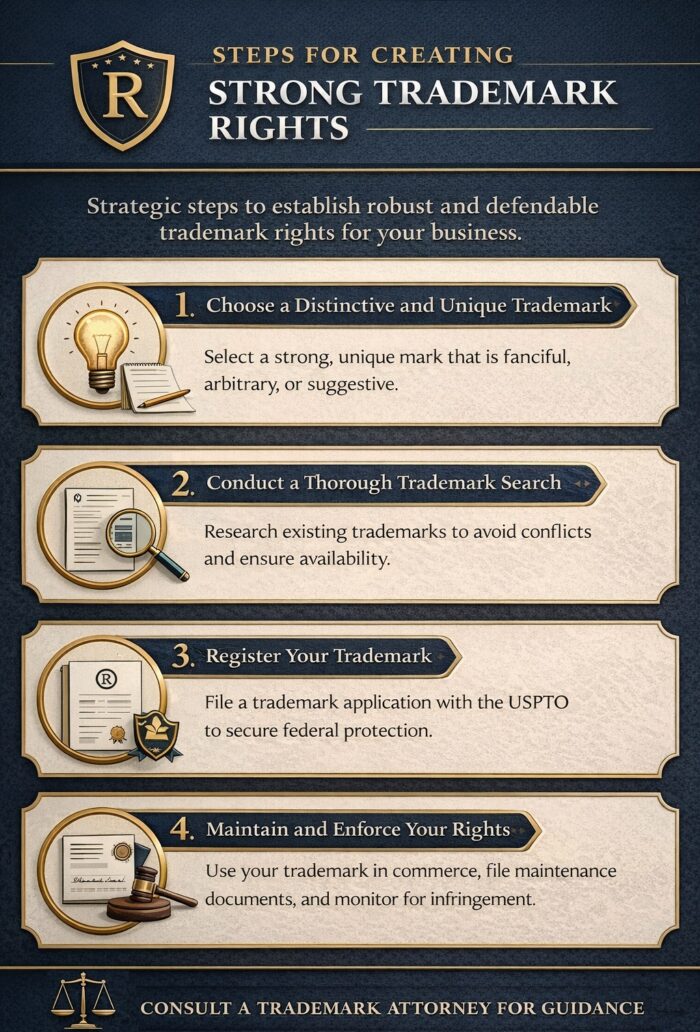
You must continuously use your trademark in commerce to maintain your trademark registration. Use in commerce means the bona fide commercial use of a mark in the ordinary course of trade under 15 U.S.C. § 1127, not token use designed merely to reserve rights. In practical terms, the trademark owner must actually use the particular mark on or in connection with the goods or services listed in the registration while selling or advertising those goods or services in interstate commerce. For goods, the mark must typically appear on the product, packaging, or labels and the goods must be sold or transported in commerce. For services, the mark must be used in advertising or promotional materials and the services must actually be rendered in commerce. See Couture v. Playdom, Inc., 778 F.3d 1379 (Fed. Cir. 2015).
This requirement reflects the fundamental principle of U.S. trademark law: rights arise from use, not simply from registration. To maintain a trademark registration, the owner must periodically provide proof of continued use. That proof typically includes a signed declaration and a specimen of use showing proper use of the mark with the relevant goods or services, submitted as part of the required maintenance filings under 15 U.S.C. § 1058; 37 C.F.R. § 2.161.
Equally important is the concept of continuous use. If a trademark owner stops using a mark in commerce for an extended period, the law may treat the mark as abandoned. Under the Lanham Act, nonuse for three consecutive years constitutes prima facie evidence of abandonment under 15 U.S.C. § 1127. Continuous, ongoing use helps ensure that the mark continues to function as a source identifier and preserves the owner’s trademark rights over time. For this reason, keeping meticulous records of ongoing commercial use, such as marketing materials, product packaging, invoices, and website screenshots, is one of the most important practical steps in the trademark maintenance process.
Between the fifth and sixth year after the trademark registration date, the owner must file a Section 8 Affidavit or Declaration confirming that the mark is still in use in commerce or that special circumstances excuse nonuse under 15 U.S.C. § 1058; 37 C.F.R. § 2.160. The filing must identify the relevant goods or services and include proof of current use showing proper use of the mark in commerce under 15 U.S.C. § 1058; 37 C.F.R. § 2.161.
At the same stage, if the mark has been in continuous use for five consecutive years on the Principal Register, the trademark owner may file a Declaration of Incontestability under 15 U.S.C. § 1065; 37 C.F.R. § 2.167. When the owner claims incontestable rights, the registration gains stronger evidentiary force because an incontestable federal trademark registration is generally conclusive evidence of the validity of the registered mark, the ownership of the mark, and the registrant’s exclusive right to use the mark in commerce for the goods or services listed in the registration under 15 U.S.C. § 1115(b).
As the Supreme Court explained in Park ’N Fly, Inc. v. Dollar Park & Fly, Inc., 469 U.S. 189 (1985), an incontestable registered trademark generally cannot later be attacked as merely descriptive once the statutory requirements for incontestable rights have been satisfied.
In the ninth and tenth year after registration, and every ten years after that, the trademark owner must file the combined Section 8 and Section 9 renewal filing with the required fees and any applicable renewal fees to keep the registration alive. See 15 U.S.C. §§ 1058(a), 1059(a). A U.S. federal trademark registration has an initial validity period of ten years from the date of registration, but it can be renewed indefinitely at regular intervals as long as the owner maintains use in commerce and makes timely filing of the required trademark maintenance documents. There is a six-month grace period after each trademark renewal deadline during which the owner may still renew the trademark registration, but an additional fee applies if the filing occurs during that grace period. See 37 C.F.R. §§ 2.160(a), 2.183(b). There are no open-ended additional periods. If the trademark owner fails to file the required maintenance documents and fees within the statutory deadlines and the six-month grace period, the registration will be canceled or deemed expired, and the federal registration will no longer remain in force.
Trademark maintenance is not just about meeting deadlines. It is also about diligence in the use of and record keeping for the trademark. The USPTO expressly instructs trademark owners not to maintain a registration for goods or services that are no longer in use (see USPTO, “Keeping your registration alive” guidance). You must also avoid filing certain documents with outdated or inaccurate claims. If the specimen submitted with a trademark maintenance filing does not show proper use of the mark in commerce, the filing may be refused and the registration will be canceled under 37 C.F.R. § 2.161. In addition, intentional misstatements about use in commerce or ownership can create fraud issues that may invalidate registered trademarks, as recognized by the Federal Circuit in In re Bose Corp., 580 F.3d 1240 (Fed. Cir. 2009).
Missing the above deadlines can have serious consequences for trademark validity. If a trademark owner fails to file the required maintenance documents before the applicable deadline, the federal trademark registration may be canceled or will expire under the Lanham Act, meaning the registration will be canceled or the registration will be treated as deemed expired, under 15 U.S.C. §§ 1058(a), 1059(a). If the owner misses both the regular deadline and the six-month grace period, the registration generally cannot be reinstated, and the federal registration will no longer provide the statutory presumptions of validity, ownership, and the exclusive right to use the mark in commerce. See 15 U.S.C. § 1115(a). When that happens, the business may still retain limited trademark rights through commercial use, but those common-law rights are typically confined to the geographic area where the trademark in commerce is actually used, making trademark enforcement against infringement significantly more difficult.
The same principle applies to an international registration designating the United States under the Madrid Protocol. The Madrid system allows a trademark owner to seek protection for a particular mark in multiple countries through a single international filing administered by the World Intellectual Property Organization. However, once the United States is designated through the Madrid Protocol, the resulting protection functions like a U.S. federal trademark registration and must satisfy the same trademark maintenance rules. Under Section 71 of the Lanham Act, the owner must file a declaration of continued use, similar to a Section 8 filing, between the fifth and sixth year, again between the ninth and tenth year, and every ten years thereafter to keep the U.S. extension of protection active. See 15 U.S.C. § 1141k(a); 37 C.F.R. § 2.164. These filings must provide proof of ongoing use of the mark in U.S. commerce for the goods or services listed, along with the required fees. If the owner fails to make the required filing, the U.S. extension of protection will be canceled even if the underlying international registration remains active. See 15 U.S.C. § 1141k(b).
It is also important to remember that maintenance payments and filings in each jurisdiction have to be independently handled. For example, a European Union trademark registration is administered by the European Union Intellectual Property Office (EUIPO), which has its own maintenance process, renewal requirements, and renewal fees. If you have registrations in both the U.S. and the E.U., you must meet all of the EUIPO and USPTO deadlines for trademark renewals to keep the registrations alive.
Maintaining your trademarks is an ongoing diligence issue. The best way to establish valid trademark rights is to choose a distinctive and unique brand, adopt and use the mark on your goods and services in commerce in a continuous manner, register the trademark with the USPTO, and diligently file maintenance and renewal documents in a timely manner. Following these steps you can establish strong trademark rights, preserve federal trademark benefits, and protect your branding and reputation.
Because trademarks and trademark registrations involve precise legal requirements, formal documentation, declarations under penalty of perjury, and a long term maintenance schedule, many owners sensibly use experienced trademark attorneys to help select their trademarks, pursue registrations, and maintain their registrations. If you need assistance with your trademarks or other intellectual property matters, contact our office for a consultation.
© 2026 Sierra IP Law, PC. The information provided herein does not constitute legal advice, but merely conveys general information that may be beneficial to the public, and should not be viewed as a substitute for legal consultation in a particular case.

"Mark and William are stellar in the capabilities, work ethic, character, knowledge, responsiveness, and quality of work. Hubby and I are incredibly grateful for them as they've done a phenomenal job working tirelessly over a time span of at least five years on a series of patents for hubby. Grateful that Fresno has such amazing patent attorneys! They're second to none and they never disappoint. Thank you, Mark, William, and your entire team!!"
Linda Guzman


Sierra IP Law, PC - Patents, Trademarks & Copyrights
FRESNO
7030 N. Fruit Ave.
Suite 110
Fresno, CA 93711
(559) 436-3800 | phone
BAKERSFIELD
1925 G. Street
Bakersfield, CA 93301
(661) 200-7724 | phone
SAN LUIS OBISPO
956 Walnut Street, 2nd Floor
San Luis Obispo, CA 93401
(805) 275-0943 | phone

SACRAMENTO
180 Promenade Circle, Suite 300
Sacramento, CA 95834
(916) 209-8525 | phone
MODESTO
1300 10th St., Suite F.
Modesto, CA 95345
(209) 286-0069 | phone
SANTA BARBARA
414 Olive Street
Santa Barbara, CA 93101
(805) 275-0943 | phone
SAN MATEO
1650 Borel Place, Suite 216
San Mateo, CA, CA 94402
(650) 398-1644. | phone
STOCKTON
110 N. San Joaquin St., 2nd Floor
Stockton, CA 95202
(209) 286-0069 | phone
PORTLAND
425 NW 10th Ave., Suite 200
Portland, OR 97209
(503) 343-9983 | phone
TACOMA
1201 Pacific Avenue, Suite 600
Tacoma, WA 98402
(253) 345-1545 | phone
KENNEWICK
1030 N Center Pkwy Suite N196
Kennewick, WA 99336
(509) 255-3442 | phone
2023 Sierra IP Law, PC - Patents, Trademarks & Copyrights - All Rights Reserved - Sitemap Privacy Lawyer Fresno, CA - Trademark Lawyer Modesto CA - Patent Lawyer Bakersfield, CA - Trademark Lawyer Bakersfield, CA - Patent Lawyer San Luis Obispo, CA - Trademark Lawyer San Luis Obispo, CA - Trademark Infringement Lawyer Tacoma WA - Internet Lawyer Bakersfield, CA - Trademark Lawyer Sacramento, CA - Patent Lawyer Sacramento, CA - Trademark Infringement Lawyer Sacrament CA - Patent Lawyer Tacoma WA - Intellectual Property Lawyer Tacoma WA - Trademark lawyer Tacoma WA - Portland Patent Attorney - Santa Barbara Patent Attorney - Santa Barbara Trademark Attorney
