Inequitable conduct is an equitable defense that can render an issued patent unenforceable when a person involved in its prosecution intentionally deceives the U.S. Patent and Trademark Office (USPTO) by withholding or misrepresenting material information. The doctrine protects the integrity of patent examination while preventing accused infringers from converting ordinary mistakes into allegations of fraud. Modern law therefore requires demanding proof of both materiality and specific intent to deceive in order to find inequitable conduct.
This article is directed to non-attorneys and explains how inequitable conduct developed, what the duty of disclosure requires, how courts evaluate an inequitable conduct claim, and why a finding can affect the enforceability of the entire patent, related patents, infringement remedies, and, in some circumstances, antitrust liability.
Inequitable conduct is judge-made law rooted in the common law doctrine of unclean hands and is an unenforceability defense under 35 U.S.C. § 282(b)(1). Inequitable conduct occurs when an applicant breaches duty of candor to the United States Patent and Trademark Office (USPTO). It can arise when a patent applicant, inventor, or patent attorney deliberately withholds material prior art, makes a material misrepresentation, or submits false information to an examiner.
A violation of the duty of disclosure does not automatically prove that inequitable conduct occurred. The accused infringer must establish two elements: materiality and specific intent to deceive. Negligence, poor judgment, and even gross negligence are not enough.
Its antecedents reach back to the Patent Act of 1790, which authorized a district court to repeal a patent obtained “surreptitiously” or through “false suggestion.” The modern inequitable conduct defense developed from Supreme Court decisions involving fraud and suppressed evidence. The following cases illustrate the nature of inequitable conduct.
In Keystone Driller Co. v. General Excavator Co., 290 U.S. 240 (1933), the patent owner learned that Bernard Clutter’s earlier use of a ditching-machine feature threatened a patent’s validity. A company official obtained Clutter’s affidavit calling the use an abandoned experiment, plus promises to assign any rights, keep the prior use secret, and suppress the evidence. The company then obtained a favorable infringement decree and relied on it when seeking injunctions on related patents. Defendants exposed the arrangement through further examination of Clutter. The Court held that the corrupt bargain directly related to the requested relief and approved dismissal as to all related patents. The agreement, affidavit, testimony, and use of the tainted decree proved deliberate concealment.
In Hazel-Atlas Glass Co. v. Hartford-Empire Co., 322 U.S. 238 (1944), Hartford’s attorneys wrote an article praising its “gob feeding” invention, arranged publication under a labor leader’s name so it appeared independent, submitted it during patent prosecution, and later emphasized it on appeal. The appellate court quoted the article in finding the patent valid and infringed. Years later, correspondence, expense records, testimony, and payments to the nominal author exposed the scheme. The Supreme Court found fraud on both the Patent Office and the courts and ordered the prior judgment vacated.
In Precision Instrument Manufacturing Co. v. Automotive Maintenance Machinery Co., 324 U.S. 806 (1945), Automotive obtained a sworn statement indicating that a rival’s torque-wrench application and interference testimony used false invention dates and false inventorship. Instead of disclosing the suspected perjury, Automotive settled the interference, acquired the application, expanded its claims, and obtained a patent. Attorney memoranda, investigative reports, the sworn statement, and settlement documents proved its knowledge and suppression. The Court reinstated dismissal under unclean hands, emphasizing the duty to report possible fraud in Patent Office proceedings.
Under 37 C.F.R. § 1.56, each person substantively involved in filing or prosecuting a patent application, including inventors and individuals acting for the applicant, such as prosecuting patent attorneys or agents, owes the USPTO a duty of candor and good faith, including a duty to disclose known information material to patentability. Information material to patentability of any pending claim includes noncumulative prior art or other information that would establish a prima facie case of unpatentability or contradict a position taken before the patent examiner. The duty continues until the claim is cancelled or withdrawn, or the application is abandoned.
Because a patent is affected with a public interest, the rule seeks to give the examiner the evidence needed to evaluate the claimed invention. “Public interest” refers to the public’s stake in accurate patent examination because a patent grants a right to exclude others from practicing the claimed invention. Full disclosure helps prevent unwarranted exclusive rights while protecting qualifying inventions. It should be understood that a breach of the disclosure requirements becomes inequitable conduct only when the breach is done with intent to deceive and the breach is material to patentability of the claimed invention.
A modern major patent case, Therasense, Inc. v. Becton, Dickinson & Co., 649 F.3d 1276 (Fed. Cir. 2011) (en banc) established a but-for analysis test for cases of inequitable conduct. In the Therasense, case, the patent at issue claimed blood-glucose strips that tested whole blood without a protective membrane. The examiner viewed the same inventor's earlier patent as prior art disclosing that feature. The patentee responded that skilled artisans would understand the earlier patent to require a membrane for whole blood, supporting the argument with a research director’s declaration. However, the patentee did not disclose briefs submitted to the European Patent Office addressing the earlier patent, where the patentee had characterized the same membrane language as optional. The district court found the omission material and held the later patent unenforceable.
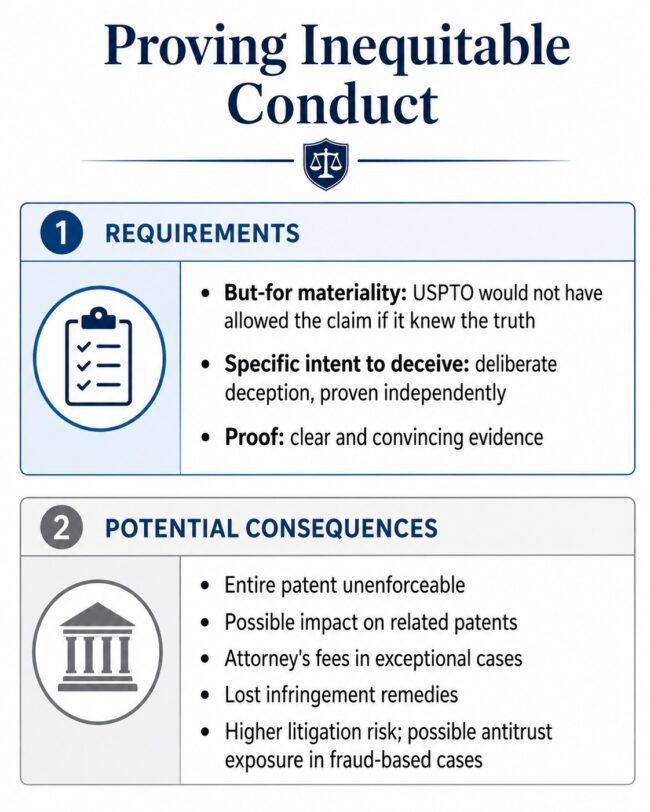
The Federal Circuit vacated and remanded. Its en banc opinion established the current, stricter but-for standard for proving inequitable conduct. Under the but-for test, information is material only when the USPTO would not have allowed a claim had it known the withheld or misrepresented information. The district court makes that hypothetical patentability determination under USPTO standards. A narrow exception presumes materiality for affirmative egregious misconduct, such as filing an unmistakably false affidavit.
Proving inequitable conduct requires the party asserting inequitable conduct to show by clear and convincing evidence that a specific person knew of the information, knew it was material, and made a deliberate decision to withhold or misrepresent it.
Intent cannot merely be inferred from materiality. It may be shown through circumstantial evidence, but deceptive intent must be the single most reasonable inference. A credible explanation consistent with good faith may defeat that inference. “Should have known” reasoning and gross negligence do not establish the required specific intent.
Because an inequitable conduct claim sounds in fraud, Federal Rule of Civil Procedure 9(b) applies. In Exergen Corp. v. Wal-Mart Stores, Inc., 575 F.3d 1312 (Fed. Cir. 2009), SAAT sought to add an inequitable conduct defense alleging that Exergen withheld two patents and website statements inconsistent with prosecution arguments. The district court, as trial court, denied leave, and the Federal Circuit affirmed. SAAT named only “Exergen, its agents and/or attorneys,” omitting the responsible person, affected claims, location of material teachings, why the references were noncumulative, and facts supporting knowledge and deceptive intent. Exergen requires the “who, what, when, where, and how,” plus facts supporting scienter. At trial, defendants must prove both elements by clear and convincing evidence. A judge makes the inequitable conduct determination; summary judgment is proper when proof is insufficient, and appeals go to the U.S. Court of Appeals for the Federal Circuit.
It is often said that inequitable conduct “invalidates all claims,” but that is technically imprecise. If the court concludes inequitable conduct occurred, the entire issued patent is rendered unenforceable: all the claims, not just the particular claims connected to the misconduct. A pending patent application has no enforceable patent claims, so inequitable conduct does not “invalidate” an application.
The taint can sometimes affect related patents or applications when they share an immediate and necessary relationship with the misconduct. The patent owner may also face an attorney-fee award under 35 U.S.C. § 285 in exceptional cases. Whether a case is "exceptional" and attorney fee awards are warranted is determined under discretion of the court.
A finding of inequitable conduct can eliminate infringement remedies. Intentional fraud in obtaining and enforcing a patent may also strip the patent holder’s antitrust exemption. Under 35 U.S.C. § 154(a)(1), a patent gives its owner the right to exclude others from making, using, offering to sell, selling, or importing the claimed invention during the patent term. Because Congress expressly created that right, a patent owner generally does not violate antitrust law merely by:
35 U.S.C. § 271(d) similarly provides that enforcing a patent or refusing to license it does not, standing alone, constitute patent misuse or an illegal extension of the patent right. In Walker Process Equipment, Inc. v. Food Machinery & Chemical Corp., 382 U.S. 172, 174–78 (1965), the Supreme Court held that if inequitable conduct is found, antitrust violations may be found if the other elements of monopolization are proven.
In Walker Process Equipment, Inc. v. Food Machinery & Chemical Corp., 382 U.S. 172 (1965), Food Machinery sued Walker on a sewage-treatment-diffuser patent. Walker alleged Food Machinery falsely swore it knew of no public use more than one year before filing, despite having participated in such public use. Lower courts dismissed the antitrust counterclaim. The Supreme Court reversed, holding that intentional fraud in obtaining and enforcing a patent may strip the patentee’s antitrust exemption. This permits Sherman Act § 2 liability and Clayton Act § 4 treble damages, but the claimant must prove the other elements of monopolization, including a relevant market, monopoly power, and anticompetitive injury. Ordinary inequitable conduct does not automatically establish antitrust liability.
These three Federal Circuit decisions discussed below illustrate the evolution of inequitable conduct law from a comparatively broad doctrine to the narrower, more disciplined framework applied today. THe McKesson case shows how courts evaluated nondisclosure and inferred intent under the pre-Therasense standards. Exergen addresses the threshold question of what a defendant must specifically allege before an inequitable conduct claim may proceed. Therasense then redefined the substantive proof required to prevail by separating materiality from intent and imposing stricter standards for each. Considered together, the cases explain both how inequitable conduct allegations must be pleaded and how they must ultimately be proven.
In McKesson Information Solutions, Inc. v. Bridge Medical, Inc., 487 F.3d 897 (Fed. Cir. 2007), one patent attorney prosecuted related applications before different examiners but did not disclose a prior-art patent cited in a related application, rejections of similar claims, or the allowance of overlapping claims. The Federal Circuit affirmed inequitable conduct because the omissions were material under the then-prevailing “reasonable examiner” test and the pattern of nondisclosure, coupled with no credible explanation, supported deceptive intent. McKesson therefore illustrates the broader pre-Therasense approach.
In Exergen Corp. v. Wal-Mart Stores, Inc., SAAT sought leave to add an inequitable conduct defense. The court affirmed denial because general accusations against a company and its attorneys were insufficient. The pleading failed to identify the responsible individual, affected claims, location of withheld information, or why it was material and noncumulative. Although knowledge and intent may be alleged generally, facts must support a reasonable inference that an identified person knew the information and deliberately withheld or misrepresented it. Pleading on information and belief also requires identification of its factual basis. Exergen therefore created a procedural gatekeeping rule.
A divided Federal Circuit panel initially affirmed unenforceability. The court then granted rehearing en banc, vacated the inequitable conduct judgment, and remanded under a new standard. The en banc court rejected the sliding-scale approach: strong materiality cannot compensate for weak intent. The accused infringer must prove materiality and specific intent independently by clear and convincing evidence; materiality ordinarily turns on the but-for test. Affirmative egregious misconduct creates a narrow exception to but-for materiality, but not to the intent requirement. Even after both elements are proven, the district court must weigh the equities. Together, Exergen governs pleading and Therasense governs proof.
Businesses seeking patent rights should be forthcoming with information relevant to their inventions during patent prosecution. A patent applicant must disclose known material information to the patent office, and should consult a patent attorney about their obligations during patent examination, such as the disclosure of potentially harmful prior art. Failure to do so could result in a loss of enforceable patent rights during patent litigation.
At the same time, defendants need strong evidence to prove inequitable conduct. The required showing generally includes materiality of the omitted information and a deliberate, specific intent to deceive, each established independently by clear and convincing evidence. But if proven, inequitable conduct does not merely eliminate one claim; it renders the entire patent unenforceable, and may affect related patents in appropriate circumstances. If the concealment or misrepresentation is egregious, the alleged infringing party may be awarded their attorney's fees. Careful disclosure practices and documented good-faith decisions provide the best protection against such an outcome.
© 2026 Sierra IP Law, PC. The information provided herein does not constitute legal advice, but merely conveys general information that may be beneficial to the public, and should not be viewed as a substitute for legal consultation in a particular case.
The expiration of the Steamboat Willie copyright became a popular issue when the 1928 cartoon entered the U.S. public domain on January 1, 2024. The lapse permits free use of the film’s original creative expression, but it did not release every version of Mickey Mouse. The Walt Disney Company still owns copyrights in many later iterations and retains extensive trademark rights related to the Mickey Mouse character. The subtleties of what versions and aspects of the Mickey Mouse character can be used without Disney's authorization are highly important to artists, filmmakers, businesses, and other creators planning new works that utilize the Steamboat Willie content.
We here explain what aspects of Steamboat Willie are in the public domain and what artists and authors can use in their own creative works.
Released in 1928, Steamboat Willie gave Mickey Mouse and Minnie Mouse their first widely distributed public appearance. Although the silent Plane Crazy was produced earlier, Steamboat Willie introduced audiences to Mickey through animation coordinated with synchronized sound. The film also featured Pete, historically called Peg Leg Pete. Its success marked a turning point for Walt Disney’s studio and established Walt Disney as a major force in animation. The value of the Steamboat Willie copyrights lay in both exclusive control and the film’s role in creating a durable character, brand, and intellectual property licensing platform.
Copyright law protects original creative works fixed in a tangible medium, including motion pictures, music, drawings, and other artistic works. Here, protection covered the film’s animation, visual designs, sequence, music, sound, and the creative expression embodied in the first versions of Mickey and Minnie. Disney’s copyright included rights to reproduce, distribute, perform, display, and prepare derivative works. Copyright does not protect the general idea of a cartoon mouse, but it can protect how the character is drawn and portrayed. See 17 U.S.C. §§ 102(a)–(b), 106.
The Steamboat Willie copyright was secured in 1928 under the Copyright Act of 1909. Works of that era generally needed publication with a copyright notice and timely renewal to receive the full copyright term. Those formalities differ from modern law, under which copyright protection generally begins when a work is created and fixed. Control over copying and unauthorized uses allowed Disney to develop the Mickey Mouse character without competitors duplicating their copyrighted work.
Congress lengthened copyright terms through the Copyright Act of 1976 and the Sonny Bono Copyright Term Extension Act of 1998. The latter, often mockingly referred to as the “Mickey Mouse Protection Act,” added 20 years and gave qualifying pre-1978 works a 95-year term. Under the pre-1978 renewal system, qualifying works had a 28-year initial term and 28-year renewal. The 1976 Act extended total protection to 75 years; the 1998 Act enlarged the renewal to 67 years, yielding 95 years total. Section 304(b) accordingly states that a copyright still in its renewal term when the 1998 Act took effect lasts 95 years from the date originally secured.
Disney supported the legislation along with a broader coalition. In Eldred v. Ashcroft, 537 U.S. 186 (2003), publishers relying on public-domain works challenged the Sonny Bono Copyright Term Extension Act, arguing that extending existing copyrights violated the Copyright Clause’s “limited Times” language and the First Amendment. The Supreme Court rejected both challenges. It held that a definite term remains “limited” after extension, relied on Congress’s historical practice, and ruled that no heightened First Amendment scrutiny was required because the idea-expression distinction and fair use safeguard speech.
The film remained protected through December 31, 2023. Because its copyright was secured in 1928, the applicable term ended at the close of 2023 after 95 years of protection under 17 U.S.C. §§ 304 and 305. Section 304 defines the copyright term length (95 years in this case) and Section 305 requires copyright terms to continue through December 31 of the year in which they would otherwise expire. The Steamboat Willie copyrights therefore expired automatically at midnight, and the film entered the U.S. public domain on January 1, 2024. No renewal, payment, or filing by Disney could extend the statutory maximum.
The 1928 film may now be copied, screened, restored, distributed through an archive, adapted, and remixed in the U.S. without the original creator’s permission or a copyright license. Creators may incorporate its public-domain expression into new works, while receiving copyright protection only for original material they add. Public-domain status does not erase authorship; it ends the former owner’s exclusive copyright rights in the work. This transition is a dramatic example of copyright’s intended balance between the creator's rights and public access: creators receive a substantial period of control, after which the public may preserve, study, and reinterpret the work.
The 2024 expiration placed only the expression in Steamboat Willie and other qualifying 1928 works, not the entire evolving Mickey Mouse character, into the public domain. The original version of Mickey is black-and-white, lacks gloves, has a long, thin tail, and looks rougher than the modern mouse. His signature gloves appeared in 1929, and his appearance changed significantly in later cartoons and movies.
There is an important current qualification. Qualifying 1929 Mickey works entered the U.S. public domain in 2025, and 1930 works followed in 2026. However, copyright infringement is analyzed on a work-by-work and version-by-version basis: the 2024 event freed the 1928 version of Mickey, while newer versions and later creative additions did not become free merely because Steamboat Willie did. Many familiar modern versions remain protected. An unauthorized use of a Mickey mouse -like character will be analyzed against both the public domain versions of mickey mouse and protected versions of Mickey, regardless of the author's intent. Thus, authors should be very careful about any derivative works based on Steamboat Willie.
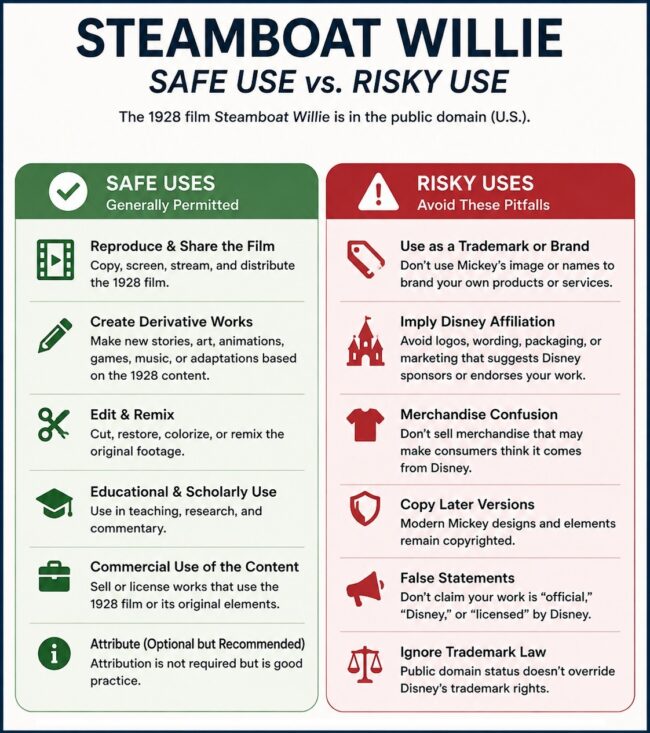
Artists may reproduce the film and create derivative works based on its public-domain expression. A creator can make a new cartoon, book, game, play, artwork, or horror film using the original versions of Mickey and Minnie Mouse. Creative adaptations of the original Steamboat Willie were in development immediately after the copyrights expired. Projects in several genres were announced almost immediately, much as the public-domain arrival of Winnie the Pooh prompted unconventional adaptations. Public domain therefore encourages new creativity and reinterpretation of cultural works.
Klinger v. Conan Doyle Estate, Ltd., 755 F.3d 496 (7th Cir. 2014), reached a similar result in copyright litigation regarding Sir Arthur Conan Doyle's Sherlock Holmes character: once a story enters the public domain, its protected elements become fair game, but original additions from later copyrighted works remain protected. A new adaptation should rely on public-domain material or independently created expression, not copy Disney’s still-protected later versions.
Copyright and trademark protect different interests. Copyright protects creative expression for a limited time. Trademark law identifies the commercial source of goods and services and prevents consumer confusion about origin, sponsorship, or approval.
Disney retains trademarks for Mickey Mouse despite the copyright expiration. Trademark rights can last indefinitely while used in commerce and properly maintained through required trademark renewal filings. See 15 U.S.C. § 1059.
Disney’s trademark rights can limit use of Mickey Mouse as a brand, logo, or source identifier on merchandise consumers may believe comes from Disney. Branding that leaves consumers confused about whether Disney licensed, sponsored, or endorsed a product may be prohibited. Trademark law cannot, however, restore an expired copyright or bar copying public-domain expression because consumers associate it with the former copyright owner.
In Dastar Corp. v. Twentieth Century Fox Film Corp., 539 U.S. 23 (2003), Dastar copied and edited a public-domain television series, sold videos under its own name, and did not credit Fox. Fox alleged reverse passing off under § 43(a) of the Lanham Act, arguing Dastar falsely claimed to be the videos’ origin. The Supreme Court rejected the claim. It held that “origin of goods” means the producer of the tangible goods sold, not the author of ideas or creative content embodied in them. Because Dastar produced the physical videos, the Lanham Act did not require attribution. The Dastar holding prevents 15 U.S.C. § 1025(a)(1)(A) from becoming a perpetual right of attribution in the authorship of communicative content. It does not establish that public-domain imagery can never function as a trademark or that source-identifying use of such imagery is immune from infringement, false-association, or dilution claims.
That distinction is particularly important here. A creator may copy public-domain expression as expression, but using that same material prominently as a brand or product-source designation can implicate trademark law. Jack Daniel’s expressly distinguishes expressive use from use “as a mark.” A contrary interpretation, the Court warned, would create a “mutant copyright” of perpetual duration. Dastar therefore preserves claims based on misleading source, sponsorship, or affiliation while preventing trademark law from removing public-domain material from lawful use.
Free use does not mean risk-free use. Copying protected features from later versions of Mickey may create copyright infringement exposure, while using Mickey as the creator’s own trademark may create a likelihood of consumer confusion.
In Jack Daniel’s Properties, Inc. v. VIP Products LLC, 599 U.S. 140 (2023), VIP Products sold a “Bad Spaniels” dog toy that mimicked Jack Daniel’s bottle and label trade dress while adding parody. The Ninth Circuit applied the Rogers First Amendment test established in Rogers v. Grimaldi, 875 F.2d 994 (2d Cir. 1989) and treated the use as non-actionable parody. The Supreme Court vacated that decision. It held that Rogers does not apply when an expressive design serves as a source identifier for the defendant’s goods. Parody remains relevant because obvious mockery may reduce perceived affiliation. Rather, ordinary trademark analysis governs whether consumers are likely to be confused.
The boundary between copyright and trademark use is already producing legal challenges. In 2025, Disney sued over a “Mickey 1928 Collection” of jewelry, alleging that the seller used Mickey as a trademark and suggested an affiliation with Disney. Disney Enterprises, Inc. v. Red Earth Group Limited d/b/a Satéur, No. 2:25-cv-06469 (C.D. Cal.). Disney alleged that Satéur’s “Mickey 1928 Collection” used Mickey imagery, names, packaging, and branding to suggest affiliation with Disney. The case ended in a stipulated final judgment and permanent injunction. The allegations show why creators should identify their own company as the source and state clearly that a new creation is not produced, sponsored, licensed, or approved by Disney, avoid Disney-style branding, and be very cautious about using public domain images and content in the context of merchandise.
The lapse of the Steamboat Willie copyrights illustrates the balance at the center of intellectual property law that applies even in the case of hugely successful and popular creative works. Copyright protected Disney’s valuable film and character expression for the limited 95-year term. Public-domain status now allows creators to build on the 1928 work without Disney's permission. However, later versions of Mickey Mouse and other works remain subject to their own copyright terms, and Disney’s trademark rights still protect its characters and branding from consumer confusion. Creators may use what is in the public domain, but they should respect protected later expression and avoid presenting new works as being associated with the Walt Disney company.
© 2026 Sierra IP Law, PC. The information provided herein does not constitute legal advice, but merely conveys general information that may be beneficial to the public, and should not be viewed as a substitute for legal consultation in a particular case.
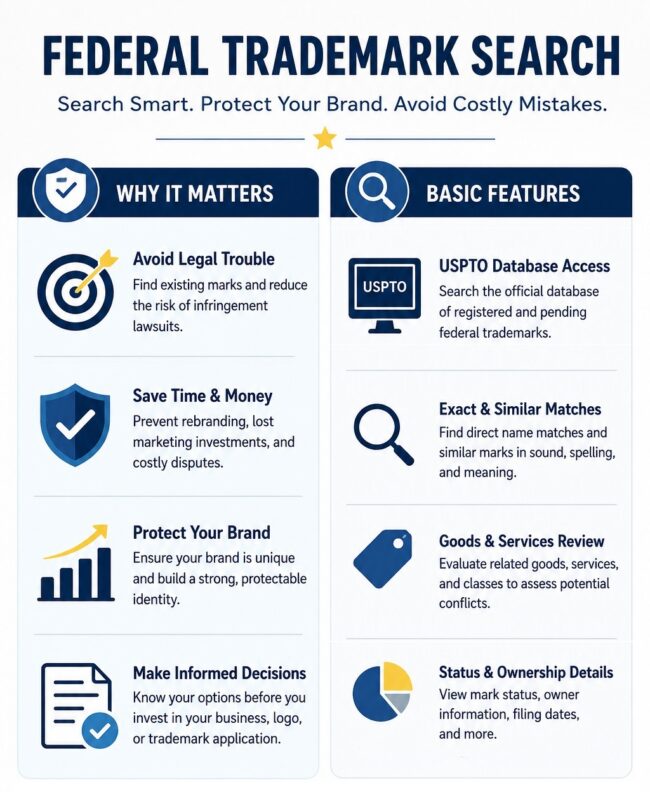
A federal trademark search is a search of the database of prior trademark filings provided by the United States Patent and Trademark Office (USPTO). The search may involve searching for combined search terms, including keywords, specified goods and services, and classes of goods and services, to find prior related trademark filings that are similar to a proposed trademark or service mark. The search determines whether a desired trademark may conflict with a prior registration or trademark application for an existing brand before a business invests in packaging, advertising, or a trademark application. It can indicate whether a proposed trademark can be registered, identify potential infringement risks, and prevent expensive future rebranding.
This article provides an explanation of federal trademark searches and related topics for entrepreneurs and business owners. It aims to provide a greater understanding of the purpose and importance of conducting trademark searches before a committing to a mark.
A federal trademark search examines records maintained by the United States Patent and Trademark Office (USPTO), the federal trademark office responsible for administering federal trademark registrations. Although the USPTO handles both patent and trademark matters, each uses a separate system and database.
The USPTO database includes registered marks, pending applications, abandoned applications, and canceled or expired registrations. Each record may provide the mark’s wording or design, owner, serial number, filing date, registration status, identified goods or services, international trademark classes, and prosecution documents. Reviewing this information helps a searcher identify direct name matches as well as related marks that are similar in appearance, sound, meaning, or overall commercial impression.
A useful search therefore goes beyond entering the exact wording of a proposed mark. It may include spelling variations, phonetic equivalents, shortened forms, synonyms, dominant words, design elements, and related goods or services. The search results can reveal potential conflicts arising from earlier federal trademark applications or registrations and help determine whether further investigation is needed before a business adopts the mark or files its own application.
Section 2(d) of the Lanham Act permits refusal of a trademark application when a mark is likely to cause confusion with a prior mark. See 15 U.S.C. § 1052(d). Confusing use may also support trademark infringement claims under 15 U.S.C. §§ 1114(1) and 1125(a), potentially exposing a business to an injunction, monetary damages, attorneys’ fees in exceptional cases, and the loss of investments made in developing the brand.
A trademark search helps avoid lawsuits by evaluating whether customers may believe related goods or services come from the same owner, are affiliated, or have approved or sponsored one another. Identifying a potential conflict before launch gives a business the opportunity to select a different mark, narrow its services, modify its branding strategy, or seek consent from the prior owner. This can protect advertising expenditures, domain names, packaging, customer goodwill, and other investments that may otherwise be lost through forced rebranding.
A search cannot guarantee that no likelihood of confusion issues exists, but a careful search can save time and money and support a more informed decision. Businesses should document every query, date, result, and conclusion for future reference.
Use the official USPTO site and verify the “dot gov” address before entering any search information. The free trademark search tool provides direct access to the USPTO database. Begin with a basic search for the exact text of the desired trademark name. This “knock-out” search can quickly identify exact matches and obvious conflicts that may make further review necessary.
For each relevant record, open the complete entry rather than relying only on the summary displayed in the search results. Save a link or screenshot showing the search terms and date, and use the listed serial number to review the mark’s current status and documents in the Trademark Status and Document Retrieval system. Examine whether the record remains active and note any limitations in the identified goods or services. Real-time search results come directly from the USPTO search system, although newly filed documents may not appear immediately.
A complete trademark search must explore phonetic equivalents, alternate pronunciations, similar spellings, singular and plural forms, spacing changes, abbreviations, translations, and similar names. Search strong words separately and together, including any slogan, because minor differences may still create the same overall impression.
Likelihood of confusion is evaluated under the nonexclusive DuPont factors. Key considerations include the similarity of the marks in appearance, sound, meaning, or commercial impression; the relatedness of the goods or services; and whether they travel through overlapping channels of trade to the same customers. In re E.I. du Pont de Nemours & Co., 476 F.2d 1357 (C.C.P.A. 1973). Other factors may include the strength or fame of the prior mark, the number and nature of similar marks in use, purchaser sophistication, purchasing conditions, actual confusion, concurrent use without confusion, and agreements or other market interaction between the owners.
The factors are weighed according to the evidence. Not every factor applies in every situation, and one factor may be decisive. Similar trademarks therefore must be assessed as a whole rather than dissected into isolated components. In re Detroit Athletic Co., 903 F.3d 1297 (Fed. Cir. 2018).
Similar marks may coexist for unrelated products, so a conflict may not prevent trademark registration. Conversely, different classes do not eliminate risk because international class numbers are primarily administrative and do not determine whether goods or services are commercially related. Advanced tools can reveal similar names across different classes, but the searcher must compare the nature, purpose, users, and customary sources of the goods or services, along with the relevant customers and channels of commerce.
The identification of goods and services should be reviewed in each application or registration for similar marks. If an identification contains no restrictions on customers or trade channels, the USPTO may presume that the goods or services reach all ordinary purchasers through all normal channels for those offerings. The USPTO will treat such trademark registrations as broadly reaching all relevant consumers for the listed goods and services.
Treat trademarks not just as names but also as logos and design elements. The USPTO assigns six-digit design search codes to nonword features such as animals, shapes, plants, or a U.S. flag. The first pair of digits identifies a broad category, the second a narrower division, and the third a specific section.
To identify the proper codes, first list the prominent or significant features that would help a viewer recognize the logo or locate a similar design. Use the Trademark Design Search Code Manual’s alphabetical index to find a likely category, then review its divisions, sections, explanatory notes, cross-references, exclusions, and sample images. Do not rely solely on the ordinary name of an object.
Complex logos may require multiple codes for separately recognizable elements. Search each applicable six-digit code and broaden overly narrow results by searching at the division level without the final section digits with truncation syntax (e.g., DC:0301*). Also search the USPTO’s text descriptions and examine the codes assigned to visually similar marks for additional possibilities. Thoughtful code selection is essential. A word and a design can create similar commercial impressions even when they are not identical.
Conducting a federal trademark search helps check existing federal registrations, but it is not a comprehensive trademark search. Additional searches should be performed of state registries, business-name databases, websites, domain names, social media, marketplaces, app stores, trade directories, and industry publications.
A common law trademark may arise from use in commerce without federal registration. Common law trademark rights are limited to the geographic region in which the trademark is recognized by consumers. However, a senior common law trademark holder has superior rights to a later trademark registrant in that geographic region. A senior common law trademark holder may also challenge the registration of a confusingly similar mark filed by a junior user. Thus, common law marks require separate search efforts and can limit a later registrant’s ability to use or register a mark. See 15 U.S.C. § 1125(a).
A free trademark search or trademark engine can check basic brand availability, returning a list of similar marks in the USPTO database. Free searches provide useful exact-match answers and direct name matches. Advanced tools offer broader insights into similar marks and classes. Search tools, however, do not substitute for professional legal advice.
A professional comprehensive search can investigate federal and state records, common law use, ownership, related companies, and live, dead, pending, registered, or approved-for-publication records. Applicants should consider contacting a trademark attorney to perform the search, interpret matches, and assess registration and infringement risks.
The cost of a professional trademark clearance search varies significantly. There are online services that offer low-cost federal trademark searches (e.g., for $50~$200). However, these searches are generally just a search report identifying similar marks in the USPTO records without common law or state trademark searches, and without significant analysis or guidance. It is highly recommended that you seek the assistance of an attorney experienced in trademark law to conduct the search and analyze the results. An experienced trademark attorney can conduct a comprehensive search that does not miss potential sources of conflict with registered or unregistered marks, and can provide detailed guidance on the risks presented by your chosen trademark or service mark.
After the search results have been reviewed, you must decide whether to proceed, select another desired mark, or explore small alterations that may improve the chances of registration. A conflict does not always bar registration, but superficial changes may not resolve confusion.
If no material conflicts exist, file a USPTO trademark application through the online form at the USPTO's online Trademark Center. The applicant must identify the owner and filing basis, describe the mark, select the goods or services, submit the application, and monitor its status. Multiple classes require a fee for each class.
A federal trademark search is an essential part of selecting and protecting a brand, but it should not end with a search for exact matches in the USPTO database. Effective clearance requires evaluating similar marks, related goods and services, overlapping customers and trade channels, and potentially conflicting logos or design elements. Because relevant rights may also arise from state registrations and common law use, businesses should investigate sources beyond federal records and document the searches performed. The results should then be analyzed under the likelihood-of-confusion standard to determine whether to proceed, modify the proposed mark, seek consent, or choose a different brand. A careful, comprehensive search cannot guarantee registration or eliminate every infringement risk, but it can support informed decisions, reduce the likelihood of costly disputes, and help protect the business’s investment in its brand.
© 2026 Sierra IP Law, PC. The information provided herein does not constitute legal advice, but merely conveys general information that may be beneficial to the public, and should not be viewed as a substitute for legal consultation in a particular case.
Apple filed a 41-page complaint on July 10, 2026, in the U.S. District Court for the Northern District of California. The Apple-OpenAI trade secret lawsuit names OpenAI, io Products, and two former Apple employees, Chang Liu and Tang Yew Tan. An Apple spokesperson said, “significant evidence has emerged suggesting individuals employed by OpenAI wrongfully took Apple’s secret and confidential information.” The allegations are claims, not court findings.
This article is provided for non-attorneys to explain the Apple-OpenAI trade secret lawsuit and the bases for Apple's claims against OpenAI and related parties in plain language.
The complaint states that former employees stole Apple’s trade secrets to advance OpenAI’s efforts to enter the consumer hardware market. The iPhone maker claims OpenAI orchestrated a coordinated pattern of action to acquire Apple's trade secrets, involving OpenAI employees, Apple insiders, job candidates, and trusted suppliers.
Although more than 400 former Apple employees allegedly now work for OpenAI, Apple’s lawsuit is not based on employee recruiting alone. Apple alleges OpenAI crossed the line by exploiting Apple’s confidential information rather than independently building innovative technology. Apple also says it raised concerns with OpenAI in February of 2026, requested an investigation, and received no response.
A trade secret can include technical, engineering, business, or manufacturing information. Apple identifies five categories: hardware engineering and product design, including circuit architecture, unreleased products, roadmaps, and engineering data; manufacturing and process-engineering information, including custom machinery, metal-finishing techniques, materials, and manufacturability expertise; component technologies and supplier specifications; testing, validation, and development methods, including failure analyses and “negative know-how”; and supply-chain, supplier-relationship, logistics, and systems-integration information.
Under the Defend Trade Secrets Act, Apple must show that the information is not generally known or readily ascertainable through proper means, is derived independent economic value from secrecy, and that Apple took reasonable measures to keep it confidential. Apple alleges competitors could bypass years of research and capital investment, reduce development costs, and accelerate market entry. It cites confidentiality agreements, training, need-to-know access, secure repositories, encryption, physical security, supplier restrictions, code names, and chain-of-custody controls.
Apple must also prove trade secret misappropriation: acquisition by improper means, or unauthorized use or disclosure by someone who knew the information was acquired by improper means. Confidential information is not automatically a trade secret, so economic value and secrecy evidence will be central to Apple’s case.
Chang Liu, a former Apple iPhone engineer, allegedly kept an internal computer owned by Apple after leaving the company and used an authentication bug to access Apple’s shared network folders. Apple alleges Liu downloaded dozens of confidential files while working for OpenAI, including more than 1,000 pages of engineering material.
The files allegedly covered unreleased products, technical specifications, manufacturing and testing workflows, and proprietary project data. Apple also claims Liu coached another employee on copying confidential Apple information while avoiding security scrutiny.
Tang Tan spent over two decades at Apple, including serving as vice president of product design for the iPhone and Apple Watch. Here thereafter became OpenAI’s chief hardware officer. Apple claims Tan used internal project names to question Apple employees about unreleased products and directed job candidates to bring “actual parts,” batteries, logic boards, and other components to OpenAI interviews.
The theory is that OpenAI’s recruiting process encouraged disclosure of proprietary information, not merely discussion of general skills and experience.
Apple’s complaint also alleges misuse of confidential information concerning manufacturing processes and supply-chain relationships. It claims the corporate defendants, OpenAI and io Products caused an Apple partner to perform a confidential metal-finishing technique for OpenAI after misleading the partner into believing it had Apple’s permission.
Apple further alleges OpenAI used confidential terminology and supplier knowledge to ask targeted questions about batteries and components. These allegations extend the claimed trade secret misappropriation to Apple’s confidential partner network and supply chain.
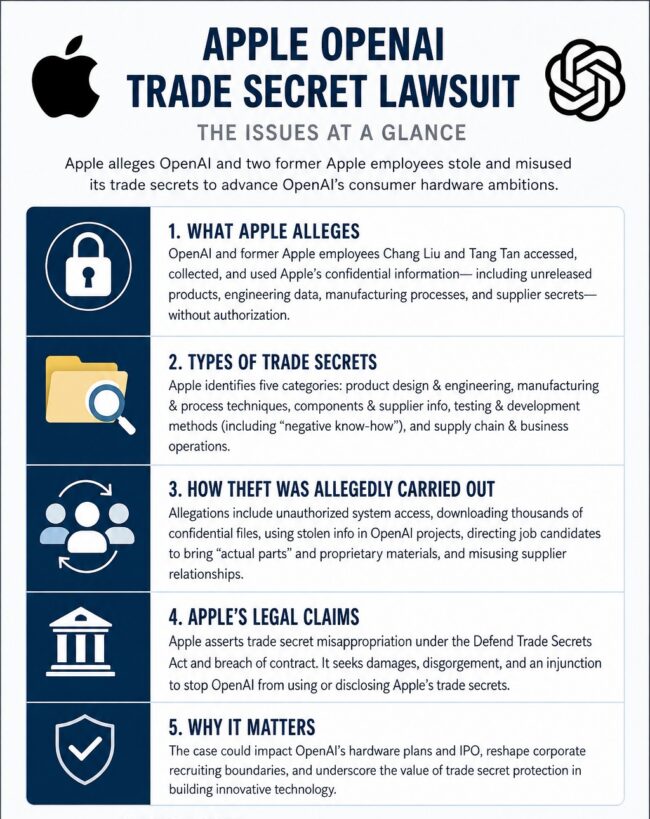
In the lawsuit, Apple asserts four federal misappropriation claims: one each against Liu, Tan, OpenAI, and io Products. It also asserts breach of contract claims against the two former Apple employees based on their intellectual property agreements.
The Apple lawsuit alleges willful and malicious conduct and seeks actual-loss damages, unjust enrichment, a reasonable royalty, exemplary damages, attorneys’ fees, and interest. The contract claims provide an alternative path for proprietary information that might not satisfy every statutory requirement for trade secret status.
Apple seeks preliminary and permanent injunctions preventing the defendants from possessing, using, or disclosing Apple’s trade secrets and confidential information. It also requests preservation of evidence, return of Apple property, and an end to unauthorized access.
If successful, an injunction could hinder development of an OpenAI hardware device by restricting allegedly tainted information, workflows, or supplier interactions. The statute generally does not permit an injunction based only on what an employee knows or bar lawful employment without evidence of threatened misappropriation. However, there can be an injunction that places protective conditions on the employment to prevent the use of the plaintiff's trade secrets by the defendant company.
The two companies partnered in 2024 to integrate ChatGPT into Apple Intelligence, and the complaint says that agreement is not at issue. However, the case may signal a significant shift in the relationship between the companies. OpenAI CEO Sam Altman expanded into hardware and recruited former Apple designer Jony Ive for the project through the io Products transaction.
Apple’s complaint states that “OpenAI’s nascent hardware business now rests on the shakiest of foundations, rotten to its core by its illegal reliance on misappropriated trade secrets.” The trade secret litigation could complicate OpenAI’s hardware plans and potential IPO preparations.
OpenAI has denied wrongdoing, expressing in a prepared statement: “We have no interest in other companies’ trade secrets. We remain focused on building innovative technology that empowers people everywhere.”
The Apple-OpenAI trade secret lawsuit is ultimately about where lawful employee experience ends and misappropriated trade secrets begin. Apple alleges illegal reliance on confidential information to accelerate OpenAI’s consumer hardware entry; OpenAI says it remains focused on its own innovative technology. The district court will determine whether Apple proves protectable secrets, improper acquisition or use, breach of contract, and entitlement to an injunction.
For companies constantly developing breakthrough technologies, the case highlights that appropriate steps should be taken to protect trade secrets and prevent trade secret theft: prohibit candidates from presenting another company’s confidential information, train interviewers not to request proprietary work, audit departing employees network and computer activity, monitor and recover company devices, and terminate internal credentials promptly. Protecting a team’s hard work requires controls at the recruiting, offboarding, and vendor-management stages.
© 2026 Sierra IP Law, PC. The information provided herein does not constitute legal advice, but merely conveys general information that may be beneficial to the public, and should not be viewed as a substitute for legal consultation in a particular case.
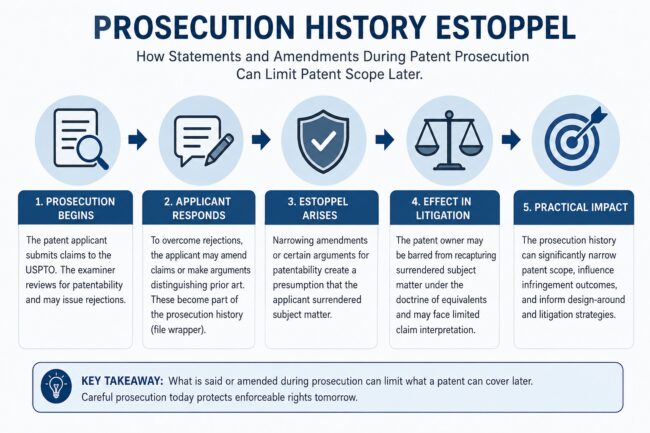
Patent claims are specialized formal descriptions of an invention that define the legal protection provided by the patent. However, the meaning of the words in the claims requires close evaluation of both the language of the claims, the detailed description of the invention provided in the specification of the application. During patent prosecution, which is the examination of a patent application by the United States Patent and Trademark Office (USPTO), an examiner may issue an office action rejecting the patent claims. The patent applicant has the opportunity to respond with statements or claim amendments. Those proceedings create the prosecution history, often called the file wrapper. In later patent litigation, that record can narrow the scope of the patent, making it easier to design around the patent claims.
This article provides a general overview to non-patent attorneys on how prosecution history estoppel is created during examination and how it affects the patent claims and the strength of the patent in later patent enforcement efforts.
Prosecution history estoppel is a patent law doctrine that prevents a patentee from later reclaiming subject matter surrendered during prosecution to obtain a patent. The doctrine is rooted in fairness and public notice: if an applicant narrows or explains a claim to persuade the USPTO to allow it, competitors should be able to rely on that prosecution history when assessing the patent’s scope.
The doctrine most often limits the doctrine of equivalents, which can allow infringement even when an accused product avoids literal infringement. In Festo Corp. v. Shoketsu Kinzoku Kogyo Kabushiki Co., the Supreme Court addressed this balance directly. The patent owner had amended its claims during prosecution, and the accused infringer argued that the amendments barred the patent owner from asserting equivalents. 535 U.S. 722 (2002). The Court held that when an original claim is narrowed for reasons related to patentability, a presumption arises that the patentee surrendered the territory between the broader original claim and the narrower issued claim.
Importantly, Festo did not impose an absolute bar. Instead, the patentee may overcome the presumption by showing that the alleged equivalent was unforeseeable, that the reason for the narrowing amendment was only tangential to the equivalent, or that some other reason prevented the applicant from claiming it. Thus, a court may treat surrendered territory as outside the enforceable reach of the patent.
The USPTO examines patent applications by comparing the claims to the statutory requirements for patentability, including novelty, non-obviousness, written description, enablement, and definiteness. If the patent examiner determines that a claim is not allowable, the USPTO issues an office action explaining the reasons for rejection. The applicant then files a response and may amend the claims, and/or submit arguments that explain why the rejection is improper and the examiner's position is not supported by applicable patent law. See 35 U.S.C. §§ 131–132; 37 C.F.R. §§ 1.111, 1.121. This back-and-forth process is called patent prosecution with the USPTO. Because each claim amendment, argument, and explanation becomes part of the prosecution history, statements made to overcome a rejection may later affect the scope of the patent and enforcement of the patent.
Thus, the examination of a patent application creates a record of amendments and arguments that have a lasting effect on the strength and enforceability of the patent. Both the text of an issued patent and the underlying prosecution history must be analyzed to determine the precise meaning of the patent claims.
Amendments can create prosecution history estoppel during patent prosecution. A narrowing amendment made to overcome prior art rejections for anticipation under 35 U.S.C. § 102 or obviousness under 35 U.S.C. § 103, or another patentability problem, such as a lack of enablement or written description under 35 U.S.C. § 112, may surrender the difference between the original claim and the amended claim.
In Festo, the Supreme Court held that a narrowing amendment made to satisfy any Patent Act requirement may give rise to estoppel. Thus, amending claims in response to a rejection limits future claim interpretation and may prevent the patent owner from asserting a particular equivalent.
Argument-based prosecution history estoppel can arise without a formal claim amendment. When an applicant distinguishes prior art by arguing that the claimed invention lacks, requires, or operates differently with respect to a feature, those statements may surrender inconsistent interpretations later used to prove infringement under the doctrine of equivalents.
In Southwall Technologies, Inc. v. Cardinal IG Co., 54 F.3d 1570 (Fed. Cir. 1995), the Federal Circuit held that a patent owner cannot obtain allowance based on one interpretation and then enforce the patent using another. The court treated prosecution statements as limiting both claim construction and equivalents, and held that arguments about one claim can restrict other claims containing the same limitation. Thus, statements made to overcome an examiner’s rejection may narrow future enforcement even without amended claim language.
Claim construction is the process of determining the legal meaning and scope of the patent claims before deciding literal infringement. The judge, not the jury, performs claim construction, often through briefing by the parties and a Markman hearing. See Markman v. Westview Instruments, Inc., 517 U.S. 370 (1996). The court reviews the claim language, the specification, the prosecution history, and, when appropriate, extrinsic evidence such as technical dictionaries or expert testimony. See Phillips v. AWH Corp., 415 F.3d 1303 (Fed. Cir. 2005).
Claim construction is a preliminary step when determining literal infringement: after the court interprets the claims, the factfinder compares the construed claims to the accused product or process and asks whether every limitation is present.
Prosecution history estoppel factors into this analysis because statements and amendments made during prosecution limit what the patentee can later argue the claims cover. In Southwall Techs., Inc., the Federal Circuit noted that claims cannot be interpreted one way to secure allowance and another way against an accused infringer. Prosecution history estoppel limits equivalents after literal infringement fails, but the same prosecution statements can affect both analyses.
Challengers use prosecution history to identify concessions made by the patentee. The patent examination record will usually include assertions by the examiner that the original claims are anticipated, obvious, or unpatentable for some other reason. The record provides a guide for separate patent invalidity and non-infringement defenses. It may reveal close prior art, admissions about novelty and obviousness of the claims, and the differences between the claims and the prior art relied on to establish patentability and obtain allowance. See 35 U.S.C. § 282(b).
An opposing party will study the prosecution history thoroughly to determine the narrowing amendments and arguments that the patentee made during the examination process and use them to narrow the claims as much as possible during the claim construction process.
A district court determines the legal effect of the record, subject to Federal Circuit review on appeal.
The Supreme Court rejected an absolute bar but adopted a rebuttable, presumptive-bar approach. When prosecution history estoppel applies, the patentee is presumed to have surrendered all equivalents between the original and amended claims. This presumption is difficult to overcome. Under Warner-Jenkinson Co. v. Hilton Davis Chemical Co., an unexplained narrowing amendment is presumed to have been made for patentability. 520 U.S. 17 (1997).
Patent owners bear the burden to establish that the alleged equivalent was unforeseeable, that the amendment was only tangentially related to it, or that another reason prevented the applicant from claiming it. Festo, 535 U.S. at 740–41.
The Federal Circuit ruled that rewriting dependent claims into independent form, coupled with canceling the original independent claims, creates a presumption of estoppel. Honeywell International Inc. v. Hamilton Sundstrand Corp., 370 F.3d 1131, 1134 (Fed. Cir. 2004) (en banc).
In appropriate circumstances, prosecution history estoppel applies to related patents as well. A surrender tied to a common term or limitation can constrain a sibling or continuation claim. Courts describe this cross-patent effect as prosecution disclaimer. The application of prosecution history to related claims in other patents is not automatic. For example, when material wording differs between the claims in related patents, prosecution history estoppel may not apply. See Microsoft Corp. v. Multi-Tech Systems, Inc., 357 F.3d 1340 (Fed. Cir. 2004).
Foreign prosecution can also be relevant in limited circumstances. Caterpillar Tractor Co. v. Berco, S.p.A. considered statements from foreign proceedings while recognizing differences among jurisdictions. 714 F.2d 1110 (Fed. Cir. 1983).
Prosecution history estoppel varies across different jurisdictions. In China, Article 6 of the Supreme People’s Court’s Patent Judicial Interpretation II allows claim interpretation using prosecution files from the patent and related patents, particularly patents having a divisional relationship. Chinese courts can invoke prosecution history estoppel without a party’s argument.
Taiwan’s Patent Infringement Determination Guidelines also recognize file-wrapper estoppel for patentability-related amendments and responses. Taiwan ordinarily places the burden on the accused infringer to raise and prove it and generally does not use corresponding foreign files absent special circumstances. In that regard, Taiwan’s regulations and practices on prosecution history are less stringent than China’s. Businesses should not assume the same defense has the same scope in other jurisdictions.
For a patent applicant or patent holder, sound strategies include making only the amendment needed to overcome an office action, stating why it is limited, preserving meaningful other claims, and coordinating positions across related patents and jurisdictions. Administrative patent appeals under 35 U.S.C. § 134 should also be considered, rather than accepting an unnecessarily narrow claim.
For a company accused of infringement, the first step is to obtain and review the complete prosecution record, including related family files. Each amendment and response should be compared against the accused feature, the asserted claim, and any alleged particular equivalent. That review can reveal whether the patent applicant surrendered relevant claim scope, limited the meaning of a claim term, or distinguished prior art in a way that affects enforcement. In many cases, the prosecution history may support a strong claim-construction position, a doctrine-of-equivalents defense, or both.
Prosecution history estoppel can significantly affect the enforceable scope of a patent by turning statements and amendments made during prosecution into limits on later enforcement. Its effect depends on the claim scope surrendered, the reasons for the surrender, and how the relevant court applies the doctrine in litigation. For patent owners, applicants, and accused infringers, the file wrapper is therefore an important source of evidence for evaluating patent scope, potential design-around decisions, and litigation strategy. Reviewing the prosecution history early can help clarify the practical strength of a patent and identify issues that may affect claim construction, patent infringement analysis, and the doctrine of equivalents.
© 2026 Sierra IP Law, PC. The information provided herein does not constitute legal advice, but merely conveys general information that may be beneficial to the public, and should not be viewed as a substitute for legal consultation in a particular case.
A trademark distinguishes a company’s products or services from those of others. It may be a word, symbol, design, color, package, or combination of branding elements. Trademark infringement occurs when unauthorized use is likely to cause consumer confusion about the source, sponsorship, or affiliation of goods or services. This article provides non-attorneys with examples of trademark infringement to demonstrate how infringement claims arise from the use of names, designs, domains, digital assets, and marketing. The examples will help you understand how trademark infringement occurs and how trademark rights are enforced.
The Lanham Act defines infringement by whether a use is “likely to cause confusion,” mistake, or deception. Courts compare the parties’ marks, the strength of the plaintiff’s mark, relatedness of the products, marketing channels, purchaser care, actual confusion, the defendant’s intent, and other factors. Similarity alone is insufficient. The trademark owner must establish a likelihood of confusion. Actual confusion is strong evidence, but is not always required for a finding of infringement.
Confusion can arise before purchase as initial-interest confusion, which diverts prospective purchasers, or after purchase as post-sale confusion, which affects public perception of the original brand. Contributory trademark infringement may also hold a party liable for inducing trademark infringement or knowingly continuing to supply an infringer.
Not every use of a pre-existing trademark owned by someone else is unlawful. Descriptive fair use, nominative fair use, and truthful comparative advertising may permit limited use of a competitor’s trademark or trademarked terms without suggesting sponsorship.
In The Coca-Cola Co. v. Koke Co. of America, 254 U.S. 143 (1920), competitors sold an imitation cola beverage under the name “Koke.” The Supreme Court found that the name was selected to benefit from Coca-Cola’s advertising and to sell the imitation as Coca-Cola’s goods. The Court held that the original trademark owner could enjoin the use of KOKE as trademark infringement and unfair competition. The case shows that changing the spelling, shortening a name, or substituting a phonetic equivalent may not avoid liability when the new designation is confusingly similar to a well-known trademark and the defendant’s goods closely resemble those sold under the famous mark. Although Koke predates the Lanham Act, its central lesson remains relevant to modern infringement claims: courts examine the probable effect on consumers, not merely whether the marks are technically identical.
International trademark infringement presents an additional territorial issue. In Abitron Austria GmbH v. Hetronic International, Inc., 600 U.S. 412 (2023), the Supreme Court held that the Lanham Act’s principal infringement provisions apply only to domestic “use in commerce.” Therefore, even when a U.S. trademark owner establishes that two marks are confusingly similar, the owner must identify actionable domestic conduct when pursuing U.S. infringement claims arising from foreign commercial activity.
In Tiffany & Co. v. Boston Club, Inc., 231 F. Supp. 836 (D. Mass. 1964), a federal court ruled that a Boston restaurant and lounge could not operate under the name “Tiffany’s.” Tiffany sold jewelry, silverware, and other luxury goods rather than restaurant services. Nevertheless, the restaurant selected the name because TIFFANY conveyed quality, promoted “Brunch at Tiffany’s” events at the restaurant, and prompted customers to ask whether Tiffany owned, operated, or sponsored the establishment. The court found a likelihood of confusion under the Lanham Act, concluded that the restaurant’s conduct also threatened dilution of Tiffany’s name, and permanently enjoined the restaurant from using TIFFANY in connection with its business.
This trademark battle demonstrates how famous trademarks can receive broader legal protection even when the parties operate in different industries. Famous trademark rights carry not only protection against trademark use that causes confusion (trademark infringement), but also protection against dilution. A business may face trademark infringement and unfair competition claims when it takes unfair advantage of a well known trademark, implies sponsorship or affiliation, or places the brand’s image and reputation in an unflattering light (i.e., by dilution). The same principle may protect a luxury fashion house, iconic retailer, or other owner of a famous mark. Fame alone, however, does not guarantee success: when pursuing an infringement claim, the trademark owner must still establish a likelihood of confusion under the applicable factors.
In 2016, Starbucks sued Obsidian Group, the parent company and operator of Coffee Culture cafés, over its “Freddoccino” frozen beverages. Starbucks Corp. v. Obsidian Group, Inc., No. 1:16-cv-00029-RJA, Complaint, ECF No. 1 (W.D.N.Y. Jan. 11, 2016). Starbucks alleged that FREDDOCCINO closely resembled its registered FRAPPUCCINO trademark in appearance, sound, and meaning: both began with “FR,” contained four syllables, ended in “CCINO,” and identified cold coffee drinks. Starbucks also alleged that the beverages’ appearance, similar cups, and circular branding in marketing materials could mislead consumers into believing Coffee Culture’s products were affiliated with, approved by, or comparable in quality to Starbucks products.
The dispute is commonly described as a settlement under which Coffee Culture stopped using the challenged name. The public docket, however, establishes only that Starbucks voluntarily dismissed the case before any court ruling on trademark infringement. Because the similar trademarks appeared on competing frozen coffee drinks sold through coffee shops, the alleged risk of consumer confusion was especially direct. The case illustrates that similar product names are evaluated by their overall commercial impression and likely source confusion—not spelling alone.
Adidas sued Forever 21 in 2017, alleging that apparel sold by the retailer displayed two-, three-, and four-stripe arrangements confusingly similar to Adidas’s registered three-stripe design. Adidas America, Inc. v. Forever 21, Inc., No. 3:17-cv-00377-YY (D. Or. filed Mar. 7, 2017). Adidas asserted trademark infringement, dilution, unfair competition, and breach of prior settlement agreements; Forever 21 argued that Adidas was trying to monopolize ordinary decorative stripes. The dispute illustrates that brand identity can reside in visual features. A design that closely resembles protected branding elements on competing products may confuse customers about source or sponsorship even when the alleged infringer uses a different company name. Courts examine the overall commercial impression, including the stripes’ number, placement, spacing, and orientation, rather than requiring exact duplication.
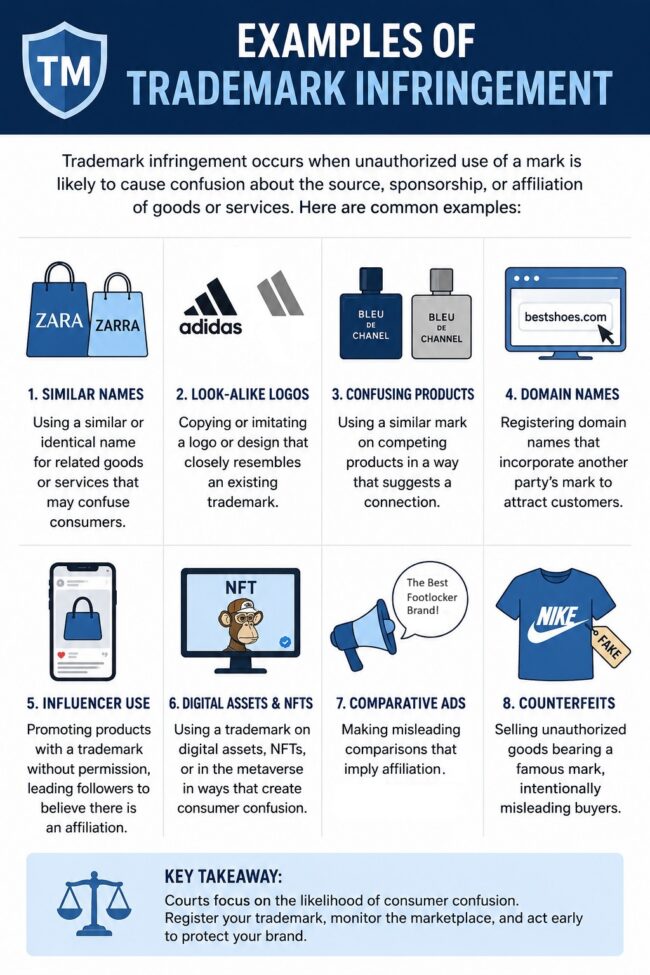
In Academy of Motion Picture Arts & Sciences v. GoDaddy.com, Inc., No. CV 10-03738 AB (CWx), 2015 WL 5311085 (C.D. Cal. Sept. 10, 2015), the Academy pursued legal action under the Anticybersquatting Consumer Protection Act concerning 293 customer-registered domains containing OSCAR or ACADEMY AWARDS. It alleged that GoDaddy’s parked-page program generated advertising revenue from traffic attracted by those marks. Before trial, the court had determined that 237 domains were confusingly similar and that GoDaddy used or trafficked in them as the registrants’ licensee. Fifty-six domains remained unresolved.
After a bench trial, the judge ruled for GoDaddy because the Academy failed to prove the required bad-faith intent to profit from its marks. The court also found GoDaddy protected by the ACPA’s good-faith safe harbor and therefore did not decide whether the remaining domains were confusingly similar.
The court’s decision shows why a confusing domain does not automatically establish intermediary liability. Although the case involved cybersquatting rather than an ordinary trademark infringement claim, every claim requires proof of the elements applicable to that defendant, including intent when the statute makes intent material.
Not all similar or identical trademarks result in infringement. Apple Corps, the Beatles’ music company, and Apple Computer, the computer and software company now known as Apple Inc., engaged in decades of legal battles over their identical “Apple” marks. Earlier agreements divided the parties’ trademark rights according to their different industries, rather than resolving a single trademark application or declaring every APPLE trademark owned exclusively by one party. The conflict intensified when Apple Inc. entered digital music, narrowing the separation between the goods or services offered by the two companies. In 2007, the parties settled: Apple Inc. became the trademark holder for the relevant marks and licensed certain rights back to Apple Corps. The dispute illustrates that identical trademarks may coexist until changing markets create a greater risk of consumer confusion.
Recent legal disputes and trademark infringement cases reflect evolving brand protection for digital assets. In Hermès v. Rothschild, Mason Rothschild created and sold a collection of “MetaBirkins” NFTs depicting digital versions of Hermès’s famous Birkin handbags covered in colorful faux fur. He promoted the project through social media and metabirkins.com. A jury found Rothschild liable for infringing and diluting Hermès’s BIRKIN marks and for cybersquatting, concluding that the project intentionally misled consumers about Hermès’s association with the NFTs. 678 F. Supp. 3d 475 (S.D.N.Y. 2023). In Yuga Labs, Inc. v. Ripps, defendants sold “RR/BAYC” NFTs tied to images identical to Yuga’s Bored Ape Yacht Club collection while presenting the project as criticism. The Ninth Circuit held Yuga’s NFTs are “goods” under the Lanham Act, but reversed summary judgment because likelihood of confusion remained factual. 144 F.4th 1137 (9th Cir. 2025). Traditional trademark principles govern; similarity alone is insufficient.
Trademark owners increasingly target individual influencers who do more than merely display counterfeit goods. In Nike, Inc. v. Tuinenburg, Nike alleged that sneaker influencer Nicholas Tuinenburg used social media, Discord communities, affiliate links, discount codes, and third-party sellers to promote and facilitate sales of replica Nike footwear. His company, Divide the Youth, also sold “Division Dunks” that copied the protected appearance of Nike’s DUNK shoes while replacing the Swoosh with its own star logo. The jury found willful trademark counterfeiting and infringement of Nike’s DUNK trademark and trade dress and awarded $11 million against Tuinenburg and Divide the Youth. Nike, Inc. v. Tuinenburg, No. 2:23-cv-10495-AB-AS (C.D. Cal. verdict Mar. 19, 2026). The verdict demonstrates substantial damages exposure in online trademark infringement cases involving counterfeit or infringing goods.
Parody is not automatically protected. In Jack Daniel’s Properties, Inc. v. VIP Products LLC, VIP sold a “Bad Spaniels” squeaky dog toy shaped and labeled like a Jack Daniel’s whiskey bottle, replacing “Old No. 7” and other wording with dog-waste jokes. The Ninth Circuit treated the toy as an expressive work entitled to heightened First Amendment protection. The Supreme Court disagreed that the expression in the toy avoided liability if it functioned as a source identifier. The court held that ordinary likelihood-of-confusion analysis applies when an alleged infringer uses the challenged designation as its own trademark, that is, as a source identifier for its goods. The Court also held that parody is not “noncommercial” merely because it comments humorously on another product. 599 U.S. 140 (2023). On remand, the district court subsequently found no trademark infringement because the parody was not likely to cause confusion, but found dilution by tarnishment and entered an injunction.
Before launching a brand, conduct thorough searches for federal and state trademark registrations, pending applications, common-law trademark uses, domains, and similar branding. A trademark or service mark must be vetted before it is used. The U.S. marketplace is very large and there are many overlapping trademark uses. So, a unique, fanciful or coined term should be selected in order to minimize the risk of overlapping with prior trademark use. Once a mark is selected, a search must be conducted for marks having similar sound, appearance, meaning, and commercial impression that would create a similar impression in the mind of the consumer. A trademark search for exact matches is far too narrow to identify all potential risks.
If the mark is sufficiently unique, a federal trademark application can be filed with the U.S. Patent and Trademark Office. The trademark registration process can take several months (e.g., 8-14 months), and so filing early is the best approach. Federal registration provides nationwide protection and enforcement tools. Distinctive marks are generally easier to register and enforce.
The marketplace should also be monitored regularly to identify potential infringements early. Trademark enforcement action (including cease and desist letters and possibly lawsuits) should be pursued early when infringements are identified. In order to maintain strong trademark protection rights, the trademark rights must be enforced. Failure to do so may weaken your rights and brand. A trademark attorney can assess risk and provide counsel on whether legal action is warranted in view of the potential harm to the trademark rights and brand, the potential monetary relief and outcome of a lawsuit, and costs and legal fees that result from pursuing a trademark infringement lawsuit.
These examples of trademark infringement show that similar names, product designs, packaging, domain names, digital assets, influencer promotions, and parody may create confusion about the source, sponsorship, affiliation, or approval of goods or services. Similarity alone, however, does not establish infringement. Courts evaluate the parties’ marks, their products and markets, purchaser care, evidence of actual confusion, intent, and other relevant factors. Qualifying famous trademarks may also receive separate protection against dilution even without direct competition or likely confusion. Businesses can reduce the risk of trademark disputes through careful trademark clearance, early registration through the U.S. trademark office, consistent brand use, marketplace monitoring, and proportionate enforcement. When a conflict arises, a trademark attorney can assess the parties’ rights, potential defenses and remedies, and the practical costs of pursuing or defending legal action.
© 2026 Sierra IP Law, PC. The information provided herein does not constitute legal advice, but merely conveys general information that may be beneficial to the public, and should not be viewed as a substitute for legal consultation in a particular case.
When do patents expire? Most United States patents follow a twenty-year term measured from a controlling filing date, but the actual expiration date may change because the application is part of a patent family with multiple related applications, maintenance fees, Patent Term Adjustment, Patent Term Extension, or a terminal disclaimer. The patent begins providing enforceable exclusive rights when the patent issues as provided in 35 U.S.C. § 154(a). At patent expiry, the patented invention generally enters the public domain as to that patent’s claims.
This article explains the U.S. rules for utility, plant, and design patents, maintenance-fee lapses, patent term adjustments (PTA), Patent Term Extensions (PTE), and terminal disclaimers. The article provides a thorough overview for inventors, entrepreneurs, and business owners, allowing them to understand patent term and what patent expiration means.
A utility patent is the kind of patent that protects new and useful processes, machines, manufactures, and compositions. A U.S. utility patent lasts 20 years from the filing date. The term of a patent begins when the patent issues and generally ends 20 years from the earliest qualifying non-provisional filing date. This means that the patent is not enforceable until it is examined and issued and the 20-year patent term is diminished by the time spent in the examination process. Thus, no patentee ever enjoys the full 20-year term of patent rights (the term can be extended in special circumstances discussed below). And once the 20-year term ends, the patent rights lapse and the patent cannot be renewed. However, it should be noted that a pending application may provide conditional provisional rights under 35 U.S.C. § 154(d) after publication, which are dependent on the patent eventually issuing.
A patent application may be part of a patent family, where there are patent applications filed after the initial application that claim priority to the initial application. A later child or grandchild application, such as a continuation, divisional, or continuation-in-part application, usually does not receive a new 20-year patent term. If it claims benefit under 35 U.S.C. §§ 120 or 121 to the filing date of an earlier application, its term is measured from the filing date of the earliest qualifying non-provisional ancestor, even when the child was filed later. Priority to a provisional application under 35 U.S.C. § 119(e), however, does not start the running of the 20-year term. See 35 U.S.C. § 154(a)(2)–(3).
Plant patents also last 20 years from the filing date and follow the same family-chain rules. They protect distinct and new asexually reproduced plant varieties under 35 U.S.C. § 161. Plant patents do not require maintenance fees, although patent term adjustment may add days for qualifying USPTO delay. See 35 U.S.C. §§ 154(a)(2), (b).
Because the patent term runs during the patent examination process, lengthy patent prosecution can reduce post-grant life unless lawful term adjustments apply.
The “earliest filing date” requires a review of the patent family where there is more than one related patent filing and claims for priority to earlier patent filings under 35 U.S.C. §§ 120, 365. A provisional application is not a patent, despite the common phrase “provisional patents”, and provisional applications do not start the 20-year clock per 35 U.S.C. § 154(a)(3). The clock begins with the earliest filed non-provisional application.
For a continuation, divisional, or continuation-in-part claiming benefit under 35 U.S.C. § 120, the term may run from an earlier filed parent. Thus, if a second application for the same invention is filed as a continuation or divisional of a previously filed patent application, the second application will expire on the same day as the original patent filing, unless there are patent term adjustments for one or both of the applications.
In the case of an international patent application under the Patent Cooperation Treaty (PCT), a United States patent application claiming priority to the international application and entering the national stage ordinarily measures its term from the international filing date to which the U.S. application claims priority under 35 U.S.C. § 365(c). An international application can pend for 30 months before a national stage application claiming priority to the international application (PCT) must be filed in the United States per 35 U.S.C. § 371 . If the applicant takes advantage of the full 30-month pendency, the U.S. application will not be filed for 2.5 years from the filing of the priority application, thereby reducing the patent term significantly.
Patent term adjustment (PTA) compensates for USPTO delays and adds days to the standard 20-year patent term. Under 35 U.S.C. § 154(b) and 37 C.F.R. §§ 1.702, 1.703, , PTA may arise from missed United States Patent and Trademark Office deadlines, failure to issue within three years, certain patent appeals, and/or secrecy orders.
These delays caused by the USPTO may extend utility and plant patents, but not design patents. Any applicant delay, including an untimely response to an office action, will reduce any PTA under 37 C.F.R. § 1.704. Patent owners should check the PTA calculation when a patent issues to determine their adjusted patent term.
Patent term extension (PTE) under 35 U.S.C. § 156 compensates eligible patents covering certain regulated products such as food additives, pharmaceuticals, and medical devices for regulatory delays before approval by, e.g., the Food and Drug Administration (FDA). See also 37 C.F.R. § 1.710. A patent owner or agent must apply to the USPTO during the nonextendable 60 days beginning on the first commercial-marketing approval date by the FDA. See 37 C.F.R. § 1.720. The patent must claim the approved product, use, or manufacture. One patent may be extended per regulatory review period. The reviewing federal agency (FDA) determines the review period, and the USPTO determines eligibility for a PTE. See 37 C.F.R. § 1.750. PTE can extend the original expiration date by up to five years, but the post-approval effective patent life, including the extension, cannot exceed 14 years.
PTE differs from supplementary protection certificates available in some foreign systems. In the EU, an SPC is a separate patent-based right effective after the basic patent expires and generally adds up to five years for a qualifying medicinal or plant-protection product.
Utility patent owners must pay maintenance fees at 3½, 7½, and 11½ years after patent grant to keep a patent in force per 35 U.S.C. § 41(b). Each fee may be paid during a six-month window before its due date. If missed, a further six-month grace period permits payment with a surcharge. Failure to pay maintenance fees before the grace period ends causes the patent to expire on the fourth, eighth, or twelfth anniversary of the grant date. See 37 C.F.R. § 1.362(d)–(g). Maintenance fees apply to utility patents, but not design or plant patents.
A patent that has lapsed for failure to pay maintenance fees may, in certain circumstances, be reinstated for unintentional delay under 37 C.F.R. § 1.378. The petition must include the overdue maintenance fee, the petition fee, and a statement that the delay was unintentional. The USPTO may require additional information. If accepted, the patent is treated as not having expired, subject to intervening rights for third parties for certain activities undertaken during the lapse. See 35 U.S.C. § 41(c)(2).
A terminal disclaimer can shorten a patent’s term by disclaiming any portion extending beyond a specified date, usually the expiration date of an earlier related patent. It is commonly filed to overcome an obviousness-type double patenting rejection by preventing patentably indistinct claims from creating an unjustified later period of exclusivity. See 35 U.S.C. § 253. A terminal disclaimer can therefore override the expected expiration date and generally requires the disclaimed and referenced patents to remain commonly owned for enforceability under 37 C.F.R. § 1.321.
Patent term adjustment (PTA) and patent term extension (PTE) are treated differently. Section 154(b)(2)(B) provides that PTA cannot extend a patent beyond the date stated in a terminal disclaimer. Claims that are patentably indistinct from a parent application may be subject to an obviousness-type double patenting rejection if no terminal disclaimer has been filed. Patent holders and applicants should evaluate their pending patent claims for relatedness to their earlier patents in the same patent family for obviousness issues before the pending application issues as a patent, after which a curative terminal disclaimer may be unavailable.
By contrast, Merck & Co. v. Hi-Tech Pharmacal Co., 482 F.3d 1317 (Fed. Cir. 2007), held that qualifying PTE under 35 U.S.C. § 156 may extend a patent shortened by terminal disclaimer. The disclaimer fixes the ordinary date of expiration, but PTE is calculated from that shortened date. Merck confirms that the disclaimer does not bar a statutory § 156 PTE extension.
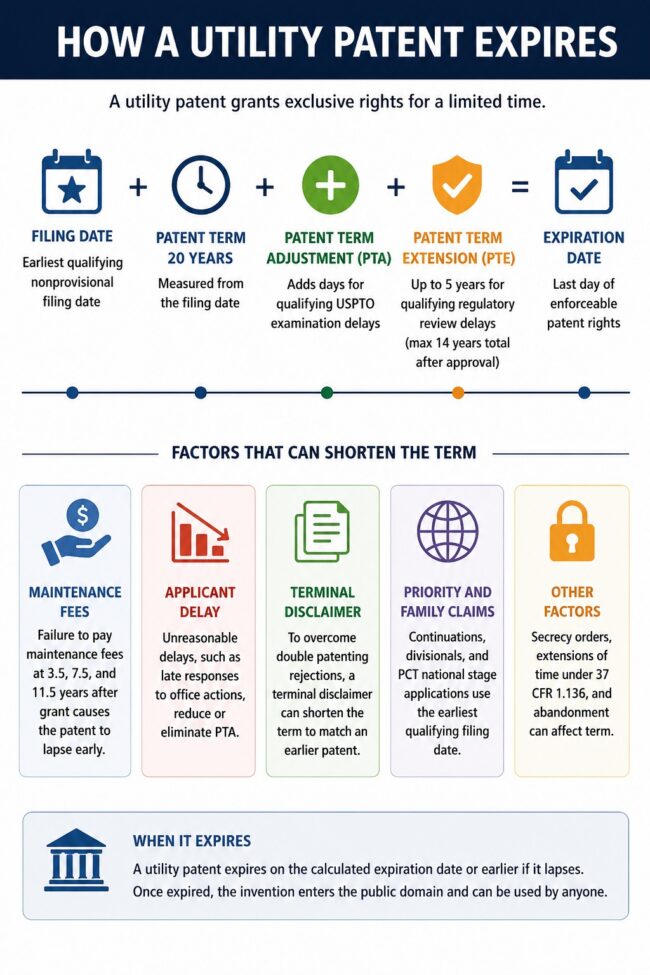
Design patents are distinct from utility patents, protecting the ornamental design of an article rather than its utility or function. See 35 U.S.C. § 171. Design patents filed on or after May 13, 2015, last 15 years from their issue date under 35 U.S.C. § 173. Design patents filed prior to May 13, 2015, last 14 years from the date of the patent grant. These older design patents will be irrelevant around 2031, which is roughly the timeframe in which the last of these older filings will expire.
Design patents do not require maintenance fees per 37 C.F.R. § 1.362(b). Their expiration therefore depends only on the grant date and statutory term.
Patent expiration is the scheduled end of patent protection. Patent invalidation is a judicial or administrative determination that a patent claim is invalid. A district court or the Federal Circuit may determine whether a patent is invalid or unenforceable, while the Patent Trial and Appeal Board may cancel claims before the expiration date.
When the patent expires and the invention enters the public domain, the public generally may make, use, sell, offer to sell, or import the formerly patented invention without permission under that patent. See 35 U.S.C. § 154(a). This is part of the quid pro quo of the patent system: the inventor publicly discloses the invention in exchange for temporary exclusive rights and then the public is allowed to practice the invention after the patent term ends.
However, it should be understood that overlapping patents, trade secrets, trademarks, contracts, or other forms of intellectual property may still restrict particular conduct related to the invention. A thorough freedom to operate analysis should be conducted prior to practicing the invention disclosed in an expired patent.
A business's patent strategy is primarily focused on the scope of the patent rights provided by a patent and whether those rights sufficiently protect the business from competing products and services. However, a patent applicant, owner, or holder should track the earliest non-provisional or international filing date, issue date, maintenance-fee deadlines, PTA, PTE, and disclaimers so that they have an accurate understanding of when their patent rights are scheduled to expire. These additional factors must be considered and the patent term must be accurately calculated and tracked in order to manage and understand a patent portfolio and plan for the business's future market position.
These concepts should also be understood in order to assess competitor and third party patent rights and predict when a third party patent expires and the protected invention may be practiced without fear of patent infringement.
Utility and plant patents typically expire 20 years from the controlling filing date, while design patents expire 14 or 15 years from grant, depending on filing date. The actual expiration date, however, may be earlier or later because of maintenance-fee lapse, patent term adjustment, patent term extension, a terminal disclaimer, or the filing history of related applications. Patent expiration ends the exclusive rights provided by that patent, and the disclosed invention generally enters the public domain as to the expired claims. However, other patents or other forms of intellectual property may continue to restrict particular conduct. For that reason, sound freedom to operate analysis reconstructs the complete family and prosecution history rather than relying only on the face of the patent. Businesses should confirm both the patent’s expiration date and any overlapping rights before launching a competing product or process.
© 2026 Sierra IP Law, PC. The information provided herein does not constitute legal advice, but merely conveys general information that may be beneficial to the public, and should not be viewed as a substitute for legal consultation in a particular case.
A restriction requirement is a procedural action in U.S. patent law. The United States Patent and Trademark Office (USPTO) issues it during examination when a single application appears to claim multiple patentably independent and distinct inventions. The examiner requires the applicant to elect one claim group for examination. This streamlines complex reviews and workload, but can affect cost, timing, claim scope, and multiple patents.
This article explains the purpose and procedure of restriction requirements, such that a person (e.g., business owner or inventor) who is new to the patent process may gain a general understanding of restriction practice.
Under 35 U.S.C. § 121, when “two or more independent and distinct inventions” are claimed in one patent application, the USPTO may restrict the application to one invention. Rules 37 C.F.R. §§ 1.141–1.142 implement that authority. The requirement for restriction usually appears in the first Office action, although the examiner may issue it any time before final action.
Restriction is procedural. It does not decide whether a claimed invention is novel or nonobvious over prior art. In In re Weber, the CCPA held that § 121 allows the USPTO to require restriction among independent and distinct inventions, but does not itself authorize rejection of a patent claim merely because it encompasses multiple inventions. 580 F.2d 455 (CCPA 1978). The court also warned that dividing a generic claim into fragments may not preserve the original claim. In In re Harnisch, the CCPA distinguished examination on the merits under §§ 101, 102, 103, and 112 from procedural restriction under § 121, and reversed an improper-Markush-grouping rejection because the claimed compounds had unity of invention, substantial structural similarity and common dye utility. 631 F.2d 716 (CCPA 1980).
A restriction requirement is proper only if two conditions are met. First, the claimed inventions must be capable of supporting separate patents and be either independent or distinct as claimed. “Independent” means that the inventions have no disclosed relationship in design, operation, or effect. “Distinct” inventions may be related, but, as claimed, are unconnected in at least one of those respects and at least one is patentable over the other. This authority derives from 35 U.S.C. § 121 and 37 C.F.R. §§ 1.141–1.142.
Second, a serious search or examination burden will result if all the claims remain together during patent examination. The examiner may show that burden through separate classifications, separate status in the art, different fields of search, or materially different non-prior-art issues under § 101 or § 112. The examiner must explain both why the inventions are independent or distinct and why the burden is serious. A conclusory statement is insufficient. Patent examiners must give reasons or examples to support conclusions. If all claims can be searched and examined without serious burden, restriction is improper and the examiner must address them on the merits, even if the examiner believes an invention is distinc. See MPEP §§ 802.01, 803, 808–808.02.
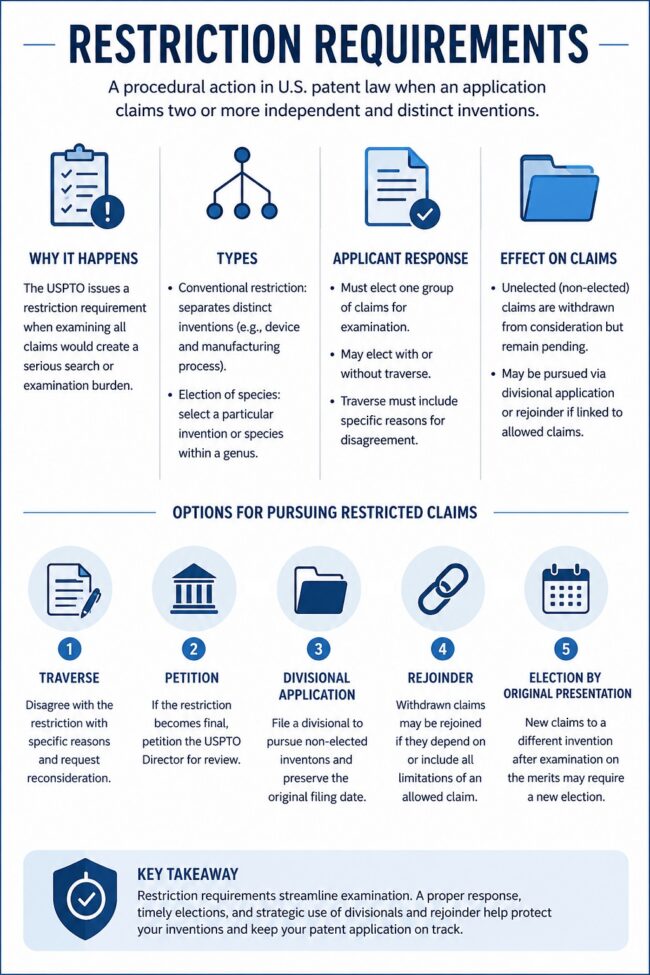
There are two types of restriction practices allowed by the US patent law and the USPTO rules. There are restrictions between two inventions (referred to as "restriction requirements"), and there are elections of species, which are directed to mutually exclusive species of an invention that are independent or distinct.
The examiner separates claims into groups directed to distinct inventions when examining all the claims together would create a serious search or examination burden. For example, a patent application may contain independent claims directed to a device and separate claims directed to a distinct manufacturing process. The applicant must elect one invention in the application, while claims to the non-elected invention are generally withdrawn from consideration but may be pursued in a divisional application.
An election of species requires the examiner to ask the applicant to select a particular invention or species within a genus for examination. A “species” is a specific embodiment that falls within a broader generic concept. For example, if a generic claim covers a fastener, separate species might include a screw, bolt, and rivet. Under 37 C.F.R. § 1.146, an election may be required when the claims encompass multiple patentably distinct species and no generic claim has been found allowable. The applicant’s election determines which species will be searched and examined. Dependent claims directed to other species may later qualify for rejoinder when they include all the limitations of an allowable generic claim that is broad enough to cover all of the identified species. See 37 C.F.R. § 1.141(a). Accordingly, an election of species may postpone examination of certain claims without requiring their immediate cancellation.
Applicants must elect one group of claims for examination. A response is incomplete without an election of claims, which may be made with or without traverse.
If the applicant believes the restriction is improper, the response must still make a provisional election and traverse with specific reasons and arguments as to why the election is improper under 37 C.F.R. § 1.143 and MPEP § 818. Once the elected claims receive an action on the merits, the election becomes fixed, and prosecution cannot shift to another invention.
Unelected claims, also called “non-elected claims,” are withdrawn from consideration in the current application under 37 C.F.R. § 1.142(b), but are not necessarily canceled. These withdrawn claims remain pending while the examiner considers the claims to the invention elected and may be reinstated if the restriction is withdrawn or overruled. The applicant may pursue restricted claims by timely traversing the restriction and petitioning if it becomes final, retaining eligible claims for possible rejoinder if linked to allowable elected claims, or filing a divisional application directed to the non-elected invention.
Claim amendments or new claims directed to an invention distinct from and independent of the originally claimed subject matter may trigger another restriction under 37 C.F.R. § 1.145. This is election by original presentation: after examination on the merits of the originally presented invention, that invention is constructively elected, and later-added claims to a different invention may be withdrawn. The applicant may cancel those claims, traverse the election, or pursue them in a divisional application.
If an applicant traverses a restriction and the examiner finds the applicant's arguments unpersuasive, the examiner may repeat the restriction as a final requirement and act on the elected claims. To preserve review, the applicant must timely traverse, request reconsideration, and distinctly identify every alleged error later relied upon.
After final restriction, the applicant may petition the USPTO Director under 37 C.F.R. § 1.144 while separately answering any remaining matters in the office action. The petition should state the relevant facts, identify the points to be reviewed, explain why the restriction is improper, specify the requested relief, and include supporting declarations or exhibits when factual proof is needed. It may be deferred until final action or notice of allowance, but must be filed no later than the notice of appeal. Restriction is reviewed by petition, not a patent appeal to the Trademark Trial and Appeal Board.
A divisional application can be filed for unelected claims after a restriction, allowing the applicant to pursue a particular invention separately while the current application continues. By claiming the benefit of the parent application under 35 U.S.C. § 120, the divisional preserves the original filing date. To invoke the safe harbor of 35 U.S.C. § 121, the divisional must result from the restriction and be filed before a patent issues on the other application.
The interaction with double patenting matters because related applications may otherwise face obviousness-type double patenting, which prevents an unjustified extension of patent exclusivity and may require a terminal disclaimer. Section 35 U.S.C. § 121 may instead prevent the parent and divisional patents from being used against each other, but the divided claim groups must maintain “consonance.” Gerber Garment Technology, Inc. v. Lectra Systems, Inc., 916 F.2d 683 (Fed. Cir. 1990), explains that consonance preserves the examiner’s line between restricted inventions. Boehringer Ingelheim International GmbH v. Barr Laboratories, Inc., 592 F.3d 1340 (Fed. Cir. 2010), confirms that the safe harbor may extend through successive divisionals when that boundary remains intact. If your application has been restricted, you should review the timing and scope of the restricted claims with a patent attorney before the parent patent issues.
Rejoinder allows certain unelected claims to be included later. If a claim to the invention elected becomes allowable, withdrawn claims to a linked invention may be rejoined when they depend from, or otherwise require, all the limitations of the allowed claim. See MPEP § 821.04(b). Well-planned dependent claims and timely claim amendments can preserve rejoinder. Amended or new claims that do not require all the limitations of an allowable claim may remain withdrawn.
For Patent Cooperation Treaty (PCT) applications, the comparable standard is the Unity of Invention Requirement: one invention, or a group linked by a single general inventive concept under PCT Regulations Rule 13.
The Unity of Invention Requirement permits a group of claims to varying embodiments of an invention that are linked by a single general inventive concept to be examined together by the International Search Authority. Unity exists when the inventions share the same or corresponding “special technical features,” meaning features that define each invention’s contribution over the prior art. If unity is lacking, the international authority may require additional search or examination fees for multiple inventions.
That differs from USPTO restriction practice. U.S. restriction generally asks whether claims cover independent or distinct inventions and whether examining them together would create a serious search or examination burden. PCT unity instead focuses on the technical relationship among the claimed inventions.
A restriction requirement is not an opinion on the merits and does not affect the patentability of the invention. It means the examiner has decided that not all of the claimed subject matter requires election of one invention or group for immediate examination. A proper response elects strategically, traverses with specific reasons when warranted, preserves divisional rights for unelected claims, and monitors rejoinder after allowance. Early review can protect filing dates, control cost, and preserve commercially important claims.
© 2026 Sierra IP Law, PC. The information provided herein does not constitute legal advice, but merely conveys general information that may be beneficial to the public, and should not be viewed as a substitute for legal consultation in a particular case.
If you have conceived and developed a promising invention, one of the first practical questions you will face is how much does a patent cost. The answer depends on what kind of patent you need, how complex your technology is, and how you approach the patent process. This guide breaks down the major cost components so you can evaluate whether a patent application is a justified expense and plan your budget with real numbers, if you decide to move forward. However, it must be understood that the cost of a patent application is highly variable and depends on the nature of the technology and its complexity.
Most U.S. utility patents cost roughly $15,000–$30,000 over 1~4 years when you factor in attorney fees, and USPTO filing fees. Design patents are significantly less expensive, often falling in the $3,000–$7,000 range from start to finish.
The cost of a patent depends mainly on three things: patent type (utility patent vs. design patent vs. plant patent), complexity of the invention, and whether you hire an experienced patent attorney or attempt a DIY approach.
Here's a quick cost snapshot to keep in mind:
These costs are spread across a timeline: initial filing in year 0, examination and responses over 1.5–4 years, and maintenance fees at 3.5, 7.5, and 11.5 years after grant. Your patent application cost should always make sense compared to the expected commercial value and enforceability of the intellectual property you're protecting. If the potential economic value of the patent application is only a few thousand dollars, there may not be sufficient justification for the cost of the patent application process.
The direct answer: expect to pay $15,000–$30,000 for a reasonably complex U.S. utility patent from first filing through grant, and $5,000–$8,000 for a single U.S. design patent application through issuance.
For a utility patent, that figure breaks down into these components:
The United States Patent and Trademark Office (USPTO) structures fees based on the applicant's entity size. Small entity and micro entity filers (independent inventors, startups, and small companies) can obtain 60–80% reductions on USPTO fees, though not on attorney fees. Software, biotech, chemical technologies, and complex electronics tend to sit at the high end of the range, while simple mechanical inventions land closer to the low end.
As an example, an individual inventor filing a U.S. non-provisional utility patent application for an invention of moderate complexity with a patent attorney, encountering one office action, and paying small entity fees might expect a total cost in a range of about $15,000 to $20,000 over about four years if the case proceeds relatively smoothly.
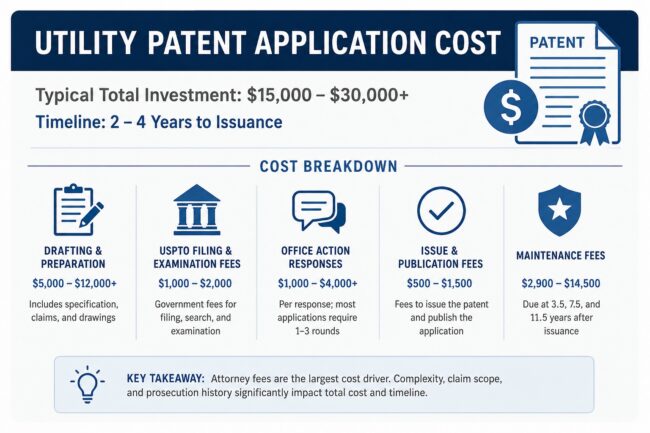
Patent application costs are not like a fixed menu price. Even though USPTO filing fees are standardized, the total cost varies widely with technology, scope, and strategy. Patent costs vary based on the complexity of the invention, and the complexity of the invention determines the attorney fees required for patent prosecution.
The main cost drivers include:
International patent filings, translation needs, and continuation or divisional patent applications can significantly increase the total budget beyond your initial U.S. patent application. Companies planning multi-country protection should plan for these additional costs early.
Most inventors pursuing protection for a functional invention will file a utility patent application. The total utility patent cost usually involves at least three stages: search, patent application drafting and filing, and patent prosecution.
A professional patentability search typically runs $1,000–$3,000 in attorney and search firm fees. This early step helps determine whether your invention has enough innovation to justify a full patent application by identifying relevant prior art.
Provisional patent applications generally cost at least around $3,000 to file when prepared by a patent attorney. Drafting a provisional patent application can cost in a range between $3,000 and $12,000 because you want a thorough written description and proper drawings. Self-filing and paying only government filing fees can keep cash costs under $500 for micro entities, but the resulting provisional application may lack the detail needed to support your later non-provisional patent claims.
Provisional applications allow a one-year patent pending status, giving you time to test the market and seek investors. However, provisional applications do not lead to granted patent rights without a follow-up non-provisional filing.
Utility patent applications cost between $4,000 and $17,000 to draft, depending on complexity. Low-complexity mechanical inventions often fall in the $4,000–$8,000 range, while software and medical device applications push closer to $13,000–$17,000. Filing a non-provisional application after a provisional may cost $2,000 to $5,000 if much of the specification groundwork was already done.
Government filing fees for a non-provisional utility patent application (filing, search, and examination combined) are currently about $800 for a small entity and around $2,000 for a large entity. Professional patent drawings are often required for non-provisional applications and can add $500–$1,500 to the total.
Legal fees generally constitute the largest portion of patent expenses. Understanding this split helps inventors budget realistically and compare quotes from different providers.
Registered U.S. patent attorneys at a typical law firm bill $300–$800+ per hour in 2025–2026, depending on location and expertise. Many offer flat fees for preparing and prosecuting a patent application, which is where most clients prefer the predictability.
Attorney work spans several categories:
On the government side, core USPTO fees include filing, search, and examination fees, excess claims fees (when claims exceed 20 total or 3 independent claims), publication fee, RCE fees, issue fees, and maintenance fees. The patent office also charges non-electronic filing surcharges if you file on paper.
The vast majority of total cost goes to attorney fees. For a typical utility patent, government fees might represent only 5–15% of overall patent application cost, with attorney time making up the rest. Small and micro entity status can reduce government fees substantially, but attorney fees remain unchanged regardless of your entity size.
The initial filing sets the patent application process in motion, but there is much more to do thereafter. The USPTO examination phase, called prosecution or examination, can add significant additional attorney and USPTO fees before a patent is granted. Utility patents may incur ongoing costs of $5,000 to $15,000 after filing depending on how many rounds of examination are needed. Design patent examination may result in additional costs in a range from about $1,500 to $4,000.
A first office action typically arrives 12–24 months after your non-provisional patent filing. The entire patent process may take 2–4 years before allowance or final rejection. This is not always the case. Some cases are allowed right away without any rejections, and some applications are allowed after responding to a single office action. In such cases, the examination may take less than a year. However, quite often the examination takes significantly longer than a year.
In the large majority of cases, the patent examiner will issue at least one office action, which is a formal rejection or objection requiring a written response. Responding to USPTO office actions can add roughly $1,000 to $4,000 per response in legal fees. Responding to patent rejections may involve substantive claim amendments factual and technical arguments, and/or legal arguments. Examination processes that involve 1–3 rounds of responses are common.
Once an application is allowed, you pay an issue fee. The issue fee for a small entity is currently $516. For large entities, the current issue fee is $1,290 per the USPTO fee schedule.
Optional prosecution costs like examiner interviews, appeal briefs, and request for continued examination filings can significantly increase the total cost in complex or high-value cases.
Utility patents must be maintained after they are issued. To keep them enforceable for up to 20 years, owners must pay maintenance fees at specific intervals. Maintenance fees are due at 3.5, 7.5, and 11.5 years after the patent is granted.
For small entities, the current payment schedule is as follows:
| Maintenance Window | Small Entity Fee |
|---|---|
| 3.5 years after grant | $860 |
| 7.5 years after grant | $1,616 |
| 11.5 years after grant | $3,312 |
Late payment surcharges apply if deadlines are missed, and failing to pay can terminate patent rights. Companies should maintain docketing systems to avoid accidental lapses. Businesses with multiple patents often intentionally let lower-value patents lapse by skipping later maintenance fees, reinvesting resources in more strategic patent applications.
Design patents do not require maintenance fees after issuance, another feature that reduces their cost relative to utility patents.
A design patent protects ornamental appearance (how a product looks), while a utility patent covers functional aspects (how it works). This difference has a major impact on patent application cost.
Design patent applications typically cost about $3,500 to about $5,500 for the preparation and initial filing, including attorney fees, professional drawings, and USPTO filing fees. Total end-to-end cost through issuance often falls in the $5,000–$8,000 range, making a design patent application significantly cheaper than a utility patent application.
Generally speaking, design patents are cheaper and more predictable because they use a simpler claim structure (a single patent claim), rely heavily on drawings rather than lengthy specifications, and have higher allowance rates with fewer office actions.
A design patent makes sense for consumer products with distinctive shapes, user interfaces, or product lines where look-alike knockoffs are a serious risk. Some products benefit from both types: a utility patent for core function and design patents for the product's signature look, providing layered intellectual property protection.
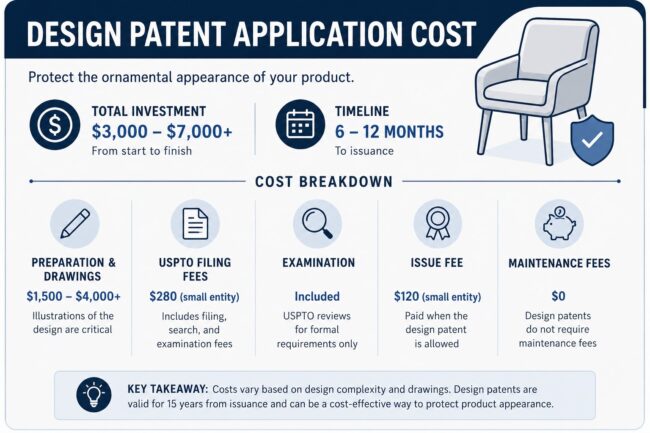
Many independent inventors look for ways to reduce patent application cost through DIY filing or low-fee online services. These options carry real trade-offs in patent quality and enforceability.
A DIY approach means preparing and submitting your own provisional or non-provisional patent application, paying primarily government filing fees (often a few hundred dollars for micro entities). Total cash outlay might stay under $2,000–$3,000 including search tools, but the investment of personal time is substantial.
The main risks: incomplete specification that doesn't fully disclose all embodiments, weak or overly narrow claims, and difficulty enforcing the resulting patent against infringers. A quality patent application requires both technical depth and legal precision. In most cases, clients who file without professional help end up with patents that can't survive patent litigation.
Working with a registered patent attorney costs more upfront but produces better alignment with long-term business goals and improved odds of navigating patent law requirements successfully. A patent attorney is an even more important resource if you plan to seek patent rights in foreign countries. Pursuing patents in Europe, China, Japan, and other markets is highly complicated and requires knowledge of the Patent Cooperation Treaty (PCT) international patent application process, foreign patent processes, and relationships with counsel in the foreign jurisdictions.
Not every invention should be patented. The decision should be driven by expected revenue, competitive risk, and the role of patents in your broader intellectual property strategy.
A simple budgeting framework:
A good strategy is to stage spending on intellectual property matters. Start with a targeted prior art search and a provisional application to secure a filing date and patent pending status. Commit to the more expensive non-provisional patent application only if there is early market validation and consumer interest.
In some situations, trade secrets offer an alternative when reverse-engineering is difficult and long-term secrecy is realistic. Prepare for that conversation with your patent attorney.
Be candid about budget constraints, risk tolerance, and patent enforcement plans. Litigation costs can reach hundreds of thousands of dollars if infringement occurs. A proper patent application prepared by an experienced patent attorney carries significant cost, but it is an investment in robust intellectual property protection. Foregoing the cost of an expertly prepared patent applications may result in less money spent on the patent, but it may yield a patent with limited value and that provides limited protection.
Below are practical questions about patent application cost that give quick, concrete answers focused on U.S. patent practice as of 2025–2026. This section provides general information to help you determine your next steps.
A realistic budget for an individual working with a patent attorney is typically $5,000–$12,000 to draft and file a non-provisional utility patent application, with total costs through grant often reaching $15,000–$30,000. Design patent applications are cheaper than a utility patent application. Someone may be able to afford to complete a design patent application and obtain a granted patent for around $5,000–$8,000 total, but not a utility application.
A provisional application secures an early filing date and patent pending status for up to 12 months. This lets you postpone the cost of patent examination for a one-year provisional period, after which a non-provisional application must be filed. Provisional applications do not lead to granted patent rights. If the application filed as a provisional isn't followed by a non-provisional within 12 months, it expires. However, this does not reduce the eventual cost of the non-provisional utility patent application. It mainly buys time for market testing and investor outreach before you commit to the full expense. The cost of a provisional patent application may be a little lower than a full-blown non-provisional patent application. However, you want the provisional to be as complete as possible and as similar to the non-provisional as possible. This is because the provisional must provide adequate support and enablement for the claims in the non-provisional application.
U.S. inventors are legally allowed to file their own patent applications and pay only USPTO filing fees, which might be a few hundred dollars for a micro entity. However, self-drafted applications frequently omit key details or lack strong claims, which can severely limit enforceability. DIY is usually best reserved for inventors who accept these risks and are comfortable learning the patent system in depth.
Most quotes cover only drafting, filing, and sometimes early prosecution stages. Maintenance fees due years later are almost never included. Estimates from your attorney should outline expected total lifecycle costs so there are no surprises down the road. Always request a full breakdown before you commit.
Pursuing patent protection in several major markets (U.S., Europe, China, Japan) can push total costs for one invention above $100,000 over time once translation, local attorney fees, national filing fees, and prosecution are factored in. Many companies start with a single PCT international patent application (with filing fees ranging from $3,500–$8,000 in fees) to keep options open for up to 30 months while deciding which markets justify the investment.
© 2026 Sierra IP Law, PC. The information provided herein does not constitute legal advice, but merely conveys general information that may be beneficial to the public, and should not be viewed as a substitute for legal consultation in a particular case.
Trade secret litigation involves legal action to protect confidential business information from misappropriation. For a company, trade secrets can be valuable intellectual property, sometimes constituting a large proportion of the business value, because they may include customer lists, business plans, data compilations, manufacturing methods, chemical formulations, source code, processes, pricing, technology, and other proprietary information.
Under federal trade secret law, a trade secret includes financial, business, scientific, technical, economic, or engineering information if the owner has taken reasonable measures to keep it secret and the information derives independent economic value from not being generally known or readily ascertainable through proper means. See 18 U.S.C. § 1839(3). Courts often focus on two key elements: whether the information was actually secret and valuable, and whether the company made reasonable efforts to protect trade secrets through confidentiality agreements, access controls, policies, employee training, and careful disclosure practices.
The two major federal statutes are the Economic Espionage Act of 1996 (EEA) and the Defend Trade Secrets Act of 2016. The federal Defend Trade Secrets Act (DTSA) allows a trade secret misappropriation lawsuit if the trade secret relates to a product or service used in interstate or foreign commerce. See 18 U.S.C. § 1836(b)(1). At the state level, the Uniform Trade Secrets Act provides the model framework for trade secret protection. The Uniform Trade Secrets Act (UTSA) has been adopted by most states, though New York is a non-UTSA jurisdiction with its own approach.
A trade secret dispute may involve departing employees, industrial espionage, breach of contract, or inadvertent or unauthorized disclosure to competitors. These disputes frequently arise when employees leave for competitors and are accused of taking sensitive trade secret information. Examples of such trade secret information includes clients’ data, customer lists, pricing information, product roadmaps, business plans, source code, manufacturing methods, or other confidential information stored on laptops, cloud accounts, email systems, thumb drives, or personal devices.
In trade secret litigation matters, the central issue is not whether the former employee had knowledge of the company’s business, but whether the employee engaged in trade secret misappropriation by improperly acquiring, copying, retaining, or using information that qualifies as a trade secret. The employee is generally not restricted from using the knowledge they gained at their former employer. They are only restricted from using specific trade secrets owned by the former employer. The former employer must demonstrate that the employee shared trade secret material or knowledge or otherwise utilized the former employer's trade secrets. That is, the information must be secret and maintained as secret by reasonable precautions and measures, and derive independent economic value to the former employer from the secrecy of the information.
To demonstrate trade secret status of the information at issue, employers often point to confidentiality agreements, non-disclosure agreements, invention assignment agreements, computer-use policies, and exit certifications to show that the employee had a duty to protect confidential information. These are all indicia of "reasonable efforts" to maintain secrecy of the information. The accused employee or new employer may defend themselves against trade secret misappropriation claims by asserting and demonstrating that they did not share or utilize any trade secret information, and/or that the information they allegedly used or shared was generally known, readily ascertainable, independently developed, or obtained through proper means.
Trade secret cases can also arise between business partners, vendors, contractors, manufacturers, consultants, or joint venture participants. For example, a company may share proprietary information during a potential transaction or development project, only to later suspect that the recipient used the information for its own benefit. Because trade secrets often include valuable intellectual property and business information, early investigation is critical. Companies typically review access logs, device activity, downloads, cloud transfers, and communications to determine whether misappropriation occurred and whether emergency court relief may be needed.
In trade secret litigation, a central question is whether the defendant obtained or used the plaintiff’s trade secrets through trade secret misappropriation, or whether the same knowledge was acquired through proper means. Under the DTSA, “misappropriation” includes acquisition, disclosure, or use by someone who knew or had reason to know the trade secret was acquired improperly through "improper means”, such as theft, bribery, misrepresentation, or breach of a duty of secrecy. Proper means include independent development, independent derivation, reverse engineering, and other lawful acquisition. See 18 U.S.C. § 1839(5)–(6). This distinction matters in disputes involving departing employees and competitors, because trade secret law protects secret business information, not general skill, experience, or public knowledge.
Taking proprietary information by knowingly transferring files, taking images and video, and receiving secret information from an employee are obviously improper means. However, there are some edge cases that one may question and debate. The key issue is whether the defendant breached reasonable measures of secrecy in order to gain access to the information. The following case is an illustrative example of such an edge case. In E.I. duPont deNemours & Co. v. Christopher, 431 F.2d 1012 (5th Cir. 1970), DuPont was constructing a methanol plant using a confidential manufacturing process. Because the facility was not yet enclosed, parts of the process were visible from above. Photographers, allegedly hired by an unknown third party, flew over the site and took aerial photographs that DuPont claimed would allow a skilled person to deduce the secret process. The Fifth Circuit held that aerial surveillance could be an improper means of acquiring trade secrets even without physical trespass and even if the flight itself complied with aviation law. The court reasoned that competitors may not bypass reasonable secrecy measures through industrial espionage. The case shows that lawful competition permits independent development and reverse engineering, but not calculated efforts to capture valuable confidential information.
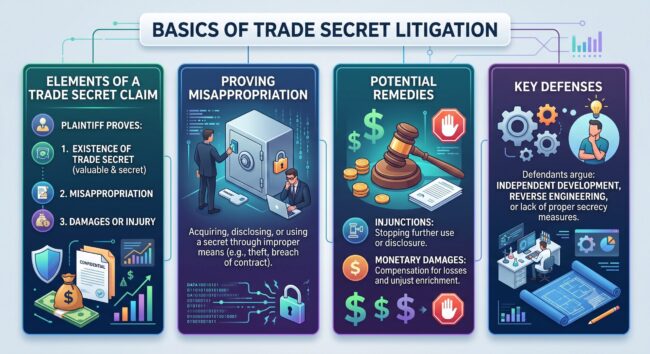
Emergency relief is often one of the first major steps in trade secret litigation, especially where a company believes trade secret misappropriation is ongoing or imminent. In many trade secret cases, the plaintiff may ask the court for a Temporary Restraining Order (TRO) followed by a preliminary injunction. These forms of relief are designed to preserve the status quo and stop the defendant from further using, disclosing, copying, transferring, or benefiting from the alleged trade secret before the case reaches final judgment.
Injunctions are court orders prohibiting the defendant from further using or disclosing the trade secret. Injunctions can be issued by a court to prevent specific conduct, such as using confidential source code, contacting customers from a stolen customer list, manufacturing a product using protected processes, or sharing proprietary information with competitors. Federal Rule of Civil Procedure 65 governs TROs and preliminary injunctions, including notice requirements, the need for specificity, and potential security bonds. To obtain emergency relief, a plaintiff typically must show a likelihood of success on the merits, irreparable harm, that the balance of equities favors relief, and that an injunction serves the public interest. See Winter v. Natural Resources Defense Council, Inc., 555 U.S. 7 (2008).
Under the DTSA, federal courts may grant injunctions to prevent actual or threatened misappropriation. See 18 U.S.C. § 1836(b)(3)(A). However, it should be noted that the DTSA limits injunctions that would prevent a person from accepting employment based merely on information the person knows, rather than evidence of threatened misuse. This makes early evidence, such as forensic findings, downloads, deleted files, suspicious access, or confidentiality agreement breaches, critical in emergency trade secret disputes.
Procedures in trade secret litigation often move quickly because the alleged harm may involve ongoing use or disclosure of sensitive information. Early in a trade secret dispute, a company may seek forensic investigation of laptops, phones, cloud accounts, email systems, USB activity, downloads, and file-transfer records to determine whether departing employees copied confidential information, customer lists, business information, data compilations, processes, manufacturing methods, or other proprietary information. These forensic issues are often central to proving or defending against claims of trade secret misappropriation.
Discovery may include expedited discovery, document requests under Federal Rule of Civil Procedure 34, depositions under Federal Rule of Civil Procedure 30, subpoenas to third parties under Federal Rule of Civil Procedure 45, expert analysis, and motions for injunctive relief under Federal Rule of Civil Procedure 65. In many trade secret cases, the plaintiff must identify the alleged trade secrets with enough specificity to allow the defendant to understand the claims and to separate alleged trade secrets from general knowledge, independent development, reverse engineering, or information that is readily ascertainable through proper means.
Because litigation itself can create a risk of inadvertent disclosure, courts routinely enter protective orders. Federal Rule of Civil Procedure 26(c)(1)(G) permits courts to restrict disclosure of “a trade secret or other confidential research, development, or commercial information.” Similarly, 18 U.S.C. § 1835 requires courts to preserve secrecy in proceedings involving federal trade secret law. Protective orders may limit access to attorneys, experts, company representatives, or outside consultants; require secure handling of source code or technical files; and control how confidential information may be filed, reviewed, or used in court.
When a trade secret is misappropriated, courts may impose injunctive relief and award damages. Monetary damages can include the plaintiff’s actual loss, the defendant’s unjust enrichment, or a reasonable royalty. See 18 U.S.C. § 1836(b)(3)(B). The court may award court costs and fees to the prevailing party, but the prevailing litigant may recover reasonable attorney’s fees only for bad-faith claims or willful and malicious misappropriation under the DTSA and under state law where the UTSA has been adopted.
Individuals convicted of criminal trade secret theft under the EEA can face severe fines and up to ten years in prison under current 18 U.S.C. § 1832.
Trade secret litigation can be expensive and disruptive. Trade secret litigation can cost in the millions of dollars due to the painstaking nature of the investigation and discovery process. Trade secret cases can be high stakes because the misappropriated trade secrets often relate to critical technology and products. In 2020, federal trade secret cases reportedly produced about $3 billion in damages, with the five largest awards exceeding $100 million each. Federal lawsuits involving trade secret disputes can also take several years to resolve. See Stout’s 2020 Trade Secrets Research Report.
Trade secrets and patents are both forms of intellectual property, but they differ significantly in terms of protection duration and requirements. Patents provide a limited monopoly for a specific period, while trade secrets can be protected indefinitely as long as they remain confidential.
Despite the distinctions, trade secrets and patents are often asserted in the same litigation when a dispute involves both patent infringement and trade secret misappropriation. For example, a company may allege that a competitor copied patented technology while also stealing related proprietary information, such as manufacturing methods, source code, customer data, testing protocols, or business processes that were never disclosed in the patent.
These claims protect different interests. Patent protection covers inventions claimed in official patent rights issued by the United States Patent and Trademark Office and may support infringement claims under federal patent law, including 35 U.S.C. § 271. Unlike patents, trade secrets do not require registration, patent applications, or full disclosure to the public. Instead, trade secret law protects confidential information that has economic value because of its secrecy, provided the owner used reasonable measures to keep it confidential. See 18 U.S.C. §§ 1836, 1839.
In combined cases, courts often examine whether the alleged trade secrets are truly separate from what was publicly disclosed in patents or published patent applications. If the information is already publicly available or readily ascertainable, it may not qualify for trade secret protection. But confidential know-how surrounding a patented product can still be protected.
Trade secret litigation can affect the core value of a business because it often concerns confidential information that drives revenue, customer relationships, product development, and competitive advantage. For business owners, the strongest position is usually built before a dispute arises: clear confidentiality agreements, careful employee onboarding and exits, limited access to sensitive information, documented reasonable measures, and prompt forensic investigation when misuse is suspected. Once litigation begins, the case may move quickly through requests for emergency relief, discovery, protective orders, damages analysis, and disputes over whether the information was truly secret or obtained through proper means. Understanding this process helps companies respond decisively to trade secret theft, protect valuable trade secrets, and reduce the risk that confidential business information will be lost through disclosure, employee departures, or competitor misuse.
© 2026 Sierra IP Law, PC. The information provided herein does not constitute legal advice, but merely conveys general information that may be beneficial to the public, and should not be viewed as a substitute for legal consultation in a particular case.

Sierra IP Law, PC - Patents, Trademarks & Copyrights
FRESNO
7030 N. Fruit Ave.
Suite 110
Fresno, CA 93711
(559) 436-3800 | phone
BAKERSFIELD
1925 G. Street
Bakersfield, CA 93301
(661) 200-7724 | phone
SAN LUIS OBISPO
956 Walnut Street, 2nd Floor
San Luis Obispo, CA 93401
(805) 275-0943 | phone

SACRAMENTO
180 Promenade Circle, Suite 300
Sacramento, CA 95834
(916) 209-8525 | phone
MODESTO
1300 10th St., Suite F.
Modesto, CA 95345
(209) 286-0069 | phone
SANTA BARBARA
414 Olive Street
Santa Barbara, CA 93101
(805) 275-0943 | phone
SAN MATEO
1650 Borel Place, Suite 216
San Mateo, CA, CA 94402
(650) 398-1644. | phone
STOCKTON
110 N. San Joaquin St., 2nd Floor
Stockton, CA 95202
(209) 286-0069 | phone
PORTLAND
425 NW 10th Ave., Suite 200
Portland, OR 97209
(503) 343-9983 | phone
TACOMA
1201 Pacific Avenue, Suite 600
Tacoma, WA 98402
(253) 345-1545 | phone
KENNEWICK
1030 N Center Pkwy Suite N196
Kennewick, WA 99336
(509) 255-3442 | phone
2023 Sierra IP Law, PC - Patents, Trademarks & Copyrights - All Rights Reserved - Sitemap Privacy Lawyer Fresno, CA - Trademark Lawyer Modesto CA - Patent Lawyer Bakersfield, CA - Trademark Lawyer Bakersfield, CA - Patent Lawyer San Luis Obispo, CA - Trademark Lawyer San Luis Obispo, CA - Trademark Infringement Lawyer Tacoma WA - Internet Lawyer Bakersfield, CA - Trademark Lawyer Sacramento, CA - Patent Lawyer Sacramento, CA - Trademark Infringement Lawyer Sacrament CA - Patent Lawyer Tacoma WA - Intellectual Property Lawyer Tacoma WA - Trademark lawyer Tacoma WA - Portland Patent Attorney - Santa Barbara Patent Attorney - Santa Barbara Trademark Attorney
