When a trademark application faces a final refusal from the United States Patent and Trademark Office (USPTO), the applicant isn’t out of options. U.S. trademark law provides a process to appeal such refusals to a specialized administrative tribunal called the Trademark Trial and Appeal Board (TTAB). A trademark appeal in this context refers to requesting TTAB review of an examining attorney’s final refusal to register a mark. The TTAB is the USPTO’s appeal board for trademark matters. It is a venue where business owners and trademark applicants can challenge an examining attorney’s decision or resolve certain disputes over trademark registrations. This article discusses trademark appeals before the TTAB, explains how the appeal process works, and discusses the options after a TTAB decision.
The Trademark Trial and Appeal Board (TTAB) is a neutral administrative body within the USPTO that functions like a court for trademark matters. It is composed of administrative trademark judges (ATJs) appointed for their expertise in trademark law. These judges sit in panels of three to decide cases. The TTAB’s authority is limited to determining a party’s right to federal trademark registration. The TTAB does not decide whether someone can use a mark in commerce, nor does it handle trademark infringement disputes or award damages. In other words, the Board can affirm or overturn decisions about registration (such as refusals by USPTO examiners or outcomes of oppositions), but it cannot stop someone from using a trademark or resolve unfair competition claims.
The TTAB’s role is strictly about the federal registration of trademarks with the USPTO. Any matter beyond the right to registration, like injunctions or monetary remedies, a party would have to go to a court, not the TTAB. The TTAB acts as an appeal board for applicants who have been denied a registration, and as a trial tribunal for certain disputes involving trademark applications or registrations. It operates under the Lanham Act (Trademark Act of 1946, 15 U.S.C. § 1051 et seq.) and the USPTO’s Trademark Rules (37 C.F.R. Parts 2 and 7), with procedures outlined in the Trademark Trial and Appeal Board Manual of Procedure (TBMP).
These are appeals by a trademark applicant against a final refusal issued by a USPTO examining attorney. “Ex parte” means only one party (the applicant) is formally involved opposite the USPTO. Common reasons for refusals include a finding that the proposed mark is descriptive, generic, confusingly similar to an existing mark, or otherwise barred by the Trademark Act. Each year, the TTAB decides hundreds of such appeals from final refusals issued by USPTO examining attorneys. If an applicant receives a final refusal, they may appeal that decision to the TTAB as a matter of right, under Trademark Act § 20 (15 U.S.C. § 1070).
These are adversarial cases between two or more parties (“inter partes” meaning between parties) before the TTAB. The most common types are oppositions and cancellation proceedings. In an opposition, a party files a notice opposing another’s application after it has been published for opposition, arguing that the applied-for mark should not register, for example, due to likelihood of confusion with the opposer’s mark.
In a cancellation proceeding, a party petitions to cancel an existing trademark registration for reasons such as the mark has become generic, has been abandoned, or was obtained by fraud. The TTAB also handles concurrent use proceedings resolving situations where two parties seek rights to use similar marks in different geographic areas. There are also new expungement and reexamination proceedings recently created by the Trademark Modernization Act in 2020. The proceedings can be used to remove registrations for non-use.
These inter partes cases resemble litigation. They involve pleadings, discovery, submission of evidence, and trial briefs, though usually no live courtroom testimony. An interlocutory attorney at the TTAB may oversee the preliminary stages of such cases, handling motions and managing the case schedule. All parties should be mindful that TTAB trial proceedings are governed by many of the same principles as civil litigation. The TTAB adapts the Federal Rules of Civil Procedure to its practice, albeit with the focus solely on the right to register a trademark.
In summary, ex parte appeals involve an applicant appealing a USPTO refusal with the examining attorney on the other side, defending the refusal, whereas inter partes TTAB proceedings involve two private parties disputing rights to registration: e.g. whether a mark should be registered or a registration should be canceled. Both fall under the TTAB’s jurisdiction.
If you’re a trademark applicant who has received a final refusal from a USPTO trademark examining attorney, an ex parte appeal to the TTAB is the next available avenue to pursue a registration. A final refusal (a “Final Office Action”) typically follows an initial refusal and the applicant’s response. It indicates that the examiner is maintaining the refusal and considers the matter closed at the examination level. Common grounds for final refusals include the mark is confusingly similar to a registered mark, the mark is merely descriptive or generic for the goods/services, the mark is a surname or geographically descriptive, the specimen was deficient, and other bases. Whatever the grounds, a final refusal means the USPTO will not register the mark as-is.
At this point, the applicant has options: they can file a Request for Reconsideration with the examiner to attempt one more time to overcome the refusal, and/or file an appeal to the TTAB. Importantly, filing a request for reconsideration does not extend the deadline to appeal. Trademark Rule 2.141 and the Lanham Act provide that an applicant must file the appeal within six months from the date of the final action, along with payment of the required appeal fee. You must pay the prescribed fee for each class of goods or services in the application that you wish to appeal. Missing this deadline or failing to pay the fee will result in losing the right to appeal, and the application will go abandoned after six months.
To file the appeal, the applicant submits a Notice of Appeal through the USPTO’s electronic filing system (ESTTA) under the application serial number. The Notice of Appeal is a simple document indicating the applicant’s intent to appeal the examiner’s decision. Once the TTAB receives the notice and fee, it will institute the appeal and set the schedule for briefs.
It’s worth noting that ex parte appeals to the TTAB are only for substantive issues (e.g., whether the law was correctly applied to refuse the mark). If the issue is a purely procedural one or a requirement of form, such an issue should be pursued through a petition to the Director rather than an appeal. For most final refusals on substantive grounds, however, an appeal is the proper course.
Once an ex parte appeal is underway, the process before the TTAB unfolds in a series of steps. Here is a step-by-step overview of a typical trademark appeal before the TTAB:
Throughout the appeal process, the TTAB is acting as an administrative appellate tribunal reviewing the examining attorney’s decision. It is crucial to present a thorough and persuasive brief, as that is the primary basis on which the TTAB will make its decision.
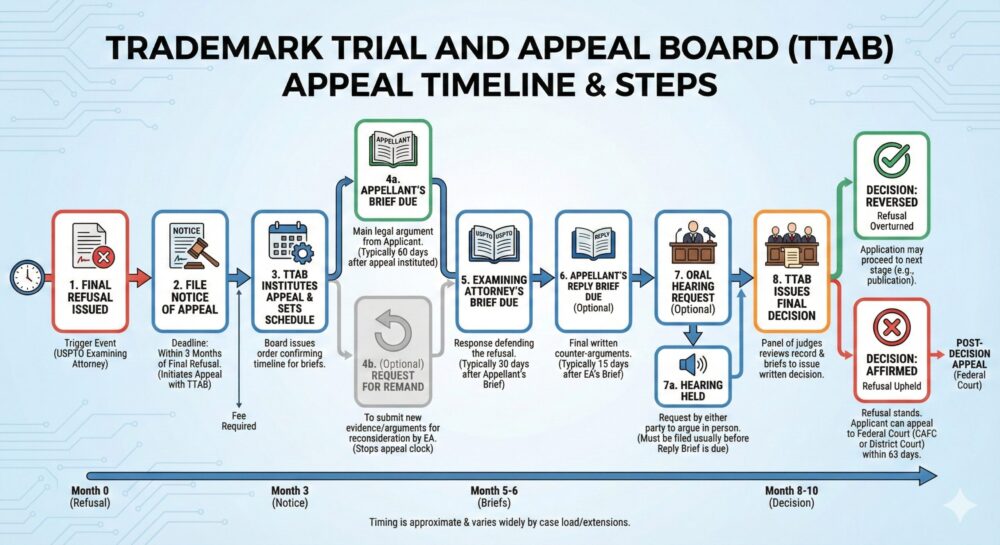
A TTAB decision isn’t necessarily the final word. If a party is unhappy with the Board’s decision, they have the right to seek further review in court. The Lanham Act § 21 (15 U.S.C. § 1071) provides two alternative routes for appealing a TTAB decision:
This is a direct appeal to a federal appellate court in Washington, D.C. The Federal Circuit has nationwide jurisdiction over patent and trademark appeals. An appeal to the Federal Circuit of an ex parte appeal must be filed within the prescribed time (60 days from the TTAB decision). This route is essentially an appellate review on the existing record; no new evidence is allowed. The Federal Circuit will review the TTAB’s legal conclusions de novo for legal issues and factual findings with deference if supported by substantial evidence. The appeal is decided on legal briefs and oral argument in front of a panel of Federal Circuit judges. This option is often chosen when the record made at the TTAB is strong and the appellant believes the TTAB made an error of law, an unreasonable factual finding, or other extraordinary circumstances. It is generally a faster and more streamlined process than a new lawsuit, but it offers no opportunity to introduce additional evidence.
The other option is to file a civil action in a U.S. District Court in lieu of a direct appeal. The lawsuit for ex parte appeal cases is filed against the USPTO to obtain a judgment on entitlement to registration. The applicant files suit against the USPTO Director in the Eastern District of Virginia, where the USPTO is based. This route, provided by 15 U.S.C. § 1071(b), allows the case to be heard as a new civil lawsuit. New evidence can be introduced, and the normal civil litigation process (discovery, live testimony, etc.) is available. One strategic advantage of the civil action route is the ability to strengthen the evidentiary record. For example, an applicant can bring in new consumer surveys or other evidence that wasn’t available during the TTAB case. The case is heard by a district court judge, and the court will make its own findings, effectively treating the matter as a new case though the TTAB record is usually submitted and considered by the court. Discovery can be conducted by the parties in the civil action, something not available in a direct appeal.
Choosing the civil action route in lieu of a direct appeal to the Federal Circuit is mutually exclusive. If you go to district court, you forego the direct appellate route. The Lanham Act was designed this way to give disappointed parties a chance to have a full trial if they want, but not to allow two bites at the apple. Also, note that if you file a civil action, you will bear the cost of what can be a full litigation process, and the USPTO can seek reimbursement of its expenses if it prevails under 15 U.S.C. § 1071(b)(3). By contrast, a Federal Circuit appeal is generally limited to attorney’s fees and costs for the briefs. So the choice between an appeal and a lawsuit in district court may depend on how important the registration is, whether you have new evidence that could change the outcome, the resources at your disposal, and sometimes which forum might be more favorable for the legal issues at hand. Consulting with a trademark attorney is wise at that juncture to make the optimal choice.
In summary, a TTAB appeal or proceeding is a critical juncture in the life of a trademark application or registration. By understanding the process and rules you can make informed decisions to protect your brand. Being proactive and knowledgeable will serve you well. Most importantly, don’t hesitate to seek professional guidance; trademark appeals involve nuanced law and procedure, but with the right approach, many applicants and brand owners have success in the process and secure their trademarks. If you are considering a trademark appeal or need assistance with another intellectual property matter, contact our office for a consultation.
© 2025 Sierra IP Law, PC. The information provided herein does not constitute legal advice, but merely conveys general information that may be beneficial to the public, and should not be viewed as a substitute for legal consultation in a particular case.
It is generally known that patents are forms of intellectual property that provide exclusive rights to innovations. However, it is less commonly known that there are different patent types that protect different types of innovation. In the United States, inventors can seek utility patents or design patents, as well as the less common plant patents, depending on what type of innovation they wish to protect. A utility patent protects an invention: a functional device, composition, or method. A design patent protects a novel ornamental design. To put it simply, a utility patent protects how something works and a design patent protects how something looks.
Each type of patent is granted by the United States Patent and Trademark Office (USPTO) and gives the patent holder exclusive rights to prevent others from making, using, selling, or importing the patented product or process. This article breaks down utility patents vs. design patents, explaining the differences in scope, application process, costs, and legal effect under U.S. patent law.
U.S. patent law provides for three primary types of patents: utility patents, design patents, and plant patents. The vast majority of patent applications filed are utility patent applications, reflecting their broad use in protecting functional inventions. Utility patents cover new and useful processes, machines, manufactures, compositions of matter, and methods: essentially the functional or technical innovations (35 U.S.C. § 101). Design patents, by contrast, cover any new, original, and ornamental design for an article of manufacture (35 U.S.C. § 171). There is also the plant patent for new varieties of plants that are asexually reproduced (e.g. by grafting or cloning), which protects distinct new plant varieties, including cultivated sports and mutants, under 35 U.S.C. § 161.
Utility patents may be obtained for inventions or discoveries in any field of technology, covering new and useful processes, machines, articles of manufacture, or compositions of matter. For example, a utility patent could cover a new engine design, a pharmaceutical composition, a software algorithm, or any improvement that is useful and meets the legal requirements of novelty and non-obviousness. In order to get a utility patent, the invention must be novel (not "anticipated" by prior art) and non-obvious (not an obvious variation of existing technology) under patent law.
The utility patent application is typically a detailed document that includes a written description, drawings, and a set of patent claims defining the scope of the invention’s protection. Unlike design patents, utility patent applications can contain multiple claims, including independent and dependent claims, to cover different aspects or embodiments of the invention. These claims delineate the legal boundaries of the invention’s functional monopoly.
Once granted, a utility patent lasts for 20 years from its filing date for applications filed since June 8, 1995 (subject to limited extensions or adjustments), and periodic maintenance fees are required to keep the patent in force at 3.5, 7.5, and 11.5 years after issuance. Failure to pay maintenance fees will cause a utility patent to expire before the end of its term. Utility patents can provide broad protection over how a product or process functions. A competitor’s product that performs the same function in the same way may infringe a utility patent even if the competitor’s product looks different or doesn't perform all of the functions the patentee's product.
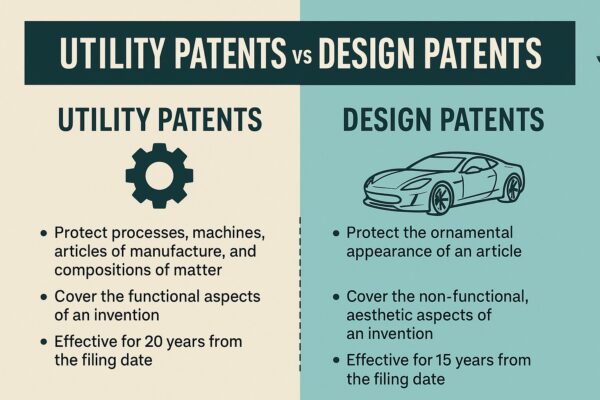
A design patent protects the ornamental design of an article of manufacture: essentially the product’s aesthetic appearance or surface ornamentation, not its utilitarian function. In simpler terms, a design patent safeguards how a product looks, as opposed to how it works. For example, the unique shape of a beverage bottle, the decorative pattern on a shoe, or the GUI icon design for an app could be protected by a design patent, so long as the design is new, original, and not dictated by purely functional considerations. If a design is “primarily functional” rather than ornamental, it is not eligible for a design patent.
The design must be embodied in or applied to an actual article of manufacture and cannot exist independently as a mere artistic concept. A design patent application consists mostly of drawings or photographs illustrating the article’s appearance from various views, and it includes only a single claim that defines the ornamental design for the article as shown and described. Unlike utility patents, there is no provision for multiple claims or multiple distinctly different designs in one design patent – if multiple distinct designs are disclosed, the USPTO will require restriction to one design per application.
Design patent applications also do not allow for a provisional application as a priority filing. This contrasts with utility patents, which can claim the benefit of a provisional patent application. If granted, a design patent gives its owner the exclusive right to the ornamental design, and it lasts for 15 years from the date of grant for design applications filed on or after May 13, 2015. Notably, no maintenance fees are required to maintain a design patent once issued. This makes design patents relatively low-cost to keep in force.
Design patent protection is narrower in scope than utility protection: it covers only the specific visual design shown in the drawings and colorable imitations thereof, and no functional features of the article. However, design patents are powerful in preventing look-alike products. If an infringing product has an appearance that is substantially similar to the patented design to the eye of an ordinary observer, it will infringe the design patent. In litigation, courts apply the “ordinary observer” test for design patent infringement, asking whether an ordinary purchaser, giving the attention usually given, would be deceived into thinking the accused design is the same as the patented design.
This test was established in Gorham Co. v. White, 81 U.S. 511 (1871), and was later modified to specify that any functional features or features that are present in the prior art will be considered in evaluating whether the ordinary observer would consider the designs to be substantially the same. Functional features are not considered as part of the design in infringement analysis. OddzOn Products, Inc. v. Just Toys, Inc., 122 F.3d 1396 (Fed. Cir. 1997). Also, the ordinary observer is considered to be aware of similar prior art designs. If there are similar prior art designs to the patented design, even small differences between the patented design and an allegedly infringing design may result in the court finding no infringement. Egyptian Goddess, Inc. v. Swisa, Inc., 543 F.3d 665 (Fed. Cir. 2008).
While both utility and design patents confer exclusive rights to their owners, they differ in fundamental ways. The table below summarizes the key differences between utility patents and design patents under U.S. law:
| Aspect | Utility Patent | Design Patent |
| What it Protects | Functional inventions: the use, operation, or structure of a process, machine, manufacture, or composition of matter (how an invention works). Protects utility or functionality, not appearance. | Ornamental designs: the visual design and ornamental characteristics of an article of manufacture. Protects aesthetic features only, not function or use. |
| Subject Matter Examples | Must have utility (practical use). A novel processes, machines, articles of manufacture, compositions of matter, or method. E.g., new engine mechanism, chemical formula, electronic circuit, software process. | Any new, original, ornamental design applied to a product. Must be primarily aesthetic, not dictated by functional features. E.g. new product shape, decorative pattern, user-interface icon design. |
| Claims | Can have multiple claims defining different aspects or embodiments of the invention. Claims describe the functional features in words. | Only a single claim is allowed, generally of the form “the ornamental design for [article] as shown and described”. The scope is defined by the drawings, and the claim covers the overall design shown. |
| Term (Duration) | 20 years from filing date of the application, subject to payment of maintenance fees and any patent term extensions/adjustments. | 15 years from grant date for design applications filed on or after 5/13/2015. Design patents filed earlier last 14 years from grant. |
| Maintenance Fees | Maintenance fees must be paid at 3.5, 7.5, and 11.5 years after issuance to keep patent enforceable. If not paid, the patent expires early. | No maintenance fees are required after a design patent is issued. The patent remains in force for the full 15-year term without additional fees. |
| Application Process | Can start with a provisional patent application (optional) to secure a filing date, followed by a non-provisional utility patent application with a full description, claims, and often many drawings. Utility applications undergo substantive examination on usefulness, novelty (35 U.S.C. § 102) and non-obviousness (35 U.S.C. § 103). Publication usually occurs 18 months after filing. | No provisional applications for designs (design apps must be filed directly as a design application). The design application consists primarily of formal drawings of the article from multiple views and a brief description. Examination focuses on whether the design is new and non-obvious over prior designs. Design applications are not published pre-grant: they remain confidential until the patent is granted. |
| Cost and Complexity | Typically more expensive and complex: attorney fees and USPTO fees are higher, due to longer applications with multiple claims and longer prosecution. Legal costs can be significant, and it may take 2~3 years for patent grant. | Generally less expensive and faster. Design patents often have lower filing and attorney fees. The process is quicker: many design patents issue within 1~2 years. Overall legal costs are lower, and no maintenance fees adds to cost savings. |
| Scope of Protection | Functional scope: The protection of the invention resides in the written claims. Any product or process that performs all of the patented function or uses the patented features infringes the claim. Even if a competitor changes the look, if they appropriate the patented functional elements, it infringes. Allows for broad market exclusion of competing technologies. | Ornamental scope: The protection resides in the aesthetic aspects of the design drawings. Products with an appearance that is substantially similar to the patented design to an ordinary observer. Functional or internal features are not covered. Competitors can copy function, not appearance. |
| Infringement Test | Infringement of a utility patent is determined by comparing the patent’s written claims to the accused product/process: if the product includes each element of at least one claim (either literally or via an equivalent), it infringes. The focus is on functional elements as defined in words by the claims. | Infringement of a design patent is determined by the ordinary observer test: would an ordinary purchaser view the accused design and the patented design as substantially the same, such that they would be confused or deceived into thinking they are the same design? If yes, infringement is found. |
| Examples | A new type of smartphone battery that lasts longer (functional improvement), a new manufacturing process for steel, a pharmaceutical drug formula: all protect how something works or is made. | The unique shape of a smartphone’s edge or its icon layout, the pattern of a sneaker’s sole, the ornamental design of a lamp: all protect the appearance only, and not the function of the item. Often used to protect product styling and brand-specific product designs. |
The process of obtaining a utility vs. design patent also differs. For a utility patent application, inventors often begin with a patentability search (patent search) to identify prior art and evaluate if the invention is novel and non-obvious. One may first file a provisional patent application to secure an early filing date and the term “patent pending,” then file a full non-provisional application within 12 months. The provisional itself is not examined and will lapse if not followed by a full application.
The non-provisional utility application must include a thorough written description of the invention, any necessary drawings, and at least one claim. It is examined by the USPTO for compliance with legal requirements: patent eligible subject matter (35 U.S.C. § 101), novelty (35 U.S.C. § 102), non-obviousness (35 U.S.C. § 103), and adequacy of disclosure (35 U.S.C. § 112). The patent examination process (patent prosecution) can involve back-and-forth with the patent examiner through office actions and responses, and may take a few years before a patent is granted. It is recommended that Applicants hire a registered patent attorney to draft and prosecute a utility patent application, given the complexity of patent drafting and prosecution.
For a design patent application, the process is generally simpler. A design application typically consists of a title, a description of the figures, one claim, and a set of formal drawings (or photographs) showing the article from multiple perspectives (e.g., front, rear, top, bottom, left, right, and any perspective views needed) in accordance with USPTO drawing rules.
Because design patents protect only the ornamental appearance, the drawings are crucial. The drawings define the scope of what the design patent protects. The drawings must capture every ornamental feature, present the design consistently throughout, and conform with all design requirements under the US patent law and the USPTO's design rules. The drawings have highly specialized form, and thus it is recommended that the applicant utilize the services of a patent attorney or law firm with experience in the design patent field.
The design application is examined mostly for novelty and non-obviousness over prior art designs. The same statutory standards of patentability apply, with 35 U.S.C. § 102 and § 103 requiring the design to be new and non-obvious. Often the examination of design applications is faster and more straightforward, though examiners may issue rejections if they find similar prior designs or if the drawings have any formal issues.
It’s worth noting that effective January 2024, the USPTO established a separate design patent practitioner bar for practitioners specializing only in design patent matters. A person with the appropriate background can become a registered patent agent in the design patent specialty without an engineering or science background. This underscores that design patent practice is a highly defined and specialized field. While sharing some fundamentals with utility patent practice, design patent practice has its own nuances, such as drawing requirements and restriction practices.
Cost considerations are often a deciding factor in choosing between utility and design patent protection. A utility patent generally involves higher legal costs due to the length and complexity of the application. Drafting a solid utility patent and prosecuting it through potential rejections can cost several thousands to tens of thousands of dollars in attorney fees, depending on complexity. The USPTO filing, search, and examination fees for a utility application are also higher than for a design application.
In contrast, a design patent application is shorter and focused on drawings, which typically makes it significantly less expensive in terms of preparation and prosecution fees. Many design applications might cost on the order of a few thousand dollars total, including professional drawing preparation. As noted earlier, maintenance fees apply only to utility and plant patents, not to design patents. Utility patent maintenance fees add to the long-term cost of a utility patent. Design patent owners do not face this ongoing expense, as once a design patent is granted, it remains in force for its entire 15-year term without additional payments.
The patent term also differs: a utility patent lasts 20 years from the effective filing date. This term can provide long-lasting protection but note that the effective enforceable term is less than the full 20 years because the patent term is not tolled during application examination. Design patent term is 15 years from issuance. While shorter in number, the design patent term is counted from grant.
You can, of course, obtain both utility and design patents for any product that has both functional and ornamental features that are novel and non-obvious. The utility patent protects the functional concept for 20 years from filing, and the design patent protects the product’s appearance for 15 years from issue.
Both utility and design patents give the owner the right to exclude others from making, using, selling, or importing the patented invention in the United States, but what constitutes infringement differs between the two. With a utility patent, infringement is determined by analyzing the patent’s claims to determine whether an accused product or process contains every element of a patent claim or an equivalent thereto, under the doctrine of equivalents. If all the claim elements are met literally or by equivalents, then that product infringes the utility patent. This means a competitor cannot avoid infringement simply by making a product look different or by trivial changes. If the underlying functionality as defined in the claims is taken, it’s an infringement. For example, if a utility patent claim covers a machine with elements A, B, and C in combination, any machine that has those elements or equivalents thereof arranged as described will likely infringe, regardless of its outward appearance. Utility patent enforcement often involves technical analysis and possibly expert testimony to show how the accused device meets the claim limitations.
For a design patent, enforcement is more about visual comparison than technical analysis. The scope of a design patent is defined by the patented drawings, and an accused design must be compared to those drawings. In practice, courts and juries will often compare images of the patented design and the accused product side-by-side. If the overall aesthetic impression of the accused design is substantially the same as the patented design, such that an ordinary purchaser would likely confuse the two, infringement is found.
Remedies for infringement are similar for both types of patents. The patent holder can sue in federal court and seek an injunction to stop sales of the infringing product and monetary damages. Monetary damages can be the plaintiff's lost profits, or at least a reasonable royalty for the infringing use. One difference is that design patent infringement gives rise to the additional remedy of disgorgement of the infringer’s profits attributable to the design under 35 U.S.C. § 289. This is a powerful remedy. However, its scope was somewhat curtailed in the Apple v. Samsung design patent case. The court limited the disgorgement of profits remedy to the particular article of manufacture claimed in the design patent, rather than a complete product that incorporates the claimed article of manufacture. See Samsung Elecs. Co. v. Apple Inc., 137 S. Ct. 429 (2016).
Utility patent damages are typically based on patent holder’s lost profits or reasonable royalties, not the infringer’s total profits. The key takeaway is that a utility patent is a stronger tool against competing products that perform the same function, whereas a design patent is a precise tool against knock-offs that look the same. In many cases, if an invention has both novel functional and ornamental aspects, obtaining both types of patents can provide complementary protection.
If you plan to pursue international patent rights, you should understand how utility and design patents are treated internationally. Utility patents can be pursued in foreign countries by filing corresponding applications in each country or via the Patent Cooperation Treaty (PCT), which allows a unified international patent application that can later enter national phases in various countries. The PCT process is available for utility and plant inventions, not for designs. Under the Paris Convention, if you first file a U.S. utility patent application, you have 12 months to file corresponding foreign patent applications claiming that priority.
For designs, there is a separate international system under the Hague Agreement for Industrial Designs, which the U.S. has joined. The Hague system permits filing a single international Hague System design application to seek design protection in multiple member countries, simplifying the process of global design protection. If you first file a U.S. design patent application, you have 6 months to file design applications in other countries claiming priority.
It’s wise to consult with patent counsel about an international filing strategy. A registered patent attorney experienced in international filings can coordinate Patent Cooperation Treaty filings for utility inventions and Hague or direct filings for designs, helping ensure you meet all deadlines and requirements across jurisdictions. Keep in mind that patent rights are territorial. A U.S. patent (utility or design) only gives rights in the United States. To stop infringements in Europe or Asia, for example, you would need to have obtained the corresponding European or Asian patents/design protections.
Both utility and design patents are valuable tools in a company’s intellectual property arsenal, but they serve different purposes. In summary, utility patents protect functional innovations, the technical solutions and functional features that allow your product or process to operate, while design patents protect ornamental innovations, the aesthetic design and visual appeal that make your product look unique. Understanding the difference is crucial for developing a robust patent strategy: if you have invented a new product, you should consider whether there are novel functional aspects, ornamental aspects, or both.
Given the complexity of patent law and the importance of proper filings, you should strongly consider consulting with a registered patent attorney for guidance on patent searches, application preparation, and prosecution. Ultimately, securing the right type of patent protection will help safeguard your competitive advantage. If you need assistance with pursuing a patent application or other intellectual property matter, contact our office for a free consultation.
© 2025 Sierra IP Law, PC. The information provided herein does not constitute legal advice, but merely conveys general information that may be beneficial to the public, and should not be viewed as a substitute for legal consultation in a particular case.
The United States Patent and Trademark Office (USPTO) has two trademark registers: the Principal Register and the Supplemental Register. The Principal Register is the primary registry, offering the strongest protection for trademark owners, while the Supplemental Register is an alternative for marks that are not yet eligible for the Principal Register. The Supplemental Register is the only option for brand names that are deemed too descriptive or non-distinctive for the Principal Register. This article explains the Supplemental Register, the benefits and limitations of a supplemental registration, and how a mark on the Supplemental Register can eventually graduate to the Principal Register.
A trademark must be distinctive to qualify for the Principal Register. Distinctiveness means the mark can identify the source of goods or services and distinguish them from others. Marks are categorized by their inherent distinctiveness. Fanciful, arbitrary, or suggestive marks are made-up brand names or unrelated words (e.g., XEROX for copiers or Apple for computers), which are considered inherently distinctive and are eligible for principal registration.
By contrast, descriptive marks directly describe a quality, feature, or characteristic of the product or service, and are not inherently distinctive. For example, the term “Bed and Breakfast Registry” was found to be merely descriptive of lodging reservation services. Such a phrase describes the service’s purpose and does not inherently distinguish one business’s services from another’s. Under the Lanham Act, a merely descriptive or indistinctive trademark cannot be registered on the Principal Register unless the applicant proves the mark has acquired secondary meaning (also called acquired distinctiveness) in the minds of consumers.
Generic terms (common names of products/services) are never registrable on either register, since no one can own exclusive rights to a generic name. The key difference between descriptive and generic marks is that a generic word is the common name of the good or service, whereas a descriptive mark is descriptive of a quality or characteristic of the good or service. For example, the word CARS could never be registered for use in connection with the sale of automobiles. It is the actual word that names the goods. This is distinct from descriptive terms, such as luxury, reliable, fuel-efficient, and other terms that describe a feature, quality, or characteristic of the automobiles.
The Supplemental Register is essentially a fallback option when the applicant seeks a principal registration, but the applied-for mark lacks the necessary distinctiveness to be on the Principal Register. Section 23 of the Lanham Act (15 U.S.C. § 1091) provides that any mark capable of distinguishing an applicant’s goods or services, but that fails to qualify for the Principal Register, may be registered on the Supplemental Register if it is already in lawful use in commerce. In practice, this means marks that are merely descriptive, primarily geographically descriptive, or primarily merely a surname can be listed on the Supplemental Register when they cannot yet show the secondary meaning required for principal registration.
The Supplemental Register gives businesses a way to obtain a federal trademark registration for a mark that is non-distinctive now, with the hope that over time the mark will acquire distinctiveness through use. For instance, many surnames or descriptive marketing terms start out on the Supplemental Register and later become eligible for the Principal Register once consumers come to associate the term with a single source: i.e., the mark gains “secondary meaning”.
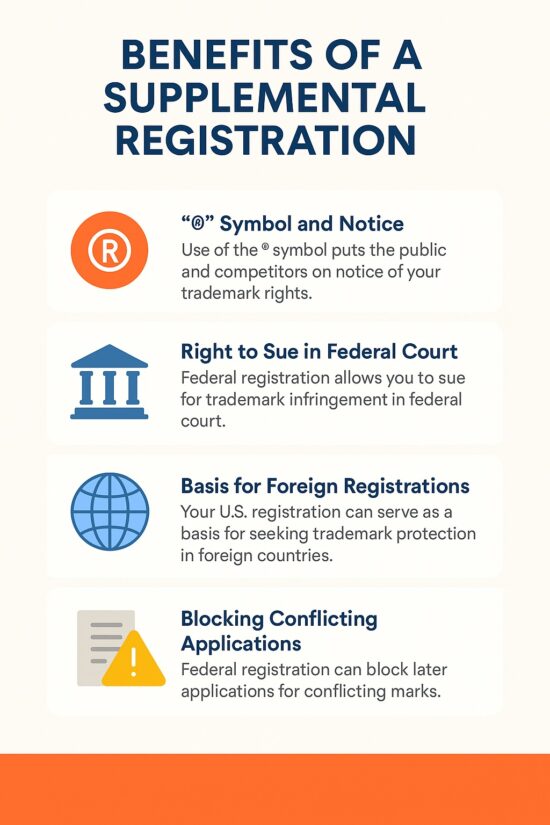
Even a federal trademark registration on the Supplemental Register provides some important benefits compared to having no federal registration at all. Marks registered on the supplemental register share a few of the advantages with the principal register:
Once your mark is federally registered, you can use the ® symbol with the mark. This puts the public and competitors on notice that you claim nationwide trademark rights in that name or logo. It can deter others from adopting a confusingly similar mark and signals that you, as the trademark owner, are serious about protecting your brand.
A federal registration (whether principal or supplemental) gives you the ability to sue for trademark infringement in federal court under the Lanham Act. In fact, 15 U.S.C. § 1121 and § 1111 allow registrants to bring infringement actions in federal court (and to recover certain remedies) even if the parties are in different states. While even unregistered marks can sometimes be protected under common law or §43(a) of the Lanham Act, owning a federal registration streamlines litigation and jurisdiction.
A U.S. registration on the Supplemental Register can serve as a basis for seeking trademark protection in foreign countries. Under international agreements like the Paris Convention, a U.S. trademark owner can use their U.S. application or registration to priority-file in other countries. Similarly, a U.S. registration can be used as the home registration for an international application through Madrid Protocol to extend protection abroad. This is a useful benefit for businesses planning to expand globally.
Importantly, any federal registration will be cited by the USPTO to refuse later applications for the same mark or a confusingly similar mark in related goods/services. In other words, once your mark is on the federal register (principal or supplemental), it can block others from registering a similar mark on either register. This can help protect your brand name from being registered by someone else and effectively “reserves” your place in line for the Principal Register once your mark becomes distinctive.
A trademark registered on the Supplemental Register does not carry all the benefits of a principal registration. Principal registrations have additional powerful rights granted by the Trademark Act. A Principal Register registration is considered “full” federal protection, and it offers trademark owners these key advantages that are not provided by a supplemental registration:
A principal registration grants the owner a nationwide exclusive right to use the mark on the goods/services listed, as of the filing date of the application. Under Lanham Act §7(c), the application’s filing date becomes the mark’s constructive use date, giving the registrant priority over others who started using the mark after that date. Additionally, once registered, the mark is listed in the USPTO database, which serves as constructive notice to the public of the registrant’s claim of ownership. This means no junior user can defend an infringement case by claiming they didn’t know of your mark.
A mark on the Principal Register comes with a statutory presumption that the trademark is valid, that the registrant is the lawful owner of the mark, and that the registrant has the exclusive right to use the mark nationwide for the identified goods or services. This is codified in 15 U.S.C. § 1057(b). In court, the burden of proof shifts to anyone challenging the mark to show it is not valid. For example, if you sue for infringement, the court will accept your registration as prima facie evidence that your mark is protectable and you have the superior rights, without you having to prove distinctiveness from scratch. This presumption can make enforcement easier and strengthen your negotiating position in disputes.
Incontestability after 5 Years of Trademark Registration
If a Principal-registered mark remains in continuous use for five years, the owner can file a Section 15 affidavit to declare the mark incontestable (15 U.S.C. § 1065). An incontestable status means the registration becomes conclusive evidence of your exclusive rights, and certain challenges can no longer be made by third parties. Notably, once a mark is incontestable, others cannot claim the mark is invalid because it’s merely descriptive. This principle affirmed by the U.S. Supreme Court in Park ‘N Fly, Inc. v. Dollar Park & Fly, Inc., where a descriptive mark’s incontestable status barred a competitor from arguing it was just descriptive. 469 U.S. 189 (1985). Incontestability can thus solidify rights in a mark that might have been borderline descriptive. Exceptions remain for challenges like the mark becoming generic, functional, or obtained by fraud.
Principal Register owners have access to certain benefits not available to Supplemental registrations. For instance, only a Principal Register registration can be recorded with U.S. Customs and Border Protection to block importation of counterfeit or infringing goods under 15 U.S.C. § 1124. Principal registration is also a prerequisite for achieving an incontestable trademark as noted above. In an infringement lawsuit, a Principal Register owner may be eligible for statutory damages or enhanced damages for counterfeiting under 15 U.S.C. § 1117 and even attorney’s fees in certain cases. Overall, the Principal Register is the gold standard of federal trademark registration, giving trademark owners the full arsenal of rights and presumptions under the Trademark Act.
Despite these limitations, a Supplemental Register entry is far better than no federal registration. It can dissuade others from adopting similar names and serve as a stepping stone in building necessary distinctiveness for your mark.
The good news is that registration on the Supplemental Register is often temporary on the path to full protection. Trademark law allows a mark on the supplemental list to be re-registered on the Principal Register once it acquires distinctiveness (secondary meaning). In fact, the law explicitly states that having a mark on the Supplemental Register does not bar the owner from later obtaining a principal registration for the same mark, nor does it constitute an admission that the mark lacks distinctiveness. Many entrepreneurs secure a supplemental registration early, build up brand recognition through continuous use, and then “graduate” to the Principal Register by proving acquired distinctiveness.
To move to the Principal Register, you must show that your formerly descriptive mark has become distinctive of your goods or services in commerce. Under §2(f) of the Lanham Act (15 U.S.C. § 1052(f)), one accepted method is proof of five years’ continuous and substantially exclusive use of the mark, which can create a presumption or at least a strong inference of secondary meaning. For example, the retailer name “Best Buy” was initially considered descriptive and thus unregistrable on the Principal Register until it had been used extensively nationwide. After years of use, the USPTO was convinced that Best Buy had acquired distinctiveness and allowed it on the Principal Register. Other evidence of acquiring distinctiveness can include large sales figures, advertising expenditures, consumer surveys, and any proof that the public associates the mark with your company and not just as a descriptive term.
When you believe your mark has gained the requisite distinctiveness, you can file a new trademark application for the Principal Register, claiming acquired distinctiveness under Section 2(f). In some cases, if the original application was still pending on the supplemental, an amendment to the application might be possible, but typically a fresh application is filed to switch registers once distinctiveness is achieved. The USPTO examining attorney will review the evidence. If convinced, your mark will be published and registered on the Principal Register, giving you all the enhanced rights discussed above. Crucially, your effective filing date for the principal registration will be the date of that new application or the date you amend from supplemental to principal, so timing your move can be important.
Note that if you filed an Intent To Use (ITU) application for a descriptive mark, you cannot actually register on the Supplemental Register until you start using the mark in commerce. An ITU application may be amended to the Supplemental Register only after an acceptable allegation of use with a specimen of use in commerce (i.e., a Statement of Use) is filed. This also means you might lose the benefit of your original filing date as the priority date. In practice, amending an application from Principal to Supplemental before registration will push your filing/priority date to the date of the amendment to use, which could open a window of vulnerability. For this reason, some applicants choose to initially seek registration on the Supplemental Register if they know their mark is descriptive and they have begun using it rather than filing ITU on the Principal Register and facing a possible downgrade later. It is a strategic decision best made with advice from a trademark attorney, considering the specifics of your situation.
In the principal and supplemental registers of the USPTO, we have a two-tier system balancing the need for trademarks to be distinctive with the reality that some names start off merely descriptive. A registration on the Supplemental Register is a valuable tool for businesses with marks that haven’t yet achieved distinctiveness. Once a mark develops the secondary meaning required, the owner can seek registration on the Principal Register to obtain the full suite of trademark rights and protections.
A Supplemental Register trademark registration can safeguard your brand while you build consumer recognition. Over time, with continuous use and marketing, you may achieve the distinctiveness required to upgrade to a Principal Register registration and enjoy the additional benefits and exclusive rights it confers. Always consider consulting a trademark professional to assist you in securing your brand. If you are seeking trademark registration or need assistance with other intellectual property matters, contact our office for a consultation.
© 2025 Sierra IP Law, PC. The information provided herein does not constitute legal advice, but merely conveys general information that may be beneficial to the public, and should not be viewed as a substitute for legal consultation in a particular case.
Securing a patent can provide crucial patent protection for a startup’s innovation, but the patent examination process may seem daunting to non-attorneys. In the United States, patent applications are reviewed by the U.S. Patent and Trademark Office (USPTO) through a structured patent examination process that can span many months or even years. Understanding the key steps, from filing a patent application to the examiner’s decision, will help you make informed choices. The following discussion addresses the patent application process for US utility patents.
The patent process can be understood by dividing it into distinct stages: filing, initial review, substantive examination (i.e., Office Actions and responses), and final disposition (grant or rejection). Each patent application is assigned to a technically trained patent examiner who evaluates whether the invention meets legal criteria for a patent grant.
The Patent Office’s review is thorough and substantive. Patent examiners search for prior art (existing patents, published patent applications, and other public disclosures), compare the claimed invention to the prior art to determine whether the claimed invention is novel and non-obvious, and ensure the application satisfies all formal legal requirements. This examination process is interactive: most patent applications receive at least one Office Action (written examination report) that outlines the examiner’s objections or rejections to which the applicant can respond through amendments and argument. Navigating these stages effectively can significantly impact the outcome of your patent and the scope of your patent rights.
The patent process begins by filing a non-provisional patent application with the USPTO. Upon filing, you receive a filing receipt confirming your application number and filing date, which marks the official start of your application’s life. The filing date is critical; under U.S. patent law, it establishes the cutoff for what counts as prior art against your claimed invention. The US became a first-to-file system in 2013 with the America Invents Act, which means that you cannot establish patent rights until you file an application. US patent law does not care when you invented something; it only recognizes your rights once you file a patent application.
Your application should include a detailed description (specification), any necessary drawings, and one or more patent claims defining the scope of the invention. By law, the specification must describe the invention in full, clear detail and submit claims that distinctly point out the invention. For example, 35 U.S.C. § 112 requires a written description sufficient to enable a skilled person to make and use the invention. It is wise to provide clear documentation. A well-prepared application that complies with all formal rules will avoid delays. If something is missing or incorrect (e.g., missing fees, absent inventor oath, omitted pages, etc.), the USPTO will send a notice of deficiencies, and you’ll need to correct it promptly to maintain your filing date.
Once filed, your application enters an initial review phase. The Office of Patent Application Processing checks that your application complies with basic requirements (so it can be given a filing date). This stage includes classifying the application and scheduling it for substantive examination. After this, the application is forwarded to an examination unit and assigned to a patent examiner. The USPTO sorts applications by technology area into specialized Technology Centers, ensuring your examiner has expertise in the field of your invention. While this initial review is mostly administrative, it sets the stage for the critical examination to follow.
The assigned examiner will read and analyze the claims and detailed description of your application to understand the claimed invention. Examiners must determine exactly what the inventor is seeking to patent. They will verify that formal requirements are met, including that the claims are in the proper format, the claims are supported in the specification, and that the claimed elements are represented in the drawings.
During substantive examination, the patent examiner evaluates your invention against the core patentability criteria set by U.S. law. The main conditions for a granted patent are established in the Patent Act: patentable subject matter (35 U.S.C. § 101), novelty (35 U.S.C. § 102), non-obviousness (35 U.S.C. § 103), and adequate disclosure (35 U.S.C. § 112). In plain terms, the examiner asks: Is the invention eligible, new, non-obvious, and properly described?
The invention must be a process, machine, manufacture, or composition of matter (or an improvement thereof). Essentially, a patentable invention must be a useful, man-made invention. Laws of nature, natural phenomena, and abstract ideas are excluded from patent protection. For example, the Supreme Court in Alice Corp. v. CLS Bank confirmed that implementing an abstract idea (like a fundamental economic practice) on a generic computer is not patent-eligible without an “inventive concept” to transform it into patentable subject matter. 573 U.S. 208 (2014). Most traditional products and processes do qualify as patentable subject matter, but purely abstract or scientific concepts cannot be patented by themselves without some novel, non-obvious practical application.
An invention must be new. The law says a person is entitled to a patent unless the claimed invention was already patented, described in a printed publication, in public use, on sale, or otherwise available to the public before the effective filing date of the application. In practice, the examiner performs a prior art search to see if any existing patents, published patent applications, or other public disclosures describe the same invention. If an earlier publication or product is found that contains all of your claimed features, the examiner will reject your claim for lack of novelty, often called an “anticipation” rejection under §102. Keep in mind that even your own public disclosures can count as prior art against you unless you filed the application promptly. U.S. patent law provides a limited one-year grace period for an inventor’s own disclosures, but it is risky to rely on it. It’s best to file before any public reveal of your invention.
Even if novel, the invention cannot be an obvious or trivial variation of what came before. The statute states that a patent may not be obtained if the differences between the claimed invention and the prior art would have been obvious to a person having ordinary skill in the art before the filing date of the patent application. This means the examiner will consider whether someone of ordinary expertise in the field, knowing the existing technologies, would find your invention an evident or predictable next step.
Often, examiners combine multiple prior references to show that all elements of your claim were known and yield nothing more than a predictable result. Obviousness rejections (§103 rejections) are common in the prosecution process. The Supreme Court’s decision in Graham v. John Deere Co. established factors for determining obviousness, including examining the “scope and content of the prior art,” the differences between the prior art and the claims, and the level of ordinary skill in the field. 383 U.S. 1 (1966). If you receive an obviousness rejection, it means the examiner believes your invention lacks an “inventive step” in view of known ideas. Overcoming it may require distinguishing your invention’s advantages or providing evidence that the improvement is not obvious, such as data demonstrating unexpected results.
The application must contain a written description of the invention sufficient to demonstrate you actually possessed the claimed invention (the written description requirement), and it must enable others to make and use it without undue experimentation (the enablement requirement). The specification should clearly describe how the invention works and include the best mode (preferred way) of practicing it. Additionally, the claims must particularly point out and distinctly claim the invention. If the examiner finds the description lacking or the claims unclear (indefinite), they may issue an objection or rejection under §112. For example, an overly broad claim that is not supported by the description, or a vague term, can draw an examiner objection. Clear documentation and description in the application before filing helps avoid these issues.
A cornerstone of patent examination is the prior art search. The patent examiner will conduct an in-depth search of existing patents, published patent applications, foreign patent documents, and other literature, such as scientific articles or industry publications, to find anything that is relevant to your invention. The goal is to determine if your claimed invention is indeed new and non-obvious in view of what is already known. This includes searching for similar features or solutions in the same field of technology, as well as analogous fields. If relevant prior art is found, the examiner compares it to your claims.
You might wonder what counts as prior art. The scope of the prior art is quite broad: any printed publications, patents, or public evidence of the invention before your filing date can be cited. For instance, if a competitor had a product on sale or a demonstration of a similar invention, it could be used as prior art. Patents and published applications are a major source. The USPTO examiners have access to databases of issued patents from all patent offices throughout the world and of published U.S. applications: generally, U.S. applications publish 18 months after filing. They also search non-patent literature (journals, websites, etc.) for existing technologies in the relevant field of technologies.
After the patentability search, the examiner evaluates the findings against the legal criteria discussed above. If no lethal prior art or issues are found, the examiner can allow the claims. However, it is more common that the examiner finds at least some issues that are communicated to you through an Office Action, as discussed next.
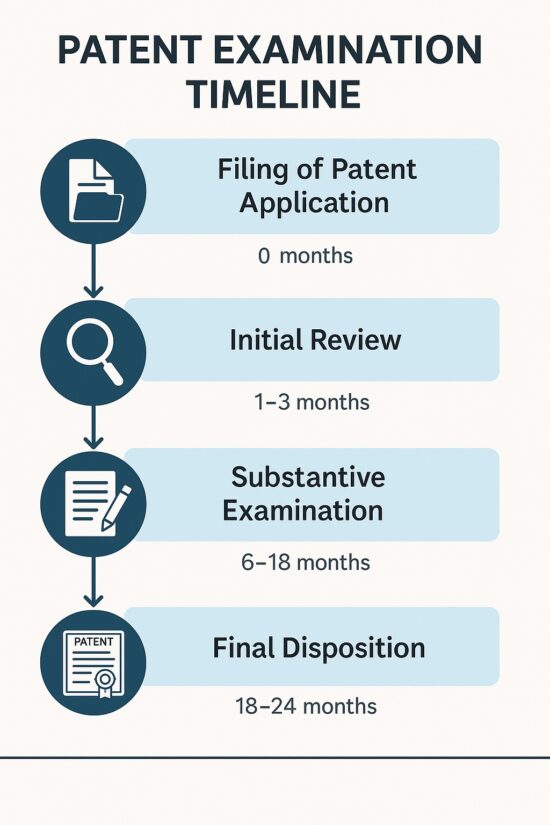
An Office Action is an official letter from the USPTO patent examiner to the applicant, and it is a normal part of the patent examination process. In fact, most patent applications receive a first Office Action roughly 1–2 years after filing. The Office Action will detail any rejections, objections, or examiner’s concerns about your application.
There are two common types of Office Actions: non-final and final. A non-final Office Action is the first addressing the substantive issues in the application. It will cite any prior art the examiner found and explain why one or more claims are rejected (e.g., “Claim 1 is rejected under 35 U.S.C. 102 as anticipated by Smith et al., U.S. Patent No. X,XXX,XXX,” or “Claim 2 is rejected under 35 U.S.C. 103 as unpatentable over Smith in view of Jones”). It may also include examiner’s objections on formal matters, requiring drawing corrections or claim wording issues. A non-final action gives you, the applicant, an opportunity to address the issues and file claim amendments.
If you respond but the examiner still finds problems, the next action might be a final Office Action. A final action means the examiner believes the major issues remain unresolved after your last response. Importantly, “final” doesn’t necessarily mean the end of the road, but it does signal that the examination is at an advanced stage. The examination report in a final action will articulate the outstanding rejections and usually will not introduce new grounds unless they were necessitated by claim amendments made in response to the non-final Office Action.
Getting an Office Action can be disheartening, but it is a routine part of the prosecution. Office Actions actually indicate that the USPTO is actively examining your case. As the USPTO explains, you will be notified in writing of the examiner’s decision by an office action that lays out the reasons for any rejections or objections. MPEP § 707.07(f). Think of it as a detailed feedback letter from the examiner. It’s your job to respond effectively, often with the help of a patent attorney or agent.
You typically have a 3-month deadline (extendable up to an additional 3 months with fees) to reply to each Office Action. In your response, you must address every point the examiner raised. This usually involves two strategies: amending the claims and/or making persuasive legal and technical arguments.
For example, if the examiner cited prior art against your claims, you might amend the claims to further distinguish your invention from that prior art. You will then explain in your reply how the amended claims avoid the cited references, or why the examiner’s reading of the prior art is incorrect. In other words, you point out errors in the rejection or highlight aspects of your invention that the examiner overlooked. Simply saying “the examiner is wrong” is not sufficient, you need to provide reasons or evidence. Sometimes, applicants submit expert declarations or experimental data as evidence that their invention has unexpected advantages, to help overcome rejections, especially for obviousness rejections under §103. You can also argue legal points by citing patent law precedents or showing the examiner misapplied a rule.
It’s important to respond in a thorough and timely manner. Failing to reply to an Office Action by the deadline will lead to abandonment of your application. Extensions of time are available for a fee, if you need more time, but dragging out responses will increase costs and delay a granted patent. The USPTO emphasizes that a reply should be a bona fide attempt to advance the case to conclusion. In practice, that means you should make real effort to resolve the examiner’s concerns, not just argue for argument’s sake. Often, a productive approach is to request an examiner interview (a phone or video call with the examiner) to discuss the rejections and potential claim amendments. Examiners are encouraged to engage with applicants to resolve issues collaboratively. Such discussions can clarify misunderstandings and speed up agreement on allowable subject matter.
If you provide a response to the examiner’s first Office Action, the examiner will re-examine your application in light of your response. If issues persist, you may get a second Office Action, which will likely be marked final. A final rejection limits your ability to amend as a matter of right, but you still have options to continue the process through (1) the submission of arguments, (2) by amendment if you file a request for continued examination (RCE) and the associated fee, or (3) through an appeal to the Patent Trial and Appeal Board (PTAB).
At the end of the examination, the USPTO will issue a final decision on your application’s fate. There are a few possible outcomes:
The ideal outcome is that the examiner finds all claims allowable or you amend them to allowable form. In this case, the USPTO will send you a Notice of Allowance. You then pay the issue fee, and the patent is granted and published as an issued patent. A granted U.S. patent gives the patent owner the right to exclude others from making, using, or selling the claimed invention, for a period of 20 years from the effective filing date.
If the examiner is not convinced by your amendments and arguments that the claims are patentable, they will issue a final rejection. This is not necessarily “game over”. You, as the applicant, have several paths to continue pursuing protection. One common approach is filing a Request for Continued Examination (RCE), which entails paying a fee to essentially reopen the prosecution and give the examiner another round of review on revised claims. An RCE puts your application back in the queue for further examination of new arguments and/or claim amendments.
Another option is to file a continuation application, which is a new application that carries the same filing date as the original. This approach is useful if you want to try a different claim strategy while keeping the earlier priority date.
Alternatively, if you believe the examiner is mistaken on the law or facts, you can appeal the rejection to the USPTO’s Patent Trial and Appeal Board (PTAB). On appeal, patent attorneys argue the case to administrative judges. These routes involve additional time and expense, so the decision often hinges on the importance of the invention and business considerations.
Some applications are abandoned by the applicant. This can happen intentionally. For example, if a final rejection issues and the applicant decides not to invest more in the process, or if business priorities change, it may not be worth the time and expense to continue pursuing the application. Abandonment also occurs if you simply fail to respond to an Office Action or pay a required fee in time. An abandoned application is no longer pending and generally cannot mature into a patent. Abandonment ends the application process.
An issued patent can also be abandoned. A patentee must pay periodic maintenance fees (renewal fees) at 3.5, 7.5, and 11.5 years after issuance to keep the patent valid. Failure to pay these fees in a timely manner results in abandonment.
It is worth noting that even after a patent is granted, the examination process can be flawed and issued patents can be challenged as being invalid on multiple bases. Patents are granted with a presumption of validity, but they can later be invalidated if the challenger provides sufficient argument and evidence. For instance, a competitor can request a re-examination of an issued patent by presenting new prior art that the USPTO had not considered to demonstrate invalidity.
In an ex parte re-examination proceeding, the patent goes back into the USPTO for another round of examination focused on the new evidence. Similarly, post-grant review or inter partes review are procedures that allow challengers to contest a patent’s validity. These mechanisms mean that patent owners should ensure their patents are on solid footing. A thoroughly vetted patent through the initial examination will be more likely to survive any such challenges.
In some circumstances, time can be of the essence. A patent can take quite awhile to be examined and granted. For example, waiting 2–3 years for an issued patent might be too slow in fast-moving industries. Fortunately, the USPTO offers ways to speed up the patent examination process. One option is the prioritized examination program, or Track One. By paying an additional fee and meeting certain requirements, an applicant can get “special status” for the application. The USPTO aims to provide a final decision in prioritized cases within 12 months. This expedited examination can be valuable if you need patent protection quickly to attract investors or assert your rights.
There are also other paths to special status. Some programs have offered acceleration for certain technologies or applicant categories. For example, the USPTO has run pilot programs for inventions related to climate change, COVID-19, and for first-time filers. These programs, when available, allow patent applications to benefit from accelerated examined without the hefty fees of Track One.
Additionally, under the Patent Prosecution Highway (PPH), if you have a corresponding foreign patent application that has been allowed, you can petition to fast-track the U.S. application by leveraging the foreign positive results. Even without formal programs, an application can be advanced out of turn for certain reasons, such as the inventor’s age or health (by petition to make special). Gaining special status means the USPTO will examine the application sooner, which can cut down pendency significantly.
While faster examination is appealing, it’s important to be ready for the initial review and Office Actions that will come sooner. Make sure your application is in clear compliance with all rules and is thoroughly prepared. Rushing to file without a solid detailed description and well-crafted claims can backfire if the expedited timeline leads to early rejections that could have been avoided. But when used appropriately, these procedures enable applicants to obtain patents much more quickly than the normal patent system would.
Patents are a key form of intellectual property that can protect your technology and give you a competitive edge, but they are only granted after careful scrutiny of the invention’s novelty, inventive step, and documentation. The patent examination process is a highly formalized, legal process that can leave the unfamiliar confused and disadvantaged. It is highly recommended that you seek the assistance of an experienced patent attorney during patent examination. Working with a patent attorney will allow you to make informed decisions during the examination and greatly increase the chances of securing a strong patent. With the right guidance, entrepreneurs can navigate the examination process and emerge with valuable patent rights that safeguard their hard-earned innovations.
If you need assistance with a patent application or other intellectual property matter, contact our office for a free consultation.
© 2025 Sierra IP Law, PC. The information provided herein does not constitute legal advice, but merely conveys general information that may be beneficial to the public, and should not be viewed as a substitute for legal consultation in a particular case.
Fictional characters are valuable intellectual property for many businesses. Think of iconic figures like Mickey Mouse, Harry Potter, or James Bond. Protecting fictional characters under intellectual property laws can provide valuable legal protection for creative works. Both copyright law and trademark law offer ways to shield characters from unauthorized use, even though the Copyright Act does not explicitly list “characters” as a category of protected works. This article explores how to establish copyright protection for a character might be secured, and how trademark protection can complement it.
Fictional characters often carry significant commercial and branding value. A well-developed character can become the face of a franchise or a character trademark for merchandise, providing strong brand recognition and valuable legal protection. For example, the boy wizard in a popular book series or a company mascot can generate revenue through films, toys, and more. Protecting fictional characters helps prevent others from exploiting your character’s name, image, or story without permission. In short, legal protection ensures you retain exclusive rights to profit from your creation.
Under U.S. copyright law, characters can be protected if they are part of an original work of authorship fixed in a tangible medium of expression. In practice, this means you create the character in some tangible form, for instance, by writing a story or comic book, or drawing the character’s image. Copyright does not protect a general idea or stock archetype of a character; it protects the specific expression of that character’s traits and story.
As the statute explains, no copyright can cover an idea, concept, or stock character type. Only the original expression of that idea in a tangible form can be protected. For example, the general idea of “a heroic female warrior” is free for all to use, but Wonder Woman, with her distinct costume, origin story, and personality traits is a protected original work owned by DC Comics. Once a character is fixed in a tangible medium (text, illustrations, film, etc.), the author automatically gains copyright ownership of that expression. This copyright protection is immediate and gives the author exclusive rights to copy, adapt, or license the character’s adventures and depictions. However, this protection does not necessarily extend to any use of the character.
Not every character is independently protectable by copyright. The character must be sufficiently unique and well delineated in its expression. U.S. courts have held that stock characters or basic types (e.g. the “hardboiled detective” or “mad scientist” archetype) are too general to be protected. In a landmark case, Nichols v. Universal Pictures, Judge Learned Hand explained that “the less developed the character, the less the copyrightability”. 45 F.2d 119 (2d. Cir. 1930). In that case, two characters (a Jewish father and Irish Catholic girl in love) were deemed mere prototypes, thinly drawn roles that were essentially unoriginal ideas and thus not protected by copyright.
To qualify for protection, a character must have distinctive attributes, backstory, and key elements that make it recognizable as the same character in multiple works. Courts often ask whether the character has specific visual or literary characteristics, and consistent traits or personality, that set it apart from a mere idea. For instance, a literary character described only in a few lines with no unique qualities might fail to qualify, whereas a richly described character like Sherlock Holmes, with his unique costume, mannerisms, and deductive genius can be protected even if only depicted in text. In short, a character that is sufficiently delineated with unique combinations of personality traits, appearance, and narrative role, may enjoy independent copyright protection.
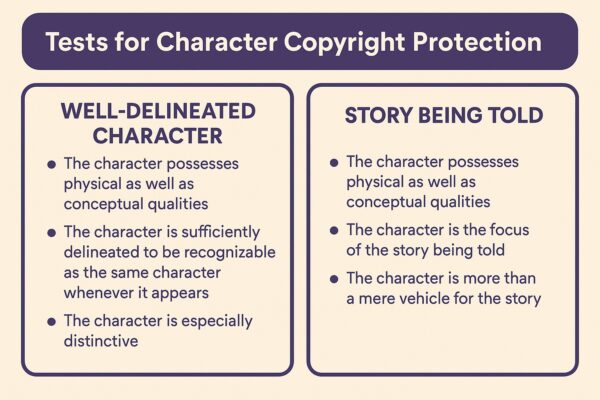
Over time, courts have used two main tests to determine if a fictional character is protected by copyright. The first is the “distinctly delineated” or “well-delineated” character test. Under this approach (traced back to the Second Circuit decision in Nichols), a character is protected if it possesses a unique set of attributes and is recognizable as the same character across different works. The character must have constant, identifiable traits such that audiences know it’s the same person or figure in each story.
Under the well-delineated or distinctly delineated test, a fictional character may qualify for independent copyright protection if:
For example, Tarzan was found to be a “sufficiently delineated” character, with his specific upbringing in the jungle, manner of speech (“Me Tarzan”), and heroic traits, and thus was held copyrightable. Burroughs v. Metro-Goldwyn-Mayer, Inc., 519 F. Supp. 388 (S.D.N.Y. 1981). Similarly, the character Superman, with his distinct costume, origin from Krypton, and set of powers, was considered well-delineated and protected by copyright. Detective Comics v. Bruns Publications, 111 F.2d 432 (2d Cir. 1940). The key elements that make these characters unique also ensure they are more than generic ideas.
The second test, developed by the Ninth Circuit, is the “story being told” test. This is a stricter standard. It asks whether the character constitutes the story being told. In other words, is the character depicted at the core of the narrative such that the story is really about that character? If so, the character can be protected. If the character is merely a device to move the story forward, it might not get independent protection. In the famous Sam Spade case, the court treated the detective Sam Spade character as a vehicle for the plot: a mere "chessman in the game of telling the story". The court allowed his original author (Dashiell Hammett) to reuse the character in new stories despite having licensed one film adaptation. Warner Bros. Pictures Inc. v. Columbia Broadcasting System, 216 F.2d 945 (9th Cir. 1954).
On the other hand, when a character is so central that there would be no story without them, the law leans toward protection. For example, courts found that Rocky Balboa in the Rocky films was deemed both well-delineated and the focus of the story, a combination that clearly qualified him for copyright protection. Anderson v. Stallone, 11 U.S.P.Q.2d 1161 (C.D. Cal. 1989). If a character can satisfy both tests, having constant traits and unique expression (well-delineated), and is central to your narratives (nearly the story itself), it stands a strong chance of qualifying for independent copyright protection.
An inanimate character, may also rise to the level of copyright protection. In DC Comics v. Towle, the Ninth Circuit established one of the most influential modern tests for determining when a fictional character is entitled to independent copyright protection. 802 F.3d 1012 (9th Cir. 2015). The case involved the Batmobile, which Mark Towle reproduced and sold as custom-built replicas modeled on the versions appearing in the 1966 Batman television series and the 1989 Batman film. Towle argued that the Batmobile was merely a functional car design not eligible for character protection.
The court disagreed and held that the Batmobile was a copyrightable character. It articulated a three-part test requiring the plaintiff to show: (1) physical and conceptual qualities of the character; (2) sufficient delineation to be recognizable when it appears in different works, with characteristic traits and attributes; and (3) the character has distinctive and unique expressive elements.
Applying this Towle framework, the court emphasized the Batmobile’s consistent personality across decades: its bat-inspired appearance, high-tech gadgetry, crime-fighting purpose, and depiction as Batman’s loyal, almost sentient partner. Although portrayed in different visual forms, the Batmobile remained instantly identifiable. Thus, the Ninth Circuit confirmed that a fictional vehicle,when imbued with coherent, distinctive expressive traits, can qualify as a protected character.
In contrast, a recent decision the Ninth Circuit held that the collection of Ford Mustangs known as “Eleanor,” which appeared in four films (including Gone in 60 Seconds (2000)), does not constitute a copyright-protected character. See Carroll Shelby Licensing, Inc. v. Halicki, No. 23-3731, 2025 WL 1499052 (9th Cir. May 27, 2025).
In applying the Towle test, the court found that “Eleanor” failed all three prongs:
In sum, the court reaffirmed that not all recurring named objects in film, even if iconic, qualify as protected characters. The decision draws a clarifying line: a named object with no autonomy, little consistent design, no personality traits or narrative agency, and shifting physical form does not meet the threshold under Ninth Circuit precedent.
Many beloved characters have been recognized by courts as protected by copyright (and often by trademark as well). James Bond is a prime example: across novels and films, Bond maintains distinctive traits: a suave British spy with a “shaken, not stirred” martini preference, a license to kill, and high-tech gadgets. Courts have noted that despite being portrayed by multiple actors, Bond’s core characteristics remain consistent, making him sufficiently delineated to be protected. In one case, a court enjoined an unauthorized car commercial that evoked James Bond, recognizing the character’s legal protection in the context of copyright law. Metro-Goldwyn-Mayer v. American Honda Motor Co., 900 F. Supp. 1287 (C.D. Cal. 1995).
Comic characters like Mickey Mouse, Donald Duck, and Wonder Woman are also well-protected. These cartoon characters have clearly defined visual appearances and personalities, making it easy to prove copying. In fact, the Ninth Circuit held that Disney’s iconic characters were protected by copyright even before character-specific registrations existed. Walt Disney Productions v. Air Pirates, 581 F.2d 751 (9th Cir. 1978). Disney had registered comic strips and films depicting Mickey and friends, and the court ruled that “the fact that [the] characters are not the separate subject of a copyright [registration] does not preclude their protection.”
These cases show that a character’s image, persona, and unique elements can be legally safeguarded. However, if a character is too abstract or a general idea, it stays in the public domain for others to use.
Aside from copyright, trademark law can also provide valuable legal protection for fictional characters, particularly their names, logos, or images used in commerce. If your character’s name or design is used to brand products or services (e.g., a trademarked character logo on merchandise, or a character name as the title of a series), you can seek a trademark registration with the U.S. Patent and Trademark Office (USPTO).
Trademark rights arise from use in commerce and protect identifiers of source (names, titles, slogans, etc.), including character names or catchphrases closely associated with products or services. Unlike copyright, trademarks do not protect the creative story or personality of the character, they protect the character’s name or symbol as a brand. For example, “James Bond” and “007” are registered trademarks for movies and merchandise, and DC Comics holds trademarks for names like “Wonder Woman” and the Superman logo.
To succeed in a trademark claim, the character name or image must be distinctive or have acquired secondary meaning in the public’s mind. In other words, consumers recognize the name or figure as specifically associated with your company or product (e.g., “Mickey Mouse” immediately signifies Disney). If someone uses a confusingly similar name or depiction, it may constitute trademark infringement by misleading consumers into thinking there’s an affiliation. Trademark law allows the owner to stop others from using marks that cause likely confusion with the character’s name or likeness in commerce.
Trademarks can thus provide additional legal protection beyond copyright, especially for merchandising and franchise branding. Many famous characters enjoy dual protection: copyright protection for the character’s creative expression in stories and trademark protection for the character’s name or image used on goods. Thus, trademark rights in a character can provide additional exclusive rights over the character as a brand and help avoid potential conflicts in the marketplace.
Protecting a character involves a combination of copyright and trademark strategies. Here are key steps for business owners and creators:
Ensure your character is created in a tangible form. For example, you may establish your character in a detailed story, screenplay, or comic, or create concept art. The character must be more than an idea. This fulfills the legal requirement of fixation and establishes your initial copyright. Make the character as original and unique as possible, with well-defined traits, backstory, and visuals. The more original works featuring the character, the stronger its copyright profile.
Develop unique characteristics that set your character apart. Give them consistent personality traits, a unique look or costume, catchphrases, and a rich background. When a well-delineated character with distinctive features appears in a story (e.g., Harry Potter’s lightning-bolt scar, round glasses, and courageous personality), it is much more likely to be protectable. The character should be recognizable as the same character even in different stories or media: consistency is key. Avoid relying on clichés or solely on genre tropes (a “mere stock character”), which are not protected.
Although copyright exists upon creation, copyright registration with the U.S. Copyright Office is highly recommended to unlock full legal benefits of registration. You generally cannot register a character in isolation. Instead, you must register the work in which the character appears. For literary characters, register the short story, novel, or script that introduces them. For graphic or comic characters, you can register artwork or comic books that depict the character. Indeed, Disney protected its characters by registering comics and animation cels that contained those characters. The registration process involves submitting an application, a copy of the work (e.g. manuscript or drawing), and a fee. Having a registration is required before you can file a copyright infringement lawsuit in federal court, and it may entitle you to statutory damages and attorney’s fees if it is timely filed. In sum, registering puts the public on notice of your copyright ownership and strengthens your position if you ever need to take legal action.
If your character’s name, nickname, or image will be used to market products (like a line of toys, comics, or a game title), consider filing a trademark application with the USPTO. First, conduct a search to avoid potential conflicts with existing marks. Then, file an application to register the character name/logo for the relevant goods (e.g., “<Character Name>” for comic books, t-shirts, etc.). A trademark registration (once approved) grants nationwide rights and legal presumptions of your exclusive right to use that character name or image as a brand identifier. This can be crucial for franchised characters. For example, Warner Bros. trademarks names like Batman and Harry Potter to stop copycat merchandise. Once registered, maintain your trademark (with proper notice ™ or ® and renewals) and monitor for any infringing uses by competitors.
Copyright owners have the exclusive rights to reproduce the character’s stories, create sequels or adaptations (like films, spinoff novels, or comic adaptations), distribute and display those works, and prepare derivative works featuring the character. If someone else writes a new story using your character or produces art depicting your character without permission, it could be copyright infringement. In such cases, you may send cease-and-desist letters or ultimately file a lawsuit in federal court to enforce your rights. Courts will compare the alleged infringing character to yours to see if there is substantial similarity in protectable elements, bearing in mind that general concepts and independently created look-alikes might not infringe if the expression is not actually copied.
For trademarks, watch out for unauthorized commercial uses of your character’s name or likeness that could confuse consumers. Trademark infringement or dilution can harm the distinct identity of your character brand. Companies like DC Comics and Disney aggressively enforce both copyright and trademark, whether it’s unlicensed costumes (which can dilute a brand) or unapproved stories. As a character owner, you should be prepared to take legal action to stop infringers, which might involve seeking an injunction and damages.
On the flip side, when creating a new character for your business, ensure you are not infringing someone else’s rights. Avoid basing your character too closely on an existing protected character. Always check if famous characters are in the public domain or still under protection. For example, early depictions of Mickey Mouse have entered the public domain, but later evolutions of Mickey and associated trademarks remain off-limits. By respecting others’ intellectual property and robustly protecting your own, you can steer clear of costly copyright infringement disputes.
Copyrighting a character requires crafting a unique, well-defined character and anchoring it in a creative work. Once your character is fixed in a tangible medium and displays originality, it can be protected under U.S. copyright law as part of that work. A character that is distinctly delineated with unique traits and is integral to the story will enjoy strong protection under the tests courts have developed. Additionally, securing trademark protection for the character’s name or image (when used as a brand) can provide an additional layer of security.
By following the steps outlined, creators can ensure their fictional characters are well protected. If you need assistance with registering copyrights in a character or other work, or need assistance with other intellectual property matters, please contact our office for a consultation.
© 2025 Sierra IP Law, PC. The information provided herein does not constitute legal advice, but merely conveys general information that may be beneficial to the public, and should not be viewed as a substitute for legal consultation in a particular case.
When you apply for a federal trademark in the United States, you may receive a trademark office action, an official letter from the U.S. Patent and Trademark Office (USPTO) examining attorney that lists any legal problems with your application or proposed trademark. This office action is essentially a response from the trademark examiner after reviewing your trademark filing. It outlines any issues that prevent your mark from registering in its current form, ranging from minor application errors to substantive refusals under trademark law. Office actions are a normal part of the trademark registration process. In this guide, we discuss the types of office actions, common issues raised, and how to respond within the required response period to keep your trademark application on track.
A trademark office action is an official letter sent by the USPTO after an examiner reviews your application. In this letter, the examining attorney details any issues raised with your trademark application. These issues generally fall into two categories: requirements and refusals. A requirement is something procedural or technical that needs to be fixed in the application: for example, clarifying your listed goods or services, correcting the applicant’s name or legal entity, or providing a proper trademark specimen. A refusal, on the other hand, is a substantive legal rejection of the mark under the Lanham Ac, such as a finding that your mark is too similar to an existing registered mark or that it is too descriptive. You must resolve all issues identified, whether by making amendments or by persuading the examiner with legal arguments, before your trademark can proceed to registration. In sum, the office action is the USPTO’s way of communicating asserted “legal problems” with your filing that must be addressed.
Office actions come in different types, and it’s important to determine whether you have a nonfinal or final office action, as this affects your response strategy. A nonfinal office action, sometimes called a “first office action” or non-final office action, is typically the first official letter you receive. It raises the examiner’s objections or issues for the first time and gives you an opportunity to respond. In the office action, the examining attorney lists each of the issues they believe the applicant must address. You must respond to each of the issues raised in the nonfinal office action within the set response deadline three months from the issue date with a possible three-month extension. In the nonfinal action, the examining attorney may list multiple issues.
If you file a trademark office action response resolves each one and does not introduce any new issues, your application can move forward toward approval. If not, or if your response itself raises a new issue (e.g., by amending your goods/services in a way that introduces a new problem), the examiner can issue another nonfinal office action addressing the new or outstanding issues.
A final office action is issued when there are still unresolved issues raised after your response to a nonfinal action. A final office action is essentially the examiner’s final rejection of your application on those grounds. It means the examining attorney has maintained the refusals or requirements despite your previous response, and it is the last chance to respond within the USPTO examination process. You must respond to a final office action within the deadline, which is three months from the issuance date, with an optional extension of three months. However, after a final action, the options to overcome the refusals narrow, you may need to file a response that substantively resolves the issues or pursue an appeal.
If you file a response to a final office action that fully satisfies each remaining issue, the application can proceed to publication and registration. If you fail to timely respond or the response still does not overcome the refusals, the application will be deemed abandoned unless you appeal the final refusal to the Trademark Trial and Appeal Board in a timely manner.
One of the most common substantive refusals in an office action is based on likelihood of confusion under Section 2(d) of the Lanham Act. The examining attorney will conduct a search of the USPTO records for conflicting marks. If your newly applied-for trademark is deemed too similar to a prior registered trademark or pending application, used on related goods or services, the USPTO will refuse registration due to likely consumer confusion. In other words, if the examiner determines that consumers encountering the two marks might believe they come from the same source, you’ll receive a confusion refusal citing Section 2(d).
The statutory basis for this refusal is 15 U.S.C. §1052(d), which bars registration of a mark that “so resembles a mark registered in the Patent and Trademark Office… as to be likely, when used on or in connection with the goods of the applicant, to cause confusion, or to cause mistake, or to deceive.” This means trademark rights are not absolute. The USPTO will not grant you exclusive rights to a mark that is confusingly similar to someone else’s mark already on the Principal Register.
When evaluating likelihood of confusion, the USPTO and courts apply a multi-factor test known as the DuPont factors, named after a famous case In re E.I. du Pont de Nemours & Co., 476 F.2d 1357 (C.C.P.A. 1973). These factors include comparisons of the marks’ appearances, sounds, meanings, the similarity of the goods/services, trade channels, and more, to assess whether consumers would likely be confused by the two marks. No single factor is dispositive, but the overall analysis drives the decision. The key point is that if the examining attorney cites a conflicting registration that is too close to your mark, a 2(d) refusal will be issued.
Overcoming a likelihood of confusion refusal can be challenging, but it is not impossible. You must submit a written response that addresses all issues raised in the office action. In your office action response, you can argue that the marks create different commercial impressions and that the goods or services are unrelated or marketed in different channels, and thus no likelihood of confusion exists. It is important to make specific, fact-based legal arguments: e.g., pointing out that your mark is sufficiently distinct from the cited mark based on differences in spelling or meaning between the two marks, or evidence that the goods listed in the cited registration are in a completely different industry from yours. You may also provide evidence of third-party registrations to show that a shared term is weak or common in your industry, indicating that consumers are used to distinguishing between similar marks in a crowded field. Another strategy is to narrow your identification of goods and services to avoid overlap with the scope of the cited registration, if appropriate.
In some cases, obtaining a consent agreement from the owner of the cited registration can help. A consent agreement is a formal agreement where the other party consents to your registration and both parties detail why they believe confusion will not occur. A consent is usually paired with co-existence agreement that governs the parties rights with respect to use of their respective trademarks. The USPTO gives consent agreements “great weight” if they are thorough and crafted to avoid confusion. However, a bare-bones or “naked” consent without clear terms or explanations may carry little weight. The USPTO’s guidance confirms that a well-drafted consent agreement can facilitate trademark registration, but it does not guarantee an approval if the marks are extremely similar.
Because of the complexity of 2(d) refusals and the legal analysis required, many applicants choose to consult an experienced trademark attorney for help in crafting a response or negotiating agreements. A timely, well-reasoned response with supporting evidence is crucial; otherwise, the refusal will stand and the application will be abandoned.
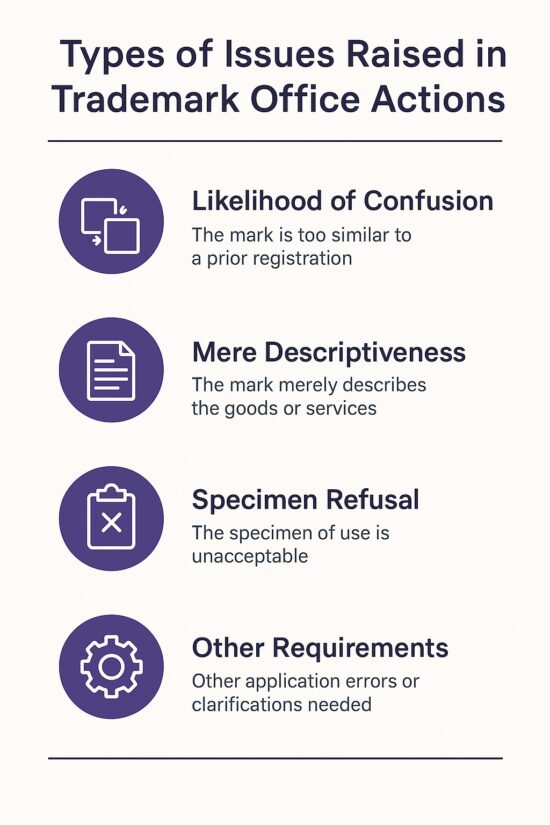
Another common issue is a refusal for merely descriptive trademarks, cited under Lanham Act §2(e)(1). A mark is “merely descriptive” if it simply describes an ingredient, quality, characteristic, function, or feature of the goods or services, without showcasing any distinctive branding. For example, calling your yogurt brand “Creamy Yogurt” or a bagel shop “Crusty & Chewy Bagels” would immediately tell consumers a feature of the product but not its source. Such terms are descriptive. 15 U.S.C. §1052(e)(1) prohibits registration of a mark which, “when used on or in connection with the goods of the applicant, is merely descriptive… of them.”
The rationale is that every business in an industry should be free to use common descriptive words for their products (industry jargon or ordinary terms) without risking a trademark infringement claim. If your trademark is too generic or descriptive of the actual nature of your product/service, the USPTO will issue a descriptiveness refusal. Similarly, marks that are primarily a surname or geographically descriptive fall under related provisions of §2(e) and can be refused on that basis.
To overcome a descriptiveness refusal, you have a few options. First, you could argue that the mark is not really descriptive but rather suggestive or arbitrary in relation to the goods. This involves making legal arguments and sometimes providing evidence that consumers would need imagination or thought to connect the mark to the goods. For instance, if you applied for a mark that the examiner thinks describes a feature, you might show that it is used metaphorically or is a coined term with no direct meaning for the goods.
Second, if the mark truly is descriptive, you might amend the application to the Supplemental Register: an alternative register for descriptive marks that have not acquired distinctiveness yet. The Supplemental Register does not give you full trademark protection or exclusive rights like the Principal Register, but it can be a stepping stone until your mark gains distinctiveness.
Third, you can attempt to show that your mark has acquired distinctiveness (secondary meaning) in the marketplace, under Lanham Act §2(f). If you can prove that through substantially exclusive and continuous use for at least five years or other evidence (e.g., sales figures, advertising, consumer testimonials) your descriptive mark has become recognized as a brand by the public, the USPTO may allow it on the Principal Register. The statute explicitly permits registration of a mark that has “become distinctive” of the applicant’s goods through use under 15 U.S.C. §1052(f). In practice, you would submit a claim of acquired distinctiveness with supporting evidence to overcome the refusal.
Finally, note that the examining attorney might also issue a disclaimer requirement for a descriptive portion of your mark. Under the law, the USPTO can require you to disclaim an “unregistrable component” of an otherwise registrable mark that is generic or descriptive. For example, if your brand is “Sunny Skies Café” for a coffee shop, you might have to disclaim the word “Café” since it is generic with respect to café services. Disclaiming simply means you are not claiming exclusive trademark rights to that specific word, except as part of your whole mark. As long as you comply with the disclaimer request, it will not block the registration. It is considered a minor issue easily resolved in an office action response.
If you filed your application based on actual use of the mark in commerce under Section 1(a) or you are responding after filing a Statement of Use in an intent-to-use application under Section 1(b), the USPTO examining attorney will evaluate your specimen of use. A specimen is a sample that shows your trademark actually being used on the goods or in connection with the services in a way that the public encounters it. Common specimens include product labels or packaging showing the mark, screenshots of webpages selling the goods, or advertisements or brochures for the services.
An office action may include a specimen refusal if the specimen you submitted is deemed unacceptable or insufficient. For instance, one frequent problem is submitting mere advertising material for goods. Advertising material (like a flyer or webpage ad) is acceptable as a specimen for services since services are often sold through ads, but not for goods. Goods generally require a specimen that is a display or label at the point of sale. Another issue arises if the specimen is a mock-up or digitally altered image, not a photo from actual sales. Such ginned up specimens are improper because they fail to show actual use in commerce. If they are submitted with deceptive intent, the trademark application may be invalidated.
An acceptable specimen must also match the mark as applied-for with no material differences and relate to the specific goods and/or services listed in the trademark application. If the specimen does not show the mark functioning as a source indicator for the goods and/or services (e.g., if it is used just ornamentally or as a business name, rather than a brand), that can also result in refusal.
There are generally two ways to fix a specimen refusal. Option 1: Submit a substitute specimen that was in use before the relevant date: the application filing date if filed under Section 1(a) as currently in use, or before the expiration of your deadline to file a Statement of Use if the trademark application was filed as an intent-to-use case under Section 1(b). The substitute specimen should be a proper example of how the mark is used on the goods or in advertising the services: a photo of the product packaging with the mark, a tag or label affixed to the product, or a screenshot of a webpage with ordering information for the goods. You will need to include a declaration verifying the new specimen was in use as of the required date.
Option 2: Argue that the original specimen was acceptable. For example, if the office action says your specimen is “mere advertising” but you believe it actually is a point-of-sale display, you can submit reasoning and possibly evidence to explain why it functions to allow purchases of the goods. You might also point out if the examiner misinterpreted the specimen. Keep in mind that some specimen problems ca not be cured. For example, if your specimen and identified goods and/or services just do not match, the USPTO will not let you substantially alter the listed goods to fit a specimen: you applied for software but your specimen was a photo of a t-shirt. In such cases, the application might have to be abandoned or certain goods deleted. You should investigate and ensure that any specimen you plan to use is a proper specimen for the goods and services you plan to identify in your trademark application.
If you filed an intent-to-use application, you will not need a specimen until later in the process, which gives you time to create acceptable use. But for use-based applicants, double-check that your specimen truly shows the mark as used in commerce on the goods/services. This due diligence can avoid a deadly specimen refusal.
Beyond the major refusals for confusion or descriptiveness and specimen problems, office actions might raise a variety of minor issues or clarifications needed. Here are some common ones:
The examining attorney may find your description of goods or services indefinite or misclassified. For example, saying “software” alone might be too broad, and the USPTO might require you to specify the purpose or type of software. You may need to amend the identification to an acceptable wording from the USPTO’s Trademark ID Manual or based on guidance from the examiner. Clarifying the scope of your goods or services is usually straightforward, and the office action will often suggest an acceptable amendment.
If the applicant’s legal entity (individual, corporation, LLC, etc.) was not correctly listed or has changed, the office action could require correction. For instance, if you mistyped your business entity name or did not clarify the citizenship of an individual, you will have to fix that. Similarly, if the application or response was not signed by a proper party (like a corporate officer or authorized attorney), you might get a notice to submit a proper signature. These are generally procedural and easy to address within the response period.
As mentioned earlier, the USPTO can require a disclaimer of an unregistrable component of a mark. This often happens when your mark contains a generic or descriptive word, a geographic term, or an entity designation (like “Inc.” or “Ltd.”). For example, if your trademark is “Swift Automobiles,” expect to disclaim “Automobiles” because it’s a generic term for the product. Disclaiming means you agree that term is not exclusive to you (others can use it), which is consistent with the trademark policy of not granting monopoly on descriptive language. The office action will explicitly state the disclaimer requirement. You can comply by including the disclaimer text in your response: “No claim is made to the exclusive right to use ‘Automobiles’ apart from the mark as shown.” Once disclaimed, that portion will not impede registration.
Sometimes a mark is refused because it does not function as a trademark. This can occur if your mark is a common slogan, a term that merely provides information about the goods, or a commonplace phrase. office actions in this area might say the mark is ornamental, a generic term, or an informational slogan. Overcoming these refusals often requires evidence that the public perceives the phrase as a mark. This is a more nuanced area of trademark law, often requiring strong arguments or proof of acquired distinctiveness if applicable.
Other issues might include needing a translation for foreign wording in the mark, correcting the mark drawing if it does not match the description, or providing a more precise description of a logo design. If your mark includes non-English words, the USPTO usually requires an English translation. If it includes a design, you might need to amend the “description of the mark” to properly identify all elements. These requirements are typically clearly outlined in the office action and can be satisfied with a simple amendment or addition in your response.
Responding to an office action in a timely manner is crucial. Missing the deadline will result in your application being abandoned, which means you lose that filing unless you successfully petition to revive, which costs extra and is only granted if the delay was unintentional. Under rules implemented in late 2022, you now have 3 months from the issue date of the office action to respond, with a one-time opportunity to request a three-month extension (with a fee) to make it 6 months total. The exact deadline is always stated in the header or body of the office action. The office action will state that a response must be received on or before the particular date of the deadline. Currently, you must either submit your complete response or file an official extension request by that date. If you do the latter, you get an additional three months. As an exception, applications filed through international treaties like the Madrid Protocol still have a 6-month response period with no extensions allowed.
The safest practice is to respond well before the response deadline to avoid missing the deadline as a result of any technical issues. All responses must be filed through the Trademark Electronic Application System (TEAS) online. The USPTO will not accept paper or email responses for regular trademark actions. Also note that the USPTO conducts business in the Eastern Time Zone. A TEAS submission is considered filed based on Eastern Time. So, a response must be filed by 11:59 pm Eastern Time on the deadline.
Failing to respond by the deadline will cause abandonment of your application. The USPTO will send a Notice of Abandonment and your mark will not register. While it is sometimes possible to revive an abandoned application by showing the delay was unintentional and paying a fee, it is far better to meet the original deadlines and keep your application alive.
If you receive a final office action and your response does not convince the examiner to withdraw the refusal, you still have a couple of avenues to pursue. The final action is not necessarily the end of the road, but it is your last chance within the USPTO’s examination process to make your case or escalate the matter.
One option is to request reconsideration from the examining attorney. This is essentially another response to the final office action, usually used if you have new evidence or legal arguments that were not previously made. For example, if you locate new case law supporting your position, or you obtain a consent agreement after the final action, you can submit it with a reconsideration request. You must file this request within the response deadline, and note that it does not extend your time to appeal. The examiner will review it, and if persuaded, can withdraw the final refusal and approve the application or possibly issue another nonfinal action if a new issue arose.
However, because it is already a final action, the bar to changing the outcome is high. Often, applicants will file a Request for Reconsideration and a Notice of Appeal simultaneously. Doing so preserves your rights. The appeal will be initiated, but the Trademark Trial and Appeal Board (TTAB) will usually suspend the appeal and remand the case to the examiner to consider the reconsideration request. If the examiner reverses the refusal, the appeal can be withdrawn. If not, the appeal continues.
The Trademark Trial and Appeal Board is an administrative tribunal within the USPTO that hears appeals of final refusals. Under the law, you have the right to appeal “any final decision of the examiner in charge of the registration of marks” to the TTAB. An appeal is initiated by filing a Notice of Appeal through the USPTO’s ESTTA system and paying the appeal fee, within the allowed time after the final office action. The TTAB will then set a schedule for you to file an appeal brief arguing your case, the examiner to file a brief in response, and possibly an oral hearing.
The TTAB will review the refusal de novo, giving no deference to the examiner’s decision, but relying on the evidence of record and applicable law. The TTAB will then issue a written decision either affirming the refusal or reversing it. If the TTAB reverses the refusal, your application moves forward toward registration. If it affirms the refusal, you still have a further right to appeal that decision to the U.S. Court of Appeals for the Federal Circuit or to file a civil action in federal court, but those are infrequently pursued by most applicants due to cost. The TTAB appeal is the main recourse if the examiner was wrong on a legal point, such as the likelihood of confusion analysis or the descriptiveness finding. The appeal process can take many months, so it is not a quick solution, but it is an effective tool for challenging a final refusal.
Finally, sometimes the most practical option after a final office action is to make practical decisions about your trademark strategy. Perhaps it is feasible to rebrand to a different or modified mark that is more distinctive or less conflicting. An experienced trademark lawyer can advise you on the chances of success on appeal versus the costs.
While not every office action is avoidable, you can minimize the risk by doing a bit of homework before filing. Consider having a trademark search done to catch any obvious conflicts in the USPTO database of prior marks. Think about the distinctiveness of your trademark. If your mark is highly descriptive or generic, understand that it will face an uphill battle and maybe choose a more unique brand name if you are seeking strong trademark protection on the Principal Register. Ensure your application is complete and accurate. Properly identify your goods and services, make sure the applicant is correctly identified, and avoid other minor issues. Keep track of your application status. You can use the USPTO’s TSDR status system or Trademark Status and Document Retrieval in the Trademark Center online to make sure you catch any office action as soon as it is issued.
Trademark office actions are a common hurdle in the trademark registration process, but with a clear understanding of the issues and a prompt, thorough response, they can be overcome. By addressing the USPTO examining attorney’s concerns, you can often turn a initially refused application into a registered trademark. Always pay attention to the response deadlines, and ensure your response leaves no outstanding issue unaddressed.
If you find the process daunting, do not hesitate to seek guidance from an experienced trademark attorney, as their expertise can be invaluable in navigating nuanced legal arguments and procedural rules. If you are seeking a trademark registration or you need assistance with the trademark process, contact our office for a free consultation.
© 2025 Sierra IP Law, PC. The information provided herein does not constitute legal advice, but merely conveys general information that may be beneficial to the public, and should not be viewed as a substitute for legal consultation in a particular case.
Patent examiners are the gatekeepers of patent rights in the United States patent system. They are employed by the United States Patent and Trademark Office (USPTO), a federal agency under the Department of Commerce headed by the Director of the USPTO. Their primary job is to examine patent applications to determine if an invention meets the legal requirements for a patent grant. This article discusses who patent examiners are, what they do, and how they impact the process of securing intellectual property rights. We cover the roles and responsibilities of patent examiners, and their qualifications. We also cover examination procedures and relevant laws, rules, and court decisions that apply to patent examiners.
Patent examiners are highly trained professionals and civil servant federal employees with backgrounds in science or engineering. In fact, to be hired as a patent examiner, one usually must possess at least a bachelor of science degree in a relevant technical field, such as electrical engineering, mechanical engineering, chemical engineering, computer science, or other technical discipline. Many examiners even hold advanced degrees in addition to the required bachelor's degree. This technical expertise enables examiners to understand highly technical inventions in their particular area of training. Examiners are typically placed in an "art unit" associated with their education and training.
Examiners are organized into specialized art units, which are groupings by technology area within the Patent Office's examiner corps. There is a broad range of art units in the USPTO covering the span of modern technology from software and artificial intelligence to complex machinery to biotech innovations. Each art unit deals with patent applications that cover technology related to its technology focus. For example, an application for a new software invention will be assigned to an art unit dealing with computer technology, while a biomedical invention goes to a different unit.
By assigning applications in this way, the USPTO ensures that each patent application is reviewed by an examiner with knowledge in the appropriate scientific or engineering discipline. The patent examiners are career professionals. Many are engineers or scientists by training and are often veterans in their fields. In fact, the USPTO is recognized as a top veteran-friendly agency, including some in patent examiner roles contributing their skills to the USPTO’s mission. As federal employees, examiners enjoy a stable career with rigorous training and ongoing education in patent law and technology.
Becoming a patent examiner requires a strong foundation in science or engineering. Most examiners enter the USPTO with a technical BS degree and must be U.S. citizens who pass a background check. New examiners undergo intensive training on patent laws, rules, and examination procedures. They learn to apply Title 35 of the United States Code (the federal patent laws) and follow the USPTO’s Manual of Patent Examining Procedure (MPEP) and regulations.
Examiners start at junior ranks, often called assistant examiners or juniors, and work under the guidance of more experienced colleagues. Over time, they can earn promotions and signatory authority, meaning they gain the power to sign off on decisions without supervisor approval. After demonstrating mastery of patent laws and examination skills, an examiner becomes a Primary Examiner. Primary examiners can independently issue office actions and review the work of junior examiners. This structured training and progression ensure that examiners have the ability, expertise, and judgment required to evaluate patent applications thoroughly. The administration of the USPTO is also populated by many former patent examiners who rose through the ranks to become department heads, deputy commissioners and other administrative roles.
The USPTO employs thousands of examiners. As of 2025, there were over 8,500 patent examiners on staff, including professionals with backgrounds in many engineering disciplines, computer science, biotechnology, and more. Each examiner typically specializes in a technology domain, which helps them assess highly technical patent applications. Ongoing training keeps examiners current with legal developments, such as new court decisions, and emerging technologies. In sum, patent examiners are highly qualified professionals with both technical know-how and legal training, operating at the intersection of technology, law, and government service.
Patent examiners also receive instruction on national security and confidentiality protocols, since some inventions have sensitive implications. For instance, an invention with potential national security impact might be flagged under special procedures under the Invention Secrecy Act for review by defense agencies. Examiners must coordinate with agencies like the Department of Defense or intelligence community in such cases. If an invention’s disclosure would be detrimental to national security, the government will impose a secrecy order to withhold publication of the patent application under 35 U.S.C. § 181. This means examiners at times work closely with other government agencies to ensure that patents do not inadvertently compromise security or defense interests.
When an inventor or other applicant files a patent application, it enters the queue for examination. Each patent examiner is assigned a docket of applications to review. By law, the USPTO Director “shall cause an examination to be made of the application and the alleged new invention” to determine if “the applicant is entitled to a patent under the law”. In practice, the patent examiners carry out this mandate. The examiner’s responsibilities include: (1) reading and understanding the patent application, including the description, drawings, and claims defining the invention; (2) conducting a search for prior art (earlier patents, published articles, or existing products) that relates to the claimed invention; and (3) comparing the invention against the prior art to evaluate patentability criteria such as novelty and non-obviousness.
USPTO rules require examiners to perform a thorough patent search of the available prior art and to analyze the application for compliance with all legal requirements. This means an examiner will search patent databases, technical journals, and other sources worldwide. US patent law holds that information that is sufficiently publicly disclosed anywhere in the world is within the scope of prior art that can be used as a basis for the patent examiner to reject a patent application.
The examiner must compare the disclosures of the most closely related prior art to the claimed invention to determine whether the patent claims are novel (i.e., the claimed invention has not previously existed in the public knowledge) and that it would not have been obvious for a person having ordinary skill in the relevant art to come up with the claimed invention based on the prior art. When assessing novelty and obviousness, the goal is to ensure that the invention is truly new and not an obvious variation of what has come before.
Examiners also check that the application meets formal and technical requirements. For example, it is required that the inventor has fully described the invention, as required by 35 U.S.C. § 112. The claims must also be clear and supported by the disclosure. The patent examiners also verify that the invention falls within the proper categories of patentable subject matter under 35 U.S.C. § 101, which means it must be a process, machine, manufacture, or composition of matter, and not a mere abstract idea, law of nature, or natural phenomenon.
Patent examiners make determinations of whether a claimed invention is patentable by applying U.S. patent laws, USPTO rules, and guidance from judicial precedents. Several key legal criteria must be met for an application to be "allowed" or approved for a patent grant. The main pillars are defined in the patent statutes: 35 U.S.C. § 101 (patentable subject matter), 35 U.S.C. § 102 (novelty), 35 U.S.C. § 103 (non-obviousness), and 35 U.S.C. § 112 (written description, enablement, and definiteness). Examiners carefully evaluate the claims of an application under each of these provisions:
Throughout this analysis, patent examiners are guided not only by statutes but also by rules and case law precedent. For instance, 37 C.F.R. § 1.104 sets out the nature of examination. An examiner must make a complete search and state clear reasons for any rejection, citing the best prior art references available. If claims are rejected for lack of novelty or obviousness, the examiner is required to cite the most pertinent prior art and explain how it applies. Similarly, examiners may rely on court decisions interpreting these statutes, such as Graham v. John Deere Co., 383 U.S. 1 (1966) (the foundational obviousness case), Mayo Collaborative Services v. Prometheus Laboratories, Inc., 566 U.S. 66 (2012)(dealing with laws of nature), and others to ensure their analysis aligns with current law. The Manual of Patent Examining Procedure (MPEP) compiles these laws and court decisions into examination guidance, and examiners consult it regularly. In effect, examiners act as quasi-judicial officials applying complex legal standards to determine an application’s fate.
After reviewing a patent application, the examiner communicates findings to the applicant through written reports known as office actions. An office action summarizes the examiner’s evaluation and specifies any rejections, objections, or requirements. Under 35 U.S.C. § 132(a), if the examiner rejects one or more claims or raises objections, they must notify the applicant, “stating the reasons for such rejection, or objection or requirement, together with such information and references as may be useful in judging the propriety of continuing the prosecution”.
An office action will provide a detailed explanation of any issues with the application, citing relevant prior art or legal grounds. For example, a typical non-final office action might state that the claims are rejected under 35 U.S.C. 102 as being anticipated by some prior patent or other prior art, and then go on to explain which parts of the cited patent correspond to each element in the claims. It would also list any objections to informalities in specification, drawings, abstract, or claims and requirements, such as requiring the applicant to make an election between multiple inventions if the application is deemed to claim more than one distinct invention.
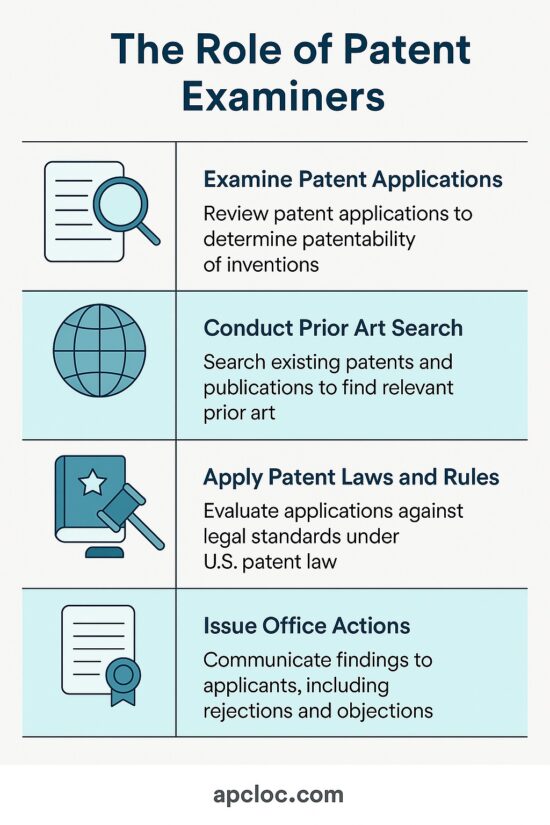
The examination process is iterative. The first office action is often a “non-final” action, giving the applicant an opportunity to respond. The applicant, usually through a patent attorney or patent agent, can reply by making arguments, amending the claims to overcome the examiner’s rejections, or submitting evidence, such as expert declarations in support of patentability. The patent examiner will then consider the response. If the issues are not resolved, the examiner may issue a “final” office action on a second round, maintaining the rejection. Even a final action doesn’t necessarily end the process, the applicant can file a Request for Continued Examination (RCE) or appeal the rejections, as discussed below.
During prosecution, examiners and applicants’ representatives can also have interviews, informal discussions either by phone or in person to clarify issues or explore possible amendments. These examiner interviews are often invaluable, allowing inventors or their attorneys to better understand the examiner’s reasoning and to present arguments or claim changes that might lead to an allowance. Examiners are generally open to such discussions, as it can make the process more efficient and improve the quality of examination.
When an examiner is satisfied that an application meets all legal requirements, they will issue a Notice of Allowance. This indicates the claims are in condition for patent grant. The applicant then pays an issue fee, and the patent will be issued. On the other hand, if the examiner concludes that the application cannot be allowed, even after the applicant’s responses, the final rejection can be made. It is worth noting that examiners have production goals and a large volume of cases. In recent years, the USPTO’s backlog of unexamined patent applications number in the hundreds of thousands, and examiners must balance efficiency with thoroughness. However, statistics show that a significant percentage of applications eventually get allowed, often after one or more rounds of negotiation and amendment. Engaging with the examiner in a professional, responsive manner can greatly help applicants reach a favorable outcome.
If a patent application is finally rejected by an examiner and the applicant does not wish to make further amendments, the patent system provides avenues to challenge the decision. Applicants should be aware that an examiner’s decision is not necessarily the end of the road. The first level of appeal is within the USPTO itself. The applicant can appeal to the Patent Trial and Appeal Board (PTAB), an administrative tribunal that reviews examiner rejections. A panel of administrative patent judges will reconsider the application and the examiner’s cited prior art and arguments. They may affirm or reverse the examiner’s decision in whole or in part. Many appeals result in either the examiner being reversed, leading to allowance of the patent or a remand for further examination with guidance.
If the PTAB also rules against the applicant, the next available step is judicial review in the courts. U.S. law provides two alternative routes: (1) an appeal to the U.S. Court of Appeals for the Federal Circuit, which will review the case on the administrative record; or (2) a civil action in federal district court in the Eastern District of Virginia under 35 U.S.C. § 145, where the applicant can present new evidence. In either case, the court will ultimately decide if the patent should issue. Notably, such proceedings are usually against the Director of the USPTO, not against the individual examiner. In fact, courts have made clear that an examiner cannot be personally sued or compelled to justify their decision in court.
Examiners act in a quasi-judicial capacity, and the proper recourse for an applicant is the appeal process, not a lawsuit against the examiner. For instance, a federal court in 2016 dismissed an attempted suit against a patent examiner on grounds of sovereign immunity, noting that Congress has only waived immunity for actions against the USPTO or its Director (e.g., appeals), not against individual examiners. The Federal Circuit similarly observed that an applicant’s remedies for a rejected patent are limited to the statutory appeal paths. One cannot circumvent the process by suing the examiner personally.
Additionally, examiners and other USPTO personnel are generally shielded from testifying in later patent litigation about their mental process or technical analysis during examination. Several court decisions have established that because examination is a quasi-judicial function, probing an examiner’s subjective thoughts is inappropriate. For example, the Federal Circuit in Western Electric Co. v. Piezo Tech., Inc., 860 F.2d 428 (Fed. Cir. 1988) held that a patent examiner may not be compelled to answer questions in court that “probe the examiner’s technical knowledge of the subject matter” of the patent.
Likewise, other courts have ruled it improper to inquire into an examiner’s reasoning or decision-making. The written record of the patent file must speak for itself. This doctrine means that once a patent is issued, any litigation over that patent typically focuses on the patent documents and prior art, not on calling the examiner as a witness. The examiner’s analysis is documented in the file history, also known as the prosecution history. It would be considered highly unusual and against USPTO policy for an examiner to provide testimony about why they allowed or rejected particular claims. This policy is rooted in maintaining the integrity of the examination process and treating examiners like judges on the record they create.
For business owners, the key takeaway is that while patent examiners have significant power in determining whether your invention gets patented, their decisions are constrained by laws and can be reviewed. If you receive an adverse decision, you have options through the appeal procedures. Examiners operate under consistent legal standards and cannot be influenced by external pressures. They must remain impartial. A strong case on the merits, supported by solid arguments and evidence, is your best strategy to ultimately obtain a patent, whether at the examiner level or on appeal.
Patent examiners evaluate patent applications to ensure that only deserving inventions receive the exclusive rights of a patent. Examiners are not adversaries; they are professionals tasked with upholding the patent laws and protecting the public interest by granting high-quality patents. By filing a well-prepared application and engaging constructively during prosecution, responding to office actions with clear arguments or claim amendments, applicants can work with examiners toward a favorable result. All communications with an examiner become part of the official record, and this file history can later impact how a patent is interpreted in the market and during enforcement in any patent litigation, so it is important to address the examiner’s points thoroughly and respectfully.
For patent applicants, navigating patent examination can be confusing and frustrating, but you don’t have to do it alone. Consider consulting a patent attorney. They can assist you with preparing, filing, and prosecuting applications that are in the best condition for examination and allowance. By engaging a skilled patent attorney, you will be better equipped to secure strong intellectual property protection for your innovations, turning your ideas into valuable assets for your company under the protection of the United States patent system.
If you need assistance with the patent process or other intellectual property matter, please contact our office for a free consultation.
© 2025 Sierra IP Law, PC. The information provided herein does not constitute legal advice, but merely conveys general information that may be beneficial to the public, and should not be viewed as a substitute for legal consultation in a particular case.
Trademark renewal filings are required to maintain a federal trademark registration and the legal protection it provides. Under U.S. trademark law, a trademark registration issued by the United States Patent and Trademark Office (USPTO) remains valid for ten years from the registration date. The trademark owner must submit a trademark renewal application at the end of the ten-year registration period.
The USPTO also requires trademark owners to file affidavit of use documents between the fifth and sixth anniversaries of registration to keep the registration active. Failing to meet these trademark renewal deadlines will result in cancellation of the registered mark, meaning the trademark is no longer on the federal register. This article breaks down the trademark renewal process and timeline in plain language, helping business owners understand how to renew their trademarks on time to ensure continuous protection for their brand.
Renewing your trademark registration on time ensures your registered mark remains on the federal Principal Register, giving you ongoing nationwide rights and legal presumptions under trademark law. Timely renewals mean your trademark remains active and you avoid cancellation of the registration. If a registration lapses, the USPTO will cancel it and the mark will lose the benefits of federal registration, including the presumption of ownership and validity.
In most cases, a trademark owner who misses the final renewal deadline must start over with a new registration application to regain protection. This not only costs additional filing fees and time, but also means losing the earlier registration date and priority, which can expose you to new risks. For example, others may have filed for a similar mark after the original registration date and before your second application is filed to recapture your rights, resulting in complications in recapturing your trademark rights. In short, trademark renewal is essential for maintaining your trademark rights and avoiding gaps in legal protection for your brand.
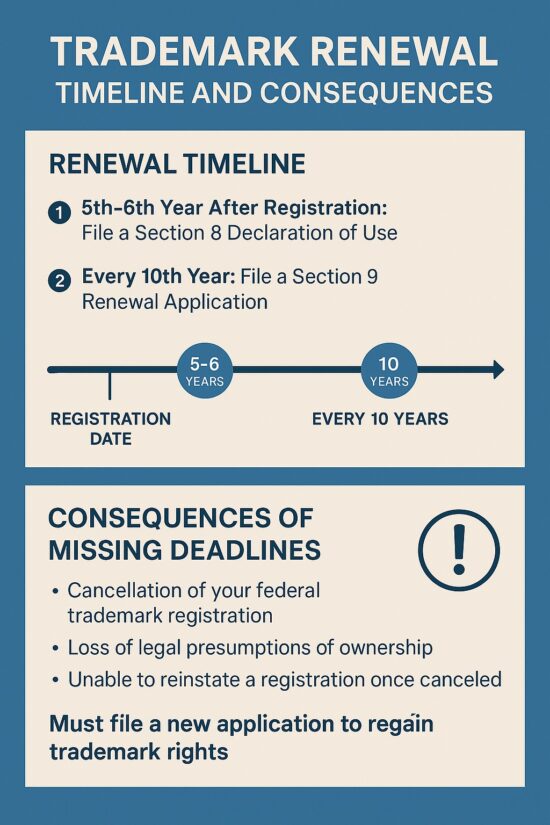
Federal trademark registrations have very specific timelines for required renewal filings. The key renewal periods and deadlines for a U.S. trademark are:
Between the fifth and sixth anniversaries of your registration, you must file a Section 8 Declaration of Use (or Excusable Nonuse) to confirm your mark is in use in commerce. This filing includes a sworn statement, a specimen of use (example of the mark in use), and the required fee per class. If your mark has been in continuous use for five consecutive years, you may also file an optional Section 15 declaration to make the registration incontestable.
Before each ten-year anniversary of your registration, you must file a Section 9 renewal application to keep the registration alive for the next decade. This is filed together with a Section 8 declaration of continued use at the ten-year mark. This combined Sections 8 and 9 filing is due in the one-year window before the end of each ten-year registration period: between the ninth and tenth anniversaries. Filing the renewal extends your registration for an additional ten-year term, and this cycle repeats every ten years as long as you continue to renew your trademark.
If you miss the standard filing window for the 6th-year or 10th-year filings, the USPTO allows a six-month grace period after the deadline to submit the trademark maintenance documents and fees. You can still renew during this grace period by submitting the required renewal documents and paying an additional fee (surcharge) per class. However, if you do not renew by the end of the grace period, the registration expires by operation of law as of the deadline, and no further extension is possible. Courts have emphasized that the statutory renewal deadlines cannot be waived or extended, even for inadvertence or mistake. In other words, after the grace period passes, a lapse is final and the only option is to file a new application.
The first required renewal document is the Section 8 Declaration of Use (or Affidavit of Use), due between the 5th and 6th year after registration. The purpose of this filing is to show the mark is still in continuous use in commerce on the goods/services listed in your registration. In the Section 8 submission, the trademark owner must declare that the mark is in use, list the specific goods or services in the registration that are in use, provide a specimen of use showing the mark in use, and pay the required fee.
If any goods or services are no longer in use, they should be removed from the registration to avoid issues. In cases where the mark is temporarily not in use due to special circumstances (e.g., a temporary business closure or supply chain issues), the owner can file a declaration of excusable nonuse, explaining the circumstances that excuse the nonuse and affirming that there is no intent to abandon the mark.
Filing the Section 8 declaration on time is critical to the validity of trademark registration. If you fail to file the Section 8 by the deadline, including the 6-month grace period, the USPTO will cancel your registration. In practice, this means your trademark registration will be removed from active status and marked “dead” in the USPTO records, stripping your mark of the benefits of registration. To keep an active registration, you must be sure to submit the Section 8 maintenance documents on time in the 5th year after registration.
In addition to the Section 8 affidavit of use, the trademark owner must file a Section 9 renewal application every ten years from the registration date. Section 9 is essentially a request to renew and extend the term of the registration for another ten-year period. Federal law provides that each registration may be renewed for successive 10-year periods by filing a renewal application within the year before the expiration of the current ten-year term, or within a six-month grace period after expiration. In practice, at the ten-year mark and every ten years thereafter, owners file a combined Section 8 and 9 submission: this includes the declaration of continued use (Section 8) and the formal renewal request (Section 9) together in one filing.
Submitting the Section 9 renewal with the Section 8 proof of use by the ten-year deadline will renew the trademark registration, preserve its priority to the original trademark application filing date, and keep your registration in force for another ten years. There is no limit on the number of times you can renew a trademark. As long as the mark remains in use and you meet the deadlines, your federal trademark registration can be renewed indefinitely, providing potentially continuous protection for your brand. Conversely, if the owner does not file the renewal application by the end of the grace period, the registration will expire and trademark rights afforded by the registration will cease as of that expiration date.
Trademark Sections 8 and 9 renewals are submitted electronically via the USPTO’s Trademark Electronic Application System (TEAS) through the USPTO.gov website. The trademark owner (or their attorney) must log in with a USPTO.gov account and access the appropriate form. The “Declaration of Use under Section 8” for mid-term maintenance, or the combined “Sections 8 and 9” form for a ten-year renewal can be accessed through the TEAS portal. The trademark identification information (e.g., registration number or serial number) is needed to access the record. The trademark renewal documents can then be electronically submitted through the TEAS portal.
When filing, you must verify the goods/services that are still in use, and attach the valid specimens of use images showing the mark in use in commerce. You can sign the declaration electronically and submit the payment all through the TEAS system. Once you submit the renewal application, you should receive a confirmation and a tracking number via the email address of record. The USPTO will then review the submission. If everything is in order, the USPTO will issue a notice or update the record to show your registration is renewed. The USPTO sends an official notice of acceptance for Section 8 and notice of renewal for Section 9.
If there is any problem with your filing, the USPTO will issue an office action explaining the deficiency. For example, if the submission is missing a specimen of use, or the affidavit of use wasn’t signed by the correct party, the filing will be defective. You are typically given an opportunity to respond and correct any issues within a set time. If a response to the office action curing the deficiency is timely filed, the maintenance filing can be accepted.
The USPTO sends courtesy email reminders to trademark owners and attorneys of record when a maintenance filing window opens: at the start of the 5th year and 9th year after registration. However, the USPTO is not obligated to send these notices, and not receiving a reminder (or having it go to spam) does not excuse missing a deadline. If you do not file the necessary renewal documents in time, your registration will be canceled or expire regardless of a lack of email notice. Therefore, trademark owners should be diligent about their renewal timelines and keep their own calendar reminders, or work with a trademark attorney, rather than relying on USPTO courtesy emails.
Renewing a trademark involves paying USPTO government fees, which are charged per class of goods or services in your registration. The exact fees can change over time, but as of recent fee schedules, the base filing fee for a Section 8 declaration is $325 per class and the Section 9 renewal fee at $325 per class, if filed electronically. These fees would be higher if filed on paper, but almost all trademark owners use the electronic TEAS filing. If you file during the six-month grace period after a deadline, an additional surcharge of $100 per class is required. All fees must be paid at the time of filing the renewal; if your registration covers multiple classes, the cost is multiplied by the number of classes.
It’s wise to check the USPTO’s current fee schedule when preparing to renew your trademark, because fees can be adjusted periodically. Also note that fees are nonrefundable, so ensure that your documents are in order to avoid having to re-file. Many trademark owners budget for these trademark renewal fees as a predictable business expense every decade. While hiring a trademark attorney or law firm to handle the renewal will incur legal service fees on top of the USPTO fees, it can help in avoiding mistakes. Whether or not you use an attorney, make sure to submit the required fee and documents on time to keep your trademark registration in good standing.
Failing to file the necessary renewal documents by the deadline has serious consequences: your federal trademark registration will be canceled or expire, and you will lose the benefits of an active registration. The mark itself does not necessarily stop being a trademark. You can still have common law rights if you continue using it, but your mark will no longer be listed on the federal register, which means losing the presumptions of ownership and nationwide scope that come with a registration. The USPTO will change the status of the registration to “dead,” and it will no longer block others from registering similar marks. In short, the valuable trademark protection afforded by a federal registration is gone once the registration is canceled for non-renewal.
If a deadline is missed by accident, unfortunately there is very little recourse. The law provides no mechanism to “undo” a lapse caused by failure to renew in time. The Trademark Trial and Appeal Board has underscored that the renewal deadlines are strict and set by statute. They cannot be extended or waived, even if a delay was unintentional. For example, even if your trademark was involved in litigation or a Trademark Trial and Appeal Board proceeding, that would not stop the USPTO from canceling a registration that wasn’t renewed. No pending dispute will toll the deadline. In a precedential case, a registrant who missed the Section 8 filing due to a calendaring error could not revive the registration because the deadline had passed. The registration was deemed expired by operation of law. The takeaway is that timely renewals are absolutely essential to avoid cancellation.
In very limited circumstances, a trademark owner might attempt a petition to revive or reinstate a registration, but these are only granted if the failure to renew was due to extraordinary situations like USPTO error. For instance, if the USPTO trademark office incorrectly failed to process a timely filing or sent a notice to the wrong address, one can petition the Director for reinstatement. Even then, strict time limits apply. Such a petition must be filed within two months of the cancellation notice. Absent USPTO error, once a registration is canceled for missing a renewal, the owner’s only option is to file a new registration application for the mark and start the process over. This underscores the importance of timely renewals.
To preserve continuous protection, trademark owners should stay abreast of all renewal deadlines and plan ahead. It’s often best to file the renewal as early as possible in the allowed window. Many businesses rely on docketing systems or their attorneys to send advance reminders well before the USPTO deadlines. By proactively managing your trademark portfolio and filing each required Section 8 and Section 9 on time, you can avoid cancellation of your registered trademarks and ensure your trademark rights remain intact.
The trademark renewal process is very manageable once you know the specific timelines and requirements. By filing the necessary Section 8 and Section 9 documents on schedule, a trademark owner can keep their registration in force indefinitely. Remember, a little advance planning ensures that your trademark will never inadvertently expire. If you need assistance with trademark renewals and maintenance or other trademark matters, please contact our office for a free consultation.
© 2025 Sierra IP Law, PC. The information provided herein does not constitute legal advice, but merely conveys general information that may be beneficial to the public, and should not be viewed as a substitute for legal consultation in a particular case.
Patent maintenance fees (also known as renewal fees or patent annuities) are periodic fees that must be paid to the United States Patent and Trademark Office (USPTO) to keep an issued utility patent in force. In the U.S., a utility patent’s term is generally 20 years from the application’s filing date, but maintaining patent rights for that full term requires paying maintenance fees at designated times. These fees do not apply to pending applications or to design patents or plant patents, which have no maintenance fees. For business owners and inventors, understanding and paying maintenance fees on time is critical. Failing to pay can result in a patent lapsing (expiring early), which means losing exclusive patent rights and allowing the invention to enter the public domain.
This article provides an overview of U.S. patent maintenance fees, including the payment schedule, grace periods, fee amounts, and what happens if a payment is missed.
Patent maintenance fees are mandatory fees required by law to keep a granted U.S. utility patent in effect after issuance. Unlike one-time filing, search, and examination fees paid during the patent application process, maintenance fees are renewal fees paid after the patent is granted, at set intervals, to maintain the patent’s enforceability. The USPTO collects these fees under authority of federal statute 35 U.S.C. § 41 and regulations. Maintenance fees were introduced to prevent patents from remaining in force if the owner is no longer interested in them, and to help fund the patent system.
Patent owners or their representatives must ensure the required fees are paid on time, otherwise the patent will expire for non-payment. Importantly, only issued utility patents and reissue patents are subject to maintenance fees. Design or plant patents do not require maintenance fee payments. No maintenance fees are due while a patent application is pending. Fees are only triggered after the patent is granted. In essence, maintenance fees are the U.S. patent system’s “patent renewal” mechanism, analogous to patent annuities in other countries, required to keep patent rights in force.

U.S. patent law specifies three maintenance fee due stages during a utility patent’s life. Under 35 U.S.C. § 41(b), maintenance fees on an issued utility patent are due at 3.5 years, 7.5 years, and 11.5 years after the patent’s grant measured from the issue date. The USPTO rules provide a payment window for each due stage: a fee can be paid without surcharge in the six-month window before each due date. In other words, the USPTO opens the window for paying the fee six months early at 3 years, 7 years, and 11 years after issue. Paying before the window opens (i.e., too early) is not permitted, so patent owners cannot “pay early” years in advance.
If the fee is not paid by the exact due date, there is a 6-month grace period after the due date during which the fee can still be paid, albeit with an additional required surcharge. For example, if a 3.5-year maintenance fee is due and missed, the patent owner can still pay it during the ensuing six months (3.5 to 4 years after grant) by including the prescribed surcharge. The current USPTO fee schedule sets the surcharge for late payment within the grace period at a fixed amount (e.g., $160 for large entities). Importantly, once the six-month grace period passes, the window to pay that maintenance fee closes and the patent will lapse.
Failure to pay a required maintenance fee by the end of the six-month grace period has serious consequences. By law, the patent expires as of the end of that grace period if the maintenance fee and any surcharge hasn’t been paid in full. In practical terms, missing a maintenance fee deadline plus grace period causes the patent to lapse, meaning it is no longer enforceable and the invention is effectively dedicated to the public domain.
The USPTO will list the patent as expired for failure to pay maintenance fees, and any patent rights are lost as of the lapse date. No further “extensions” beyond the 6-month grace are available as a matter of right. A patent owner must act before the grace period ends to avoid expiration. It’s worth noting that a maintenance fee payment that is insufficient (e.g. paying the small entity amount when the patent owner did not qualify for that status) will not be considered a proper payment. An underpayment or incorrect payment that isn’t corrected in time can therefore result in an unintended lapse, just as if no fee were paid.
Patent owners should also be aware that maintenance fee deadlines falling on a weekend or federal holiday are effectively extended to the next business day for payment purposes, but the patent’s expiration is still determined by the statutory deadline. So missing the next business day will cause the patent to expire as of the original deadline. In short, missing a maintenance fee deadline is a critical issue, the patent is deemed abandoned or expired for non-payment, and the owner’s patent rights cease.
If a patent expires due to failure to pay maintenance fees, all is not necessarily lost. However, reinstating the patent is subject to strict standards. U.S. law provides that an expired patent may be revived only if the delay in paying the maintenance fee is shown to have been “unintentional” or “unavoidable” on the part of the patent owner. The patent owner (or an authorized agent) must file a formal petition with the USPTO to accept the delayed maintenance fee under 35 U.S.C. § 41(c) and 37 C.F.R. § 1.378.
This petition requires: (1) payment of the required maintenance fee, (2) payment of a petition fee for delayed maintenance , and (3) a statement that the entire delay was unintentional on the part of the patent owner. The petition must be signed by a responsible party such as the patent owner or a registered patent attorney; if there are joint inventors or an assignee of record, those parties must be properly identified in the petition. Critically, “unintentional delay” has a strict legal meaning: it cannot include any deliberate decision or intentional choice not to pay.
The federal courts has made clear that a patent owner who consciously chose not to pay a maintenance fee (e.g., believing the patent had no value at the time) cannot later claim the delay was unintentional. In In re Rembrandt Techs. LP Patent Litigation, 2009 U.S. Dist. LEXIS 61771 (D. Del., June 29, 2009), the court refused revival where the patentee intentionally let the patent lapse and only later changed their mind. Similarly, in Network Signatures, Inc. v. State Farm Mut. Auto. Ins. Co., 731 F.3d 1239 (Fed. Cir. 2013), the court affirmed that the “unintentional” standard does not cover deliberate non-payment decisions.
If the USPTO grants the petition and accepts the late payment, the patent can be reinstated, but any intervening rights that arose during the lapse period may limit enforcement against third parties, and in some cases, substantial delay in seeking revival can complicate matters. Because revival is not guaranteed and involves additional costs and legal procedure, the best practice is to pay maintenance fees timely and avoid lapse.
The dollar amount of each maintenance fee depends on the patent owner’s entity status. To account for the needs of independent inventors, small businesses, and nonprofits, Congress created a discounted fee schedule for “small entities,” and an even lower rate for “micro entities.” Large entity (undiscounted) fees are the standard amounts set by the USPTO, which are periodically adjusted for inflation.
A small entity, defined by USPTO rules as a business with no more than 500 employees, an independent inventor, or a nonprofit organization, not obligated to license or assign the invention to a large entity, pays 50% of the large entity fee for most patent fees, including maintenance fees.
A micro entity, a subset of small entities, typically an inventor who has filed only a few patents and has a limited income, or who qualifies via a university affiliation per 35 U.S.C. § 123, enjoys a 75% fee reduction, paying only 25% of the large entity USPTO fees. For example, as of the current USPTO fee schedule, the first maintenance fee (due at 3.5 years) is $2,150 for a large entity, $860 for a small entity, and $430 for a micro entity.
The USPTO’s fee schedule is subject to change. Fees are generally adjusted annually under 35 U.S.C. § 41(f) for inflation. Patent owners should consult the current USPTO fee schedule to know the exact fee amounts due. It is crucial to pay the correct amount according to your entity status. Paying the small or micro entity fee when not actually eligible for such status can lead to the lapse of the patent. Deliberately misrepresenting one’s status to pay a lower fee could be deemed fraud on the USPTO.
Indeed, the Federal Circuit has held that intentionally paying small-entity fees despite not qualifying can constitute inequitable conduct, rendering the patent unenforceable. Thus, patent owners must verify their entity status before paying, and if a company grows or an ownership or licensing change occurs, the status should be updated before the next fee is paid. If a fee was accidentally underpaid due to status error, the USPTO allows a late deficiency payment with a surcharge to correct it, if done timely.
The USPTO provides several methods for paying maintenance fees, and patent owners can choose the most convenient option. The preferred method is to pay online via the USPTO’s Patent Maintenance Fees Storefront – an online payment portal where one can look up the patent by number and submit payment electronically. Online payment can be made by credit/debit card, electronic funds transfer (EFT), or through a USPTO deposit account.
Notably, the USPTO advises not to use the regular patent filing system (EFS-Web) for maintenance fee payments. There is a dedicated fee payment portal for maintenance fee payments, or other methods can be used. To successfully pay a maintenance fee, you must provide both the patent number and the corresponding application number with your payment so that the USPTO can accurately apply the fee to the correct patent record. For a reissue patent, you would provide the reissue patent/application numbers as well.
Other acceptable payment methods include: wire transfer via the Federal Reserve Fedwire system, with required information like the patent number, application number, and fee amount noted in the transfer; payment by fax using a credit card payment form and Maintenance Fee transmittal form faxed to the USPTO; and payment by mail with the forms and payment sent to the USPTO’s Office of Maintenance Fees in Alexandria, Virginia. Note that if paying by mail, the “payment date” is the date the USPTO receives the payment, unless a Certificate of Mailing or USPS Priority Mail Express procedure is properly used per 37 C.F.R. §§ 1.8 or 1.10. Whichever method is used, it’s wise to make the payment a bit ahead of the deadline to allow for processing time and to verify the fee was received.
Many patent owners use patent attorneys, law firms, or specialized annuity payment services to handle maintenance fee payments on their behalf, ensuring deadlines are not missed. In fact, any person or entity can pay the maintenance fee on behalf of the patent owner. It does not have to be the inventor or owner themselves, as long as the fee is properly submitted. The key is that the fee is paid timely and in full.
The USPTO sends courtesy reminders to official correspondence address for the patent file, and it does publish notices of upcoming maintenance fee due dates and expirations. Also, the Patent Maintenance Fees Storefront allows users to check a patent’s status, see upcoming payment window dates and due dates, and even download a maintenance fee statement showing the payment history. There is sufficient information provided by the USPTO to make timely maintenance fee payments. However, they are still easy to miss due to the distant deadlines. Memory fades, and so patent owners must stay vigilant about their patent maintenance fees.
The USPTO’s Official Gazette also regularly lists patents with fees due and patents that have expired for failure to pay. Business owners should keep their own docket or calendar of maintenance fee due dates and the start of each payment window. Setting reminders well in advance of due dates can help avoid inadvertent lapses. Using the USPTO’s online lookup or engaging a law firm’s docketing services are effective ways to track and ensure maintenance fees are paid in a timely fashion. The relatively additional costs of paying these fees are small compared to the serious consequences of losing a patent, so maintaining diligence is crucial.
Every patent owner needs to be aware of their patent maintenance fee schedule. To ensure your patent rights remain in force for the patent’s full term, you must know when fees are due, the applicable grace periods, and the proper payment procedures. Always be mindful of your entity status (large, small, or micro) and pay the correct fee. Missing a maintenance fee can cause a patent to expire early, cutting off your rights. A lapsed patent might be revived via petition if the delay was unintentional. However, revival is not provided as a matter of right and the process is costly.
In summary, treat maintenance fee deadlines with the same importance as the original patent filing. Timely payment of these fees will protect your investment in the patent and preserve the exclusive rights granted by the USPTO.
If you need assistance with patents or other intellectual property matters, contact our office for a consultation with one of our experienced patent attorneys.
© 2025 Sierra IP Law, PC. The information provided herein does not constitute legal advice, but merely conveys general information that may be beneficial to the public, and should not be viewed as a substitute for legal consultation in a particular case.
Copyright owners sometimes are faced with an infringement matter that requires action. These situations raise an important question: “Can you sue for copyright infringement without registration?” In the United States, copyright protection is automatic. It exists as soon as an original work is created and fixed in a tangible medium of expression. However, U.S. copyright law generally requires a registration before the copyright owner can file an infringement lawsuit in federal court. In practice, this means you must register your copyright to sue for copyright infringement. This article breaks down the rules under U.S. copyright law, the role of the U.S. Copyright Office, and why timely registration is crucial for obtaining remedies like statutory damages and attorney’s fees in an infringement suit.
Under U.S. law, you automatically own the copyright in any original work of authorship once it is fixed in a tangible medium of expression (e.g., writing an article, saving a digital photo, or recording a song). You do not have to file anything to have copyright protection, the copyright exists from the moment the work is created. Copyright covers a wide range of creative works both published and unpublished, including various forms such as:
The copyright owner immediately enjoys certain exclusive rights granted by copyright law. For example, the rights to reproduce the work, distribute it, create derivative works from it, and to perform or display the work publicly. These rights give the owner control over how the copyrighted work is used.
Copyright infringement occurs when someone exercises one of the copyright owner’s exclusive rights without permission (i.e. without a license or authorization). In legal terms, 17 U.S.C. § 501(a) provides that “anyone who violates any of the exclusive rights of the copyright owner… is an infringer”. Those exclusive rights include the right to reproduce the work, to distribute copies, to prepare derivative works, and to perform or display the work publicly. Any unauthorized use of these rights (e.g., copying your article or photo and posting it online without your permission) will constitute an act of infringement, giving rise to a civil copyright infringement claim by the copyright holder. In other words, if someone uses your creative work without a license or consent, that person is infringing your copyright. The copyright owner would then have the right to take legal action by filing a copyright infringement suit to enforce their exclusive rights.
While your work is protected by copyright automatically, U.S. copyright law makes copyright registration a prerequisite to filing a lawsuit for infringement of any United States work. In fact, the Copyright Act says “no civil action for infringement of the copyright in any United States work shall be instituted until registration of the copyright claim has been made”. This means that if your work is considered a U.S. work (e.g. first published in the U.S.), you cannot sue the infringer in federal court until you have a Certificate of Registration from the U.S. Copyright Office. U.S. federal courts have exclusive jurisdiction over copyright claims, so registration is essentially your entry ticket to court for U.S. works.
The Supreme Court underscored this rule in Fourth Estate Pub. Benefit Corp. v. Wall-Street.com, 139 S.Ct. 881 (2019), unanimously holding that copyright owners must wait until the Copyright Office actually issues a registration before filing an infringement lawsuit. Simply submitting a registration application is not enough. The registration has to be granted by the Copyright Office for the suit to proceed. If you file a lawsuit before registration, the court will dismiss the case for failure to meet this statutory requirement.
The law provides only a few narrow exceptions where a suit can proceed without registration. For example, claims under the Visual Artists Rights Act, which protects certain moral rights of attribution/integrity for visual art, and certain cases involving works fixed during live broadcasts under 17 U.S.C. §411(c). These are uncommon scenarios. For nearly all typical infringement cases (e.g. unauthorized use of your business’s marketing materials, software, photos, etc.), registration is required before you can bring a civil infringement action.
The registration prerequisite applies only to “United States works.” If your work is a non-U.S., foreign work, U.S. law does not require registration to sue. This distinction exists because of international treaty obligations under the Berne Convention, which prohibit member countries from imposing formalities like registration on foreign works as a condition of protection. In other countries, generally you can sue for copyright infringement without registration, as most countries do not have a registration requirement for enforcement. For example, a UK or Canadian copyright owner can usually go straight to court since their copyright laws recognize copyright automatically upon creation.
However, if you are a foreign copyright owner suing in a U.S. court, you should explicitly plead and prove the foreign status of your work to be exempt from the registration rule. Courts have dismissed lawsuits by foreign plaintiffs who failed to allege that their works were not “United States works.” In practice, it’s wise even for foreign authors to consider U.S. registration, not only to avoid any confusion about eligibility to sue, but also to access the full range of remedies, such as statutory damages. And while registration is typically optional abroad, some countries have voluntary copyright registries that can serve as public record or evidence of ownership.
Registering your copyright not only allows you to sue, but also unlocks important legal remedies. Perhaps the biggest advantages of timely registration are the ability to seek statutory damages and attorney’s fees from the infringer in a successful lawsuit. Statutory damages are pre-set monetary awards defined by the Copyright Act, ranging from $750 to $30,000 per work infringed, and up to $150,000 per work for willful infringement. These damages can be awarded without needing to prove your actual monetary loss. By contrast, if you haven’t preserved the right to statutory damages, you are limited to actual damages, which may be your lost profits or the infringer’s profits attributable to the infringement, which you must prove with evidence. Proving actual damages can be difficult and may result in lower recovery, especially if the actual funds lost from the infringement are small or hard to quantify.
Attorney’s fees can also be awarded to the prevailing party at the court’s discretion under 17 U.S.C. §505. However, to be eligible for an award of attorney’s fees and statutory damages, the copyright must have been registered timely. “Timely” generally means before the infringement occurs, or if the work was published, within three months of its first publication, as provided under 17 U.S.C. §412. If you do not register before infringement begins, the law bars you from recovering statutory damages or attorney’s fees for that infringement. In a practical sense, this can make a huge difference. For example, a business whose work was infringed but not registered may only recover perhaps a few thousand dollars of actual damages or in some cases $0 if actual loss can’t be proven, and would have to pay its own lawyers. Such a scenario may make litigation not worth the cost. Conversely, a business with a registered work can threaten statutory damages up to $150,000 plus attorney’s fees for willful infringement, creating a strong incentive for an infringer to settle or for the court to fully compensate the copyright owner.
Failing to register in time means you cannot “seek statutory damages” or reimbursement of attorneys’ fees in court for past infringement. You would be limited to proving and obtaining actual damages and stopping further infringement via injunction. These actual losses are often lower than statutory awards and successful litigation may not even be economically feasible without the prospect of statutory damages and fee-shifting. Timely registration ensures you retain the right to these powerful remedies, which can be critical in an infringement action.
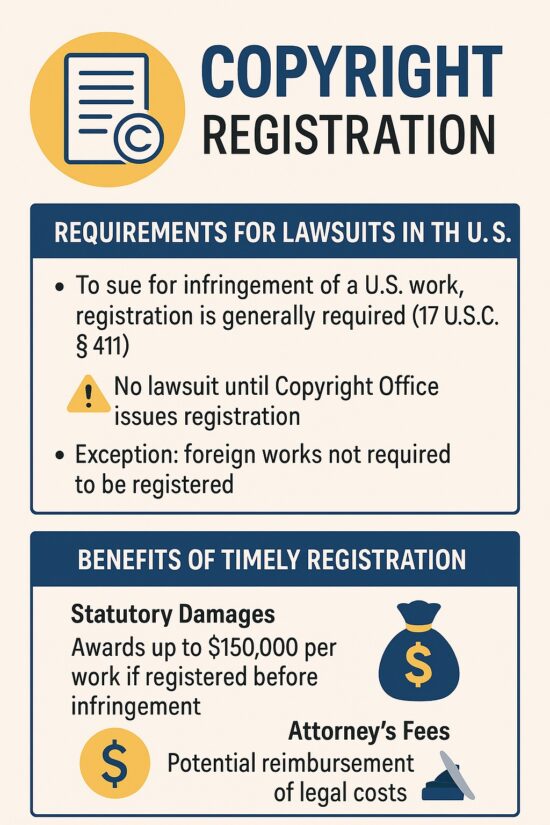
It is important to understand that even if you missed registering before an infringement, you can still register and then file a copyright infringement lawsuit, but your remedies will be limited as noted above. Once you do obtain a registration, you can sue to stop the unauthorized use and claim any provable actual damages and infringer’s profits from the misuse of your work. The infringer does not get a “free pass” simply because you hadn’t registered at the time of infringement. The infringer may still be found liable and be ordered to pay for the damage done to you. However, any infringement that occurred before the effective date of your registration will not qualify for statutory damages or attorney’s fees under the Copyright Act. Only infringements that commence after your registration or after timely copyright registration within the publication grace period can potentially yield those enhanced remedies. This is why many copyright owners choose to register early, even if no infringement is yet known. It is an investment in being able to fully enforce your rights should infringement occur.
Additionally, registering your work provides an evidentiary benefit in court. Specifically, if you register before an infringement or within five years of first publication, your certificate of registration is treated as prima facie evidence of the validity of your copyright and of the facts in the certificate, including your ownership. In an infringement lawsuit, the copyright owner must prove ownership of a valid copyright and prove infringement by the defendant. A timely copyright registration creates several benefits, including a presumption that your copyright is valid, which can make it easier to prove the first element of infringement in court. The burden would shift to the defendant to rebut your ownership or the copyright’s validity. Without registration, you may need to provide additional proof of your ownership and the work’s originality/creation date. Thus, registration can strengthen your position in litigation beyond just the damages. It helps establish your case from the outset, contributing to more successful litigation outcomes.
Registering a copyright with the U.S. Copyright Office is a relatively straightforward process. It involves filing a copyright application, commonly done online via the Electronic Copyright Office portal, paying a filing fee, and submitting copies of the work referred to as a “deposit” to the Copyright Office. Once the Office examines and approves the claim, it will issue a Certificate of Registration under its seal, and that certificate will list details like the title, author, owner, and effective date of registration. The effective date is important. It is the date the Copyright Office received your complete application and fee, not the date they finally issue the certificate.
In recent years, standard copyright registrations can take anywhere from a few weeks to several months for the Copyright Office to process, depending on the complexity of the work and backlog. The average processing time is often around 4–6 months, and it could be longer if the examiner raises issues that must be addressed before registration. If you anticipate an infringement lawsuit or need a registration quickly, the Copyright Office offers an expedited service called “special handling.” For an additional fee, you can request special handling to have your application processed on an urgent basis if there is pending or prospective litigation. An application under special handling may be processed in a few days to a few weeks. Many copyright owners use this option when they discover infringement and need to sue immediately, essentially paying extra to get the registration issued so they can proceed to court.
It’s best practice to register your work as early as possible, ideally within three months of first publication, so that you qualify for the full range of remedies if an infringement occurs. If you register within that 3-month window after publication, any infringement that happens in those first months after publication is still eligible for statutory damages and attorney’s fees. The law treats the registration as if it were in place at the time of infringement. If you wait longer than three months after publishing to register and someone infringes in the interim, you have potentially lost the chance to recover those enhanced damages for that period. Therefore, timely registration is crucial for valuable works.
Aside from enabling lawsuits and damages, certificate of registration also creates a public record of your claim to copyright. The details of your registration go into the Copyright Office’s database (e.g., listing the copyright holder, dates, etc.), which puts the world on notice that you claim ownership. This can deter potential infringers and helps others who may seek to license or get permission to find the owner easily, since the registration can include contact info for licensing requests. In sum, registering your works promptly will protect your ability to enforce your rights and maximize your legal remedies if infringement arises.
In the U.S., for works of U.S. origin, you must register your copyright before you can file an infringement lawsuit. Copyright protection may be automatic, but enforcing your rights is another matter. Registration is a critical step that empowers the copyright owner to bring a civil action in federal court and to claim powerful remedies like statutory damages and attorney’s fees. If you skip registration or delay it, you risk losing out on those remedies and weakening your position against an alleged infringer. On the other hand, timely copyright registration sets you up for successful litigation if needed, establishing a public record, providing legal presumptions of ownership, and allowing recovery of statutory damages and attorney's fees if infringement occurs. With the proper registration and legal guidance, you can confidently sue for copyright infringement when necessary and seek the full remedies that copyright law provides to the copyright holder.
The takeaway is clear: register your copyrights in your important creative works early. The cost and effort of registration are small compared to the protection and advantages it provides. If you have concerns related to unregistered copyrights or discover an infringement, contact our office to consult with an experienced intellectual property attorney.
© 2025 Sierra IP Law, PC. The information provided herein does not constitute legal advice, but merely conveys general information that may be beneficial to the public, and should not be viewed as a substitute for legal consultation in a particular case.

Sierra IP Law, PC - Patents, Trademarks & Copyrights
FRESNO
7030 N. Fruit Ave.
Suite 110
Fresno, CA 93711
(559) 436-3800 | phone
BAKERSFIELD
1925 G. Street
Bakersfield, CA 93301
(661) 200-7724 | phone
SAN LUIS OBISPO
956 Walnut Street, 2nd Floor
San Luis Obispo, CA 93401
(805) 275-0943 | phone

SACRAMENTO
180 Promenade Circle, Suite 300
Sacramento, CA 95834
(916) 209-8525 | phone
MODESTO
1300 10th St., Suite F.
Modesto, CA 95345
(209) 286-0069 | phone
SANTA BARBARA
414 Olive Street
Santa Barbara, CA 93101
(805) 275-0943 | phone
SAN MATEO
1650 Borel Place, Suite 216
San Mateo, CA, CA 94402
(650) 398-1644. | phone
STOCKTON
110 N. San Joaquin St., 2nd Floor
Stockton, CA 95202
(209) 286-0069 | phone
PORTLAND
425 NW 10th Ave., Suite 200
Portland, OR 97209
(503) 343-9983 | phone
TACOMA
1201 Pacific Avenue, Suite 600
Tacoma, WA 98402
(253) 345-1545 | phone
KENNEWICK
1030 N Center Pkwy Suite N196
Kennewick, WA 99336
(509) 255-3442 | phone
2023 Sierra IP Law, PC - Patents, Trademarks & Copyrights - All Rights Reserved - Sitemap Privacy Lawyer Fresno, CA - Trademark Lawyer Modesto CA - Patent Lawyer Bakersfield, CA - Trademark Lawyer Bakersfield, CA - Patent Lawyer San Luis Obispo, CA - Trademark Lawyer San Luis Obispo, CA - Trademark Infringement Lawyer Tacoma WA - Internet Lawyer Bakersfield, CA - Trademark Lawyer Sacramento, CA - Patent Lawyer Sacramento, CA - Trademark Infringement Lawyer Sacrament CA - Patent Lawyer Tacoma WA - Intellectual Property Lawyer Tacoma WA - Trademark lawyer Tacoma WA - Portland Patent Attorney - Santa Barbara Patent Attorney - Santa Barbara Trademark Attorney
