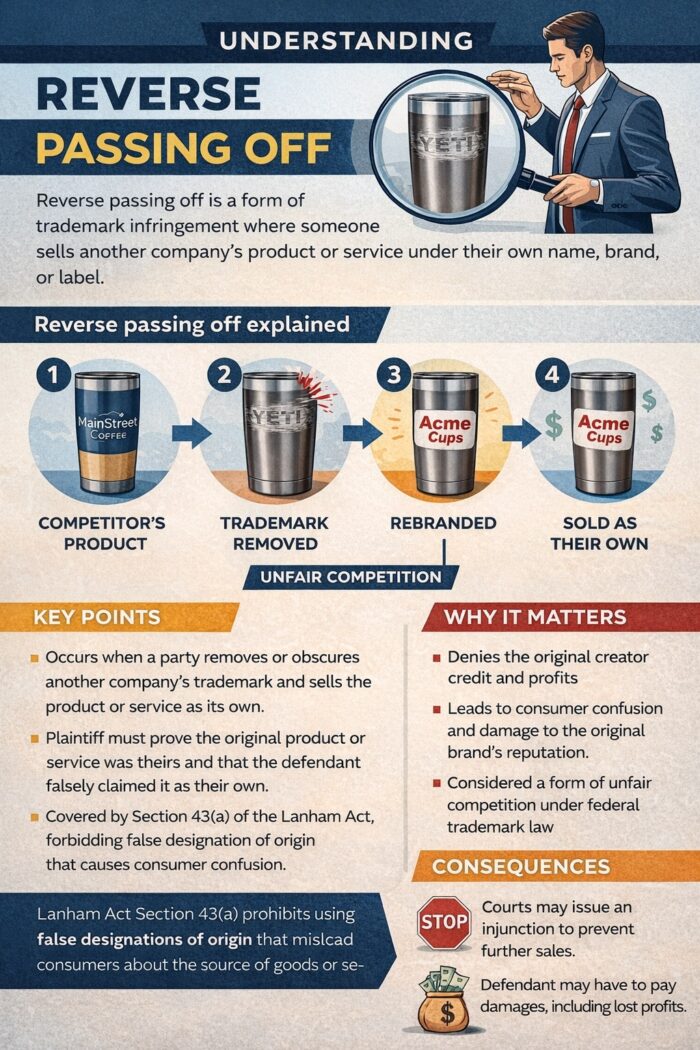
“Reverse passing off” is a form of unfair competition where someone sells another company’s product under their own name or brand. Unlike ordinary “passing off” (or palming off), which involves misrepresenting your goods as someone else’s, reverse passing off occurs when a party misrepresents someone else’s goods or services as its own. This deceptive practice is considered unfair competition under U.S. trademark law and is prohibited by federal law under the Lanham Act’s false designation of origin provisions. In this article, we break down the concept of reverse passing off, how it differs from traditional trademark infringement, legal elements of the claim, and key court decisions.
Reverse passing off essentially occurs when one company takes a competitor’s product, removes or obscures the competitor’s trademarks, and then markets the product under a different mark or its own name. In other words, the offender is selling someone else’s goods as if they were the offender’s goods. For example, if Company B buys widgets from Company A, strips off A’s brand labels (if present), and then sells those identical widgets as “B’s” products, B is engaging in reverse passing off. Courts define this as a form of false designation of origin, a type of misrepresentation expressly covered by the Lanham Act.
To better understand reverse passing off, it helps to compare it to traditional passing off. Passing off (also called “palming off”) is the classic trademark infringement scenario: a business tries to pass its own products or services off as if they came from another brand. For instance, a company or individual might sell counterfeit goods bearing someone else’s trademark, like selling knock-off yoga pants as Lululemon pants. By contrast, reverse passing off flips the scenario. The wrongdoer uses the plaintiff’s actual product, but presents it as their own product by rebranding or removing the original mark. In both cases the intended harm is similar: consumers are misled about the product’s true origin, which can cause confusion in the market and harm the rightful producer’s reputation and sales.
Reverse passing off is prohibited by federal law. Section 43(a) of the Lanham Act (15 U.S.C. § 1125(a)) forbids using any false designation of origin in connection with goods or services if it is likely to cause confusion about the origin of those goods. This law is a federal unfair competition statute that applies to all goods and services in commerce. Notably, a reverse passing off claim does not require that the original trademark be registered with the U.S. Patent and Trademark Office. Unregistered trade names or product configurations are protected from false origin claims. The key question under the Lanham Act is whether the public is likely to be misled or confused about who actually produced the product or service. In short, the law aims to protect the integrity of the marketplace by ensuring consumers are not deceived about a product’s origin or maker.
To succeed in a reverse passing off claim, a plaintiff (the source of the goods) generally must prove that:
Crucially, unlike typical trademark infringement, reverse passing off does not require the plaintiff to show the defendant’s mark is similar to the plaintiff’s mark. The gravamen of the claim is the false designation of origin: that the defendant falsely presented the plaintiff’s goods as its own, causing consumer confusion about who deserves credit for the product. This kind of misrepresentation can damage the plaintiff’s goodwill and deny the plaintiff the profits and recognition associated with its product.
Reverse passing off can take various forms. Express reverse passing off is when the wrongdoer not only removes the original manufacturer’s name or logo but rebrands the product with a different mark, often the defendant’s own brand. An example would be peeling off the nameplate of a competitor’s device and replacing it with your company’s label before sale.
Implied reverse passing off occurs when the wrongdoer simply removes or obscures the plaintiff’s name or mark and sells the product unlabeled, effectively presenting it as generic or self-produced. In both scenarios, the result is that customers don’t see the plaintiff’s mark. They either see the defendant’s mark or no brand at all, leading them to believe the defendant is the source. Both forms are actionable as false designation of origin under the Lanham Act. Courts have consistently found that selling someone else’s goods misbranded as one’s own is “a false designation of origin” under federal law.
Reverse passing off is a relatively rare form of trademark infringement. Most trademark cases involve the more common scenario of a junior user trying to copy or mimic the senior user’s mark to sell its own products. In contrast, reverse passing off arises with unauthorized rebranding of a manufacturer’s goods, distributors mislabeling products, or intellectual property disputes over attribution. One reason it’s uncommon is that it’s often easier for an infringer to benefit from another’s reputation by using the plaintiff’s mark (traditional infringement) rather than by hiding it.
Nonetheless, when reverse passing off does occur, it can be very damaging. The original producer is deprived of recognition and market credit for its product’s quality, and consumers are denied the knowledge of the product’s true source. This lack of transparency can harm the marketplace integrity and consumer confidence in knowing what brand they’re actually buying.
To illustrate, consider a real-world example: Liz Claiborne (a fashion brand) once discovered that one of its overseas sweater manufacturers had secretly sold extra sweaters that were originally made for Liz Claiborne, but the manufacturer replaced Liz Claiborne’s label with its own “Mademoiselle” brand and sold them without authorization. Liz Claiborne, Inc. v. Mademoiselle Knitwear, Inc., 13 F. Supp. 2d 430 (S.D.N.Y. 1998). This meant identical sweaters marked with the Mademoiselle brand ended up on the same store rack. This is a textbook case of reverse passing off: the manufacturer took the plaintiff’s product and passed it off as its own, a practice the law forbids.
Other examples include a company buying a competitor’s product, lightly modifying it (or not at all), and then repackaging it under the company’s brand for sale. In one case, a defendant was found liable for reverse passing off after it obtained a competitor’s grain trailer, removed the competitor’s labels, and marketed the trailer as its own product, conduct the court said was “of the same economic nature as trademark infringement”. Truck Equipment Service Company v. Fruehauf Corporation, 536 F.2d 1210 (8th Cir. 1976). The harm in such cases is clear: the originator loses sales and the goodwill associated with its name, while the infringer capitalizes on the originator’s talents and workmanship without permission.
Reverse passing off has been recognized by courts as a viable claim for decades. For instance, the Ninth Circuit Court of Appeals acknowledged this cause of action in Smith v. Montoro, where a film distributor removed the lead actor’s name from movie credits and substituted another name. Smith v. Montoro, 648 F.2d 602 (9th Cir. 1981). The court found this misattribution stated a valid Lanham Act claim for reverse passing off.
Various other circuits have similarly held that purchasing a competitor’s goods and selling them under one’s own name or a different mark is a form of false designation of origin under Section 43(a). However, the most significant decision is the U.S. Supreme Court’s ruling in Dastar Corp. v. Twentieth Century Fox Film Corp., 539 U.S. 23 (2003). In that case, Dastar copied and edited a series of public domain videos originally produced by Fox, then sold them as Dastar’s own product (with Dastar’s branding and no credit to Fox). The Ninth Circuit had found this to be reverse passing off, calling Dastar’s uncredited copying a “bodily appropriation” of Fox’s work. But the Supreme Court unanimously reversed that decision, significantly narrowing the scope of reverse passing off claims.
In Dastar, the Supreme Court clarified what “origin” means under the Lanham Act. The Court held that the “origin of goods” in a reverse passing off claim refers only to the producer of the tangible goods that are offered for sale, not the creator of any idea, concept, or content within those goods. In practical terms, this means if a company legitimately produces or manufactures a physical product, even if it incorporates someone else’s unbranded content or design, that company is deemed the origin of the goods for trademark purposes.
The Lanham Act does not require attribution to the author of any underlying creative work or idea: it is not a “credit” or plagiarism law. The Supreme Court emphasized that extending trademark law to require attribution for creative ideas would effectively create a “species of mutant copyright law” that interferes with the public’s right to copy and use public domain (unprotected) works. After Dastar, reverse passing off claims are generally limited to scenarios where the defendant is literally reselling the plaintiff’s physical products under a false label. Simply copying someone’s product and selling it under your own brand without using their actual goods typically won’t be actionable under trademark law. Unless other intellectual property rights (like patents or copyrights) are involved, no legal claim for copying another's concept, design, or content will be available. In short, Dastar ensures that trademark law remains focused on preventing confusion about a product’s physical source or manufacturer, while preserving free access to ideas and information in the public domain.
Business owners should also be aware that reverse passing off can involve foreign manufacturing relationships. For example, a company might contract with a foreign manufacturer to produce its goods. If that manufacturer, without authorization, takes the company’s products and sells them under the manufacturer’s own name, it could constitute reverse passing off. The earlier Liz Claiborne case is one illustration. Another scenario is an importer buying genuine products overseas, removing the original manufacturer’s branding, and then selling them in the U.S. under the importer’s brand. This kind of misrepresentation is related to actionable sales of gray market goods.
U.S. courts have indeed enjoined former distributors from covering a foreign manufacturer’s label with their own label after a distribution contract ended. The federal law applies so long as the goods are entering U.S. commerce with false origin information. The bottom line is that using a foreign manufacturer’s goods without proper branding or permission is risky: if you intended to deceive customers about who made the product, you could be facing an unfair competition claim.
Reverse passing off is not just an academic concept; it carries legal consequences that can be costly for businesses. If a plaintiff proves reverse passing off, courts can award remedies under the Lanham Act similar to those in other trademark infringement cases. These include injunctions (court orders stopping the defendant from selling the misbranded goods) and monetary damages.
A plaintiff may recover the defendant’s profits earned from the sales, any provable lost sales or damage to the plaintiff’s market and reputation, and possibly additional damages or attorney’s fees in exceptional cases. For instance, before Dastar reached the Supreme Court, the trial court had ordered Dastar to disgorge its profits. While that specific award was nullified when the Supreme Court found no Lanham Act violation, it illustrates the potential financial cost of a reverse passing off claim. In essence, a company caught relabeling someone else’s goods as its own may have to pay back money it made from those sales and might also suffer damage to its credibility.
Reverse passing off occurs when one party sells another’s product under its own branding, thereby falsely claiming the product’s origin. This practice undermines fair competition and can confuse consumers, so U.S. law provides a cause of action for affected companies to protect their interests. Although such cases are uncommon, the concept has seen renewed attention in scenarios like supply chain shortages or unauthorized overseas dealings.
The Lanham Act’s false designation provisions under Section 43(a) are the backbone of these claims. Businesses should be careful to avoid any branding strategies that could be seen as reverse passing off. If they are on the receiving end of such misconduct, they have legal recourse. By understanding reverse passing off and the legal standards involved, companies can better navigate their branding practices and ensure they remain on the right side of trademark law.
If you are facing an unfair competition situation or you need assistance with another intellectual property matter, contact our office for a free consultation.
© 2026 Sierra IP Law, PC. The information provided herein does not constitute legal advice, but merely conveys general information that may be beneficial to the public, and should not be viewed as a substitute for legal consultation in a particular case.
An invention disclosure is often the first step in protecting an invention and transforming it into a commercial asset. It is a document drafted to capture the invention for review by the company employing the inventor(s), patent counsel, or other parties that will consider the merits of the invention. The invention disclosure can be used for various purposes, including notifying a company of the internal development of a new invention, to inform a patent attorney of what is to be covered in a patent application, or to inform potential investors of the invention and its potential market value. The discovery of a new innovation or invention is valuable development and opportunity. Prompt action should be taken to document the essential features and embodiments of the invention.
An invention disclosure is a confidential internal disclosure that serves two equally important purposes. First, it creates a formal record of an invention, preserving the innovation by documenting when it was created, who the inventors are, and how the invention arose from a specific project, research, or development effort. This record is critical for establishing ownership, complying with organizational practices, and meeting obligations tied to funding sources, including government funding under the Bayh-Dole Act (35 U.S.C. §§ 200–212).
Second, an invention disclosure is an explanation to others, such as an internal IP office, licensing officer, or outside patent counsel, of what the invention actually is. The disclosure must clearly describe the technology, the underlying idea, and how it works as a system, method, or product. This explanation allows the invention to be evaluated for patentability, commercial potential, and suitability for commercialization or licensing.
Most organizations require inventors to complete an invention disclosure form, often through an online portal or inventor portal. While formats vary, strong disclosures typically include several key sections. These include a summary of the invention; a detailed description with technical details sufficient to be enabling; identification of all inventors; relevant data, drawings, or prototypes; and a discussion of alternative embodiments. The form also commonly asks inventors to identify any public disclosures, such as publications, presentations, or conferences, as well as any confidentiality agreement or other agreements governing the work.
Submitting an invention disclosure is crucial because it creates an internal recordkeeping system that allows a company or organization to control how, when, and whether an invention is disclosed to third parties. Most companies, universities, and research organizations maintain formal trade secret and intellectual property control policies that require inventors to submit an invention disclosure before discussing the invention externally. These policies help ensure that disclosures to customers, partners, investors, or vendors occur only under appropriate confidentiality agreements and consistent internal practices.
From a legal standpoint, uncontrolled public disclosures, including presentations, conferences, publications, offers for sale, or other external communications, can jeopardize patent rights if a patent application is not filed within the statutory one-year grace period under U.S. law. See 35 U.S.C. § 102(b). An invention disclosure allows the organization to manage this risk by routing all external communications through a centralized process and IP management personnel.
Equally important, the disclosure preserves the invention concept itself. The disclosure establishes a dated record of the idea as it exists at a particular stage of development, capturing the core innovation before it evolves further. As the invention is refined, additional details, data, embodiments, and improvements can be added, creating a living record that supports future protection, commercialization decisions, and ongoing development of the technology over time.
The invention disclosure form is a structured document designed to capture all information needed to evaluate, protect, and develop an invention. Each section serves a specific purpose within the overall process of intellectual property management and commercialization.
Most forms begin with a summary section. This high-level overview explains the core idea, the problem it solves, and why the invention is different from existing solutions. The summary allows reviewers to quickly understand the technology and its potential relevance.
The detailed description section is the most critical. Here, inventors must fully describe how the invention works, including technical details, components, steps, or architecture of the system or method. This section should be sufficiently enabling so that a person skilled in the field could understand the invention. Supporting data, drawings, figures, or prototypes are often included to strengthen this explanation.
Another key section identifies all inventors, contributors, and the circumstances under which the invention was created, including related research, project information, and employment or agreements. This ensures proper ownership and assignment.
The form also typically includes sections addressing public disclosures (such as publications, presentations, or conferences), funding sources, and any applicable confidentiality agreement. These sections help assess legal risks and compliance obligations.
Finally, many forms ask about commercial potential, possible companies or markets of interest, and anticipated development paths, supporting informed decisions about patent applications and commercialization strategies.
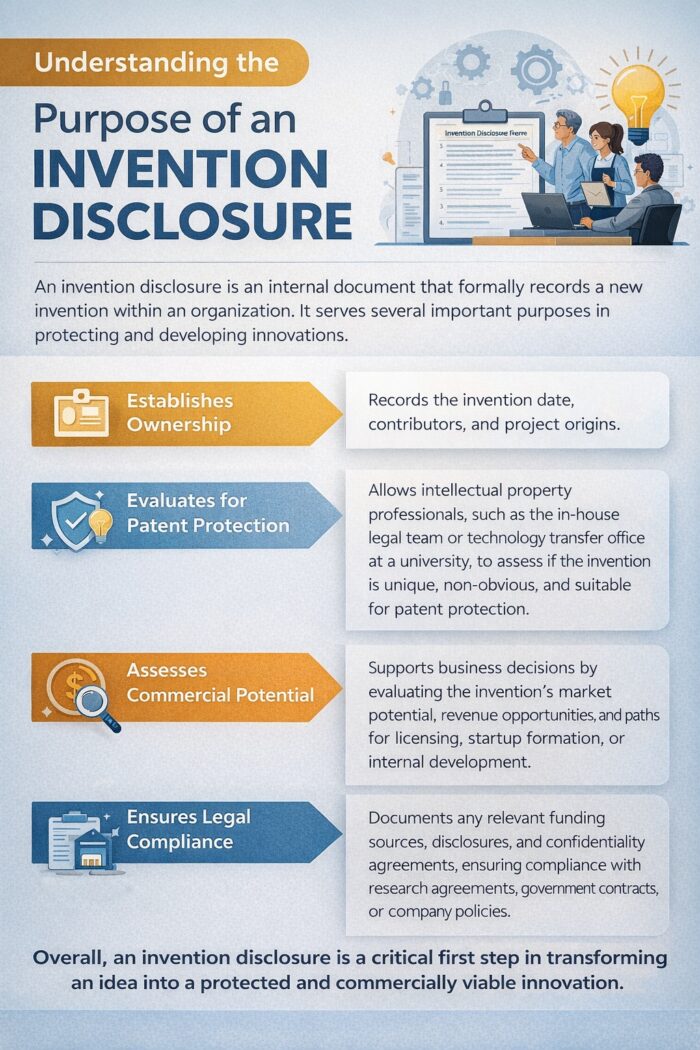
Submitting an invention disclosure typically involves coordination with the internal group responsible for intellectual property protection. In corporate settings, disclosures are commonly handled by in-house legal departments, intellectual property groups, or dedicated innovation or R&D offices that manage invention records and control external disclosures. At a university, invention disclosures are usually submitted to a technology transfer or commercialization office that supports faculty, researchers, and staff in evaluating and developing inventions. In some cases, outside law firms assist with intake, review, and preparation of disclosures for patent and licensing purposes.
The submission format varies by organization. Some entities still accept paper or PDF form submissions, while others rely on centralized online portals or inventor portals that guide inventors through the process step by step. These systems may require uploading technical descriptions, drawings, and data, as well as confirming inventor information and funding details. Regardless of format, timely submission is critical to ensure prompt review, coordinated patent strategy, and effective control over future disclosures.
After an invention disclosure is submitted, the organization evaluates the invention’s commercial potential to determine the most effective path forward. This assessment is typically conducted by a licensing or technology commercialization team and considers whether the invention is best suited for licensing to existing companies, forming a startup, or pursuing internal development. Factors often include the maturity of the technology, market size, competitive landscape, regulatory considerations, and the availability of funding or investor interest.
The quality of the invention disclosure plays a central role in this evaluation. A clear description, supporting data, and well-articulated use cases make it easier to identify interested partners and align the invention with real-world needs. Licensing officers may contact potential commercial partners, industry organizations, or investors to gauge interest and validate market assumptions.
Strong disclosures can accelerate the commercialization process, support successful licensing negotiations, and generate ongoing revenue. That revenue, in turn, often helps support future research, product refinement, and continued innovation within the organization.
University and corporate practices around invention disclosure are designed to ensure consistent protection, clear ownership, and compliance with legal and contractual obligations. At universities, invention disclosures are typically required from faculty, researchers, students, and staff who create inventions in the course of sponsored research or institutional activities. These disclosures are submitted to a technology transfer or commercialization office, which evaluates the invention for patentability, commercialization, and compliance with funding requirements, including federal grant obligations.
In corporate environments, invention disclosure obligations are usually established through employment agreements, invention assignment clauses, and internal IP policies. Employees are required to disclose inventions developed during their employment so the company can assess ownership, control disclosures, and determine whether to pursue patent applications or maintain the invention as a trade secret. These structured disclosure requirements help organizations maintain centralized records, manage risk, and ensure that intellectual property rights are consistently identified, secured, and enforced across teams and business units.
Maintaining accurate and complete invention disclosure records is a critical part of effective intellectual property management. Well-maintained disclosure records also support internal reviews, compliance audits, and due diligence activities related to funding obligations, government reporting, or corporate transactions. By clearly linking inventions to specific funding sources, contributors, and agreements, organizations can more easily demonstrate ownership and compliance with applicable policies and laws.
In addition, disclosure records create a foundation that can be built upon over time. As new embodiments, data, improvements, or use cases emerge, the original disclosure can be updated or supplemented, preserving institutional knowledge and strengthening future patent applications, licensing efforts, and enforcement strategies.
Controlling disclosures to third parties is critical because both an inventor’s own disclosure and derivative disclosures by others can qualify as prior art under U.S. patent law. Under 35 U.S.C. § 102(a), an invention is not patentable if it was publicly disclosed, on sale, or otherwise made available to the public before a patent application is filed. This includes situations where the inventor or company itself discloses the invention through presentations, publications, demonstrations, or unrestricted discussions. Importantly, disclosures by third parties who learned of the invention from the inventor or company can also become prior art if those disclosures are made publicly.
Using a confidentiality agreement or non-disclosure agreement (NDA) before sharing an invention serves several important purposes. First, it provides contractual remedies if the third party improperly discloses or uses the invention. Second, it can create a documented record of what was disclosed, when it was disclosed, and to whom. This record can be critical in demonstrating that a third party’s later disclosure, or even an allegedly infringing product, was derived from the inventor’s original disclosure rather than independently developed. Such evidence can be highly relevant in derivation proceedings and infringement disputes.
The risks of uncontrolled disclosure were highlighted long ago in Egbert v. Lippmann, 104 U.S. 333 (1881), where even limited, non-commercial use of an invention without confidentiality restrictions was deemed a public use that invalidated patent rights. The case underscores that secrecy and control, not the size of the audience, are what matter. Proper use of NDAs, combined with internal invention disclosure procedures, helps preserve patent rights while enabling necessary business and development discussions.
When an invention is developed using federal funding, additional legal obligations apply that make accurate disclosure especially important. Under the Bayh-Dole Act (35 U.S.C. §§ 200–212), organizations such as universities, nonprofit institutions, and certain companies receiving federal research support must disclose each subject invention to the appropriate funding agency within a prescribed time period after the invention is identified. This obligation is typically triggered through the organization’s internal invention disclosure process.
The invention disclosure must accurately identify all funding sources, grants, or contracts that supported the research or project leading to the invention. Federal agencies rely on this information to track rights, confirm compliance, and determine whether the organization may elect to retain title. Failure to timely disclose, elect title, or comply with reporting requirements can give the government so-called “march-in rights” or allow the agency to take ownership of the invention.
Accurate and complete funding disclosure also supports downstream patent applications, licensing, and commercialization, ensuring that ownership, reporting, and revenue-sharing obligations are properly managed from the outset.
An invention disclosure is more than paperwork. It is the gateway to securing patent rights, and it enables commercialization. Invention disclosures should be prepared and submitted in a timely manner in order to preserve the innovation and initiate evaluation and commercialization. By promptly completing the invention disclosure form, inventors and companies can secure their discoveries, avoid costly mistakes, and lead their innovations toward successful commercialization.
If you need assistance with developing an invention disclosure form or other intellectual property matters, please contact our office for a consultation.
© 2026 Sierra IP Law, PC. The information provided herein does not constitute legal advice, but merely conveys general information that may be beneficial to the public, and should not be viewed as a substitute for legal consultation in a particular case.
Obtaining a utility patent in the United States grants you exclusive rights over your invention. A utility patent, one of three types alongside design and plant patents, protects any “new and useful process, machine, manufacture, or composition of matter” that you invent. In practice, the patenting process is governed by U.S. patent law and handled by the U.S. Patent and Trademark Office (USPTO), which is the government agency responsible for examining patent applications. The journey from idea to patent pending status and finally to a granted patent can be complicated and may seem daunting to non-attorneys. The following sections break down how to get a utility patent in clear terms, from preparation through patent protection.
A utility patent protects the functional aspects of an invention, as opposed to a design patent (protecting ornamental appearance) or a plant patent (protecting new asexually reproduced plant varieties). To qualify, your invention must fall within patentable subject matter and have utility. U.S. law specifies that any new and useful process, machine, manufacture, or composition of matter or improvement thereof is eligible for a patent under 35 U.S.C. § 101.
Laws of nature, abstract ideas, and purely artistic works are not patent eligible. Ensure your concept is technical and patent eligible. If granted, a utility patent gives the patent holder the right to exclude others from making, using, or selling the invention, typically for 20 years from the filing date of the application. Maintenance fees are required to keep the patent in force for the 20 year term.
Beyond subject matter, your claimed invention must be novel and non-obvious. An invention is novel only if no existing patents or publications (prior art) have already disclosed it. U.S. patent law bars patents if the invention was “patented, described in a printed publication, or in public use, on sale, or otherwise available to the public” before your effective filing date under 35 U.S.C. § 102. It also provides a limited one-year grace period for an inventor’s own public disclosure of the invention, but it is risky to rely on the grace period. It is best to file your patent application before any public disclosure.
Even if novel, the invention must not be an obvious variation of prior art. Under 35 U.S.C. § 103, a patent cannot be obtained “if the differences between the claimed invention and the prior art are such that the claimed invention as a whole would have been obvious” to a person of ordinary skill. In other words, your idea must involve an inventive step beyond what was known. The Supreme Court’s decision in Graham v. John Deere Co., 383 U.S. 1 (1966) set out factors for determining non-obvious inventions. Practically, this means your invention should not be an evident next step to a skilled expert given the existing prior art. Ensure no single prior reference, or combination of references, already teaches all aspects of your invention.
Before investing in a patent application, perform a thorough prior art search. This involves searching for existing prior art such as patents, published patent applications, articles, and products related to your invention. A good patent search will reveal if your idea has been done before and help you refine your invention or distinguish it from the prior art. Conducting a prior art search prior to preparing a patent application can make the patent application process more efficient and cost-effective by allowing you to draft claims strategically around what’s already known. The search aids in identifying any similar inventions, including in foreign patents and non-patent literature, to ensure your concept is truly new. This step can also uncover existing patents that you might need to “design around” or license. Ultimately, a thorough search reduces the chance of surprise rejections from the patent examiner later and increases the odds of securing broad utility patent protection.
When you’re ready to file, decide whether to start with a provisional patent application or go straight to a non provisional application. Provisional applications are filed under 35 U.S.C. § 111(b) and are an optional, lower-cost filing that secures an earlier filing date for your invention. It allows you to legally apply patent marking to your invention as “patent pending” for 12 months without starting the patent examination process. Notably, a provisional is never examined on its merits and does not require formal claims, an inventor’s oath, or an information disclosure statement.
It must be followed by a corresponding nonprovisional application within that 12-month period, or else it expires and you lose the benefit of the early date. By contrast, a nonprovisional application, the actual utility patent application, is the full application that will be examined and can lead to a granted patent. If you file a provisional, use the time to refine your invention or raise funds, but remember to file the nonprovisional before the deadline. Many inventors use the provisional route to secure a quick filing date and patent pending status, then file the fully complete nonprovisional application within the year. If timing is critical or your invention is already fully developed, you may file a nonprovisional application directly.
Preparing a strong utility patent application is a crucial step. A nonprovisional application must contain a written specification, essentially a detailed description of the invention, and one or more claims defining the scope of what you seek to protect. By law, the specification must describe the invention in full, clear, concise, and exact terms to enable others in the field to make and use it in order to satisfy the written description and enablement requirements of 35 U.S.C. § 112. It should also set forth the best mode of carrying out the invention. Include any necessary drawings to illustrate the invention, as required by 35 U.S.C. § 113. Your application should start with a title, followed by sections such as a brief summary of the invention, any applicable background, a detailed description with reference to drawings, and claims.
The claims define the legal boundaries of your patent rights. They define the “metes and bounds” of your invention. Every nonprovisional application must conclude with at least one claim particularly pointing out and distinctly claiming the invention. Draft independent claims that cover the core inventive concept, and add dependent claims for specific features or refinements. Each claim element should be supported by the description. Because claims define what infringers cannot do, careful claim drafting is critical. This is where a skilled patent attorney’s expertise is especially valuable. In addition to the specification and claims, you will need to include an inventor’s oath or declaration, which is a signed statement by the inventor(s) asserting their inventorship and understanding of the application. The patent application also requires an Application Data Sheet (ADS) providing bibliographic information. All of these parts together form a complete utility patent application.
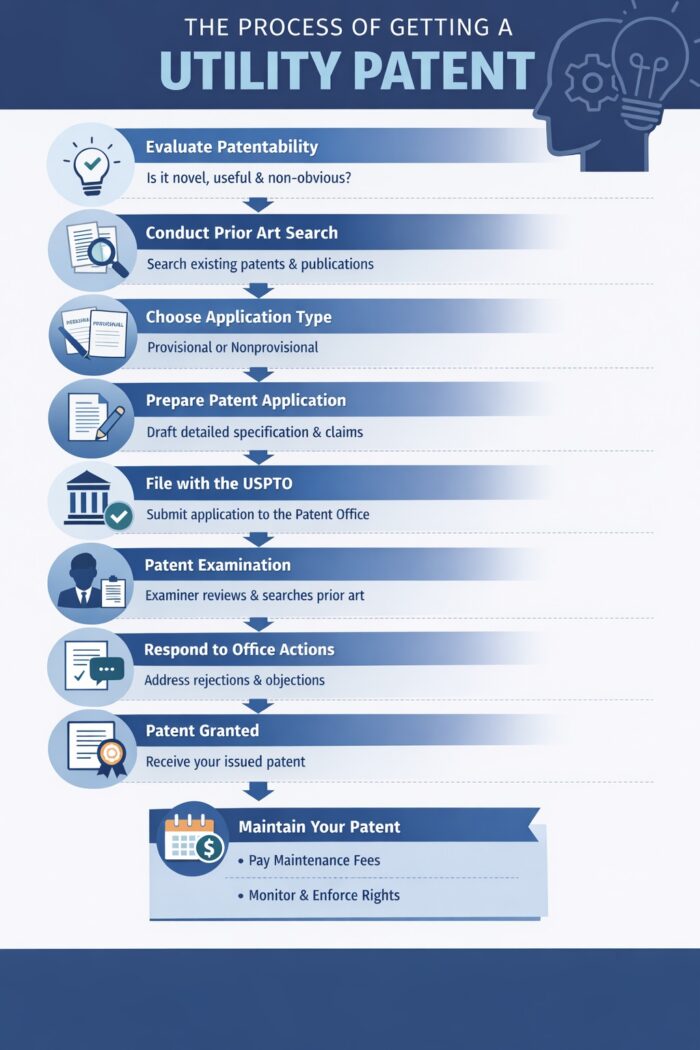
Once your application is drafted, file it with the patent office. The USPTO’s electronic filing system, called Patent Center, is the preferred way to submit your application. Electronic filing is faster and reduces errors. When filing, you must pay the appropriate fees, which typically include a filing fee, search fee, and examination fees for a utility application. These fees can vary based on the applicant's entity status: the USPTO offers reduced fees for small and micro entities (e.g. individual inventors or small businesses).
Upon successful filing, the USPTO will assign an application number and filing date, and issue a filing receipt. The filing date is critical. Under the first-to-file system, it locks in your priority against later filers. You can now legitimately use the term “patent pending” in connection with your invention. The USPTO will also review your submission for formalities. If anything is missing, the USPTO will send a Notice of Missing Parts, giving you a chance to correct the issue while keeping your original filing date. To avoid delays, double-check that all forms and documents are properly submitted. With the application on file, your journey moves to the examination phase.
After filing, your application enters the patent examination process at the USPTO. It will be assigned to a patent examiner skilled in the relevant technology. The examiner’s job is to evaluate whether your utility application meets all legal requirements for patentability. First, the examiner will read your specification and claims to understand the claimed invention. They will verify that formal requirements are met, including that the claims are clear and supported by the description, drawings are present, and one or more claims are included.
Substantive review begins with the Patent examiners search for prior art. The patent examiner will search existing patents, published applications, and other literature to find references similar to your invention. The examiner compares the prior art to your claims to determine if your invention is truly novel and non-obvious in light of what was already known. The examiner also checks for patentable subject matter issues under 35 U.S.C. §101 to determine whether your claims are not directed to a mere abstract idea or natural phenomenon. The examiner also determines whether your disclosure satisfies the 35 U.S.C. §112 requirements of an adequate written description, sufficient enablement, and definite claims. This examination procedure is rigorous and thorough. Patent prosecution often takes about 1–2 years from filing to receive initial feedback, due to the USPTO patent application backlog. Remember that the patent examining procedure is essentially a negotiation: the examiner is not against you, but they must ensure your application meets all legal standards before granting a United States patent.
In most cases, the examiner will issue an Office Action detailing any objections or rejections found during examination. An Office Action is an official letter from the examiner and is a normal part of patent prosecution. The first Office Action is “non-final” and will cite relevant prior art references and explain why certain claims are rejected. For example, a claim might be rejected under 35 U.S.C. § 102 as being anticipated by a single prior patent, or under § 103 as obvious in view of a combination of references. You will have an opportunity to respond. In your response, you can amend the claims to add details from the description to overcome the prior art and/or present arguments explaining why the examiner’s rejections are not applicable or why the invention is patentable over the existing prior art. There are typically both technical and legal analysis required to properly respond to the office action. It is recommended that you engage a patent attorney to assist you with your patent application so that the legal and technical issues are appropriately addressed.
This patent prosecution phase may involve multiple rounds. After your response, the patent examiner might allow the case or issue a final rejection. If final rejection occurs, options include filing an appeal or a request for continued examination (RCE) to keep prosecution moving forward with the ability to amend the claims. Independent claims are typically narrowed during this process to distinguish them from the prior art, with dependent claims possibly rewritten into allowable form. Patent prosecution can be complex, but its goal is to ensure that any patented invention meets all legal requirements and that your claims are unambiguous and valid. Maintaining a cooperative tone and addressing the examiner’s concerns thoroughly, sometimes including an examiner interview to discuss the case, can improve your chances of success. Many experienced patent attorneys are adept at navigating this process to secure the broadest protection possible.
If the examiner is satisfied that your application meets all requirements, you will receive a Notice of Allowance. This means your patent will be granted once you pay the issue fee. Upon issuance, you become the proud patent holder of a U.S. patent. The patent will be given a patent number and publication. You can then label your product as “U.S. Patent No. X,XXX,XXX.” A granted patent confers the right to exclude others from making, using, selling, or importing your invention, turning your idea into a valuable business asset.
Keep in mind that utility patent protection does not last forever. A utility patent expires 20 years from its effective filing date. Moreover, to keep a U.S. utility patent in force for the full term, you must pay patent maintenance fees at intervals (at 3.5, 7.5, and 11.5 years after grant). These fees are required by statute under 37 C.F.R. § 1.20. If a maintenance fee is not paid, the patent will lapse for non-payment, and the patent protection ends. There are provisions to revive unintentionally lapsed patents, but it’s best to pay on time. Note that, unlike utility patents, design patents have a shorter term (15 years from issuance for recent filings) and require no maintenance fees, a reminder of how utility patents differ from designs in several respects.
Once your patent is granted, you have a patented invention. With a granted patent in hand, you have a significant competitive advantage and a tangible reward for your inventive effort. You can license it, enforce it against infringers, or use it to secure investment. You must monitor your patent’s maintenance schedule and know your expiration date. After a patent expires, the invention enters the public domain, meaning anyone can use it. To summarize, obtaining a patent is not the end of the process of securing your patent rights. Maintaining patents through fee payments and careful patent enforcement is part of the lifecycle.
The patent process is complex, and most inventors benefit from working with an experienced patent attorney or patent agent to navigate it. A registered patent attorney can assist with prior art searches, drafting strong applications, and prosecuting the application before the USPTO. Patent professionals understand the nuances of patent law and patent examining procedure, helping avoid pitfalls like inadequate disclosures or overly broad claims that could jeopardize your rights.
Given the high stakes, a mistake could mean a weak patent or no patent at all, and the investment in professional guidance often pays for itself by improving your patent’s quality.
Additionally, think about your broader business goals: a U.S. patent only protects your invention within the United States. If you are seeking international protection, you have options.
Under the Paris Convention, you generally have 12 months from your U.S. filing date to file corresponding applications in other countries and claim priority. Alternatively, you can file an international patent application via the Patent Cooperation Treaty (PCT) within that same timeframe, which can later be nationalized in various countries. Each country’s laws differ, but novelty is universally required. In many jurisdictions, publicly disclosing your invention before filing can forfeit your foreign patent rights. Unlike the US, most countries have no grace period. Thus, to keep the door open globally, file first and disclose second.
If you have other related patent applications, such as continuations or divisionals in the U.S., or related foreign applications, be sure to coordinate them with your patent attorney to maximize protection. In some cases, inventors and companies also use provisional patents strategically to stagger product or service development and costs, or they might enter into licensing deals. Always consider confidentiality (e.g. using non-disclosure agreements) before filing, and be mindful of improvements or other inventions that might merit separate patent filings.
Pursuing a utility patent is a step-by-step process, including confirming that your invention meets patent eligibility criteria (new, useful, non-obvious); performing a prior art search; drafting a thorough nonprovisional application; filing the application with the Patent Office, and working through the patent examination process until grant. A granted patent provides valuable patent protection, a legally enforceable monopoly over your innovation for a limited time. This can safeguard your market position and add asset value to your company.
However, remember that the patent system rewards diligence and precision. Small mistakes, such as insufficient disclosure or missed deadlines, can derail an application. It is recommended that you seek the help from a qualified patent attorney or agent to avoid these pitfalls. If you are considering pursuing a patent or you have some other intellectual property matter, contact our office for a free consultation.
© 2026 Sierra IP Law, PC. The information provided herein does not constitute legal advice, but merely conveys general information that may be beneficial to the public, and should not be viewed as a substitute for legal consultation in a particular case.
Common law trademark rights are an important aspect of U.S. trademark law that every business owner should understand. In the United States, trademark rights can arise automatically from the actual use of a name, logo, or other distinctive identifier in commerce, without any formal registration. These unregistered or “common law” trademarks can provide a level of protection for your brand, but they come with significant limitations. This article explains what common law trademark rights are, how they are acquired, and how they differ from federally registered trademarks. We’ll also discuss enforcement mechanisms, and the scope of common law rights.
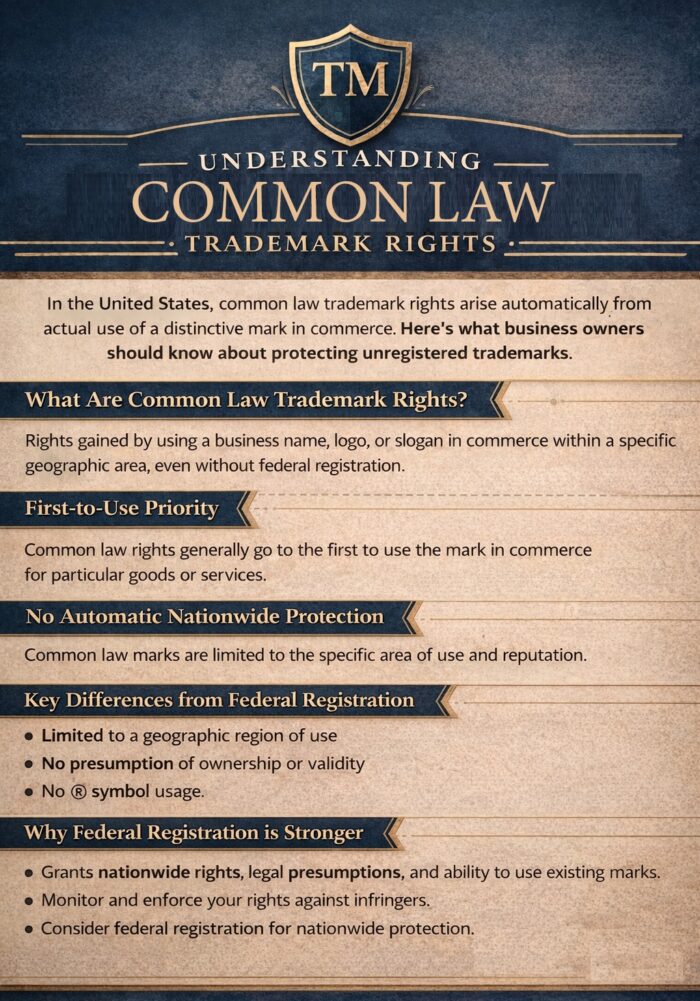
“Common law” trademark rights refer to the rights you automatically acquire by using a distinctive mark, such as a business name, logo, or slogan in commerce, and that are not registered with the United States Patent and Trademark Office (USPTO). Unlike patents or copyrights, you do not gain trademark rights through the creation of something, the right grows out of use of a source identifier (something that identifies the source of your goods) in commerce through the sales and provision of your goods and services. In other words, you must engage in bona fide commercial use of the mark for trademark law to recognize exclusive rights.
U.S. courts have long held that there is no property right in a trademark per se without an associated business use. A trademark is simply an instrument to protect the goodwill of a business. The Lanham Act (federal trademark law) echoes this principle by defining “use in commerce” as the bona fide use of a mark in the ordinary course of trade, and not made merely to reserve a right. See 15 U.S.C. § 1127. So if you are the first to use a particular mark in commerce for certain goods or services, you become the senior “common law” trademark owner of that mark in your market. These common law marks can use the “™” (trademark) or “SM” (service mark) symbol to put others on notice of your claim, even though they lack federal registration.
Under U.S. trademark law, rights are generally determined on a first-to-use basis, not simply first-to-file. This means the first business to actually use a distinctive mark on goods or services in commerce usually has priority over others. If you have been using a name or logo in your business, you may have developed enforceable rights in that mark, making it a common law trademark even without any registration. These rights are often described as “senior” rights against later users.
Importantly, the mark must be inherently distinctive or have acquired distinctiveness (secondary meaning) for trademark rights to exist. Generic marks cannot acquire trademark protection under either common law or federal law. A generic term is a term that is the common name of the goods sold (e.g. calling a coffee shop “Coffee Shop”), and will not qualify for any trademark protection under common law or federal law. Assuming your mark is distinctive, continuous and actual use is key to establishing and maintaining common law rights. Stopping use can lead to loss of those rights by abandonment. Also, mere token use or non-commercial use will not suffice. In short, trademark rights belong to those who earn them through bona fide use in trade under both federal and state law. The use-based system is underpinned by legal policy that favors trademark use as a protection for consumers, who can expect reliable quality from a particular source identified by a trademark, and an open competitive marketplace that is not hindered by parties trying to reserve or hold onto trademarks that have fallen out of bona fide use.
One critical limitation of common law trademark protection is that it is typically limited to the particular geographic area where you are using the mark and where your goods or services are known. Unlike a federal registration, which can confer nationwide rights, a common law trademark generally grants the owner exclusive rights only within the region or market area of actual use and reputation. For example, if you operate a local business under a unique name in southern California, your common law rights may allow you to stop competitors from using a confusingly similar name in the same locale. However, you likely cannot prevent a different company from using the same or a similar mark in a distant area (e.g. on the other side of the country) where your brand has no presence.
As the U.S. Supreme Court noted in the landmark Tea Rose case, a trademark owner “may not monopolize markets that his trade has never reached”. Hanover Star Milling Co. v. Metcalf, 240 U.S. 403 (1916). In practical terms, this means two businesses in different states could unknowingly develop identical common law marks, each valid in their own local spheres. When their markets eventually collide, priority will favor the one who used the mark first, but the junior user might retain rights in the remote area where it first operated. Common law trademark holders therefore enjoy exclusive rights in their established geographic area, but not automatically beyond it. This local nature of common law rights often makes expansion tricky. You might find your brand name is free to use in your city, yet already “taken” by someone else in another region. It is a reminder that trademark clearance searches should cover not only federal registrations but also other parties’ unregistered (common law) uses across state lines.
Because of the inherent limits on unregistered marks, business owners should understand the differences between common law trademarks and federal trademarks registered with the USPTO. Both forms of trademarks grant the exclusive right to use a mark in connection with particular goods or services, but the scope and strength of those rights differ significantly.
A federal trademark registration on the Principal Register gives the owner nationwide protection for the mark, even in areas where the owner has not yet done business. In contrast, a common law mark only protects you in the areas where you have established a market presence. Another key difference is the legal presumptions that come with a federal registration. When you register a trademark federally, the registration certificate is prima facie evidence of your ownership and the validity of the mark, and of your exclusive right to use the mark nationwide for the listed goods or services. This means that in a legal dispute, you benefit from a presumption that your mark is valid and protectable, shifting the burden to others to prove otherwise.
An unregistered mark has no such automatic presumption. The owner must affirmatively prove that the mark is valid (i.e., distinctive and not generic), and that it has priority in the specific market, every time they enforce it. Thus, common law trademark owners face a heavier evidentiary burden in court. Additionally, federal registration provides constructive notice to the public of your claim to the mark, putting everyone on notice nationwide, so no one can later claim they innocently adopted the same name.
Common law rights, on the other hand, do not appear in any central registry, so other businesses might inadvertently adopt a similar mark unaware of your local use, potentially leading to disputes. In summary, a federally registered trademark offers benefits and rights that are broader and stronger than common law trademark rights, including nationwide scope, legal presumptions of validity and ownership, and easier enforceability.
Given the above differences, it’s worth highlighting the concrete benefits of federal trademark registration for trademark holders. First and foremost, a federal registration grants nationwide protection for your mark. Under the Lanham Act, a federal registrant is deemed to have rights throughout the entire United States, as of the filing date of the application, assuming the mark is ultimately registered. This can prevent other parties from using confusingly similar marks anywhere in the country, even in areas where you haven’t yet expanded your business. By contrast, a common law mark owner who only operates a local business has rights only in that locale and cannot claim exclusive rights in other areas absent use there.
Registration also provides a legal presumption that your trademark is valid, distinctive, and owned by you. There is also a presumption of your exclusive right to use the mark on the goods/services nationwide. This can be decisive in court because you will not have to prove the basic facts of your rights from scratch. After five years on the federal register, a mark can even achieve incontestable status, which cuts off many grounds of challenge and serves as conclusive evidence of your exclusive rights, subject to a few exceptions.
Federal registration also enables use of the registered trademark ® symbol, which puts the public on notice of your registration and can deter infringers. Common law mark owners can only use “TM” or “SM”. Using the Ⓡ symbol without a federal registration is unlawful. The registered trademark symbol is more than just decorative, it signifies that the mark is officially recorded at the USPTO and it legally eliminates any defense of innocent infringement by making others legally assumed to know of your rights.
Moreover, a federal registration gives you the ability to enlist powerful enforcement mechanisms. You can record your registered mark with U.S. Customs to block importation of counterfeit or infringing goods. You also unlock certain remedies under federal law that are not available for unregistered marks, such as the possibility of statutory damages and attorney’s fees in cases of willful trademark counterfeiting. For example, federal law provides statutory damages against counterfeiters of registered marks under 15 U.S.C. § 1117(c), and only owners of registered marks can sue for trademark dilution under 15 U.S.C. § 1125(c). In short, federal registration not only broadens your trademark rights geographically, but also bolsters your position legally, providing evidentiary advantages and stronger enforcement mechanisms and more robust remedies. For any business aiming to expand or franchise beyond a local area, these benefits of federal registration are invaluable.
Whether your mark is a common law mark or a federally registered mark, as the trademark owner you are responsible for enforcing your rights. Both state and federal trademark law provide causes of action to stop others from using marks that are confusingly similar to yours in a way that is likely to mislead consumers. The classic hallmark of trademark infringement is likelihood of confusion: if another company’s use of the same name or a similar mark on related goods or services is likely to cause consumers to mistakenly believe there is an association, common source, or sponsorship, then that use infringes your rights.
Common law trademark holders typically can bring an infringement claim under state law unfair competition doctrines or state trademark statutes, seeking injunctions or damages for business harm. In addition, the federal Lanham Act offers an unfair competition cause of action for owners of unregistered marks through Section 43(a) (15 U.S.C. § 1125(a)). Section 43(a) forbids “any false designation of origin” or misleading use of a mark that is likely to confuse consumers, and it effectively protects unregistered trademarks from infringement in federal court. This means that even without a federal registration, you can sue an infringer under federal law for using a mark that unfairly competes with or passes off their goods as yours, assuming the activity affects interstate commerce. Both registered and unregistered marks are thus granted some level of federal protection under the Lanham Act.
However, owning a federally registered trademark significantly enhances your enforcement position. For a registered mark, you can sue for infringement under Section 32 of the Lanham Act (15 U.S.C. § 1114), which is only available to registered marks and carries the aforementioned presumptions, broader remedies, etc. By contrast, a common law mark owner suing under Section 43(a) must prove the validity of their mark and their priority without benefit of a registration certificate. Additionally, certain claims like federal dilution or counterfeiting require a registration.
Regardless of registration, the trademark enforcement process typically involves sending cease-and-desist letters, negotiating coexistence or rebranding if appropriate, and potentially filing a lawsuit for trademark infringement or unfair competition. Because enforcement can be legally complex and fact-intensive, it’s often wise to consult an experienced trademark attorney to strategize the best approach. An attorney can help gather evidence of your priority and market scope and guide you through federal court litigation or settlement with the infringing party.
Remember, failing to enforce your mark against infringers can weaken your rights over time. Trademark owners have a duty to police their marks. If you allow others to use identical or similar marks in commerce without challenge, your mark’s distinctiveness could be diluted and your exclusive rights may erode.
Trademark protection in the United States operates on multiple levels. Common law trademark rights originally evolved under state law through judicial decisions and statutes, and are not preempted by federal law. Every state has its own trademark laws and many have a registration system for state trademarks, usually through the Secretary of State’s office. A state trademark registration can offer a public record of your claim and some procedural advantages within that state, but it still only protects your mark within that single state’s borders. It does not confer the nationwide rights or legal presumptions of a federal registration. In essence, a state registration typically just reinforces the existing common law rights in that state and is often seen as a supplement for marks that are not eligible for federal registration or are used only intrastate. Moreover, state laws provide remedies for unfair competition and passing off, which can be used to enforce common law marks. For instance, if someone in your state uses a similar mark to free-ride on your business reputation, causing consumer confusion, you might bring a claim under state unfair competition statutes or common law principles to stop the “false designation” of origin, which is analogous to a federal 43(a) claim, but at the state level.
Some states allow recovery of damages, attorney’s fees, or even statutory remedies under their laws, though these vary state by state. It’s worth noting that the Lanham Act explicitly coexists with state law, meaning you can have both federal and state claims in a trademark lawsuit. Often, a trademark infringement suit in federal court will include a parallel claim for violation of the state’s unfair competition law. Ultimately, while federal law provides the most powerful tools, especially when you have a registered mark, state trademark law continues to play a role in protecting trademarks at the local level.
Before you adopt a new business name, product name, or logo, and certainly before you invest in a federal trademark application, it’s crucial to perform a comprehensive trademark search as due diligence. Many entrepreneurs make the mistake of checking only the USPTO’s online database of federally registered trademarks. While a USPTO search is essential to catch any federally registered or pending marks that might conflict, it is not sufficient by itself. This is because unregistered marks (common law trademarks) will not appear in the federal trademark registry.
A thorough search needs to cover federal registrations and other sources of potential trademark rights: namely, state trademark registrations and common law, unregistered uses. A common law trademark search means digging into various databases and public records to find any business or brand using a similar name or logo in commerce, even without a federal record. This can include searching the internet, corporate and business name databases, trade directories, industry publications, domain name records, and state business registries. The goal is to uncover any prior users of the mark or a similar mark that carries existing unregistered rights that might conflict with your proposed mark.
For example, you might discover a small company in another state that has been using a similar brand name for similar goods. Even if they never registered federally, their common law trademark could still block your expansion or impact your federal registration in the future. Likewise, checking state trademark registrations is important, as a preexisting state trademark registration in any given state could prevent you from using your mark in that state and be a basis for opposition or cancellation of your federal registration.
Thus, a comprehensive trademark search includes: (1) the USPTO records for federally registered or applied-for marks to avoid conflicts that would bar your federal application due to confusingly similar registered marks; (2) a search of state trademark databases and business name filings; and (3) a diligent common law search for unregistered usage, using search engines, industry databases, and possibly a professional trademark research service. Conducting these trademark searches up front helps identify potential conflicts and avoids costly legal problems down the road.
It is advisable to have a trademark attorney conduct the search and analysis, as they are skilled in conducting such searches and analyzing the results. Ignoring common law trademark owners during clearance can lead to nasty surprises, such as receiving a cease-and-desist letter after you’ve already launched your brand, or having your federal application opposed by someone who claims earlier use. In summary, due diligence in the form of trademark searches is a must for anyone looking to establish strong trademark rights and reduce the risk of infringement of others’ marks.
Navigating trademark rights can be complex, especially when dealing with the interplay of common law rights, state registrations, and federal registrations. As a business owner, you should take proactive steps to protect your business and branding. First, choose a strong, distinctive trademark: the more unique, the stronger protection it will have. Second, conduct a thorough trademark search to avoid unintentional infringement of another’s mark. It is worth noting that ignorance of a prior user is not a defense if your use causes confusion. Third, make continuous use in commerce of the mark in connection with the goods to establish common law rights. Fourth, consider the scope of your business and expansion plans. If you operate only locally and plan to remain a local enterprise, you might rely on common law rights or register the mark at the state level for added certainty. However, if the reach of your brand is beyond your region, or you foresee that your market will expand beyond your initial state of operation, you should consider obtaining a federal trademark registration. It is highly advisable to secure nationwide federal trademark rights to prevent others from locking you out of new markets. Registering sooner rather than later can also prevent scenarios where someone else files a federal application for a similar trademark and obtains nationwide priority over you.
Even after you have rights, enforcement and maintenance are ongoing tasks. You should monitor the marketplace and USPTO trademark filings for potentially conflicting uses. Many companies set up trademark watch services or regularly search for similar names to catch problems early. If you do discover an infringer or a conflicting user, timely action is important. Trademark enforcement could range from a polite heads-up or request to change the name for minor, unintentional conflicts, to sending a formal cease-and-desist letter, and possibly filing a lawsuit in state or federal court for trademark infringement and unfair competition.
Keep in mind that lawsuits can be costly and outcomes uncertain, so it is wise to consult a trademark lawyer to evaluate the strength of your case and explore alternatives, such as co-existence agreements or re-branding solutions before rushing to court. An experienced trademark attorney can help you understand the nuances of trademark law rights, including how common law rights might be proven, what evidence you’d need to show priority and consumer recognition in a given area, and what damages or remedies you could seek. They can also handle the federal trademark application process for you, increasing the chances of approval and advising on how to describe your goods or services to maximize protection.
In the U.S., the United States Patent and Trademark Office’s application process can take many months and involves potential refusals or oppositions; having a knowledgeable attorney can make a big difference in overcoming these hurdles. Ultimately, investing in professional guidance can save a business from costly mistakes, such as infringing someone else’s mark or failing to fully capitalize on your own brand’s value.
Common law trademark rights offer a foundational layer of protection for names, logos, and other brand identifiers based on actual use in commerce. They are a meaningful part of U.S. trademark law, providing local or regional trademark rights even without formal registration. However, common law rights are inherently limited in scope and lack many benefits of federal trademarks. Relying solely on unregistered “common law” marks can leave a business exposed to risk. Federal trademark registration with the USPTO remains the gold standard for robust trademark protection, granting nationwide rights, legal presumptions, and stronger enforcement tools under the Lanham Act.
If you need assistance in evaluating your trademark protection or other intellectual property matters, contact our office for a consultation.
© 2026 Sierra IP Law, PC. The information provided herein does not constitute legal advice, but merely conveys general information that may be beneficial to the public, and should not be viewed as a substitute for legal consultation in a particular case.
The United States patent system includes design patents, which protect the unique way that a product looks (its ornamental appearance), rather than how it works. In simple terms, a design patent safeguards the visual design of an item, such as the shape, surface ornamentation, and overall look. A design patent provides the owner exclusive rights to protect the design from third party usage. This article provides an overview of design patent protection in the U.S., explaining its scope, requirements, and how it compares to utility patents and other forms of intellectual property.
A design patent is a form of legal protection granted by the U.S. Patent and Trademark Office (USPTO) for “any new, original and ornamental design for an article of manufacture” under 35 U.S.C. § 171. In other words, it covers the visual ornamental characteristics of a product. The design can be embodied in or applied to an article of manufacture, meaning a tangible item made by humans. Notably, a design patent protects the design itself, not the underlying article or any technical invention. For example, if an inventor creates a new chair shape, a design patent could protect that specific aesthetic design, assuming it is novel and non-obvious. The inventor would then have the right to exclude others from making, using, or selling any product with that same ornamental design.
It is important to distinguish design patents from utility patents, which are patents for "inventions”. A utility patent protects how an invention works or is used: its functional and structural features. In contrast, a design patent protects how an article looks. For instance, a new smartphone may be protected by a utility patent for its innovative electronic circuitry or functionality, while a design patent could protect the distinctive shape or surface decoration of the phone. Both design and utility patents are issued by the USPTO as part of the United States patent system, but they cover different aspects of innovation. In short, utility patents cover functional features and processes, whereas design patents cover the ornamental appearance of an item. Because they protect different aspects, it is possible and sometimes advisable for a company to seek both utility and design patents for the same product: one guarding the product’s function and the other guarding its aesthetic design. Keep in mind that a design patent never covers functional or mechanical aspects of an invention.
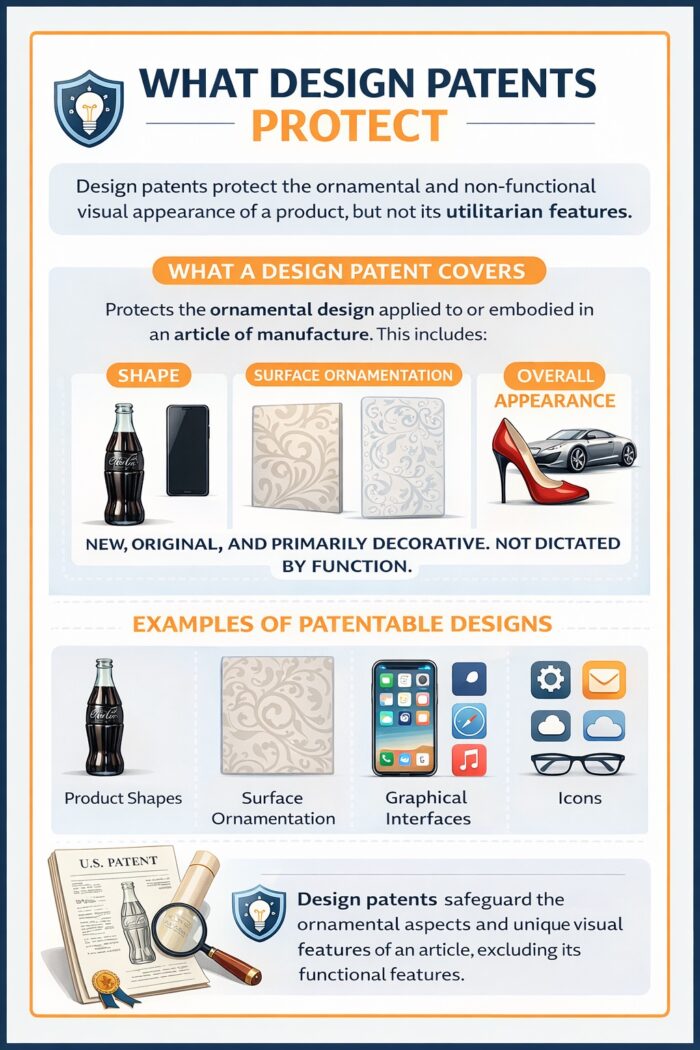
What does a design patent protect? In essence, it protects the ornamental design of an article of manufacture, meaning the visual appearance or decorative design as shown in the patent’s drawings. The claimed design may encompass the shape or configuration of the article, the surface ornamentation applied to the article, or a combination of both. For example, a design patent could cover the unique shape of a beverage bottle, the pattern engraved on a piece of jewelry, or the GUI layout of a smartphone app icon, provided these designs are new and non-functional. The patent rights granted allow the owner to stop others from making or selling any product that embodies a substantially similar design without permission.
By law, a protectable design must be primarily aesthetic and “not dictated by function”. If the appearance of a product is dictated by functional necessity (i.e. a purely functional design), it cannot be protected by a design patent. The U.S. Supreme Court has explained that to qualify for design patent protection, a design should have an aesthetic appearance that is not driven solely by functionality. Bonito Boats, Inc. v. Thunder Craft Boats, Inc., 489 U.S. 141 (1989). In sum, a design patent protects the ornamental features that decorate or shape an article, as opposed to any functional aspects of the article.
Another aspect of scope is that a design patent can cover all or part of an article. The law permits claiming just a portion of a product’s design. For instance, the design of a product’s handle or interface, rather than the entire product. In such cases, the patent drawings will show the claimed portion in solid lines and omit or show other parts in broken lines, indicating those parts are not claimed. This allows inventors to obtain patent protection on unique ornamental components or portions of a product without claiming the whole item.
Design patents are used across many industries to protect a wide range of visual designs. Some examples of things that design patents cover include:
The distinctive shape of a consumer product or article of manufacture can be patented. Famous examples include the contour of a beverage bottle or the casing design of a smartphone. Even a portion thereof, like the frame of a pair of eyeglasses or the tread pattern on a tire, can be protected, as long as it is a new ornamental design.
Two-dimensional visual designs applied to products, such as an embossed pattern on wallpaper or a decorative graphic on a handbag, are eligible for design patents. Any original pattern can be patented as long as it is applied to an article of manufacture.
Computer screen graphics and GUI designs are also patentable. For example, the layout of a smartphone’s app icons or a unique animated GUI can be protected by a design patent as an ornamental design on a display. The USPTO considers a computer icon or GUI shown on a display panel or portion thereof to be a patentable design, since it is viewed as part of a physical display device. By contrast, a design patent would not cover a digital image in the abstract. The GUI or icon must be shown as integrated into a screen or other article to qualify. Many software companies obtain design patents for computer icons and screen designs to protect the look and feel of their user interfaces.
Virtually any industrial or consumer product with a novel ornamental appearance may be eligible. This includes furniture designs, fashion accessories, vehicle parts, packaging designs, lamp designs, and more. For instance, car manufacturers often patent the ornamental design of car parts, including grilles, lights, and wheel designs. As long as the design is new, non-obvious, and not based on function, a broad array of visual characteristics can potentially receive design patent protection.
Obtaining a design patent is generally easier and faster than obtaining a utility patent, but it still requires following a formal application process with the USPTO. Here is an overview of the steps to obtain patent protection for a design:
The applicant prepares a design patent application that includes a specification having a brief description of the design, a single design claim, and high-quality drawings of the design from various views. The claim is typically very short, merely stating the article name and that the design is as shown in the drawings. Unlike utility patents, design applications do not require extensive written descriptions or multiple claims. The drawings are the most critical part, as they define the scope of the claimed invention, i.e., the design. It’s common to hire a patent firm that specializes in design patents and utilizes a professional draftsperson to ensure the drawings meet USPTO formal requirements for design patents.
The design application is filed with the USPTO, including the required filing fee, search fee, and examination fee. The filing date is important, as U.S. patent law generally follows a first-to-file system. Also note, if the design has been publicly disclosed, the application must be filed within 1 year of that public disclosure to avoid losing U.S. rights.
A USPTO examiner will review the design application for compliance with formalities and patentability. They will ensure the drawings adequately show the design and that the design is novel and non-obvious over any prior art, which can be any prior public disclosure of a design. In practice, many design applications are allowed without substantive rejections, but an examiner may cite prior art patents or products if the design is too similar to an existing design. The design must be sufficiently distinct and non-obvious in the eyes of an ordinary designer skilled in the art, meaning it shouldn’t just be a trivial variation of known designs.
If the application meets all formal and patentability requirements, the USPTO will issue a Notice of Allowance. The applicant then pays an issue fee. Once the issue fee is paid, the patent will issue. A U.S. design patent is identified with a patent number preceded by “D” (for example, D1234567).
Unlike utility patents, design patents require no maintenance fees to keep them in force. After issuance, the patent remains valid for its full term without additional fee payments. For comparison, utility patent applications can optionally start with a provisional application and granted utility patents require periodic maintenance fees to stay in force, but these aspects do not apply to design patents.
Throughout this process, it can be beneficial to work with experienced patent practitioners (patent attorneys or agents) familiar with design patent practice. They can help navigate drawing requirements, respond to any USPTO objections, and craft a filing strategy that might include multiple design embodiments or related applications if needed.
The drawings in a design patent application are crucial because they define the scope of what the design patent covers. By rule, a design patent may contain only a single claim, and that claim is defined entirely by the drawings with minimal verbal description. The drawings must show the design from enough angles (e.g., front, rear, sides, top, bottom, perspective) to completely disclose the ornamental appearance of the article. Here are some key points about design patent drawings:
Elements of the design that are shown in solid lines in the drawings are the claimed design defining the ornamental features for which legal protection is sought. In contrast, any parts of the drawings shown in broken lines (dashed lines) are not claimed; they are included only to show context or environment. Broken lines can illustrate portions of the article that form no part of the claimed design or show the surrounding environment in which the design resides. For example, if you are patenting the ornamental design of a chair’s backrest, you might show the chair’s seat and legs in broken lines, indicating that only the backrest’s design is claimed, not the rest of the chair. The patent will typically include a written statement clarifying that the broken-line portions form no part of the claimed design. Using broken lines effectively allows claiming just a partial design or specific element of a product.
A single design patent application may include multiple embodiments (variations) of a design only if those embodiments are patentably indistinguishable and look very similar overall. All embodiments must be clearly shown and consistent. If the embodiments are too different, the USPTO may issue a design restriction requirement dividing them into separate applications. Generally, most design patents focus on one design. However, closely related variants can sometimes be included in one filing to cover them in a single patent.
The drawings must meet strict formal standards: high resolution, proper shading to show contour, and identical features aligning across views. There should be no inconsistencies between views. If a feature is shown in solid line in one view, it must appear in solid line in all views where visible, and likewise for broken lines. The USPTO’s formal requirements found in rules and the Manual of Patent Examining Procedure require that the scope of the claimed design is clear and unambiguous. It is often said that in design patents, “the drawings are the claim,” so precision in drawings is paramount.
By carefully using solid and broken lines, applicants can carve out what the design patent protects, while excluding any unclaimed portions or functional elements.
U.S. design patents have a term of 15 years from the date of grant for design applications filed on or after May 13, 2015. This term is shorter than the 20-year term from filing for utility patents, but an advantage of design patents is that no maintenance fees are required to keep them in force. Once granted, a design patent remains in effect for the full 15-year term without additional payments. By contrast, utility patents require maintenance fee payments at 3.5, 7.5, and 11.5 years after issuance or they lapse. The absence of maintenance fees makes design patent protection relatively cost-effective over the life of the patent. You pay the application and issue fees up front, and then no further fees to maintain the patent rights.
During its term, a design patent gives the owner the exclusive right to make, use, sell, or import the patented design in the United States. After expiration, the design falls into the public domain. However, 15 years of exclusivity for the product’s design can be very valuable in industries where aesthetic design is a key product differentiator.
Design patent infringement occurs when an unauthorized party makes, uses, sells, or imports a product that embodies the patented design or a design that is substantially similar to it. The courts apply the “ordinary observer” test to determine infringement: would an ordinary observer, familiar with the prior art designs, be deceived into thinking the accused product is the same as the patented design? If the overall visual appearance of the accused design is so close to the patented design that an ordinary purchaser would likely confuse the two, then infringement can be found. It’s not necessary that every detail be identical; rather, the overall impression on the eye is key. Notably, this test comes from a 1871 U.S. Supreme Court case, Gorham Co. v. White, which remains the foundation of design patent infringement analysis. Gorham Co. v. White, 81 U.S. 511 (1871).
In enforcing a design patent, one does not have to prove copying or intent. Independent development that results in a similar-looking product can infringe, because design patent rights are absolute for the claimed design. However, the accused design will be compared to prior art as well, since subtle differences might avoid infringement if the patented design itself is narrowly distinguished from prior designs.
Legal protection for a design patent can be quite strong. Remedies for infringement include monetary damages and injunction, which are court orders to stop making or selling the infringing product. Uniquely, U.S. law provides that a design patent owner may recover the total profit the infringer made from selling the infringing products under 35 U.S.C. § 289. For example, if a competitor copied a patented shoe design and sold 100,000 shoes, the patent owner could sue to recover all the profit from those sales. The U.S. Supreme Court has refined how infringing profits remedy is calculated in the case of multi-component products, such as a smartphone. In the Samsung v. Apple case, the U.S. Supreme Court held that for design patent infringement, the statutory “total profits” remedy under 35 U.S.C. § 289 does not automatically mean profits from the entire end product, but instead may be limited to profits attributable to the specific “article of manufacture” to which the patented design is applied when that design is embodied in a multi-component product. The Court explained that determining the relevant article of manufacture is a fact-specific inquiry, requiring courts to evaluate whether the patented design applies to the whole product (e.g., a smartphone) or only to a particular component (e.g., a screen or casing), before calculating infringing profits.
This “total profit” remedy is a powerful enforcement tool that does not exist for utility patents, which typically only allow damages calculated as lost profits or a reasonable royalty.
When protecting the appearance of a product, design patents are one tool among several in intellectual property (IP) law. It is useful to understand how design patents differ from or complement other forms of protection:
Product designs can sometimes be protected under trademark law as trade dress if the design functions as a brand identifier. The shape of a famous Coca-Cola bottle, can function like a trademark by immediately signaling its source. Trade dress protection requires that the design has acquired distinctiveness (consumer recognition) and is non-functional. Trademark law, like design patent law, will not protect functional product features. Trade dress can potentially last indefinitely, as long as the product is sold and the design signifies source, whereas a design patent is limited to 15 years. However, trade dress can be harder to obtain. The owner of the trade dress must prove that consumers associate the trade dress with the source of the goods and services.
Design patent protection is often easier and faster to get, and it doesn’t require showing consumer recognition, it simply grants a monopoly on the design itself for a term, regardless of branding or consumer confusion. Many companies use a design patent to get immediate protection for a new product’s look, and later rely on trade dress for long-term protection once the design becomes iconic. These protections can overlap without “double patenting” issues because they arise from different laws (patent vs trademark) and serve different purposes.
Copyright law protects original artistic and creative works. Generally, the design or shape of useful articles is not eligible for copyright unless the design has elements that can be conceptually separated as pure art. For example, a sculptural lamp base might have copyrightable artistic elements. But most industrial designs are covered by design patents or trade dress rather than copyright. Notably, getting a design patent on a product’s appearance does not give copyright protection, and copying a patented design after the patent expires is not “copyright infringement”. Conversely, a copyrighted artistic design like a graphic might be used on a product, but without a design patent that specifically covers it on the product, protection would be reliant on copyright law. In summary, copyright and design patents are distinct. Copyright is rarely used for industrial product configurations, whereas design patents are tailor-made for that.
As discussed, utility patents cover functional inventions. Sometimes an invention is both aesthetically unique and functionally novel. In such cases, both a utility patent and a design patent might be pursued. There is generally no conflict in having both, since they protect different aspects. The law even explicitly allows simultaneous design and utility patents in separate applications for the same subject in appropriate circumstances, as long as one is not used to extend the other’s term improperly. Issues of double patenting are usually avoided because the claims are not coextensive. A strategic filing strategy can involve using all applicable IP protections: utility patents for new functional features, design patents for the product’s appearance, and trademarks for names/logos or even product configuration trade dress once it gains recognition.
Design patent (or “industrial design”) protection is available in many countries worldwide. Notably, the U.S. is part of the Hague Agreement on industrial designs, which provides a mechanism to file an international design application. Through the Hague system, an applicant can file a single international design application and designate multiple member countries in which to seek protection. This system is administered by the World Intellectual Property Organization (WIPO) and can significantly streamline obtaining design rights abroad. Under 35 U.S.C. § 172, a U.S. company that patents a product’s design domestically can, within six months of the U.S. filing, file via the Hague Agreement to cover key foreign markets in one application. Each designated country will then examine and grant protection according to its own laws, but the initial filing is centralized.
It is important to remember that design patents are territorial. A U.S. design patent protects the design only in the United States. If your business markets products in foreign countries, you would need to secure design protection in those countries separately, either via direct national filings or the Hague Agreement. Many jurisdictions (Europe, China, Japan, etc.) have their own form of design patents or registrations, with varying terms in a range of 10–25 years. If international protection is important, consult a patent attorney with experience in registering designs to devise a global design filing strategy. Most countries protect industrial designs that are new and original, and they likewise exclude purely functional designs from design patentability. Using the U.S. patent system as a springboard, one can obtain patent protection for a product’s design across the world, ensuring a comprehensive shield for the product’s unique features and look in the global marketplace.
A United States design patent protects the ornamental design that makes a product look unique. It does not cover how the product functions or any functional aspects of the design. For business owners, design patents are a valuable form of intellectual property protection to consider, especially for consumer products where appearance matters. They provide a relatively fast, affordable way to secure exclusive rights to a product’s appearance, preventing competitors from selling look-alike products. Often, the best approach is layered protection: use design patents for the ornamental design, utility patents for new functions, and trademarks/trade dress for brand identity. This ensures that both the functional and visual characteristics of your innovations are well-guarded under U.S. law. With proper guidance and a solid filing strategy, securing a design patent can be an effective and valuable process that safeguards your product.
If you need assistance with protecting your designs or other intellectual property matters, contact our office for a free consultation.
© 2025 Sierra IP Law, PC. The information provided herein does not constitute legal advice, but merely conveys general information that may be beneficial to the public, and should not be viewed as a substitute for legal consultation in a particular case.
Patents provide exclusive intellectual property rights over inventions. Under U.S. federal law, a granted United States patent confers the patent owner “the right to exclude others from making, using, offering for sale, selling, or importing” the patented invention in the U.S. If anyone other than the patent holder engages in these exclusive patent rights without permission, the patent holder may sue for patent infringement. Patent enforcement is the process by which a patent holder (also called a patent owner) asserts their legal rights against an infringing party. This article provides a general overview of U.S. patent enforcement, explaining how patent infringement lawsuits generally work, what remedies are available, and key considerations in protecting a patented invention.
A U.S. patent grants its owner a time-limited monopoly over the invention’s use. This means others cannot make, use, sell, or import the patented product or process without the patent owner’s consent. For example, if your company holds a patent on a new gadget, and a competitor starts manufacturing or selling a similar gadget covered by your patent claims without a license, that is an infringing product and you have the right to take action. U.S. patent law broadly defines infringement as any unauthorized making, using, selling, offering for sale, or importing of the patented invention during the patent term. 35 U.S.C. § 271. Both the patent holder and any accused infringer should note that a patent is enforceable only after it is granted by the U.S. Patent and Trademark Office (USPTO); patent pending applications cannot be enforced in court. Once a patent issues, the patent owner can file a lawsuit to protect their patent rights and stop any alleged infringement.
In general, only the patent’s owner (the patentee or an assignee of the patent) or someone holding exclusive rights can bring a patent infringement lawsuit. If a patent is co-owned or exclusively licensed, typically all owners or an exclusive licensee who has been given all substantial rights in the patent must be involved to have standing to sue. By contrast, a non-exclusive licensee who merely has permission to use the patent cannot sue on the patent. On the other side, an accused infringer does not have to wait to be sued. If there is a real dispute (e.g., the patent owner sends a cease-and-desist notice letter accusing infringement), the accused party may file a declaratory judgment action. In a declaratory judgment suit, the accused infringer asks a federal court to determine the patent’s validity or declare that their product does not infringe, which can give clarity and jurisdictional advantage.
Patent infringement lawsuits in the United States are handled exclusively in the federal court system under 28 U.S.C. § 1338. A patent owner typically files suit in a U.S. district court that has jurisdiction over the defendant. U.S. district courts serve as the trial courts for patent cases. There are no specialized patent trial courts, though some districts have judges with expertise in patent law. Importantly, any appeal from a district court’s final decision in a patent case goes to the U.S. Court of Appeals for the Federal Circuit, a specialized appellate court that hears patent appeals nationwide. In addition to court litigation, patent owners have an alternative enforcement venue for certain cases. The U.S. International Trade Commission (ITC) can investigate claims of patent infringement involving imported goods and can issue exclusion orders, which works like an injunction barring imports, if a violation is found. However, the ITC does not award damages, it simply bans infringing imports. Most commonly, patent enforcement means filing a civil lawsuit under 35 U.S.C. § 281 to seek remedies for infringement.
Before resorting to a lawsuit, patent owners often take initial enforcement steps. These steps can sometimes resolve the issue without the time and costs of full litigation. Common pre-litigation enforcement actions include:
Taking these steps can often lead to a resolution without a formal suit. Indeed, patent enforcement is not always about rushing to court. Strategic and practical decision-making is employed to balance enforcement with business realities.
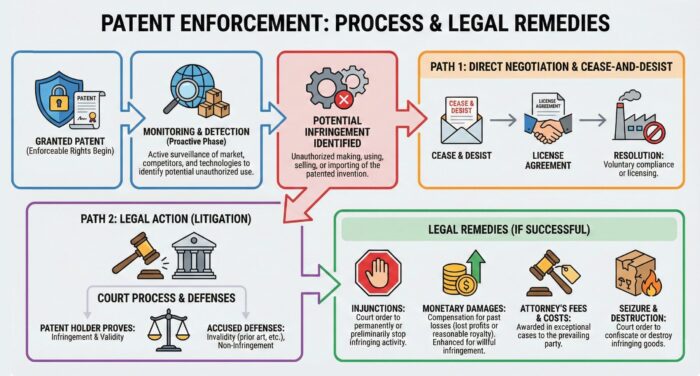
When informal efforts fail, the patent owner can initiate a patent infringement lawsuit. The process begins with filing a complaint in the appropriate federal district court. The complaint identifies the patent at issue, alleges how the defendant’s acts infringe one or more patent claims, and requests relief, such as injunction, damages, and other available relief. The defendant (the accused infringer) must respond by filing an answer, in which they will typically deny infringement and may assert defenses or counterclaims, such as claiming the patent is invalid or unenforceable.
Once the pleadings are set, the case enters discovery, a pretrial phase where both sides gather evidence. During discovery, each side can demand documents, emails, and other records, take depositions of witnesses, and consult experts. In patent cases, discovery is often extensive, both sides may hire expert witnesses. The expert witnesses are typically technical experts having knowledge in the field of the invention. Experts are used to compare the accused product to the patent and explain technical aspects of the invention. Financial experts are also engaged to assess damages.
Patent cases also involve a critical pretrial step called claim construction through a Markman hearing with the court. The judge determines the meaning of disputed patent claim terms based on the parties briefing on the issue of claim construction. The claim construction decided by the court is a critical step in the case. It can shape the outcome of infringement and validity issues.
A patent infringement case is likely to involve motion practice, including summary judgment motions on critical issues and claims in the case. The court may resolve some issues through summary judgment where a party can show that certain facts are established and that they result in a certain legal outcome based on those facts. In other words, based on the established facts, the legal outcome can be determined without trial. Summary judgment motions are referred to as dispositive motions because they can provide a final judgment on the issues addressed in the motion.
Once dispositive motion practice has ended, the case proceeds to a patent trial. If monetary damages are sought, either party can demand a jury trial. In such cases, a jury will decide key factual questions like whether infringement occurred and the amount of damages. For purely equitable relief like an injunction, the trial would be a bench trial before a judge.
During the trial, each side presents evidence and witnesses. The patent owner must prove infringement by a preponderance of the evidence, meaning it’s more likely than not that infringement occurred. The defendant, meanwhile, will try to cast doubt on infringement or prove the patent is invalid, often relying on technical comparisons and prior art patents or publications. After deliberation, the jury or judge will render a verdict. The court then enters a judgment, and the losing party has the right to appeal to the Federal Circuit. Patent litigation can be a long process. It is not uncommon for cases to take 1–3 years or more from filing to trial, given the complexity and volume of evidence.
Facing a patent infringement suit, defendants have several defenses and strategies available. The most common defenses include arguing that the patent is invalid or that no infringement actually occurred: e.g. the accused product is different or omits a feature of the patent claims. U.S. patents are presumed valid once issued, but a defendant can rebut this presumption by proving the patent should not have been granted. Typical patent invalidity arguments are that the invention was not new or was obvious in view of earlier technology, known as prior art, or that the patent has some legal defect. In fact, a patent challenger will often comb through prior patents and publications to show the patented invention was already known or obvious. If successful, the court may invalidate the patent, and the patent holder would lose all rights. Other defenses might be that the patent owner committed some misconduct with the United States Patent and Trademark Office (USPTO) in the process of acquiring the patent, referred to as inequitable conduct. The defendant may additionally or alternatively argue that the patent does not cover patent eligible subject matter.
Because validity is such a central issue, accused infringers frequently use a parallel strategy: challenging the patent through administrative proceedings. The USPTO’s Patent Trial and Appeal Board (PTAB) provides procedures like post grant review and inter partes review (IPR), which allow a challenger to petition for cancellation of some or all patent claims. Congress created IPRs in 2012 as a cost-effective and timely alternative to court litigation for testing patent validity. If an accused infringer files an IPR petition, a PTAB panel will decide, usually within about 18 months, whether the patent claims are valid over prior art. IPRs often run in parallel with district court litigation on the same patent. Often, courts will even pause or stay the court case pending the PTAB’s decision. A successful IPR can render the whole patent or certain claims invalid, mooting the infringement suit. From the patent owner’s perspective, this means that enforcement can involve fighting on two fronts: in federal court and at the USPTO. It’s crucial for businesses to work closely with patent counsel on these defense strategies, as they involve complex legal and technical analyses.
If the patent owner succeeds in proving infringement (and fends off any invalidity defenses), the court will award remedies to compensate for and stop the infringement. The two primary remedies in patent cases are injunctive relief and monetary damages.
An injunction is a court order that prohibits the infringer from continuing the infringing activities. U.S. patent law expressly authorizes courts to grant injunctions “in accordance with the principles of equity” to prevent the violation of patent rights. In practice, after winning a case the patent holder will often seek a permanent injunction to stop the defendant from making or selling the infringing product. However, an injunction is not automatic even if infringement is proven. In the landmark eBay Inc. v. MercExchange case, the U.S. Supreme Court ruled that courts must apply the traditional four-factor equitable test before issuing a patent injunction, rather than issue injunctions as a matter of course. eBay Inc. v. MercExchange, L.L.C., 547 U.S. 388 (2006). This means the patent owner must demonstrate (1) irreparable harm from continued infringement, (2) that monetary damages are inadequate to compensate, (3) the balance of hardships favors an injunction, and (4) the public interest would not be disserved.
Many patent cases settle without an injunction, but for a business that practices its patent (e.g., by selling its patented product), an injunction can be a vital tool to protect market share by excluding competitors. In some circumstances, courts may deny injunctions. For instance, if the patent owner is a non-practicing entity that primarily seeks royalties, the court may deny an injunction and instead limit the remedy to money. There is also the option of a preliminary injunction early in a case, but those are granted only if the patent owner shows a likelihood of success on the merits and risk of irreparable harm, which is a higher bar.
Monetary damages are the main remedy to compensate the patent owner for past infringement. The Patent Act mandates that a successful patent owner be awarded infringement damages adequate to compensate for the infringement, “but in no event less than a reasonable royalty” for the use of the invention by the infringer. In other words, the patent holder should receive at least a fair licensing payment for the unauthorized use of the patent. Often, if the patent owner can prove that the infringement caused them to lose sales or profits, they can seek lost profits damages. The lost profits are the profit the company would have made but for the infringement. Lost profit awards require showing, for example, that the patent owner had the capacity to make those additional sales and that there were no non-infringing substitutes the customers would have bought instead. If lost profits are too speculative or cannot be proved, then reasonable royalties become the fallback measure of damages. A reasonable royalty is typically determined by imagining a hypothetical negotiation between the patent owner and infringer at the time infringement began. Factors such as existing licensing rates for similar patents, the invention’s value, and the sales of the infringing products are taken into account in setting this royalty.
Importantly, U.S. law also allows enhanced damages for willful infringement. If the infringer intentionally copied the invention or behaved egregiously, the court may increase the damages up to three times the amount found. Courts reserve these punitive enhancements for exceptional cases of misconduct. As the Supreme Court noted, enhanced damages under 35 U.S.C. § 284 are designed as a sanction for “egregious infringement behavior” rather than a typical case. In Halo Electronics v. Pulse Electronics, the Supreme Court affirmed that willful infringers can face treble damages at the judge’s discretion, and it removed stricter "objective recklessness” standard to ensure truly egregious cases are punished. Halo Elecs., Inc. v. Pulse Elecs., Inc., 579 U.S. 93 (2016). The court also eliminated the clear and convincing evidence standard for willful infringement, placing the application of enhanced damages in the discretion of the court.
Finally, the Patent Act provides that in exceptional cases the court may order the losing party to pay the winner’s attorney fees. Historically, fee awards were rare, but the Supreme Court’s Octane Fitness decision made it easier for prevailing parties to be awarded attorney fees under 35 U.S.C. 285 when the opposing party’s claims or conduct stand out as unusually weak or unreasonable. Octane Fitness, LLC v. ICON Health & Fitness, Inc., 572 U.S. 545 (2014). This means if a company is dragged into a baseless patent suit or faces an opponent engaging in litigation misconduct, it has a chance to recover its legal fees. For patent owners, it also means that if they prove deliberate infringement plus litigation misconduct, they could get their attorneys’ bills paid. Aside from fees, the court will also award court costs (filing fees, etc.) to the winner as routine. All these remedies, injunctions, damages, enhanced damages, and fee, are aimed at making the patent owner whole and deterring infringement, while not unduly punishing legitimate innovators.
Patent enforcement is a powerful tool to protect your competitive edge, but it comes with substantial considerations for any business. Patent litigation is costly and complex. Even a relatively straightforward patent infringement lawsuit can cost hundreds of thousands of dollars in legal fees through discovery and trial. For example, industry surveys show that a case with relatively modest stakes under $1 million in controversy still has a median total cost around $600,000–$700,000 through the end of trial, and cases with more at risk easily run into millions. These costs include not only attorneys’ fees, but also expert witness fees (patent cases often require multiple experts), discovery expenses, and the opportunity cost of management and engineers spending time on the lawsuit rather than the business. Litigation also can take years to reach a resolution, creating uncertainty that can cloud a company’s investment and product strategies.
Because of the high costs and risks, most patent infringement suits never reach a full trial and final judgment. Settlements are common, studies suggest the majority of patent cases settle out of court. Courts often encourage settlement or mediation, and some even require the parties to attempt mediation before trial. Settlement can involve a payment or cross-licensing agreement that resolves the dispute privately. For a patent owner, accepting a reasonable royalty through settlement might make business sense if it guarantees compensation and avoids the uncertainty of a jury trial. For the accused infringer, a settlement or license can eliminate the risk of an injunction or a large damages award.
When deciding on patent enforcement, a company should evaluate the extent of infringement and the strength of evidence, and conduct a cost-benefit analysis. Questions to consider include:
In some cases, simply having a patent and sending a notice can bring the other party to the table for a business resolution without a lawsuit. In other circumstances, especially when an infringer is undermining your market or your patent is a core asset, enforcement through litigation may be necessary despite the costs, to protect your investment in the patented technology.
Patent enforcement in the United States is a key mechanism for companies to safeguard their innovations. However, it is complex and requires a carefully crafted strategy. Business owners, entrepreneurs, and inventors should have a basic understanding of patent rights and how they are enforced. Effective patent enforcement often comes down to a combination of legal and business considerations. If infringement arises, the patent owner should consult with patent counsel to determine the strengths and weaknesses of the case, evaluate the economic impact of the infringement, and then choose an enforcement path that makes sense under the specific circumstances, whether that’s a licensing deal or a full-fledged patent infringement lawsuit.
Every situation is unique. Thus, the legal strategy should be tailored to the particular circumstances. With a clear understanding of the enforcement process and remedies, and with the guidance of experienced patent attorneys, business owners can navigate patent enforcement effectively and foster an innovative, fair marketplace. If you are facing a patent infringement situation or have another intellectual property matter with which you need assistance, contact our office for a free consultation.
© 2025 Sierra IP Law, PC. The information provided herein does not constitute legal advice, but merely conveys general information that may be beneficial to the public, and should not be viewed as a substitute for legal consultation in a particular case.
False designation of origin is a form of trademark unfair competition where a business misrepresents the source of its goods or services. In simple terms, it occurs when someone uses branding or descriptions that confuse consumers about who made a product or where it comes from. U.S. federal law (the Lanham Act) prohibits such false or misleading practices to protect both consumers and honest businesses. This article provides a clear overview of false designation of origin law, explains the relevant legal standards, and outlines the consequences of violating the law.
False designation of origin refers to a false or misleading representation about the origin or source of a product or service. It typically involves using a name, mark, symbol, or other branding in a way that is likely to cause consumer confusion about who produced or endorsed the goods or services. For example, if Company A sells handbags with a logo or packaging that makes consumers think the bags were made by Company B, Company A could be liable for false designation of origin. This concept is part of the broader prohibition on false or misleading description and representation in marketing. It aims to prevent businesses from passing off their products as those of another and to ensure consumers are not misled.
The primary federal law governing false designation of origin is § 43(a) of the Lanham Act, codified at 15 U.S.C. § 1125(a). This statute broadly forbids the use of any “word, term, name, symbol, or device, or any combination thereof” that is likely to deceive consumers as to the affiliation, connection, or origin of goods or services. In other words, the law prohibits any false designation or any false or misleading description or representation of fact that misleads consumers. The statute creates a civil action for any person or company who believes they are, or are likely to be damaged by such act of misrepresentation. Additionally, states and state agencies can be held liable for acts of an employee acting in his or her official capacity to the same extent as private entities.
Notably, Congress intended this law to apply very broadly, providing remedies in the case of unfair use of unregistered trademarks, trade dress, and false advertising. Section 43(a) is thus a powerful federal unfair competition law that covers a broader range of unfair business practices than section 15 U.S.C. § 1114, which is limited to covering infringement of federally registered trademarks.
To establish liability under § 43(a) for false designation of origin, a plaintiff generally must show: (1) the defendant used a designation (such as a name, mark, symbol, etc.) in commerce on or in connection with goods or services; (2) the designation is likely to cause confusion, mistake, or deception as to the origin, sponsorship, or approval of the goods or services; and (3) the plaintiff has been or is likely to be harmed by this false designation. This is sometimes called a "passing off" claim: the defendant is passing off their goods as if they came from the plaintiff. Importantly, intent to deceive is not a required element for liability, though willful intent can affect the remedies, as discussed later.
At the heart of a false designation claim is the concept of consumer confusion. The law targets representations “which are likely to cause confusion” about a product’s origin. This confusion can be direct (thinking the defendant’s product is the plaintiff’s product) or confusion as to affiliation or sponsorship (thinking the defendant is associated with or endorsed by the plaintiff). The test is an “actual or likely confusion” standard. The plaintiff need not prove every customer was deceived, only that an appreciable number of typical consumers would likely be confused.
In practice, courts evaluate relevant factors to gauge likelihood of confusion, such as the similarity of the marks or trade dress, the similarity of the goods or services, the channels of trade, the sophistication of consumers, evidence of actual confusion, and the defendant’s intent, among others. No single factor is decisive. It is a holistic analysis of whether consumers are apt to be misled about the product’s true source: i.e., whether association arising in the consumer’s mind is with the wrong source. If such confusion occurs, the law deems it unfair competition.
It is worth noting that confusion can also occur in a reverse manner, the so-called reverse passing off. This is when a party misrepresents someone else’s goods or services as its own. For example, selling a product made by another company but removing or obscuring the original source’s name. The U.S. Supreme Court has addressed this scenario in Dastar Corp. v. Twentieth Century Fox Film Corp., 539 U.S. 23 (2003). In that case, the Court clarified that the “origin” of goods under § 43(a) refers to the producer of the tangible product sold in the marketplace, not, for instance, the creator of any idea or content embodied in the product. In other words, simply selling another’s unbranded product as your own could be false designation of origin, but copying a product that is in the public domain without implying the original producer is involved is not covered by trademark law. This scenario is simply healthy market competition that causes no recognized actual economic injury. The Lanham Act should not be stretched to cover matters that are outside of recognized economic unfairness that is intended to fool consumers to gain an advantage.
Section 43(a) of the Lanham Act also covers false advertising, which is defined as false or misleading descriptions or representations in advertising or promotion. Section 43(a) also forbids misrepresenting the nature, characteristics, qualities, or geographic origin of goods or services in commercial advertising or promotion. For example, making a false claim that “Our product is made in Italy” when it is not or disparaging a competitor’s product with false facts can violate § 43(a)(1)(B).
To succeed in a false advertising claim, a plaintiff generally must prove that the defendant made a false or misleading statement of fact in an advertisement, that the deception is material in that it is likely to influence purchasing decisions, that the product traveled in interstate commerce, and that the plaintiff is or is likely to be injured by the false statement, often through lost sales or reputational harm. The Lanham Act’s false advertising provision aims to ensure a fair marketplace where commercial activities are not driven by false or misleading representation of products. Both consumers and competitors can be harmed by false advertising, so the law provides a remedy for business competitors to sue over false or misleading descriptions that cause actual or likely damage to their business.
If Company X advertises that its juice contains “0g sugar” when it actually contains high sugar content, a competitor whose sales suffer could sue under false advertising, provided the misrepresentation is factual (not mere opinion or “puffery”) and injures the competitor. The plaintiff need not be the only one harmed. The law allows suit by “any person who believes that he or she is or is likely to be damaged” by the false ad, which typically means competitors in the marketplace. Consumers themselves usually rely on consumer protection statutes rather than the Lanham Act for false advertising issues.
The Lanham Act’s false designation provisions apply not only to brand names and logos, but also to trade dress, which is the distinctive overall image or design of a product or its packaging. Trade dress can include things like the shape of a bottle, the design of a restaurant or store, or the look and feel of a product’s packaging, and is protected under the Lanham Act in the same manner that trademarks are protected if the trade dress has inherent or acquired distinctiveness. If a competitor copies a product’s appearance in a way that confuses consumers about the product’s source, that can be trade dress infringement under § 43(a). For instance, if one coffee shop chain adopts a confusingly similar interior décor and color scheme to mimic a famous chain, it could be liable for creating confusion about its affiliation or origin.
To succeed in a trade dress false designation claim, the plaintiff must prove that the claimed trade dress (the design or packaging) is distinctive and non-functional, and that the similarity of the defendant’s trade dress causes likely confusion among consumers. Trade dress distinctiveness can be inherent or acquired through use (also known as secondary meaning).
In a notable case, Two Pesos, Inc. v. Taco Cabana, Inc., the U.S. Supreme Court found that restaurant’s thematic décor (its trade dress) was inherently distinctive and thus protectable without proof of secondary meaning. 505 U.S. 763 (1992). In other words, inherently distinctive trade dress is protectable under § 43(a) without needing to show that consumers already associate it with a source.
However, in Wal-Mart Stores, Inc. v. Samara Brothers, Inc., the Supreme Court later clarified that product design, as opposed to product packaging, cannot be inherently distinctive. 529 U.S. 205 (2000). A product’s design is protectable only upon showing it has acquired secondary meaning, which is public recognition of the design as identifying source. This means if your trade dress is the design of the product itself, you must show it has gained recognition in the market as coming from your company. Demonstrating secondary meaning at trial is required if the claimed trade dress includes the product design itself.
The Lanham Act explicitly places the burden of proof on plaintiffs for certain aspects of trade dress claims. If a trade dress is not registered on the Principal Register, the person who asserts trade dress protection bears the burden to prove the trade dress is not functional. Functionality is a critical issue: trademark law cannot be used to monopolize useful product features. Only non-functional, distinctive design features can be protected. The statute also notes that if the matter sought to be protected as trade dress is unregistered, you must establish it is non-functional (and, by case law, distinctive) to prevail. It is also worth noting that the United States Patent and Trademark Office requires the demonstration of secondary meaning in order to acquire a valid registration for trade dress.
In short, trade dress infringement is treated similarly to a false designation of origin: it is another way a false or misleading representation of a product’s source can occur by copying the look and feel of a competitor’s product in a confusing way.
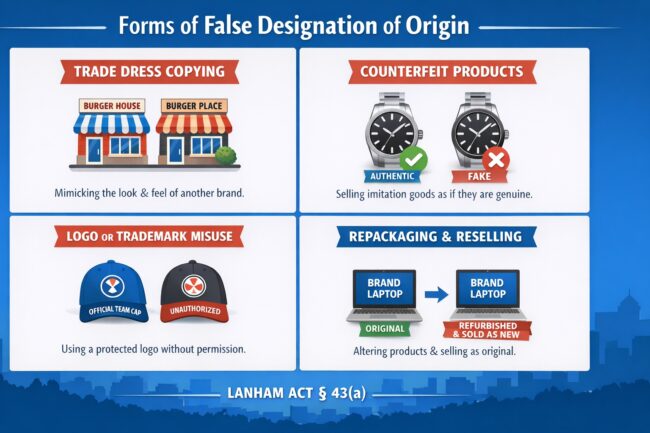
Any mark or trade dress must have distinctiveness to be protectable in a false designation of origin claim. Distinctiveness means the mark or dress identifies the source of the product in the minds of consumers. There are two types of distinctiveness:
A trademark registration is not required for protectability under § 43(a). A common law (unregistered) trademark can be protected and enforced under section § 43. Distinctiveness (inherent or acquired) is what matters. In evaluating distinctiveness, courts will classify the distinctiveness of the mark (generic, descriptive, suggestive, arbitrary/fanciful) and assess evidence of secondary meaning if needed. If a mark or dress is generic (the common name for a product) or entirely functional, it cannot be protected at all. Descriptive marks or designs need proof of secondary meaning, whereas suggestive, arbitrary, or fanciful ones, and packaging trade dress that is inherently distinctive, are protectable immediately upon use.
Apart from false designation of origin, which is confusion-based, federal law also provides protection against dilution of famous marks in § 43(c) of the Lanham Act. Dilution is a different type of harm that does not require consumer confusion. Instead, it protects famous marks from dilution by blurring (uses that blur the distinctiveness of a trademark or trade name) or tarnishment of their reputation, even if consumers are not confused about source. For example, using a famous mark like “Kodak” on an unrelated product (like “Kodak shoes”) could dilute the mark’s distinct identity, and using a mark in an unwholesome context could tarnish its reputation.
Only an owner of a famous mark can bring a federal dilution claim. A mark is considered famous if it is widely recognized by the general consuming public as a designation of source for the owner’s goods or services. The law provides that in determining whether a mark possesses the requisite degree of recognition, courts may consider all relevant factors, including the duration and geographic extent of the mark’s use and advertising, the volume and geographic extent of sales under the mark, the extent of actual recognition of the mark, and whether the mark was registered (on the Principal Register or under prior trademark acts). Trade dress dilution claims are also available to businesses that have famous trade dress, such as the Tiffany and Co. blue box.
A famous mark is a very well-known mark (think of brands like Coca-Cola, Nike, or Disney that are household names across the country). Courts look at factors such as the degree of similarity between the marks, the distinctiveness of the famous mark (inherent or acquired), how exclusive the famous mark’s use has been (substantially exclusive use by the owner), the degree of recognition of the famous mark, whether the junior user intended to create an association, and any actual association between the two marks or involves an association that harms the reputation of the famous mark. If dilution is shown, the famous mark owner to damages or profits in addition to injunctive relief, subject to the court’s discretion. However, the law also provides some important exclusions to dilution claims. Fair use is protected: using a famous mark in a non-trademark way to describe one’s own product (descriptive fair use) or for parody, commentary, or criticism is not actionable as dilution. For instance, comparative advertising that permits consumers to compare goods or services, news reporting and news commentary are also explicitly protected uses.
Violating the false designation of origin or false advertising provisions can lead to serious consequences. Under the Lanham Act, a plaintiff successfully demonstrates that false designation of origin occurred, the plaintiff may be entitled to injunctive relief, which is a court order stopping the defendant from continuing the false designation or misleading advertising. In fact, the law explicitly authorizes courts to issue injunctions according to principles of equity, which means the court may consider factors like the balance of hardships and the public interest when tailoring an injunction. Injunctive relief is the most common remedy, as it prevents further confusion in the marketplace.
Beyond injunctions, plaintiffs may also recover monetary remedies in appropriate cases. Under 15 U.S.C. § 1117(a), a court can award the plaintiff the defendant’s profits earned from the wrongful act, any actual damages sustained by the plaintiff (e.g., lost sales or harm to goodwill), and the costs of the lawsuit. In cases of deliberate and egregious infringement (e.g., an infringement claim arising from willful use of the plaintiff’s trademark or intentional deception), courts have the discretion to award up to treble (triple) damages or profits, and in “exceptional cases” the plaintiff may also recover attorneys’ fees.
Willfulness is not an absolute prerequisite for monetary relief in a false designation claim. The U.S. Supreme Court in Romag Fasteners, Inc. v. Fossil, Inc., 590 U.S. 212 (2020) clarified that while willful infringement is a significant factor, it is not a strict requirement for an award of profits in a Lanham Act case. However, demonstrating the defendant’s willful intent to deceive or to cause such false description of origin can greatly strengthen the case for getting monetary relief. If the false designation involves use of a counterfeit mark, the Lanham Act provides even higher statutory damages and seizure remedies under related sections, but that is a subset of trademark infringement cases.
Another interesting enforcement aspect involves imports: products marked or labeled with a false designation of origin (for example, falsely indicating a certain geographic origin or brand) can be stopped by U.S. Customs. The Lanham Act provides that goods marked or advertised in violation of § 43(a) shall not be imported into the United States. Customs authorities have the power to refuse entry of goods that carry false designations. This means that if someone tries to import products with misleading branding or origin claims, those goods may be blocked at the border, and the importer might face legal action. The owner or importer of the goods refused entry can protest such exclusion or seizure under the customs revenue laws, or seek relief under the Lanham Act itself for the seizure of those goods.
The focus of this article is federal law, but it is worth noting that state common law and statutory laws also address false designations and unfair competition. Many states have statutes or common law doctrines against “passing off” or deceptive trade practices. For example, at common law, a business could sue for passing off if another business misrepresented its goods as coming from the plaintiff. These state-law unfair competition claims often parallel Lanham Act claims, though they may have some differences in scope or available remedies. Generally, federal law does not preempt state unfair competition laws, so a plaintiff could have both federal and state causes of action for the same wrongful conduct. However, federal registration of a mark can preempt certain state claims like dilution, and the Lanham Act’s savings clause confirms it does not override other laws except where explicitly stated.
The common law of unfair competition historically aimed to prevent the same kind of misleading practices that false designation of origin covers. The Lanham Act was designed to complement, not replace, existing rights, and when it was enacted in 1946 (the Trademark Act of 1946, also known as the Lanham Act), Congress specifically preserved existing trademark rights and pending proceedings under prior acts (the Acts of 1881, 1905, and 1920). The new federal law repealed inconsistent provisions of earlier trademark statutes, but ensured that no one lost rights they already had. There was no “complete bar” to ongoing claims simply because the law changed. In essence, federal and state laws work in tandem to combat false designations. Businesses should be aware that misleading consumers can trigger multiple legal repercussions.
False designation of origin is a serious legal issue that can expose businesses to lawsuits and liability under federal law and state laws. In essence, any false or misleading representation that causes confusion about who is behind a product, or any false description in advertising, can be unlawful. The Lanham Act’s false designation provisions (15 U.S.C. § 1125(a)) protect businesses’ goodwill and consumers’ ability to rely on branding as a source indicator. They require that you not use trademarks, names, or other marketing materials in a way that deceives customers. The legal standards center on whether consumers are likely to be confused or misled. An honest mistake might not be a violation, but deliberate deceit or careless use of similar branding can lead to legal trouble.
You should consult with an experienced trademark attorney before launching new products and businesses in order to determine whether your branding and marketing too closely imitate a competitor’s branding, misuses famous trademarks in a way that could be seen as trading on their fame, or runs other risks under the Lanham Act or state law. Due diligence, including trademark searches and legal reviews are wise steps to take before launching new brands or advertising campaigns. Conversely, the law provides remedies if another business is misleading customers by suggesting an association with your company or by false advertising. If you need assistance with evaluating a potential trademark dispute or have other intellectual property matters to address, contact our office for a free consultation.
© 2025 Sierra IP Law, PC. The information provided herein does not constitute legal advice, but merely conveys general information that may be beneficial to the public, and should not be viewed as a substitute for legal consultation in a particular case.
An invention must be nonobvious to qualify for a patent. This means a patent cannot be granted “if the differences between the claimed invention and the prior art are such that the claimed invention as a whole would have been obvious… to a person having ordinary skill in the art”. 35 U.S.C. § 103. Determining obviousness involves comparing the invention to earlier technology (prior art) and assessing what an ordinary skilled practitioner would find obvious.
However, even when prior art seems to suggest an invention, secondary considerations of nonobviousness, also known as objective evidence or objective indicia, can tip the balance by showing the real-world significance of the invention. Such objective evidence of non-obviousness can overcome a rejection of the claimed invention. Secondary considerations can mean the differences between patentability and rejection in a patent application. This article explains secondary considerations, outlining what they are, why they matter, and how they are used.
Obviousness is a core patentability test codified in 35 U.S.C. § 103, which bars patents on inventions that “would have been obvious” in light of earlier technology. In practice, patent examiners and courts evaluate obviousness by considering the differences between the prior art and the patent claim, the scope of relevant prior art references, and the level of ordinary skill in the field. This framework was established by the U.S. Supreme Court in Graham v. John Deere Co., which set forth factors to guide obviousness determination. Under the Graham factors, the decision-maker looks at (1) the scope and content of the prior art; (2) the differences between the prior art and the claimed invention; and (3) the level of ordinary skill in the art. 383 U.S. 1 (1966). Once these primary factors are analyzed, the obviousness or nonobviousness of the invention “is determined” against that backdrop. Notably, the Supreme Court acknowledged that “[s]uch secondary considerations as commercial success, long felt but unsolved needs, failure of others, etc., might be utilized to give light to the circumstances surrounding the origin of the subject matter sought to be patented.” Ibid. In other words, beyond the technical comparison of elements, the law invites consideration of real-world objective indicia that an invention is not obvious.
Secondary considerations of nonobviousness are facts about how an invention fared in the real world, offered as objective evidence that the invention was not obvious. They are “secondary” in the sense that they are considered after establishing a prima facie (at first glance) case of obviousness based on the prior art. Unlike subjective arguments or theoretical comparisons, these factors rely on tangible outcomes and reactions to the invention: hence also called “objective indicia of nonobviousness.” Courts have emphasized that such evidence must always be considered when present, and it can be highly probative. In fact, the Federal Circuit noted that:
In short, secondary considerations help ground the obviousness inquiry in real-world facts, guarding against hindsight and highlighting the invention’s unique characteristics or impact.
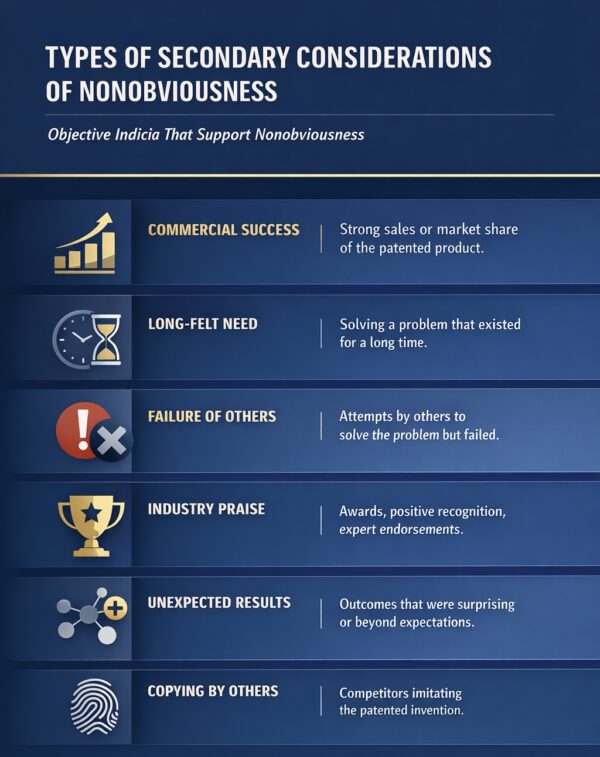
Patent law recognizes many objective factors that can serve as secondary considerations. Some of the most common secondary considerations (sometimes called objective evidence of nonobviousness) include:
Commercial success of a product embodying the invention. Strong sales or market share attributable to the invention’s features can demonstrate that invention disclosed is more likely to be innovative and nonobvious.
Long-felt but unsolved need that the invention finally addressed can indicate patentability. If industry had a longstanding problem that the invention solved, the invention may be patentable.
Failure of others to find a solution: if others tried and failed to invent what the patent claims, it is an indication that the invention was not obvious.
Industry praise or recognition: Awards and professional accolades for the invention, such as winning industry awards or positive press, signal it is a patentable advance.
Copying by competitors: If others in the market copied the invention, it suggests the idea was not obvious to them beforehand.
Unexpected results achieved by the invention, such as the results or properties go far beyond what the prior art or routine skill would predict, indicate nonobviousness.
Skepticism of experts: If experts initially thought the idea would not work, the invention's success indicates an inventive step.
Licensing of the patented invention: Competitors taking licenses or investors investing due to the invention’s merits can indicate its nonobvious value.
Industry adoption or widespread use: If the invention’s features are widely adopted in the field, displacing older technology, the invention may be patentable.
Each of these factors is a form of objective indicia: evidence stemming from the real-world impact of the invention. Not every patent will have all (or any) of these, but such evidence, when available, can strongly support a patent owner’s position that the invention was not obvious.
Crucially, for any secondary considerations evidence to carry weight, there must be a “nexus” between the evidence and the claimed features of the invention. The term nexus means a legally and factually sufficient connection. The evidence must actually be due to the merits of the claimed invention, not other factors. The Federal Circuit has explained that when a patentee asserts that secondary considerations support a finding that a patent claim is nonobviousness and valid, there must be a sufficient relationship or "nexus" between the secondary considerations and the patented invention. Demaco Corporation v. F. Von Langsdorff Licensing Limited and F. Von Langsdorffbauverfahren Gmbh, 851 F.2d 1387 (Fed. Cir. 1988).
In practical terms, this nexus requirement ensures that the success or praise arises from what is specifically claimed in the patent (the inventive combination or feature), rather than from extraneous factors like marketing, superior quality, or features already known in the prior art.
Establishing nexus can be done in two ways. First, if the product that achieved commercial success or praise is coextensive with the patent’s claims, then a presumption of nexus arises: i.e., the product’s core features are included in the patent claims and it has no significant unclaimed features. For instance, if a patented drug has only active ingredient, the ingredient is claimed, and the drug achieves great success, one can presume the success is due to the claimed invention.
However, if the product includes additional unclaimed features or improvements, or if external factors, like aggressive advertising or price might explain its success, then no automatic presumption applies. In that case, the patent owner must prove nexus with specific evidence tying the positive outcome to the unique characteristics of the claimed invention. The patent owner can do this by showing, for example, that customers or experts specifically credit the invention’s claimed feature for the product’s success or that the success would not have been possible without the claimed combination.
Without a nexus, even compelling evidence (sales figures, awards, etc.) will be given little or no weight. For example, simply showing high sales is not enough if those sales might be due to marketing or to features not covered by the patent. The Federal Circuit has held that a mere showing of a licensing deal or industry acclaim must be connected to the patent’s specific innovation. In one case, a patent owner pointed to a lucrative licensing agreement as evidence of nonobviousness, but the court found no nexus because “the mere existence of the license is insufficient to overcome the conclusion of obviousness” absent proof that the license stemmed from the merits of the claimed invention. Sibia Neurosciences, Inc. v. Cadus Pharm. Corp., 225 F.3d 1349 (Fed. Cir. 2000).
In another example, a company’s patent on a recording and processing audio system for wireless microphones received industry praise, including an Engineering Emmy award, for solving the long-felt problem of fixing dropouts (signal loss). Lectrosonics, Inc. v. Zaxcom, Inc., Case No. IPR2018-01129 (PTAB Jan. 24, 2020). However, the broad patent claims did not actually require the dropout-repair feature, they were written broadly to cover any combining of local and remote audio data. Because the offered secondary consideration (industry awards and praise) was primarily directed at the dropout-fixing capability and the challenged claims did not include that feature, the PTAB found a lack of nexus because the evidence couldn’t be clearly attributed to the claimed invention. As a result, the patent trial decision discounted the industry praise as a secondary consideration. The patent owner in that case had more success only after amending the claims to include the dropout-repair element explicitly, thereby aligning the evidence of praise with the claimed invention’s unique characteristics. This illustrates that secondary consideration arguments will only persuade if a nexus exists between the evidence and what is actually claimed.
During patent examination, secondary considerations can be a powerful tool for applicants to overcome an obviousness rejection. Typically, a patent examiner first establishes a prima facie case that the invention would have been obvious based on prior art. The patent applicant (or patent owner in a reexamination) may then rebut that case by submitting objective evidence. For example, sales data showing commercial success, declarations from experts about a long-felt need, or other evidence of secondary considerations. The USPTO’s examination guidelines instruct examiners to consider all such objective evidence of nonobviousness in the record before reaching a final determination. Secondary considerations can provide a strong patent prosecution strategy for overcoming patent rejections based on obviousness.
In fact, examiners are reminded to consider all objective evidence that has been properly made of record and is relevant to the issue of obviousness. M.P.E.P. § 2142. This means that if an applicant provides affidavits or documents demonstrating real-world success or failure of others, the examiner must weigh that along with the prior art. Importantly, even if the examiner thinks the prior art makes the invention prima facie obvious, secondary considerations must be analyzed together with the other Graham factors, not just after a conclusion is already drawn. Neglecting to consider such evidence is legal error.
The Federal Circuit has cautioned that an examiner “must not stop until all pieces of evidence on that issue have been fully considered and each has been given its appropriate weight,” including any secondary indicia. Stratoflex, Inc. v. Aeroquip Corp., 713 F.2d at 1539. Thus, an applicant can establish nonobviousness by successfully demonstrating that, on balance, the invention’s proven benefits or industry recognition outweigh what the prior art seemed to suggest, especially if a strong nexus to the claimed features is shown.
Secondary considerations frequently come into play in patent litigation, such as in validity challenges before the Patent Trial and Appeal Board (PTAB) or in court. In inter partes review (IPR) proceedings at the PTAB, which is a type of patent trial focused on obviousness and other validity issues, the patent owner often introduces secondary consideration evidence in its response to an obviousness challenge. For example, the patent owner might present evidence of the invention’s commercial success, industry praise, or that competitors failed and then copied the invention, all to reinforce that the invention would not “have been obvious” to try or develop earlier. The PTAB and courts must weigh this alongside the prior art evidence.
As noted, the Appeal Board will scrutinize the nexus requirement carefully in these cases. The Federal Circuit (the court that hears appeals from patent office decisions) has consistently held that secondary considerations lacking a nexus to the claimed invention cannot overcome a strong showing of obviousness. In Fox Factory, Inc. v. SRAM, LLC, for instance, the PTAB initially found a patent nonobvious due to evidence of commercial success and industry praise for the product. No. 18-2024 (Fed. Cir. 2019). But the Federal Circuit vacated that decision because the Board erred in presuming nexus without adequate proof that the success was due to the claimed combination of features. The case underscored that secondary considerations are given “substantial weight” only when tied to the specific claimed combination of elements, not just the product in general.
Similarly, in Teva Pharm. v. Eli Lilly & Co., the court affirmed an obviousness finding where the patent owner’s asserted objective evidence (a third-party license agreement) was not shown to have any nexus to the claimed invention’s merits, calling the license evidence “insufficient to overcome the conclusion of obviousness” in that case. No. 20-1749 (Fed. Cir. 2021). These cases demonstrate that while objective indicia are an integral part of an obviousness analysis, success in using them depends on clearly connecting the patent owner’s objective evidence to the inventive aspects of the patent claim at issue.
Ultimately, the determination of obviousness is a case-by-case judgment, considering all evidence. Secondary consideration evidence does not automatically trump a strong prior art case, but it can make the difference in a close call or even overcome a weak obviousness showing. The Graham factors (primary criteria and secondary indicia) must be weighed together on a case-by-case basis, with no single factor being dispositive. If an invention was truly obvious, one would not expect to see significant objective evidence of innovation like unmet needs solved or acclaim from experts. Thus, when a patent owner presents robust secondary considerations with a proven nexus, they are entitled to “substantial weight”.
In fact, secondary considerations can be the most compelling evidence of nonobviousness, especially when technical comparisons alone are debatable. On the other hand, if no secondary considerations are present for a given invention, that absence does not by itself prove obviousness – it simply means the decision rests on the prior art and other factors. All relevant factors must be analyzed and given appropriate weight before concluding obviousness or nonobviousness.
Secondary considerations of nonobviousness provide real-world validation that an invention was a nonobvious leap. They can strengthen a patent application during patent examination or serve as crucial evidence in a patent trial to uphold a patent’s validity. However, one must also ensure a nexus between the evidence and the specific claimed features of the invention. Courts and the USPTO will give substantial weight to secondary considerations if they genuinely stem from the patented invention itself.
By gathering and presenting relevant factors on these secondary considerations, a patent applicant can significantly bolster their case that an invention “would not have been obvious” to create beforehand. Such evidence helps ensure that truly innovative advancements receive the legal protection they deserve.
Subtle issues in patent law like secondary considerations are best handled by an experienced patent attorney. If you are considering pursuing a patent or you have other patent matters you need to address, contact our office for a free consultation.
© 2025 Sierra IP Law, PC. The information provided herein does not constitute legal advice, but merely conveys general information that may be beneficial to the public, and should not be viewed as a substitute for legal consultation in a particular case.
Two primary forms of intellectual property protection are trademark and copyright, each serving distinct purposes under U.S. intellectual property law. In essence, trademarks protect brand identity in commerce, while copyrights protect creative works and original expression. This article provides a clear comparison of trademark and copyright law in the United States. We explore the scope of each form of protection, how they are obtained, the legal benefits of federal registration, and practical examples illustrating how trademark and copyright law apply differently in real-world business scenarios.
A trademark is a type of intellectual property that protects brand identifiers: the names, logos, and other symbols that distinguish a company’s products or services in the marketplace. Under the Lanham Act (statutory federal trademark law), a trademark can include “any word, name, symbol, or device, or any combination thereof” used by a person “to identify and distinguish his or her goods…from those manufactured or sold by others and to indicate the source of the goods”. In short, a trademark is a legally protected brand indicator. Service marks are the same as trademarks except they apply to services rather than goods.
The primary purpose of trademark law is to protect brand identity and prevent consumer confusion. By ensuring that only the trademark holder can use a particular mark for certain goods or services, trademarks help consumers identify the source of products and services. As the U.S. Supreme Court explained, federal trademark law prevents competitors from copying a source-identifying mark, which reduces the customer’s costs of shopping and making purchasing decisions and ensures a producer will reap the financial, reputation-related rewards of its product’s goodwill. For example, a trademark registration for a business name or logo gives the company the exclusive right to use that name or logo for the registered classes of goods or services, so that other businesses cannot use a similar name or logo in a way that would confuse consumers about the source of the goods.
To qualify for trademark protection, a mark generally must be distinctive. This means it can identify the source of goods and distinguish them from others. Generic terms (the common name of a product) cannot be protected as trademarks, and descriptive terms are only protectable if they acquire secondary meaning associated with a particular source. By contrast, suggestive, arbitrary, or fanciful marks (like coined brand names or logos) are inherently distinctive and can function as a trademark and be federally registered under trademark law. For instance, “Apple” as a brand for computers is an arbitrary mark that does not describe the product and is thus protectable. In contrast, “Fresh Apple Juice” for a juice brand includes descriptive ("Fresh") and generic ("Apple Juice") elements for that product and is not eligible for trademark protection without secondary meaning.
Importantly, trademark rights in the U.S. arise from use in commerce. Simply being the first to coin a name or design a logo isn’t enough; the mark must be used to identify goods or services in the marketplace to create trademark rights. From the first actual use of a mark on goods or services, one obtains common law trademark rights in the geographic area of use, even without any formal registration. Such common law rights are governed by state and common law principles. Common law rights can be enforced to a degree, but they are limited. For example, common law rights are limited to the region where the mark is used and known.
Obtaining a federal trademark registration through the United States Patent and Trademark Office (USPTO) is highly recommended for broader protection. Federal registration creates a presumption of nationwide rights and gives significant legal advantages to the trademark owner that are not available under common law alone. We will discuss the trademark registration process and its benefits further below.
A copyright is a form of intellectual property that protects original creative works fixed in a tangible form. The U.S. Copyright Act provides that copyright protection subsists in original works of authorship fixed in any tangible medium of expression from which they can be perceived, reproduced, or otherwise communicated. In simpler terms, any creative work that an author produces and writes down or records is automatically subject to copyright protection. Original works include a wide range of creative works: literature, articles, websites and blog content, visual art, photographs, music, audio recordings, videos, films, sculptures, and computer programs (software code), among others. Even business materials like marketing content, product manuals, or software user interfaces can be protected by copyright if they contain original expression. Copyright covers both published and unpublished works, as long as they meet the originality and fixation requirements.
The purpose of copyright law is to protect and encourage creative expression by giving authors exclusive rights to their works. These exclusive rights are defined by statute (17 U.S.C. § 106) and include the right to reproduce the work, create derivative works (adaptations or modifications), distribute copies of the work, publicly perform or display the work, and, for sound recordings, to perform the work by digital transmission. For example, the author of a software code (which is treated as a literary work under copyright) has the exclusive right to make copies of that code, to create modified versions or improvements, and to distribute or license the software. Likewise, the creator of an original graphic or photo on a website has the exclusive right to reproduce or display that image. If someone else wants to use or copy a creative work, they generally need permission from the copyright owner, unless an exception like fair use applies.
Copyright arises automatically upon creation of the work in tangible form: there is no requirement to file or register a work to create copyrights. The moment you, for instance, write an original blog article or design an original graphic and save it (fix it in a tangible medium, whether on paper or digital file), you are the copyright owner of that work. This automatic protection is different from trademarks, which require use in commerce and benefit greatly from registration. However, while formal registration with the U.S. Copyright Office is not required to have a copyright, it does confer important legal benefits, especially if you ever need to enforce your rights in court. We will discuss the copyright registration process and its advantages shortly.
It is important to note the limits of copyright. Copyright law protects the original expression of ideas, not the underlying facts, ideas, processes, or systems themselves. The statute explicitly says no copyright protection extends to “any idea, procedure, process, system, method of operation, concept, principle, or discovery” regardless of how it is described. Courts have long held as a fundamental axiom that no one may copyright facts or ideas. For example, a list of facts or data (like a database of customer addresses) is not protected by copyright unless there is some creative selection or arrangement, and even then the facts themselves remain free for anyone to use. This principle was affirmed by the U.S. Supreme Court in Feist Publications, Inc. v. Rural Tel. Serv. Co., which denied copyright for a white-pages phone directory consisting of factual listings. 499 U.S. 340 (1991).
Similarly, short phrases, titles, and slogans are generally not protected by copyright because they lack sufficient creativity or are considered ideas. This is a key difference: a slogan or short phrase might be protectable as a trademark if it identifies a brand (e.g., a slogan like “Just Do It” is a registered trademark of Nike), but the same phrase would not get copyright protection due to lack of originality and length. Thus, copyright protects creative works, whereas trademark protects brand names, logos, and other identifiers. Both are forms of intellectual property, but they apply to very different subject matter.
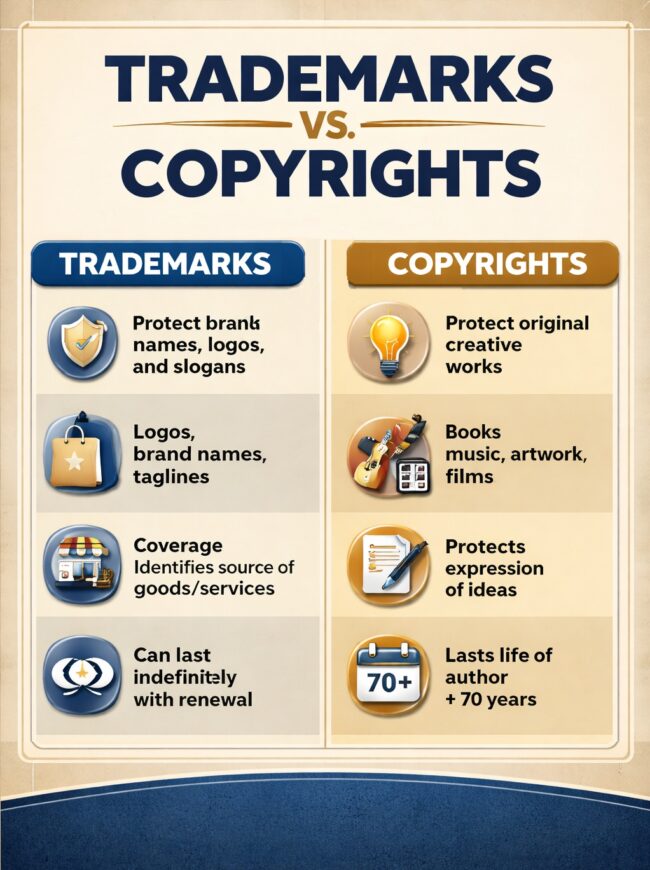
The most fundamental difference between trademark and copyright is the subject matter they protect. Trademark law protects symbols of brand identity: words, names, logos, slogans, colors, sounds, or even packaging and product designs (trade dress) that indicate the source of goods or services. Examples of trademarks include company names (e.g., Nike for athletic apparel), product names (e.g., iPhone for smartphones), brand logos (e.g., Apple’s apple-with-a-bite logo), taglines or slogans (e.g., Nike’s “Just Do It”), and even distinctive elements of product packaging or store appearance, referred to as trade dress (e.g., Tiffany & Co.'s blue box). Trademark rights protect against confusingly similar marks. The trademark owner has the right to prevent other businesses from using a name or mark that is so similar that it would likely confuse consumers about the origin of the goods or services. The focus is on consumer perception. Trademarks exist to identify and distinguish products in the marketplace.
In contrast, copyright law protects original creative expression in a work. This can be thought of as the actual content or substance that someone creates: the text of an article or book, the code of a software program, the design of a graphic, the composition of a song, etc. Copyright gives the creator exclusive rights to use and authorize use of the creative work. Unlike trademarks, the scope of copyright protection has nothing to do with consumer confusion or marketplace competition. It is solely about protecting the author’s expression from unauthorized copying or exploitation. Another key distinction in scope: trademark rights are generally limited to specific categories of goods or services. A trademark is registered in certain classes of goods/services, and another company might use a similar name in a totally unrelated industry without infringement if consumers aren’t likely to be confused (e.g., there is no meaningful consumer confusion between Delta Airlines and Delta faucets).
Copyright rights, however, are universal to the work. If you own the copyright to a photograph or a piece of software code, no one can reproduce it or make derivative works in any context without permission, regardless of industry or intent, unless the use qualifies as fair use or the work has fallen into the public domain after expiration.
Trademarks and copyrights also differ greatly in how long protection lasts. A trademark can potentially last forever. Trademark rights have no fixed term of years, but they require continuous use and periodic renewal. Under U.S. law, a federal trademark registration initially lasts 10 years and can be renewed indefinitely for additional 10-year periods, as long as the mark is still in use in commerce, and the registrant provides to the US Patent and Trademark Office proof of continued use and payment of renewal fees. The logic is that trademark rights persist as long as the brand is actively used to identify source and has not become generic. However, if a trademark owner abandons use of the mark (e.g., by non-use for three years with intent not to resume is deemed abandonment, per 15 U.S.C. § 1127) or if the mark becomes a generic term in the public’s eyes for the product, the trademark protection can be lost. Famous examples of marks that became generic and lost protection include “aspirin” and “escalator”: originally brand names that became the generic name of the product for the consumer. Generally though, a trademark can be maintained in perpetuity with diligent use and enforcement. For example, registered trademarks like Coca-Cola® or Microsoft® have been protected for many decades and will continue to be, as those companies actively use and defend their marks.
Copyright, by contrast, has a finite duration determined by statute. Modern U.S. copyright law (post-1978 works) provides that a copyright in an individual work lasts for the life of the author plus 70 years after the author’s death for works made by individual creators. For works made for hire or anonymous works (e.g., corporate creations), the term is 95 years from first publication or 120 years from creation, whichever expires first. After the copyright term ends, the work enters the public domain, meaning anyone is free to use it without permission. The expiration of copyright is a fundamental aspect. It ensures that creative works eventually become free for the public to build upon.
Trademark law has no analogous automatic expiration. The closest concept is that a trademark can effectively end if usage stops or it becomes generic, but there is no pre-set term as long as it is renewed and in use. This difference has real business implications. For example, the copyrights in classic novels like those by Jane Austen are expired and the works are in the public domain. Thus, anyone can publish or adapt them without permission. But a company’s brand name can remain legally protected forever if the company continues to exist and use the mark (think of long-lasting brands like Coca-Cola or Ford). Thus, failing to maintain use of a trademark could mean losing potentially perpetual rights, whereas failing to renew a copyright simply means eventually it will expire as scheduled by law.
A trademark owner’s primary right is to prevent others from using the same or a confusingly similar mark in commerce in a way that is likely to mislead consumers. Trademark infringement is defined generally as unauthorized use of a protected mark or a confusingly similar mark in connection with goods or services in a manner likely to cause confusion, mistake, or deception among the consuming public as to the source, sponsorship, or affiliation of those goods or services. 15 U.S.C. §§ 1114(1), 1125(a)(1). The trademark owner does not literally own a word or symbol in gross. They own it as a mark for specific goods/services. For instance, if you have a trademark on the brand name “Sunburst Electronics” for computer equipment, you can stop another electronics company from branding its products “Sunburst” because that would likely confuse customers. But you typically could not stop an unrelated business, say a “Sunburst Hotel,” unless your mark is famous and you are able to claim dilution.
Trademark law is mainly about preventing confusion in a particular market. Trademark law also provides causes of action for related violations like trademark dilution (blurring or tarnishing a famous mark’s distinctiveness, under 15 U.S.C. § 1125(c)) and false advertising/passing off under Section 43(a) of the Lanham Act. The trademark owner has the right to use the ® symbol once a mark is federally registered, and to sue for infringement in federal court with the benefits of registration, including potential recovery of infringer’s profits, damages, and even attorney’s fees in exceptional cases, per 15 U.S.C. § 1117(a). In summary, trademark protection gives you exclusive rights to your brand identity in commerce and legal tools to stop competitors from using branding that would confuse consumers or dilute your brand.
A copyright owner, on the other hand, holds a bundle of exclusive rights in the creative work as enumerated in 17 U.S.C. § 106. These include the right to reproduce the work, prepare derivative works (i.e., adaptations, translations, sequels), distribute copies to the public, perform the work publicly (for example, a play or film), and display the work publicly. Only the copyright owner or licensees may do these things; if anyone else does so without permission, it constitutes copyright infringement under 17 U.S.C. § 501. For example, if you write original content for your business’s website or code for a software application, you have the exclusive right to control who can copy that text or code or create new content derived from it. No one can lawfully copy and paste your website text onto their own site or incorporate your software code into their product without your permission, unless a specific exception like fair use applies.
Unlike trademark, consumer confusion is irrelevant in copyright infringement; the question is simply whether a protected expression was used without authorization. Even if someone copies your content and gives you credit (avoiding confusion about authorship), it’s still infringement unless it is authorized by you. Copyright also differs in that it does not protect any names or short phrases. So, if someone uses the same slogan or title as yours, that alone is not a copyright issue. Conversely, it could be a trademark issue if it identifies a product or service. Overall, copyright protection grants the creator broad control over the use of their original works, whereas trademark protection protects specific marks with respect to particular goods or services, and prevents marketplace confusion of the source of the particular goods or services.
While common law trademark rights can exist without registration, federal trademark registration with the USPTO is highly beneficial and is often crucial for nationwide brand protection. The trademark registration process involves filing an application with the USPTO, which includes details of the mark, the goods or services it’s used with, and often a specimen showing the mark in use, unless filing on an intent-to-use basis, in which case proof of use will be provided later. The USPTO will examine the application for compliance and check for conflicts with existing registered or applied-for marks.
A trademark search before filing is wise to ensure no other similar mark is out there that could bar your registration. If the application meets all requirements and no confusingly similar marks are found (or any such issues are resolved), the mark is published for opposition. If no trademark opposition is filed, the mark proceeds to registration. Upon registration, the owner may use the ® symbol. Federal registration confers significant legal advantages: nationwide presumptive rights as of the filing date, a legal presumption of the validity of the mark and the registrant’s ownership under 15 U.S.C. § 1057(b), the ability to sue in federal court and invoke certain statutory remedies, and the opportunity after five years to make the mark incontestable, which limits certain defenses against it, per 15 U.S.C. § 1065. It also allows recording the trademark with U.S. Customs to block importation of counterfeit goods.
The USPTO is the federal agency that administers trademark registration. It is part of the federal government (Department of Commerce) tasked with granting patents and registering trademarks. Federal registration is not free, there are filing fees per class of goods/services. If you skip registration and rely on common law trademark rights, you may still use “™” and can enforce your mark within your local area of use, but you could face challenges expanding nationally, and another party might register a similar mark and gain nationwide priority over you. Thus, failing to register a trademark can put your brand at risk.
Copyright protection is automatic, but there are compelling reasons to go through the copyright registration process with the U.S. Copyright Office. The process is generally simpler and cheaper than trademark registration. It involves submitting an application, a modest filing fee, and a copy or specimen of the work (the deposit) to the Copyright Office. The Office does not deeply examine the artistic merit. It mainly checks the application for completeness and that the work is subject to copyright. It may refuse registration for clearly uncopyrightable content like entirely blank forms or short phrases, etc., but there is not an extensive examination like trademarks.
Once the copyright application is processed and approved, a certificate of registration is issued. Importantly, under U.S. law, registration is a prerequisite to filing a copyright infringement lawsuit for works of U.S. origin under 17 U.S.C. § 411(a). The Supreme Court confirmed in Fourth Estate Public Benefit Corp. v. Wall-Street.com, LLC that one must have an issued registration or a refusal of registration before suing for infringement in federal court. 586 U.S. 881 (2019). So if your work is not registered at the time of infringement, you will need to register it and wait for the certificate before you can take legal action in court.
Moreover, if you register your work before an infringement happens (or within three months of first publication of the work), you gain access to special remedies: statutory damages and potential attorney’s fees under 17 U.S.C. § 412, § 504, § 505. Statutory damages mean you don’t have to prove actual losses. The law allows an award per work infringed, ranging generally from $750 up to $30,000 per work, and up to $150,000 per work for willful infringement. Attorney’s fees can also be awarded at the court’s discretion to a prevailing party, which can make pursuing a case more feasible. If you do not timely register, you are limited to actual damages and infringer’s profits, which can sometimes be hard to prove, and you cannot recover your attorney’s fees, making litigation more difficult and expensive to justify.
Thus, copyright registration provides significant legal advantages when enforcing your rights. It also serves as public record of your ownership and creates a presumption of validity of the copyright if done within five years of publication per 17 U.S.C. § 410(c). However, unlike trademark, you don’t need to register to put a notice on your work. You can use the copyright symbol (©), your name, and year on published works to inform the public of your claim. This notice is not mandatory under modern law but is still a good practice. In summary, formal registration of copyrights, while not required to be “legally protected,” is crucial if you ever foresee needing to take legal action to stop infringement or claim damages.
Both trademark and copyright protections discussed here are creatures of U.S. federal law, and they are generally territorial. A U.S. trademark registration gives rights in the United States and its territories, and a U.S. copyright likewise is enforceable in the U.S. with some international effect via treaties like the Berne Convention for international copyright protection, and Madrid Protocol for international trademark protection. The key point for business owners is that if you operate globally, you may need to secure rights in other countries separately. A U.S. trademark or copyright does not automatically grant international protection. You would need to file in other jurisdictions to protect your IP abroad.
Trademark owners are responsible for their own trademark enforcement, including policing their marks and stopping unauthorized uses that could harm their brand or confuse consumers. If another business uses a name, logo, or other mark that is identical or substantially similar to your trademark in a way that overlaps with your market or goods or services, you likely have a case for trademark infringement. The legal test for infringement is “likelihood of confusion”: would an average consumer be likely to believe that the infringer’s goods or services are coming from the trademark owner or are approved or affiliated with them due to the similarity of the marks and business context? To enforce rights, trademark owners often start by sending a cease and desist letter to the infringing party. If that fails, the owner can file a civil lawsuit in either state court or federal court. In federal court, the Lanham Act provides the causes of action for both infringement of registered marks (15 U.S.C. § 1114) and for unregistered marks (false designation of origin under 15 U.S.C. § 1125).
Remedies for trademark infringement can include:
Besides litigation, trademark owners should also monitor the USPTO’s Trademark Gazette for potentially conflicting applications and file oppositions or petitions for cancellation to prevent registration of confusingly similar marks by others. Common law rights can be asserted in state courts or as part of a federal unfair competition claim, but they lack the nationwide scope. For example, two businesses in different regions might each have common law rights to the same name until one expands or registers. This underscores the value of federal registration and early enforcement. Failing to enforce your trademark can lead to weakening of your rights or even loss. As a trademark owner, being proactive in enforcement is key to maintaining a strong brand.
Copyright infringement occurs when someone violates one of the exclusive rights of the copyright holder without authorization and without a valid defense. This typically means copying or using someone’s protected expression, whether by reproducing text, images, code, music, etc., or by distributing it, publicly displaying it, creating an unauthorized derivative, and so on. Unlike trademark, there is no requirement of commerce or consumer confusion. For example, if a competitor copies paragraphs from your website for their own site, or uses your photograph in their advertising, that is copyright infringement. If a former employee takes your software code and reuses portions in a competing program without permission, that’s infringement of your software copyright.
Copyright owners often enforce their rights by sending a cease and desist notice or a DMCA takedown request for online infringements, under the Digital Millennium Copyright Act’s notice-and-takedown system. To escalate enforcement, the copyright owner may file a lawsuit in federal court. As mentioned, you need a copyright registration in hand to file a suit for U.S. works.
If successful in a copyright infringement lawsuit, the owner can obtain an injunction to stop further infringement and, depending on the timing of registration, can seek either actual damages plus any profits the infringer made from using the work or statutory damages set by law. Statutory damages can be very potent. The court can also order the destruction or impounding of infringing copies. Attorney’s fees and costs can potentially be awarded to the prevailing party, which is a major benefit if you registered early, as it can deter infringers (they know they might have to pay your legal fees) and make it financially viable for you to pursue a case.
Criminal enforcement is rarer for copyright, but the law does criminalize willful commercial piracy (e.g. bootleg movie distribution) under certain circumstances. Generally, most business-related copyright disputes are handled civilly. As noted earlier, there are exceptions for certain unauthorized uses of copyright material, such as the fair use exception, which permits the use of copyright material for commentary, parody, news reporting, or other transformative uses. However, fair use is a complex defense that courts analyze case-by-case. Trademark law has limited trademark fair use defenses, including nominative fair use or descriptive fair use of marks in limited cases, and First Amendment defenses in parody cases.
Failure of the copyright holder to enforce a copyright does not cause loss of the copyright: you won’t lose ownership just because you didn’t sue an infringer. However, it can have practical downsides, such as the work might be widely exploited by others, diminishing its value, and you might be seen as acquiescing to some uses. In trademark, inaction can be more directly harmful because it might contribute to your mark becoming generic or losing distinctiveness, or you could be barred by laches (unreasonable delay) from seeking certain remedies against an infringing party. So both trademark and copyright owners should be vigilant, but trademark owners in particular must actively police the use of their brand to avoid dilution or genericide.
To illustrate how trademark and copyright protections apply differently, let’s look at a few real-world business scenarios:
Consider a startup software company that creates a new business name and a distinctive logo. The brand name (e.g., “TechNova Solutions”) is something they would protect through trademark for use on their services. They do a trademark search to ensure no one else has a similar name in the industry, then file a trademark application to register “TechNova Solutions” as a service mark for software development services. Once registered, this gives them the exclusive right to use that name for those services in the U.S., and to stop later companies from using confusingly similar names.
The company also has a logo composed of a creative graphic design. The logo can have dual protection: as a trademark and as a copyrighted work. The graphic itself is original artwork fixed in digital form, so the designer automatically has copyrights therein. Suppose a competitor starts using a very similar logo for related services: the company could sue for trademark infringement even if the competitor didn’t literally copy the graphic but came up with a lookalike. If another party outright copies the logo design and prints it on merchandise or uses it on a website without permission, that’s both copyright infringement (unauthorized copying of the artwork) and potentially trademark infringement if used to identify goods in commerce. The company should ideally have registered the logo as a trademark and also registered the copyrights in the logo with the U.S. Copyright Office for maximum protection.
Short phrases are often used as marketing slogans. For example, a bakery using the tagline “Baked Fresh, Served Warm” to promote its goods. Such a phrase likely does not have any copyrights; titles and short phrases are excluded from copyright protection for lack of originality. However, it can potentially be a trademark if it is distinctive enough and used consistently to identify the bakery’s services. If a competitor across town starts using the same slogan in their advertising, the original bakery’s recourse would be via trademark law. They might send a cease and desist citing their trademark rights.
A company’s website often contains various elements: text descriptions of the company and products, photographs or graphics, perhaps blog articles or videos. All of this creative content is protected by copyright as soon as it is created and posted, assuming the company or its employees/contractors created it and it is original. If another site or a competitor copies these creative elements (for instance, photos, blog posts, etc.), that is copyright infringement. The company can enforce its rights by sending DMCA takedown notices to the infringer’s web host or by suing for copyright infringement if necessary.
The website would also prominently feature the company’s brand name and logo, which are protected as trademarks if they are distinctive. If another business tries to use a confusingly similar website name, domain, or logo, the company would rely on trademark law to address that using Uniform Domain Name Dispute Resolution Policy action through the Internet Corporation for Assigned Names and Numbers (ICANN) for domain squatting, which is a trademark-based mechanism, or suing for trademark infringement and/or or Anti-Cybersquatting Consumer Protection Act (ACPA) violation over the logo use.
If the company has software code or a mobile app, the code is protected by copyright as a literary work and potentially by trade secret law if it’s kept internal and secret. If a competitor outright copies portions of the code or the software’s screen designs, that is a copyright issue. But if a competitor simply creates a competing software that does the same function with a different code and look, there’s no copyright issue. Ideas and functionality aren’t protected by copyright. Baker v. Selden, 101 U.S. 99 (1879). The name of the software, however, may be a trademark matter. Two software applications with the same or very similar name could confuse consumers. This scenario shows how a single product can involve multiple IP rights: the code and content (copyright), the branding (trademark), and confidential algorithms (trade secret).
A company selling a unique beverage might have a special bottle shape and label design. The label artwork (e.g., with creative graphics and text layout) would automatically carry copyrights as a pictorial work, if original. The bottle shape and label appearance could also function as trade dress: a type of trademark protection for the overall image of a product’s packaging, if it’s distinctive and not functional. Trademark law could prevent other drink companies from using a confusingly similar packaging that would mislead consumers. For instance, Coca-Cola’s famous contoured bottle is protected trade dress and no one else can lawfully use a bottle shape so similar that it would cause consumer confusion. In a famous Supreme Court case, Two Pesos, Inc. v. Taco Cabana, Inc., 505 U.S. 763 (1992), a Mexican restaurant chain’s distinctive interior decor (colors, murals, style) was protected as trade dress under trademark law without needing proof of secondary meaning, because it was inherently distinctive.
Copyright might protect any original graphic elements on the label, like a unique illustration, but copyright would not prevent someone from creating a bottle with a similar shape if that shape is not a copy of a sculptural artwork. This highlights that trademark and copyright can sometimes both apply to the same object in different ways: e.g., a product packaging can have trademark protection for its look and feel as a source identifier, and copyright protection for any original imagery or text on it. If you fail to secure trademark rights in your distinctive packaging, a competitor could imitate the look enough to confuse customers and you would have limited recourse.
A business name or the name of a product line is typically protected by trademark, not copyright. Many small businesses mistakenly think just registering a business name with the state or grabbing a domain name gives them exclusive rights. It does not confer trademark rights beyond perhaps some local trade name protections. To truly own rights in a name nationally, one should use it in commerce and ideally get a federal trademark registration. For example, if two entrepreneurs in different states both start restaurants called “Sunrise Cafe,” each will have local common law rights. The one who first files a federal trademark application and gets registration will gain nationwide priority, except possibly carving out the other’s existing local area. The other might eventually be forced to rebrand outside its original zone. Copyright offers no help for conflict over names. Names are generally not protected by copyrights. So the lesson is that trademark is the appropriate protection for brand names.
Domain names are not themselves IP, but knowingly using another's trademark in a domain can be addressed via trademark-based remedies. Knowingly adopting or owning a domain that is the same or similar to another's trademark for the purpose of profiting from the domain on that basis is cybersquatting and potentially trademark infringement through the use of the domain.
In all these examples, we see the key differences in trademark and copyright protection. Trademarks protect against confusing uses of similar marks by others (even if they didn’t outright copy you, if their use causes confusion, it’s forbidden). Copyright protects against any copying of your original expression by others (even if it doesn’t cause confusion or they credit you, it can be infringement unless it’s a permissible fair use). Trademarks require distinctiveness and are tied to commerce; copyrights require originality and fixation but not use in commerce. Trademark rights potentially last indefinitely but hinge on continued use and enforcement; copyright is time-limited but powerful during that term, and does not require use or enforcement to remain in force. Both provide federal protection of exclusive rights that can be enforced in federal court, but the types of harm addressed (consumer confusion vs. unauthorized copying) are different.
Many valuable assets might require both copyright and trademark considerations: e.g., a distinctive logo, a website full of original content, a proprietary software, etc. Often, securing one type of protection without the other could leave you exposed. Federal registration, through the USPTO for trademarks and through the Copyright Office for copyrights, is critical to maximize your legal rights and remedies. While it may take time and some investment, the legal benefits of copyright registration far outweigh the costs. If infringement issues do arise, you will be in a strong position to take legal action and protect your company’s interests, potentially recovering damages and attorney’s fees and obtaining injunctions to halt the unlawful use.
Always consider consulting with an intellectual property attorney to develop a comprehensive strategy tailored to your company. If you need assistance with a trademark or copyright matter, contact our office for a consultation.
© 2025 Sierra IP Law, PC. The information provided herein does not constitute legal advice, but merely conveys general information that may be beneficial to the public, and should not be viewed as a substitute for legal consultation in a particular case.
Design patents protect the ornamental design or visual characteristics of a tangible product, referred to as an “article of manufacture”. Essentially, design patents protect how the product looks. This is in contrast to utility patents, which protect new and useful inventions: how a product works or is used. In other words, a utility patent protects functional aspects.
This distinction between design and utility patents is a fundamental and important distinction. If you are filing a design patent, you need to understand that you are protecting the visual appearance and ornamental aspects (e.g., the shape of the design, the surface ornamentation applied, etc.), not the functional features of the design. Utilitarian aspects are generally not protected by a design patent. This article explains the concept of design patent functionality: a purely functional element in a design cannot be protected by a design patent.
Under U.S. patent law, a utility patent covers the functional components of an invention (e.g. processes, machines, or useful improvements), while a design patent covers only the invention's ornamental appearance. For example, a utility patent could protect an innovative locking mechanism in a jewelry cabinet, whereas a design patent could protect the cabinet's new decorative shape or surface ornamentation. Both types of patents require the invention to be novel and non-obvious over the prior art (previous designs and technologies). However, utility patents provide intellectual property protection for the function of a design or innovation, while design patents protect how something looks.
The legal framework reflects this:
35 U.S.C. § 101 (the utility patent statute) requires a “new and useful” invention,
35 U.S.C. § 171 (the design patent statute) grants protection to a “new, original and ornamental design for an article of manufacture”. Thus, a design patent provides patent protection for the product's ornamental design, but not its functional purpose or use.
From a practical standpoint, there are additional differences in patent law between these two patent types. U.S. utility patents have a term of 20 years from the filing date and require periodic maintenance fees. Design patent protection lasts 15 years from issuance and no maintenance fees are needed. Both are examined by the United States Patent and Trademark Office (USPTO) in a formal examination process, but a design patent application consists mostly of drawings showing the ornamental design, while a utility patent application contains detailed descriptions and claims defining functional elements.
In short, the U.S. patent system provides separate routes to protect different aspects of an invention: functional utility patent applications for new functions or mechanisms, and design patent applications for new visual design elements.
To be patentable under United States patent law, a design must be primarily ornamental and not dictated by functional considerations to qualify for legal protection. The design is viewed in its entirety, and the question is whether the claimed design as a whole is driven by aesthetic choice or by the product's utilitarian purpose. In other words, even if a product serves a useful function (as most do), the specific design elements (shape, configuration, surface decoration) must be chosen for ornamental appearance, not because they are the only way the product could function.
An “ornamental” feature is one created for the purpose of decoration, not merely a by-product of engineering or efficiency. Design patents can protect the ornamental appearance of a wide range of articles, far beyond traditional physical products. In addition to tangible items like furniture, tools, and consumer goods, design patent protection extends to digital and electronic displays, including elements of a graphical user interface shown on a computer screen. For example, computer icons, layout arrangements, and visual transitions displayed on electronic devices may be eligible for design patent protection when they are purely ornamental and not dictated by function. As long as the claimed design is applied to an article of manufacture and conveys a distinctive visual impression, U.S. design patents can safeguard both physical and digital design innovations.
Design patent law allows for protection of the aesthetic features of a design applied to a useful article, but not the article's function. For example, a coffee mug can have the same utilitarian function in countless shapes. A particular novel shape or pattern on the mug is protectable by a design patent, but a spout or handle shape that is engineered solely for pouring or gripping might be considered functional. The legal framework ensures that patent protection of functional features (which are in the domain of utility patents) and ornamental features (which are the domain of design patents) are kept separate.
A fundamental principle of design patent law is that a primarily functional design is not patentable as a design patent. Courts have emphasized that if a design is “dictated solely by the function” of the article, it cannot be the subject of a design patent. In the words of the U.S. Supreme Court, to qualify for design patent protection, an article's design must present an aesthetically pleasing appearance not dictated by function alone. Sport Dimension, Inc. v. The Coleman Co., 820 F.3d 1316 (Fed. Cir. 2016). The Federal Circuit likewise stated: “if a particular design is essential to the use of the article, it can not be the subject of a design patent”. L.A. Gear, Inc. v. Thom McAn Shoe Company, 988 F.2d 1117 (Fed. Cir. 1993). In short, design patents do not cover any functional aspects of an invention.
Importantly, this does not mean a product with a function cannot get a design patent, it means the applied-for design itself must be ornamental. The inquiry is whether the visual characteristics of the design were chosen for appearance or if they are dictated solely by functional necessity. If significant aspects of the design were chosen for brand identity or style (i.e. to make the product look attractive or distinctive), rather than to make the product work, those are considered ornamental characteristics eligible for design patent protection. But if the design elements are the only feasible way for the product to perform its function, the design is considered primarily functional and unprotectable as a design patent. In sum, a design patent can include articles that serve a utilitarian purpose, but the claimed design must be about aesthetic features, not the utility.
The ornamental aspects can be protected even if the article as a whole is useful and only a portion thereof is ornamental. For instance, a smartphone has many functional components, but a unique icon arrangement or case shape could be ornamental. The same invention or product can be protected by both utility and design patents. Patent practitioners often employ filing strategies for new designs that include both utility patent applications and design patent applications.
How do we determine if a design is too functional to patent? U.S. courts apply the “dictated by function” test. They ask whether the ornamental appearance was independent of the product's function or whether the design was dictated solely by functional needs. One useful indicator is the availability of alternative designs that can perform the same function. If other alternative designs could achieve the utilitarian aspects of the product, then the chosen design is not the only way the product could look and still work, which suggests the design was a creative choice rather than a functional mandate. A design is not dictated solely by its function when alternative designs for the article of manufacture are available. In practice, this means that even if a design has some functional considerations, it can be patented as long as the overall appearance was chosen from among different possibilities for how the product could look.
On the other hand, if no other design could perform the product's function, then the existing design is effectively functional and ineligible. A classic example comes from a case involving a key blank: the shape of the key was designed to fit a lock, leaving no room for aesthetic variation. Best Lock Corporation v. Ilco Unican Corporation, 94 F.3d 1563 (Fed. Cir. 1996).The court found that the key's shape was dictated by its functional purpose (to engage the lock keyway and to open the lock) and thus the design patent was invalid . In that case, every aspect of the shape served a functional feature, and there were no ornamentations or alternative shapes possible without losing utility. Thus, it failed the test; the design was purely functional, not ornamental.
Generally, if designers of ordinary skill in the field would all have to make the product look a certain way for it to work, that design is considered functional. But if those skilled in the art could devise many different looks while still achieving the function, then a particular look chosen is likely considered ornamental rather than functional. Courts and the USPTO often examine whether functional elements could be arranged or shaped differently. For example, could a handle or button have a different design and still work? If yes, the existing design isn't “inevitable” for function and thus may be entitled to a design patent. In essence, the existence of alternative designs that perform the same function is evidence that the claimed design was a matter of aesthetic choice, not engineering necessity.
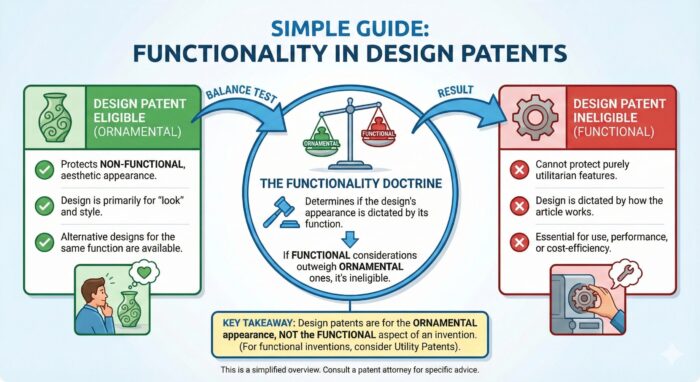
In many products, certain elements serve a function while the overall product also has a distinctive appearance. When preparing a design patent application, it is possible to disclaim functional elements so that the patent focuses only on the ornamental aspects. The USPTO's rules and practice allow applicants to use broken lines in the patent drawings to indicate portions of the article that form no part of the claimed design (i.e. unclaimed functional features). Only the features drawn in solid lines are claimed as the patented design.
For example, if you are patenting the ornamental design of a chair but the specific shape of the chair's hidden mounting bracket is purely functional, you might show that bracket in broken lines in the drawings. The broken-line elements are not considered as part of the protected design, signaling to the patent examiner that those parts are just the environment or functional parts of the article. This practice helps ensure the design patent application process targets the ornamental design only, avoiding rejection for including functional elements.
During examination, USPTO examiners will scrutinize the drawings and description to ensure the design is indeed ornamental. They may reject a claim under 35 U.S.C. § 171 for “lack of ornamentality” if the design appears to be “primarily functional” based on the evidence. To overcome such a rejection, applicants can submit evidence showing the design was created for aesthetic reasons.
Evidence may include inventor affidavits or even advertising materials and product literature that highlight the item's style, novelty, or aesthetic features rather than its utility. For instance, if your product brochure or advertising emphasizes the sleek ornamental appearance or unique style of the design, that can support the argument that the design is not dictated solely by function.
Likewise, pointing out alternative designs can rebut an examiner's claim that the design is purely functional. In sum, careful drafting of design patent drawings using solid and broken lines appropriately and providing evidence of the design's aesthetic appeal can help secure a design patent even when the product has both ornamental and functional aspects.
For many products, both appearance and utility are important, and each can be protected in different ways. It is common to pursue dual protection by obtaining both a utility and design patent for the same product, as long as the applications cover different aspects. In fact, the USPTO allows you to file separate applications to cover both the utilitarian and ornamental aspects of an invention. For example, a company might secure a utility patent on a novel engine technology and also a design patent on the distinctive outer casing of the engine. Or consider a tech gadget: the utility patent protection might cover its electronic circuitry or software (the utilitarian aspects), while a design patent protects the unique exterior shape or GUI icon layout (the aesthetic aspects). These forms of protection can coexist without “double patenting” issues because they protect different aspects of the claimed invention.
The legal coverage provided by each is complementary: the utility patent stops others from using the same functional concept, and the design patent stops others from selling a product with the same ornamental look. This dual approach in the patent system is often the best strategy to comprehensively protect an innovative product that has both new function and new style. Keep in mind, each requires its own application and will be examined separately, and each will confer its own patent rights if granted.
Beyond patents, another layer of protection for product designs is trade dress, which is a form of trademark protection. Over time, an ornamental product design that is not functional can serve as a brand identity. Think of the shape of a Coca-Cola bottle or the grill of a Jeep. Trade dress can provide potentially indefinite protection for those ornamental design elements as identifiers of source, but it requires distinctiveness and that the design remain non-functional under trademark law.
Design patents have a term (15 years) but do not require proof of consumer association. Many companies use design patents to secure exclusive rights to an innovative design immediately, and later, if the design becomes iconic, they may rely on trade dress for long-term protection of the design elements as part of their brand. Both design patents and trade dress share a common requirement: the design cannot be functional if it's to be protected. Businesses can take advantage of these different forms of intellectual property rights to provide multiple safeguards for their product and market identity.
Filing a design patent application in the U.S. involves meeting certain formal requirements. The application includes a set of drawings (or photographs) illustrating the ornamental design from various views, a brief description of the drawings, and a single claim defining the design as shown. The application process also requires the inventor/designer (the person(s) who had the artistic conception for the design) to sign an inventor declaration attesting to the creation of the submitted design, and the submission some other forms, including an application data sheet identifying the inventors and information related to the application.
It is important that the drawings are done to professional standards, since they essentially are the claim. It is important to engage a skilled patent practitioner to assist in preparing the drawings. The design claimed is what is shown in solid lines in the images. Any omission or unclear detail could limit your protection or lead to an indefiniteness rejection.
The USPTO examination of a design application is generally focused on two areas: (1) novelty/non-obviousness: the design must be new and sufficiently distinct over prior art designs; and (2) ornamentality: the design must meet the subject matter requirements of §171 (i.e. be an ornamental design for an article of manufacture, not primarily dictated by function).
The examination process for design patents is usually quicker and more streamlined than for complex utility patents, often taking 1–2 years to grant. Patent examiner first reviews the application for formal requirements. If the examiner finds that there are multiple embodiments that are patentably distinct, the examiner will issue a restriction requirement that requires the applicant to elect only one of the designs embodied in the drawings of the application. After dealing the formality issues have been addressed, the examiner identifies the unique features that the articles includes, conducts a search of the prior art, and analyzes the design to determine whether it is novel and non obvious over the prior art. An office action may be issued that includes rejections based on formal matters and/or prior art bases. If the application is able to overcome the rejections.
If the rejections are overcome, the examiner will issue a notice of allowance indicating that the design is worthy of a design patent. The patent can subsequently be acquired by submitting a filing issue form and paying the required issue fee.
Once granted, a U.S. design patent has a 15-year term from issuance with no renewals or maintenance fees required. This is different from utility patents, which last 20 years from filing. You are also required to pay maintenance fees to keep the patent enforceable. This means design patents are relatively low-maintenance and generally easier to acquire.
The filing date is important for priority, especially if you plan to file in foreign countries for international industrial design protection (e.g., through the Hague Agreement process), since many countries require filing before public disclosure. The Hague Agreement provides a centralized system for pursuing design and industrial design protection in foreign countries.
U.S. design patents are enforceable in federal court just like utility patents. Design patent infringement is assessed by comparing the accused product design to the patented design through the eyes of an “ordinary observer", essentially asking if the two designs are substantially the same in overall impression. Notably, because design patents only protect the ornamental appearance, an accused product that has the same utilitarian features but a different look will not infringe. This was illustrated in a case where a patented tool design was a combination of certain functional components. Richardson v. Stanley Works, Inc., 597 F.3d 1288 (Fed. Cir. 2010).
In Richardson, the claimed design was for a multi-function carpentry tool made up of familiar functional components (hammer, jaw, crowbar/pry bar, etc.). The Federal Circuit held there was no design patent infringement because, even though the accused product used essentially the same functional components, they were arranged and shaped differently so that the overall visual impression was different in the eyes of the ordinary observer. The court also emphasized filtering out the strongly functional aspects when evaluating the design as a whole.
A design patent doesn't stop competitors from making products with the same function, it does prevent them from making something that looks “substantially the same” as your patented product. This is why protecting the ornamental design can play a crucial role in markets where visual appeal and distinctiveness drive consumer choice: for example, consumer electronics, fashion, furniture, and other style-centric goods. To maximize protection, consider protecting different aspects of your product through multiple IP routes. You should file the design application promptly to secure the earliest possible filing date, and coordinate any utility patent applications accordingly if you need to protect functional innovations as well.
Conclusion
U.S. design patents are a powerful tool for protecting designs, providing exclusive rights to the ornamental appearance of a product. They can be invaluable in preventing knockoffs that copy the look of your product. However, it's critical to remember that design patents cannot protect functional features or utilitarian aspects of an invention.
If your innovation lies in how a product works, you'll need a utility patent. If it lies in how the product looks, a design patent is the appropriate protection. Often, both types of protection are used in tandem to cover different aspects of a new product. This balanced strategy will fortify your product's intellectual property rights on all fronts, helping to preserve both its innovation and its unique design in the marketplace.
If you are seeking to obtain patent protection for your product or have other intellectual property matters to address, contact our office for a free consultation with a patent attorney.
© 2025 Sierra IP Law, PC. The information provided herein does not constitute legal advice, but merely conveys general information that may be beneficial to the public, and should not be viewed as a substitute for legal consultation in a particular case.

Sierra IP Law, PC - Patents, Trademarks & Copyrights
FRESNO
7030 N. Fruit Ave.
Suite 110
Fresno, CA 93711
(559) 436-3800 | phone
BAKERSFIELD
1925 G. Street
Bakersfield, CA 93301
(661) 200-7724 | phone
SAN LUIS OBISPO
956 Walnut Street, 2nd Floor
San Luis Obispo, CA 93401
(805) 275-0943 | phone

SACRAMENTO
180 Promenade Circle, Suite 300
Sacramento, CA 95834
(916) 209-8525 | phone
MODESTO
1300 10th St., Suite F.
Modesto, CA 95345
(209) 286-0069 | phone
SANTA BARBARA
414 Olive Street
Santa Barbara, CA 93101
(805) 275-0943 | phone
SAN MATEO
1650 Borel Place, Suite 216
San Mateo, CA, CA 94402
(650) 398-1644. | phone
STOCKTON
110 N. San Joaquin St., 2nd Floor
Stockton, CA 95202
(209) 286-0069 | phone
PORTLAND
425 NW 10th Ave., Suite 200
Portland, OR 97209
(503) 343-9983 | phone
TACOMA
1201 Pacific Avenue, Suite 600
Tacoma, WA 98402
(253) 345-1545 | phone
KENNEWICK
1030 N Center Pkwy Suite N196
Kennewick, WA 99336
(509) 255-3442 | phone
2023 Sierra IP Law, PC - Patents, Trademarks & Copyrights - All Rights Reserved - Sitemap Privacy Lawyer Fresno, CA - Trademark Lawyer Modesto CA - Patent Lawyer Bakersfield, CA - Trademark Lawyer Bakersfield, CA - Patent Lawyer San Luis Obispo, CA - Trademark Lawyer San Luis Obispo, CA - Trademark Infringement Lawyer Tacoma WA - Internet Lawyer Bakersfield, CA - Trademark Lawyer Sacramento, CA - Patent Lawyer Sacramento, CA - Trademark Infringement Lawyer Sacrament CA - Patent Lawyer Tacoma WA - Intellectual Property Lawyer Tacoma WA - Trademark lawyer Tacoma WA - Portland Patent Attorney - Santa Barbara Patent Attorney - Santa Barbara Trademark Attorney
