Patent claim construction is the process by which a court determines the meaning of patent claims, which are the words that define the scope and rights of a United States patent. Claim construction therefore shapes the outcome of a patent infringement lawsuit. In plain terms, before anyone can decide infringement or validity, the judge must decide what the patent claim language actually covers.
Because so much rides on a few disputed words, uncertainty over how a given court will construe a claim term is one of the main issues facing patent professionals in enforcing a patented invention. Claim interpretation and construction is a crucial issue that affects patent licensing value and the odds of winning or losing a patent infringement trial.
We provide below an explanation of what happens in claim construction, what evidence matters, and why outcomes can be hard to predict.
A United States patent is not enforced based on its general disclosure or drawings. It is enforced based on its claim language. In litigation, patent claim construction is a pivotal process where the court determines what the words of each claim mean, within the context of the patent's description of the claimed technology and in light of the written record of the patent's examination before the United States Patent and Trademark Office (USPTO). In other words, claim construction answers the central question: what is the legal scope of the patent?
That determination is determinative of whether you can stop others from making, using, or selling a product. It dictates whether an accused device meets each claim limitation for literal infringement or possibly under the doctrine of equivalents. It also affects validity, because a construction that reads too broadly may encompass prior art and render the claim invalid.
For these reasons, claim construction is often outcome-determinative. Patent cases are frequently won or lost depending on whether the court adopts the proposed meaning advanced by the patentee or the interpretation urged by the accused infringer.
Claim construction usually takes place fairly early in a patent case, typically after the initial pleadings and a period of focused discovery. At this stage, the court identifies disputed claim terms and conducts a dedicated Markman hearing, named after Markman v. Westview Instruments, Inc., 517 U.S. 370 (1996). During this hearing, the judge, not the jury, decides how the relevant patent claim language should be interpreted. The goal is to establish a clear claim construction framework before the case proceeds to summary judgment, expert reports, and/or trial.
This phase of a patent dispute is often pivotal. Many patent cases reach a private settlement agreement shortly after a Markman ruling because the court’s construction clarifies the likely scope of infringement exposure or patent invalidity risk. Once the judge defines key claim terms, both parties can more accurately predict the outcome and adjust litigation strategy, valuation, and settlement positions accordingly.
Importantly, the Markman hearing is not always the final word on construction. Courts retain flexibility and may revisit a construction as the evidentiary record develops, or if trial testimony sheds additional light on the technology.
The construction of a patent claim, including specialized terms of art, is exclusively within the province of the court, not the jury. In Markman v. Westview Instruments, Inc., the Supreme Court held that interpreting a patent claim is a matter for the judge, not a fact question for jurors. That decision reshaped modern patent litigation practice and made formal claim construction a central phase of every patent case.
This allocation of authority matters because claim construction is treated primarily as a question of law, even though limited factual issues, such as the role of technical evidence, may arise. The judge’s interpretation of disputed claim language establishes the legal boundaries of the invention and directly influences findings of infringement and validity. A broad construction may expand potential liability exposure, while a narrow construction may reduce claim scope and affect damages posture. As a result, the judge’s construction often determines settlement leverage and can effectively decide the outcome of the dispute before trial.
In federal court, the dominant claim construction standard comes from the Federal Circuit’s en banc decision in Phillips v. AWH Corp., 415 F.3d 1303 (Fed. Cir. 2005) (en banc). In Phillips, the Federal Circuit clarified how courts should approach patent claim construction, emphasizing that the starting point for any claim construction analysis is the words of the patent claim itself. Those words are not read in isolation. Instead, they are interpreted through the lens of a hypothetical “person of ordinary skill in the art” at the time of the invention.
Under Phillips, the central question is how such a skilled artisan would understand the claim language in light of the subject matter of the patent as a whole. That includes careful attention to the specification, which the Federal Circuit noted was “the single best guide” to the meaning of a disputed claim term. The court also considers the prosecution history as part of the intrinsic record, particularly where statements made to the USPTO clarify or limit claim scope.
This means the court is not improvising or attempting to guess what the inventor subjectively intended. The court anchors its interpretation in the patent documents themselves, referring to extrinsic evidence outside of the patent application record typically to clarify certain terms that are not defined or seem uncertain based on the intrinsic record of the patent application. This structured methodology is designed to produce predictable and principled outcomes, even though reasonable judges may still disagree in close cases.
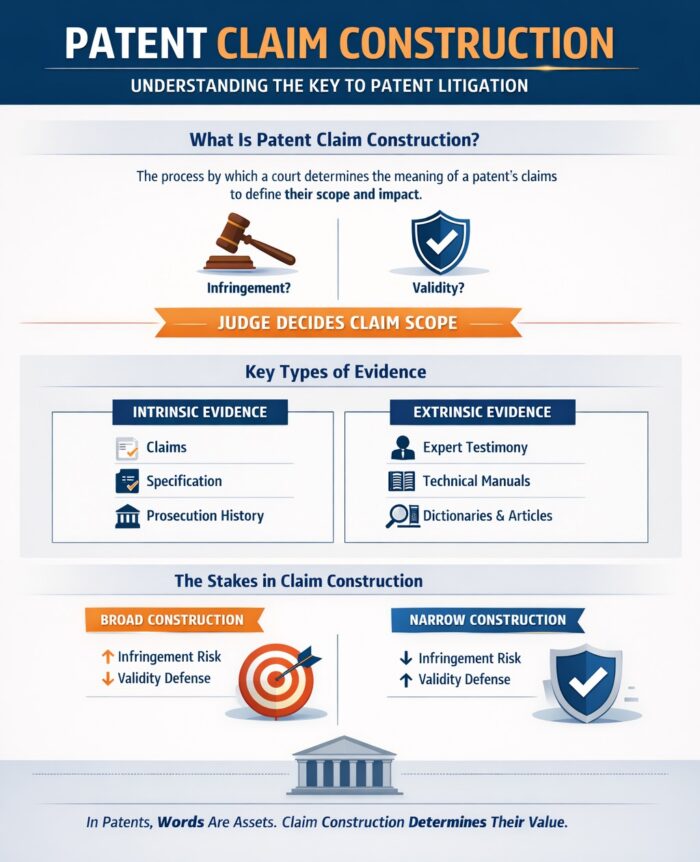
Under Phillips v. AWH Corp., intrinsic evidence is the starting point, and usually the most important evidence, of the meaning of the claims in patent claim construction. Courts look first to the patent’s own record before turning to outside materials. Intrinsic evidence includes:
Together, these materials form the core record the judge relies on to interpret claim scope. These sources help fill gaps in understanding the plain language of the claims, and resolve disputes about meaning without relying heavily on extrinsic sources. Additionally, statements made during prosecution can operate as limits on how broadly a claim may later be construed.
Why it matters: when drafting patents or preparing a response to an office action, you are creating a record that may later define and restrict the enforceable scope of the resulting patent.
Extrinsic evidence is evidence outside the patent’s intrinsic record. It may include dictionaries, technical treatises, expert testimony, and other materials that help the court understand the underlying technology and the real-world usage of a disputed claim term. In patent claim construction, this type of evidence can provide helpful context, particularly where the claim language involves specialized terminology or complex scientific principles.
For example, experts may explain how a person of ordinary skill in the art would interpret certain terms at the time of the invention. Dictionaries and treatises may also shed light on the ordinary and customary meaning of technical language. This can help the judge build an accurate account of how skilled artisans use a term in practice.
However, under the claim construction standard articulated in Phillips v. AWH Corp., extrinsic evidence plays a supporting role. It may clarify, but it cannot override the intrinsic evidence or alter the claim scope in a way that conflicts with the patent’s specification or prosecution history.
A major debate in claim construction often centers on two distinct theories that shape how a court approaches the meaning of a patent claim.
Textualism focuses on the linguistic meaning of the claim text: how the specific words, grammar, and surrounding context point to a particular meaning. Under this approach, the analysis begins and largely remains anchored in the claim language itself, read in light of the specification and prosecution history. The emphasis is on what the words would convey to a person of ordinary skill in the art, not on broader notions of fairness or inventive contribution.
Anti-textualism, by contrast, focuses on construing claims to capture the “true invention,” sometimes pushing past strict textual boundaries to reflect what the inventor actually invented. This approach may give greater weight to the overall disclosure and purpose of the patented invention.
Scholars have argued that this conflict, textualism vs anti-textualism, is a primary driver of claim uncertainty. Different judges can sincerely apply different methodological commitments to the same record and reach different constructions, making outcomes difficult to predict even when the claim language initially appears clear.
Claim construction is not just about dictionary meaning or how a technical term might be used in isolation. It is also deeply influenced by statutory interpretation, especially of 35 U.S.C. § 112. In practice, courts do not interpret a patent claim in a vacuum. They interpret it against the backdrop of the Patent Act’s disclosure requirements, which operate as guardrails on permissible claim scope.
The statutory requirements under 35 U.S.C. § 112 impose minimum standards of disclosure that judges must apply when deciding what a patent’s claims mean. Put differently, the Patent Act sets baseline disclosure rules, and courts apply those rules when deciding whether particular claim language can legitimately support a proposed scope. If a patentee urges a broad construction, the court will ask whether that construction is actually supported by the specification and consistent with the requirements of § 112.
There are three key requirements under § 112 :
§ 112(a):
§ 112(b): The definiteness requirement, which requires that a patent claim “particularly point out and distinctly claim” the invention. In other words, the claim must clearly inform the public of what is claimed. A patent claim is indefinite if it fails to provide reasonably clear boundaries.
The Supreme Court’s decision in Nautilus, Inc. v. Biosig Instruments, Inc., 572 U.S. 898 (2014), is a leading example of how disagreements over statutory interpretation directly shape patent claim construction. The case addressed the definiteness requirement under 35 U.S.C. § 112(b), which requires that a patent’s claims “particularly point out and distinctly claim” the subject matter regarded as the invention. At issue was how much linguistic imprecision the law tolerates when defining claim scope.
Before Nautilus, the Federal Circuit had applied a relatively forgiving definiteness framework, under which a claim was indefinite only if it was “insolubly ambiguous.” The Supreme Court rejected that standard as too lenient. In its place, the Court adopted a stricter test: a patent claim is invalid for indefiniteness if, viewed in light of the specification and prosecution history, it fails to inform those skilled in the art about the scope of the invention with “reasonable certainty.”
That shift has practical consequences for claim construction. A court applying Nautilus may decline to adopt a broad construction if the underlying claim language does not provide clear notice of its limits. In other words, definiteness doctrine now plays a more active role in policing ambiguity. When claim construction disputes are described as being influenced by statutory interpretation, Nautilus provides a concrete illustration: the Supreme Court’s reading of § 112(b) directly reshaped the boundaries of acceptable claim language and, by extension, the constructions courts will permit going forward.
Claim construction affects both infringement and validity, and the direction of the construction, broad or narrow, can dramatically alter the risk on both sides of a dispute.
In patent litigation, a broad construction of a claim can make it easier for a patentee to prove an accused product is infringed. When a court interprets claim language broadly, the claim scope expands, increasing the likelihood that the accused technology falls within the boundaries of the patented invention. From a patent enforcement perspective, this broader construction strengthens leverage in settlement discussions and enhances potential damages exposure.
By contrast, a narrow construction can make it easier for a defendant to escape liability. If the judge defines a claim term in a limited way, the accused product may fall outside the construed scope of the claim. In that scenario, even if the product competes directly in the marketplace, it may not legally infringe the patent as construed by the court.
The issue also cuts the other way on validity. An overly broad construction may cause a claim to cover prior art, increasing the risk of invalidation based on anticipation or obviousness. Expanding claim scope too far can expose the patent to previously undiscovered references that undermine its novelty. On the other hand, a narrower construction may preserve validity by avoiding prior art, but at the cost of reduced enforcement value and diminished commercial reach.
This tradeoff is why claim construction can drive the entire case outcome before trial. For example, summary judgment under Federal Rule of Civil Procedure 56 may be granted if a judge defines a claim term in a way that the accused product does not meet. In that situation, the court’s construction effectively decides non-infringement without a jury. For this reason, defendants typically advocate for narrow constructions, while patentees argue that claim terms should be construed more broadly to protect the full value of their innovation.
A common misconception in patent litigation is that claim construction is a standardized process across courts. Markman hearings are formalized in some courts, but there is no procedure set by the Markman case. In reality, courts retain significant flexibility in addressing claim construction.
Two key principles drive this flexible approach:
The Federal Circuit has made clear that when a genuine dispute about the meaning or scope of a claim term arises, the court, not the jury, must resolve it. In O2 Micro Int’l Ltd. v. Beyond Innovation Tech. Co., 521 F.3d 1351 (Fed. Cir. 2008), the Federal Circuit held that a court has an affirmative duty to decide disputes over claim scope and may not simply characterize them as factual disagreements for the jury. If the parties present competing interpretations that affect infringement or validity, the judge must construe the claim. This reinforces that claim construction remains a core judicial function throughout the case.
Although Markman established that claim construction is a matter for the court, it did not prescribe a mandatory procedure for how or when construction must occur. As several district courts have observed, the Supreme Court did not require a formal, pretrial “Markman hearing” in every case. Instead, trial courts have discretion to decide how to conduct claim construction, including whether to hold an evidentiary hearing, rely solely on briefing, or address disputed claim terms within conventional motion practice.
In practice, this has led to substantial variability. Some courts conduct multi-day evidentiary hearings with expert testimony. Others resolve claim construction on the paper record without live testimony. In certain cases, courts have construed claims in connection with summary judgment motions under Fed. R. Civ. P. 56. In still others, courts have deferred final construction until the eve of jury instructions, or even addressed particular claim terms during the trial itself when the dispute crystallized in light of the evidence. See Johns Hopkins University v. Celpro, 894 F. Supp. 819 (D. Del. 1995).
Courts also have wide latitude to receive aids to interpretation, including expert testimony, so long as extrinsic evidence does not override the intrinsic record (claims, specification, and prosecution history). The practical result is clear: there is no single procedural template for claim construction. The timing, format, and depth of analysis can vary significantly from court to court and case to case, including during the trial phase itself.
Claim construction is frequently appealed to the Federal Circuit, making the standard of appellate review critically important in patent disputes. For many years, the Federal Circuit applied de novo review broadly, effectively reconsidering claim construction “from scratch,” with little deference to the district court’s analysis. That approach reflected the view that construction was purely a question of law.
The Supreme Court altered that framework in Teva Pharm. USA, Inc. v. Sandoz, Inc., 574 U.S. 318 (2015). The Court clarified a split approach to appellate review. The ultimate claim construction, the final interpretation of the patent claim and its legal scope, remains a legal conclusion reviewed de novo. However, subsidiary factual findings made by the district court, often tied to disputed extrinsic evidence such as expert testimony about technology or term usage, are reviewed only for clear error under Fed. R. Civ. P. 52(a)(6).
This distinction can materially affect the outcome of an appeal, especially where credibility determinations or technical facts play a central role in the construction.
For many years, PTAB trials applied a different claim construction standard than federal district courts, creating meaningful differences in how claim scope could be evaluated in parallel proceedings. Historically, the PTAB used the “broadest reasonable interpretation” (BRI) approach, which often resulted in a broader construction of a claim than a district court might adopt.
In 2018, the USPTO issued a final rule changing the claim construction standard applied in inter partes review (IPR), post-grant review (PGR), and covered business method (CBM) proceedings. The rule replaced BRI with the same federal court claim construction standard used to construe a claim in a civil action under 35 U.S.C. § 282(b) and the Phillips framework.
The rule is not retroactive; it applies only to petitions filed on or after November 13, 2018. The change was intended to promote consistency and harmonization among PTAB proceedings, federal courts, and the International Trade Commission (ITC).
This alignment improves predictability when assessing enforcement strategy, acquisition targets, or freedom-to-operate risk, although procedural differences and evidentiary records can still influence outcomes.
While no strategy can eliminate unpredictability in claim construction, disciplined drafting and thoughtful litigation strategy can materially improve the odds of a favorable construction and protect long-term claim scope.
Start with the specification. Use clear terminology and define key terms in a way that supports the intended scope of the patent claim, but avoid accidental over-limiting definitions that unnecessarily narrow the claim language. Courts interpret claims in light of the specification, so clarity in writing directly affects how a judge will later interpret and construe a disputed claim term.
Maintain internal consistency. The same claim term should not quietly shift meaning across the document. Inconsistent usage can create ambiguity that weakens your preferred interpretation and opens the door to a narrow construction. Precision and disciplined patent drafting reduce room for adverse arguments.
Equally important, treat the prosecution history as future litigation evidence. Statements made to overcome prior art rejections, amendments to distinguish the invention, and characterizations of the technology can become binding limits on claim scope. Arguments that seem tactical during patent examination may later restrict how broadly a court is willing to construe the claim.
In a patent trial, identify early which disputed terms truly drive the outcome. Not every word warrants a fight. Focus on the claim terms that determine infringement or validity.
Develop crisp, concise positions anchored in intrinsic evidence before relying on experts. Courts give primacy to the patent record. Extrinsic evidence is most persuasive when it helps the court understand the technology, not when it attempts to override the intrinsic record.
Finally, consider procedural leverage. A favorable claim construction can support early non-infringement or invalidity positions, including Rule 56 summary judgment, and may decisively shape the litigation outcome.
Patent claim construction is the process by which a court decides what a patent claim means, and that decision defines claim scope and often drives the ultimate outcome on infringement and validity. In practical terms, the way a judge interprets key claim language can determine whether a competitor’s product is infringed or whether the patent survives a validity challenge.
Claim construction is often the make-or-break stage of patent litigation because once the court fixes the meaning of disputed terms, the rest of the case frequently follows. Intrinsic evidence (the claims themselves, the specification, and the prosecution history) is usually decisive, while extrinsic evidence such as expert testimony plays a supporting role in helping the court understand the technology. In patents, words define the asset, and claim construction is where a judge determines their true value.
If you need assistance with patent preparation, or another intellectual property matter, please contact our office for a free consultation.
© 2026 Sierra IP Law, PC. The information provided herein does not constitute legal advice, but merely conveys general information that may be beneficial to the public, and should not be viewed as a substitute for legal consultation in a particular case.
Integrating brand and trademark protection into your overall business strategy is one of the smartest investments you can make to support your long-term success. Your brand is more than marketing; it is the symbol of the public perception of your company, including its reputation, voice, customer experience, and commitment to quality. By contrast, a trademark (or service mark for services) is a specific legal tool within that broader brand strategy. A trademark can include your business name, logo, slogan, or distinctive product word or phrase that identifies and distinguishes the source of your goods or services. See 15 U.S.C. § 1127.
Strong brand recognition depends on maintaining a consistent and well-defined brand identity. Trademarks serve as both a visual and conceptual anchor in the marketplace, creating a direct link in the minds of consumers between your business and the goods and services you provide. Without deliberate trademark protection, even a well-developed brand can become vulnerable to misuse, imitation, and customer confusion.
Below we discuss trademark basics and a roadmap to help you protect the brand equity you have worked hard to build, before competitors turn inaction into an expensive cleanup effort.
A trademark is not just a name; it is the mark customers rely on to recognize your brand in a crowded marketplace. In legal terms, a trademark is a form of intellectual property that may be in the form of a brand name, logo, tagline, or other distinctive identifier used in connection with goods and services. A trademark functions as a source identifier. It tells consumers who stands behind the product or service and what level of quality they can expect.
Trademarks exist to reduce customer confusion and to prevent consumers from mistakenly purchasing one company’s products believing they come from another. By clearly distinguishing the source of goods and services, a trademark creates a mental link between a business and its offerings. Over time, that connection builds trust, strengthens brand recognition, and reinforces a company’s reputation.
Building trademark rights begins with choosing a distinctive mark that can be registered and not similar to existing trademarks. This early decision is crucial because the strength of your trademark directly affects the scope of your legal protection, your ability to enforce exclusive rights, and the long-term value of your brand. Before investing in packaging, marketing, or a logo, a business should evaluate whether its proposed mark is capable of functioning as a source identifier for its goods or services.
Distinctiveness matters. Courts generally classify marks along a spectrum: generic terms, which provide no protection; descriptive terms, which are harder to protect absent acquired distinctiveness; and suggestive, arbitrary, or fanciful marks, which are considered strong marks. See Abercrombie & Fitch Co. v. Hunting World, Inc., 537 F.2d 4 (2d Cir. 1976). The more distinctive the mark, the easier it is to protect and enforce against competitors using similar marks that could cause confusion in the marketplace.
A strong brand identity often starts with an inherently distinctive mark. Such marks are easier to register, easier to protect, and more valuable as a long-term investment in brand recognition and overall business success.
Conducting a trademark search is an essential step to take before you commit to a particular mark. If your mark or a similar mark is already in use by someone else, you will not be able to establish exclusive rights in the mark. A proper search helps determine whether your proposed trademark is already in use or registered by another party, and whether it could create confusion in the marketplace. Skipping this step can expose your business to infringement claims, costly rebranding, and loss of investment.
A thorough trademark clearance search should include review of the federal database at the United States Patent and Trademark Office (USPTO), to identify existing registrations and pending applications. It should also cover common-law sources such as websites, social media platforms, app stores, and trade publications, since unregistered users may still hold priority in a geographic area. Finally, industry- and channel-specific searches for related goods or related goods or services are critical.
This diligence is crucial because similar marks can block your application or form the basis of trademark infringement claims under 15 U.S.C. §§ 1114(1), 1125(a), if they create confusion among customers. As an example, “NOVA” for energy drinks could conflict with “NOVA” for sports supplements, depending on market overlap and consumer perception.
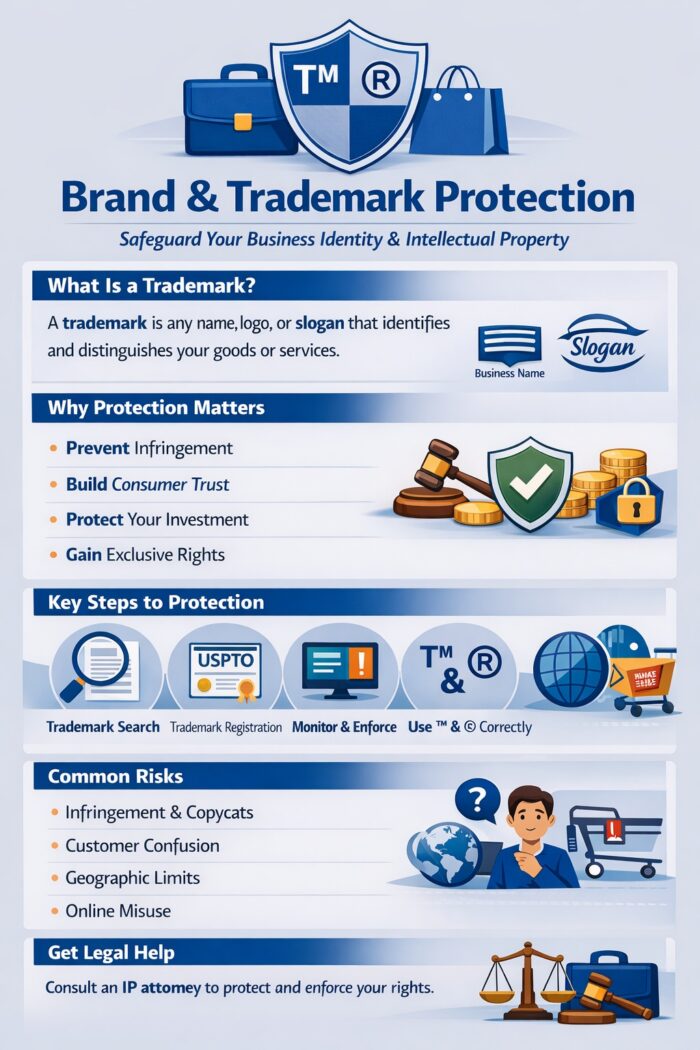
A common law trademark can arise automatically through bona fide trademark use in commerce, even without formal registration. Under the Lanham Act, rights are tied to use in commerce. See 15 U.S.C. § 1127. This means a business that consistently uses a mark in connection with its goods or services may acquire enforceable common law rights by operating in the marketplace.
However, those rights are typically limited to the specific geographic area where the mark is actually used and where it has developed recognition among consumers. The Supreme Court has long recognized this territorial limitation. In Hanover Star Milling Co. v. Metcalf, 240 U.S. 403 (1916), the Supreme Court addressed competing claims to the trademark “Tea Rose” for flour. The plaintiff had used the mark in certain states, while the defendant adopted the same mark in a geographically distinct area without knowledge of the plaintiff’s prior use. The Court held that trademark rights arise from actual use and are limited to the territory where the mark has established goodwill and recognition among consumers. Because the defendant adopted the mark in good faith in a remote market, it could continue using the mark in that territory. This case established what is often called the “Tea Rose” doctrine, under which common law trademark rights are territorial and tied to market penetration.
In United Drug Co. v. Theodore Rectanus Co., 248 U.S. 90 (1918), the dispute involved the trademark “Rex” for medicinal products. The plaintiff had prior use in the Northeast, while the defendant later adopted the same mark in Kentucky, also without knowledge of the plaintiff’s use. The Court reaffirmed that trademark rights depend on actual use and reputation in a specific market. Because the defendant built goodwill in a separate geographic area before the plaintiff expanded there, the defendant retained rights in its territory. Without a federal registration, priority does not automatically confer exclusive rights. If another company independently adopts the same or a similar mark in a different region, both parties may hold concurrent rights within their respective territories.
Without a federal trademark registration, a growing company may discover that its claimed exclusive rights are limited, and another user may control the mark in other geographic areas. For businesses planning meaningful growth, relying solely on common law trademark protection often leaves critical brand assets exposed.
A federal trademark registration is one of the most powerful tools available for meaningful brand and trademark protection. While limited rights may arise through use alone, federal registration under the Lanham Act provides significantly stronger legal protection than an unregistered mark. Among the most important benefits are nationwide priority tied to the filing date, constructive notice to the public of the registrant’s claim of ownership, and a presumption of validity and exclusive ownership under 15 U.S.C. §§ 1057(c), 1072.
These statutory advantages substantially strengthen an owner’s position when asserting exclusive rights against infringers. In practical terms, federal registration streamlines enforcement, reduces disputes over priority, and enhances credibility in negotiations. It also provides access to federal remedies, including injunctive relief and monetary damages in appropriate cases under 15 U.S.C. §§ 1116, 1117.
In other words, trademarks provide legal protection that does more than simply confirm ownership: they function as a deterrent. Competitors are far less likely to adopt similar branding when a mark is federally registered and publicly searchable. For growing businesses, this predictability and leverage are central to a comprehensive brand protection strategy, helping secure market position while preserving long-term brand value.
A trademark application filed with the United States Patent and Trademark Office (USPTO) must clearly set out three core elements: the mark itself, a precise identification of the relevant goods or services, and the legal basis for filing, either current use in commerce or a bona fide intent to use the mark in commerce under 15 U.S.C. § 1051(a)–(b). Whether you are protecting a business name, logo, slogan, or other brand identifier, the application must accurately reflect how the mark appears and how it is used in the marketplace.
Careful drafting of the identification of goods or services is especially important. Trademark rights are defined in large part by the scope of the goods and services listed in the application, and the listed goods and services must align with how the mark is actually used in the real market. If the listed goods or services do not match what you are actually selling, a registration issuing from your application will be partially or fully invalid.
After filing a trademark application with the patent and trademark office, a USPTO examining attorney reviews the submission for compliance with federal law and USPTO rules. During this stage, the trademark office evaluates whether the mark conflicts with existing trademarks, whether the mark is merely descriptive, whether the mark functions properly as a source identifier, and whether the trademark application includes an acceptable specimen of use showing the trademark in actual use in commerce.
If problems are identified, the USPTO issues an office action under 15 U.S.C. § 1062(b) explaining the refusals or requirements that must be addressed. Common issues include likelihood of confusion with similar marks, improper identification of goods or services, technical filing errors, or insufficient evidence of use. In order to overcome the refusals in the office action, a timely response must be filed, providing remarks and arguments explaining why the refusals are improper. Failure to respond to an office action can result in abandonment of the application. See 37 C.F.R. § 2.65.
If the application is approved by the trademark examiner, the trademark will be published in the Official Gazette so third parties have an opportunity to oppose registration. By statute, the opposition period is 30 days, although challengers may request extensions of time to oppose. See 15 U.S.C. §§ 1062(a), 1063. This stage is a critical checkpoint in the trademark registration process because it allows third party owners of existing trademarks to challenge registration of the applied-for mark based likelihood of confusion, trademark dilution, or other bases for preventing registration.
Oppositions are administrative proceedings that function much like litigation before the Trademark Trial and Appeal Board, requiring evidence and legal argument. The opposition process underscores the importance of conducting a thorough trademark search before filing an application, including surveying unregistered, common law use of the proposed mark and similar marks. If no opposition is filed, or if you successfully defend against it, the application proceeds toward registration.
After the opposition period, the path forward depends on your filing basis. For applications filed under Section 1(a) with use in commerce established prior to filing, the trademark will proceed directly to registration, and you will receive a certificate of registration confirming your status as the owner of a federally registered trademark under 15 U.S.C. § 1057. At that point, your federal trademark registration provides nationwide priority benefits and strengthens your overall trademark protection strategy.
For intent-to-use applications filed under Section 1(b) with no use in commerce established at the time of filing, the process includes an additional step. After publication, the USPTO issues a notice of allowance, which does not grant registration yet but confirms the mark is entitled to register once actual use begins. You have six months from the mailing date of the notice of allowance to file a statement of use, with the option to extend the time for filing the statement of use to a total period of three years . See 15 U.S.C. § 1051(d). Failure to timely file the statement of use results in abandonment of the trademark application under 37 C.F.R. § 2.65.
There are rules and differences between the use of the ™ for an unregistered mark and ® for a federally registered trademark. The ™ symbol signals a claim of common law rights, while ® provides public notice of federal registration and the enhanced legal protection that accompanies it. These symbols should be used properly and consistently in order to establish and maintain your trademark rights. Under 15 U.S.C. § 1111, failure to use the ® symbol properly can limit available damages in an infringement action, and improper use of ® without a valid registration can result in false marking claims and potentially deceptive trade practice or fraud claims. Clear and consistent trademark use puts the public on notice of your rights and helps to preserve the distinctiveness of your mark in the marketplace.
Trademark infringement generally occurs when a third party uses your trademark, or a confusingly similar mark, without authorization on related goods or services in a manner that is likely to cause confusion among consumers. See 15 U.S.C. §§ 1114(1), 1125(a). The core question is whether ordinary purchasers would mistakenly believe the accused goods or services originate from, are affiliated with, or are sponsored by your business. When infringement takes hold, the fallout can be significant: damage to brand reputation, diversion of sales, lost revenue, and long-term erosion of consumer trust. The risk of damage to your trademark rights and brand is heightened by the threat of online infringement in digital marketplaces and social media, where misleading listings and knock-off products and services can be created and spread quickly.
A proactive approach to trademark protection and enforcement includes:
This kind of comprehensive approach can mitigate the challenges manufacturers and growing businesses face when brand protection measures are inadequate. It is recommended that businesses consult with an experienced trademark attorney to carry out these processes. The foregoing steps (at least 3-5) should not be carried out without the assistance of an experienced trademark attorney.
Without trademark protection, a business’s valuable assets are left vulnerable. Effective brand and trademark protection is critical to protecting the reputation and customer perception upon which a business is built. Proper trademark strategy combines careful selection of a distinctive mark, clearance searching, trademark registration, disciplined trademark use, and consistent monitoring and enforcement.
Businesses should practice disciplined trademark use, including consistent branding, proper use of symbols, and quality control over trademark licensing. Brands should be diligently protected through ongoing monitoring of the market and online platforms to detect potential trademark infringement early. When necessary, enforcement tools such as cease and desist letters and formal proceedings should be employed to protect your exclusive rights and preserve consumer trust. A proactive, structured approach protects reputation, strengthens market position, and secures the long-term value of your brand.
If you need assistance with establishing your brand and trademark protection, or protecting other intellectual property rights, contact our offices for a consultation.
© 2026 Sierra IP Law, PC. The information provided herein does not constitute legal advice, but merely conveys general information that may be beneficial to the public, and should not be viewed as a substitute for legal consultation in a particular case.
Business owners and entrepreneurs often develop new products that may or may not be patentable, and need to understand how to draft a patent application, and the key aspects of the patent application process. A well-drafted patent application is far more than simply describing an idea or invention. It is a carefully structured legal and technical document designed to comply with U.S. patent law while clearly defining what is being claimed and protected. When done correctly, a patent application can help you obtain enforceable patent protection, establish valuable intellectual property rights, and discourage competitors from copying or designing around your invention. The drafting process requires thoughtful organization, precise writing, and an understanding of how the claims and specification work together to define the scope of protection.
Below is a general explanation of how to draft a patent and the core requirements of U.S. patent law.
Before writing a patent, you should conduct a prior art search to evaluate whether your invention is truly patentable and to understand the landscape of existing technology. A patent must satisfy the requirement of novelty under 35 U.S.C. § 102, meaning the claimed invention must be new and not previously disclosed to the public, and be non-obvious to a person having ordinary skill in the art under 35 U.S.C. § 103. A well-executed patentability search and analysis helps identify similar devices, processes, or publications that may affect the patentability of your invention.
Beyond novelty, reviewing the prior art allows you to better define what is unique about your invention, refine your patent claim strategy, and draft claims that meaningfully distinguish over what already exists. This step can prevent costly mistakes, such as attempting to protect an idea that is already part of the prior art.
It is equally important to recognize that inventors can unintentionally create their own prior art. Public disclosure of your invention, through marketing, sales, presentations, or publications, before filing a patent application can destroy patent rights. While the United States provides a limited one-year grace period for certain inventor disclosures, many foreign jurisdictions require absolute novelty, making early filing critical.
One of the first strategic decisions in how to draft a patent is determining what type of patent application to file. A provisional patent application can be filed under 35 U.S.C. § 111(b) as a starting point because it allows inventors and companies to secure an early filing date while providing up to 12 months to further develop, test, and refine the invention before filing a non-provisional utility application claiming priority to the provisional application under 35 U.S.C. § 119(e). During this period, inventors can evaluate market interest, seek funding, or iterate on a device or process, all while preserving priority for the disclosed subject matter. However, a provisional application is not examined and never becomes a patent on its own, so it must adequately describe the invention to support later claims.
A non-provisional utility patent application, by contrast, is the formal filing examined by the USPTO. It must include all required sections, such as claims, a detailed description, and drawings where applicable, and it ultimately determines the scope of enforceable patent protection.
A non-provisional utility patent application is not an informal narrative; it is a highly structured legal document that must follow a recognized format to be effective. Under U.S. patent law, a non-provisional filing must include distinct, organized parts arranged in a standard sequence. This required structure is not just a formality, it directly affects how the United States Patent and Trademark Office (the USPTO) examines the application and how courts later interpret the scope of the patent.
As a practical drafting convention, a patent application generally consists of nine sections, presented in a logical order that moves from high-level context to precise legal boundaries:
Each section serves a specific and essential purpose. The early sections orient the reader by explaining what the invention is, the technological area it belongs to, and the problem it addresses. The middle sections, particularly the detailed description, must carefully describe the invention with enough specific details to enable someone skilled in the art to make and use it. The claims section, which comes near the end but carries the most legal weight, defines the precise boundaries of the claimed invention and the exclusive rights you seek to obtain.
Your overall submission package may also include drawings, inventor declarations, and other required documents, but the sections above are the drafting backbone of every non-provisional patent. Maintaining this standardized organization improves clarity, reduces examination issues, and ensures your application aligns with USPTO expectations.
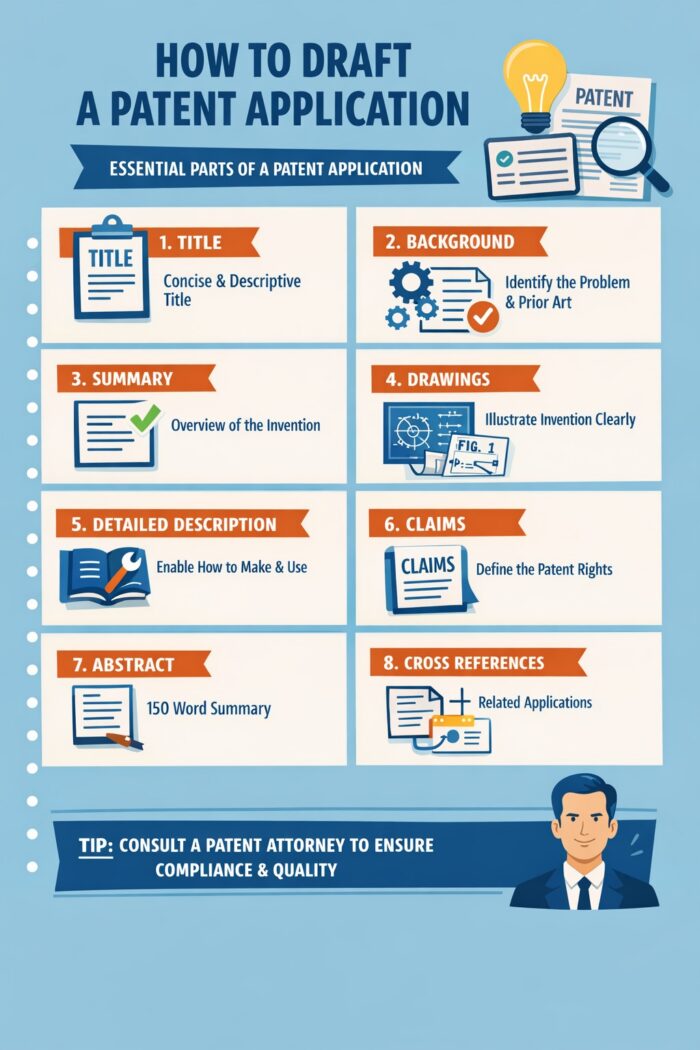
The title of a patent plays an important role in framing the invention for both the examiner and the public record, so it should be concise, technically precise, and descriptive of the subject matter. Under USPTO rules, the title should briefly summarize the nature of the invention without unnecessary detail or promotional language. See 37 C.F.R. § 1.72(a). When preparing your patent application, it is good practice to use title text that clearly reflects the core concept of the claimed invention, such as:
“Modular Thermal Management System for Battery Packs”
Avoid marketing terms or exaggerated language, as these can create ambiguity or confusion. A well-crafted title helps examiners efficiently categorize the application and allows later readers to quickly explain what the invention covers.
If you have related filings, such as a provisional patent application or an earlier non-provisional patent application, it is critical to include a clear cross reference section at the beginning of your application that properly claims priority or benefit to those earlier filings. Under 35 U.S.C. § 119(e) and 35 U.S.C. § 120, a valid priority claim allows the later-filed application to rely on the earlier filing date for the claimed invention, which can be decisive when determining novelty and assessing prior art.
The purpose of a priority claim is to protect your intellectual property rights by establishing the earliest possible effective filing date, reducing the risk that intervening publications, public disclosures, or competitor filings will be used against you. From a practical standpoint, this administrative front matter also creates a clear prosecution record and helps the patent examiner understand how the application fits within a broader family of related patent documents. Because errors or omissions in priority claims can permanently forfeit valuable patent protection, this section should be drafted carefully, with precise references to application numbers, filing dates, and relationships between the applications.
The background section should identify the problem your invention addresses and describe the area related to the claimed invention, including existing technologies and/or prior art. This is where you define the technical field and frame why the invention is needed, without an exhaustive narrative.
A good background:
The summary of the invention provides a high-level explanation of the invention and serves as a bridge between the background section and the claims section. Its purpose is to clearly explain the core concepts of the claimed invention by highlighting its key features, advantages, and intended operation that is broad enough to cover the embodiments described in the detailed description section, as well as additional embodiments. A well-written summary should read as a generalized overview that captures the essence of the invention in a way that aligns with, and supports, the eventual patent claim language.
Importantly, the summary should be broader than the particular example embodiments shown in the drawings or discussed later in the description, while still remaining faithful to what the claims define as the scope of protection. There is an important balance to strike in the Summary section. If the summary is too narrow, it may unintentionally limit how the invention is interpreted. If it is too abstract, it may fail to adequately support the claims. The goal is to describe what the invention is, what problem it solves, and why it is advantageous over existing solutions, all while staying consistent with the terminology used throughout the specification.
From a drafting perspective, the summary also helps frame the invention for the patent examiner at the USPTO and for future readers evaluating the strength of the patent protection. When done carefully, it reinforces the novelty and advantages of the invention and sets the stage for clear, enforceable intellectual property rights.
Planning drawings early is a critical step when drafting a patent application, because U.S. rules require drawings whenever they are necessary to understand the claimed invention. Under 37 C.F.R. §§ 1.81, 1.84, applications for mechanical devices, systems, or other tangible structures almost always must include drawings, while some method-based or chemical inventions may be understandable without them. An application that does not require drawings must still fully describe the invention in words alone, but if a visual depiction would aid understanding, omitting drawings can weaken the disclosure.
When drawings are required, they should clearly show all claimed features of the invention. Every element recited in a claim should appear in at least one figure, even if shown schematically. In the detailed description, each figure (for example, “FIG. 1” or “FIG. 2”) should be expressly referenced and tied to specific components or steps. This careful cross-referencing improves clarity, supports proper claim interpretation, and helps ensure the scope of the claims is fully supported by the specification.
The claims section defines the legal protection your patent provides and is the most important part of a patent application because the claims define the precise scope and boundaries of the patent rights. Under 35 U.S.C. § 112(b), each claim must particularly point out and distinctly claim the claimed invention, making claim drafting a careful balance between breadth and precision. Well-written claims clearly describe what the inventor owns, and just as importantly, what competitors are prohibited from doing, while poorly drafted claims can leave dangerous gaps in protection or invite costly disputes.
Drafting claims first is often a best practice because it helps lock in consistent terminology and ensures the specification, detailed description, and drawings fully support what you ultimately seek to protect. Since the claims are read in light of the specification, inconsistencies or missing support in the written description can later narrow claim interpretation or even render claims invalid.
In both patent litigation and patent licensing, the claims are central because a patent does not grant a general right to practice an invention. Instead, it grants the right to exclude others from making, using, selling, offering for sale, or importing the claimed invention, as set forth in 35 U.S.C. § 154(a)(1). As a result, carefully drafted claims, using clear language, appropriate transitional terms, and a strategic mix of independent and dependent claims, are essential for securing meaningful, enforceable patent protection that holds up under scrutiny.
The following guidelines and rules should be followed closely in the claim drafting process.
Claims should generally be a single sentence, as required by MPEP § 608.01(m). See also 37 C.F.R. § 1.75. They should start with a capital letter and end with a period. Each distinct component, feature, or step should be separated by indented line and be followed by a semicolon or comma for clarity.
Use open-ended transitions like “comprising” to avoid unintentionally narrowing coverage; “comprising” is typically interpreted as open-ended. In Genentech, Inc. v. Chiron Corp., 112 F.3d 495 (Fed. Cir. 1997), the Federal Circuit addressed the meaning of the transitional term “comprising” in patent claims and reaffirmed its well-established interpretation in U.S. patent law. The court explained that “comprising” is an open-ended term, meaning that a claim using “comprising” includes the listed elements but does not exclude additional, unrecited elements. As a result, an accused product or process can still infringe a claim that uses “comprising” even if it contains extra components beyond those explicitly recited in the claim.
By contrast, “consisting of” is a closed transition. When a claim uses “consisting of,” it is limited strictly to the elements listed in the claim and excludes any additional elements. If an accused product includes even one extra element, it typically does not infringe. This transition is therefore much narrower and is usually used only when the inventor intends to precisely define, and limit the claimed invention.
“Consisting essentially of” falls between these two extremes. It permits additional elements, but only if those elements do not materially affect the basic and novel characteristics of the invention. This transition is often used when some flexibility is needed, but the inventor wants to exclude changes that would alter the core functionality.
Because transitional language directly affects claim scope and infringement analysis, the choice among “comprising,” “consisting of,” and “consisting essentially of” is a critical strategic decision in claim drafting.
Using both broad and narrow claims provides flexibility during examination and patent enforcement. A broad independent claim is drafted to cover the core concept of the invention with minimal limitations, maximizing potential patent protection. For example:
This broad claim defines the essential structure of the claimed invention without specifying how the cooling element operates or what type of cooling is used. While this breadth is valuable, it also increases the likelihood of prior art rejections.
To address this risk, dependent claims add narrower limitations as fallback positions:
These narrower claims introduce specific details that may distinguish over prior art if the broad claim is rejected. Importantly, dependent claims do not replace the broad claim, they refine it. This layered approach preserves the possibility of broad protection while increasing the chances that at least some claims will be allowed, resulting in enforceable patent rights even if examination requires narrowing the scope.
Claims must define an apparatus, system, or method, not merely a desired outcome. In patent law, a result by itself is not an invention. Instead, a patent claim must clearly recite the concrete structure, components, or process steps that perform a function or achieve an intended result. This is a core principle of effective claim drafting and is essential for obtaining meaningful patent protection.
Each claim should therefore state how the claimed invention operates and/or is structured, not just what it accomplishes. Structurally grounded claims are far less vulnerable to rejection or later invalidation because they provide objective boundaries for the scope of the invention described in the specification. This requirement is rooted in 35 U.S.C. § 112(b), which mandates that claims “particularly point out and distinctly claim” the invention.
The Supreme Court’s decision in Nautilus, Inc. v. Biosig Instruments, Inc., 572 U.S. 898 (2014) reinforced this standard by explaining that claims must inform those skilled in the art, with reasonable certainty, of the scope of the invention. Vague, result-oriented language invites ambiguity and increases the risk that a patent claim is invalid. Clear structural or procedural limitations help ensure enforceability and reduce indefiniteness challenges under 35 U.S.C. § 112(b), and written description and enablement challenges under 35 U.S.C. § 112(a).
The detailed description section is the technical and legal backbone of a patent application. Its primary purpose is to enable the invention—meaning the disclosure must teach someone of ordinary skill in the art how to make and use the claimed invention without undue experimentation. This requirement comes directly from 35 U.S.C. § 112(a) and was articulated in In re Wands, 858 F.2d 731 (Fed. Cir. 1988), where the Federal Circuit explained that enablement depends on whether the specification provides sufficient guidance in view of the complexity of the technology and the predictability of the art. In practical terms, vague explanations or missing steps can undermine patent protection, even if the invention itself is novel.
In addition to enablement, the detailed description must satisfy the written description requirement by demonstrating that the inventor actually possessed the claimed invention at the time of filing. As clarified in Ariad Pharms., Inc. v. Eli Lilly & Co., 598 F.3d 1336 (Fed. Cir. 2010) (en banc), this is a separate and independent requirement under § 112(a). Merely describing a desired result is not enough, the specification must clearly describe the structure, process, or features that achieve that result. These requirements make clear that drafting a patent application is not just about explaining an idea, but about documenting a complete technical solution.
Consistency in the description of the invention also matters because, during enforcement or litigation, courts interpret claims in light of the specification. As emphasized in Phillips v. AWH Corp., 415 F.3d 1303 (Fed. Cir. 2005) (en banc), the intrinsic record, especially the detailed description, often controls how claim language is understood.
It is helpful to have and follow a practical checklist for preparing a detailed description of the invention to avoid the pitfalls of inadequate written description and enablement:
The abstract should provide a concise summary of the invention, typically no longer than 150 words, as required under 37 C.F.R. § 1.72(b). Its purpose is to quickly convey the technical field, core structure, and unique features of the claimed invention in a clear and descriptive manner. While the abstract helps patent examiners and the public understand the nature of the patent, it does not define the legal scope of protection, that role belongs to the claims section. Avoid marketing language or unnecessary detail, and do not attempt to argue novelty. Instead, focus on accurately explaining what the invention is and how it generally operates, using precise, neutral language that aligns with the specification and claims.
Before you file your patent application at the United States Patent and Trademark Office (USPTO), a careful final quality review is essential. This step helps ensure the application functions as a clear, enforceable legal document rather than a loosely connected technical write-up.
A carefully drafted specification is important because claims are interpreted in light of it during patent litigation, and sloppy drafting can materially affect outcomes.
Learning how to draft a patent means translating a technical invention into a disciplined legal narrative. Done well, a patent can protect your competitive advantage, support licensing, and strengthen your portfolio of intellectual property. Done poorly, it can lead to rejection, narrow protection, or expensive disputes. For most business-critical inventions, engaging a registered patent attorney is the most reliable way to maximize protection and navigate the requirements of law and USPTO practice.
This article provides general information only and does not constitute legal advice; and reading it does not create an attorney client relationship. If your goal is strong, defensible exclusive rights, consulting a registered patent attorney is often essential. Contact our office for a free consultation with an experienced patent attorney.
© 2026 Sierra IP Law, PC. The information provided herein does not constitute legal advice, but merely conveys general information that may be beneficial to the public, and should not be viewed as a substitute for legal consultation in a particular case.
Patent licensing lets a patent owner (the licensor) grant a license to another person or company (the licensee) to use a patented invention or patented technology. Rather than transferring ownership of the patent itself, a patent licensing agreement gives the licensee defined permission, under negotiated and agreed terms, to make, use, manufacture, sell, and/or import products or services that fall within the scope of the patent rights. In practice, a well-structured license agreement specifies how and where the patented invention may be used, the duration and scope of the license, and the payment terms, including upfront fees or ongoing royalties. For the licensee, this arrangement provides lawful access to valuable intellectual property while avoiding the cost and risk of a patent infringement dispute. For the patent owner, patent licensing offers a way to protect and monetize innovations, expand into new markets, and generate revenue without bearing the full cost of manufacturing, distribution, or sales.
Patent licensing agreements can benefit both parties by aligning business goals with intellectual property rights, allowing inventions and technology to reach the market efficiently while creating a sustainable revenue stream for the patent owner.
A United States patent gives the patent owner a set of enforceable patent rights, including the right to exclude other parties from making, using, selling, offering for sale, or importing the patented invention under 35 U.S.C. § 154. Patent licensing does not transfer ownership of those rights. Instead, a license is a carefully defined permission that allows a licensee to engage in specific activities that would otherwise infringe the patent.
In practical terms, a patent license agreement sets the agreed terms under which the licensee may operate. Those terms define what the licensee may do, how they may do it, where they may do it, and for how long. Any activity that falls outside the negotiated scope of the license agreement, such as selling into an unauthorized market, exceeding field-of-use limitations, or continuing use after expiration, may constitute patent infringement under 35 U.S.C. § 271.
Patent licensing agreements are highly flexible and can be tailored to a wide range of business models. A license may apply to physical products, an industrial or manufacturing process, or software implementations of the patented technology. In many cases, licensors also bundle additional intellectual property with the patent rights, such as trade secrets, proprietary know-how, documentation, or technical assistance. This bundling can increase the value of the deal by giving the licensee faster and more reliable access to the technology needed to commercialize the invention successfully.
A well-drafted patent license clarifies expectations, aligns incentives, and creates a framework where both parties can develop, manufacture, and sell products based on the patented technology without crossing into infringement territory.
A license agreement and a patent assignment serve very different purposes under patent law, even though both involve rights in a patented invention. An assignment permanently transfers ownership of the patent itself, including the right to exclude others and to enforce the patent, making the recipient the new patent owner. By contrast, a patent license generally grants limited permission to use, make, or sell the patented technology while ownership remains with the licensor. Courts carefully distinguish true assignments from exclusive licenses that do not transfer “all substantial rights,” as explained in Waterman v. Mackenzie, 138 U.S. 252 (1891). However, some licenses carry sufficient rights to provide the licensee with standing to sue (i.e., the right to sue) for infringement of the licensed patent.
In the Waterman case, the Supreme Court held that only a transfer of all substantial rights in a patent, such as the exclusive right to make, use, and sell the patented invention for the full term of the patent, constitutes an assignment. Transfers that fall short of conveying all substantial rights are treated as licenses, even if labeled “exclusive.” This distinction determines who is considered the patent owner, who has standing to sue for patent infringement, and whether ownership must be recorded under 35 U.S.C. § 261.
One of the most important decisions in any patent licensing strategy is whether to grant exclusivity. The level of exclusivity directly affects the patent owner’s control over the patented invention, the size and predictability of royalty payments, and the licensee’s willingness to invest in development, manufacture, and sales.
An exclusive license grants one party the exclusive right to use, make, and sell the patented technology within a defined scope, such as a specific field of use, territory, or market segment. In most cases, an exclusive license prevents the patent owner from granting licenses to other parties within that same scope and may also restrict the owner’s own ability to practice the invention. Because exclusivity can provide a strong competitive advantage, exclusive licenses often command higher upfront fees, milestone payments, or ongoing royalties. For the licensee, exclusivity can justify the significant cost of commercialization and reduce the risk that competitors will enter the same space using the same intellectual property rights.
By contrast, a non-exclusive license allows the patent owner to grant licenses to multiple parties at the same time. This approach gives the licensor flexibility to pursue a wider range of licensing opportunities and can be an effective way to generate revenue from many companies across an industry. Non-exclusive licensing is common in software, platform technologies, and standardized processes where broad adoption is more valuable than exclusivity. While individual royalty rates may be lower, licensing to multiple parties can create a steady and diversified revenue stream for the patent owner.
A sole license sits between these two models. Under a sole license, the licensee becomes the only licensee, but the patent owner retains the right to use and practice the patented invention itself. This structure can be attractive when the owner wants to remain active in the market, for example, continuing internal development or limited sales, while still partnering with a single commercial licensee. Sole licenses can balance collaboration and control, allowing the licensor to participate in the technology’s growth without opening the door to additional licensees.
Choosing between an exclusive license, a non-exclusive license, or a sole license is a strategic business decision. It should align with the company’s overall licensing strategies, long-term business goals, and realistic assessment of how much control, risk, and revenue the patent owner is willing to exchange for market access and partner investment.
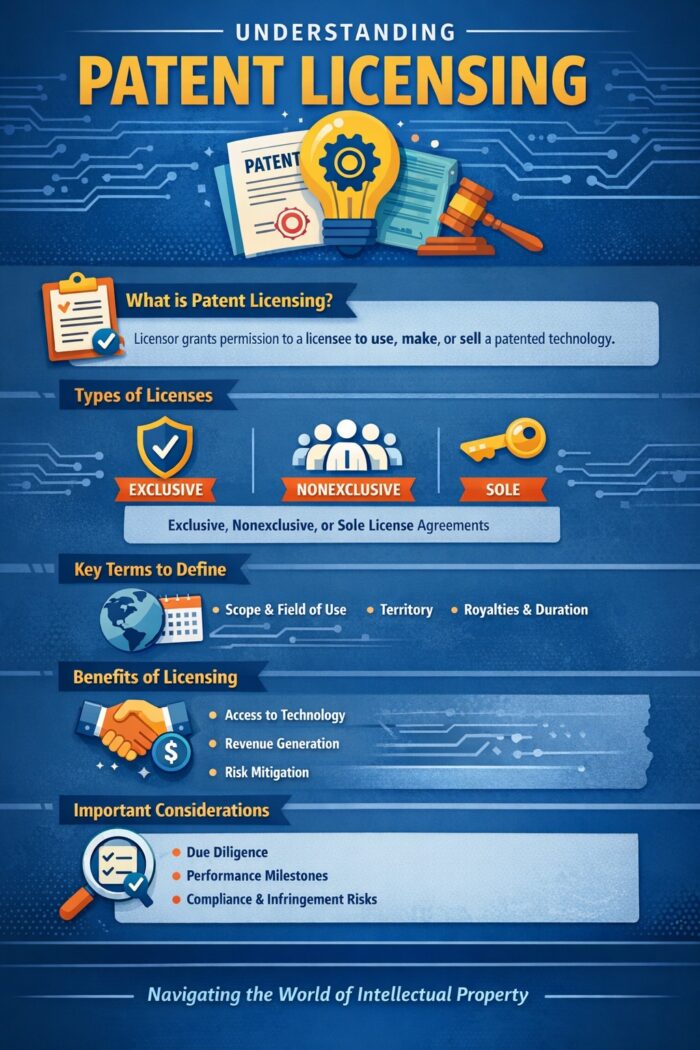
The grant clause is the heart of any patent licensing agreement. It defines exactly which patent rights the patent owner is granting to the licensee, and what rights are being withheld. In practice, this clause determines the scope of the license, the permitted field of use, the geographic territory, which can be as narrow as a single country or as broad as “the world”, and the term or time limit of the license agreement.
Clarity in the grant clause protects both parties. A narrowly drafted grant can preserve the licensor’s ability to grant licenses to other parties, maintain a competitive advantage, or retain freedom to operate in adjacent markets. A clearly defined grant also helps the licensee assess whether the licensed patented technology is sufficient to justify investment in development, manufacture, marketing, and sales.
Field-of-use restrictions are especially important in modern licensing strategies. A patent may cover a core invention that applies across multiple industries, such as software, medical devices, or industrial processes. Courts have long recognized that field-of-use limits can be enforceable when they are clearly negotiated and reflected in the agreement, as illustrated by General Talking Pictures Corp. v. W. Elec. Co., 304 U.S. 175 (1938). Western Electric owned patents covering vacuum-tube amplifier technology. Rather than granting a blanket license, Western Electric licensed the patents to a manufacturer only for a limited field of use, specifically, for non-commercial applications such as private or home use. The license expressly excluded commercial use, such as use in theaters.
Despite this restriction, the licensee knowingly manufactured amplifiers for commercial theaters and sold them to General Talking Pictures Corp., which was aware of the field-of-use limitation. When Western Electric sued for patent infringement, the defendants argued that once a license existed, downstream sales should be protected. The Supreme Court rejected that argument, finding that a patent owner may lawfully grant a license restricted to a particular field of use, and that any manufacture or sale outside that field is unauthorized and therefore constitutes patent infringement.
Territory is another critical term. A license may be limited to specific regions of the United States. A license granting broader territory can be attractive to the licensee. For licensors, however, broader territory should usually be matched with stronger performance obligations or higher royalty payments to ensure the licensee actually exploits the market.
The term of the grant should also be explicit. Many agreements tie the license duration to the life of the relevant patents, while others impose shorter contractual terms with renewal options. The agreement should specify how termination works, including termination for breach, insolvency, failure to meet minimum sales, or nonpayment of royalties. These termination rights are essential tools for licensors to enforce compliance and protect the long-term value of their intellectual property.
Finally, a well-drafted grant clause often addresses related issues that can otherwise create disputes later: whether sublicenses are allowed, who owns improvements or derivative inventions developed by the licensee, how confidential information is handled, and what happens to rights upon expiration or termination. Taken together, these provisions ensure the license is aligned with the parties’ negotiated business goals and reduces the risk of future infringement claims or contract disputes.
Royalties and payment terms sit at the heart of most patent licensing agreements because they define how the patent owner turns intellectual property rights into predictable revenue. Royalty structures vary widely depending on the patented technology, the industry, the bargaining power of the parties, and the licensee company’s ability to commercialize the invention.
In many deals, royalty payments take the form of a running royalty tied to sales, such as a per-unit fee or a percentage of net revenue. Other arrangements use lump-sum payments, milestone payments linked to development or regulatory events, or minimum royalties designed to ensure the licensee actively exploits the patent rather than shelving it. These structures allow licensors to collect royalties while helping licensees fund ongoing development, manufacturing, and market expansion.
Common licensing strategies include tiered royalty rates that increase as sales volume grows, blended or bundled royalties for software and related services, and hybrid models combining upfront fees with ongoing royalties. High-value utility patents, particularly in biotech, pharmaceuticals, and platform technologies, may justify significant upfront payments or milestone-based compensation to offset the licensor’s risk and opportunity cost.
Equally important are the payment terms that govern how and when royalties are paid. Well-drafted license agreements typically require regular royalty reports, clear definitions of “net sales,” audit rights to verify compliance, and remedies such as interest or late fees if payments are delayed. These provisions reduce disputes, improve transparency, and protect the licensor’s money flow over the life of the agreement.
One legal constraint deserves special attention: in the United States, royalty obligations tied to patent rights generally cannot extend beyond the patent’s expiration in a way that improperly leverages the patent monopoly. The Supreme Court reaffirmed this rule in Kimble v. Marvel Ent., LLC, 576 U.S. 446 (2015). In Kimble, the inventor of a toy that allowed children to shoot foam string from their hands (similar to Spider-Man’s web shooters) entered into a license agreement with Marvel. Under the agreement, Marvel agreed to make ongoing royalty payments without an explicit end date, even after the underlying patent expired. When the patent term ended, Marvel stopped paying royalties and challenged the agreement.
The Supreme Court ruled in Marvel’s favor, holding that post-expiration royalties tied to patent rights are unenforceable. The Court relied on its earlier decision in Brulotte v. Thys Co., 379 U.S. 29 (1964), reasoning that allowing patent royalties to extend beyond expiration would improperly extend the patent monopoly beyond the time period granted by Congress. Once a patent expires, the patented technology enters the public domain, and other parties must be free to use it without paying royalties.
The practical takeaway is straightforward but important: royalties that are explicitly based on patent rights must stop when the patent expires. Even if both parties willingly agreed to longer payments, courts will not enforce them if they are tied to the patent itself.
However, Kimble does not prohibit all post-expiration payments. The Court emphasized that parties remain free to structure licensing agreements creatively and lawfully. For example, post-expiration payments may be permissible if they are clearly allocated to non-patent rights, such as trade secrets, know-how, confidential information, or bundled technology and services. Similarly, parties may amortize pre-expiration patent value over a longer payment schedule, provided the agreement makes clear that the payments are not royalties for post-expiration patent use.
Poorly drafted royalty clauses can unintentionally invalidate payment obligations, while carefully structured agreements can preserve economic value without violating patent law. Consulting a knowledgeable patent attorney during negotiation and drafting is essential to ensure that royalty provisions comply with Kimble while still achieving the parties’ commercial goals.
In most cases, once a patented invention is sold in an authorized transaction, such as a sale by a licensee operating under a valid patent license agreement, the patent owner’s ability to control that specific product through patent rights is significantly limited. This doctrine, known as patent exhaustion, means that the initial authorized sale exhausts the patent holder’s right to control the use, resale, or further distribution of that particular item under patent law.
The U.S. Supreme Court has repeatedly confirmed this principle. In Quanta Computer, Inc. v. LG Electronics, Inc., 553 U.S. 617 (2008), the Court held that an authorized sale of a product that substantially embodies a patent exhausts the patent holder’s rights, even when the sale occurs under a license agreement with restrictions not imposed directly on downstream purchasers.
More recently, in Impression Products, Inc. v. Lexmark International, Inc., 581 U.S. 152 (2017), the Court reaffirmed that once a patented product is sold, whether in the United States or abroad, with the patent owner’s authorization, the patent owner generally cannot rely on patent law to enforce post-sale restrictions. Lexmark sold patented printer cartridges subject to contractual “single-use” and “no resale” restrictions, and later attempted to sue downstream resellers for patent infringement when those cartridges were refurbished and resold. The Supreme Court rejected that approach. It held that an authorized sale of a patented item, whether made directly by the patent owner or by a licensee acting within the scope of a license agreement, exhausts the patent rights in that item. Once exhaustion occurs, the patent owner may not rely on patent law to enforce post-sale restrictions on use or resale, even if those restrictions were clearly stated at the time of sale. The Court further confirmed that exhaustion applies to authorized foreign sales as well as domestic sales.
For purposes of patent licensing, Lexmark draws a bright line between patent rights and contract rights. While a licensor may negotiate detailed payment terms, distribution limits, or resale conditions in a patent licensing agreement, those obligations generally bind only the contracting party (the licensee). Once the licensed product is sold into the market, patent law typically cannot be used to control how downstream purchasers use, resell, or refurbish that product.
If your company plans to control downstream sales, pricing, refurbishment, or reuse after the first authorized sale, those controls typically must be enforced through contract law, not patent infringement claims. In other words, while a licensor may structure payment terms, reporting obligations, or distribution limits in the agreement with the licensee, those restrictions may not “run with the product” to bind other parties once the product enters the market.
This is especially important when licensing software, components, or platform technologies that will be integrated into larger systems and resold by multiple parties. Careful drafting of the scope of the license, field-of-use limitations, and commercialization pathways, and a clear understanding of where patent exhaustion begins and ends, can help protect revenue expectations while avoiding overreliance on post-sale patent enforcement that courts are unlikely to support.
Many patent licensing negotiations begin before a United States patent has actually issued, when the application is still patent pending at the United States Patent and Trademark Office (USPTO). From a business perspective, this timing can be attractive: it allows companies to secure early access to promising technology, begin development, and move toward commercialization while the patent prosecution process continues.
However, licensing a patented invention that is not yet granted carries risk. The patent claims may issue in a narrower form than expected, or may never issue at all. Well-drafted license agreements address this uncertainty by allocating risk between the patent owner (or inventor) and the potential licensee. For example, agreements may adjust royalty payments, reduce or eliminate obligations if no enforceable patent rights issue, or convert the deal into a limited know-how or technology license. The U.S. Supreme Court confirmed that such arrangements are enforceable, even if a patent never issues, so long as the agreement reflects the parties’ negotiated expectations. Aronson v. Quick Point Pencil Co., 440 U.S. 257 (1979). In Aronson, an inventor agreed to license a keyholder design to a company while the invention was patent pending. The contract required a higher royalty if a patent issued and a lower, ongoing royalty if no patent issued within a set time. Ultimately, the patent application was denied. The licensee argued that continuing to pay royalties was improper because there was no issued patent and that federal patent law preempted the agreement. The Court held that federal patent law does not prohibit parties from contractually allocating risk regarding a patent pending invention. Because the agreement did not improperly extend patent exclusivity or restrain the public’s ability to use unpatented ideas, it was governed by state contract law and remained valid even though no patent issued.
Equally important is planning for the future. Licensing agreements should clearly address who owns future inventions, later-developed improvements, and new products that build on the original patented technology. In most cases, ownership depends on the relationship between the parties, whether the inventor is an individual, an employee, or has already transferred rights by assignment to an employer or assignee. Some agreements give the licensor ownership of improvements while granting the licensee a right to use them; others require the parties to grant licenses back to one another or negotiate additional terms.
Failing to address these issues can create disputes years later, particularly when a licensed technology becomes commercially successful or spawns multiple product lines across a growing market. From a strategic standpoint, careful drafting around patent pending rights and future inventions helps protect long-term value, preserves the company’s ability to innovate, and ensures the licensing relationship remains aligned as the business and technology evolve.
A properly structured patent license acts as a shield against patent infringement claims by clearly defining what the licensee is permitted to do with the patented technology. As long as the licensee operates within the agreed scope of the license agreement, its activities are authorized and not infringing. However, when a licensee exceeds those limits, such as selling outside the licensed market, manufacturing unapproved products, or continuing use after termination, the protection disappears, and infringement liability may arise.
Under patent law, a patent owner may enforce patent rights through litigation and, if successful, seek remedies including injunctive relief to stop unauthorized use under 35 U.S.C. § 283 and monetary damages adequate to compensate for the infringement under 35 U.S.C. § 284. Patent infringement damages are commonly based on lost profits or, more frequently, a reasonable royalty reflecting what the parties would have negotiated. In exceptional cases, courts may also award attorneys’ fees to the prevailing party under 35 U.S.C. § 285. Careful monitoring and enforcement are therefore critical to protecting the value of a licensing program.
Successful patent licensing depends on careful negotiation and a realistic assessment of practical fit between the parties. A potential licensee should conduct due diligence to validate claim coverage, confirm freedom to operate, and evaluate expected costs, including royalty payments, development expenses, and compliance obligations. Just as important is assessing the company’s ability to manufacture, market, and sell products that incorporate the patented technology at commercial scale. From the licensor’s perspective, negotiations often focus on protecting the value of the patent by requiring performance milestones, minimum royalties, or minimum sales thresholds to ensure the licensee actively commercializes the invention rather than shelving it.
In highly competitive technology markets, cross licenses are a common and practical solution. Cross licenses allow companies to exchange access to each other’s patented technology, reducing the risk of patent infringement claims and avoiding product roadblocks. This approach is particularly useful when multiple parties own complementary or overlapping patents within the same industry, enabling faster development, broader market access, and more efficient use of intellectual property rights.
Patent licensing can help an owner monetize inventions, protect a competitive advantage, and let a licensee access technology without patent litigation risk. The key is translating business goals into precise scope, exclusivity, and economics. For material deals, a patent attorney can help draft patent licensing agreements that hold up when real-world sales, disputes, and patent enforcement pressure arise.
If you need assistance with patent licensing or other intellectual property matters, contact our office for a free consultation.
© 2026 Sierra IP Law, PC. The information provided herein does not constitute legal advice, but merely conveys general information that may be beneficial to the public, and should not be viewed as a substitute for legal consultation in a particular case.
When comparing design patents and copyrights, you need to understand what the law is trying to protect and why. Both are forms of intellectual property, but they serve different policy goals within the broader system of intellectual property protection. A design patent focuses on protecting the ornamental design and visual appearance of a product: how something looks when it is embodied in a functional object. By contrast, copyright protection is aimed at safeguarding creative expression, such as art, drawings, sculptural works, and other creative works that are fixed in a tangible medium (e.g., a canvas, a digital recording, film, a vinyl record, etc.).
The legal policy behind design patent protection is to encourage innovation in product design by granting exclusivity that helps businesses and creators compete and recover investment in a competitive market. Copyright law, on the other hand, emphasizes encouraging creativity and dissemination by providing protection for original creative works. These conceptual differences are discussed in more detail below. Understanding the distinctions is critical for choosing the appropriate protection for your company or project and avoiding costly disputes over ownership and infringement.
A design patent protects the ornamental design and overall visual appearance of a manufactured article under 35 U.S.C. § 171. This is in contrast to the common conception of a patent. Most people think of a utility patent when they hear the word "patent", which covers the function of an invention. In plain terms, a design patent covers how the product looks rather than how it functions. This form of patent protection is directed to the visual appearance of a functional object.
Copyright protection covers original works of authorship that have been fixed in a tangible medium of expression, such as artwork, drawings, written works, and sculptural works under 17 U.S.C. §§ 101, 102(a). Unlike design patents, copyrights cover several forms of expression, including audio, visual, written, and computer code. There are some areas of overlap between the forms of intellectual property, as explained below.
Design patent protection focuses on the ornamental design of a manufactured product, not how the product works. A design patent protects the patented design’s decorative design choices, including lines, contours, surface ornamentation, proportions, and other aesthetic features, and is evaluated by overall visual impression, as explained in Egyptian Goddess, Inc. v. Swisa, Inc., 543 F.3d 665 (Fed. Cir. 2008). This specific protection allows for blocking knock-offs and similar designs of products covered by a design patent.
The key inquiry is how the patented design looks to an ordinary observer, evaluated based on the overall visual impression rather than isolated details. This form of protection is especially valuable for businesses selling physical products in a competitive market where appearance drives consumer purchasing decisions. A design patent protects the aesthetic features of a product even when the product itself is a functional object.
A manufactured article can be functional in nature, but it is critical that the claimed design is not purely functional. The design patent functionality analysis is focused on whether the claimed design protected functional aspects or the ornamental visual appearance of the product. Functionality of the overall article does not defeat design patentability so long as the claimed design is not dictated solely by function. Useful articles commonly incorporate ornamental choices, such as shape, surface decoration, and proportions, that are not strictly necessary for performance.
L.A. Gear, Inc. v. Thom Mcan Shoe Co., 988 F.2d 1117 (Fed. Cir. 1993) provides an example of a design patent (United States Design Patent No. 299,081) for a highly functional manufactured article with utilitarian features that still included patentable, ornamental features. The claimed shoe design included the shape and placement of decorative side panels, the configuration of the heel counter, the layered overlays, and the overall ornamental styling of the upper. See the image below. These are highly functional elements, but they included designs that were not dictated by function. The Federal Circuit explained that the key question with respect to functionality is whether alternative designs could perform the same function. The court upheld the design patent because the shoe’s aesthetic features, such as decorative overlays and overall visual styling, were not the only way to achieve athletic performance. If a product’s appearance is the only way it can work, design patent protection is unavailable, and utility patent law is the proper route.
In other words, while design patents cannot protect functional designs or utilitarian aspects, they can protect how a functional object looks as long as the appearance is not determined by function. This makes design patent protection well-suited for consumer goods, packaging, electronics, furniture, tools, and other products where the decorative design differentiates the brand.
Unlike copyright protection, a design patent prohibits others from making, using, selling, offering for sale, or importing a product that embodies a substantially similar design, regardless of independent creation. Copyright infringement requires access to the original work and copying thereof. Design patents do not. A design patent can be infringed by someone who has never seen and is completely unaware of the design patent and any products it covers.
Design patents cannot protect purely functional or utilitarian aspects of a functional object. Under design law, the claimed appearance must be ornamental, not dictated solely by function. A clear illustration of a design dictated by function is provided in Best Lock Corp. v. Ilco Unican Corp., 94 F.3d 1563 (Fed. Cir. 1996). The case involved a design patent for a key blade, as shown below (United States Design Patent No. D327,636). The Federal Circuit invalidated a design patent, finding that the shape was entirely driven by the need to fit a corresponding lock, leaving no room for alternative ornamental designs. Because the configuration was essential to how the product worked, it was functional rather than decorative. If your competitive advantage lies in performance or mechanical interaction, protection must come from utility patent law, not a design patent.
Under copyright law, copyright protects original works of authorship and other creative works, such as art, illustrations, drawings, sculptural works, written content, software code, and architectural designs, once they are created and fixed in a tangible medium of expression. See 17 U.S.C. § 102(a). "Original” means the work was independently created and contains at least a minimal degree of creativity, and “fixed” means it is recorded in a sufficiently permanent form. Protection arises automatically at creation, without a copyright registration.
Copyright protects the expressive elements of a work, including its form, composition, and artistic choices. However, copyright does not protect ideas, concepts, systems, processes, or methods of operation. In other words, you cannot protect ideas themselves, only the particular expression of those ideas.
The following are the categories of copyrightable subject matter. Creative works generally fall into one of the following categories:
Literary works include books, articles, blog posts, manuals, marketing copy, and software code. The creative expression lies in the author’s choice of words, structure, and organization. Facts, ideas, and short phrases are not protected, but original text is.
Musical works consist of original compositions, including melody, harmony, and lyrics. Copyright protects the musical expression itself, not general chord progressions or musical styles. A recorded song may involve multiple copyrights for sheet music, composition, and sound recording.
Dramatic works include plays, screenplays, and scripts. Protection covers dialogue, plot structure, characters, and stage directions, so long as they are sufficiently developed and original.
These include original dance routines and choreographed movements that are fixed, such as in video or notation. Everyday movements or athletic routines generally lack the creativity required for protection.
This category includes paintings, drawings, illustrations, logos, photographs, and sculptural works. Copyright protects artistic choices such as composition, shape, line, and visual style. For useful articles, protection extends only to separable artistic elements.
Films, videos, commercials, and online content are protected as audiovisual works. The creative expression includes visual sequencing, editing, dialogue, and audiovisual composition.
Sound recordings protect the fixation of sounds, such as a recorded performance. The creative expression lies in the performance and production choices, not the underlying musical composition.
Architectural designs protect original building designs as embodied in plans or constructed buildings, focusing on the overall form and arrangement of spaces, not purely functional features.
Computer code is expressly protected as a literary work under 17 U.S.C. § 101. Copyright protects original source code and object code, including structure, sequence, and organization, to the extent they reflect creative expression. Functional concepts, algorithms, programming languages, and methods of operation are not protected, but the particular expressive implementation of code may justify copyright registration.
Copyright protection is limited to creative expression, not ideas, concepts, or functional principles. Under U.S. copyright law, a work must be an “original work of authorship” to qualify for protection under 17 U.S.C. § 102(a). This requirement has two core components: originality and expression.
Creative expression refers to the author’s particular way of expressing an idea. Copyright law expressly excludes ideas, procedures, systems, methods of operation, and concepts from protection under 17 U.S.C. § 102(b). This “idea–expression dichotomy” means copyright protects how something is expressed, not what is expressed. For example, a general product concept or design idea is not protected, but original artwork, drawings, graphics, or sculptural elements reflecting creative choices may be.
Originality is a low but meaningful threshold. A work must be independently created by the author and possess at least a minimal degree of creativity. It does not need to be novel, innovative, or unique in a patent-law sense. As the Supreme Court explained, originality requires only some creative spark, even if modest. A work copied entirely from another source, even if labor-intensive, fails this test. Conversely, two authors can create similar works, and each may be protected if each work was independently created.
The Supreme Court’s decision in Feist Publications, Inc. v. Rural Telephone Service Co., 499 U.S. 340 (1991) makes clear that copyright protects originality, not effort, investment, or mere factual compilation, and that similarity alone is not enough to establish infringement. In the case, the Rural Telephone Service published a standard white-pages telephone directory listing subscribers alphabetically with their phone numbers. Feist Publications copied many of those listings for use in its own directory. Rural sued for copyright infringement, arguing that its effort in collecting and organizing the data justified protection under the so-called “sweat of the brow” doctrine. The Supreme Court rejected that theory, holding that copyright protection extends only to original expression, not facts themselves.
For a useful article, copyrightable subject matter generally does not include the article’s physical shape or other functional designs, unless an artistic element can be conceptually separated from the item’s utilitarian function. See 17 U.S.C. § 101. The Supreme Court clarified this rule in Star Athletica, L.L.C. v. Varsity Brands, Inc. 580 U.S. 405 (2017). In that case, the Court held that decorative designs on cheerleading uniforms, such as stripes, chevrons, and color blocks, could qualify for copyright protection even though the uniforms themselves were functional objects. The key question was whether the artistic features could be perceived as a two-dimensional or three-dimensional work of art separate from the useful article and would qualify as copyrightable on their own.
Applying this standard, copyright will usually not protect, e.g., the overall form of a bottle, chair, or other functional object. However, it may protect separable artwork applied to that object, such as a graphic illustration, sculptural embellishment, or surface design. The bottom line is that copyright protects creative expression, not functional designs or the utilitarian aspects of products.
Copyrights arise automatically when an original work of authorship is created and fixed in a tangible medium of expression, such as a drawing, photograph, sculpture, or digital design file under 17 U.S.C. §§ 101–102(a). No filing, registration, or notice is required for a copyright owner to obtain basic copyright protection, and the work is automatically protected the moment it is fixed. A copyright holder exclusive rights to reproduce, distribute, display, perform, and create derivative works from the protected work under 17 U.S.C. § 106. However, while automatic protection exists, copyright registration with the U.S. Copyright Office is required before filing a copyright infringement lawsuit and is often critical for enforcing rights in court under 17 U.S.C. § 411(a).
Design patent rights do not arise automatically. Design patent protection requires filing a design patent application with the U.S. Patent and Trademark Office and completing a formal examination process under 35 U.S.C. §§ 111, 131, 171. The application must include a filing fee, precise drawings that define the ornamental design, and a detailed application that complies with USPTO rules. Only after the Patent Office allows and issues the patent does the owner receive enforceable design patent protection.
Although copyright arises automatically when an original work is created and fixed in a tangible medium of expression, registration with the U.S. Copyright Office carries important legal consequences (17 U.S.C. §§ 102(a), 408). Most critically, copyright registration is required before filing a copyright infringement lawsuit in federal court under 17 U.S.C. § 411(a). Timely registration, generally before infringement or within three months of first publication, also enables statutory damages and attorney’s fees, which are otherwise unavailable (17 U.S.C. § 412). A registration further creates a presumption of validity and ownership if made within five years of publication, strengthening enforcement and reducing litigation risk (17 U.S.C. § 410(c)).
In the United States, a design patent application must be filed within one year of the first offer for sale, public disclosure, or public use of the design, or patent protection is permanently barred under 35 U.S.C. § 102(a)(1). In the case of sales of the claimed design, confidentiality and lack of public disclosure is not controlling. In Helsinn Healthcare S.A. v. Teva Pharm. USA, Inc., 139 S. Ct. 628 (2019), the Supreme Court confirmed that even confidential or non-public sales activity can qualify as an invalidating “on sale” event under patent law. For design patents, this means early licensing deals, investor pitches, marketing decks, or website launches may quietly start the clock.
A copyright owner receives a defined bundle of exclusive rights under copyright law. These include the rights to reproduce the work, distribute copies, publicly display or perform the work, and prepare derivative works based on the original creation under 17 U.S.C. § 106. In practice, this means only the copyright owner can decide who may copy the work, sell or distribute it, post it online, or modify it into a new version.
However, copyright protects against copying, not against similarity alone. If a competing company independently creates a similar design without copying the original, that independent creation is a complete defense to copyright infringement. This limitation can be significant in a competitive market where multiple designers are responding to the same trends or functional constraints.
Design patents operate very differently. A design patent prohibits others from making, using, offering for sale, selling, or importing the patented design regardless of whether copying occurred under 35 U.S.C. § 154(a)(1). A violation of any of these rights results in design patent infringement under 35 U.S.C. § 271(a). Unlike design patents, copyright does not prevent others from making or selling a similar-looking product if they arrived at the design on their own.
Design patents last for a fixed term of 15 years from the date of issuance, providing a defined window of patent protection for the patented design under 35 U.S.C. § 173. This limited duration reflects the goal of design patent law: encouraging innovation in ornamental and aesthetic features without granting perpetual exclusivity. Importantly for businesses, design patents do not require maintenance fees to keep them in force. Maintenance fees apply to utility patents, not design patents, making long-term cost management more predictable.
By contrast, copyright protection is much longer, generally lasting for the life of the author plus 70 years, which can extend protection well beyond the commercial life of a product (17 U.S.C. § 302(a)). For works made for hire, corporate applicants, or works published under a pseudonym or anonymously, the term is 95 years from first publication or 120 years from creation, whichever expires first under 17 U.S.C. § 302(c). Copyright does not require maintenance fees or periodic renewals.
In considering design patent vs copyright protections, you should consider the particular kind of product, article, or content you are creating and determine whether it is proper subject matter for design patent or copyright. Design patents offer powerful, targeted protection for the visual appearance of a product, while copyright can extend protection to artistic elements that exist independently of function. For example, a fancy original lamp design may be effectively sculpture with a lighting element added to provide function. Such a design can be protected by both design patent and copyright registration, providing overlapping and broader protection.
Speaking with a patent attorney or intellectual property attorney can help ensure that protection is secured for your intellectual property. An experienced attorney can provide both legal guidance and practical business advice that can guide your decisions on whether to pursue design patent and/or copyright protection. If you have a patent, copyright, or other intellectual property matter, contact our office for a free consultation with an experienced patent attorney.
© 2026 Sierra IP Law, PC. The information provided herein does not constitute legal advice, but merely conveys general information that may be beneficial to the public, and should not be viewed as a substitute for legal consultation in a particular case.
Trade dress can be registered with the United States Patent and Trademark Office (USPTO), just like a word mark like NIKE or a logo like the swoosh. Trade dress is the look and feel of product packaging, distinctive decor, or product configuration that creates a connection in the consumer's mind between a product or service and the source of that product or service. Proper, registrable trade dress is distinctive, providing a unique impression for the goods or services and must also be non-functional in nature. Businesses that create proper trade dress around their products and/or services register their trade dress rights to establish national protection of their branding. A trade dress registration is a powerful way to protect that branding and help deter trade dress infringement.
Trade dress includes the overall look that identifies the source of the product. It is not a single word mark or logo. It is the combined elements that create the market impression of the product or service. Courts describe trade dress as the “total image” of a business or offering. Two Pesos, Inc. v. Taco Cabana, Inc., 505 U.S. 763 (1992).
Trade dress can consist of such elements as size, shape, color combinations, texture, and graphics, plus how those features are arranged, so long as they constitute trade dress by functioning as a source-identifier rather than a product feature customers expect from a particular class of goods in a particular field. See TMEP § 1202.02. Trade dress can include packaging of goods, the décor of a restaurant, or the product design / 3D product configuration itself.
A protectable trade dress must be non functional. In trademark law, a feature is functional if it is “essential to the use or purpose” of the article or affects cost or quality, meaning the feature provides utilitarian advantages rather than brand identity. Inwood Labs., Inc. v. Ives Labs., Inc., 456 U.S. 844 (1982). Inwood arose in the context of pharmaceutical pill color and contributory trademark infringement. The functionality definition provided by the court has been broadly applied to trade dress claims involving product configuration, packaging, and design features. The test focuses on whether the claimed feature provides a utilitarian advantage, such as improved performance, lower manufacturing cost, or enhanced durability, rather than serving primarily as a source identifier. If a feature affects how well a product works, how cheaply it can be made, or how effectively it performs its intended function, trademark protection is inappropriate.
The functionality rule exists to maintain the separation between patent and trademark: functional features should be protected, if at all, by a utility patent (i.e., a United States patent), and cannot be extended or established under trademark rights. TrafFix Devices, Inc. v. Mktg. Displays, Inc., 532 U.S. 23 (2001). Trademark rights are intended to identify and protect the source of the product, not to grant exclusive rights in features that make a product work better, cost less to manufacture, or perform a utilitarian function. If functional product features could be protected indefinitely as trademarks or trade dress, companies could effectively extend monopolies beyond the limited term Congress allows under utility patent law.
The Supreme Court’s decision in TrafFix Devices is the leading authority on this principle and remains central to modern trade dress analysis. In TrafFix, the Court held that the existence of an expired utility patent covering a product feature is strong evidence, often dispositive, that the feature is functional and therefore ineligible for trade dress protection. The Court emphasized that when a feature is claimed in a utility patent, it is presumed to be essential to the article’s use or purpose, making trademark protection improper.
TrafFix also clarified that applicants cannot avoid a finding of functionality by arguing that alternative designs exist when the feature itself provides a utilitarian advantage. As a result, examining attorneys and courts routinely rely on TrafFix when rejecting or invalidating trade dress claims that attempt to protect functional product designs better suited for patent protection.
When the examining attorney at the trademark office assesses functionality, they consider the following factors:
A basic shape that is commonly adopted in the industry, a well known functional form, or a mere refinement that improves the performance of a device often fail to demonstrate non-functionality.
In the context of functionality, the Supreme Court’s decision in Wal-Mart Stores, Inc. v. Samara Bros., Inc., 529 U.S. 205 (2000) clarified a critical distinction between product packaging and product design trade dress. It held that product design trade dress can never be inherently distinctive as a matter of law. Instead, product design is viewed by consumers as decoration or a refinement of the product itself, not as a brand identifier. As a result, a business seeking to protect trade dress for its product configuration trade dress must affirmatively prove secondary meaning through evidence such as length and exclusivity of use, advertising, sales success, unsolicited media coverage, and consumer surveys.
The Wal-Mart decision significantly raised the evidentiary burden for businesses seeking trade dress protection for product design, reinforcing the principle that trademark law protects source identification, not product aesthetics.
Trade dress must be either inherently distinctive or have acquired distinctiveness, often referred to as secondary meaning or acquired secondary meaning. Inherent distinctiveness exists when the trade dress, by its nature, immediately signals source to consumers without the need for prior exposure. Many forms of product packaging or distinctive décor can qualify at the outset. By contrast, product design and product configuration almost never qualify as inherently distinctive and typically must rely on acquired distinctiveness to obtain protection.
To show secondary meaning, the trade dress owner must demonstrate that the primary significance of the claimed trade dress in the minds of relevant consumers is to identify a single source of goods or services, even if that source is anonymous. In other words, consumers must perceive the trade dress as a brand identifier, not merely as decoration, ornamentation, or an attractive design choice.
A trademark applicant can demonstrate acquired distinctiveness with several categories of evidence, including length and exclusivity of use, sales success, substantial advertising expenditures, unsolicited media coverage, and consumer studies (consumer surveys). The USPTO specifically allows applicants to submit evidence to claim acquired distinctiveness under Section 2(f) (15 U.S.C. § 1052(f) to supplement an application for trademark registration of a non-distinct or otherwise weak trade dress (or trademark). Weaker trade dress (or product trade dress) typically ends up on the USPTO's Supplemental Register, which has fewer benefits than the Principal Register. Submission of evidence of secondary meaning can allow an applicant to establish more robust trademark rights through a principal registration.
Such evidence can also be used to establish strong trademark rights in the context of trademark litigation. It is not uncommon for a trade dress or trademark owner to file a trade dress infringement lawsuit when they have only common law trademark rights and no registration. In such circumstances it is critical that the plaintiff is able to show that the consumer associates the asserted trade dress with the plaintiff. Establishing acquired distinctiveness can significantly increase the probability of success in the litigation context.
Examples of trade dress include the unique shape of a Coca-Cola bottle, the blue Tiffany & Co. gift box, and the specific interior layout of a Starbucks store. Restaurant concepts can also qualify: the Hard Rock Cafe restaurant chain uses distinctive decor often discussed as trade dress, similar to the restaurant décor analysis in the Two Pesos case. In the Two Pesos case, the plaintiff's trade dress was described as a "festive eating atmosphere" featuring a distinct combination of bright, festive colors, paintings, and murals. The design included interior dining and patios, with a stepped exterior, neon stripes, and vibrant awnings and umbrellas. Thus, distinctive and unique decor in a restaurant or other consumer services contexts can serve as proper trade dress.
In the alcoholic beverage industry, an unusual bottle shape can sometimes be distinctive enough to indicate source. Maker’s Mark Distillery has registered (and enforced) trade dress for its wax-like coating covering the cap and trickling down the neck in a freeform irregular pattern (US Registration Number 1370465). Maker’s Mark Distillery, Inc. v. Diageo N. Am., Inc., 679 F.3d 410 (6th Cir. 2012). The court in the Marker's Mark case held that Maker's Mark's registered red dripping wax seal is a valid, non-functional, enforceable trademark and not merely functional, as it serves to identify the brand rather than provide a significant competitive advantage.
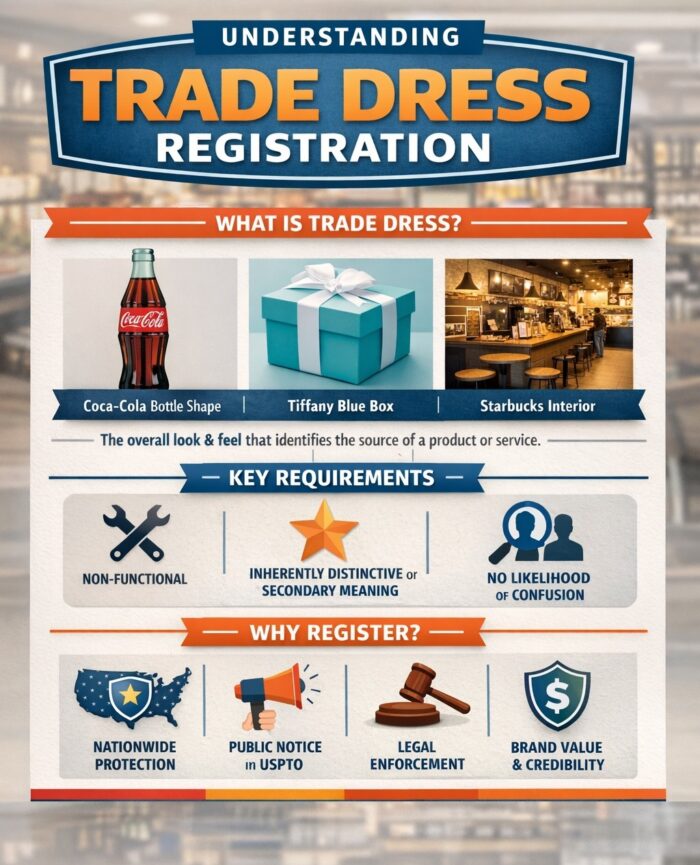
The primary difference between standard trademark and trade dress registration is the nature of what is protected. A conventional mark is often a word/design used on labels and ads. Trade dress focuses on the packaging, design, or environment that creates the brand’s overall appearance. Both are registered through the same trademark application system, with the requirements defined by 37 C.F.R. § 2.32.
A trade dress application is filed and examined as a trademark application, and it must satisfy the same core formal requirements. The applicant must clearly identify the relevant goods and/or services, submit an acceptable drawing, and provide a written description of the proposed mark or proposed trade dress that explains what the applicant is claiming and how it functions as a source identifier. See 37 C.F.R. §§ 2.32, 2.37, 2.52. In trade dress cases, the description is especially important because the “mark” is not a word or logo, but the overall appearance of packaging, product design, or décor.
The drawing is often the most critical, and most challenging, part of a trade dress application. The drawing must clearly and accurately depict the claimed trade dress so that the scope of rights is unmistakable to the USPTO, competitors, and the public. When the trademark consists of only a portion of a product or container, the rules require solid lines to show the elements that are claimed as trade dress, while broken or dotted lines are used to depict unclaimed features shown only for context. See 37 C.F.R. § 2.52(b)(4); TMEP § 1202.02(c)(i); TMEP § 807.08.
Failure to properly define the claimed versus unclaimed elements frequently results in an office action. A precise drawing and description help the examining attorney evaluate functionality and distinctiveness and can significantly streamline prosecution of a trade dress application.
After a trade dress application is filed, the USPTO examining attorney conducts a substantive review under the Trademark Act. In trade dress cases, the analysis almost always begins with functionality. Under TMEP § 1202.02, the examining attorney determines whether the claimed trade dress is essential to the use or purpose of the product, affects cost or quality, or provides utilitarian advantages that competitors would need. If the trade dress appears functional, such as a shape dictated by performance or manufacturing efficiency, the application will be refused registration on the Principal Register.
If the trade dress is deemed non-functional, the examining attorney then evaluates distinctiveness. For product configuration trade dress, this typically requires evidence of acquired distinctiveness under Section 2(f), such as sales success, advertising, unsolicited media coverage, or consumer studies. If the application has deficiencies, the USPTO will issue an office action requiring clarification of the claimed trade dress, revisions to the drawing or description, or submission of evidence supporting secondary meaning, consistent with 37 C.F.R. §§ 2.37 and 2.52.
In addition, the USPTO examines the application for likelihood of consumer confusion under Section 2(d). This analysis is guided by the DuPont factors, including the similarity of the trade dress in overall commercial impression, the relatedness of the goods or services, and the overlap in marketing channels. In re E.I. duPont de Nemours & Co., 476 F.2d 1357 (CCPA 1973). Even non-functional and distinctive trade dress may be refused if it is too close to an existing registration and likely to confuse consumers as to source.
Trade dress registration offers meaningful, long-term benefits for business owners who invest in a distinctive overall commercial image. Federal registration strengthens your ability to protect non-functional design features that identify the source of the product, whether packaging, décor, or product configuration.
A registration for trade dress can be attained if you define the claimed trade dress clearly and can prove three things: (1) non functionality, (2) distinctiveness (inherent or acquired distinctiveness / secondary meaning), and (3) no likely confusion with existing marks. Successful registration provides nationwide rights, public notice through the USPTO register, and powerful enforcement tools against trade dress infringement and consumer confusion.
If you need assistance with trade dress registration or other intellectual property matter, contact our office for a free consultation.
© 2026 Sierra IP Law, PC. The information provided herein does not constitute legal advice, but merely conveys general information that may be beneficial to the public, and should not be viewed as a substitute for legal consultation in a particular case.
An important term in patent law is the Person Having Ordinary Skill in the Art (PHOSITA or POSITA). A PHOSITA is a “hypothetical person” used to judge obviousness, disclosure, and claim meaning. It is a figurative hurdle for patenting an invention. In the patent system, many critical questions, like non-obviousness, what counts as prior art, and what a claim “means” are evaluated through a legal fiction called the PHOSITA. The PHOSITA standard drives how a patent examiner rejects claims, how companies assess patentability, and how a court might later interpret your patented inventions in federal patent litigation.
A person having ordinary skill in the art (PHOSITA) is not a real employee, consultant, customer, or even a specific inventor. Instead, PHOSITA is a hypothetical person, a legal fiction created by patent law to provide a neutral, objective benchmark for evaluating patentability across industries and technologies. Courts, patent examiners, and judges rely on this construct to avoid hindsight and to ensure that the patent system rewards true innovation rather than routine progress.
At its core, PHOSITA represents the “average skilled practitioner” in a given technical field, possessing ordinary skill, ordinary creativity, and ordinary knowledge at the relevant time, usually before the effective filing date of the patent application. Importantly, PHOSITA is not a genius, is not an inventor, and is not permitted to invent. Instead, this person skilled in the art is expected to follow conventional wisdom, apply known techniques in a predictable manner, and draw upon what was publicly accessible in the prior art.
The Federal Circuit has repeatedly emphasized that the PHOSITA standard is context-specific. In Environmental Designs, Ltd. v. Union Oil Co. of California, 713 F.2d 693 (Fed. Cir. 1983) the court explained that determining ordinary skill in the art depends on several factors, including the educational level of practitioners, the problems encountered in the art, prior art solutions, the sophistication of the technology, and the pace of innovation. This means PHOSITA is not static, it changes depending on the context and the art to which the claimed invention pertains.
For example, in mechanical inventions, such as tools or industrial devices, PHOSITA is often described as a technician or engineer with practical experience rather than advanced theoretical training. In Union Oil, the court noted that PHOSITA was someone familiar with routine experimentation and standard design choices in environmental designs and petroleum-related systems, capable of combining known elements without exercising inventive skill.
By contrast, in pharmaceutical and chemical arts, PHOSITA is typically more highly educated. In Daiichi Sankyo Co., Ltd. v. Apotex, Inc., 501 F.3d 1254 (Fed. Cir. 2007) the Federal Circuit held that PHOSITA in drug formulation was not a general physician but a researcher with advanced training in treating ear pathologies with training in pharmacology. This higher baseline affected the obviousness and inventive step analysis because such a PHOSITA would have deeper familiarity with biochemical references, formulation techniques, and experimental methods.
In software and computer-implemented inventions, courts often describe PHOSITA as a programmer or computer scientist with ordinary experience in the relevant programming environment. In WMS Gaming Inc. v. International Game Technology, 184 F.3d 1339 (Fed. Cir. 1999) claim meaning and disclosure were evaluated from the perspective of a PHOSITA who understood standard programming practices, not from the viewpoint of a lay person or business user. Today, that analysis increasingly includes access to modern development tools, and, in some cases, artificial intelligence systems, when determining what constitutes routine skill.
Across all these examples, one principle remains constant: PHOSITA is presumed to be aware of all relevant prior art, yet is confined to the capabilities of an ordinary practitioner. This balance allows courts to determine whether a claimed invention reflects true innovation or merely an obvious application of existing knowledge, ensuring consistency, fairness, and predictability in patent law. However, it should be noted that the level of ordinary skill in the art can vary greatly in sophistication. Technologies that involve a high level of training have a relatively high level of "ordinary skill".
The concept of PHOSITA is not a judicial add-on; it is embedded directly into the Patent Act itself. 35 U.S.C. § 103 defines obviousness expressly from the perspective of a person having ordinary skill in the art. Under the statute, a patent may not be obtained if, before the effective filing date, the differences between the claimed invention and the prior art would have rendered the invention obvious to a PHOSITA, even if the invention was not identically disclosed in a single reference.
This statutory framing makes PHOSITA the central decision-making concept for non-obviousness and inventive step. The inquiry does not ask whether the invention seems obvious today, or whether it was obvious to the inventor, a judge, or a patent examiner exercising hindsight. Instead, patentability is determined by asking what a hypothetical person skilled in the relevant art would have understood, known, and been capable of doing at the relevant time.
The Supreme Court confirmed this statutory interpretation in Graham v. John Deere, 383 U.S. 1 (1966), where it explained that obviousness analysis must consider (1) the scope and content of the prior art, (2) differences between the prior art and the patent claims, and (3) the level of ordinary skill in the art, explicitly anchoring the analysis to PHOSITA rather than any real-world person. This framework remains the foundation of modern obviousness law applied by the Federal Circuit and the USPTO.
Two statutory details are especially important for business owners.
First, timing: Obviousness is evaluated as of the effective filing date, not the date an idea was conceived, reduced to practice, or commercialized. This matters when provisional applications, continuations, or priority claims shift the relevant date, and therefore shift what prior art the PHOSITA is presumed to know.
Second, the last sentence of § 103. Congress made clear that “[p]atentability shall not be negated by the manner in which the invention was made.” This language rejects the old “flash of genius” approach and reinforces that the opinion or story of how an invention came about is legally irrelevant. Even a breakthrough achieved through persistence, insight, or luck fails if a PHOSITA, armed with ordinary knowledge, ordinary tools, and conventional reasoning, would have found the claim obvious in light of the prior art.
Together, these rules ensure that PHOSITA functions as an objective guardrail in the patent system, separating true innovation from predictable technological progress.
Obviousness analysis is inherently PHOSITA based: it does not focus on what a particular inventor, startup team, or company actually knew or reviewed. Instead, it asks what the art as a whole would have conveyed to a hypothetical person of ordinary skill in the relevant technical field at the relevant time. In USPTO practice, the person skilled in the art is treated as a legal construct “presumed to have known the relevant art at the relevant time,” regardless of whether any real-world person actually located or appreciated every reference.
This presumption is critical to how patent law defines “public knowledge.” The PHOSITA is assumed to have full access to all prior art that is publicly available before the effective filing date, including patents, published applications, and other disclosures. By attributing this complete body of knowledge to a single hypothetical individual, the patent system avoids turning obviousness and non-obviousness into a subjective inquiry based on chance, research skill, or uneven information access.
The Federal Circuit has repeatedly reinforced the principle that the obviousness inquiry must be conducted through the eyes of the hypothetical person of ordinary skill in the art having knowledge of all pertinent, publicly available prior art. Custom Accessories, Inc. v. Jeffrey-Allan Industries, Inc., 807 F.2d 955 (Fed. Cir. 1986). This formulation makes clear that PHOSITA is presumed to know all pertinent prior art, not selectively, and not imperfectly.
Practically, this means that arguments based on a lack of actual knowledge of prior art (“we never saw that paper”) have no weight in an obviousness determination. The law presumes that the PHOSITA knew those teachings and could combine them in an ordinary, predictable manner, even if the combination was never identically disclosed in a single source.
At the same time, this legal presumption does not relieve applicants of real-world obligations. During prosecution of a patent application, applicants and practitioners must still comply with the duty of disclosure under 37 C.F.R. § 1.56, requiring disclosure of information material to patentability.
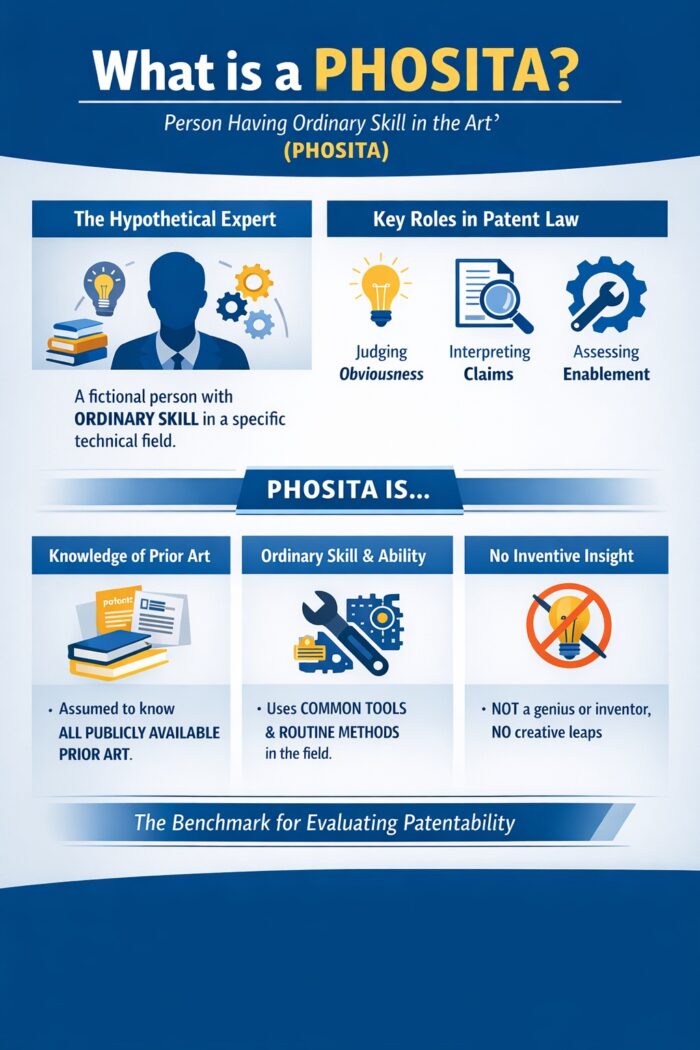
The PHOSITA standard is not a single, fixed definition that applies across all technology or art. Instead, courts determine the level of ordinary skill in the art on a case-by-case basis, grounded in the context of the claimed invention, the technical field, and the state of the prior art as of the relevant effective filing date. This contextual approach ensures that patentability, obviousness, and inventive step are evaluated realistically rather than through abstract generalizations.
As mentioned above, the framework for analyzing the level of ordinary skill in the art comes from the Federal Circuit’s decision in Environmental Designs v. Union Oil. In that opinion, the court explained that determining the level of skill in the art requires consideration of multiple factors, none of which is dispositive on its own. These criteria include:
This multi-factor analysis underscores that PHOSITA is a hypothetical person, not an abstract average. In mature mechanical or industrial fields, for example, PHOSITA may be a technician or engineer with hands-on experience and familiarity with standard design choices. In contrast, in cutting-edge fields such as biotechnology, semiconductors, or artificial intelligence, a PHOSITA may be assumed to have advanced formal education, familiarity with complex modeling, and routine access to specialized tools and research environments.
Importantly, Environmental Designs also cautioned that PHOSITA is not defined by the most skilled or innovative actors in the field. The PHOSITA has ordinary skill, follows conventional approaches, and does not engage in creative leaps reserved for the inventor. This distinction helps courts determine whether differences between the claimed invention and the prior art reflect true innovation or merely predictable variations that would have been obvious.
The same principles are echoed in USPTO practice. The Manual of Patent Examining Procedure (MPEP) instructs a patent examiner to make an explicit or implicit finding of the level of ordinary skill based on evidence in the record, including the nature of the technology and the problems addressed. See M.P.E.P. § 2141.03. This evidence-driven approach reinforces that PHOSITA is a legal fiction grounded in real-world industry conditions, which aims to align the patent law of obviousness with how innovation actually occurs, while avoiding hindsight and subjective judgment.
The modern doctrine of non-obviousness is inseparable from the PHOSITA standard, and the Supreme Court has made clear that obviousness must be evaluated through a structured, evidence-based inquiry grounded in both the scope of the prior art and the ordinary level of skill in the art. The starting point is the Supreme Court’s decision in the Graham v. John Deere case, which articulated the four factual inquiries, commonly called the Graham factors, that govern an obviousness analysis under 35 U.S.C. § 103.
Under this framework, a court must determine:
The first and third factors (the scope of the prior art and the ordinary level of skill in the art) are especially critical because they define the informational and technical universe attributed to the hypothetical person. As discussed above, the PHOSITA is presumed to have (1) full knowledge of all relevant prior art and (2) the capabilities are limited to ordinary technical ability. If the prior art is broad and the PHOSITA’s skill level is high, more significant differences may be needed to find an invention patentable. Conversely, in a less developed field with slower innovation, fewer differences may support patentability.
In KSR Int'l Co. v. Teleflex Inc., 550 U.S. 398 (2007), the Supreme Court reaffirmed the Graham framework, but rejected rigid rules that insulated claims from obviousness merely because no single reference provided a teaching, suggestion, or motivation to combine prior art or modify existing technology to arrive at the claimed invention. The Court emphasized a flexible, common-sense analysis and famously observed that a PHOSITA is “a person of ordinary creativity, not an automaton.” This language recognizes that the PHOSITA may apply conventional reasoning, combine familiar elements, and pursue known options, yet still may not invent or rely on hindsight reconstruction.
Taken together, Graham and KSR confirm that obviousness turns on a careful calibration between what the prior art teaches and what a PHOSITA of ordinary skill could realistically do at the relevant time.
PHOSITA also plays a critical role in the enablement requirement. Under 35 U.S.C. § 112, a patent specification must include a written description of the invention and must describe the manner and process of making and using the invention in “full, clear, concise, and exact terms” so that any person skilled in the art to which the invention pertains can make and use it. Courts routinely evaluate enablement from the perspective of a person having ordinary skill in the relevant technical field.
The central enablement question is whether practicing the claimed invention would require undue experimentation. The leading case on this point is In re Wands, 858 F.2d 731 (Fed. Cir. 1988), where the Federal Circuit identified a non-exhaustive set of factors for determining whether experimentation is undue, including the quantity of experimentation required, the amount of guidance in the specification, the presence of working examples, the nature and predictability of the art, and the level of skill in the art. Critically, these factors are evaluated through the lens of the ordinary practitioner in the relevant art or field.
It should be understood that the PHOSITA analysis for enablement purposes is not identical to the PHOSITA analysis in obviousness. For patent enablement, the inquiry asks whether a person skilled in the art, equipped with ordinary knowledge and abilities, could make and use the invention across its full scope without excessive trial and error. The PHOSITA is assumed to understand standard techniques and to recognize routine variations, but is not expected to solve open research problems or engage in creative invention to fill gaps in the disclosure.
The undue experimentation standard presumes familiarity with the ordinary materials, software, laboratory equipment, manufacturing processes, or analytical methods commonly used in the field at the relevant filing date. See M.P.E.P. § 2164. As technology evolves, particularly with advances such as artificial intelligence, what counts as “ordinary” tools may expand, but the underlying principle remains the same: the patent must teach enough that a PHOSITA can practice the invention as claimed, without turning the patent into a research assignment.
The PHOSITA concept is also central to evaluating whether a patent application satisfies the written description requirement of 35 U.S.C. § 112. Written description asks a different question than enablement or obviousness: does the application demonstrate that the inventor actually possessed the claimed invention at the time of the filing date? Courts answer that question by asking what a person having ordinary skill in the relevant art would understand from the disclosure in the patent specification.
The Federal Circuit, sitting en banc, made this point explicit in Ariad Pharmaceuticals, Inc. v. Eli Lilly & Co., 560 F.3d 1366 (Fed. Cir. 2009). There, the court held that written description is a distinct statutory requirement, separate from enablement, and requires more than simply stating a desired result. Instead, the specification must convey to a PHOSITA that the inventor had possession of the invention as broadly as it is claimed. This possession can be shown through structure, representative examples, functional relationships, or other concrete definitional content that anchors the scope of the claim.
From the perspective of a person skilled in the art, vague or purely aspirational language is insufficient. A PHOSITA reading the application must be able to determine, based on the language used, that the inventor actually invented what is being claimed, not merely identified a problem or articulated a research plan. This is particularly important in unpredictable or fast-moving fields such as biotechnology, software, and artificial intelligence, where the gap between an idea and a working invention can be substantial.
The closer your technology is to the edge of new technologies, the more carefully the application must be written to reflect real technical possession. Broad claims unsupported by commensurate disclosure risk patent invalidation, even if they might appear non-obvious. The written description requirement ensures that patent protection is granted only for what the inventor actually contributed to the public store of knowledge, preserving the balance at the heart of the patent system.
PHOSITA plays a central role in claim construction, the process by which a court determines the meaning and scope of the words used in a patent claim. Claim construction is not about what the inventor subjectively intended or how a business internally used a term. Instead, courts ask how a person having ordinary skill in the relevant art would understand the claim language at the time of the filing date, in light of the entire patent specification.
The leading authority is Phillips v. AWH, 415 F.3d 1303 (Fed. Cir. 2005), where the Federal Circuit, sitting en banc, held that claim terms must be given the meaning they would have to a person skilled in the art “in the context of the entire patent.” The court emphasized that the specification is the “single best guide” to claim meaning, because it provides the technical context, definitions, and explanations that shape how a PHOSITA would read the language of the claims. While dictionaries and extrinsic evidence may sometimes assist, they cannot override the understanding conveyed by the intrinsic record.
This PHOSITA-centered approach ensures consistency across the patent system. A claim term is not interpreted in isolation, nor is it stretched to cover every possible meaning of a word. Instead, courts determine how an ordinarily skilled practitioner, familiar with the technology, the prior art, and the disclosed invention, would understand the term when reading the patent as a whole.
For business owners, the implication is significant. The enforceable scope of your patent protection is not defined by marketing language or internal usage, but by what a PHOSITA would reasonably understand from the claims and specification, often many years later, during patent infringement litigation or validity challenges. Careful drafting, precise definitions, and alignment between the claims and disclosure are therefore critical to controlling claim meaning and reducing downstream risk.
Recent advances in artificial intelligence have prompted renewed discussion about whether the traditional PHOSITA standard should evolve to reflect modern innovation practices. In particular, commentators have questioned whether patent law should move toward a THOSITA framework, a “Team Having Ordinary Skills in the Arts”, to better capture how inventions are actually developed in collaborative, tool-intensive environments. The idea recognizes that the article “a” in “a person having ordinary skill” can describe not just a single hypothetical individual, but a group of people with complementary expertise working together.
AI has fueled this discussion because “ordinary” technical work increasingly relies on sophisticated computational tools. However, it is important to keep the PHOSITA analysis grounded in existing law. The PHOSITA is already presumed to have complete knowledge of all relevant prior art in the field. As a result, AI does not expand what the PHOSITA is deemed to “know.” That aspect of the analysis is already maximized by legal fiction.
Where AI may matter is in the skill component of the PHOSITA inquiry. If AI tools become standard tools of the trade, they may affect what tasks a person skilled in the art can perform routinely, efficiently, or at scale. But at this stage, AI systems are not considered inventive actors. They do not invent; they generate outputs based on training data and existing information.
For now, it remains unclear whether AI meaningfully changes the PHOSITA standard itself. Instead, AI is best understood as a potential input to the “ordinary skill” analysis, not a replacement for the PHOSITA framework that already anchors obviousness, enablement, and disclosure in the patent system.
The PHOSITA isn’t just a law-school concept, it’s the lens that determines whether you get patent protection, how broad your claim scope is, and how resilient your patents will be against prior art challenges.
The PHOSITA is a reference point that appears at multiple stages of the patent process, and in different roles. During prior art analysis, PHOSITA functions as a stand-in for the collective public knowledge in the relevant art, presumed to have access to all pertinent references regardless of what the inventor actually reviewed. During drafting, PHOSITA becomes the audience for the patent specification, shaping how the written description, disclosure, and level of technical detail are calibrated to allow a person skilled in the field to make and use the invention without undue experimentation. In the obviousness context, PHOSITA serves as the decision-maker against whom differences between the prior art and the claimed invention are measured, applying ordinary reasoning but not inventive insight. And in claim construction, PHOSITA becomes the interpretive lens through which a court determines how claim language would be understood in context, often years after the filing date. Appreciating these different PHOSITA perspectives helps align prosecution strategy, claim scope, and long-term patent enforcement expectations, while reinforcing that the inventor’s subjective intent or path to invention is legally irrelevant under 35 U.S.C. § 103.
If you need assistance with a patent matter or other intellectual property matter, contact our office for a free consultation with one of our skilled patent attorneys.
© 2026 Sierra IP Law, PC. The information provided herein does not constitute legal advice, but merely conveys general information that may be beneficial to the public, and should not be viewed as a substitute for legal consultation in a particular case.
Trade dress is protectable under US law as a form trademark protection. Trade dress is generally the overall appearance, commercial image, and commercial impression that identify the source of the product or service under federal law. Trade dress rights are violated under the Lanham Act (federal trademark law) when a competitor adopts a confusingly similar look and feel, causing consumers to believe the goods or services come from the same source. Violations often involve copied product packaging, storefront decor, or product design used as a brand signal rather than mere ornamentation. The focus is the total impression on ordinary buyers.
Trade dress refers to the visual appearance customers recognize as coming from a particular company, a distinctive combination of design elements and design features that becomes instantly recognizable in the consumer's mind. In practical terms, it is the overall appearance and commercial impression of a product, product packaging, store layout, decor, color scheme, or other presentation that signals source without using words. When this consistent look causes the average consumer to associate the appearance with one business, it can function like a trademark. The key is the total “look and feel,” not any single feature viewed in isolation.
A claimed trade dress may be product packaging, store distinctive decor, or a product configuration: i.e., product trade dress. It can also include a website “look and feel,” such as a consistent layout, color palette, typography, and arrangement of visual elements that create a recognizable commercial image. In retail and restaurant settings, claimed trade dress often involves interior and exterior decor, furniture style, lighting, signage, and spatial layout that together form a cohesive commercial impression. Some plaintiffs attempt to include even particular sales techniques or marketing techniques as part of the claimed trade dress, arguing that these elements contribute to brand identity. Courts, however, are cautious in this area and typically limit trade dress protection to non-functional visual features, emphasizing the overall look and feel rather than business methods or abstract concepts. The analysis centers on whether the combined elements create a distinctive appearance that consumers associate with a single source.

A leading case illustrating this principle is Two Pesos, Inc. v. Taco Cabana, Inc., 505 U.S. 763 (1992). In that case, the Supreme Court upheld trade dress protection for the festive decor of a Mexican restaurant chain, including its bright colors, patio-style seating, distinctive outdoor umbrellas and awnings, interior layout, and decorative features. The Court emphasized that the protectable trade dress was the restaurant’s distinctive overall appearance, the total visual impression experienced by customers, not Taco Cabana’s food, pricing, service style, or marketing techniques.
A trade dress infringement claim is an infringement suit brought under federal law when a competitor’s use of a similar overall appearance is likely to mislead consumers about the source of the product or service. The primary statutory basis is Section 43(a) of the Lanham Act (15 U.S.C. §1125(a)), which prohibits the use of any word, symbol, or design, including trade dress, that is likely to cause consumer confusion as to origin, sponsorship, or approval. Claims for infringement are also available under 15 U.S.C. §1114 if the trade dress has been registered with the United States Patent and Trademark Office (USPTO). The registration process is discussed in more detail below.
To succeed on a trade dress infringement claim, the plaintiff must first prove the existence of a valid trade dress. This requires showing that the claimed trade dress is distinctive, either inherently distinctive or having acquired secondary meaning, and non functional. Functional elements, functional features, and functional aspects that provide utilitarian advantages or affect cost or quality cannot support a trade dress infringement claim. This requirement ensures that trade dress law does not improperly restrict competition by granting trademark rights over useful product features.
Second, the plaintiff must show a likelihood of confusion among consumers. Courts assess this using multi-factor tests designed to evaluate how the average consumer perceives the competing products or services. One of the most influential frameworks is the Sleekcraft test, established in AMF, Inc. v. Sleekcraft Boats, 599 F.2d 341 (9th Cir. 1979). Although the specific factors vary by jurisdiction, they typically include the strength of the trade dress, similarity of the overall appearance and commercial impression, proximity of the products or services, evidence of actual confusion, defendant’s intent, and the sophistication of buyers.
The Two Pesos case is a good example of how courts perform the likelihood of confusion analysis in trade dress infringement cases:
Taco Cabana alleged trade dress in the overall look of its restaurants, including a festive Mexican decor, bright colors, patio-style seating, interior layout, and decorative artifacts. The Court agreed this was a specific, well-defined trade dress consisting of a distinctive combination of visual elements, not a vague concept or marketing idea.
The jury found Taco Cabana’s trade dress to be inherently distinctive, meaning it immediately signaled source without needing proof of secondary meaning. The Supreme Court affirmed that restaurant decor and packaging-style trade dress can be inherently distinctive, unlike product design trade dress.
The decor elements were aesthetic and not essential to operating a Mexican restaurant. They did not provide utilitarian advantages, reduce costs, or affect quality. As a result, the trade dress qualified as non-functional and eligible for protection.
Evidence showed that Two Pesos deliberately copied Taco Cabana’s look to compete directly. The restaurants targeted the same customers, offered similar services, and created a nearly identical commercial impression. The jury concluded that ordinary consumers were likely to be confused as to source, sponsorship, or affiliation.
Because Taco Cabana proved a valid, distinctive, non-functional trade dress and likely consumer confusion, the Court upheld the finding of trade dress infringement under the Lanham Act. The case remains a foundational example of how courts analyze trade dress claims element by element, focusing on overall appearance rather than isolated features.
The Two Pesos case illustrates how courts focus on the totality of the circumstances, rather than any single design element, when evaluating consumer confusion. Even when individual design features differ, a defendant may still be liable if the overall look and feel creates a confusingly similar commercial image.
Remedies for trade dress infringement are largely the same as those available for trademark infringement, reflecting the close relationship between trademark and trade dress under federal law. Under 15 U.S.C. §§1116, 1117, a prevailing plaintiff may obtain injunctive relief, monetary damages, disgorgement of the defendant’s profits, and, in exceptional cases, an award of attorneys’ fees. Courts frequently issue injunctions to stop ongoing infringement, and in urgent situations may grant a preliminary injunction to prevent continued consumer confusion while the case is litigated. Federal Rule of Civil Procedure 65 governs injunction practice and sets the standards for obtaining temporary and preliminary relief.
As is true for litigation generally, trade dress litigation costs can be substantial due to the need for consumer surveys, expert testimony, and other market data. This should be taken into consideration in evaluation of trade dress infringement cases. The strength of the trade dress protection and the extent of the infringement should be considered with the guidance of a trademark attorney, and should inform the decision on whether to pursue litigation.
In addition to traditional infringement, famous brands may bring claims for dilution under 15 U.S.C. §1125(c). Dilution protects against uses that blur or tarnish a famous trade dress even without proof of direct consumer confusion, recognizing that repeated imitation can weaken a brand’s distinctiveness over time. This protection is particularly important for iconic designs that function as powerful source identifiers, such as Tiffany & Co.’s distinctive blue color and packaging design or the contour bottle with the "hobble-skirt" silhouette shape of the coca cola bottle.
Numerous trade dress infringement cases illustrate these principles. In Qualitex Co. v. Jacobson Products Co., 514 U.S. 159 (1995), the Supreme Court confirmed that a single color, the green-gold color of cleaning press pads, can serve as protectable trade dress if it is non-functional and distinctive. Courts have also recognized trade dress in environments and experiences, such as the Apple Store design with its glass storefronts and minimalist decor, the overall design and distinctive decor of Dunkin’ Donuts restaurants, and the Mexican restaurant chain’s decor in the Two Pesos case.
For protectable trade dress that can be enforced in court, trade dress must be sufficiently distinct and non functional. This means the overall appearance must be capable of identifying and distinguishing a single source in the consumer’s mind, rather than merely describing the product or serving a utilitarian purpose. Trademark and trade dress standards and remedies are largely similar, but trade dress demands more exacting proof of distinctiveness and non-functionality because it often involves product design or configuration. Under trademark law, functional elements, functional features, and functional aspects that provide utilitarian advantages or are essential to the product’s use cannot be protected. Instead, courts examine whether the claimed trade dress, viewed as a whole, creates a unique commercial impression unrelated to function. If a design is functional, it must remain available for competitors to use.
Trade dress may be inherently distinctive, meaning its appearance is so unusual or unique that consumers immediately perceive it as identifying a single source without prior exposure. If trade dress is not inherently distinctive, the owner must prove that it has acquired secondary meaning (also called acquired distinctiveness), showing that consumers have come to associate the trade dress with one particular company over time.
The Supreme Court drew an important distinction between types of trade dress in Two Pesos, Inc. v. Taco Cabana, Inc. and the later Wal-Mart Stores, Inc. v. Samara Bros., Inc., 529 U.S. 205 (2000). In Two Pesos, the Court held that restaurant décor and packaging-style trade dress can be inherently distinctive and protected without proof of secondary meaning. By contrast, in Wal-Mart, the Court ruled that product design trade dress, the shape or configuration of the product itself, is never inherently distinctive and therefore generally requires secondary meaning to obtain protection.
The Wal-Mart decision is critical because it reflects judicial concern about granting trademark rights too easily over product designs that competitors may need to use. As a result, businesses claiming product design trade dress must present evidence that the design has acquired distinctiveness in the minds of consumers and functions as a source identifier rather than mere decoration.
To establish secondary meaning, it must be shown that the average consumer associates the trade dress with one source rather than viewing it as mere decoration or product design. In other words, the trade dress must have acquired distinctiveness such that, in the consumer’s mind, the overall appearance signals who makes or provides the product or service. Courts evaluate secondary meaning using multiple forms of evidence, with particular emphasis on sales success, length and manner of use, advertising that promotes the appearance as a brand identifier, and consumer surveys directed to the product’s intended consumers within a particular class of purchasers.
A plaintiff asserting trade dress claims based on product configuration or other trade dress that is not considered to be inherently distinctive faces a higher evidentiary burden. Consumer surveys are often the most persuasive evidence, as they directly measure whether consumers associate the trade dress with a single source. Without such proof, courts are reluctant to grant trade dress rights that could improperly limit competition by removing common or attractive designs from the marketplace.
Non functional trade dress is a strict requirement for protection under trademark law. Functional features, functional elements, and functional aspects are excluded from trade dress protection if they deliver utilitarian advantages, are essential to the product’s use or purpose, or affect the cost or quality of the article. This includes a necessary basic shape or any product feature that competitors must be free to use to effectively compete. Trade dress law is not meant to substitute for patent law or extend monopoly rights over useful articles covered by utility patents beyond the patent term.
The Supreme Court’s decision in TrafFix Devices, Inc. v. Marketing Displays, Inc., 532 U.S. 23 (2001) is central to this analysis. In TrafFix, the Court held that the existence of an expired utility patent covering certain design features was strong evidence that those features were functional and therefore not eligible for trade dress protection. The Court emphasized that once functionality is shown, there is no need to consider alternative designs. This ruling prevents businesses from using trade dress claims to re-capture exclusivity over functional inventions after a utility patent has expired, but not a design patent. In contrast to a utility patent, a design patent protects ornamental features only and does not automatically establish nonfunctionality for trade dress purposes.
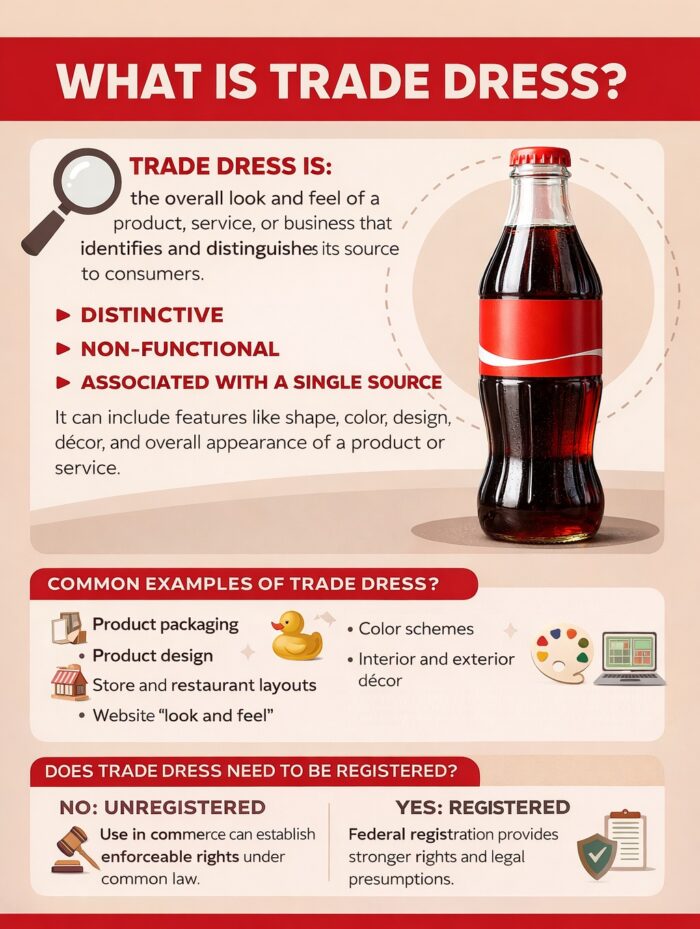
To register trade dress, a business may file a trade dress registration application with the U.S. Patent and Trademark Office (USPTO). Although trade dress rights can arise through use alone, federal registration provides significant advantages, including nationwide priority, statutory remedies, and enhanced enforcement options. Trade dress is typically examined by the USPTO for accurate depiction of the claimed trade dress, distinctiveness, and non-functionality, and registration often requires substantial evidence because trade dress claims are closely scrutinized.
Under 15 U.S.C. §1052(f), an applicant to register trade dress that is not inherently distinctive by proving evidence of acquired distinctiveness, such as long-term use, advertising, and consumer recognition. If it is found that the trade dress lacks sufficient distinctiveness, the trade dress may be registered on the supplemental register under 15 U.S.C. §1091. Federal rule 37 C.F.R. §2.41 sets out the procedural requirements for claiming acquired distinctiveness, including the types of evidence the USPTO may accept. Depending on the strength of the evidence, applicants may seek registration on the principal register or, as an interim step, the United States supplemental register.
Use in commerce can create common law rights in trademarks and trade dress, even without federal registration, a concept commonly referred to as common law protection. When a business consistently uses a distinctive, non-functional trade dress in connection with its goods or services, enforceable rights can arise based solely on consumer recognition in the relevant market. These common law trade dress rights are generally limited to the geographic areas where the trade dress is actually used and recognized, but they can still be powerful tools in stopping copycats engaging in unfair competition.
It should be understood that common law rights are only established and maintained if the trade dress is used continuously in commerce and is not abandoned. 15 U.S.C. §1127 defines “use in commerce” and “abandonment”. Under §1127, a mark or trade dress is deemed abandoned if its use has been discontinued with intent not to resume, or if the owner’s conduct causes the trade dress to lose its significance as a source identifier. Failure to enforce trade dress rights, such as tolerating widespread imitation, can lead to a loss of exclusivity because the trade dress no longer distinguishes a single source in the consumer’s mind. As a result, active monitoring and enforcement are essential to preserve common law protection and long-term trade dress rights.
Trade dress protects the distinctive, non-functional features that make a product or service immediately recognizable to consumers, whether those features appear in product packaging, product configuration, store design, or other elements that create a consistent overall appearance. Importantly, trade dress can be protectable whether it is registered or unregistered. Businesses may obtain federal registration through the U.S. Patent and Trademark Office, but enforceable trade dress rights can also arise through use in commerce under common law, so long as the trade dress is sufficiently distinctive and serves as a source identifier.
When valid trade dress rights are infringed, trademark law provides meaningful remedies. Courts may issue injunctions to stop confusingly similar use, award monetary damages and disgorgement of profits, and in exceptional cases grant attorneys’ fees. For well-known, protected trade dress, dilution claims may also be available even without direct consumer confusion. Together, these protections allow businesses to preserve the commercial value of their brand identity and prevent competitors from trading on their hard-earned goodwill.
Trade dress is a valuable form of brand protection and intellectual property. Consumer-oriented brands should consider distinctive trade dress to differentiate and protect their branding.
If you have a trade dress issue or other intellectual property matter, contact our office for a free consultation.
© 2026 Sierra IP Law, PC. The information provided herein does not constitute legal advice, but merely conveys general information that may be beneficial to the public, and should not be viewed as a substitute for legal consultation in a particular case.
If you have developed an invention, built a technology-driven business, or are preparing to commercialize new technological innovations, you have likely encountered overlapping terms such as patent attorney vs lawyer, patent lawyer, intellectual property lawyer, and patent agent. The labels sound similar, but the underlying authority, training, and permitted scope of work can differ in ways that matter immediately to your strategy, budget, and risk profile.
This is not merely a terminology issue in intellectual property law. The distinction affects who can file patent applications, who can handle prosecuting patent applications before the patent office, who can provide legal advice beyond United States Patent and Trademark Office (USPTO) practice, and who can represent clients in court when a dispute becomes litigation. In practical terms, selecting the right professional impacts the strength of your patent rights, the enforceability of your intellectual property rights, and the quality of legal protection you ultimately obtain.
This article explains the key differences among these roles, how they fit into IP law and broader business needs, and how to match the right legal counsel to the specific legal matters you are facing.
The simplest framing for patent attorney vs general attorney (non-patent attorney or lawyer) is this: all patent attorneys are attorneys (lawyers), but not all attorneys are qualified to handle patent matters.
A patent attorney is both (1) admitted to a state bar and authorized to practice law and (2) registered to practice before the USPTO after passing the patent bar exam, also referred to as the patent bar examination. That registration is what allows the practitioner to appear before the USPTO in patent prosecution and to engage in patent related matters before the agency.
By contrast, a general lawyer may have substantial legal expertise across corporate transactions, employment, privacy, contracts, or disputes, but without USPTO registration that lawyer generally cannot independently prosecute patent applications. In many startups and operating companies, that general attorney role is still essential because there is a broad range of business needs and legal issues beyond the patent pipeline.
This distinction is often misunderstood because the phrase “lawyer” is broad. A person may be an excellent commercial attorney with significant legal training and still be unable to draft and submit a patent application to the USPTO as a registered practitioner. When your next step involves patent prosecution, or patent advice and counseling, you need an attorney with the proper expertise and licensing.
“Patent attorney” and "patent lawyer" are used interchangeably. These professionals typically has:
Because of those credentials, a patent attorney can draft patent applications, communicate with the USPTO, and handle complex issues of patent law during patent examination. Importantly, patent attorneys can also provide legal advice in areas outside patent prosecution, including disputes, contracts, and strategy, subject to the rules of the jurisdictions in which they are admitted.
A patent agent is also registered to practice before the USPTO, but is not a licensed attorney. A patent agent generally has:
A patent agent can draft and prosecute patent applications before the USPTO. In other words, both patent agents and patent attorneys can handle USPTO patent prosecution work. The difference is that the patent agent is not licensed to practice law and generally cannot provide legal advice beyond the narrow scope permitted for USPTO practice.
An intellectual property lawyer (often called an IP lawyer) practices in the distinct areas of intellectual property, which may include patents, trademark law, copyright law, and trade secrets. In many organizations, the term IP attorneys signals a team that covers multiple IP disciplines and the various aspects of brand, content, technology, and confidentiality protection.
Not every IP lawyer is registered for USPTO patent practice. An IP lawyer may focus on trademarks and copyright and may collaborate with a registered patent practitioner when patent prosecution is needed. This division of work is common and often efficient.
A non-patent attorney may be a corporate lawyer, commercial attorney, employment counsel, privacy counsel, or trial counsel. That lawyer may provide broad legal counsel, draft and negotiate a wide array of agreements, and manage disputes. However, unlike patent attorneys, a general lawyer who is not registered with the USPTO typically cannot take primary responsibility for patent prosecution tasks such as drafting claims and responding to USPTO office actions.
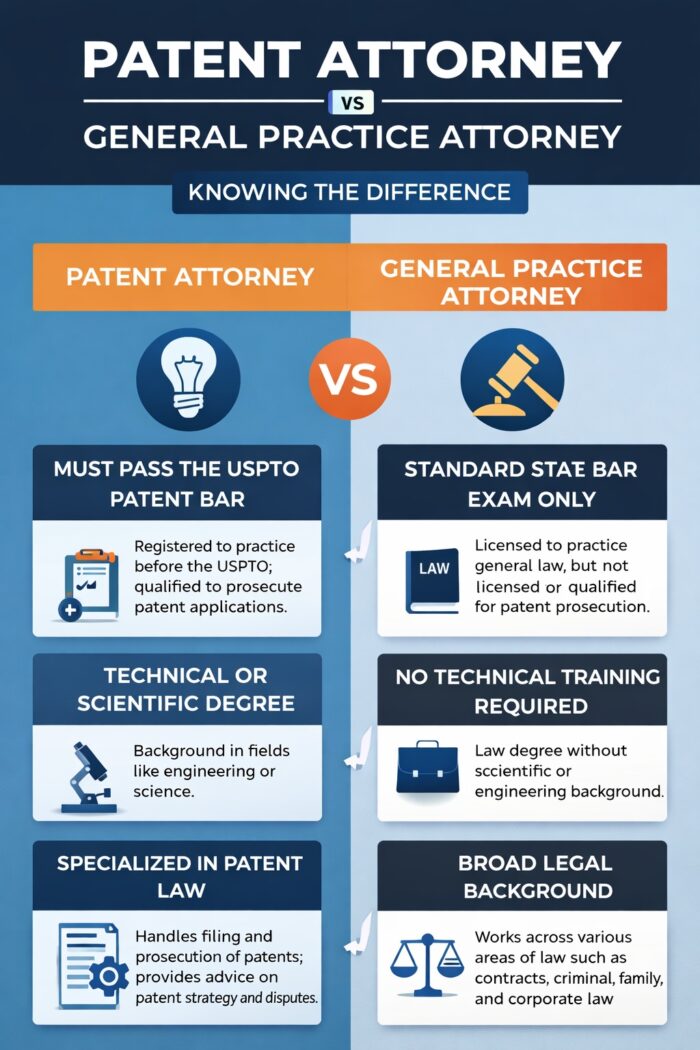
Patent attorneys operate at the intersection of technology and law, translating inventions into enforceable rights. Their specialized knowledge is not limited to writing documents; it includes how the USPTO evaluates patent applications for novelty, obviousness, and formalities, how patent statutes and rules apply to the patent application process, and how claim language later performs in enforcement and licensing.
Key roles of patent attorneys include:
This is the heart of prosecuting patent applications, and it is often where technical understanding directly shapes outcomes. A practitioner with the right technical grounding can better describe the invention, anticipate examiner objections, and build a claim set that aligns with commercial objectives.
Patent prosecution is rarely a single filing. Companies often develop families of applications that mirror product roadmaps. Patent attorneys advise on portfolio architecture, including:
This is where patent strategy meets business strategy, and it is a common reason companies retain patent counsel even when they have strong in-house business counsel.
Patents are frequently monetized through contracts. Patent attorneys often provide transactional work involving:
In many cases, patent counsel drafts contracts that are closely tied to patent assets, particularly where the agreement depends on claim scope or prosecution history.
Patent rights are only as valuable as the ability to enforce them. Patent attorneys may advise on:
While many organizations distinguish between prosecution counsel and trial counsel, the technical and legal analysis underlying infringement and validity is often grounded in the prosecution record. For that reason, prosecution-oriented patent attorneys frequently play a meaningful role in infringement cases even when a separate litigation team leads court proceedings.
Many business needs surrounding innovation are not patent prosecution tasks. A general lawyer or IP-focused lawyer can be indispensable for commercial operations, compliance, employment, transactions, and dispute management.
A non-patent lawyer often handles:
These professionals often operate in-house within legal departments or externally through law firms, and they may manage the overall legal function while specialized patent counsel handles USPTO prosecution, intellectual property disputes, and IP licensing.
Many companies require an IP strategy beyond patents. An IP lawyer who focuses on non-patent areas may handle:
This broader scope is often described as a broader range of intellectual property ip work, especially for companies whose value includes brand identity, code, data, and proprietary processes.
General litigators can provide substantial value in disputes involving contracts, business torts, and complex commercial claims. They may also coordinate or co-lead matters that include IP components, particularly where the dispute spans multiple claims and forums. In many cases, patent-specific issues are handled by registered practitioners or specialized litigators, while the broader case is managed by a litigation team with deep courtroom experience.
People often search variations such as attorney vs patent or “patent attorney versus general lawyer.” Those searches reflect a real confusion: the term “attorney” identifies a legal license, but the patent system adds an additional layer of registration and technical eligibility.
In practical terms, the meaningful divide is not whether someone is called an attorney; it is whether that attorney is also registered to prosecute patents before the USPTO and whether that person has the technical literacy to draft a defensible patent application that aligns with the invention.
The right answer depends on the task in front of you. A professional, risk-based approach focuses on what you must accomplish, which rights are at stake, and which professional is legally authorized to deliver that outcome.
A patent attorney is usually the appropriate choice when you need patent-specific work that intersects with broader legal risk, such as:
Be prepared to discuss your invention with the patent attorney. Have a compete invention disclosure for the patent attorney's review, understand your goals, and have questions ready to ask the patent attorney regarding how to achieve your goals related to pursuing a patent.
An IP lawyer or general lawyer is often the best fit when the matter is primarily contractual, operational, or dispute-based outside patent prosecution, including:
Selecting counsel is not only about credentials. It is also about timing, budget, and the intended business outcome.
Timing and Disclosure Control
Patent rights can be sensitive to timing and disclosure. Coordinating product launches, publications, demos, and partnership discussions with filing strategy can materially impact the strength of your patent position and the scope of legal protection available later. This is one reason businesses treat patent filings as part of a broader commercialization plan rather than a standalone administrative step.
Deal Flow and Commercial Readiness
Where patents are central to the value of a business, the quality of the prosecution record and claim drafting can affect licensing value. At the same time, contract infrastructure matters. If your business is actively entering customer contracts or partnerships, the right legal coverage may be a general business lawyer who can quickly produce reliable commercial agreements, while patent counsel focuses on prosecution milestones.
Portfolio Economics
A patent portfolio is a long-term project. Beyond filing, prosecution includes office action responses, interviews, possible appeals, continuation practice, and coordination across jurisdictions. A strategic plan that matches prosecution activity to business milestones often produces better outcomes than reactive filings made at the last minute.
The practical takeaway is that the roles serve different functions, and those functions map to different risk profiles. Patent attorneys and patent agents provide USPTO-facing prosecution capabilities that are essential when you must draft and prosecute patent applications, respond to a patent examiner, and build enforceable patent rights. Patent attorneys also bring the ability to provide legal advice beyond prosecution and to coordinate enforcement strategy and dispute planning, including patent litigation, patent infringement, and patent transactions.
IP lawyers and general business lawyers deliver critical coverage across contracts, transactions, trademarks, copyright, and confidentiality programs. They protect the broader ecosystem of intellectual property, including brands and trade secrets, and they often support operational growth through reliable commercial contracting and dispute management.
Our firm handles all aspects of intellectual property law, including patents, trademarks, copyrights, trade secrets, and disputes and transactions in those areas. If you need assistance with a patent or other intellectual property matter, contact our office for a free consultation.
© 2026 Sierra IP Law, PC. The information provided herein does not constitute legal advice, but merely conveys general information that may be beneficial to the public, and should not be viewed as a substitute for legal consultation in a particular case.
A Notice of Allowance (NOA) is an official letter from the United States Patent and Trademark Office (USPTO) signaling that an application has cleared examination and is on track for grant. Receiving an NOA is a positive development. The NOA means your patent application is allowed and the patent claims have been approved by the examiner after any required office action responses. However, an NOA is not a granted patent yet. It comes with final responsibilities, like paying issue fees and filing additional documents, to actually obtain the patent. This article breaks down the Notice of Allowance process, explaining the next steps and how to avoid pitfalls on the way to issuance.
In the patent process, patent applications filed with the USPTO are examined to ensure that the claimed invention meets the patentability standards. The claim invention must be proper patentable subject matter, novel, and non-obvious, and must also meet the formality requirements of written description and enablement. A NOA is issued when the USPTO examiner determines that the application meets these requirements and is entitled to a patent under US patent law (i.e. all patentability requirements are met). This typically follows one or more rounds of patent examination and any necessary amendments and responses to office actions. The NOA is mailed to the correspondence address on record, which is usually the address of the applicant or their patent attorney. Importantly, the NOA indicates that the application has been allowed, meaning the patent office has approved the claims, but it is not yet an issued patent.
A patent Notice of Allowance consists of an official letter and an attached “Fee(s) Due” form (Fee Transmittal Form PTOL-85B). The notice lists key details like the application number, inventor name, the title of the invention, and the date the Notice of Allowance was mailed. It also includes a summary of the allowed claims and a notice of allowability document explaining any examiner remarks about the allowance. Crucially, the NOA specifies a sum constituting the issue fee that must be paid for the patent to issue. This is the last fee in the patent application process, after which the patent can be granted.
The issue fee is a fee due upon allowance of a patent application. The Notice of Allowance will state the total amount due, which includes the issue fee and the deadline for paying the fee. The post-allowance fees set by the patent office no longer include a required publication fee. The issue fee can vary based on the type of application (utility application, design application, or plant patent application) and entity status (small or micro entities receive discounts). The fee(s) due form attached to the NOA (PTOL-85B) will itemize the correct issue fee and indicate if a publication fee is required, indicating the exact amount to pay. It is critical to pay such fees in time to avoid losing your application.
Paying the issue fee is straightforward, and the USPTO gives several options. To advance the patent application to a granted patent, the applicant files the Fee Transmittal form (PTOL-85B) included with the NOA and the required issue fee payment. This form can be mailed back with a check or credit card details, or you can pay electronically via the USPTO’s online systems. Many applicants opt to pay online or use a USPTO deposit account. A deposit account is a pre-funded USPTO account. An authorization to charge a deposit account for the issue fee can be filed for an individual application after the NOA is received. The NOA form allows you to authorize payment from a deposit account identified in the form or to include credit card payment via a PTO-2038 form. Regardless of method, be sure to include the application number and fee transmittal form so the payment is properly applied to your application.
By law, the issue fee must be paid within three months from the NOA’s mailing date. This is a strict deadline. No extensions of this deadline are allowed by the USPTO, unlike some other patent deadlines. There are no extension requests that can be filed. If you miss the due date and fail to pay the required fees by the end of the three-month window, the application will be regarded as abandoned by the USPTO. An abandoned application means you lose the opportunity to get the patent, unless you take extra steps to revive it, which can be costly and uncertain. Thus, timely payment is critical to avoid abandonment of your allowed patent application.

If you fail to pay the issue fee by the deadline and the application goes abandoned, you would have to file a petition to revive the application, showing that the delay in payment was unintentional, in order to continue forward. There is also a significant fee that must be paid with the petition. It’s far better to avoid this situation altogether by paying on time. Here are some tips to prevent errors:
Once the issue fee and any publication fee are paid, the USPTO processes the application for issuance. The patent will be scheduled for issuance and grant as a United States Patent. Typically, the USPTO issues the patent within a few weeks after fee payment, usually about 4–6 weeks. The USPTO will send an Issue Notification to the applicant, which is a notice telling you the scheduled patent number and issue date of your patent. The issue date is when your patent rights officially begin.
As of recent practice, Issue Notifications are generally sent out 2-3 weeks before the patent issues. The patent number is assigned just before issuance and will be listed on this notification. Upon issuance, the USPTO will publish the patent document and mail out a patent certificate. At that point you have an enforceable patent.
After an NOA but before issuance, applicants who want to make further changes or pursue additional claims can file a continuation application, while the original case is allowed. Such submission should ideally be done before paying the issue fee or at least before the patent actually issues. Once the patent issues, you lose the option to pursue further patent coverage through a continuation application.
A Notice of Allowance signals approval of your application and lays out the final steps needed to obtain your patent rights. That means paying the issue fee to get your patent granted. This will transition from an allowed application to an official United States patent. Before the Notice of Allowance is mailed, the patent examiner must be convinced that your claimed invention is patentable. The patent examination process can be complex and confusing.
If you need assistance with the patent filing and examination process, you should seek the assistance of a qualified patent attorney. A skilled patent attorney can ensure all formalities and substantive issues are handled correctly.
Contact our office if you are pursuing a patent or other intellectual property matter for a free consultation.
© 2026 Sierra IP Law, PC. The information provided herein does not constitute legal advice, but merely conveys general information that may be beneficial to the public, and should not be viewed as a substitute for legal consultation in a particular case.

Sierra IP Law, PC - Patents, Trademarks & Copyrights
FRESNO
7030 N. Fruit Ave.
Suite 110
Fresno, CA 93711
(559) 436-3800 | phone
BAKERSFIELD
1925 G. Street
Bakersfield, CA 93301
(661) 200-7724 | phone
SAN LUIS OBISPO
956 Walnut Street, 2nd Floor
San Luis Obispo, CA 93401
(805) 275-0943 | phone

SACRAMENTO
180 Promenade Circle, Suite 300
Sacramento, CA 95834
(916) 209-8525 | phone
MODESTO
1300 10th St., Suite F.
Modesto, CA 95345
(209) 286-0069 | phone
SANTA BARBARA
414 Olive Street
Santa Barbara, CA 93101
(805) 275-0943 | phone
SAN MATEO
1650 Borel Place, Suite 216
San Mateo, CA, CA 94402
(650) 398-1644. | phone
STOCKTON
110 N. San Joaquin St., 2nd Floor
Stockton, CA 95202
(209) 286-0069 | phone
PORTLAND
425 NW 10th Ave., Suite 200
Portland, OR 97209
(503) 343-9983 | phone
TACOMA
1201 Pacific Avenue, Suite 600
Tacoma, WA 98402
(253) 345-1545 | phone
KENNEWICK
1030 N Center Pkwy Suite N196
Kennewick, WA 99336
(509) 255-3442 | phone
2023 Sierra IP Law, PC - Patents, Trademarks & Copyrights - All Rights Reserved - Sitemap Privacy Lawyer Fresno, CA - Trademark Lawyer Modesto CA - Patent Lawyer Bakersfield, CA - Trademark Lawyer Bakersfield, CA - Patent Lawyer San Luis Obispo, CA - Trademark Lawyer San Luis Obispo, CA - Trademark Infringement Lawyer Tacoma WA - Internet Lawyer Bakersfield, CA - Trademark Lawyer Sacramento, CA - Patent Lawyer Sacramento, CA - Trademark Infringement Lawyer Sacrament CA - Patent Lawyer Tacoma WA - Intellectual Property Lawyer Tacoma WA - Trademark lawyer Tacoma WA - Portland Patent Attorney - Santa Barbara Patent Attorney - Santa Barbara Trademark Attorney
