In today’s knowledge-based economy, businesses must understand the value of intellectual property (IP). Intellectual property plays a central role in how businesses create and protect their value. Intellectual property refers to intangible assets that are legally protected, including patents, trademarks, copyrights, and trade secrets. IP is capable of generating substantial economic benefits. These intellectual property assets often represent a significant portion of a company’s overall business value. Thus, understanding the economic value of IP assets is critical for informed business strategy.
Moreover, valuing IP assets is required across a range of financial processes, including financial reporting, tax planning, and dispute resolution. Well-executed intellectual property management and valuation enables businesses to maximize the value of their IP assets and align their IP protection strategies with long-term success.
Intellectual property is legally protected, transferable, and capable of generating economic benefits and monetary value. Common forms of intellectual property rights include patents, trademarks, copyrights, and trade secrets, each of which can be owned, licensed, enforced, or incorporated into a company’s business model.
Under the Patent Act, a patent confers “the right to exclude others from making, using, offering for sale, or selling” the claimed invention under 35 U.S.C. § 154, thereby creating a legally enforceable exclusivity that drives future economic benefits and competitive advantage. Patents are also expressly treated as personal property that can be assigned or licensed, reinforcing their status as valuable IP assets within broader business assets. See 35 U.S.C. § 261.
Similarly, copyright law grants a bundle of exclusive rights, including reproduction, distribution, and public display under 17 U.S.C. § 106, that allow the owner to control and monetize creative works, forming the basis for future cash flows and licensing revenue. These exclusive rights make copyrights a central category of intellectual property assets with measurable economic value.
Trademark rights, governed primarily by the Lanham Act, protect brand identifiers such as names, logos, and slogans that distinguish goods or services in commerce. Federal trademark registration provides nationwide priority and evidentiary advantages, including prima facie evidence of validity and ownership under 15 U.S.C. § 1057(b). These rights enable a business to prevent confusingly similar uses under 15 U.S.C. § 1114, preserve goodwill, and maintain brand-driven future revenue potential, making trademarks particularly valuable intellectual property assets tied to customer recognition.
For trade secrets, the Defend Trade Secrets Act defines protectable information as that which “derives independent economic value… from not being generally known” and is subject to reasonable efforts to maintain secrecy under 18 U.S.C. § 1839(3). The statute also provides a federal civil cause of action for misappropriation under 18 U.S.C. § 1836, reinforcing that secrecy itself can create substantial IP value when it preserves a competitive advantage.
IP assets essentially derive their value from their intrinsic value (e.g., the improvements provided by an invention, the market value of a copyrighted work, etc.) in combination with the statutory framework that prevents others from using the IP asset. The legal rights provided by the statutory framework allow the owner of the IP asset to exclude competitors, and the capacity to produce future benefits through commercialization, licensing, or strategic deployment within a company’s operations.
IP assets can be independently identified, transferred, and monetized through structured commercial arrangements. IP can be licensed, sold, or pledged as collateral, enabling businesses to unlock economic benefits and create additional income streams. Moreover, strong IP portfolios may serve as signals of reduced risk and future revenue potential in financing and M&A contexts. Valuing intellectual property helps establish enhanced market value, collateral, and accurate financial assessments of a business.
Registered IP rights strengthen IP protection, reduce copying risk, and support economic growth because they provide legally enforceable exclusivity grounded in statute. For example, patents confer a right to exclude others from making, using, or selling the claimed invention under 35 U.S.C. § 154, while trademark registrations under 15 U.S.C. § 1057 provide nationwide priority and evidentiary presumptions of validity and ownership. Copyright law similarly grants exclusive rights to reproduce and distribute protected works under 17 U.S.C. § 106, and trade secrets are protected so long as they derive independent economic value from not being generally known under 18 U.S.C. § 1839(3). These intellectual property assets therefore provide the legal power to prevent third parties from using or exploiting protected subject matter, preserving future economic benefits and reinforcing a company’s competitive advantage. At the same time, because IP rights are enforceable in court and transferable, courts and regulators routinely require reliable intellectual property valuation methodologies to quantify their monetary value in disputes, transactions, and reporting contexts.
In the legal dispute context, courts often rely on the hypothetical negotiation framework set forth in Georgia-Pacific Corp. v. U.S. Plywood Corp., 318 F. Supp. 1116 (S.D.N.Y. 1970), which remains a foundational approach for determining reasonable royalty damages in patent litigation. This framework incorporates detailed financial analysis of expected future cash flows, established licensing practices, and comparable agreements to estimate the present value of the use of the IP. Similar reasoning applies in copyright litigation cases, where damages may include the fair market value of a license under 17 U.S.C. § 504. In trade secret litigation cases, courts may award a reasonable royalty based on the value of the misappropriated information. See University Computing Co. v. Lykes-Youngstown Corp., 504 F.2d 518 (5th Cir. 1974). These authorities underscore that valuing intellectual property in litigation is inherently tied to estimating the economic value of the rights at issue using recognized IP valuation methods.
Transfers of IP assets also have significant tax implications. For example, related entities that transfer intellectual property assets between them must determine objective arm’s-length pricing for those intangible transfers. These rules require the use of reliable valuation methods, often grounded in the income approach, market method, or other accepted financial processes, to ensure that intercompany transactions reflect what unrelated parties would have agreed to under comparable circumstances. Consequently, intellectual property valuation is integral to financial management, tax compliance, and broader business strategy, and must be carefully considered in the internal management of the business to properly account for IP assets, support financial statements, and avoid regulatory exposure.
IP value rises when legal protections are broad, durable, and enforceable, because those protections are what allow an owner to exclude competitors and capture economic benefits from intellectual property assets. For patents, the statutory right to exclude under 35 U.S.C. § 154, coupled with infringement liability under 35 U.S.C. § 271, directly underpins the ability of a patent holder to control use and monetize the invention over its remaining term, making scope, validity, and duration central to future revenue potential and future benefits.
Under the Lanham Act, federal trademark registration provides significant evidentiary advantages, and it can serve as conclusive evidence of validity and exclusive right to use in commerce, reinforcing brand-based competitive advantage and preventing damage to a brand.
Copyright law similarly grants exclusive rights to reproduce, distribute, and display works under 17 U.S.C. § 106, but enforcement generally requires copyright registration for U.S. works, making registration a practical prerequisite to realizing the monetary value of those rights. See 17 U.S.C. § 411. In Fourth Estate Pub. Benefit Corp. v. Wall-Street.com, LLC, 586 U.S. 296 (2019), the Supreme Court confirmed that registration, not merely application, is required before suit.
For trade secrets, the Defend Trade Secrets Act defines protectable information as that which derives independent economic value from not being generally known and is subject to reasonable efforts to maintain secrecy under 18 U.S.C. § 1839(3). This statutory definition ties economic value directly to secrecy itself, if confidentiality is lost, so too is the asset’s value. Courts consistently emphasize this connection, recognizing that the value of a trade secret lies in its ability to provide a competitive advantage through exclusivity.
More broadly, these legal frameworks allow intellectual property rights to be enforced in court, enabling licensing, assignment, and other commercial arrangements based on exclusivity. As a result, the strength, scope, and enforceability of those rights directly influence whether an IP owner can extract economic value, gain market advantage, and ultimately realize the full value of intellectual property over time. Intellectual property creates value in a business through these legal mechanisms.
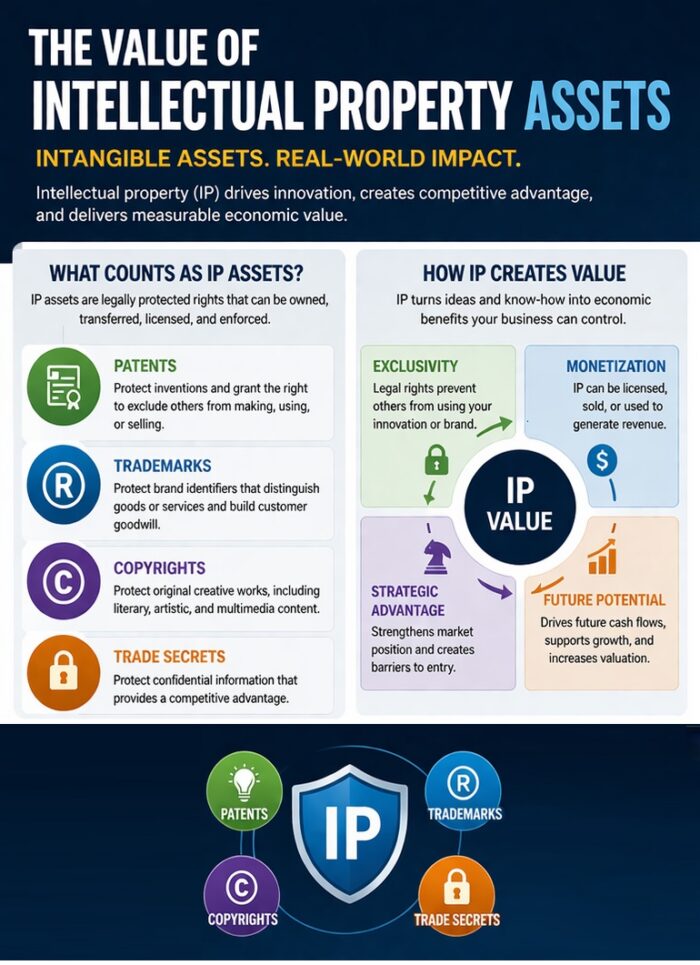
Intellectual property valuation is the process of determining the monetary value of intellectual property assets based on their ability to generate future economic benefits, such as future cash flows, licensing revenue, or strategic competitive advantage. For business owners, valuing IP assets is essential for financial reporting, negotiating licensing deals, securing financing, supporting mergers and acquisitions, and guiding internal management decisions about how to deploy and protect IP rights.
The valuation process requires gathering information about the asset’s legal strength, market demand, commercial use, and role in the company’s business model, along with broader financial analysis of expected future income and risk. Because intellectual property assets are intangible assets, their quantifiable value must be inferred through structured financial processes rather than direct observation.
The primary methods for valuing intellectual property are the income method, market method, and cost method. The income approach estimates the present value of expected cash flows or royalties attributable to the IP. The market method compares the asset to comparable IP or similar assets in a well-established market, while the cost method considers the historical cost or replacement cost of creating the asset.
Choosing the appropriate valuation method depends on factors such as the valuation date, the asset’s legal protections, availability of market comparables, and the purpose of the valuation: i.e., whether for a transaction, litigation, tax planning, or strategic planning. No single valuation method fits every situation. Accurate IP valuation requires selecting the approach that best captures the asset’s future revenue potential and overall contribution to the company’s assets, ensuring that the resulting valuation reflects real-world economic benefits provided by the company's IP, rather than theoretical assumptions.
The income approach is the most commonly used method for revenue-producing IP assets. It estimates present value from future cash flows, positive cash flows, cost savings, or an expected income stream. This approach makes sense when the asset already helps the company generate revenue or has clear future revenue potential. In licensing and damages settings, determining royalty rates often starts with the hypothetical negotiation framework from the Georgia-Pacific Corp. approach.
The market approach values intellectual property by comparing the subject asset to comparable IP, similar assets, or real-world transactions such as licenses, assignments, or sales in a well established market. This method is grounded in supply-and-demand principles and asks what buyers have actually paid for comparable rights under similar conditions. It is particularly useful for trademarks, software, and other intellectual property based businesses where there is tangible evidence of prior deals, including royalty rates or purchase prices. However, applying the market approach can be challenging because many IP assets have unique or novel characteristics, and reliable public data is often limited. Differences in industry, geography, exclusivity, and field of use can also affect comparability. Despite these limitations, when appropriate comparables exist, the market approach can provide reliable benchmarks and help establish approximate values grounded in real commercial activity.
The cost method is an IP valuation method used when an IP asset essentially lacks a proven income stream. This valuation method estimates the monetary value of intellectual property assets by calculating what it would cost to recreate, replace, or design around the asset, including historical cost, development time, prosecution expense, and technical risk. As part of the broader valuation process, it helps establish approximate values where market data or future cash flows are uncertain. The cost approach is commonly applied to early-stage patents, copyrights, and trade secrets that have not yet demonstrated future economic benefits. However, proper valuation requires recognizing that cost does not always equal fair value. An asset may have low development cost but high economic value, or significant investment but limited economic benefits if it fails to generate revenue.
The valuation process requires gathering license agreements, sales records, margins, market studies, prosecution files, chain-of-title documents, and commercialization evidence. Because IP is less visible than other business assets, proper valuation depends on tangible evidence: contracts, customer demand, renewal history, legal scope, and adoption data. The valuation process also asks what cash flows are actually attributable to the IP, rather than to goodwill, other intangible assets, or ordinary operating functions.
Several factors move the value of intellectual property up or down, including remaining enforceable term, claim scope, validity risk, infringement risk, market size, substitutability, brand strength, and scalability. Licensing history is particularly important, often providing a practical benchmark for determining value and assessing damages. For example, in patent cases royalty expectations must respect legal limits on duration. In Kimble v. Marvel Entertainment, LLC, 576 U.S. 446 (2015), the Court confirmed that royalties generally cannot extend beyond patent expiration, directly impacting discounted cash-flow models and reinforcing that the value of intellectual property is tied to enforceability and duration of rights.
A formal intellectual property valuation is critical whenever a business must determine the fair value or monetary value of its intellectual property assets for strategic, legal, or financial purposes. In practice, IP valuation is most commonly needed before major licensing deals, mergers, acquisitions, fundraising, or other commercial arrangements based on IP, where parties must agree on the economic value of IP assets and projected future cash flows. It is also essential for financial reporting, tax compliance, and other various financial processes.
Beyond transactions, valuing intellectual property is often required in legal disputes, including infringement or damages analyses, where courts expect a proper valuation supported by reliable financial analysis and expert testimony under Federal Rule of Evidence 702 and Daubert v. Merrell Dow Pharmaceuticals, Inc., 509 U.S. 579 (1993). Businesses also rely on accurate IP valuation for internal management, portfolio optimization, and assessing future economic benefits tied to their intellectual property rights.
The value of intellectual property is found in its ability to create revenue, sustain a competitive advantage, and contribute meaningfully to a company’s overall economic value. Intellectual property assets are not merely abstract rights, they are valuable assets that can produce revenue and a competitive advantage in the marketplace. Additionally, IP valuation and analysis can be a key component of business strategy, informing decisions about commercialization, enforcement, and investment in particular IP assets. Businesses that manage their intellectual property assets are better positioned to capitalize on their innovations, mitigate risk, and maximize the long-term value of their intellectual property.
If you need assistance with an intellectual property matter, please contact our office for a consultation.
© 2026 Sierra IP Law, PC. The information provided herein does not constitute legal advice, but merely conveys general information that may be beneficial to the public, and should not be viewed as a substitute for legal consultation in a particular case.
Trade secret misappropriation can cause significant damage to a company. Under federal law, the Defend Trade Secrets Act (DTSA), enacted in 2016, creates a federal civil cause of action allowing a trade secret owner to bring trade secret misappropriation claims in federal court for the unlawful acquisition, disclosure, or use of a company’s trade secrets, including through improper means such as theft, breach of confidentiality, or unauthorized access under 18 U.S.C. § 1836. The DTSA operates alongside the Uniform Trade Secrets Act (UTSA), which has been adopted in most jurisdictions and provides a parallel framework under state laws for addressing trade secrets misappropriated through improper use or disclosure. We discuss herein the requirements and legal standards for trade secret misappropriation claims.
Trade secrets may include formulas, processes, software code, pricing, manufacturing methods, customer lists, referral lists, and other secret information or proprietary information. Under federal trade secret law, the Defend Trade Secrets Act (DTSA) defines a trade secret broadly to include financial and business information, and technical data, provided that the information “derives independent economic value” from not being generally known and is not readily ascertainable through proper means under 18 U.S.C. § 1839(3). Courts applying this statute have emphasized that the trade secret owner must do more than simply label information as confidential; the company must take reasonable steps under the circumstances to maintain secrecy, such as restricting access and using nondisclosure agreements. For example, courts have held that failure to implement meaningful safeguards can defeat trade secret claims because the information is not truly secret within the meaning of the statute.
Similarly, the Uniform Trade Secrets Act, which has been adopted across most U.S. jurisdictions, defines trade secrets in nearly identical terms, requiring that the information have independent economic value and be subject to reasonable efforts to maintain its secrecy. The DTSA does not displace state laws such as the Uniform Trade Secrets Act (UTSA), so trade secret claims are often pursued in federal and state courts together or in parallel. As of 2024 the UTSA had been adopted in 48 states, the District of Columbia, Puerto Rico, and the U.S. Virgin Islands.
Courts interpreting the UTSA have repeatedly held that information that is readily ascertainable through proper means, such as public sources or reverse engineering, does not qualify for protection, even if the company considers it sensitive. At the same time, courts recognize that materials like customer lists or pricing data may qualify as trade secrets where they reflect compiled, non-public business information that competitors could not easily duplicate. In practice, whether information qualifies as a trade secret often turns on the specific circumstances, including how the information was developed, who had access to it, and what steps the trade secret holder took to maintain its secrecy.
The Economic Espionage Act of 1996 establishes federal law criminal liability for trade secret misappropriation involving theft, improper use, or disclosure of a company’s trade secrets, particularly where the conduct benefits foreign entities or foreign governments or involves commercial advantage. Under 18 U.S.C. §§ 1831 and 1832, it is a crime to knowingly steal, acquire, or disclose trade secrets without authorization, including through improper means such as theft, breach of confidentiality, or espionage, where the information derives independent economic value and is used in interstate or foreign commerce.
Section 1831 specifically targets economic espionage intended to benefit foreign entities, while § 1832 addresses commercial trade secret misappropriation for private economic gain. Courts interpreting these provisions have emphasized that the statute applies broadly to confidential business information, including proprietary information, customer lists, and technical data that maintain secrecy and are not readily ascertainable. For example, in United States v. Chung, 659 F.3d 815 (9th Cir. 2011), the court upheld a conviction under 18 U.S.C. § 1831 where a defendant acquired sensitive aerospace trade secrets over many years and retained them with the intent to benefit the Chinese government, finding sufficient evidence that the information had economic value and was subject to reasonable efforts to maintain secrecy.
Similarly, in United States v. Aleynikov, 676 F.3d 71 (2d Cir. 2012), the court addressed the scope of 18 U.S.C. § 1832 in a case involving alleged theft of proprietary source code for high frequency trading, ultimately reversing the conviction based on the statutory requirement that the trade secret be “related to or included in a product that is produced for or placed in interstate or foreign commerce,” illustrating the importance of statutory elements in trade secret cases.
In United States v. Nosal, 844 F.3d 1024 (9th Cir. 2016), the defendant conspired with former employees to access and download confidential data from his former employer’s database after his credentials were revoked. The Ninth Circuit upheld criminal liability under the Economic Espionage Act, reinforcing that unauthorized access and misuse of proprietary information constitutes trade secret misappropriation under federal law.
The Economic Espionage Act also provides for significant civil and criminal penalties, including fines, imprisonment, and forfeiture, reinforcing that trade secret misappropriation can constitute both a civil offense and a federal crime. These provisions operate alongside the Defend Trade Secrets Act, which provides a federal civil cause of action for trade secret misappropriation claims under 18 U.S.C. § 1836, allowing trade secret owners to pursue remedies in federal court while criminal enforcement proceeds under the Economic Espionage Act.
Not all confidential business information qualifies as a trade secret. The information must derive independent economic value because competitors or other persons cannot readily obtain it. A core requirement of a trade secret is whether the information derives independent economic value from not being generally known or readily ascertainable and whether the company took reasonable efforts to protect trade secrets and maintain secrecy. See 18 U.S.C. § 1839(3). In Kewanee Oil Co. v. Bicron Corp., 416 U.S. 470 (1974), the Supreme Court held that trade secrets are protectable intellectual property where secrecy provides economic value. Similarly, in InteliClear, LLC v. ETC Global Holdings, Inc., 978 F.3d 653 (9th Cir. 2020), the court held that plaintiffs must identify specific secret information and demonstrate that it derives independent economic value from its secrecy, reinforcing that generalized or publicly available business information does not qualify as protected trade secrets.
In practice, trade secret misappropriation often arises when a defendant acquires knowledge of proprietary information under circumstances giving rise to a duty to maintain secrecy, such as through nondisclosure agreements or employment relationships, and then engages in improper use or disclosure without express or implied consent. These principles are captured in the statutory framework under both federal law and state laws, which recognize that the unlawful acquisition and use of trade secrets, whether through employee misconduct, breach, or theft, can give rise to significant civil and criminal penalties, including injunctive relief and damages.
Trade secret misappropriation generally arises in two ways: (1) acquisition of a trade secret by improper means, or (2) disclosure or use of trade secrets without express or implied consent where the defendant knew or had reason to know that the information was acquired through improper means or under circumstances giving rise to a duty to maintain secrecy. This framework is codified in both federal law under the DTSA and under UTSA, which together form the backbone of modern trade secret law.
Under these statutes, “improper means” is broadly defined to include theft, bribery, misrepresentation, breach or inducement of a breach of a duty to maintain secrecy, and electronic espionage under 18 U.S.C. § 1839(6). Courts routinely apply this definition in trade secret cases involving employee misconduct or competitive intelligence gathering. For example, in E.I. duPont deNemours & Co. v. Christopher, 431 F.2d 1012 (5th Cir. 1970), the defendant used aerial photography to capture confidential plant construction details. The court held that even though the information was technically visible from the air, the conduct constituted improper means because it circumvented reasonable efforts to maintain secrecy, illustrating that misappropriation can occur even without physical trespass.
Importantly, not all acquisition or use of valuable business information constitutes misappropriation. The DTSA and UTSA expressly exclude lawful methods such as reverse engineering, independent derivation, or acquisition through proper means. This distinction was emphasized in Kewanee Oil Co., the Supreme Court recognized that competitors are free to discover trade secrets through legitimate means, even if the result is identical to the trade secret holder’s proprietary information.
Courts also frequently address situations involving breach of confidentiality obligations. In BladeRoom Group Ltd. v. Emerson Electric Co., 331 F. Supp. 3d 977 (N.D. Cal. 2018), the defendant allegedly obtained confidential data during a partnership and later used it to develop competing technology. The court allowed trade secret misappropriation claims to proceed, finding that acquisition and subsequent use under circumstances involving a duty of confidentiality satisfied the statutory definition of misappropriation.
As a practical matter, trade secret misappropriation often occurs when employees or business partners acquire knowledge of a company’s trade secrets through authorized access but later engage in improper use or disclosure. Courts analyze whether the defendant’s conduct violated confidentiality obligations, exceeded authorized access, or involved deceptive practices. These “circumstances giving rise” to a duty to maintain secrecy are central to many trade secret claims and frequently determine whether the conduct crosses the line into actionable misappropriation.
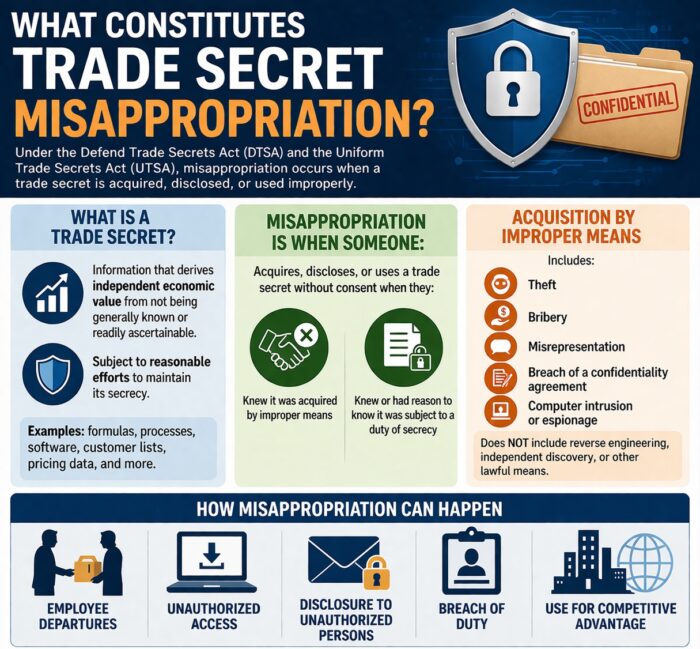
A classic trade secret misappropriation scenario arises when an employee departs and takes sensitive information, such as customer lists, pricing data, or source code, to a competitor. Both the DTSA and the USTA authorize courts to grant injunctive relief for actual or threatened misuse, but require evidence of improper use or threatened disclosure, not mere possession of knowledge. In PepsiCo, Inc. v. Redmond, 54 F.3d 1262 (7th Cir. 1995), a former executive joined a competitor with detailed strategic plans. The court held that inevitable disclosure of trade secrets justified an injunction based on likely misuse. However, courts generally reject restraints based solely on knowledge without evidence of threatened misappropriation. Accordingly, businesses should protect trade secrets through nondisclosure agreements, access controls, and disciplined offboarding, rather than relying primarily on non compete agreements.
In trade secret misappropriation claims under the Defend Trade Secrets Act and the Uniform Trade Secrets Act, plaintiffs must identify trade secrets with particularity, showing the information derives independent economic value from not being generally known and was subject to reasonable efforts to maintain secrecy. Courts require more than vague descriptions of business information or general know-how. In InteliClear, LLC, the court held that plaintiffs must clearly delineate the alleged trade secrets, rejecting conclusory “catchall” descriptions. Similarly, in Oakwood Labs. LLC v. Thanoo, 999 F.3d 892 (3d Cir. 2021), the court held that a complaint must plausibly allege both the existence of protectable trade secrets and specific acts of misappropriation, including acquisition by improper means or improper use or disclosure.
Plaintiffs must also prove the defendant acquired, disclosed, or used the trade secrets without consent under circumstances giving rise to a duty of secrecy under 18 U.S.C. § 1839(5). These standards apply in both federal court and under parallel state laws governing trade secret litigation.
Common defenses in trade secret misappropriation claims focus on whether the information qualifies as protected under trade secret law. Under the UTSA and the DTSA, defendants argue the information was generally known, readily ascertainable, independently developed, or obtained through reverse engineering or other proper means. As discussed above, the Supreme Court in Kewanee Oil Co. held that reverse engineering and independent discovery are lawful and defeat misappropriation. Defendants also assert disclosure occurred with express or implied consent or that plaintiffs failed to take reasonable steps to maintain secrecy. Courts routinely reject vague claims, as in InteliClear, LLC, which required specific identification of trade secrets. Additionally, UTSA implementation by individual states may preempt duplicative tort claims like tortious interference, limiting recovery to statutory or contractual theories.
Trade secret litigation under the Defend Trade Secrets Act provides robust remedies, including injunctive relief, actual-loss damages, unjust-enrichment damages, and a reasonable royalty where misappropriated trade secrets cannot be otherwise quantified under 18 U.S.C. § 1836(b)(3)(A). The Uniform Trade Secrets Act has similar provisions. Courts may award exemplary damages up to twice the damages amount and attorneys’ fees for willful and malicious misappropriation, reflecting the seriousness of trade secret claims under 18 U.S.C. § 1836(b)(3)(C)-(D). The DTSA also authorizes ex parte seizure in extraordinary circumstances to prevent dissemination of a company’s trade secrets under 18 U.S.C. § 1836(b)(2).
In PPG Industries Inc. v. Jiangsu Tie Mao Glass Co. Ltd., 47 F.4th 156 (3d Cir. 2022), the defendant, a competitor, used improperly acquired proprietary information to accelerate product development; the court held that damages could include avoided research-and-development costs as a measure of unjust enrichment. Similarly, courts applying Federal Rule of Civil Procedure 65 routinely grant injunctions to prevent ongoing disclosure or use, emphasizing that trade secret misappropriation remedies aim both to compensate the trade secret owner and to prevent further competitive harm.
In trade secret litigation, courts actively balance disclosure obligations with the need to protect trade secrets and other confidential business information. Federal Rule of Civil Procedure 26(c)(1)(G) authorizes courts to issue protective orders limiting access, requiring sealed filings, or permitting in camera proceedings to prevent disclosure of a company’s trade secrets. Similarly, the Defend Trade Secrets Act requires courts to “preserve the confidentiality of trade secrets” during litigation under 18 U.S.C. § 1835. The Uniform Trade Secrets Act provides similar protections.
Courts routinely enforce these safeguards. In In re Remington Arms Co., 952 F.2d 1029 (8th Cir. 1991), the court held that protective orders restricting disclosure of proprietary information were appropriate to prevent competitive harm. Courts will implement procedural mechanisms to maintain secrecy while allowing plaintiffs to pursue trade secret misappropriation claims without forfeiting protection.
To defend trade secrets, a company must show it took reasonable efforts to maintain secrecy, as required under the DTSA and the UTSA, both of which define trade secrets as information deriving independent economic value from not being generally known and subject to protection measures. Courts consistently enforce this requirement. In InteliClear, the court held that failure to clearly identify and protect alleged trade secrets can defeat claims. Practically, this means protections such as limiting access and using confidentiality nondisclosure agreements should be implemented and diligently enforced.
Also, under the Defend Trade Secrets Act, employers must provide DTSA whistleblower immunity notices in agreements governing confidential information. Courts have enforced this strictly, and failure to comply with 18 U.S.C. § 1833(b) can preclude recovery of exemplary damages and attorneys’ fees in a suit against a current or former employee, even where trade secret misappropriation is otherwise proven.
If you believe trade secrets have been misappropriated, act immediately to secure devices, preserve evidence, and cut off access, as courts routinely consider early conduct when evaluating injunctive relief under Federal Rule of Civil Procedure 65. The DTSA allows a trade secret owner to file a federal civil action and seek emergency relief, including injunctions and, in extraordinary circumstances, ex parte seizure of property to recover misappropriated trade secrets. See 18 U.S.C. § 1836(b). For example, in Henry Schein, Inc. v. Cook, 191 F. Supp. 3d 1072 (N.D. Cal. 2016), the court granted a preliminary injunction where a former employee retained and threatened to use confidential customer data, emphasizing the risk of ongoing disclosure.
In more serious cases involving theft, foreign entities, or coordinated improper use, criminal referral to the US Department of Justice through the local US Attorney's office may be appropriate under the Economic Espionage Act, which imposes fines and imprisonment for trade secret misappropriation involving interstate or foreign commerce. Delay can undermine trade secret claims, as courts require proof of what was acquired, how it was disclosed, and whether misuse is continuing.
Trade secret misappropriation presents a substantial legal and business risk to any company that relies on confidential or proprietary information. Assets such as customer lists, pricing strategies, technical processes, and other sensitive business information may qualify as trade secrets, but only where the trade secret holder can demonstrate that the information derives independent economic value from not being generally known and that reasonable steps were taken to maintain its secrecy. When these elements are satisfied, both federal and state laws, including the DTSA and the UTSA, provide robust remedies, including injunctive relief, damages, and, in some cases, enhanced penalties. However, where a company fails to adequately protect its information, courts may find that the material is readily ascertainable or insufficiently safeguarded, leaving it vulnerable to lawful use by competitors. Proactive protection and enforcement are therefore essential to preserving a company’s competitive advantage.
If you need assistance with trade secret matters or other intellectual property matters, please contact our office for a consultation.
© 2026 Sierra IP Law, PC. The information provided herein does not constitute legal advice, but merely conveys general information that may be beneficial to the public, and should not be viewed as a substitute for legal consultation in a particular case.
AI for patents is no longer a niche topic. Artificial intelligence, machine learning, neural networks, large language models, and other AI technology (generally referred to as "AI") are changing how practitioners search prior art, analyze data, prepare patent applications, and manage patent prosecution. But the question remains of whether AI is an effective and lawful tool for patent work. In the U.S. patent system, the key issues surrounding the use of AI in connection with patents are inventorship, patent eligibility, disclosure, claim quality, and security.
This is a new era for patents, but AI is not a game changer by itself. It is a tool that can improve efficiency, productivity, and patent intelligence in software, electronics, medical imaging, life sciences, and other fields. The United States Patent and Trademark Office (USPTO) says patent examiners have already conducted more than 1.3 million searches using AI tools, including patent searches that surface foreign prior art from over 60 countries, and the office’s ASAP! pilot system is testing automated pre-examination search notices. That shows how seriously the USPTO is treating AI-assisted analysis.
AI can be used as a tool for developing and refining an invention that was conceived by a human inventor. If the subject matter of a patent application is purely AI output, it is not a patentable invention under US patent law. The USPTO’s current guidance (USPTO Inventorship Guidance for AI-Assisted Inventions) makes clear that AI systems, including generative AI, are treated as instruments used by human inventors, not inventors themselves. The guidance emphasizes that there is no separate legal standard for AI-assisted inventions and that traditional inventorship law still applies, meaning only natural persons can be named as inventors and must have conceived the claimed invention.
In practice, that means AI may provide services, analyze data, and generate ideas, but it does not become an inventor. AI can help move inventors from a rough idea to a more specific solution. But patent law still asks who conceived the claimed invention, not who generated the first draft or suggestion. The human contribution remains the controlling factor.
Under current U.S. law, the answer remains no, AI cannot be an inventor. Title 35 defines an “inventor” as an “individual,” and courts have interpreted that term to mean a natural person. In Thaler v. Vidal, 43 F.4th 1207 (Fed. Cir. 2022), the applicant, Stephen Thaler, filed patent applications naming an artificial intelligence system (DABUS) as the sole inventor of two inventions: a "neural flame" and a "fractal container". The United States Patent and Trademark Office rejected the applications for failing to identify a human inventor, and the Federal Circuit affirmed. The court held that the statutory language of 35 U.S.C. § 100(f), which defines an inventor as an “individual,” unambiguously requires a human being. Because no natural person was named, the applications were defective and could not proceed.
Consistent with that holding, the USPTO’s revised 2025 guidance confirms that artificial intelligence, including generative AI, cannot be listed as an inventor or joint inventor in patent applications, even where AI systems play a significant role in generating ideas or assisting with the invention process. As a result, any patent application that identifies an AI system instead of a human inventor risks rejection or other corrective action under 35 U.S.C. §§ 100 and 115. In addition, each named inventor must properly execute or support an oath or declaration under 37 C.F.R. § 1.63, affirming their role in the conception of the claimed invention. This remains a core legal principle in the patent system: regardless of advances in artificial intelligence, inventorship, and the associated rights and obligations, must trace back to a human individual before a patent application can be validly filed.
The current rule in the patent system remains the traditional conception test, even in the age of artificial intelligence. The United States Patent and Trademark Office’s 2025 revised guidance confirms that there is no separate or modified legal standard for AI-assisted inventions. The key question is still whether a human inventor formed a “definite and permanent idea of the complete and operative invention,” which is the longstanding definition of conception in patent law.
If a human uses generative AI or large language models as tools, the analysis focuses on whether that individual exercised enough technical expertise and control over the process to form the invention. The AI system may assist with data processing, patent drafting, or generating options, but it cannot supply the required inventive contribution under current law.
This principle is illustrated by Burroughs Wellcome Co. v. Barr Laboratories, Inc., 40 F.3d 1223 (Fed. Cir. 1994), where the court held that conception requires a specific, settled idea, not just a general research plan or wish. In that case, the inventors identified AZT as a treatment for HIV based on prior research and testing, and the court found they had achieved conception because they could describe the invention with sufficient detail. Applied to AI technology, this means that simply prompting a system or reviewing outputs from machine learning or neural networks is not enough, there must be human intellectual contribution that rises to the level of a complete invention.
Where multiple humans collaborate, whether directly or through AI-assisted workflows, joint inventorship is governed by 35 U.S.C. § 116 and clarified by Pannu v. Iolab Corp., 155 F.3d 1344 (Fed. Cir. 1998). In Pannu, the court held that a joint inventor must (1) contribute in some significant manner to the conception of the invention, (2) make a contribution that is not insignificant in quality, and (3) do more than merely explain well-known concepts or follow instructions. The case involved intraocular lens technology, where one contributor’s role was evaluated to determine whether it rose above routine assistance. The court emphasized that joint inventorship requires meaningful participation in the inventive concept, not just execution or support.
Together, these authorities reinforce a consistent rule across AI-related inventions, software, life sciences, and other fields: inventorship turns on human contribution to conception of the novel elements of the invention, not on who operated the tools. Whether using an artificial neural network, a computer program, or other AI tools, the named inventors must have the knowledge, ability, and involvement necessary to articulate the invention with particularity in the patent application, including its patent claims and detailed descriptions.
Often yes, but AI for patents operates within the same legal framework as any other technology. AI-related inventions and AI-related patents must satisfy patent eligibility under 35 U.S.C. § 101, novelty under 35 U.S.C. § 102, non-obviousness under 35 U.S.C. § 103, and written description and enablement under 35 U.S.C. § 112. These requirements apply regardless of whether the invention involves artificial intelligence, machine learning, neural networks, or other advanced software tools.
Patent eligibility under § 101 is often the most contested issue for AI-related inventions. The Alice Corp. v. CLS Bank International, 573 U.S. 208 (2014) decision remains central. In Alice, the patents claimed a computerized scheme for mitigating settlement risk using a third-party intermediary. The Supreme Court of the United States held that merely implementing an abstract idea (intermediated settlement) on a generic computer does not make it patentable. The Court established the now-familiar two-step test: (1) determine whether the claims are directed to an abstract idea, and if so, (2) determine whether the claims include an “inventive concept” sufficient to transform the abstract idea into patent-eligible subject matter. This framework frequently applies to AI-related patents, especially where claims resemble data processing, prediction models, or algorithmic outputs performed on conventional computing systems.
That said, not all AI inventions are treated as abstract. Courts and the patent office have recognized that claims directed to specific technological improvements, rather than generalized data analysis, may satisfy § 101. For example, in Enfish, LLC v. Microsoft Corp., 822 F.3d 1327 (Fed. Cir. 2016), the Federal Circuit upheld claims directed to a self-referential database structure because they improved the way computers operate, rather than simply using computers as tools. Similarly, in McRO, Inc. v. Bandai Namco Games America Inc., 837 F.3d 1299 (Fed. Cir. 2016), the Federal Circuit found claims patent-eligible where they used specific rules to automate lip synchronization in animation, improving a technical process rather than claiming a broad abstract idea.
Consistent with these cases, the United States Patent and Trademark Office has issued guidance clarifying how examiners should evaluate AI technology. The USPTO’s 2024 subject matter eligibility guidance update explains that AI-related inventions are more likely to be patentable when the claims recite a specific improvement to computer functionality or another technical field, such as medical imaging, signal processing, or specialized hardware implementations of an artificial neural network.
In practice, this means that AI-related inventions framed as concrete technological solutions, rather than generalized data manipulation or mathematical concepts, stand a stronger chance of obtaining patent protection.
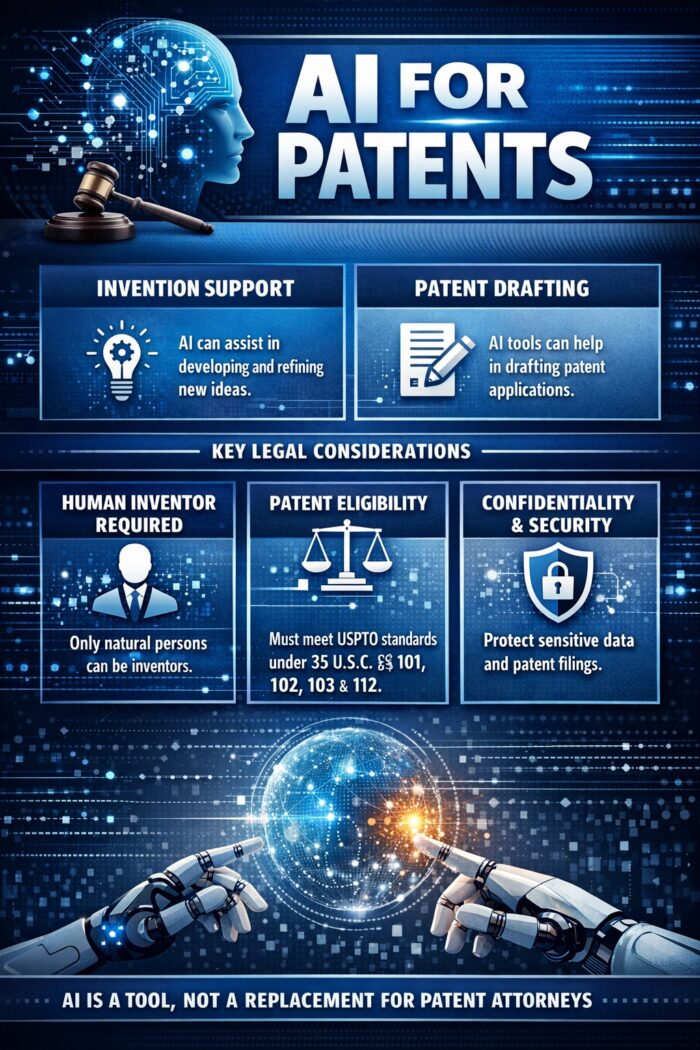
The best use of AI for patents is not replacing a patent attorney but improving early analysis. AI tools can use semantic search, natural language processing (NLP), and machine learning to review prior art, compare an invention disclosure to the field, identify related patents, and map competitive landscapes much faster than manual work alone. AI can assist as a patent drafting tool, but is generally not effective for single-prompt, one-shot drafting. It can be helpful in drafting certain sections (e.g., background sections) with effective prompting, but it is not a substitute for a professional patent drafter. AI is a valuable support tool for patent attorneys and patent practitioners handling repetitive tasks, but it cannot handle all patent tasks and matters.
AI can also help in patent prosecution, including office action responses. USPTO guidance recognizes that tools may be used to draft responses, but the signer still must review the paper, verify the facts, check citations, and ensure the arguments are warranted by law. Patent practitioners also remain subject to 37 C.F.R. § 11.303 and cannot make false statements of fact or law. That matters because office action responses can affect claim scope, estoppel, validity, and later enforcement. A polished AI draft with a bad citation can result in significant issues in the application and potential disciplinary action for the practitioner.
The biggest pitfalls are predictable: hallucinated prior art, incorrect case citations, overbroad claims, unsupported limitations, and invented technical detail. Under 37 C.F.R. § 1.56, people involved in filing and prosecution owe the patent office a duty of candor and good faith. Under 37 C.F.R. § 11.18, anyone presenting a paper certifies that the factual and legal contentions have evidentiary support after a reasonable inquiry. The USPTO specifically warns that parties cannot simply assume that output by an AI system is accurate. Specifications and drawings prepared with AI may not meet § 112 compliance. Before an application prepared using an AI tool is filed, the draft should be thoroughly reviewed for accuracy, completeness, and compliance with the disclosure requirements of 35 U.S.C. § 112.
Security is a concern when using AI for patents, particularly when handling unpublished inventions, patent applications, and sensitive intellectual property. If users input confidential invention disclosures into poorly governed AI tools, they risk unintended access, data leakage, or even loss of patent protection. The United States Patent and Trademark Office has expressly warned that some artificial intelligence systems may retain user inputs, use them to train models, or share them with third parties, raising serious concerns under 37 C.F.R. § 11.106, which imposes strict confidentiality obligations on patent practitioners.
In response, several AI companies have developed platforms specifically tailored for patent drafting, patent prosecution, and patent intelligence workflows with an emphasis on security. For example, DeepIP markets its system as offering highest security standards, including end-to-end encryption, strict data segregation, and controlled access environments. It also emphasizes seamless integration with tools like Microsoft Word while maintaining isolated processing pipelines to prevent cross-client data exposure.
Similarly, Solve Intelligence promotes secure collaboration features for drafting and office action responses, with safeguards designed to ensure that user data is not reused for model training without authorization. Rowan Patents and IP Author also highlight security-focused architectures, including sandboxed environments, jurisdiction-specific data handling, and compliance with standards such as SOC 2 and GDPR, features that are increasingly expected when dealing with global patent portfolios across various fields like life sciences, medical imaging, and software.
Inventors and patent attorneys should conduct careful diligence before using any AI system. This includes reviewing how the platform handles data retention, who has access to the data, whether the system uses inputs for training purposes, and what contractual support is provided in the event of a breach.
Conclusion
Inventors and patent practitioners will be using AI for patents more as the technology develops. AI can improve efficiency in invention development, prior art review, patent drafting, and patent prosecution. However, the law still requires human inventors, human responsibility, and human review. AI is not a replacement for inventors or patent attorneys. It is a tool that improves efficiency and reduces some of the tedious aspects of innovation and patent drafting.
If you have a patent matter or other intellectual property matter with which you need assistance, contact for a consultation.
© 2026 Sierra IP Law, PC. The information provided herein does not constitute legal advice, but merely conveys general information that may be beneficial to the public, and should not be viewed as a substitute for legal consultation in a particular case.
As of January 2, 2024, the United States Patent and Trademark Office (USPTO) is accepting applications for the newly created design patent practitioner bar. The design patent practitioner bar is a new form of patent agent license to practice before the USPTO in design patent applications. This new registration system under 35 U.S.C. § 2(b)(2)(D) and 37 C.F.R. Part 11 provides a new area of patent practice that allows for specialists in visual and graphic arts to provide their skills to clients. The agency says the new design patent bar is meant to open the USPTO’s doors more broadly, bring more people into the innovation ecosystem, and improve the robustness and reliability in the specific area of design patents.
A design patent protects the ornamental design of an article of manufacture (examples include clothing, vehicle designs, electronic device designs, beverage containers, etc.), not the way the item works. See 35 U.S.C. § 171. In other words, design patent law is concerned with how a product looks, not how it functions, making it especially important in industries driven by industrial design, graphic design, and other applied arts.
The leading design patent cases clarify how courts evaluate ornamental appearance. In Gorham Co. v. White, 81 U.S. 511 (1871), the Supreme Court considered competing designs for silverware handles. The accused products were not identical, but the Court held that infringement exists if, in the eyes of an ordinary observer, the two designs are substantially the same such that the resemblance would deceive a purchaser into buying one thinking it was the other. This case established the foundational “ordinary observer” test that still governs design patent matters today.
More than a century later, the Federal Circuit reaffirmed and refined that standard in Egyptian Goddess, Inc. v. Swisa, Inc., 543 F.3d 665 (Fed. Cir. 2008) (en banc). That case involved competing nail buffer designs used in the beauty industry. The court rejected earlier, more rigid point of novelty test and confirmed that the ordinary observer test, viewing the design as a whole in light of prior art, is the proper framework for determining infringement in design patent infringement cases. The decision emphasized that small differences do not avoid infringement if the overall visual impression remains substantially the same.
The above cases underscore a practical point: a design patent practitioner focuses on protecting the overall visual impression of a product. That role is distinct from a utility patent practitioner handling a utility patent, which protects how an invention works rather than how it looks.
Before this final rule, there was effectively only one patent bar for practice in patent matters before the Office. The USPTO published Representation of Others in Design Patent Matters Before the United States Patent and Trademark Office, 88 Fed. Reg. 78644 (Nov. 16, 2023), creating a separate design patent bar effective January 2, 2024 for practice in design patent proceedings only. In the rulemaking, supporters argued that this separate design patent practitioner pathway could improve design patent practitioner quality, enlarge the pool of qualified practitioners, and aid design patent prosecution, while opponents warned that a divided bar could create confusion and increase the costs of identifying appropriate counsel.
Applicants do not need a law degree to qualify for the new design patent bar. Instead, the USPTO requires a bachelor’s, master’s, or doctorate of philosophy from an accredited college or university in fields such as industrial design, product design, architecture, applied arts, graphic design, fine art, studio arts, or art teacher education, or an equivalent degree. The agency expressly tied these admission criteria to the backgrounds of those in the visual arts and design field, and noted that the same design-centered degrees are used when hiring design patent examiners. That means individuals seeking registration may qualify without the scientific and technical qualifications usually associated with the traditional patent bar.
The process is straightforward in concept, even if the paperwork matters. Applicants must submit a complete USPTO Office of Enrollment and Discipline (OED) application, official transcripts, and fees; pass a registration examination on patent legal process and procedure; and undergo a moral character evaluation. The USPTO chose the current registration examination rather than creating a separate design patent practitioner bar exam, explaining that design bar applicants still need the rules-and-procedure knowledge tested by the current registration exam. Once admitted, they receive a registration number and may begin practicing in design patent matters.
Under 37 C.F.R. § 11.6(d), a lawyer admitted through this pathway is a design patent attorney, and a non-lawyer is a design patent agent. That is different from a registered patent attorney or registered patent agent admitted under 37 C.F.R. § 11.6(a)-(c), who may practice in all patent matters. In practical terms, a business that needs help with design filings only may hire a design patent practitioner, while a company with utility patents, plant patents, and design patent work may need a full patent lawyer with the broader licensing and registration.
The USPTO’s rules define practice before the Office in design patent matters broadly. Under 37 C.F.R. § 11.5(b)(2), a design patent practitioner may prepare and prosecute a design patent application, advise a client about filing strategy, draft the specification or claim, respond to Office communications, and handle petitions, appeals, and other design patent proceedings before the Patent Trial and Appeal Board (PTAB). The rule also permits work reasonably incident to prosecution, including certain assignment drafting and advice about alternative protection under state law. This is patent-side practice at the USPTO, but not trademark office practice, which is separately defined by USPTO rules.
The most important limit is also the easiest one to miss. Under 37 C.F.R. § 1.32(a)(1), an attorney or agent registered under § 11.6(d) may take action and file applications and other documents only in design patent applications, design patent matters, or design patent proceedings. The MPEP states that such a practitioner cannot sign papers in a utility or plant application. The competence rule, 37 C.F.R. § 11.101, still applies, so practitioners must properly explain those practice limitations to clients. That is one reason the USPTO took seriously comments about malpractice, public confusion, and other ethical concerns raised during rulemaking.
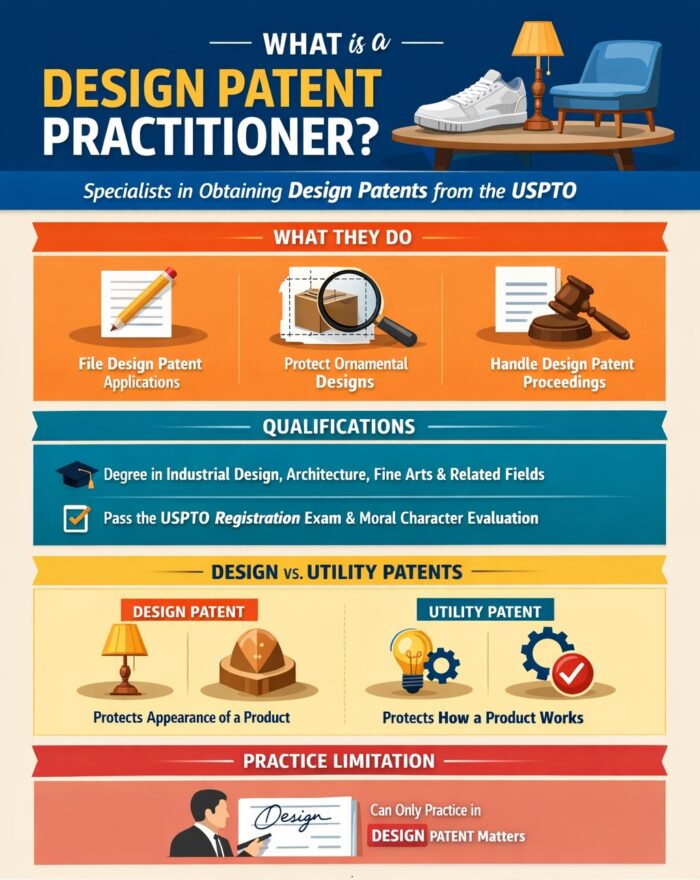
The USPTO built disclosure rules into daily practice. Rule 37 C.F.R. § 1.4(d) requires design patent practitioners to indicate design patent practitioner status by placing the word “design” adjacent to a handwritten, S-signature, or electronic signature when signing USPTO documents. The Office also said these practitioners will receive a particular registration number series to distinguish them from full patent practitioners. For a company reviewing correspondence, that labeling helps confirm whether the signer is authorized only in design patent matters.
Design patent prosecution turns on the visuals. Under 37 C.F.R. §§ 1.152 and 1.153 and MPEP Chapter 1500 of the Manual of Patent Examining Procedure, a design application has a single patent claim, and the drawing or photograph is the entire visual disclosure of that claim. The rules require enough views to disclose appearance completely, and design filings often rise or fall on details such as broken lines, straight-line shading, stippling, and specialized surface shading. For businesses in graphic design, industrial design, packaging, furniture, or other applied arts, that specialized drafting work is exactly where a strong design patent practitioner adds value.
If you are hiring a practitioner to assist with design patents, do not rely on practitioner and law firm marketing. The USPTO’s OED register distinguishes practitioners authorized in all patent matters from those admitted in design patent matters only. The OED Register can be searched for any particular practitioner, including admitted design patent practitioners. It also distinguishes registered patent attorneys, registered patent agents, registered design patent attorneys, registered design patent agents, and individuals granted limited recognition. The Office will not recommend counsel, so potential design patent applicants should verify whether the professional can handle only design filings or broader patent matters as well.
One of the policy arguments for allowing design patent practitioners was broader access. Commenters expressed that the rule could help more under-represented groups practice design patent law and assist more under-represented inventors in acquiring patents. Additionally, for companies or creators seeking lower-cost professional services, the USPTO’s Patent Pro Bono Program matches volunteer patent attorneys and patent agents with financially under-resourced inventors and small businesses. Programs like Volunteer Lawyers for the Arts (VLA) also provide assistance to artists, creators, and independent inventors interested in a design patent or utility patent.
The new design patent practitioner pathway is a limited, separate registration system for practice in USPTO design patent proceedings, created by the USPTO to align with design-focused educational backgrounds. The registration requires the same current registration exam, moral character review, and competence obligations that govern other patent practitioners. Thus, these new practitioners are held to the same procedural, professional, and moral standards as other registered practitioners.
If you need assistance with design patent matters or other intellectual property matters, please contact our office for a consultation.
© 2026 Sierra IP Law, PC. The information provided herein does not constitute legal advice, but merely conveys general information that may be beneficial to the public, and should not be viewed as a substitute for legal consultation in a particular case.
Reverse engineering is a common method of working backward from a physical object, computer hardware, software, or other technology to discover its functionality, components, and hidden design information. Businesses use reverse engineering to analyze a competitor’s product, recover lost data, recreate obsolete parts, build compatible accessories, and develop a next generation or competing product. However, it is not always lawful to copy or borrow from a competitor's product. We explore in this article whether and when reverse engineering crosses the line into misuse of trade secret or other intellectual property rights.
Reverse engineering (or back engineering) is the process of studying a previously made device, system, or code base to determine how it works and what it contains. In law, the concept usually means starting with the finished article and learning its internal design, structure, or operation from the article itself rather than from leaked drawings or other confidential information.
The reverse engineering process usually has three steps: information extraction, modeling, and review. For hardware, that may involve disassembling a product, scanning it with coordinate measuring machines, laser scanners, or structured-light tools, then converting the scan into digital models in computer aided design software. For software, static analysis examines a program without running it, while dynamic analysis observes it in operation. Engineers may use disassemblers and decompilers to inspect assembly language, data structures, and sometimes recover a higher-level view of lost source code.
Reverse engineering speeds research and development, shortens prototyping, and reduces cost and waste by repairing existing parts instead of replacing whole systems. It is used in aerospace and automotive work to scan parts and create digital replicas, in medical-device work to create custom implants and prosthetics, in classic-car restoration to recreate parts, and in failure analysis to determine why a machine failed and improve its functionality. It also helps companies analyze existing designs, improve ergonomics, create compatible accessories, repurpose obsolete objects, build a digital twin, or regain lost designs for long-discontinued products and product-legacy archives.
Under the Defend Trade Secrets Act, a trade secret is information that derives value from not being generally known and not being readily ascertainable through proper means, so long as the owner used reasonable secrecy measures. See 18 U.S.C. § 1839(3). Critically, the DTSA defines improper means to include theft, bribery, misrepresentation, breach of duty, and espionage, but it expressly says improper means “does not include reverse engineering, independent derivation, or any other lawful means of acquisition” under 18 U.S.C. §§ 1839(3),(6). State trade secret law generally follows the same Uniform Trade Secrets Act model. In other words, reverse engineering a lawfully acquired product on the market is not an improper means of acquiring product design and information under U.S. trade secret law, even when the product embodies valuable trade secrets.
The Supreme Court’s decision in Kewanee Oil Co. v. Bicron Corp., 416 U.S. 470 (1974), reinforces this principle. There, former employees left Kewanee and began using knowledge related to crystal-growing processes. The Court found that state trade secret protection does not conflict with federal patent law. The court explained that trade secret law protects against breaches of confidence and improper means, but does not prevent competitors from discovering the same information through legitimate reverse engineering techniques or independent development. In other words, even where valuable trade secrets exist, others remain free to use reverse engineering on a lawfully obtained product to discover its underlying design information.
Similarly, in Bonito Boats, Inc. v. Thunder Craft Boats, Inc., 489 U.S. 141 (1989), the Supreme Court struck down a Florida statute that prohibited duplicating unpatented boat hull designs using a direct molding process. A competitor had copied a hull design from an existing boat, effectively working backward from a physical object to create a similar product. The Court held that the state law improperly granted patent-like exclusive rights to unpatented designs and conflicted with federal patent law, which allows copying of publicly available products. The Court emphasized that once a product is placed on the market, competitors may lawfully engage in analyzing products, including through reverse engineering, unless they employ improper means.
These authorities establish the baseline rule: performing reverse engineering on a lawfully acquired competitor’s product is often generally legal, even where the product embodies proprietary information or valuable trade secrets, so long as the reverse engineering process relies on proper means rather than conduct that would constitute misappropriation.
The core issue in determining the propriety of reverse engineering is how you gain access. Buying a product on the open market and analyzing it is ordinarily proper means under trade secret law. By contrast, using theft, deception, breach of a confidentiality agreement, or industrial espionage constitutes improper means.
In E.I. duPont deNemours & Co. v. Christopher, 431 F.2d 1012 (5th Cir. 1970), the defendants hired a pilot to take aerial photographs of DuPont’s methanol plant while it was still under construction and not yet enclosed. DuPont had taken reasonable steps to maintain secrecy from ground-level observation, but had not covered the facility from above. The Fifth Circuit held that this conduct constituted improper means, reasoning that although the information was visible from the air, the use of aerial surveillance to obtain proprietary information that was not otherwise readily ascertainable through normal inspection went beyond acceptable competitive practices.
Similarly, in Compulife Software Inc. v. Newman, 959 F.3d 1288 (11th Cir. 2020), the defendants accessed publicly available insurance quote data through the plaintiff’s website. While individual, manual queries by a human user could be considered proper means, the defendants deployed automated bots to extract massive volumes of data at a scale that ordinary users could not replicate. The Eleventh Circuit held that this type of automated scraping could qualify as improper means and enabled the collection of data in a manner inconsistent with normal access.
These cases illustrate that reverse engineering itself is not the problem. Rather, liability arises when performing reverse engineering involves such means as deception, circumvention, or automated overreach that enable a party to access confidential information or secret information in ways that go beyond legitimate market acquisition. In those circumstances, the conduct may constitute misappropriation, even if the end goal is to analyze a product or develop a competing design.
A marketed product does not automatically lose trade secret protection simply because it is sold to the public. The key inquiry under trade secret law remains whether the alleged secret is still not readily ascertainable through proper means, such as lawful reverse engineering of a publicly available product.
The Federal Circuit’s decision in ams-OSRAM USA Inc. v. Renesas Electronics America, Inc., 133 F.4th 1337 (Fed. Cir. 2025) illustrates how this principle operates in practice. In that case, the dispute involved semiconductor technology used in ambient light sensors embedded in consumer electronics. The plaintiff argued that certain design features and proprietary information within its chips constituted protectable trade secrets, while the defendant contended that those features could be discovered through standard reverse engineering techniques applied to chips available on the market. The court held that the relevant question was not whether the defendant had actually completed the reverse engineering process, but whether the information could have been obtained through proper means, i.e., by analyzing a lawfully acquired product using routine and straightforward engineering methods. Because the information was susceptible to such analysis, it was deemed readily ascertainable, and therefore not entitled to ongoing trade secret protection.
This reasoning aligns with longstanding Supreme Court precedent. In Bonito Boats (discussed above), the invalidated statute effectively barred reverse engineering of a physical object. The Supreme Court emphasized that once a product is placed into the public domain without patent protection, competitors are generally free to study and copy it using proper means, including working backward from the product itself.
These cases underscore an important limitation: the original manufacturer may gain a competitive advantage from secrecy at the outset, but once a product enters the market, that advantage can erode if competitors can lawfully gain access to the underlying design information through reverse engineering techniques. In practical terms, if a competitor’s product can be disassembled, analyzed, and understood using standard industry methods without resorting to improper means, then the information may no longer qualify as a protected trade secret, even if the reverse engineering process requires technical skill or detailed analysis.
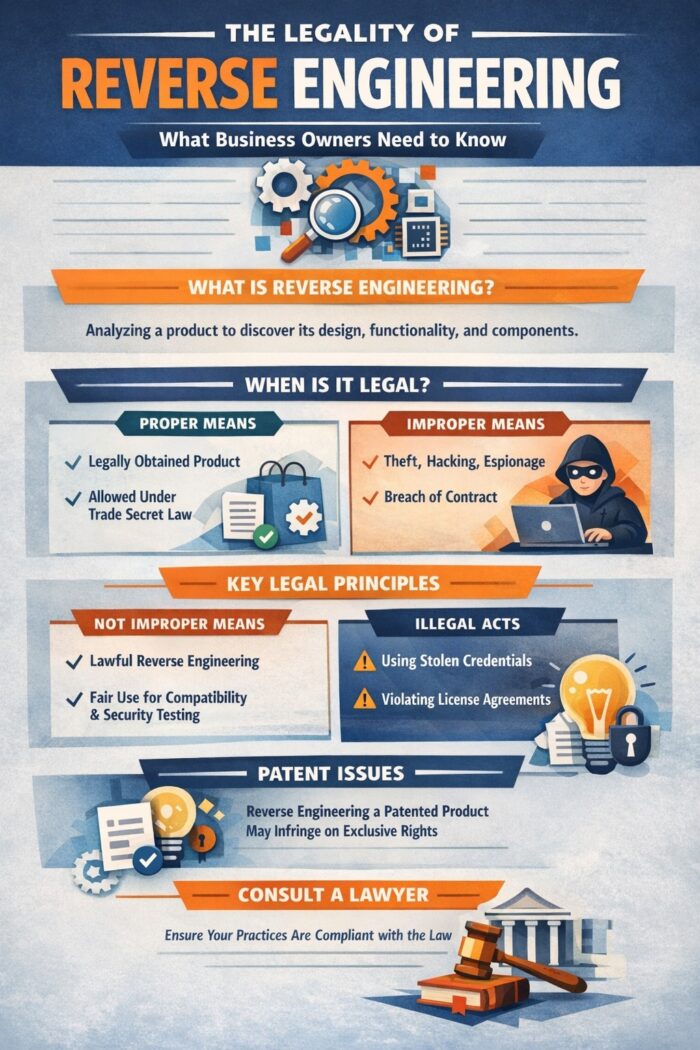
Even when trade secret law permits reverse engineering, patent law may still matter. A patent gives the owner exclusive rights to exclude others from making, using, selling, offering to sell, or importing the claimed invention. So you may be free to study a product to determine how it works, but selling a reverse engineered product that falls within valid patent claims can still infringe. That is why a business can win the trade secret issue and still face legal action under patent law. See 35 U.S.C. § 271.
With proprietary software, engineers often lack access to the original source code, which leads them to use reverse engineering techniques, including disassembly into assembly language and analysis of data structures, to understand unprotected functional elements and enable interoperability. Courts have repeatedly addressed whether this type of analyzing and intermediate copying is permissible.
In Sega Enters. Ltd. v. Accolade, Inc., 977 F.2d 1510 (9th Cir. 1992), Accolade sought to develop video games compatible with Sega’s Genesis console. Because Sega’s interface specifications were not publicly available, Accolade disassembled Sega’s object code to identify the interface requirements. Sega brought legal action, arguing that this copying infringed copyright. The Ninth Circuit court held that Accolade’s intermediate copying constituted fair use because it was necessary to access unprotected functional elements and achieve interoperability with the console. The court emphasized that where disassembly is the only way to gain access to functional requirements, such use can be justified.
Similarly, in Sony Computer Entertainment, Inc. v. Connectix Corp., 203 F.3d 596 (9th Cir. 2000), Connectix created a PlayStation emulator that allowed Sony games to run on personal computers. To do so, Connectix engaged in extensive reverse engineering of Sony’s BIOS, including temporary copying during development. Sony argued this was infringing, but the Ninth Circuit again held that the reverse engineering was fair use. The court found that Connectix’s work was transformative because it produced a new platform and enhanced functionality, and that the intermediate copying was necessary to understand the system’s operation.
Congress has also provided limited statutory support for this type of activity. Under 17 U.S.C. § 1201(f), circumvention of technological protection measures is permitted when undertaken for the sole purpose of identifying and analyzing elements necessary to achieve interoperability of independently created software. Section 1201(j) similarly permits certain acts of reverse engineering for good-faith security testing, with authorization from the owner or operator of the computer system. These provisions reflect a recognition that performing reverse engineering can be essential to innovation, competition, and security, particularly where developers seek to create a similar product or compatible system.
At the same time, the boundaries remain contested. Reverse engineering of software may still implicate contract restrictions, licensing terms, or anti-circumvention rules, and improper use of proprietary information can still constitute misappropriation. As technology continues to evolve, especially with increasingly complex platforms and AI systems, the legality of reverse engineering software for interoperability remains an active and closely watched area of law.
Software disputes involving the reverse engineering of software often turn as much on contract law as on intellectual property law. Courts have repeatedly emphasized that how a party obtains access to software, data, or a system, and what restrictions govern that access, can determine whether performing reverse engineering remains lawful or crosses into improper means.
In Bowers v. Baystate Technologies, Inc., 320 F.3d 1317 (Fed. Cir. 2003), the dispute arose from competing computer aided design (CAD) programs. The defendant purchased the plaintiff’s software, which was distributed under a shrinkwrap license expressly prohibiting reverse engineering techniques, including decompilation. The defendant nevertheless analyzed the software to develop a competing product. The Federal Circuit held that the shrinkwrap agreement was enforceable and that violating the anti-reverse engineering clause constituted a breach of contract, even if federal copyright law might otherwise permit certain reverse engineering activities. The court reasoned that private parties can contractually waive rights that might otherwise exist under federal law. The key takeaway for businesses is that even if reverse engineering might be generally legal under trade secret law, contractual restrictions can independently prohibit it and create exposure to legal action.
By contrast, Aqua Connect, Inc. v. Code Rebel, LLC, No. CV 11-5764 RSWL (C.D. Cal. Nov. 5, 2012), addressed whether violating a license agreement automatically transforms reverse engineering into improper means under California’s Uniform Trade Secrets Act. In that case, the plaintiff alleged that the defendant improperly accessed and analyzed its remote desktop software to develop a competing product. Although the plaintiff pointed to end-user license agreement (EULA) restrictions, the court held that a mere breach of contract, standing alone, does not necessarily constitute improper means sufficient to support a trade secret misappropriation claim. In other words, while the defendant’s conduct might support a contract claim, it did not automatically establish that the defendant used prohibited or deceptive means to gain access to protected confidential information under trade secret law.
These cases illustrate a critical distinction: contractual restrictions can limit the ability to use reverse engineering, but not every contract breach rises to the level of trade secret misappropriation. That distinction becomes especially important in modern disputes involving online platforms and automated access. Courts have increasingly found that large-scale scraping using bots or circumvention of technical barriers may constitute improper means, particularly where access controls are bypassed or the method of analyzing data would not be feasible through ordinary means.
For businesses analyzing a competitor’s product, proprietary software, or online systems, the practical guidance is straightforward: before performing reverse engineering, carefully review all applicable licenses, clickwrap agreements, and terms of use. The legality of your method, your tools, and how you access the system can be just as important as the underlying engineering analysis itself.
On the hardware side, businesses commonly analyze printed circuit boards, electronic components, microprocessors, and other components when original files are missing. The workflow usually runs from scan capture to post-processing to CAD modeling, with quality checks against original specifications. Reverse engineering is used to create digital records, analyze existing products, recover missing design information, and preserve design intent for later development. That is especially valuable when a company wants to revive discontinued products, secure spare-part supply, or understand how a competitor’s product was assembled.
Reverse engineering is also central to cybersecurity. Security teams use reverse engineering, including decompilers, disassemblers, and other automated tools, to analyze software, identify buffer overflows, authentication flaws, malware behavior, and architectural weaknesses in code. This reverse engineering process often involves both static and dynamic analysis to better understand functionality, data structures, and potential vulnerabilities. At the same time, attackers use the same reverse engineering techniques to expose secret information, uncover proprietary algorithms, and exploit weaknesses in proprietary software systems.
Courts have increasingly addressed when such conduct crosses into improper means under trade secret law. For example, in Compulife Software Inc. (discussed above), the defendants use of automated bots to scrape large volumes of insurance quote data from a competitor’s website was far beyond what a human user could access. The use of bots to systematically extract data could constitute improper means and support a claim for misappropriation under the Defend Trade Secrets Act and Uniform Trade Secrets Act.
The legal risks become even more pronounced where access is obtained through deception or circumvention of safeguards. In United States v. Nosal, 844 F.3d 1024 (9th Cir. 2016), the Ninth Circuit held that using another person’s login credentials to gain access to protected systems after authorization had been revoked could violate federal law, highlighting how credential misuse can transform otherwise lawful analyzing or reverse engineering into unlawful conduct.
These principles are now being tested in the AI context. In OpenEvidence Inc. v. Pathway Medical, Inc., No. 1:24-cv-10471 (D. Mass. filed 2024), the plaintiff claimed that a competitor used stolen credentials and prompt-injection attacks to extract system prompts and other proprietary information from an AI platform. The allegations focus on whether such conduct constitutes improper means to obtain confidential information, rather than lawful reverse engineering of a publicly available system. While the case remains pending, it reflects a broader trend: as AI systems become more complex, companies are increasingly attempting to determine how models operate internally, raising difficult questions about whether extracting hidden prompts, weights, or outputs is permissible reverse engineering or unlawful acquisition of valuable trade secrets.
Reverse engineering for cybersecurity, such as vulnerability testing, malware analysis, and development of more secure systems, is legitimate when conducted through proper means. But using deception, bypassing authentication controls, or exploiting access mechanisms to obtain proprietary information can quickly shift the analysis and trigger legal action under trade secret, computer access, or contract law.
Reverse engineering of a lawfully acquired product is lawful, and it is a legitimate tool to analyze technology, improve existing designs, recover lost knowledge, secure software, and create better products. But reverse engineering is unlawful if you rely on deception, insider leaks, bot scraping, stolen credentials, or you violate binding anti-reverse-engineering clauses or patent rights. Companies can still defend trade secrets, but they do so through reasonable secrecy measures, contracts, patents, and technical controls, but not by pursuing parties engaged in post-sale reverse engineering analyses of a product in the marketplace.
If you have inquiries regarding the legality of a reverse engineering project, trade secret matters, or other intellectual property matters, contact our office for a consultation.
© 2026 Sierra IP Law, PC. The information provided herein does not constitute legal advice, but merely conveys general information that may be beneficial to the public, and should not be viewed as a substitute for legal consultation in a particular case.
Copyright litigation refers to the legal process of enforcing one’s rights in creative works through lawsuits in federal court to address unauthorized use of copyrighted works (“copyright infringement”). A copyright owner can sue in federal civil court to stop the alleged infringement and recover damages, if they have gone through the copyright registration process for the infringed work. The copyright litigation process is time-consuming and expensive, but it is a necessary process for protecting valuable creative works like music, literature, visual arts, and other works that include creative expression. We discuss herein copyright litigation, covering what acts qualify as infringement, how lawsuits are pursued, common related claims, defenses to copyright claims (e.g., fair use), and remedies available to the copyright owner.
Copyright is a form of intellectual property (IP) that protects original creative works. It covers a broad range of works, including literature (blog posts, novels, movie scripts, etc.), music (sound recordings and written compositions), visual arts (photos, paintings, illustrations), motion pictures and other audiovisual works, theatrical works, and even architecture. If you or your business create content in any medium, that content may be protected under U.S. copyright law.
Owning a copyright gives the creator (or copyright owner) a bundle of exclusive rights in the work. Under the Copyright Act, these rights include: (1) reproducing the work (making copies); (2) creating derivative works based on it (e.g. adaptations or sequels); (3) distributing copies of the work to the public; (4) publicly performing the work; and (5) publicly displaying the work. In 1995, a sixth right was added for sound recordings: the exclusive right to perform the recording via digital audio transmission. In essence, only the copyright owner (or those they authorize) may exercise these rights. If someone else does any of these without permission, it likely infringes the copyright.
It is also important to understand what copyright does not protect. Copyright safeguards the expression of ideas, but not the underlying ideas or facts themselves. It does not cover names, logos, slogans, or brand names; those are typically protected by trademark law. Similarly, functional inventions or processes are covered by patents, not copyright. Content created by the U.S. government or in the public domain is not protected by copyright. This means, for example, that while a novel or software code you wrote is protected, a general idea for a marketing strategy or a common symbol is not. Understanding these boundaries will help you recognize what falls under “copyright issues” and what might be outside copyright’s scope.
Copyright infringement occurs when someone violates one of the copyright owner’s exclusive rights without authorization. In practical terms, this means using a protected work in a way reserved for the owner, such as copying text or images from a website, distributing music or videos without a license, publicly displaying someone’s photo or artwork, or creating an unauthorized derivative like a knock-off design, all without the copyright owner’s permission. Even well-meaning businesses can inadvertently commit infringement by using content found online or hiring a contractor who uses “borrowed” material. If that happens, your company could be sued and potentially held liable for damages.
To succeed in a copyright infringement lawsuit, the plaintiff (copyright owner) must prove two key elements. First, the plaintiff must show ownership of a valid copyright in the work. This typically involves demonstrating that the work is original and fixed in a tangible form (written, recorded, saved digitally, etc.). Second, the plaintiff must prove that the defendant infringed, i.e., that the defendant copied protected expression from the plaintiff’s work without permission. Often, direct evidence of copying is unavailable, so courts look for substantial similarities between the plaintiff’s work and the defendant’s work, plus evidence that the defendant had access to the original, since independent creation of the same content would not infringe.
In straightforward cases, infringement can be shown by a defendant’s unauthorized use. For example, selling pirated copies of a book or software is clear-cut infringement. In more complex cases, such as when only a portion of a work, courts will filter out unprotected elements, such as general ideas or common scenes, and ask whether the defendant took enough original expression to constitute improper appropriation. If only the general idea or concept was similar, it may not be infringement, but if the particular expression was copied, the court may find infringement. For example, in Twentieth Century-Fox Film Corp. v. MCA, Inc., 715 F.2d 1327 (9th Cir. 1983), the Ninth Circuit held that summary judgment was improper where Fox alleged that Universal’s Battlestar: Galactica copied protected expression from Star Wars. Fox claimed that the television series appropriated numerous specific expressive similarities from the film, including plot elements, character relationships, settings, and sequences. The Ninth Circuit concluded that the similarities raised genuine issues of material fact as to whether defendants copied only the unprotectable idea of a space fantasy adventure or instead copied protectable expression, making the issue one for trial.
It is worth noting that intent is not required for civil infringement liability, even unintentional or unaware copying can infringe. However, willfulness (knowing infringement) can increase the penalties, as discussed below. The bottom line is that if your business uses content created by someone else, whether it’s text, images, music, software code, or architectural plans, you should ensure you have the right to do so, or you risk a potential infringement claim.
Copyright protection exists automatically as soon as an original work is fixed in a tangible medium, and registration is not required to own a copyright. However, U.S. law requires a copyright to be registered with the U.S. Copyright Office before the copyright owner can file an infringement lawsuit in federal court. In other words, while unregistered works are still protected, you cannot sue over an unregistered U.S. work until you obtain a copyright registration certificate, a rule recently affirmed by the Supreme Court. This makes registration an essential step if you need to enforce your rights and provides many benefits. The registration process involves depositing a copy of the work with the Copyright Office and paying a filing fee, after which the Office issues a certificate of registration. Fortunately, the registration process can be done online and is relatively inexpensive compared to litigation costs.
Beyond being a legal prerequisite to sue, registration comes with additional benefits in litigation. Most importantly, if you registered your work before an infringement began or within 3 months of the first publication of the work, you are eligible to seek statutory damages and attorney’s fees from an infringer. Statutory damages are set amounts of money per work infringed, defined by statute, which the plaintiff can elect instead of proving actual damages. This means even if you cannot quantify your loss, the court can award between $750 and $30,000 per infringed work without requiring detailed proof. If the infringement was willful, the court can increase statutory damages up to $150,000 per work as a punishment. Additionally, the Copyright Act gives courts discretion to order the losing party to pay the prevailing party’s attorney's fees. Together, the availability of statutory damages and fee-shifting gives registered copyright holders significant leverage. The risk of having to pay hefty damages and the other side’s legal bills often pressures defendants into settlement. Conversely, if you never registered your work before the infringement, you will be limited to actual damages and the infringer’s profits and cannot recover attorney's fees, which may make a case less economically feasible to pursue. The takeaway for businesses is clear: if you have valuable original content (e.g., software, writings, designs, etc.), register it early to preserve your full range of remedies in case of litigation. The Copyright Office’s public records also put others on notice of your claims, which can help deter infringement in the first place.
Copyright litigation is generally a federal matter. Copyright is governed by federal statute (Title 17 of the U.S. Code), so lawsuits must be brought in federal court. In fact, federal courts have exclusive jurisdiction over copyright claims, meaning state courts usually cannot hear copyright infringement cases. Many copyright suits arise in industry centers like California and New York. For example, the Ninth Circuit, which is the federal appeals court covering the West Coast, and the Second Circuit, which is the federal appeals court covering New York, are widely regarded as two of the most important jurisdictions for copyright law developments. This is no surprise, as California’s entertainment and software industries and New York’s publishing and media industries generate a large share of U.S. copyright disputes. However, a lawsuit may be filed in any federal district that has a connection to the dispute, typically where the defendant resides or where the infringement took place. For instance, if an infringing product was distributed nationwide, the plaintiff might have a choice of forums. The choice of venue can sometimes impact how the law is interpreted, since different circuits have slightly different precedents, but the core copyright principles are federal and thus similar across jurisdictions.
Timing is another important consideration. Copyright claims are subject to a statute of limitations. In the U.S., the Copyright Act provides that a civil action must be commenced “within three years after the claim accrued” under 17 U.S.C. § 507(b). In some copyright cases, courts apply an injury rule, under which a claim accrues when the infringing act occurs. In other cases, courts have applied a discovery rule, under which a claim accrues when the plaintiff discovers, or reasonably should have discovered, the infringement.
The Supreme Court has stated that it has not definitively resolved whether the Copyright Act always incorporates a discovery rule, but in Warner Chappell Music, Inc. v. Nealy, 601 U.S. 366 (2024), it addressed the question of whether damages dating back more than three years are available where the claim is timely under the discovery rule. In Nealy, the plaintiff alleged that music rights had been exploited without authorization for many years, but he claimed he did not discover the alleged infringement until much later. The defendants argued that even if the suit was timely under a discovery-based accrual rule, the plaintiff still could not recover damages for infringements occurring more than three years before the complaint was filed. The Supreme Court rejected that separate three-year damages cap. Assuming the claim is timely under the applicable accrual rule, the Court held that the Copyright Act does not impose an additional bar that automatically limits recovery to only the three years immediately preceding suit.
Business owners who suspect their work is being infringed should act diligently and seek legal advice promptly, rather than “sleep on their rights.” On the flip side, if your business is accused of infringement long after the fact, the statute of limitations could be a defense. For instance, if a plaintiff knew of an unauthorized use for over three years and did nothing, their claim might be time-barred.
It is also worth noting that not every potential defendant can be sued in copyright. Thanks to the Eleventh Amendment and principles of state sovereign immunity, state government entities and state universities, agencies, etc. are generally immune from copyright infringement suits. In 2020, the U.S. Supreme Court unanimously held that Congress’s attempt to allow copyright suits against states, the Copyright Remedy Clarification Act, was unconstitutional, and therefore states cannot be sued for copyright infringement without their consent. This means if, say, a public university or state government office infringes your work, your remedies may be limited, unless Congress crafts a new valid law. Private parties and corporations, however, have no such immunity and can be sued for infringement like anyone else. Additionally, foreign defendants can be sued in U.S. courts for acts of infringement that have sufficient connection to the United States, though jurisdictional and enforcement issues can arise in international cases. In any event, it is crucial to file in the proper court and within the allowed timeframe to ensure your copyright claims are heard.
A copyright lawsuit follows the same general trajectory as other civil litigation, but there are some features particular to IP cases. Typically, the process begins with the copyright owner (plaintiff) sending a cease and desist letter or takedown notice to the alleged infringer. If the dispute isn’t resolved informally, the plaintiff files a complaint in federal court. The pleadings stage will frame the claims and defenses. For example, a complaint might allege that “the defendant reproduced and distributed the plaintiff’s software without authorization, infringing the plaintiff’s exclusive rights under 17 U.S.C. §106,” and the defendant’s answer may deny the allegations and possibly raise defenses, like fair use or invalidity of the copyright.
After pleadings, the case enters discovery, where each side exchanges information and evidence. This can involve document production, such as sales records of an allegedly infringing product, or proof of the plaintiff’s ownership and registration; depositions of witnesses; and expert reports. Copyright cases often require expert testimony, especially on issues like substantial similarity of music or code, or to calculate damages. For instance, an expert might opine on the portion of the defendant’s profits attributable to the infringement. Copyright litigation can be complex and costly, even when the monetary stakes of the infringement seem limited because of the need for expert analysis, extensive evidence gathering, and other factors.
It is common for either party to file a summary judgment motion after discovery. In a summary judgment motion, a party argues that there are no genuine disputes of material fact for a jury to decide, and that they are entitled to judgment as a matter of law. For example, an accused infringer might move for summary judgment that the works are not substantially similar, or that the use is protected by fair use, thus no trial is needed. Courts in some circuits have been willing to decide lack of substantial similarity as a matter of law and dismiss cases early if the works are clearly different. In other circuits, courts are more cautious, often finding that as long as there is some similarity, the question of substantial similarity should go to a jury, making summary judgment for the defense harder to obtain. If the case is not resolved on motions, it will proceed to a trial, where a judge or jury will determine whether infringement occurred and what damages or relief should be granted.
Throughout this process, parties will often discuss settlement. The reality is that full trials are relatively rare in copyright cases. Many disputes end before reaching the verdict stage. One reason is that litigation can be expensive and time-consuming, costing hundreds of thousands of dollars if the process is taken through trial to a verdict. Cases can take a year or more to resolve, imposing distractions and legal fees on both sides.
Recognizing this, Congress recently created an alternative forum called the Copyright Claims Board (CCB) as part of the 2020 CASE Act. The CCB is a small-claims tribunal within the Copyright Office that provides a voluntary alternative to federal court for smaller disputes. It can hear claims of up to $30,000 in damages, using a streamlined process without extensive discovery or in-person hearings. The CCB cannot issue injunctions, though it can order an infringer to stop if both parties agree, but it offers a lower-cost path to resolve minor infringements. Business owners with a relatively small copyright claim may consider the CCB as an option to avoid the full federal litigation process. However, both parties must voluntarily participate. A respondent can opt out, forcing the claimant to go to federal court. For larger or more complex cases, traditional federal litigation remains the main avenue.
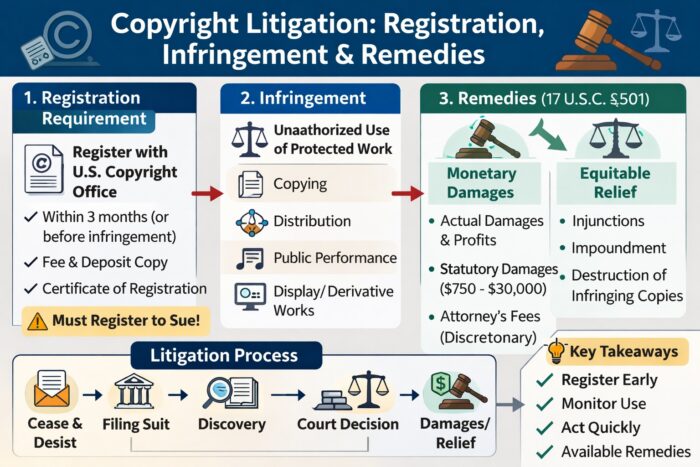
Copyright litigation often doesn’t exist in a vacuum. In many cases, a plaintiff will assert multiple intellectual property claims in the same lawsuit. For instance, if someone is selling bootleg copies of a motion picture, the movie studio might sue for copyright infringement and for trademark infringement if the bootleg uses the studio’s logos or the movie’s branded characters to market the product. Copyright is just one segment of IP; other types include patents, trade secrets, and trademarks. It is not uncommon for a dispute to touch on more than one area. A classic example is when a business believes a competitor stole its creative content and is engaging in misleading practices in the marketplace. The competitor’s actions might violate copyright law and also constitute trademark infringement or unfair competition under broader business tort principles.
U.S. law allows plaintiffs to bundle such related claims in one suit. Unfair competition is a particularly common add-on claim in IP lawsuits. Unfair competition law, at its core, aims to prevent deceptive or unethical business practices that aren’t specifically covered by other IP laws. As one firm explains, unfair competition claims are often included alongside trademark and copyright infringement claims to address misconduct that falls outside the precise scope of those laws. For example, if a former employee takes your company’s confidential client list and creative marketing content, you might sue them for trade secret misappropriation for stealing secret information and for copyright infringement for copying original text or graphics, and also add an unfair competition claim for the overall unethical scheme. Unfair competition can encompass things like passing off one’s goods as another’s, false advertising, idea theft in certain circumstances, and other misrepresentations in commerce. Note that some unfair competition claims may be preempted by the Copyright Act if they don’t involve an extra element beyond copying the work, but many claims can coexist with a copyright claim.
Trademark infringement is another claim that frequently overlaps with copyright disputes. Trademarks protect names, logos, and identifiers of source, such as character names, brand logos, or band names. If an alleged infringer is not only copying your content but also using your brand name or logo, you would pursue trademark claims under the Lanham Act in addition to copyright. In fact, a single unauthorized venture can trigger several IP claims. Imagine someone screens your company’s film without permission and uses your characters’ images and movie title to advertise the event. Such a situation involves copyright infringement (the unauthorized public performance of the film) and trademark infringement (unauthorized use of protected names in advertising). A copyright plaintiff could also file for trademark infringement if the infringed property has branded aspects used in commerce, such as character names or logos.
Finally, breach of contract or other civil claims might be present. For example, if the parties had a license agreement or employee agreement and one party exceeded their permissions, a breach of contract claim would accompany the copyright claim. In summary, parties in IP disputes often cast a wide net: plaintiffs often assert claims for copyright infringement alongside trademark infringement, unfair competition, breach of contract, and more in the same lawsuit. As a business owner, it’s useful to recognize that an infringement scenario may implicate multiple legal issues. Conversely, if your business is accused of infringement, be aware the plaintiff might allege related wrongdoing, like claiming your marketing amounted to false advertising or that you breached some implied agreement. These overlapping claims increase the stakes of litigation, but sometimes also present additional defenses. Each type of claim has its own elements and defenses, so consult with an IP attorney to navigate the multi-faceted dispute.
The rise of the internet and digital media has brought special challenges to copyright enforcement. When infringement happens online, such as users uploading music, videos, or images to websites or social media without permission, the question arises: who is liable, the user or the platform hosting the content or both? In the late 1990s, to foster growth of internet services, Congress passed the Digital Millennium Copyright Act (DMCA), which includes provisions that create a safe harbor for online service providers. See 17 U.S.C. §512. In short, the DMCA safe harbor protects internet platforms from monetary liability for copyright infringement committed by their users, as long as the service meets certain conditions. These conditions include: (1) the service provider must not have actual knowledge of the infringing material on its system and not be “willfully blind” to obvious infringement; (2) if the provider becomes aware of infringement, for example, via a proper takedown notice from a copyright holder, it must act expeditiously to remove or disable access to the infringing material; and (3) the provider must not receive a direct financial benefit from the infringement in cases where it has the right and ability to control the activity. In practice, compliance often means having a registered DMCA agent, a published takedown policy, and promptly removing content when a valid notice is received.
For example, imagine your company runs a video-sharing website. One of your users uploads a popular song or movie without authorization. Under the DMCA, if you swiftly take down that content once you are notified, your company would likely be shielded from liability for that user’s post if you were not aware of it beforehand. Generalized knowledge that “there’s probably some infringement on our platform” is not enough to lose safe harbor; the courts require knowledge of specific infringing material. The Second Circuit emphasized this in Viacom Int’l, Inc. v. YouTube, Inc., 676 F.3d 19 (2d Cir. 2012). In that case, media company plaintiffs claimed that YouTube hosted thousands of unauthorized clips of television shows and other copyrighted programming uploaded by users. Plaintiff Viacom argued that YouTube was generally aware that infringing material was widespread on its platform. The U.S. District Court granted summary judgment in YouTube’s favor, finding that YouTube fell within the DMCA safe harbor for all the claims asserted by the plaintiffs regarding the alleged copyright infringement on its platform. The court noted that YouTube had a robust notice-and-takedown system and that placing the burden on content owners to notify platforms of infringing material “makes sense, as the infringing works in suit may be a small fraction of millions of works” on the platform. In other words, an internet service with millions of user uploads cannot realistically screen everything for licenses or fair use, so the law shifts the policing burden to copyright owners – they send notices of specific infringing material, and the service must respond quickly.
The Second Circuit held, however, that generalized awareness of infringement on a platform is not enough to disqualify a service provider from DMCA safe-harbor protection; instead, the provider must have actual knowledge or “red flag” awareness of specific infringing material. As long as the service provider does not have actual or “red flag” knowledge of a particular infringement and is not inducing users to infringe, it can avoid being held liable for the infringements of its users.
For business owners, the DMCA safe harbor is crucial if your business model involves user content. By registering an agent with the Copyright Office and implementing DMCA-compliant policies, you can significantly reduce the risk of copyright liability from user posts. However, note that the safe harbor will not protect you if your own company is directly posting infringing content, nor if you encourage or induce infringement. In Metro-Goldwyn-Mayer Studios Inc. v. Grokster, Ltd., 545 U.S. 913 (2005), the Supreme Court held that distributors of peer-to-peer file-sharing software could be liable for induced copyright infringement where the services were marketed to former Napster users, the companies promoted the software as a way to obtain copyrighted music and movies for free, and their business model depended on high-volume infringing use by users. The Court explained that a party that distributes a product “with the object of promoting its use to infringe copyright” may be liable for the resulting third-party infringement.
Also, the DMCA safe harbor does not categorically bar injunctive relief. Section 512 limits monetary relief for qualifying service providers, but it expressly preserves certain forms of injunctive and other equitable relief under subsection (j), including orders directed at restraining access to infringing material or accounts involved in repeat infringement.
In summary, the DMCA provides powerful protections for online services, but compliance and a neutral stance are key. If your business is the one whose content is being infringed online, the DMCA also provides a tool for you as a copyright holder: you can send takedown notices to platforms hosting infringing copies of your work, and they are obligated to remove the material or potentially lose their immunity.
Being accused of copyright infringement does not automatically mean you will be held liable. There are several defenses and exceptions to infringement in copyright law. The most well-known is fair use. Codified in Section 107 of the Copyright Act, fair use permits certain uses of copyrighted material without permission if the use is considered socially beneficial or unlikely to harm the copyright owner’s market. Fair use is a somewhat flexible doctrine, evaluated case-by-case by weighing four statutory factors:
Courts ask why and how you used the work. Uses for criticism, comment, news reporting, teaching, scholarship or research are explicitly mentioned as examples of favored purposes. Nonprofit or educational uses are more likely fair than purely commercial ones. Transformative uses, those that add new meaning or message to the original, rather than just republishing it, also weigh in favor of fair use, as recent court decisions have emphasized. For example, a parody song that mocks the original is transformative, whereas simply using a song as background music in a commercial is not.
This factor looks at the type of work used. Using factual or informational works is more likely to be fair use than using highly creative works (e.g., songs or novels), since creative works sit at the core of copyright. Also, using unpublished works is viewed less favorably because the law favors the author's or owner's right to control the first publication.
Here, the court considers both the quantity and the quality of what was taken. Using a small, necessary excerpt of a work may be fair, but using the “heart” of the work might weigh against fair use. There is no strict rule on amount. For example, copying 200 words from a 300-page book could be fair, whereas copying 30 seconds of a 3-minute song might not be, if those 30 seconds are the hook of the song.
Perhaps the most important factor, this looks at whether the secondary use harms the existing or potential market for the original work. If the use acts as a substitute for the original, it will likely weigh against fair use. For example, if people watch your summary of a movie instead of buying the movie, this factor will weigh against a finding of fair use. If the use is in a different market and doesn’t usurp demand (e.g., a few lines of a song in a historical documentary), this factor can favor fair use.
No single factor is determinative; courts balance them together. Fair use is famously unpredictable, which can be frustrating. However, some categories of use have generally been upheld as fair use: quoting text for a book review or academic commentary, parodying a popular work, using a short clip or still image in a news report, or creating a search engine thumbnail image index. On the other hand, uses that simply save the user the cost or effort of purchasing the original, such as sharing full copies of music, movies, or software, are routinely found not to be fair use. A recent Supreme Court decision in 2023, Andy Warhol Foundation for the Visual Arts, Inc. v. Goldsmith, 598 U.S. 508 (2023), underscored that even transformative intent does not guarantee fair use. In that case, photographer Lynn Goldsmith took a 1981 photograph of Prince, and Vanity Fair initially licensed the photograph for use as an artist reference. Andy Warhol later created a series of Prince images based on that photograph, and after Prince’s death, the Warhol Foundation licensed one of those images to Condé Nast for a magazine cover. The Supreme Court held, in the context of that commercial magazine licensing, that the first fair-use factor did not favor fair use because the secondary use shared substantially the same commercial purpose as Goldsmith’s original photograph. The Court emphasized that each challenged use must be examined in its specific context. The key for businesses is that they should not assume a use is fair simply because credit was given or because the use was not highly profitable. Fair use is a legal defense that would ultimately be decided by a judge or jury if litigated. When in doubt, seek a license or consult counsel, especially for any commercial use of someone else’s content.
Aside from fair use, other defenses and exceptions exist. One is consent or license. If you actually had permission or an implied license to use the work, then there is no infringement. For example, if a photographer licensed you an image for your website, you can defend an infringement claim by showing that license. Invalid copyright is another defense: the defendant might argue the plaintiff’s work is not protected. For example, the defendant may argue that the work is too factual or not original. In some cases, defendants claim independent creation. Another defense is de minimis use, which means the copying was so minor as to be trivial. Courts sometimes accept this when the copied portion is extremely small or unrecognizable in the defendant’s work. First Sale doctrine permits resale of lawfully made copies, which is not exactly a defense to making copies but allows, say, reselling purchased books or DVDs without infringement. There are also specific statutory exceptions for things like library archiving, some educational performances, and others that likely won’t apply to most business contexts.
If your business is accused of infringement, it’s important to evaluate these defenses. Sometimes a strong fair use argument or proof of a license can lead the other side to drop the case or result in a quick win on summary judgment. On the flip side, if you are the plaintiff, be prepared that the defendant may invoke fair use or other defenses. Many high-profile cases have turned on the fair use analysis, which can be somewhat subjective. Ultimately, fair use and other defenses are highly fact-specific. Courts will consider the nuances of your situation, which is why getting legal advice on the strength of a fair use position is wise before banking on it.
If a copyright infringement claim is proven, the focus shifts to remedies: what the court will award or order to right the wrong. Copyright law provides both injunctive relief (an order to stop the infringement) and monetary damages to compensate the owner and/or disgorge the infringer’s gains.
Injunctive relief is often the first thing a copyright owner seeks. Because every unauthorized copy or distribution is a new violation of the exclusive rights, ongoing infringement can cause harm that money alone cannot fix. It can devalue the work, harm the market, or damage the creator’s control over their creation. A court can issue a preliminary injunction early in the case to halt the activity while the case is pending and a permanent injunction after a final judgment to prohibit the defendant from infringing the work in the future.
To get a permanent injunction, a plaintiff must satisfy the traditional equity test, including demonstrating irreparable harm if the infringement were to continue. In the past, courts often presumed irreparable harm from copyright infringement, but after the Supreme Court’s decision in eBay Inc. v. MercExchange, L.L.C., 547 U.S. 388 (2006), courts require actual evidence of irreparable harm rather than applying any automatic presumption. For example, in Perfect 10, Inc. v. Google, Inc., 653 F.3d 976 (9th Cir. 2011), the plaintiff, an adult entertainment publisher and owner of copyrighted photographs, sued Google over its display of thumbnail versions of Perfect 10’s images in Google Image Search and its linking to third-party websites that displayed allegedly infringing full-size copies. The Ninth Circuit court affirmed the denial of injunctive relief, holding that Perfect 10 had not met its burden to show irreparable harm caused by Google’s conduct. In many straightforward cases, however, it is not hard to show that an unlicensed use undermines your exclusive rights in a way that money cannot fully repair, especially if the infringement is continuous or threatens your market.
Courts commonly grant injunctions to stop infringing activities once liability is established, preventing further unauthorized distribution or display of the copyrighted material. An injunction might order the destruction or impounding of infringing goods, the removal of infringing content from websites, or other steps to cease the violation. For business owners, this means that if you lose an infringement case, you will likely be legally barred from any further use of the work. Violating an injunction can lead to contempt of court. If you’re the plaintiff, an injunction is a powerful tool to regain control over your work and avoid future infringement by that defendant.
U.S. copyright law offers two main types of damages: actual damages plus any of the infringer’s profits, or statutory damages. The plaintiff typically must choose one or the other. Actual damages aim to compensate the copyright owner for the losses suffered due to the infringement. This could include lost sales, lost licensing fees, or diminution of the work’s value. In addition, the plaintiff can seek to recover the profits the defendant earned from the infringement, to the extent those profits are not already counted in the actual damages. The law only permits disgorging profits attributable to the infringement. The plaintiff has to show a causal link. For instance, if a defendant’s advertisement used your photo, you might claim the ad helped generate sales, and seek those profits. Once the plaintiff shows the gross revenue the defendant made from the infringing activity, the burden shifts to the defendant to prove which portions of that revenue were not due to the infringing material. In some cases, this actual damages route can yield large awards, especially if the infringement involved a hit product or was widespread. However, calculating and proving actual damages can be complicated and often requires financial experts.
Statutory damages, on the other hand, are often a more straightforward option, if the work was registered in time. Statutory damages do not require proving any specific loss or profit. The Copyright Act provides a range of $750 to $30,000 per infringed work for ordinary infringements, “as the court considers just.” The judge or jury can decide an amount in that range based on the circumstances (e.g. how egregious or willful the infringement was, the need to deter, etc.). If the infringement is found to be willful, the maximum per-work statutory award can go up to $150,000. Conversely, if the infringer proves they were not aware and had no reason to know they were infringing (an “innocent infringer”), the minimum can drop to $200 per work.
In practice, courts have broad discretion within these ranges. Statutory damages serve both compensatory and deterrent purposes. Even if an infringement caused little measurable harm, the court might award a significant sum to penalize the behavior and deter others. For example, in cases against small businesses or individuals who use images without a license, courts still frequently award at least the minimum or more, to reinforce that infringing is more expensive than simply licensing the content. Some copyright holders, particularly music publishers and photographers, are known for suing over relatively minor infringements precisely because statutory damages and attorney's fees make it economically viable to do so. As a defendant, you should be aware that even if the actual harm was minimal, you could face a statutory damages award of several thousands of dollars per work. And if multiple works were infringed (e.g., 10 songs or 50 photos), the damages can multiply quickly.
In addition to damages, the court may order the losing party to pay the prevailing party’s attorney’s fees and court costs, under 17 U.S.C. §505, but such an award is discretionary, not automatic. The statute expressly provides that “the court in its discretion may” award costs and “a reasonable attorney’s fee to the prevailing party.”
The Supreme Court has made clear that this discretion applies equally to prevailing plaintiffs and prevailing defendants. In Fogerty v. Fantasy, Inc., 510 U.S. 517 (1994), the Court rejected the idea that prevailing copyright plaintiffs should ordinarily recover fees while prevailing defendants should face a higher bar. Instead, courts must treat both sides alike and decide fee requests based on equitable considerations, not a one-sided presumption.
The Supreme Court later clarified how courts should exercise that discretion in Kirtsaeng v. John Wiley & Sons, Inc., 579 U.S. 197 (2016).The Supreme Court stated that “substantial weight” should be given to the objective reasonableness of the losing parties position, whether it be plaintiff's asserted claims and the defendant's defenses. Those circumstances may include factors such as frivolousness, motivation, compensation, and deterrence. In other words, objective reasonableness is important, but it is not controlling, and there is no strong presumption that fees will be awarded simply because one side prevailed.
As a practical matter, this means a business that wins a copyright case may recover attorney’s fees, but should not assume that fees will automatically be awarded. Likewise, a party with a weak, unreasonable, or strategically abusive position faces a greater risk that the court will shift fees under § 505.
Finally, for truly egregious cases, criminal penalties may apply. While ordinary infringement is a civil matter, willful infringement done for commercial advantage or private financial gain can lead to criminal charges by the Department of Justice. Typically, criminal copyright infringement involves large-scale piracy: e.g. a bootleg DVD ring, or an operator of a pirate software website. Criminal infringement can result in fines and even imprisonment. For example, willfully infringing copyrights (e.g., distributing copies worth over $2,500) can be punishable by up to 5 years in prison and $250,000 in fines for a first offense. And each act can count as a separate offense.
The DOJ must prove willfulness, meaning knowledge that the act was infringing, and usually some level of distribution or profit motive. For instance, someone who knowingly uploads a movie to the internet for free, right before the studio’s release, thus harming the commercial value, could be charged on the theory they intended to harm the market for commercial gain of others. In sum, criminal enforcement is relatively rare and typically not a risk for inadvertent infringement by a small business, but it underscores the seriousness with which large-scale, intentional infringement is viewed.
Most copyright disputes involving businesses are resolved out of court, often through negotiated settlements. Litigation is expensive and unpredictable, so both sides frequently have an incentive to reach a deal. A settlement might involve the defendant stopping the infringing use and perhaps paying a license fee or damages, or even a favorable settlement permitting some continued use under agreed conditions. For example, in Viacom International Inc. v. Cablevision Systems Corp., No. 1:11-cv-04265 (S.D.N.Y. filed June 23, 2011), Viacom sued Cablevision after Cablevision launched its “Optimum App,” which allowed cable subscribers to stream live television programming, including Viacom channels, to iPads within their homes over Cablevision’s cable system. Viacom alleged that this feature exceeded Cablevision’s contractual rights and asserted claims for breach of contract, copyright infringement, trademark infringement, and unfair competition.
The case ended in a settlement that allowed Cablevision’s service to continue with certain limitations rather than being shut down outright. Reports at the time explained that the settlement permitted cable subscribers to view content on additional in-home screens, including tablets, reflecting a negotiated business solution instead of a merits ruling by the court. This illustrates how a creative settlement can resolve IP disputes without a winner-take-all court judgment.
If your business is accused of infringement, you should address it immediately. Don’t ignore cease-and-desist letters or DMCA takedown notices. Often, there is room to resolve the issue amicably, perhaps by promptly removing the content, paying a retroactive license fee, or entering a new license going forward. An early consultation with a copyright attorney can help you evaluate the claim’s validity and negotiate from a position of knowledge. As one law firm advises, if you receive an infringement notice or demand, you should consider contacting an attorney familiar with copyright litigation promptly to assess your potential exposure and options. Sometimes a quick response and willingness to cure the problem can prevent a full-blown lawsuit. If a lawsuit is filed, settlement can still occur at any stage, even after judgment, though earlier is usually better to control costs.
On the proactive side, businesses should implement preventive measures to avoid infringing others’ copyrights in the first place. Train your employees and content creators about copyright rules. For instance, employees can be trained to use stock images with proper licenses, writing original copy or verifying that any source material is public domain or licensed, and being cautious with music or footage in marketing materials. Employers should establish appropriate internal policies. For example, legal or managerial approval should be required before using third-party content in any project. These steps can significantly reduce the risk of accidental infringement. The ultimate goal is never to be accused in the first place, and measures like employee training and clear procedures can help protect your company from copyright litigation. Also, if your business relies on user-generated content, have a DMCA policy and content moderation practices to swiftly address complaints. This not only helps with safe harbor protection but also shows good faith.
Lastly, remember that competent legal counsel is invaluable in navigating complex copyright matters. Copyright law has many nuances and evolving case law. An experienced attorney can assist clients in both enforcing their rights and defending against claims. They can also help negotiate licenses or settlements that avoid litigation entirely. Speaking with a lawyer who has litigated copyright disputes can help manage the risk and expense of a potential lawsuit. In other words, a bit of legal guidance up front can save you from costly lessons later.
Copyright litigation involves a myriad of legal and practical issues, but understanding the basics can help business owners avoid infringement and deal effectively with infringement claims if they do arise. We have seen that copyright law grants creators exclusive rights and provides strong remedies to enforce those rights, from injunctions stopping infringing activities to hefty statutory damages against violators.
When disputes do arise, remember that early resolution is often preferable. Litigation in federal court is a serious undertaking with high stakes. By being proactive and informed, and by consulting legal professionals when needed, you can significantly reduce the risk of copyright issues derailing your business. Every business should treat copyright matters with the importance they deserve. If you need assistance with a copyright infringement issue or other intellectual property matter, contact our office for a consultation.
© 2026 Sierra IP Law, PC. The information provided herein does not constitute legal advice, but merely conveys general information that may be beneficial to the public, and should not be viewed as a substitute for legal consultation in a particular case.
When a company develops valuable technology, processes, or business information, one of the most important considerations is how to protect it. Both trade secret protection and patent protection are powerful tools for protecting intellectual property, but their applicability and benefits vary for different kinds of innovations. Understanding how each form of IP protection works helps business owners determine the best strategy for protecting technology, methods, or other commercially valuable information. The choice between trade secret vs patent protection can significantly affect your competitive advantage, your intellectual property rights, and the long-term value of your business. We explain herein the key differences between trade secrets and patents, the legal framework behind them, and how to determine which option may be right for your business.
A trade secret is confidential information that derives economic value from not being generally known and is subject to reasonable efforts to maintain secrecy. Trade secret law is primarily governed by the Defend Trade Secrets Act at the federal level, 18 U.S.C. § 1836, and the Uniform Trade Secrets Act at the state level, which has been adopted in many states.
Under these laws, information qualifies as a trade secret if it:
Trade secrets can protect a wide range of information, including: manufacturing processes, proprietary technology, algorithms, customer lists, chemical formulas, and pricing and business strategies. Because trade secrets can protect commercially valuable information that is not publicly known, they can cover a broader range of information than just patentable inventions.
Patent protection grants the inventor exclusive rights to an invention for a limited period. Under 35 U.S.C. § 154, utility patents generally provide protection for 20 years from the filing date of the patent application, although certain adjustments may apply. During that period, the patent owner receives the legal right to stop others from making, using, selling, offering to sell, or importing the patented invention without permission.
To obtain a utility patent, an inventor must submit a patent application to the United States Patent and Trademark Office (USPTO). The patent application is then placed in the examination system for assignment to a patent examiner. There is a significant backlog of patent applications with the USPTO, and assignment to an examiner will take several months. Once the application is assigned, the examiner will conduct a search of the prior art (relevant public information that was available before the application was filed) and examine the application to determine whether it meets the statutory requirements of an invention.
Here is a general overview of the steps of the patent application process:
The applicant must provide a detailed written description of the invention. The patent specification must explain the invention clearly enough that a person skilled in the relevant field could understand and practice the invention without undue experimentation. This disclosure requirement is set out in 35 U.S.C. § 112 and is a central requirement of a patent application because it ensures that the public receives the technical knowledge contributed by the inventor. That is what is provided by the inventor in exchange for the patent protection provided to the inventor. This is the quid pro quo of the US patent system.
After the application is filed, the examiner evaluates whether the invention satisfies several statutory requirements for a United States patent, including:
If the examiner finds issues with the patent application, the USPTO issues an office action explaining the objections or rejections. The applicant then has an opportunity to respond by amending claims or presenting legal arguments. Multiple rounds of examination may occur before the application is allowed or finally rejected.
The patent process can be time consuming and often takes several years from the initial filing date to issuance. Successful patent applications can cost many thousands of dollars when attorney fees, government application fees, and examination expenses are included. In addition, once a patent is granted, the patent owner must pay periodic maintenance fees to keep the patent protection in force.
One of the most important factors in choosing between trade secret and patent protection is disclosure. A patent application requires the inventor to disclose the invention to the United States Patent and Trademark Office (USPTO), describing the technology, method, or process in enough detail that others skilled in the field can understand and practice it. Once a patent is granted, the invention becomes publicly disclosed, if it is not early disclosed in the application phase. By contrast, a trade secret depends on keeping valuable information secret. Businesses must take reasonable steps, such as using nondisclosure agreements and limiting access, to maintain trade secret protection and preserve the competitive advantage created by confidential information.
To obtain a United States patent, an inventor must disclose the invention to the public through a patent application filed with the United States Patent and Trademark Office. The application typically becomes publicly disclosed about 18 months after the effective filing date. See 35 U.S.C. § 122(b).
This means the patent process requires inventors to reveal how their technology, method, or process works in detail. The disclosure must be sufficient for someone skilled in the relevant field to understand and practice the patented invention. See 35 U.S.C. § 112(a). Once the patent is granted, the information remains public permanently.
In contrast, trade secrets are kept confidential rather than publicly disclosed. Trade secret protection depends on maintaining trade secrets and ensuring the information is not publicly disclosed or readily available to the public or competitors. To preserve trade secret status, a company must take reasonable steps to protect the secret, such as limiting access to the information, using nondisclosure agreements, and implementing security policies designed to maintain the information secret. These measures help ensure the information is not readily ascertainable through proper means. If the secret becomes public through disclosure or loss of confidentiality, the trade secret status is lost and the information generally cannot regain trade secret protection.
Another major factor in selecting trade secret vs patent protection is how long the protection lasts and how that affects a company’s long-term intellectual property rights and competitive advantage.
Under 35 U.S.C. § 154, patent protection lasts about 20 years from the filing date for most utility patents. The clock generally runs from the effective filing date of the patent application filed with the United States Patent and Trademark Office. Once that period expires, the patented invention enters the public domain, meaning competitors are free to make and sell the technology without permission from the patent owner.
During the life of the patent, however, the owner receives powerful patent rights. A granted patent provides exclusive rights to prevent others from making, using, selling, or importing the invention.
Patent owners must also pay maintenance fees under 35 U.S.C. § 41(b) to keep the patent in force. If those fees are not paid at required intervals, the patent may lapse before the full term expires.
By contrast, trade secret protection lasts indefinitely as long as the information remains confidential and the company takes reasonable steps and reasonable effort to maintain secrecy. See 18 U.S.C. § 1839(3). These steps may include limiting access, using nondisclosure agreements, and carefully maintaining trade secrets within the business.
The famous Coca Cola formula is a classic example. The company chose secret protection instead of pursuing a patent, allowing the formula to maintain trade secret status for more than a century while continuing to deliver a lasting competitive advantage.
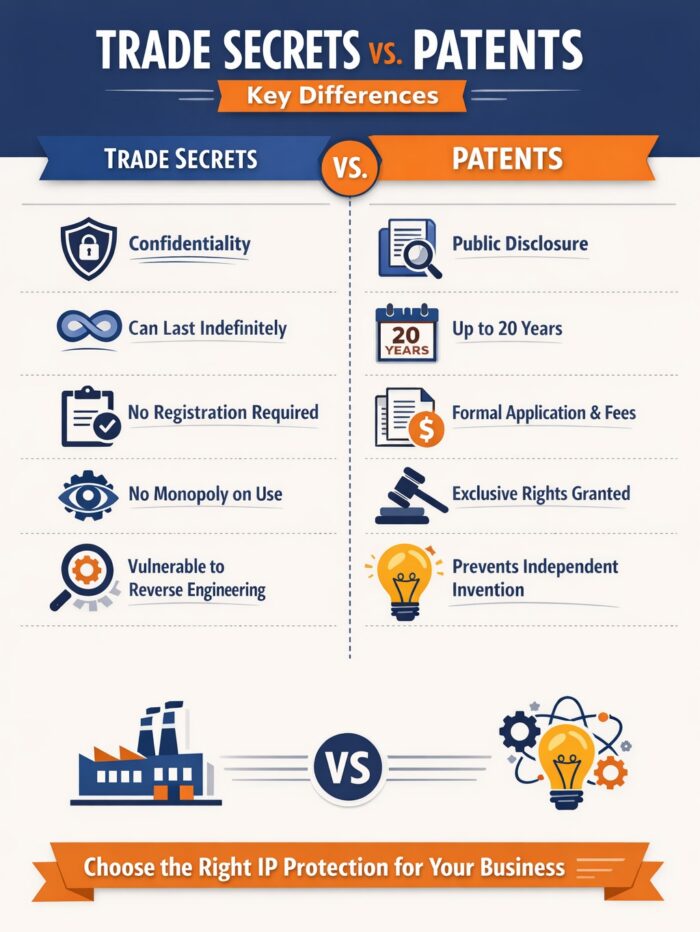
Unlike patents, trade secrets do not require a formal patent application process or approval from a government agency. There are no filing forms, application fees, or patent examination procedures involved. Instead, a company obtains trade secret rights automatically under trade secret law if the information qualifies as a trade secret and the company takes steps to keep it confidential.
In general, a company establishes trade secret protection by doing two things:
This approach reflects the definition of a trade secret under federal law, which requires that the information derive economic value from not being generally known and that the owner make reasonable efforts to maintain its secrecy under 18 U.S.C. § 1839(3).
Because trade secret protection lasts only as long as the information remains secret, businesses must actively manage trade secrets confidentiality. If the information becomes publicly disclosed, or is no longer treated as confidential, the trade secret status may be lost.
Common methods for maintaining trade secrets and demonstrating reasonable steps to protect confidential business information include:
Courts evaluating whether a company has valid trade secret rights often focus on whether the company made a reasonable effort to keep the information secret. In Rockwell Graphic Systems, Inc. v. DEV Industries, 925 F.2d 174 (7th Cir. 1991), the court explained that absolute secrecy is not required, but a business must demonstrate that it took practical steps to preserve the confidentiality of the information.
Another major consideration in choosing between trade secret and patent is whether competitors can reverse engineer your product. Under trade secret law, competitors may legally obtain information through proper means, including reverse engineering. Courts have repeatedly recognized that reverse engineering is a lawful way to learn how a product works. For example, the Supreme Court explained that discovery of a trade secret by “fair and honest means,” including reverse engineering of a publicly available product, is perfectly legal assuming there are no applicable patent rights. Kewanee Oil Co. v. Bicron Corp., 416 U.S. 470, 476 (1974).
This means a competitor may purchase a product on the open market, analyze its technology, and develop a competing product without violating trade secret rights, so long as they do not rely on improper means such as theft or breach of confidentiality. Because of this rule, if an invention can be easily reverse engineered, patent protection is often the stronger strategy for protecting technology. Trade secrets are generally more effective when the underlying method, process, or technical information cannot be readily discovered from the finished product.
Another key difference between patents and trade secrets involves independent discovery by competitors. A patent gives the patent owner enforceable patent rights that can be used to prevent competitors from making, using, or selling the patented invention during the patent term. This is true even if competitors independently invent the same technology or method without copying the original invention. In other words, independent development does not avoid infringement when valid patent protection exists.
By contrast, trade secret protection does not create a monopoly over information. If competitors independently develop the same information secret, process, or technology, they are generally free to use it in their business.
Courts recognize liability under trade secret law only when a trade secret is obtained through improper means, such as theft, espionage, or breach of nondisclosure agreements or other confidentiality obligations. See 18 U.S.C. § 1839(6). If a competitor discovers the information through lawful research and independent development, using it is typically perfectly legal.
In some situations, trade secret protection may be the better strategy for protecting intellectual property, particularly when the value of the technology comes from keeping the information secret rather than publicly disclosing it. For example, trade secret protection may be preferable when the invention secret can realistically be kept confidential within the company. If the information can be restricted to a limited group of employees and partners and safeguarded through reasonable steps such as nondisclosure agreements, access controls, and internal policies, maintaining trade secret status may be a practical approach.
Trade secret protection may also make sense when the technology or process is not easily reverse engineered. If competitors cannot readily analyze a competing product to determine how it works, keeping the method or technical information confidential may provide long-term secret protection. This is particularly common with manufacturing techniques, algorithms, and internal business processes.
Another factor is product lifespan. If the product has a short market life or operates in a fast-moving competitive landscape, the lengthy and time consuming patent process may not align with business goals. In these situations, the cost of preparing a patent application, paying application fees, and waiting for approval may outweigh the benefit of patent protection.
Trade secrets can also protect valuable information that may not qualify as patentable inventions under patent law. Many forms of technology, business know-how, and proprietary process improvements may not meet the legal requirements for patentable subject matter, or they may be difficult to describe in a way that satisfies the disclosure rules of the patent application process. In those situations, trade secret protection can still provide meaningful intellectual property protection. For example, a company may protect proprietary data, internal methods, formulas, algorithms, pricing strategies, and customer lists as a trade secret, as long as the information is not readily ascertainable and the company takes reasonable steps to maintain its secrecy.
In other situations, it may be better to seek patent protection or pursue patent protection rather than rely on trade secret protection. The decision often depends on how the invention will be used in the marketplace and whether competitors could realistically discover the technology on their own. Patent protection may be advantageous when:
When a product or method can be easily analyzed by competitors, maintaining the invention secret may be unrealistic. In those situations, a patent application may provide stronger intellectual property protection because the resulting patent gives the patent owner enforceable patent rights against competing businesses that attempt to commercialize the same technology or process.
Once a patent is granted, the patent owner gains legally enforceable rights that can prevent competitors from manufacturing, using, importing, or selling a competing product based on the patented invention during the patent term.
The choice between trade secret vs patent protection is one of the most important decisions for businesses developing new technology. Trade secrets and patents are mutually exclusive pathways with distinct pros and cons. Patents provide a government-granted monopoly that typically lasts 20 years from the filing date, but they require significant costs and public disclosure of the invention. Trade secrets, on the other hand, protect confidential information indefinitely as long as the company takes reasonable steps to maintain secrecy. However, they do not prevent competitors from independently developing the same technology or obtaining it through proper means such as reverse engineering.
Choosing the right form of IP protection can determine whether you extract the highest value from an innovation. An understanding of both patent and trade secret fundamentals is needed. Because the best strategy depends on the nature of the invention, the technology, and the business environment, it is recommended that you consult an intellectual property attorney when deciding how to protect valuable innovations.
If you need assistance in protecting your new innovation or need assistance with other intellectual property matters, please contact our office for a consultation.
© 2026 Sierra IP Law, PC. The information provided herein does not constitute legal advice, but merely conveys general information that may be beneficial to the public, and should not be viewed as a substitute for legal consultation in a particular case.
A proper, valid trademark or service mark must identify and distinguish your goods or services, be used in commerce, and be distinctive, allowing it to function as a source identifier. The purpose of a trademark is to provide a reliable indicator to a consumer that the product comes from a certain source and carries certain quality and characteristics associated with the source. Thus, a trademark can only be valid if it is being used in the marketplace in a manner that associates it with particular goods or services and the particular source of the goods or services. These are the basic requirements for establishing and maintaining trademark validity. Below we explore the specifics of valid trademarks and good trademark practice.
A mark is valid only if it can distinguish one seller’s goods or services from another’s. Trademark law evaluates this ability through a concept called distinctiveness, which determines whether a trademark can function as a source identifier. Inherently distinctive marks, such as fanciful, arbitrary, and suggestive marks, are the strongest and usually have the best chance of receiving federal registration. Below is a discussion of these different types of trademarks.
A fanciful mark is a completely invented word with no prior meaning, such as KODAK for cameras. Because the term has no dictionary meaning before its use as a brand, it immediately identifies the source of the goods or services.
An arbitrary mark uses a real word in an unrelated context, such as APPLE for computers. Although the word exists in ordinary language, it has no logical relationship to the product, making it highly distinctive.
A suggestive mark falls in the middle. It hints at qualities or characteristics of the product but requires some imagination to understand the connection. For example, COPPERTONE for sunscreen suggests a bronzed skin tone without directly describing the product. Suggestive marks are still considered inherently distinctive and typically qualify for trademark protection and federal trademark registration without proof of acquired distinctiveness.
By contrast, a descriptive mark directly describes a feature, quality, or characteristic of the goods or services, such as CREAMY for yogurt or FAST PRINT for printing services. Descriptive marks do not provide strong trademark protection and are not registerable with the United States Patent and Trademark Office on the Principal Register. See 15 U.S.C. § 1052(e). They can be registered on the Supplemental Trademark Register, which is different than the Principal Register and does not provide the same benefits. It should be noted that descriptive marks can acquire secondary meaning and become distinctive based on extensive use that creates an association of the mark with the goods in the mind of the consumer. If a descriptive trademark acquires secondary meaning, meaning consumers have come to associate the term with a particular business rather than the product itself, the trademark protection becomes stronger and the descriptive mark may be registered on the Principal Register under 15 U.S.C. § 1052(f).
Unlike the foregoing categories, generic terms, such as “computer” for computers, can never function as a trademark or provide any trademark protection. Understanding these distinctions is important because choosing a more unique mark significantly increases the likelihood of obtaining and maintaining a valid federal registration.
If a similar mark on similar goods or services was in use before you begin using your trademark, then your trademark may have limited value as a trademark. The earlier user will have better rights than you do, and may pursue trademark infringement claims against you. This can happen even if the prior user does not have a trademark registration. Moreover, the prior user may be able to enjoin you (prevent you from using) your trademark if they are successful in a trademark lawsuit.
Confusingly similar marks are also highly relevant in the trademark registration process. The USPTO closely examines every trademark application to determine whether the proposed mark is likely to cause confusion with an existing registered mark or an earlier filed application for a similar mark. This evaluation is required under Section 2(d) of the Lanham Act, which prohibits registration of a mark that is likely to cause confusion, mistake, or deception with a previously registered mark under 15 U.S.C. § 1052(d).
Importantly, the analysis does not ask whether two marks are identical. Instead, the question is whether the particular mark is so close to a confusingly similar mark that consumers would mistakenly believe the goods or services come from the same source. The USPTO compares marks based on their similarity in sound, appearance, meaning, and overall commercial impression. Small differences may not be enough to avoid confusion, if the marks create a similar overall impression in the marketplace.
Another critical factor is the relationship between the goods or services offered under each mark. Marks that are somewhat different may be refused registration, if they are used for closely related products or services that consumers would reasonably expect to come from the same business.
The USPTO evaluates these issues using a multi-factor test known as the DuPont factors, which examine the similarity of the marks, the relationship of the goods or services, trade channels, consumer sophistication, and other marketplace considerations. In re E.I. du Pont de Nemours & Co., 476 F.2d 1357 (C.C.P.A. 1973).
Because likelihood of confusion is one of the most common reasons a trademark application is refused, businesses should conduct careful trademark clearance searches before filing for trademark registration.
Trademark law does not protect a product feature that is functional. This comes into play in the context of trade dress, which can be product features, product packaging, store decorations, and other "look and feel" features that are used in branding. For instance, the contoured design of a Coca-Cola bottle is a form of trade dress that acts as a source identifier.
However, under U.S. trademark law, a feature is functional if it is an essential part of the product’s use or purpose, or if it affects the product’s cost or quality. When a feature is functional, it cannot serve as a valid trademark, even if consumers associate the feature with a particular owner or brand. The rule exists to prevent businesses from using trademark protection as a way to obtain perpetual rights over useful product features that should instead fall under patent law, which has limited terms. See 15 U.S.C. § 1052(e)(5).
For example, suppose Company A sells portable roadside signs supported by a dual-spring mechanism that allows the sign to bend in strong winds and then return upright. Because the spring design performs a mechanical function essential to the product’s operation, the company cannot claim exclusive rights to that feature as a registered trademark, even if drivers recognize signs with that spring configuration as coming from Company A. This was the scenario in TrafFix Devices, Inc. v. Marketing Displays, Inc., 532 U.S. 23 (2001). Marketing Displays had previously held a utility patent covering the dual-spring mechanism used in temporary road signs. After the patent expired, TrafFix began selling a competing sign stand using a similar dual-spring structure. Marketing Displays argued that the spring configuration functioned as a protectable trademark identifying the source of the product.
In rejecting Marketing Displays' arguments, the Supreme Court explained that a product feature is functional, and therefore not eligible for trademark protection, if it is essential to the use or purpose of the article or affects the article’s cost or quality. The dual-spring design allowed roadside signs to remain stable in windy conditions and quickly return upright, making it a useful mechanical feature rather than a source identifier. The Court also emphasized that the existence of a prior utility patent strongly indicates that the claimed feature is functional. Allowing trademark rights in such a feature after the patent expires would improperly extend the patent monopoly beyond its statutory term. As a result, the Court held that the dual-spring mechanism was functional and could not serve as protectable trade dress or a valid federal trademark registration for the trade dress.
The key question is whether protecting the particular mark would place competitors at a disadvantage unrelated to brand identification. If the feature provides a practical advantage in commerce, it must remain available for others to use, and therefore cannot qualify for trademark registration.
A business can rely on common law trademark rights, pursue state trademark registration, or seek federal trademark registration. But federal registration offers broader legal protection. A Principal Register registration provides the benefits of a presumption of validity and ownership, and the registrant’s exclusive right to use the mark in commerce for the identified goods or services. By contrast, common law rights are based on actual use in a particular geographic area.
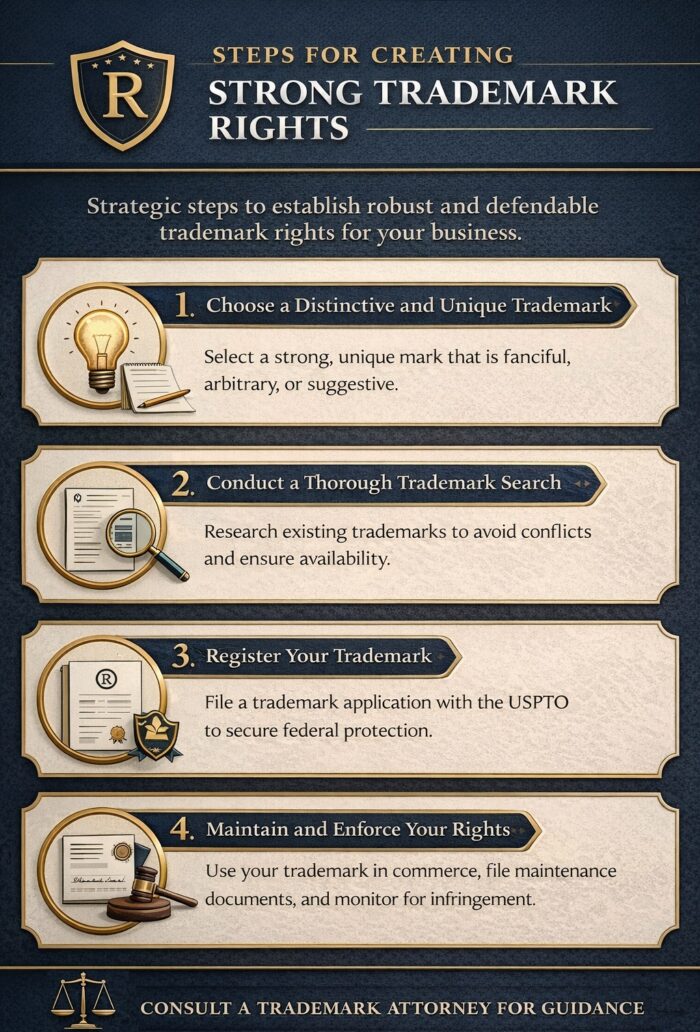
You must continuously use your trademark in commerce to maintain your trademark registration. Use in commerce means the bona fide commercial use of a mark in the ordinary course of trade under 15 U.S.C. § 1127, not token use designed merely to reserve rights. In practical terms, the trademark owner must actually use the particular mark on or in connection with the goods or services listed in the registration while selling or advertising those goods or services in interstate commerce. For goods, the mark must typically appear on the product, packaging, or labels and the goods must be sold or transported in commerce. For services, the mark must be used in advertising or promotional materials and the services must actually be rendered in commerce. See Couture v. Playdom, Inc., 778 F.3d 1379 (Fed. Cir. 2015).
This requirement reflects the fundamental principle of U.S. trademark law: rights arise from use, not simply from registration. To maintain a trademark registration, the owner must periodically provide proof of continued use. That proof typically includes a signed declaration and a specimen of use showing proper use of the mark with the relevant goods or services, submitted as part of the required maintenance filings under 15 U.S.C. § 1058; 37 C.F.R. § 2.161.
Equally important is the concept of continuous use. If a trademark owner stops using a mark in commerce for an extended period, the law may treat the mark as abandoned. Under the Lanham Act, nonuse for three consecutive years constitutes prima facie evidence of abandonment under 15 U.S.C. § 1127. Continuous, ongoing use helps ensure that the mark continues to function as a source identifier and preserves the owner’s trademark rights over time. For this reason, keeping meticulous records of ongoing commercial use, such as marketing materials, product packaging, invoices, and website screenshots, is one of the most important practical steps in the trademark maintenance process.
Between the fifth and sixth year after the trademark registration date, the owner must file a Section 8 Affidavit or Declaration confirming that the mark is still in use in commerce or that special circumstances excuse nonuse under 15 U.S.C. § 1058; 37 C.F.R. § 2.160. The filing must identify the relevant goods or services and include proof of current use showing proper use of the mark in commerce under 15 U.S.C. § 1058; 37 C.F.R. § 2.161.
At the same stage, if the mark has been in continuous use for five consecutive years on the Principal Register, the trademark owner may file a Declaration of Incontestability under 15 U.S.C. § 1065; 37 C.F.R. § 2.167. When the owner claims incontestable rights, the registration gains stronger evidentiary force because an incontestable federal trademark registration is generally conclusive evidence of the validity of the registered mark, the ownership of the mark, and the registrant’s exclusive right to use the mark in commerce for the goods or services listed in the registration under 15 U.S.C. § 1115(b).
As the Supreme Court explained in Park ’N Fly, Inc. v. Dollar Park & Fly, Inc., 469 U.S. 189 (1985), an incontestable registered trademark generally cannot later be attacked as merely descriptive once the statutory requirements for incontestable rights have been satisfied.
In the ninth and tenth year after registration, and every ten years after that, the trademark owner must file the combined Section 8 and Section 9 renewal filing with the required fees and any applicable renewal fees to keep the registration alive. See 15 U.S.C. §§ 1058(a), 1059(a). A U.S. federal trademark registration has an initial validity period of ten years from the date of registration, but it can be renewed indefinitely at regular intervals as long as the owner maintains use in commerce and makes timely filing of the required trademark maintenance documents. There is a six-month grace period after each trademark renewal deadline during which the owner may still renew the trademark registration, but an additional fee applies if the filing occurs during that grace period. See 37 C.F.R. §§ 2.160(a), 2.183(b). There are no open-ended additional periods. If the trademark owner fails to file the required maintenance documents and fees within the statutory deadlines and the six-month grace period, the registration will be canceled or deemed expired, and the federal registration will no longer remain in force.
Trademark maintenance is not just about meeting deadlines. It is also about diligence in the use of and record keeping for the trademark. The USPTO expressly instructs trademark owners not to maintain a registration for goods or services that are no longer in use (see USPTO, “Keeping your registration alive” guidance). You must also avoid filing certain documents with outdated or inaccurate claims. If the specimen submitted with a trademark maintenance filing does not show proper use of the mark in commerce, the filing may be refused and the registration will be canceled under 37 C.F.R. § 2.161. In addition, intentional misstatements about use in commerce or ownership can create fraud issues that may invalidate registered trademarks, as recognized by the Federal Circuit in In re Bose Corp., 580 F.3d 1240 (Fed. Cir. 2009).
Missing the above deadlines can have serious consequences for trademark validity. If a trademark owner fails to file the required maintenance documents before the applicable deadline, the federal trademark registration may be canceled or will expire under the Lanham Act, meaning the registration will be canceled or the registration will be treated as deemed expired, under 15 U.S.C. §§ 1058(a), 1059(a). If the owner misses both the regular deadline and the six-month grace period, the registration generally cannot be reinstated, and the federal registration will no longer provide the statutory presumptions of validity, ownership, and the exclusive right to use the mark in commerce. See 15 U.S.C. § 1115(a). When that happens, the business may still retain limited trademark rights through commercial use, but those common-law rights are typically confined to the geographic area where the trademark in commerce is actually used, making trademark enforcement against infringement significantly more difficult.
The same principle applies to an international registration designating the United States under the Madrid Protocol. The Madrid system allows a trademark owner to seek protection for a particular mark in multiple countries through a single international filing administered by the World Intellectual Property Organization. However, once the United States is designated through the Madrid Protocol, the resulting protection functions like a U.S. federal trademark registration and must satisfy the same trademark maintenance rules. Under Section 71 of the Lanham Act, the owner must file a declaration of continued use, similar to a Section 8 filing, between the fifth and sixth year, again between the ninth and tenth year, and every ten years thereafter to keep the U.S. extension of protection active. See 15 U.S.C. § 1141k(a); 37 C.F.R. § 2.164. These filings must provide proof of ongoing use of the mark in U.S. commerce for the goods or services listed, along with the required fees. If the owner fails to make the required filing, the U.S. extension of protection will be canceled even if the underlying international registration remains active. See 15 U.S.C. § 1141k(b).
It is also important to remember that maintenance payments and filings in each jurisdiction have to be independently handled. For example, a European Union trademark registration is administered by the European Union Intellectual Property Office (EUIPO), which has its own maintenance process, renewal requirements, and renewal fees. If you have registrations in both the U.S. and the E.U., you must meet all of the EUIPO and USPTO deadlines for trademark renewals to keep the registrations alive.
Maintaining your trademarks is an ongoing diligence issue. The best way to establish valid trademark rights is to choose a distinctive and unique brand, adopt and use the mark on your goods and services in commerce in a continuous manner, register the trademark with the USPTO, and diligently file maintenance and renewal documents in a timely manner. Following these steps you can establish strong trademark rights, preserve federal trademark benefits, and protect your branding and reputation.
Because trademarks and trademark registrations involve precise legal requirements, formal documentation, declarations under penalty of perjury, and a long term maintenance schedule, many owners sensibly use experienced trademark attorneys to help select their trademarks, pursue registrations, and maintain their registrations. If you need assistance with your trademarks or other intellectual property matters, contact our office for a consultation.
© 2026 Sierra IP Law, PC. The information provided herein does not constitute legal advice, but merely conveys general information that may be beneficial to the public, and should not be viewed as a substitute for legal consultation in a particular case.
If your product’s appearance is unique and attracts customers (e.g., it includes a sleek silhouette, ornate surface styling, etc.) it may be worthy of design patent protection under U.S. patent law. Even if a product design does not qualify as a technical invention, a novel and non-obvious product design that includes some ornamental features can be protected by a design patent. In this article, we provide design patent examples to show the kinds of designs and products that can be covered by a design patent, and what cannot be covered by a design patent. We also touch on the design patent application process from patent search through prosecution to patent issuance.
A U.S. design patent protects a “new, original and ornamental design for an article of manufacture" under 35 U.S.C. § 171. In plain terms, it protects the product’s ornamental appearance, the visual characteristics that make a product look the way it looks, rather than the functional aspects of the design. Thus, design patents are a way to protect product styling even though competitors may be able to copy the function. Because a design is “manifested in appearance,” design patent scope is keyed to what an observer sees: the overall visual impression created by the article’s contours, proportions, and decoration.
The United States Patent and Trademark Office (USPTO) explains that a design consists of visual ornamental characteristics “embodied in, or applied to, an article of manufacture,” and that design subject matter may relate to (i) configuration or shape, (ii) surface ornamentation applied to an article, or (iii) a combination of both. A design may be embodied in an entire product or only a portion of a product, useful when only some external features are distinctive. And if the design is only surface ornamentation, it is inseparable from the article. The ornamentation must be shown to be applied to the product, not as a standalone image. In drawings, the article can be distinguished from the ornamentation, such as by showing the article in broken lines to clarify what is and is not part of the claimed design.
Just as important is what a design patent does not cover. The Manual of Patent Examining Procedure summarizes the core distinction: in general terms, a utility patent protects the way an article is used and works, while a design patent protects the way an article looks. So a design patent cannot protect purely functional engineering choices, and a claimed design may fail to provide the protection you intended if there are no real ornamental choices and the appearance is dictated solely by function.
This issue was addressed by the Federal Circuit’s invalidity decision in Best Lock Corp. v. Ilco Unican Corp., 94 F.3d 1563 (Fed. Cir. 1996). There, the patent claimed the design of the operative portion of a key blade blank, but the court held the design invalid because the blade had to have that exact profile to fit the corresponding lock’s keyway. Best Lock argued that many lock-and-key designs were possible in the abstract, but the court focused on the claimed article as shown in the patent: this particular key blade. Because no alternative blade shape would work with the mating lock, the claimed appearance was deemed functional rather than ornamental, and the design patent failed under 35 U.S.C. § 171.
There are many categories of products and articles that can be protected by a design patent. A few examples of protectable product categories are discussed below to illustrate the breadth of design patent subject matter.
Design patents can protect jewelry and other accessories because they are articles of manufacture whose market value often turns on visual features and aspects. Jewelry is also a straightforward “article” for design purposes, making it a common category where inventors seek patent protection for unique designs.
Furniture is another classic category. Design patents can protect the ornamental design of chairs, tables, storage, and other home goods. Competitors may be able to legally copy your idea at a high level (“a chair with a curved back”), but a design patent can help protect the specific overall visual design you create.

Beverage containers are frequently protected as designs. A famous example is the original Coca-Cola contour bottle: it was protected by U.S. Design Patent No. 48,160, issued Nov. 16, 1915. Over time, that container shape became source‑identifying and is now protected as a trademark/trade dress (e.g., U.S. Trademark Registration No. 696,147). This is a practical “lifecycle” example: a design can start as a time‑limited patent right and later provide protection as trade dress, e.g., through a federal trademark registration through the United States Patent and Trademark Office).
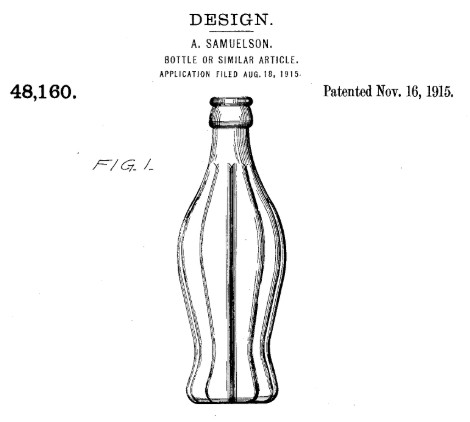
A well‑known example used in many design patent discussions is the Apple iMac. The design patent protects its distinctive “rounded triangle” shape, not its internal function as a computer. A more litigated example is the iPhone design, which was the subject of a billion-dollar lawsuit between Apple Inc. and Samsung. The case reached the U.S. Supreme Court on the issue of what constitutes the relevant “article of manufacture” for purposes of determining design‑patent damages under 35 U.S.C. § 289. Samsung Electronics Co. v. Apple Inc., 580 U.S. 53 (2016). Under § 289, a design-patent owner can recover an infringer’s “total profit” on the relevant article of manufacture. The dispute was what, for a multicomponent product like a smartphone, is the relevant article for which the design patent was issued. Is it the whole phone or just the screen? The Federal Circuit had treated the entire smartphone as the only permissible article of manufacture and therefore affirmed an award of Samsung’s entire profit on the phones. The Supreme Court unanimously reversed, holding that in a multicomponent product the relevant “article of manufacture” need not be the finished product sold to consumers. It may be only a component of that product that is covered by the design patent. The Court explained that § 289 requires two steps: first identify the article of manufacture to which the design was applied, and then calculate the infringer’s total profit on that article.
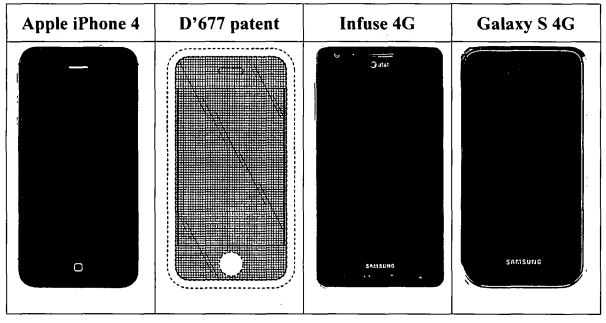
Design patents are routinely used in the fashion industry, including footwear, on novel aesthetic designs for fabric textures, fabric patterns, garment designs, shoe designs, and other innovations. In L.A. Gear, Inc. v. Thom McAn Shoe Co., the accused infringer argued that the asserted L.A. Gear’s design patent covering its “Hot Shots” athletic shoe was invalid because several visible features served functional purposes. The defendant pointed to elements such as the side mesh, and the rear “moustache” feature, contending that they were functional rather than ornamental because they provided support, reinforced the eyelets, and cushioned the Achilles area. The Federal Circuit rejected that argument. It explained that the right question is not whether individual features have utility in isolation, but whether the claimed design as a whole is dictated by function. Because the record showed that the same athletic-shoe functions could be achieved through many different shoe designs, the court agreed that the patented shoe design was primarily ornamental, not invalid for functionality. The court observed that, in the athletic-shoe market, “the primacy of appearance” cannot be ignored and the design features provided a unique look that was proper design patent subject matter.
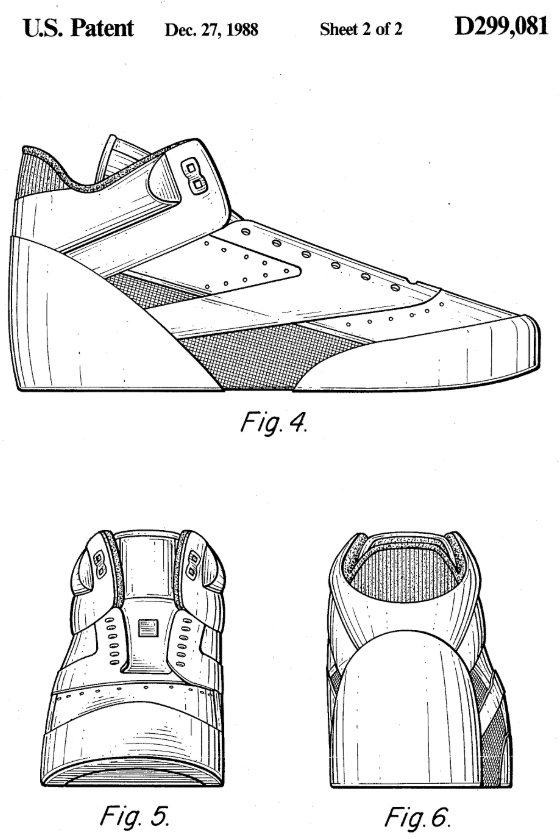
Design patents can cover certain digital designs, including a computer icon or GUI, but the design must be claimed as embodied in an “article of manufacture”, commonly presented as a display panel with the icon or GUI. The USPTO’s 2023 supplemental guidance emphasizes that design protection is not for a mere image “per se”. Properly claimed icons and GUIs are treated as integral and active components of a programmed computer’s operation when displayed on a screen, and therefore can satisfy the article‑of‑manufacture requirement under 35 U.S.C. § 171.
The USPTO has also historically granted design patents “drawn to type fonts,” and USPTO guidance instructs examiners not to reject type‑font claims under § 171 simply because modern font creation is computer‑generated rather than cut from physical blocks.
The practical difference between a utility patent and a design patent is that a utility patent protects how an invention works, covering a new and useful process, machine, manufacture, or composition of matter, and a design patent protects the ornamental appearance of an article of manufacture. In other words, utility patents protect functional innovation; design patents protect ornamental appearance.
You can often seek patent protection under both regimes for the same product. Both design and utility patents may be obtained on an article if there is invention in its utility and ornamental appearance. This is a key planning point for companies launching products where the value of the product is found in both the way the product functions and its distinctive look.
Design patents are subject to the novelty and non‑obviousness standards under the U.S. patent law, even though the analysis is significantly different than in a utility patent for which the novelty and non-obvious standards were developed. The appearance of a design must be new and non-obvious over the prior art as of the effective filing date of the design patent application. This is conceptually similar to how utility patents are evaluated, but significantly different in practice. It is less intuitive to think about how a design might be obvious in view of multiple prior designs than contemplating the obviousness of, e.g., substituting a magnetic clasp for a slide bolt on a door.
A design patent contains only a single claim, and that claim typically reads: “The ornamental design for [the article], as shown and described.” Because of this structure, the title and claim language identifying the article of manufacture play an important role in defining the scope of the design claimed. Patent rules require that the title identify the article in which the design is embodied using the name generally known and used by the public. See 37 C.F.R. § 1.153; MPEP § 1503.01. Although design patent scope is primarily defined by the drawings, the identified article can affect how the public understands what the patent actually covers. As a result, applicants should take care when selecting the article description during the design patent application process, because it may influence how courts interpret the patent later.
The Federal Circuit highlighted this issue in Curver Luxembourg, SARL v. Home Expressions Inc., 938 F.3d 1334 (Fed. Cir. 2019). The patent at issue claimed a repeating decorative pattern shown in the design drawings. However, the patent’s title and claim described the design as “a pattern for a chair.” When Curver sued over baskets that used the same pattern, the defendant argued that the design patent was limited to chairs. The Federal Circuit agreed. Even though the drawings showed only the pattern itself and did not depict a chair, the court held that the claimed article of manufacture, chairs, limited the scope of the design patent. Because the accused products were baskets rather than chairs, there was no infringement.
The decision underscores an important practical lesson for inventors and applicants seeking patent protection. While the drawings remain the primary disclosure defining the ornamental appearance of a design, the article named in the claim can narrow the design patent’s reach in later design patent litigation. If the applicant had claimed the design more broadly, such as a “pattern for a surface,” or depicted the design applied to multiple articles, the scope analysis might have been different. Instead, the choice to identify the design as being “for a chair” effectively limited enforcement of the patent to that particular category of products.
Design patents do not require the design to be functional; they focus on ornamental features. But if the claimed appearance is dictated solely by utilitarian constraints, i.e., no alternative ornamental design choices, the design may be unprotectable or vulnerable, as reflected in Federal Circuit case law such as Best Lock Corporation v. Ilco Unican Corporation, 94 F.3d 1563 (Fed. Cir. 1996), where a key blade was found to be dictated purely by function.
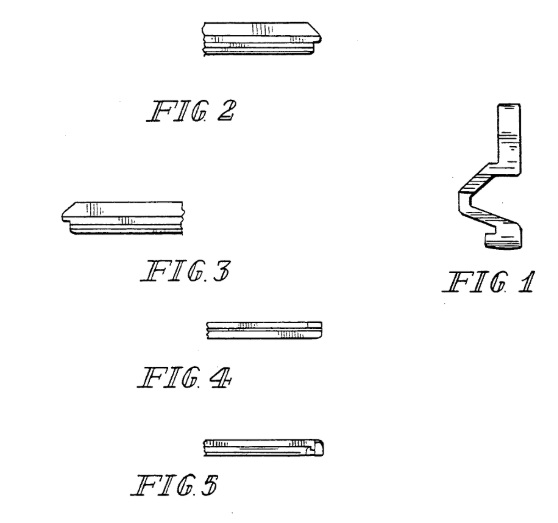
When a company obtains a design patent, the key enforcement question is whether another product copies the ornamental appearance of the patented design. Under U.S. patent law, design patent infringement focuses on visual similarity rather than technical function. A design patent protects the ornamental aspects of an article of manufacture, meaning the visual shape, configuration, and surface decoration that give a product its unique appearance.
The traditional infringement framework asks whether, in the eye of an ordinary observer, the accused design is substantially the same such that the observer would be deceived into buying one supposing it to be the other. This standard was established by the Supreme Court in Gorham Co. v. White, 81 U.S. 511 (1871). In that case, which involved silverware patterns, the Court rejected a highly technical comparison of individual design features. Instead, it held that infringement should be evaluated from the perspective of an ordinary purchaser familiar with the relevant products. If the overall visual impression of the accused design is so similar that the ordinary observer would be deceived, the design patent may be infringed. This approach reflects the nature of design patents: they protect the overall ornamental design, not isolated details.
Over time, courts experimented with additional analytical frameworks for design patent infringement. One influential approach required the patentee to prove both the ordinary observer test and a separate “point of novelty” test, which asked whether the accused product appropriated the specific design features that distinguished the patented design from the prior art. However, this dual-test framework often proved difficult to apply because it encouraged courts and litigants to dissect the design claimed into individual components rather than evaluate the overall visual impression of the product.
The Federal Circuit addressed this issue in its en banc decision in Egyptian Goddess, Inc. v. Swisa, Inc., 543 F.3d 665 (Fed. Cir. 2008). The court rejected the separate point-of-novelty test and returned to a single ordinary observer standard, but with an important refinement. The court explained that the ordinary observer should evaluate the accused design in light of the prior art, meaning that similarities between the designs are more significant when the patented design is visually distinct from existing products. In practice, this framework focuses on the overall design, while still recognizing that the background of existing designs affects what an observer would perceive as substantially similar.
As discussed above, under 35 U.S.C. § 289, a design patent owner may recover an infringer’s “total profit” from the sale of the infringing article of manufacture. The Supreme Court clarified this remedy in Samsung Electronics Co. v. Apple Inc., the relevant “article of manufacture” may be either the entire product or a particular component to which the design is applied. The decision confirmed the strength of the statutory remedy while also recognizing that damages must be tied to the specific design-patented article.
These legal standards help explain why design patents protect valuable commercial assets and why companies increasingly seek patent protection for product styling. Because the infringement test focuses on the overall appearance of a product, competitors often attempt to design around existing patents. This may involve modifying the shape, adjusting visible features, or introducing new decorative aspects so that the final product creates a sufficiently different visual impression. The need to avoid infringement can lead competitors to develop more unique designs, particularly in industries where visual appeal drives consumer demand.
The patent enforcement value of design patents is particularly evident in aesthetics-driven markets such as smartphones, consumer electronics, jewelry, furniture, and fashion goods. In these industries, the visual design of a product often influences purchasing decisions as much as its technical function. A valid United States design patent covering a product’s ornamental appearance can therefore provide meaningful protection against competitors who attempt to imitate the look of a successful product.
Before a patent application, a patent search should be performed to understand likely prior art and refine the scope and object of what they’re trying to protect. A proper patentability search and analysis should research both prior patents, as well as non-patent prior art that can be publicly accessed, such as past and present products in the market. The prior art discovered in the patent search should be used to evaluate the patentability of the design prior to submitting an application. If the design is too close to the prior art, a design patent application should not be filed, as the investment of time and effort is likely to yield no benefit. A primary function of the United States Patent and Trademark Office (USPTO) in the examination of a design patent is to compare the claimed design to the prior art. If the prior art shows the design or highly similar designs, the application will likely be rejected.
If the decision to file an application is made, the design patent application must include (i) a brief specification, (ii) drawings or photographs, and (iii) a single claim in formal terms (e.g., “The ornamental design for [article], as shown and described.”). The USPTO rules require design drawings that comply with strict drawing standards, and rules address when photographs may be accepted.
The drawing section is critical because it depicts the design claimed. The USPTO warns that a design must be capable of being understood from the drawings, with nothing left to conjecture, and that poorly prepared drawings can lead to an incomplete disclosure that cannot become a patent. In practice, line drawings are common, and broken lines are used to show environment or boundaries that form no part of the claimed design, helping to define what you claim and what you leave as context.
A design patent application can be filed with the USPTO through its electronic filing systems, by mail, or by hand delivery. When the USPTO receives an application that includes at least a specification, a drawing, and a claim, it assigns an Application Number and a Filing Date, and issues a Filing Receipt that the applicant should promptly review for accuracy, including inventor names and any priority or earlier filing date benefit claims. During examination, the USPTO checks formal requirements, evaluates whether the design is understandable from the drawings, and compares it to prior art. If patentable, the application is allowed with instructions to complete issuance, and if not, the examiner issues office actions including objections and/or rejections that the applicant must respond to in a timely manner to continue prosecution.
Design patents have a defined, limited term: for applications filed on or after May 13, 2015, the term is 15 years from the date of grant. For applications filed before May 13, 2015, the term is 14 years from the date of grant. Currently, the filing fees for a design patent are around $500, and if you engage an attorney for assistance, you will need to also pay legal fees. Many companies use a patent attorney or patent agent to help determine filing strategy, including whether to file one or more related applications, and respond to office actions. Engaging a patent attorney can ensure that the patent application is prepared and filed properly.
Design patents protect the ornamental design of an article of manufacture, providing U.S. patent rights to exclude others from making, using, selling, offering for sale, or importing substantially similar designs during the patent term. Design patent examples can cover a wide variety of physical goods (e.g., jewelry, furniture, beverage containers), as well as digital products (e.g., icons, GUIs, and other graphical elements). Design patent success depends on careful planning, strong drawings, and disciplined prosecution. Once granted, the patent provides as valuable, enforceable property rights that can protect your product from competition.
If you need assistance with design patents or other intellectual property matters, contact our office for a free consultation.
© 2026 Sierra IP Law, PC. The information provided herein does not constitute legal advice, but merely conveys general information that may be beneficial to the public, and should not be viewed as a substitute for legal consultation in a particular case.
Intellectual property portfolio management is an important business tool for companies that are engaged in innovation or creative industries. Businesses that own patents, trademarks, trade secrets, and other intellectual property (IP) need management of their IP assets to maintain their enforceability and maximize their value. A strong IP portfolio can help you protect your innovation in the relevant markets, create barriers to entry for competitors, and open licensing opportunities that generate revenue. If your business produces innovations, creative works, and/or has strong branding, your intellectual property portfolio should be carefully managed by experienced intellectual property professionals such that it provides maximum protection and value. Such businesses need active management of their IP portfolio.
Intellectual Property (IP) portfolio management is the systematic approach to handling the intellectual property assets owned by an individual or an organization, across the full lifecycle from idea creation to registration, maintenance, monitoring, and eventual enforcement of IP rights. Effective IP portfolio management includes researching, filing, renewing, monitoring, and identifying value in IP assets to achieve business goals and maximize their value.
Intellectual property rights are incredibly valuable assets because they can create a legal moat around a company’s unique product space. For example, a patent grants the right to exclude others from making, using, selling, offering for sale, or importing the patented invention under 35 U.S.C. § 154(a)(1). Trademarks similarly protect brand identifiers by providing remedies against confusingly similar uses of registered marks and against certain unfair competition. See 15 U.S.C. § 1125(a). Copyrights prevent unauthorized publication, copying, and other unauthorized use of creative works, such as audiovisual works, graphical and pictorial works, and written works. See 17 U.S.C. § 106.
A comprehensive IP portfolio can also increase business value, increasing the total asset value reflected on a balance sheet. IP is an intangible IP asset that carries real value for a company or organization, just like real estate, machinery, and other assets owned by a business. Managing your IP brings invaluable rewards, such as maximizing return on investment and providing important protections in a competitive market.
Your IP strategy should start with business objectives. It should be coordinated with and be tailored to address the critical features of your business: what you sell, how you differentiate, where you plan to expand, and the potential risks that could disrupt your business. Aligning IP strategy with overall corporate goals should not be a one-time exercise. It should be an evolving strategic plan that keeps your portfolio aligned with shifting markets, competitors, and overall business goals.
A well-managed IP portfolio typically prioritizes (a) what supports current core services, (b) what protects future bets in new technology, and (c) what creates leverage against competitors. Strategic objectives often include: cost-effective protection where it matters, careful attention to renewal deadlines and maintenance, and capturing valuable insights about where your market is going.
A foundational step in IP portfolio management is conducting IP audits to inventory and evaluate the company’s intellectual property assets and related agreements. The World Intellectual Property Organization describes an IP audit as a systematic review of IP owned, used, or acquired to assess and manage risk, remedy problems, and implement best practices in IP asset management.
A comprehensive audit does more than list patents, copyrights, and trademarks. It helps you identify opportunities, uncover unused or underused intellectual property assets that cost money, spot gaps in IP protection, and confirm that you actually own the assets you think you own.
IP portfolio management should be an ongoing process, rather than a one-time intervention. IP portfolio audits are typically conducted as annual semi-annual reviews of the IP assets of the business and existing and upcoming projects likely to yield intellectual property assets, such as inventions, designs, software code, creative works, etc. Annual or semiannual audits allow companies to reassess their IP position in line with shifting markets and technologies, including whether to maintain, license, or abandon assets. Market analysis (including patent analytics and market data) can allow for informed decisions about which patents and other assets still serve strategic objectives, and which do not.
Such audits also facilitate assessment of your business value. Regular audits can help identify underused patents and trade secrets that may no longer justify fees or curation, and, conversely, underutilized assets that can generate revenue through licensing or strategic partnerships.
Effective intellectual property portfolio management starts with clean ownership. Clear ownership clauses in agreements help ensure the company owns IP created by employees or contractors during their tenure, and that the company can enforce or monetize those rights later. In particular, intellectual property assets are assignable only by an instrument in writing, and ownership issues can affect standing to sue for infringement. Abraxis Bioscience, Inc. v. Navinta LLC, 625 F.3d 1359 (Fed. Cir. 2010).
Because licensing is central to many monetization strategies, a business should work with counsel to keep licensing agreements organized, searchable, and consistent with your portfolio strategy. For example, field-of-use limits, territory, sublicensing, and audit rights should be carefully controlled in licensing agreements and closely managed. Educate employees to recognize and document new IP and reinforce confidentiality expectations early, not only after a product launches.
For patent holders, a proactive filing strategy means filing patents early, especially in a first-inventor-to-file framework where prior art and effective filing dates are important. A common cost-managed approach is to file a U.S. provisional patent application to secure an early filing date while you validate the product and market.
After issuance, there are required patent maintenance fee filings to keep the patent enforceable. For U.S. utility patents, maintenance fees are due in specific post-grant timeframes, and missing them can cause rights to lapse. IP portfolio management is necessary for patent holders to ensure these maintenance obligations are met and patent rights are not inadvertently lost. To illustrate the importance of patent maintenance, a patent licensing contract may become unenforceable if the underlying patent is allowed to lapse. Lapsed patents cannot be lawfully licensed.
Internationally, using the Patent Cooperation Treaty (PCT) can be cost effective by deferring national-phase expenses while you assess commercial traction and investors’ interest. Filing patent applications in individual countries (National Phase) based on a PCT application allows you to defer the cost of filing in individual countries for 30 months (31 months in some countries) after the earliest priority date. Thus, a PCT application is often used to stage costs and decisions on international patent filings.
Strong brand protection is often the fastest “day one” win for businesses because trademarks protect customer recognition and reduce confusion risk. U.S. law allows intent-to-use filings under 15 U.S.C. § 1051(b) for marks you intend to use, but have not yet launched, which can support early market entry planning.
Trademark portfolio management is deadline-driven. U.S. trademark registrations require periodic filings to remain active, and each registration can be renewed in successive 10-year periods when statutory requirements are met. Missing trademark renewal deadlines can be an expensive way to lose priority.
For international expansion, the Madrid Protocol is commonly used to file one streamlined international trademark application covering many member jurisdictions, supporting a centralized system for registrations and later renewals/changes. Where trademark licensing is part of your business model, you should be diligent about ensuring quality licensing structures and work closely with experienced trademark counsel. Poor quality control can result in poor enforcement mechanisms, low value, and risks of “naked licensing”, which can result in abandonment.
Trade secrets are often the highest-value IP assets for businesses whose advantage is process, data, know-how, or customer intelligence. Under federal law, trade secret protection depends in part on taking “reasonable measures” to keep information secret. Safeguard trade secrets by using strict access controls, encryption, and NDAs with all employees and partners, and by segmenting sensitive repositories so departing personnel cannot export or remove files containing your sensitive trade secrets and know-how.
Trade secret enforcement can be powerful: the Defend Trade Secrets Act provides a federal civil cause of action under 18 U.S.C. § 1836(b)(1) when the trade secret relates to a product or service used in interstate or foreign commerce. But trade secret cases also routinely turn on whether the company can articulate what the secret is and prove confidentiality measures, another reason the audit function and documentation discipline matter.
Copyright is the IP right most businesses accidentally ignore until a website redesign, marketing campaign, or software dispute. Copyright protects original works of authorship and grants exclusive rights (such as reproduction and distribution rights) to the owner. If your company depends on content, software, training materials, product photography, or UI/UX assets, copyright portfolio management is part of comprehensive IP portfolio discipline. A common mistake is to fail to acquire copyrights from contractors and vendors that create creative and technical materials for your business. An assignment of rights from the contractor or vendor is an essential IP management step.
Another common mistake businesses make is failing to pursue copyright registrations for their creative works. Copyright registrations are required to both pursue copyright infringement lawsuits and to be awarded statutory damages. Registration should be pursued early before third parties have the opportunity to infringe. If infringement occurs prior to registration, the opportunity to pursue statutory damages may be lost.
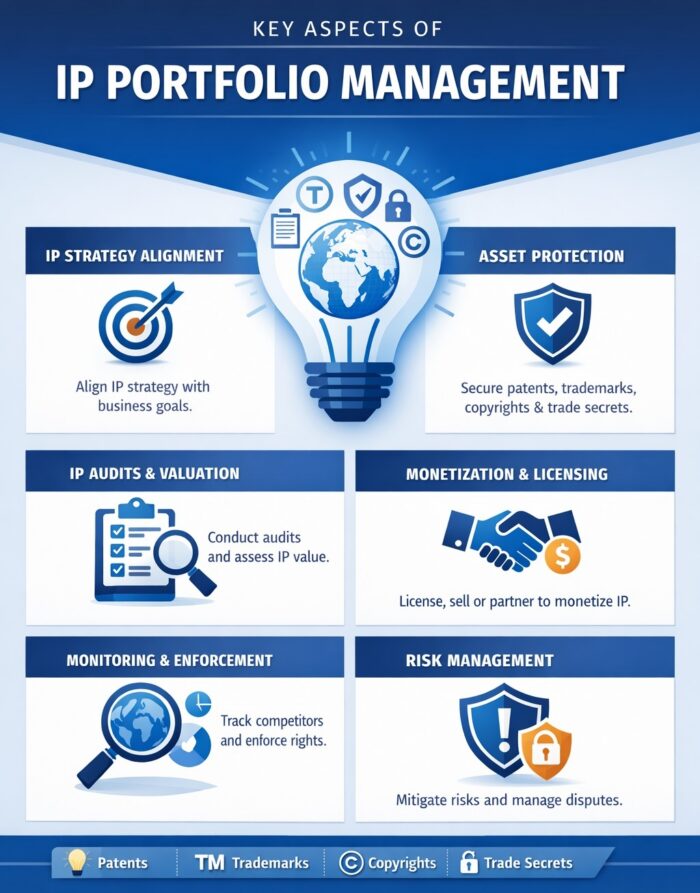
Regular maintenance and surveillance are necessary to keep your IP portfolio maintained and enforceable. This can be done by manual docket tracking through various docketing systems and diligent tracking. There are also third-party IP management software systems that specialize in monitoring your patent portfolio. These systems allow for automated tracking of filing statuses, deadlines for prosecution filings, and renewal deadlines. For example, businesses commonly use third-party IP management and docketing platforms such as Clarivate FoundationIP, Clarivate Docket, Anaqua PATTSY WAVE, AppColl, and Dennemeyer DIAMS iQ to automate monitoring of patent portfolios, track filing statuses, manage prosecution deadlines, and monitor renewal or maintenance obligations. For companies with trademark or mixed IP portfolios, systems such as Alt Legal may also be used to track trademark deadlines and related portfolio activity. These software systems help reduce the risk of missed deadlines, improve portfolio visibility, and support more consistent maintenance and enforcement of intellectual property rights.
There are also competitive intelligence tools and analytics systems to track patent and trademark filings and litigation in your particular market or field of technology. These systems can be used to monitor competitors to aid in determining when your intellectual property rights should be enforced and inform your product strategy and licensing opportunities. For example, platforms such as Clarivate Derwent Patent Monitor are designed to support competitor monitoring, freedom-to-operate review, portfolio benchmarking, and licensing-oriented patent analysis. Other commonly used patent analytics systems include LexisNexis PatentSight+ and Anaqua AcclaimIP/AQX, which can help companies perform competitive analysis on other companies in the market space, monitor technologies that overlap with your own, and identify possible licensing opportunities.
For trademark and brand-monitoring functions, companies may use Questel Markify Watch and Corsearch TrademarkNow/Trademark Watch, which monitor new trademark filings, confusingly similar marks, and competitor filing activity across large numbers of jurisdictions.
Competitor lawsuits remain a commercially immediate threat for many companies because disputes with operating competitors can directly target core products, customers, and partnerships. Without proper risk controls, litigation costs can spiral and settlements may erode business value. There are litigation intelligence tools that help monitor competitors and potential litigation threats, such as Clarivate Darts-ip which provides searchable global IP case-law data and analytics for patents, trademarks, and related rights, helping businesses track disputes, assess enforcement trends, and make more informed enforcement and licensing decisions.
IP portfolio management is also employed to enable IP owners to derive maximum value from their IP portfolios, including through monetization efforts. IP rights can be used defensively to protect your product and service space, and they can also be used aggressively to expand commercial activities via IP licensing, licensing opportunities, strategic partnerships, and attracting investors through your innovations.
To maximize IP value, businesses commonly evaluate (1) direct licensing, including royalty-bearing deals, cross-licenses, and platform licenses, (2) sales or assignments of non-core assets, and (3) strategic partnership opportunities where IP is a contribution to a larger distribution or co-development relationship. The commercial value of these opportunities is often easily demonstrated by new revenue streams, stronger negotiating positions with suppliers and partners, and improved attractiveness to investors during diligence.
Effective IP portfolio management is an important business practice, whether you have a modest or large portfolio of IP assets. Portfolio management should be continuous, systematic, and strategically executed to maximize business value. When you execute and align your IP portfolio management with your business strategy, you create additive strength and competitive value in your business that provides long-term value.
If you need assistance with IP portfolio management or other intellectual property matters, contact our office for a free consultation.
© 2026 Sierra IP Law, PC. The information provided herein does not constitute legal advice, but merely conveys general information that may be beneficial to the public, and should not be viewed as a substitute for legal consultation in a particular case.

Sierra IP Law, PC - Patents, Trademarks & Copyrights
FRESNO
7030 N. Fruit Ave.
Suite 110
Fresno, CA 93711
(559) 436-3800 | phone
BAKERSFIELD
1925 G. Street
Bakersfield, CA 93301
(661) 200-7724 | phone
SAN LUIS OBISPO
956 Walnut Street, 2nd Floor
San Luis Obispo, CA 93401
(805) 275-0943 | phone

SACRAMENTO
180 Promenade Circle, Suite 300
Sacramento, CA 95834
(916) 209-8525 | phone
MODESTO
1300 10th St., Suite F.
Modesto, CA 95345
(209) 286-0069 | phone
SANTA BARBARA
414 Olive Street
Santa Barbara, CA 93101
(805) 275-0943 | phone
SAN MATEO
1650 Borel Place, Suite 216
San Mateo, CA, CA 94402
(650) 398-1644. | phone
STOCKTON
110 N. San Joaquin St., 2nd Floor
Stockton, CA 95202
(209) 286-0069 | phone
PORTLAND
425 NW 10th Ave., Suite 200
Portland, OR 97209
(503) 343-9983 | phone
TACOMA
1201 Pacific Avenue, Suite 600
Tacoma, WA 98402
(253) 345-1545 | phone
KENNEWICK
1030 N Center Pkwy Suite N196
Kennewick, WA 99336
(509) 255-3442 | phone
2023 Sierra IP Law, PC - Patents, Trademarks & Copyrights - All Rights Reserved - Sitemap Privacy Lawyer Fresno, CA - Trademark Lawyer Modesto CA - Patent Lawyer Bakersfield, CA - Trademark Lawyer Bakersfield, CA - Patent Lawyer San Luis Obispo, CA - Trademark Lawyer San Luis Obispo, CA - Trademark Infringement Lawyer Tacoma WA - Internet Lawyer Bakersfield, CA - Trademark Lawyer Sacramento, CA - Patent Lawyer Sacramento, CA - Trademark Infringement Lawyer Sacrament CA - Patent Lawyer Tacoma WA - Intellectual Property Lawyer Tacoma WA - Trademark lawyer Tacoma WA - Portland Patent Attorney - Santa Barbara Patent Attorney - Santa Barbara Trademark Attorney
