Entrepreneurs, inventors, artists, and other creators and owners of intellectual property assets need to have a succession plan for their valuable IP assets. The possibility of disposal of intellectual property in probate is a risk that should be avoided, if possible. In a probate estate, IP is generally intangible personal property that must be identified, valued, managed, and distributed. As a result, IP going through probate is subject to the probate court's judgment about the rightful recipient of the IP. If IP assets are owned by an individual, estate planning for the IP must be implemented to protect the intended beneficiaries, preserve income, and reduce disputes among heirs.
Intellectual property includes inventions, original works, literary works, music, art, designs, logos, and confidential information. The U.S. Patent and Trademark Office identifies four general types of IP: patents, trademark rights, copyrights, and trade secrets. These different types of IP provide creators with exclusive rights to their work. Ideas are not automatically protected, but documented ideas may support obtaining patent protection or, if secret, qualify as trade secrets. Examples of trade secrets include prototypes, chemical formulas, technical know-how, and business knowledge that are confidential and reasonable measures are taken to maintain secrecy, as required under 18 U.S.C. § 1839.
Original works of creativity, such as original writings, audiovisual works, graphical works, and music, are also protected by copyrights under 17 U.S.C. § 102. Trademarks and service marks are words, graphical logos, symbols, designs, and combinations of such elements that are associated with and identify a source of goods or services (e.g., the mark Nike is associated with quality athletic gear). See 15 U.S.C. § 1127.
Intellectual property can provide a substantial portion of the value of an estate or business. Thus, intellectual property can be an important source of wealth and value to businesses and individuals.
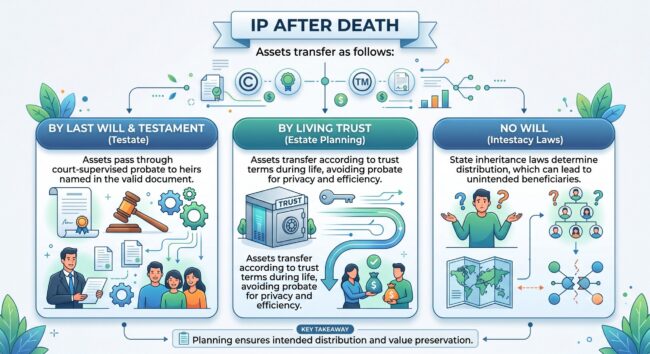
Intellectual property enters probate when the decedent owned it personally at death and did not previously transfer it to a trust, business entity, or other owner. As a result, the IP then becomes an asset of the estate and passes under the decedent’s will or applicable intestacy law. Federal law recognizes that copyrights and patents may be treated as personal property in probate proceedings. See 17 U.S.C. § 201(d)(1) and 35 U.S.C. § 261. Trademarks and trade secrets are also treated as intangible personal property in probate.
Trademarks enter probate when the decedent owns the mark and its associated business goodwill. Because a trademark generally cannot be assigned apart from that goodwill, the executor must consider whether the trademark should be transferred with the related business or product line. See 15 U.S.C. § 1060(a)(1).
When IP remains titled to the decedent, the executor should inventory related agreements, licenses, registrations, filing records, royalty statements, and confidentiality controls. Active management preserves value and because IP may lose value if patent maintenance fees, trademark renewal filings, quality controls, or confidentiality measures are neglected. Missing documentation can impair ownership, interrupt royalties, weaken exclusive rights, compromise trade secrets, or prevent an effective sale or distribution to beneficiaries. Careful administration during the probate process therefore protects beneficiaries and reduces disputes among heirs, licensees, and business partners.
Who receives intellectual property in probate depends principally on the decedent’s will and the intestacy law of the state administering the estate. A valid will may make a specific gift of a patent, copyright, trademark, domain name, royalty stream, or related agreement to a named beneficiary. It may also transfer IP through a residuary clause covering property not otherwise specifically devised. The executor must identify the rights owned at death, determine whether they were previously transferred to a funded trust or business entity, and complete any assignments or recordations needed to place ownership in the beneficiary’s name.
If the owner dies without a valid will, or if the will does not dispose of particular IP assets, the rights generally pass to the heirs designated by state intestacy statutes. The applicable shares may depend on whether the decedent left a surviving spouse, descendants, parents, or more remote relatives.
Clear estate planning is important because divided ownership among multiple heirs can complicate licensing, enforcement, maintenance decisions, and distribution of royalties.
IP titled to the owner may require probate under state law. Avoiding probate requires a legally enforceable transfer of the IP assets. For example, an individual can transfer copyrights, patents, and trademark assets by a written assignment to a trust during their lifetime. Alternatively, the owner may assign IP to a corporation or LLC, leaving the entity interests to pass under the estate plan. Conveyances should identify registrations, applications, works, inventions, marks, licenses, and royalty rights. A pour-over will does not itself complete a lifetime transfer.
Copyright ownership may be transferred by written instrument prior to death (e.g., by trust) or by will. See 17 U.S.C. §§ 201(d), 204.To transfer copyrights voluntarily, an instrument or memorandum must be in writing and signed by the owner or authorized agent. Written copyright transfers may be recorded with the Copyright Office under 17 U.S.C. § 205.
Patent applications, patents, and patent interests are assignable by a written instrument under 35 U.S.C. § 261. Patent ownership may pass by operation of probate law, but confirmatory assignments should document the estate’s chain of title. See Akazawa v. Link New Technology International, Inc., 520 F.3d 1354, 1356–58 (Fed. Cir. 2008).
A trademark assignment must be written and transfer the goodwill connected with the mark. See 15 U.S.C. § 1060. Trade secrets and confidential information should transfer with repositories, access credentials, and confidentiality protections.
Patent and trademark documents may be recorded with the USPTO under 37 C.F.R. § 3.11. Timely recordation can provide notice, protect priority against later purchasers, and strengthen title documentation. It does not cure a defective conveyance or independently establish validity. See 37 C.F.R. § 3.54. Drafting and recordation reduce disputes over intellectual property in probate and help beneficiaries receive ownership.
When intellectual property remains in the probate estate, the executor must confirm authority under the will, court appointment, and state law before executing documents that legally transfer ownership to beneficiaries, a trustee, or buyer. The assignment should cover royalties, infringement claims, future enforcement and renewal rights, and related agreements for licenses, services, security, or confidentiality. Court approval will likely be required for a sale or distribution.
IP assets must be formally valued and distributed during probate. Federal estate tax includes tangible and intangible property, and Treasury rules generally use fair market value. Professional appraisal is critical for determining IP's value, estate and gift tax purposes, beneficiary division, and retain, license, or sell decisions. For example, an IP attorney can find valuation firms and coordinate income, market, and cost methods.
IP rights vary in duration, so the executor or trustee must treat deadlines as part of asset management, not paperwork. Copyright in many original works lasts for the author's life plus 70 years, often beyond the creator's lifetime, but ownership still must be tracked so beneficiaries can collect royalties, license works, or transfer copyrights. Utility patents generally end 20 years from filing, subject to patent-term adjustments and maintenance fees; design patents protecting an ornamental design last 15 years from grant. Federal trademark registrations require periodic maintenance and renewal filings: a Section 8 declaration is due between the fifth and sixth years, and Section 8/9 filings are due every ten years thereafter. Missed filings can cancel registrations, lapse patent rights, reduce fair market value, and invite disputes. The fiduciary should calendar fees, preserve registrations, maintain use in commerce, monitor infringement, and document every action for the estate.
Trade secrets may include formulas, client information, methods, technical knowledge, source code, pricing models, customer lists, manufacturing processes, and other confidential information that gives a business value because competitors do not know it. Federal law requires reasonable measures to keep the information secret and independent economic value that results from the confidentiality of the information. See 18 U.S.C. § 1839(3). Trade secrets are also property interests that can be owned, transferred, licensed, and inherited.
The key assignment issue is specificity without disclosure. A trade secret assignment should transfer ownership of “trade secrets, know-how, confidential information, inventions, formulas, methods, processes, customer data, documentation, and related agreements,” but identify the assets in a confidential schedule, not the public-facing instrument. That schedule can use categories, code names, product lines, repositories, file paths, custodians, dates, or document-control numbers, with access limited to the executor, trustee, attorney, valuation firm, buyer, or beneficiary who needs to know. The assignment should also transfer rights to sue for past and future misappropriation, existing licenses, nondisclosure agreements, and security records.
If trade secrets are subject to probate, the responsible person should preserve access controls, nondisclosure duties, electronic security, contractor confidentiality, and need-to-know limits. Avoid filing formulas or technical details in the probate record. Where court approval, appraisal, or sale documentation is required, counsel should seek sealed filings, redacted inventories, in camera review, or protective orders under applicable probate rules. Federal trade secret proceedings expressly contemplate confidentiality-preserving court orders. See 18 U.S.C. § 1835. Disclosure during appraisal, probate, or a sale can destroy protection and reduce value.
Patents, copyrights, trademarks, and trade secrets can generate ongoing revenue long after the original owner’s death. These assets may produce income through licenses, royalties, product sales, franchise arrangements, software subscriptions, merchandising, or enforcement against unauthorized users. During probate, the executor should audit all related agreements to confirm who owes payments, when renewals are due, whether termination clauses are triggered by death, and whether licensees created improvements that affect ownership or future value. The executor should also review royalty statements, trademark use requirements, patent maintenance fees, copyright registrations, confidentiality obligations, and any pending disputes. Because intellectual property can appreciate or decline depending on active management, the estate should avoid treating IP like ordinary property. A sound plan may benefit beneficiaries by preserving investments, continuing licensing income, protecting exclusive rights, and reducing disputes among heirs.
Transferring ownership of IP to a properly funded trust can avoid many probate complexities under state law, especially when the estate includes valuable intellectual property that may need immediate management after death. But merely listing “intellectual property” in a trust schedule is usually not enough. The owner should execute written assignments that clearly identify each asset, including patents, utility patents, design patents, trademark registrations, copyrightable original works, trade secrets, licenses, domain names, software, logos, formulas, confidential information, and related agreements.
For trust-owned IP, the trustee is responsible for managing assets posthumously for the benefit of beneficiaries. That role may include maintaining registrations, paying renewal or maintenance fees, preserving confidentiality and security for trade secrets, collecting income and royalties, enforcing exclusive rights, and deciding whether to license or sell the property. Because IP requires active management, the trust should give the trustee clear authority to protect, value, transfer, and commercialize the assets.
Professional guidance is crucial both before and after death. An IP attorney and estate-planning attorney can create an effective transfer plan, and help ensure that the estate or trust can preserve future commerce. By cataloging assets, obtaining an appraisal, executing transfers, and selecting a fiduciary capable of managing IP, business owners, artists, inventors, and other creators can protect intellectual property and maximize estate value.
An IP attorney and estate-planning attorney can create a transfer plan, assist with asset valuation, and coordinate clients' appraiser, accounting firm, and business advisers. Incorporating IP into estate planning maximizes estate value and protects future commerce.
Intellectual property may be a creator's most valuable asset, but it only retains that value if it is properly identified, documented, valued, and managed. As part of estate planning, intellectual property should be cataloged with enough detail to allow an executor, trustee, or attorney to understand what exists and how it should be handled. That documentation should list the inventor or author, current owner, registrations, renewal deadlines, licenses, royalties, related agreements, and original records.
A strong estate plan should expressly include IP assets and authorize the fiduciary to manage, protect, license, transfer, or sell them. Planning turns exclusive rights granted by law into durable value for beneficiaries, while neglect can create title gaps, lost protection, unpaid fees, tax risk, interrupted income, and conflict among heirs. For valuable intellectual property, a professional appraisal is often essential to establish fair market value and support estate, gift, or probate administration decisions.
© 2026 Sierra IP Law, PC. The information provided herein does not constitute legal advice, but merely conveys general information that may be beneficial to the public, and should not be viewed as a substitute for legal consultation in a particular case.
Why would a company that makes no product threaten a patent infringement lawsuit? The US patent system permits patent owners to license and enforce patent rights regardless of whether they manufacture or otherwise provide the patented invention. However, patent trolls acquire patents mainly to collect licensing fees or settlements through aggressive assertion. The label is informal and, of course, does not apply to every owner who seeks to license an invention to an infringer. We explain here what a patent troll is.
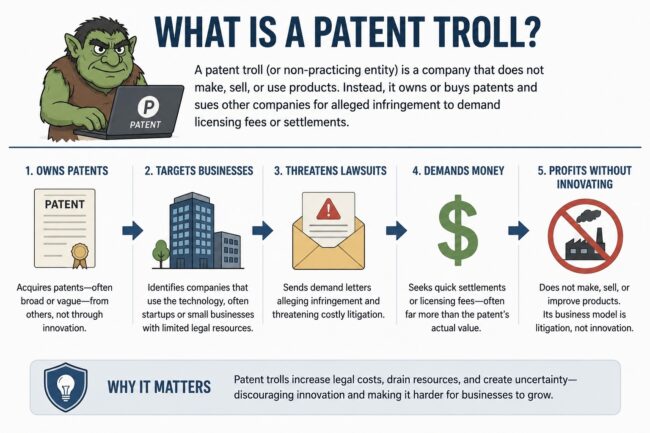
Patent trolls are commonly called patent assertion entities or non-practicing entities. They own patents but generally do not manufacture products, sell a patented product, or supply services using a patented technology or method. Instead, the patent holder seeks out patent infringement claims against operating companies that may be making, using, selling, and/or importing an infringing product or offering an infringing service. Under 35 U.S.C. § 271(a), unauthorized making, using, selling, offering to sell, or importing a patented invention can constitute patent infringement. This is the case whether or not the patent owner makes or practices the invention. The licensing or enforcement of patent rights by a non-practicing entity is not inherently misuse.
Universities, research firms, inventors, and other non-practicing entities may sell and license patents legitimately. Some non-practicing entities connect inventors with manufacturers. In the patent world, “patent troll” usually means an entity using bad patents, hidden ownership, or coercive tactics disconnected from the patent’s actual merit and contribution to society. The term typically refers to companies with no products bringing suits that are essentially meritless.
A troll may buy vague or overly broad patents, perhaps from a failing or small company, then assemble a patent portfolio. It may monitor patent applications, new patents, emerging technologies, and possibly infringing technologies for signs that another company is developing infringing or arguably infringing technology. It compares patent claims with the alleged infringer’s product, sends threatening letters asserting alleged infringement, and demands a license.
The demand may be a few thousand dollars, a small sum of money compared with litigation costs, making an early settlement rational, even though there may be weaknesses in the patent due to overly broad patent claims, written description and enablement problems, close prior art that may render the patent invalid, and/or other possible weaknesses. An early victory or settlement by the troll can be used to build momentum and pressure the next company to settle, thereby rewarding the patent troll behavior and causing a detriment to an operating business that may not have engaged in unlawful behavior.
Patent trolls typically target companies with limited legal resources. Patent litigation can span years and cost millions. Median costs for patent infringement litigation may range from $650,000 in smaller cases to more than $5 million in high-value cases. Lawsuits divert focus from core business activities, create financial and operational burdens, and can present significant financial risk, perhaps rising to the level of bankruptcy. They may also block startups from entering markets or discourage companies from developing new products.
Patent trolls filed around 3,000 U.S. lawsuits in 2012. See Colleen Chien’s “Patent Trolls by the Numbers”. Additionally, it was estimated that U.S. businesses incurred $29 billion in direct NPE-dispute costs in 2011. See the Bessen-Meurer study, “The Direct Costs from NPE Disputes”. That estimate was based on defendant survey data and litigation data, and it focused on direct costs such as settlements, licensing fees, and legal expenses. Large companies paid much of the total, but most defendants were small or medium-sized.
MPHJ Technology Investments is an illustrative example of alleged patent troll behavior. The Federal Trade Commission (FTC) filed an administrative complaint against MPHJ, alleging that MPHJ purchased patents covering networked scanning systems and, from September 2012 through June 2013, sent licensing letters to thousands of small businesses in all fifty states and the District of Columbia. The FTC further alleged that recipients were told they likely infringed by using common office equipment, that 9,081 first letters referenced payments of $1,000 or $1,200 per employee, and that later letters threatened legal action for patent infringement. This campaign shows how a patent holder can target more vulnerable technology end users, rather than the manufacturer or other company supplying the equipment, using licensing fees and patent litigation risk to push settlement below expected defense costs.
In Personal Audio, LLC v. Electronic Frontier Foundation, 867 F.3d 1246 (Fed. Cir. 2017), Personal Audio asserted a podcasting patent, U.S. Patent No. 8,112,504. The Electronic Frontier Foundation challenged the patent through inter partes review, an administrative proceeding through the United States Patent and Trademark Office created under the America Invents Act to challenge the validity of patents. It is a faster procedure than patent litigation. The Federal Circuit affirmed the Patent Trial and Appeal Board’s ruling that the challenged claims were unpatentable, due to a lack of novelty in view of the prior art presented to the Patent Trial and Appeal Board during the inter partes review. The case illustrates how prior art challenges can neutralize overly broad or bad patents before they generate additional licensing fees or settlement leverage.
Patent infringement litigation can cause significant harm beyond attorney’s fees and settlement payments because the costs are not limited to the final judgment or settlement. Companies that were in protracted disputes with NPEs were found to experience an average 20% reduction in R&D investment. See Patent Trolls: Evidence from Targeted Firms by Lauren Cohen, Umit Gurun, and Scott Duke Kominers. The same paper reports $163 million less R&D overall in the years following the loss, relative to comparable firms that won.
The research shows that patent troll disputes are correlated with material reductions in R&D. Patent trolls asserting low-quality patents can delay a patented product, chill emerging technology, divert management attention, and reduce innovation by forcing companies to spend on patent litigation instead of developing new products or responding to genuine market demand.
Critics say trolls often buy vague, overly broad, or low-quality patents from failing or small companies and use them to extort settlements. The 2013 Executive Office report, Patent Assertion and U.S. Innovation, identified the following issue: patent assertion entities exploit uncertainty over claim scope and validity, especially where software claims describe a desired function rather than the means for achieving it. Early software patents were leniently issued for technologies that essentially just digitized known processes and methods. Such software patents were commonly exploited by patent trolls.
The June 4, 2013 White House fact sheet, White House Task Force on High-Tech Patent Issues, announced five executive actions and seven legislative recommendations. One action directed the U.S. Patent and Trademark Office (USPTO) to tighten scrutiny of functional claiming, particularly in software patent applications. President Obama essentially directed the USPTO to tighten scrutiny by training examiners on functional claims and improving claim clarity, especially for software. Better examination of patent applications and clearer claims can reduce uncertainty over whether existing uses or new technology infringe.
These initiatives track Patent Act requirements: 35 U.S.C. § 112(b) requires claims that particularly point out and distinctly claim the invention, while § 112(a) requires clear written description and enablement of the invention. Clearer patent applications and stricter examination make it harder to assert a patent’s actual coverage against existing uses or technology that does not infringe.
The America Invents Act, approved September 16, 2011, changed the patent system by creating faster post-grant challenge procedures before the Patent Trial and Appeal Board (PTAB). Inter partes review took effect on September 16, 2012 and became a key defensive tool in patent litigation involving patent trolls because alleged infringers can test weak patent claims by petitioning the PTAB to review a patent without waiting for a trial in district court. A petitioner other than the patent owner may ask the PTAB to cancel (invalidate) claims based on prior art consisting of patents or printed publications that render the claimed invention anticipated (lacking novelty) or obvious to a person of ordinary skill in the relevant art or technology (PHOSITA). See 35 U.S.C. § 311.
Under 35 U.S.C. § 312, the petition must identify the real parties in interest, challenged patent claims, grounds, evidence, and fees. The defendant in a patent infringement lawsuit must act promptly. An IPR must be filed within one year of being served with the complaint under 35 U.S.C. § 315(b). After institution, the Board normally issues a final written decision within one year, extendable six months for good cause. See 35 U.S.C. § 316(a)(11). An IPR can pressure patent trolls by exposing bad patents.
In 2015, over 40% of U.S. patent filings were filed in the Eastern District of Texas, making it a favored forum for patent trolls, patent assertion entities, and other patent plaintiffs. Plaintiffs chose the Eastern District of Texas because the district had developed a reputation as a plaintiff-friendly patent litigation forum. Specifically, the Eastern District had a reputation for experienced patent judges, local patent rules, relatively firm trial schedules, early and expensive discovery obligations, reluctance to transfer cases or stay litigation for Patent Office proceedings, and juries viewed as receptive to patent rights all increased settlement pressure on alleged infringers. Those procedural and practical features made the district especially attractive to patent holders, including patent trolls, seeking licensing fees or early settlement from companies facing potentially high litigation costs. Before 2017, the procedural hook was VE Holding Corp. v. Johnson Gas Appliance Co., 917 F.2d 1574 (Fed. Cir. 1990), where the Federal Circuit held that the general corporate venue definition in 28 U.S.C. § 1391(c) supplemented the patent venue statute, 28 U.S.C. § 1400(b). Because § 1391(c) treated a corporate defendant as residing wherever it was subject to personal jurisdiction, a patent holder could often file a patent infringement lawsuit in any district where accused products were sold, offered for sale, shipped, or supported. For national companies, that meant almost anywhere. Eastern District of Texas complaints therefore often alleged infringement resulting from sales to or use by Texas customers, retailers, or other local acts of infringement.
In 2017, TC Heartland LLC v. Kraft Foods Group Brands LLC, 581 U.S. 258 (2017) rejected that expansive residence theory and held that domestic corporations “reside” only in the state of incorporation for purposes of 28 U.S.C. § 1400(b). Patent cases may still be filed where the defendant committed acts of patent infringement and has a “regular and established place of business.” 28 U.S.C. § 1400(b). That generally requires a physical place in the district that is regular, established, and the defendant’s own place of business. See In re Cray Inc., 871 F.3d 1355 (Fed. Cir. 2017). This changed the game for plaintiffs because potential defendant companies do not reside in the largely rural Eastern District of Texas. These rulings reduced patent plaintiffs' abilities to file in the Plaintiff-friendly forum in the ED of Texas.
Federal Rule of Civil Procedure 11 does not bar patent plaintiffs from enforcing patent rights, but it does require every filed complaint to have a reasonable legal and factual basis. By signing a patent infringement complaint, counsel certifies that the lawsuit is not being filed for an improper purpose, such as harassment or needlessly increasing litigation costs. The legal theories must be warranted by existing law or a nonfrivolous argument to change the law, and that the factual allegations must have evidentiary support or likely will after reasonable discovery. In patent litigation, that means the patent owner’s counsel must conduct a reasonable pre-suit investigation, including interpreting the asserted patent claims and conducting a thorough infringement analysis of the alleged infringer’s product to determine whether the infringement claims are supported. Rule 11 is enforced through a separately filed sanctions motion or, in some circumstances, by a court’s own order to show cause. For party-filed motions, Rule 11 includes a 21-day “safe harbor” requiring that the motion must first be served on the opposing party and prohibiting the filing of the motion if the challenged complaint is withdrawn or corrected within that period. Sanctions may include nonmonetary relief, penalties, or attorney’s fees limited to deterrence.
The proposed Patent Litigation Integrity Act of 2013 would have shifted reasonable lawsuit costs to a losing party unless substantially justified and allowed bonding. It was introduced, but not enacted. Vermont’s May 2013 law prohibits bad-faith infringement threats, including demand letters lacking claim-specific infringement allegations or demanding unreasonable licensing fees. These “loser pays” and demand-letter reforms show the frustration that businesses have toward the disruptive impact of patent trolls and the existing support for patent reform. However, patent reform is slow moving, and there is no likely near term reforms contemplated in the US Congress to address patent trolls.
Patent trolls acquire (e.g., through patent assignment) and assert patents to generate revenue through licensing campaigns or litigation rather than manufacture or sell products. The practical issue is whether their allegations are reasonably supported by the circumstances of the dispute patent claims, the alleged infringer’s product, and the prior art. A company that is sued or receives a demand letter should promptly evaluate ownership, claim scope, infringement, validity, venue, indemnity, and coordinated defenses with suppliers or peer companies before deciding whether to fight, license, or settle.
© 2026 Sierra IP Law, PC. The information provided herein does not constitute legal advice, but merely conveys general information that may be beneficial to the public, and should not be viewed as a substitute for legal consultation in a particular case.
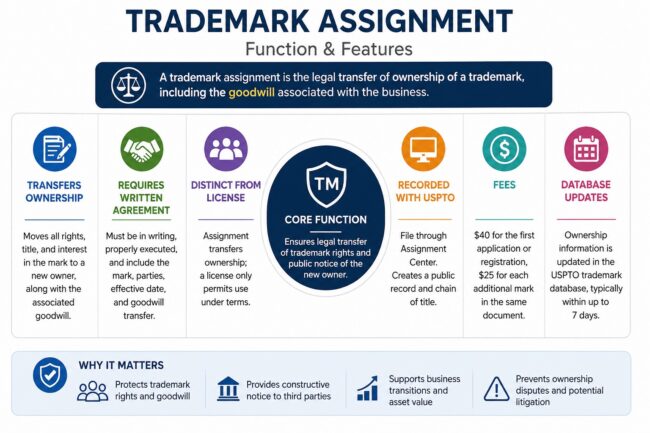
A trademark assignment is the legal transfer of trademark ownership from one party to another. Business owners use an assignment to move a brand, mark, trademark registration, or trademark application when selling a business, moving intellectual property assets into a new entity, or documenting ownership changes. Trademark assignments are governed primarily by the Lanham Act. Under 15 U.S.C. § 1060(a)(1). A registered mark or filed application may be assigned only with the associated goodwill of the business.
A trademark assignment agreement transfers the assignor’s right, title, and interest in a trademark to the assignee, who becomes the new owner and may enforce the trademark rights against unauthorized users. The transfer may cover a registered mark, a pending application, or both, and it includes the goodwill associated with the business connected to the mark. That goodwill is important because a trademark cannot ordinarily be assigned as an isolated symbol divorced from the products, services, reputation, and consumer recognition it represents.
This differs from a license agreement. Trademark licensing allows another person or company to use the mark under defined conditions, while the trademark owner remains the current owner and generally retains responsibility for controlling the quality of the licensed goods or services. By contrast, an assignment changes ownership itself.
A complete assignment agreement should identify the mark, registration number or application serial number, goods or services, assignor, assignee, effective date, and consideration. It should also state whether related applications, registrations, common-law rights, trademark enforcement, and associated goodwill are included in the transfer.
Trademark goodwill is the positive associations and consumer trust a trademark creates in connection with a product or service. Because a mark symbolizes source and reputation, every valid assignment must transfer the associated goodwill. A bare assignment is an “assignment in gross,” jeopardizing the validity of the mark and potentially causing loss of rights.
In Marshak v. Green, 746 F.2d 927, 929–30 (2d Cir. 1984), a judgment creditor bought the trade name VITO AND THE SALUTATIONS at auction for $100 without acquiring the group’s business or goodwill. The Second Circuit set aside the sale, holding that a trademark has no independent significance apart from goodwill and that another group’s use could mislead consumers about source, quality, and continuity.
In Sugar Busters LLC v. Brennan, 177 F.3d 258, 265–68 (5th Cir. 1999), the plaintiff acquired the SUGARBUSTERS service mark, used by an Indiana retail store for diabetic products, and asserted it against a competing diet-book title. The Fifth Circuit held the assignment invalid because the plaintiff’s publishing business was not substantially similar to the assignor’s retail-store services. Tangible assets need not accompany a trademark assignment, but sufficient continuity must preserve the goodwill symbolized by the mark and consumers’ expectations.
The Trademark Act requires a trademark assignment to be made through “instruments in writing duly executed.” The assignment agreement should be properly executed by the assigning owner and identify the parties, the mark, the application or registration number, and the effective date. The document should use definite language showing that the owner intends to assign and transfer all right, title, and interest in the trademark to the assignee. It should expressly state that all goodwill connected with the mark and associated business is transferred. This goodwill language is critical because an assignment that transfers only the symbol, without its related goodwill, may be challenged as an assignment in gross. The agreement should be signed by an authorized person and accurately reflect the ownership being conveyed. Ambiguous terms, missing signatures, or an incomplete description of the transferred rights can create disputes, cloud chain of title, undermine enforcement, and lead to litigation.
An intent-to-use application under Section 1(b) generally cannot be assigned before the applicant files an Amendment to Allege Use or Statement of Use. This rule includes an exception that permits transfer to a business successor that acquires the applicant’s ongoing and existing business, or the portion connected with the mark under 15 U.S.C. § 1060(a)(1). See also 37 C.F.R. § 3.16. However, an intent-to-use application is otherwise not assignable. The Trademark Manual of Examining Procedure (TMEP) used in the examining procedure of the United States Patent and Trademark Office (USPTO), addresses this restriction in TMEP § 501.01(a).
The application of the exception to the no-transfer rule is illustrated in Central Garden & Pet Co. v. Doskocil Manufacturing Co., 108 USPQ2d 1134 (TTAB 2013). All-Glass Aquarium filed an intent-to-use application for ZILLA and assigned it to its ultimate corporate parent, Central Garden, before filing an allegation of use. Although the assignment transferred the mark and goodwill and was recorded with the USPTO, no transaction transferred All-Glass or any part of its business. All-Glass continued producing and selling ZILLA-branded products.
The TTAB held that related-company status, continuity of use, actual use before assignment, and lack of bad intent did not satisfy Section 10. Because Central Garden was not a business successor, the assignment violated the statute, rendering the application void and requiring cancellation of the resulting registration.
A name change and a trademark assignment involve distinct legal events, although both may require updating USPTO records. If a legal entity changes its name but ownership does not change, the USPTO treats the filing as a name change, not an assignment. For example, if the same corporation changes from “OldCo, Inc.” to “NewCo, Inc.,” the owner remains the same entity, and title to the trademark remains with that entity. The filing simply updates the ownership information. By contrast, selling a brand, transferring the mark to an affiliate, or moving trademark rights to another company changes the legal owner and therefore constitutes a trademark assignment. This distinction matters because an assignment generally requires a written transfer document and the associated goodwill, while a name change is usually supported by corporate records showing continuity of the entity. Mischaracterizing the transaction can create chain-of-title problems, delay USPTO processing, and complicate later enforcement.
To record ownership changes, use the USPTO’s Assignment Center, the agency’s online portal for patent and trademark assignment submissions. Older materials may refer to the Electronic Trademark Assignment System or ETAS. However, the USPTO retired ETAS and EPAS in 2024 and replaced these systems with Assignment Center. The filer should identify the assignor, assignee, affected trademark application or registration, execution date, and nature of the ownership transfer. The filing also requires a cover form and supporting document. Under 37 C.F.R. § 3.25, the submission must include a cover sheet and a copy of the assignment, an extract, or a signed statement explaining how the conveyance affects title. Before submission, it is critical to confirm that names, serial numbers, registration numbers, and entity information match USPTO records to avoid delays or an inaccurate public chain of title.
The USPTO charges a fee for recording a trademark assignment: currently $40 for the first trademark application or trademark registration identified in the same document, plus $25 for each additional mark. These fees cover recordation only and do not confirm the assignment’s validity or correct errors in the agreement. Once recorded, the USPTO trademark database should be automatically updated to display the new ownership information. Owners should retain the Notice of Recordation and verify the database entry. The USPTO recommends waiting one week before checking because processing delays may occur, and ownership updates can take up to seven days to appear.
Recording with the USPTO creates a public record, helps provide public notice, and supports a public chain of title for the registration or application. Under 37 C.F.R. § 2.200, trademark assignment records are open to public inspection. Under 15 U.S.C. § 1060(a)(3)-(4), recordation is prima facie evidence of execution, and recording within three months of the assignment date protects the transfer against later purchasers for value without notice. This matters in financing, acquisition diligence, enforcement, and ownership disputes. Trademark transfers are also common: USPTO-associated research found that 21% of registrations issued from 1978–2013 were transferred to different parties.
A Trademark Assignment is the legal mechanism to transfer ownership of valuable assets while preserving consumer trust, goodwill, and enforceable trademark rights. The assignment process should be approached with care. The assignment should be a clear written agreement, include the goodwill of the business, and the information regarding the trademark(s), assignor, and assignee needs to be accurate. The assignment should be promptly recorded with the USPTO after execution.
© 2026 Sierra IP Law, PC. The information provided herein does not constitute legal advice, but merely conveys general information that may be beneficial to the public, and should not be viewed as a substitute for legal consultation in a particular case.
The Doctrine of Equivalents is a U.S. patent law rule that can make an accused product, accused device, or accused process infringe a patent even when it does not literally infringe the exact claim language of the asserted patent. The doctrine limits the available design-around options for products and services that are similar to the claimed invention. It is not enough to simply avoid the literal wording of a specific patent claim. A similar product, technology, or service may still infringe the patent if the substitute technology performs the same function in substantially the same way to achieve substantially the same result. This article provides an explanation of what the doctrine of equivalents is and how it affects patent infringement.
This article is intended for business owners, patent professionals, and anyone interested in understanding how the doctrine of equivalents affects patent infringement.
Patent infringement is defined by statute. 35 U.S.C. § 271(a) prohibits making, using, selling, offering to sell, or importing a patented invention within the United States, or importing it into the United States, without authority from the patent owner. In practice, the patent infringement analysis usually starts with the patent claim, often an independent claim, because the claims, not the abstract, drawings, or general description, define the legal boundaries of the patent rights. A court first performs claim construction to determine the meaning of the claim language from the perspective of a person of ordinary skill in the art. This is a formal process referred to as a Markman hearing under Markman v. Westview Instruments, 517 U.S. 370 (1996)(which is explained in more detail in our Markman hearing article). The court studies the claim language, the patent’s specification, the prosecution history, and sometimes extrinsic evidence to determine the claim construction. The literal meaning of the claim matters because the doctrine of equivalents extends only beyond, not instead of, the literal claim. The court then compares the properly construed claim to the accused product or process.
For literal infringement, every claim limitation must be found in the accused product or process. If even one claimed element is missing, there is no literal infringement of that particular claim. Conversely, if every claimed element is present within the literal scope of the patent claim, the accused product or process infringes literally. This claim-by-claim and element-by-element framework is also important when considering the doctrine of equivalents, because equivalents cannot be used to ignore or eliminate a specific claim limitation.
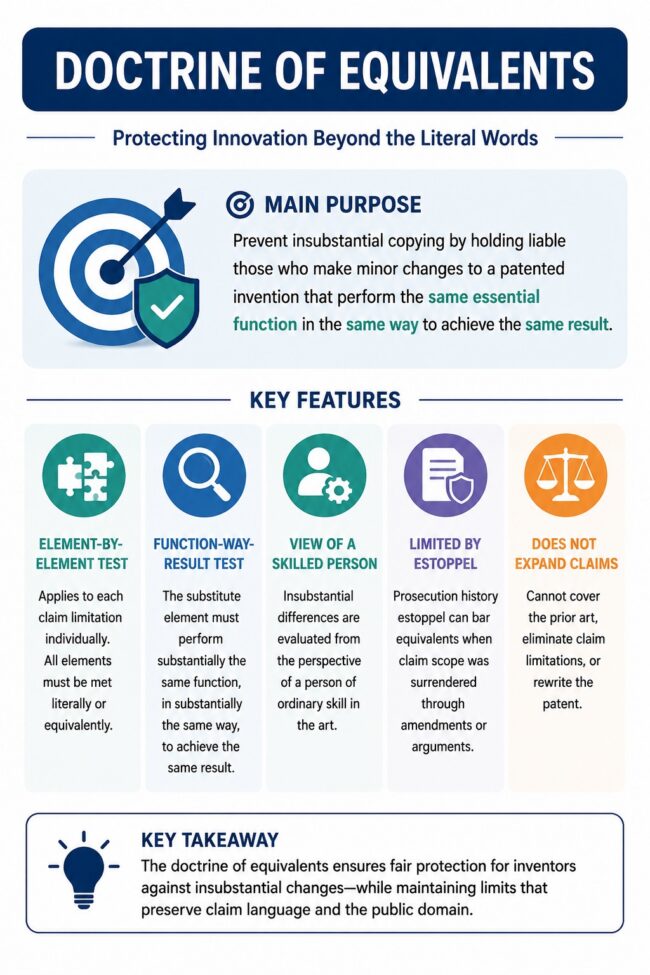
The doctrine of equivalents addresses the situation where an accused infringer changes one feature of a product or process but keeps the practical substance of the invention. In other words, a business cannot always avoid patent infringement simply by replacing a component with a slightly different version if the replacement does the same work in the same practical manner. Equivalent infringement can establish infringement even without elements identical to the claims recited in the patent.
The key issue is whether an accused element or substitute element is equivalent to the claimed element in the relevant patent claim. Courts do not ask whether the accused product generally resembles the patented invention as a whole. Instead, the analysis focuses on each claim limitation individually. If a claimed element is missing literally, the patent owner may argue that the substitute element performs the same function, in substantially the same way, to achieve the same result.
This doctrine is important because patent claims are written in words, but technology often evolves through minor changes in form, materials, software logic, or mechanical arrangement. Without the doctrine of equivalents, an accused infringer could sometimes avoid liability through an insubstantial design change that captures the benefit of the claimed invention while avoiding the literal wording of the claim. At the same time, the doctrine is limited. It cannot expand a patent to cover the prior art, erase meaningful claim language, or recapture subject matter surrendered during patent prosecution through prosecution history estoppel.
In Graver Tank & Manufacturing Co. v. Linde Air Products Co., 339 U.S. 605 (1950), the Supreme Court gave the doctrine of equivalents its classic modern formulation. The case involved welding-flux claims in the Jones patent. The claimed composition used a combination of alkaline earth metal silicate and calcium fluoride. The accused Lincolnweld flux used calcium and manganese silicates instead of calcium and magnesium silicates, meaning the accused composition did not literally track the patent claim language. The district court nonetheless found infringement, and the Supreme Court affirmed because the substitution was insubstantial in light of the technology and prior art. The Court explained that equivalence depends on context: the patent, the prior art, the purpose of the ingredient, its qualities in combination, its function, and whether persons reasonably skilled in the art would have known the materials were interchangeable.
The resulting “function-way-result” or triple identity test asks whether a substitute element performs substantially the same function, in substantially the same way, to achieve the same result as the claimed element. In practical terms, the Graver Tank test assesses function, way, and result. If a substitute element matches those points, and the differences are not substantial when viewed through the eyes of a person skilled in the art, a court may find equivalence even without literal infringement. The takeaway is that changing a material, component, or step may not avoid patent infringement if the change is merely colorable and preserves the practical operation of the claimed invention.
In Warner-Jenkinson Co. v. Hilton Davis Chemical Co., 520 U.S. 17 (1997), the Supreme Court reaffirmed the doctrine of equivalents while limiting how it may be used to prove patent infringement. The Hilton Davis patent concerned an ultrafiltration process for purifying dyes. The relevant claim required the process to operate at a pH between 6.0 and 9.0. The accused process used a pH of 5.0, so Hilton Davis conceded there was no literal infringement and relied on equivalence. The Court preserved the doctrine, but rejected any free-ranging comparison between the overall accused process and the patented invention. Instead, the Warner-Jenkinson test emphasizes the insubstantial differences test and requires an objective, element-by-element inquiry focused on each claimed element. The Court also made clear in 1997 that the “all elements” test applies to each claim element individually, meaning the doctrine cannot erase or ignore a limitation from the relevant claim. The decision also tied equivalence to prosecution history estoppel: when the reason for a narrowing amendment is unclear, the patentee bears the burden to show the amendment was not made for patentability reasons.
A patentee cannot establish infringement under the Doctrine of Equivalents by arguing that “our invention is close enough overall.” In Warner-Jenkinson, the Supreme Court emphasized that the equivalents analysis must be applied to each claim limitation individually. Each claimed element must be either literally present in the accused product or accused process, or equivalently present through an accused feature that differs only insubstantially. This “all elements” rule prevents the doctrine from expanding a patent claim so broadly that a limitation disappears from the claim language. Courts therefore compare the accused feature with the claimed feature and ask whether it performs substantially the same function, in substantially the same way, to achieve the same result, or whether the differences are meaningful.
The doctrine cannot let a patentee capture what already existed in the prior art or what the patentee disclosed but chose not to claim. In Wilson Sporting Goods Co. v. David Geoffrey & Assocs., 904 F.2d 677 (Fed. Cir. 1990), Wilson asserted doctrine of equivalents infringement against Dunlop golf balls that used a similar icosahedral dimple pattern but did not meet the literal claim limitation requiring that no dimples intersect the ball’s “great circles.” The Federal Circuit held that a court may test the asserted range of equivalents by drafting a hypothetical claim broad enough to cover the accused product and asking whether that claim would have been patentable over the prior art. Because Wilson’s hypothetical claim would have ensnared the prior-art Uniroyal ball, the claim could not reach Dunlop’s balls under equivalents.
In Johnson & Johnston Assocs. Inc. v. R.E. Serv. Co., Inc., 285 F.3d 1046 (Fed. Cir. 2002), the patent claimed copper foil laminated to aluminum, while the patent’s specification disclosed stainless steel as an alternative substrate. The accused products used steel. The Federal Circuit held that, under the disclosure dedication rule, disclosed but unclaimed subject matter is dedicated to the public and cannot be recaptured through the doctrine of equivalents.
Prosecution history estoppel limits doctrine of equivalents application by preventing a patentee from using equivalents to recapture claim scope surrendered during patent prosecution. In Festo Corp. v. Shoketsu Kinzoku Kogyo Kabushiki Co., 535 U.S. 722 (2002), Festo owned patents for a magnetically coupled rodless cylinder; after amendment, the asserted claims required sealing rings and a magnetizable sleeve. The defendant sold a similar accused device using a single two-way sealing ring and a nonmagnetizable sleeve, and Festo alleged infringement under the doctrine of equivalents. The Supreme Court held that narrowing claim amendments made to secure allowance can trigger estoppel, whether made to overcome prior art or to satisfy other Patent Act requirements, including formal matters such as the written description, enablement, and definiteness requirements under 35 U.S.C. § 112.
The Court also rejected the Federal Circuit’s complete-bar rule, holding instead that estoppel creates a presumption of surrender that may be rebutted when the equivalent was unforeseeable, the amendment’s rationale bore only a tangential relation to the equivalent, or another reason shows the patentee could not reasonably have described it. Patent prosecutors should draft claims, amendment remarks, and arguments carefully because avoiding prosecution history estoppel often depends on preserving a clear record that no relevant subject matter was surrendered. USPTO replies and amendments can be properly filed under 37 C.F.R. § 1.111 without excess arguments or claim limitations. A response to an office action should address each issue in an office action succinctly and create as little prosecution history as possible.
Estoppel can arise not only from amendments but also from arguments. Argument-based estoppel occurs when the patentee makes a clear and unmistakable surrender of claim scope to the USPTO. In Amgen Inc. v. Coherus BioSciences Inc., 931 F.3d 1154 (Fed. Cir. 2019), Amgen asserted the doctrine of equivalents against Coherus for a protein-purification process using a salt combination not literally recited in the patent claims. During prosecution, however, Amgen had distinguished prior art by emphasizing the “particular” salt combinations in the claims. The Federal Circuit affirmed dismissal, holding that Amgen’s prosecution arguments surrendered unclaimed salt combinations and barred equivalence.
Statements made in foreign patent offices can also affect the analysis. In Tanabe Seiyaku Co. v. U.S. International Trade Commission, 109 F.3d 726 (Fed. Cir. 1997), the patent covered a process for making diltiazem using specific base-solvent combinations, while the accused process substituted butanone for acetone. The court held that foreign prosecution statements to the EPO, Finland, and Israel did not create a separate “foreign prosecution estoppel,” but were relevant to whether a skilled person would view the substitute element as interchangeable.
Prosecution history estoppel may also affect related patents. In Elkay Manufacturing Co. v. Ebco Manufacturing Co., 192 F.3d 973 (Fed. Cir. 1999), the court held that prosecution history for a claim limitation in one patent can apply to later related patents containing the same relevant subject matter.
When asserting infringement under the doctrine of equivalents, a patent owner must do more than show general similarity between the accused product and the patented invention. U.S. courts generally require particularized testimony and a linking argument tying each accused feature or substitute element to a specific claim limitation. See AquaTex Industries, Inc. v. Techniche Solutions, 479 F.3d 1320 (Fed. Cir. 2007). This proof must address the legal test element by element, often using technical expert evidence to explain why any differences are insubstantial. A jury verdict on equivalence must be supported by substantial evidence, and a district court may test the sufficiency of that proof.
The U.S. is unique in how it approaches determining infringement by equivalents. German courts use a three-step test, asking whether the variant has the same effect, whether that would have been discoverable to the skilled person, and whether the reasoning remains oriented to the claim’s technical teaching. UK courts apply their own framework, including whether a variant achieves substantially the same result in substantially the same way, whether that would be obvious to a person having ordinary skill in the art (PHOSITA) at the priority date, and whether a PHOSITA would think the patentee nonetheless intended strict compliance with the literal meaning of the claim. These approaches are not entirely different, but there are important variances.
The Doctrine of Equivalents is a flexible but limited legal rule. It protects the inventive concept captured in a patent against insubstantial copying, but it does not rewrite the claim, erase the all elements test, recapture surrendered territory, or cover the prior art. Business owners need to understand this aspect of patent law because it expands the scope of a patent claim beyond the literal words in the patent claim. The infringement analysis is not limited to whether an accused product falls within the literal scope of one claim, but also whether each substitute element performs substantially the same function, in substantially the same way, to reach the same result.
© 2026 Sierra IP Law, PC. The information provided herein does not constitute legal advice, but merely conveys general information that may be beneficial to the public, and should not be viewed as a substitute for legal consultation in a particular case.
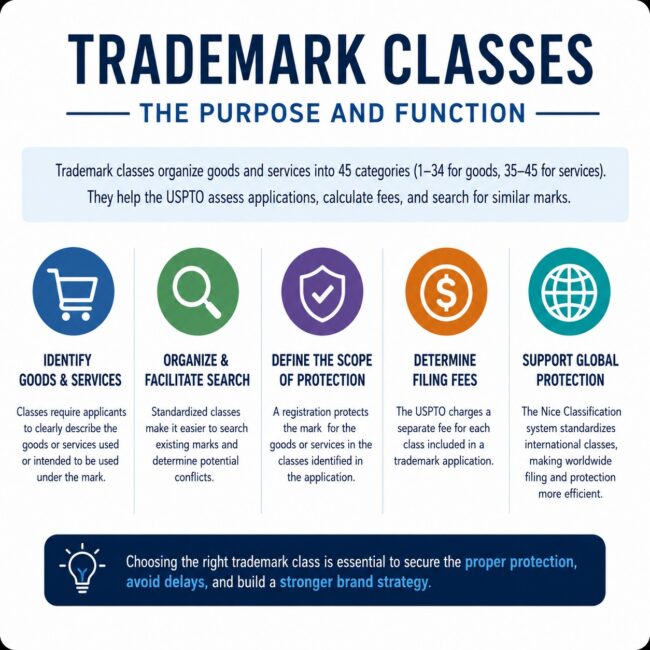
Trademark classes are the numbered categories used in trademark registration to describe the goods and services sold under a mark. They are a critical feature of the trademark application process because the applicant's goods and services must be placed in the proper classes at the time the trademark application is filed. The trademark class(es) also affect filing costs, trademark search strategy, the risk of refusal by the trademark examiner, and the practical scope of protection.
A trademark application must identify the goods or services for which the mark is used or will be used. Goods are tangible products customers buy and use, such as clothing, software sold as downloadable products, food items, or machinery. Services are intangible activities performed for the benefit of others, such as online retail store services, business consulting, entertainment, education, medical care, or legal services. The USPTO uses trademark classes to organize goods and services, assess fees, and aid searching its database of registered and pending marks. They help applicants describe their commercial activity, help the USPTO assess fees, and aid searching its database of registered and pending marks.
Choosing the correct class matters because a registration generally protects the mark only for the identified goods or services, not for every possible product or business activity. A company may need one class or multiple classes if the same brand is used across different offerings. Class selection also affects clearance searching, because similar marks in related or coordinated classes may still create a likelihood of confusion even if they are not in the same class. In short, trademark classes define the commercial context in which trademark rights are examined, registered, and enforced.
The Nice Classification system, established by the Nice Agreement in 1957 and administered through the World Intellectual Property Organization (WIPO), is the global framework for grouping trademark-related goods and services into standardized international trademark classes. Instead of requiring every country to create its own incompatible class labels, the system uses a shared classification system that allows applicants, trademark offices, and searchers to describe products and services in a consistent way. For business owners, that consistency matters because it makes international trademark filing, Madrid-based international registration, and cross-border clearance more predictable. A company seeking protection for computer software, medical devices, clothing, or business services can often begin with the same international classes when evaluating filings in different jurisdictions. The class number does not decide by itself whether trademark infringement occurred, but it helps organize searches, compare competitors’ filings, identify related goods or services, and reduce avoidable errors when expanding a brand internationally.
How many trademark classes are there? There are 45 international classes in the Nice Classification system. Classes 1–34 cover goods, meaning tangible products such as clothing, software, food, machinery, chemicals, and building materials. Classes 35–45 cover services, meaning activities performed for others, such as advertising, business management, education, legal services, medical services, and retail store services. The system began with 34 goods classes and later expanded to include 11 services class categories. Each trademark application must identify at least one class, and protection generally tracks the selected goods or services listed in the application.
Choosing the appropriate class matters because a trademark application must explain exactly how the mark is or will be used. The United States Patent and Trademark Office (USPTO) requires at least one class, and 37 C.F.R. § 2.32 requires the application to include a list of the particular goods or services and the fee for each class. A registration generally protects the trademark only in the class or classes identified in the application and only for the listed goods and services, not for every possible business activity. For example, a mark registered for clothing does not automatically protect unrelated software, food products, or legal services. The class also affects USPTO filing fees because each class requires a separate fee. Selecting the wrong class can lead to an Office Action, delays, added costs, or a narrower registration than expected. Careful classification helps define the trademark’s commercial scope and supports stronger trademark registration strategy.
The first 34 trademark classes cover goods, meaning physical products that customers buy, use, consume, wear, install, or otherwise receive as tangible items. These classes are organized partly by product function and partly by material composition. For example, some classes focus on chemicals, cosmetics, foods, machines, electronics, clothing, or building products, while others group products based on whether they are made of metal, paper, textile, synthetic materials, or other materials.
The class should match the actual product sold under the mark. A company selling fertilizer, for example, will likely look at a different class than a company selling cosmetics, metal hardware, or automatic vending machines. The following examples illustrate how the goods classes begin to operate in practice:
While goods classes cover tangible products, services classes cover intangible activities performed for the benefit of others. In the trademark context, a service is performed for customers, clients, members, or the public, such as advertising, consulting, banking, construction, education, healthcare, or legal services. However, advertising for your own business is not providing services you are providing in commerce under trademark law, and does not support any trademark rights or registration. Services have to be provided to another.
Selecting the correct services class is important because the trademark application must accurately describe how the mark is used in commerce. A company that offers consulting, education, professional, healthcare, or other services should identify the class that best matches the actual customer-facing service. Common services classes include:
Searching the USPTO trademark ID manual for similar products can help identify class choices and reveal how examiners may view related goods or services. It is also important to search the USPTO trademark search system and use the coordinated classes options in your trademark search because certain products may fall into classes that are closely related even when they are not in the same class. For example, clothing in Class 25 may be related to jewelry in Class 14 or retail services in Class 35 if consumers would expect them to come from the same brand. Searching for similar marks in these coordinated classes helps applicants identify potential conflicting trademark filings and avoid potential likelihood of confusion issues.
A single trademark application may cover multiple classes when a brand is used for different goods or services, but the USPTO charges filing fees separately for each class. Under the USPTO’s current electronic filing framework in the Trademark Center, which recently replaced many functions of the Trademark Electronic Application System (TEAS), the base application fee is $350 per class for Section 1 and Section 44 applications that meet base requirements. That means a two-class application generally starts at $700, and a three-class application starts at $1,050. Additional USPTO fees may apply for incomplete information, custom identifications, or later use-related filings, so class selection directly affects total cost.
Using the Trademark ID Manual facilitates finding pre-approved descriptions of goods and services, which can lower filing fees, and expedite approval. Filing also requires use in commerce or a bona fide intent to use the mark in the near future. 15 U.S.C. § 1051(b) expressly permits an intent-to-use application based on a bona fide intention to use the mark in commerce. Selecting the wrong class or using vague wording can trigger an Office Action, which may require amendment, added-class fees, or refiling if the problem cannot be corrected within the application.
A registration in one class does not automatically prevent another party from registering the same trademark in a different class, or even in the same class, if the respective goods or services are sufficiently unrelated and consumers are unlikely to believe they come from the same source. For example, Delta Airlines and Delta faucets coexist because of the unrelatedness of their respective services and goods. The controlling question under 15 U.S.C. § 1052(d) is whether the applicant’s mark, as used with the identified goods or services, is likely to cause confusion, mistake, or deception. For example
The leading case, In re E.I. du Pont de Nemours & Co., 476 F.2d 1357 (C.C.P.A. 1973), identifies the multi-factor likelihood-of-confusion test used by the USPTO and courts. The du Pont factors show why two identical marks can sometimes coexist: the analysis considers not only the similarity of the marks, but also the relatedness of the goods or services, trade channels, purchasers, market conditions, and evidence of actual confusion.
In In re 1729 Investments LLC, Serial No. 90694523 (TTAB Apr. 24, 2023), the TTAB reversed a likelihood-of-confusion refusal and allowed the applicant to pursue registration of RAO’S for wine in Class 33 despite existing RAO’S registrations for restaurant and bar services in Classes 42/43. The Board found the marks identical, but held that the USPTO had not shown the required relatedness between the identified wine and restaurant/bar services, particularly in view of the applicant’s trade-channel restrictions and the sophistication of purchasers.
Accordingly, the same mark may be simultaneously registered when the records show commercially distinct goods or services, different trade channels, and no likely consumer confusion.
Trademark classes are more than filing categories. Trademark classes help business owners and entrepreneurs describe what they sell, compare competitors, budget filing fees, and avoid preventable refusals. Best practices include searching the USPTO database, reviewing coordinated classes, and checking the Trademark ID Manual for proper classification of goods and services and choosing the appropriate class or multiple classes that match actual use or bona fide intent. Careful class selection can reduce filing mistakes, avoid unnecessary USPTO fees, lower the risk of an Office Action, and help ensure that the resulting registration reflects the real scope of the business’s brand use.
If you need assistance with a trademark application or other trademark matter, please contact our office to work with our skilled trademark attorneys.
© 2026 Sierra IP Law, PC. The information provided herein does not constitute legal advice, but merely conveys general information that may be beneficial to the public, and should not be viewed as a substitute for legal consultation in a particular case.
A Copyright Licensing Agreement is a legally binding contract in which a copyright owner gives another party permission, through a copyright license, to use a creative work or other copyrighted material for a specific purpose under specific conditions. A license agreement is important because it turns informal approval into defined rights granted, obligations, and limits. The document should identify the parties, describe the work, state who retains ownership, and explain whether the license is exclusive, non-exclusive, limited by territory, or limited to a particular time period. It should also address restrictions on copying, distribution, sublicensing, modification, derivative works, and unauthorized use. Payment terms may include a one-time fee, royalties, or other compensation tied to the licensee’s use. A termination clause should explain when the license ends and what happens afterward. Clear terms reduce disputes and help protect intellectual property while allowing lawful commercial use.
A strong copyright licensing agreement starts with accurate basic information. The licensing agreement should list the full legal names, addresses, entity types, company details, and signing authority for all parties involved, including the licensor, the licensee, and any parent, affiliate, agent, or authorized representative signing on behalf of a company. This matters because the license granted is only reliable if the party granting it actually has the authority to do so. The effective date should also be stated clearly, along with any start date for access, delivery, or permitted use.
The agreement should identify the copyrighted work with enough specific details to avoid confusion. For example, the contract may cover photographs, website copy, videos, music, training content, software, product illustrations, marketing materials, or other creative work. Attachments, file names, copyright registration numbers, version numbers, URLs, titles, creation dates, and approved formats can help define the exact copyrighted material being licensed.
The agreement should also confirm accurate ownership of the copyright and any associated intellectual property rights. Under U.S. copyright law, copyright initially belongs to the author unless the work is a work made for hire or ownership has been transferred. See 17 U.S.C. §§ 101, 201. If the agreement includes an exclusive license or other transfer of copyright ownership, it must be in writing and signed by the copyright owner or authorized agent, as required by 17 U.S.C. § 204(a). The contract should also specify whether related rights are included, such as trademarks, trade secrets, publicity rights, source code access, or third-party materials. Clear ownership language helps prevent later disputes over the rights granted, restrictions, and lawful use.
Licensing agreements can be exclusive, non-exclusive, sole, or based on standardized Creative Commons licenses. In U.S. copyright law, the starting point is the copyright owner’s bundle of exclusive rights, including reproduction, distribution, public performance, public display, and preparation of derivative works under 17 U.S.C. § 106.
An exclusive license gives one licensee the sole right to use designated copyrighted material within the stated scope, territory, and time period. In practice, the licensor may not grant the same specific rights to another party, and the copyright owner may be barred from exercising those rights if the agreement makes the license exclusive and there is no reservation allowing the owner to exercise such rights. Under U.S. copyright law, an exclusive license is a “transfer of copyright ownership,” even when limited by duration or territory, and unlike a nonexclusive license, it must be in a written agreement signed by the owner or authorized agent to be valid. 17 U.S.C. §§ 101, 204(a). The clause should identify the exclusive rights being granted, such as reproduction, distribution, display, performance, or creation of derivative works under 17 U.S.C. § 106, and reserve all other rights to the licensor. Because an exclusive licensee may have standing to sue for infringement of the licensed rights under 17 U.S.C. § 501(b), the parties should address enforcement obligations, costs, and notice requirements so that the parties coordinate in copyright enforcement.
An exclusive license should not be confused with a full copyright assignment. An assignment transfers ownership of the copyright, or a specified ownership interest, from the copyright owner to another party. After an assignment, the assignee owns the assigned rights and may generally control, enforce, sell, or further license those rights, subject to any contractual limits. An exclusive license, by contrast, grants the licensee exclusive permission to exercise particular rights while the licensor may retain overall ownership and all rights not expressly granted. In short, an assignment changes who owns the copyright interest, while an exclusive license controls who may use defined rights.
A nonexclusive license lets the copyright owner grant the same license to use a copyrighted work to multiple licensees at the same time. Unlike an exclusive license, it does not transfer copyright ownership. 17 U.S.C. § 101 defines a transfer of copyright ownership to include an assignment or exclusive license, but not a nonexclusive license. Because 17 U.S.C. § 204(a)’s writing requirement applies to transfers of copyright ownership, nonexclusive licenses may be written, oral, or implied from conduct. In Effects Associates, Inc. v. Cohen, 908 F.2d 555 (9th Cir. 1990), a filmmaker hired Effects Associates to create special-effects footage for the movie The Stuff, paid less than the agreed amount, and used the delivered footage in the film without a signed copyright license. The Ninth Circuit held that Effects had impliedly granted a nonexclusive license because it created the footage at Cohen’s request, delivered it for use in the film, and intended Cohen to copy and distribute it as part of the movie. Thus, while a nonexclusive license can arise informally, it is preferable to have a written agreement that defines the scope, territory, time period, payment terms, restrictions, and whether the licensee may reproduce, display, distribute, perform, or create derivative works from the copyrighted material.
A sole license is a contract-based middle ground between an exclusive license and a nonexclusive license. In a sole license, the licensor agrees not to grant the same license to use the copyrighted material to any other licensee, but the copyright owner keeps the right to use the work itself. This contractual structure can be useful when a business wants market protection without paying for a fully exclusive grant. The agreement should carefully identify the rights granted, such as reproduction, distribution, display, performance, or creation of derivative works, because U.S. copyright law treats those rights as separate exclusive rights under 17 U.S.C. § 106.
Creative Commons licenses are standardized public copyright licenses that allow a copyright holder to give advance permission for certain uses of a creative work. Common versions include CC BY, CC BY-SA, CC BY-ND, CC BY-NC, CC BY-NC-SA, and CC BY-NC-ND. These licenses can be helpful for online content, educational materials, photographs, and other creative assets, but they are not one-size-fits-all. For example, some allow commercial use, some prohibit it, some allow adaptations, and some restrict derivative works. A business owner should confirm the specific conditions before relying on a Creative Commons license, especially using third party creative materials for advertising, software, trademarks, or paid products.
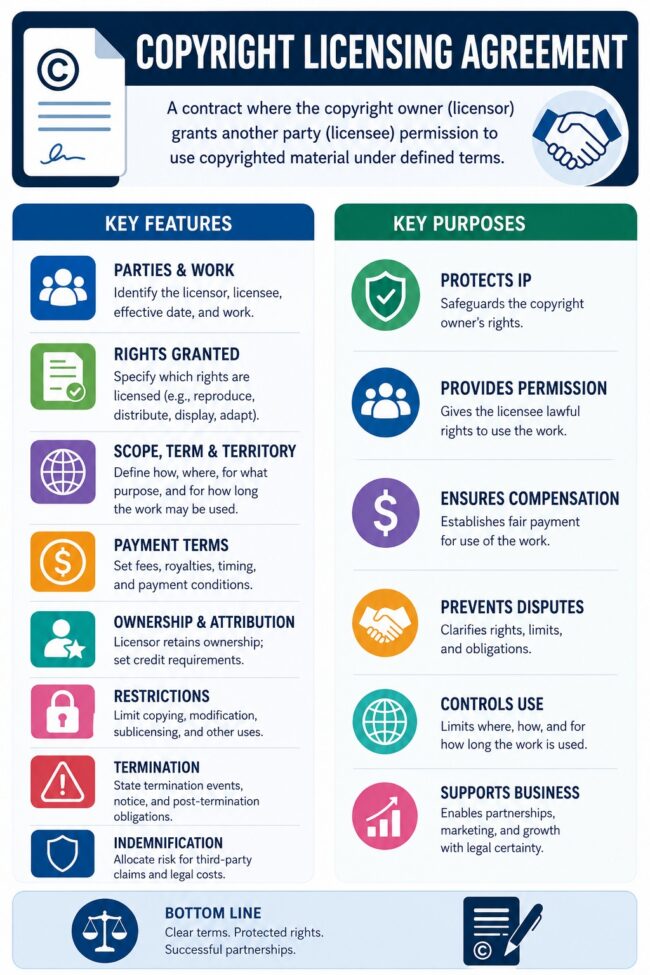
The grant of rights is the heart of a copyright licensing agreement because it identifies the exact copyright license being given. Under U.S. copyright law, the copyright owner controls a bundle of exclusive rights, including the rights to reproduce the copyrighted work, prepare derivative works, distribute copies, publicly perform the work, publicly display the work, and, for sound recordings, perform the work through certain digital audio transmissions. See 17 U.S.C. § 106.
The grant clause should not rely on broad phrases like “use the work.” Instead, the agreement should state exactly what the license allows the licensee to do: view, download, copy, reproduce, modify, edit, display, publish, provide access to, sublicense, sell, or distribute the copyrighted material. It should also state whether the rights granted include the right to create derivative works, such as translations, adaptations, updated versions, excerpts, compilations, or customized marketing materials.
The clause should also define the scope of the license, including territory, platform, media, time period, specific purpose, and any restrictions or approval rights. Finally, the licensor should reserve all other rights not expressly granted so the licensee does not assume broader permission than the contract actually provides.
A solid copyright license agreement should define the scope of the license with practical precision. The agreement should identify the approved media, platforms, number of copies, audience, sales or marketing channels, territory, and specific purpose for which the licensee may use the copyrighted work. For example, a licensing agreement might allow use of an image on a company website in the United States for one year, but not in paid advertising, merchandise, social media campaigns, or international distribution.
In U.S. copyright law, the copyright owner controls distinct exclusive rights, including reproduction, preparation of derivative works, distribution, public performance, and public display. Because those rights can be licensed separately, the agreement should clearly identify the specific rights granted to the licensee, while expressly reserving all other rights to the copyright owner.
Use restrictions should also state when prior written consent is required. Common restrictions include sublicensing, editing, translating, adapting the work, using it in advertising, combining it with third party material, creating derivative works, transferring the license, or expanding the use into new platforms or territories. This level of detail helps prevent unauthorized use and disputes over whether a particular use falls inside or outside the license.
The payment terms should state exactly how and when the licensee will compensate the licensor for the license. Copyright license agreements commonly use two payment types: a copyright fee, often a one-time payment due on signing, delivery, or the effective date, and royalty fees, which are ongoing payments tied to revenue, usage, downloads, subscribers, views, sales, or another measurable metric. Because a copyright owner controls exclusive rights such as reproduction, distribution, public display, public performance, and derivative works, the payment clause should match the actual rights granted and the permitted scope of use.
The clause should also cover invoices, due date, taxes, reports, audit rights, late payment interest, currency, and whether the license remains valid only if amounts are paid. This distinction matters because a missed payment may create only a contract claim unless the agreement makes payment a condition of the license. In Graham v. James, 144 F.3d 229 (2d Cir. 1998), Richard Graham hired Larry James to convert a CD-ROM retrieval program from BASIC into C++. James owned the copyright in the C++ version, but the parties had a licensing agreement under which Graham could use the program in CD-ROM releases in exchange for payment of $1,000 per release plus $1 per disk sold. Graham later failed to pay royalties and removed James’s copyright notice. The Second Circuit held that those breaches did not automatically convert Graham’s licensed use into copyright infringement because the payment and notice provisions were covenants, not express conditions limiting the scope of the license. The court therefore distinguished between breach of contract and infringement. Use outside the licensed rights, however, may still trigger infringement under 17 U.S.C. § 501.
Most licensors retain original copyright ownership in a copyright licensing agreement. The agreement grants permission to use the copyrighted work, but it does not transfer title unless the contract expressly states that ownership or specific intellectual property rights are being assigned. Copyright ownership may be transferred in whole or in part, but an exclusive license or assignment should be clearly documented in writing. See 17 U.S.C. §§ 101, 201(d), 204(a).
The agreement should also address attribution, including whether the licensee must credit the copyright owner, author, company, or creator, and the exact form of that credit. Attribution terms are especially important for creative work used in advertising, software, publications, social media, or branded content. For certain works of visual art, 17 U.S.C. § 106A provides limited rights of attribution and integrity, separate from ordinary ownership rights.
A non-disclosure clause may be essential when the licensee receives source files, unpublished materials, customer data, pricing, know-how, technical documentation, business plans, or trade secrets. This clause should define the protected information, limit disclosure to employees or contractors with a need to know, require reasonable safeguards, and state whether confidentiality obligations survive termination of the agreement. Under U.S. law, trade secret protection depends in part on taking reasonable measures to keep the information secret under 18 U.S.C. § 1839(3).
The agreement should also address practical business obligations, including implementation assistance, technical support, audit rights, quality control, and whether the licensee must obtain prior written consent before using third-party fonts, stock images, music, plug-ins, trademarks, or other rights.
A non-compete clause may be included that provides competitive restrictions in a broader commercial arrangement involving intellectual property, software, proprietary workflows, or sensitive market information.
A strong termination clause should identify the events that end the copyright license, including breach of contract, failure to pay, unauthorized use, insolvency, reputational misuse, failure to obtain required approvals, or use outside the granted rights. The clause should require written notice, state whether the breaching party has a cure period, and explain what happens after termination. For example, the licensee may need to stop using the copyrighted material, remove it from websites or products, delete digital files, return confidential materials, cease distribution activities, and provide written certification of compliance.
This matters because once the agreement expires or is terminated, continued use may exceed the rights granted and become copyright infringement under U.S. copyright law. Conduct that was permitted during the license term may become actionable unauthorized use after termination.
Indemnification clauses allocate legal risk if a third-party claims that use of the copyrighted work infringes its intellectual property rights, violates privacy or publicity rights, or breaches another agreement. These risks can include infringement damages, injunctions, takedown demands, lost revenue, settlement payments, and attorneys’ fees. In a copyright licensing agreement, the licensor should typically indemnify the licensee for claims that the licensor does not own or control the copyrighted material, lacks authority to grant the license, or supplied work that infringes another party’s rights. The licensee should typically indemnify the licensor for claims arising from the licensee’s unauthorized use, modification, distribution, failure to follow restrictions, or combination of the work with other materials. The indemnifying party may be required to defend the claim at its own expense, provide reasonable assistance, and pay covered losses, subject to notice, settlement approval, exclusions, and control of defense.
A well-structured copyright licensing agreement helps protect the copyright owner, gives the licensee reliable permission, and reduces disputes over scope, payment, ownership, territory, derivative works, and termination. A proper license agreement is specifically identifies the work, defines the rights granted, states the duration and territory, includes clear payment terms, preserves ownership, manages confidentiality, allocates risk, and requires written notice before key actions. For copyrighted material that is not in the public domain or covered by a valid exception, a written and signed copyright license is the safest path to lawful commercial use. Licenses are also critical tools for leveraging the important value and rights provided by copyrights.
© 2026 Sierra IP Law, PC. The information provided herein does not constitute legal advice, but merely conveys general information that may be beneficial to the public, and should not be viewed as a substitute for legal consultation in a particular case.
This article explains whether entrepreneurs and business owners can trademark a name, the requirements and process involved, and special considerations for personal and business names.
Can you trademark a name, like Donald or Johnson? Yes, under certain conditions. In U.S. trademark law, a name can become a trademark when it identifies the source of goods or services, and not merely the person or family behind the business. A trademark differentiates a business’s products or services from others, protects brand identity from misuse, and helps build customer trust. A name can function in that way if properly used and understood by the relevant consumers to be a trademark.
The answer is usually yes, but not every personal name, own name, business name, or famous person’s name can be registered as a trademark. Under trademark law, a trademark can be a word, name, symbol, logo, or design used in commerce to identify and distinguish goods or services, as provided by 15 U.S.C. § 1127. The key question is whether the name functions as a source identifier, meaning the trademark identifies a particular business, product line, or service, not merely the person behind it. In the case of a trademark application that includes a person's name, the United States Patent and Trademark Office (USPTO), in addition to determining whether the applied-for mark conflicts with a similar trademark, will review the trademark application to determine whether the mark is primarily merely a surname, and whether consent is required for a living person’s name. See 15 U.S.C. § 1052. If those issues are satisfied, a federal trademark registration may be issued and provide legal protection and stronger trademark rights.
A key distinction in this area of trademark law is that given names and surnames are not treated the same. A first name can often be registered as a trademark without proof of acquired distinctiveness if it is used in commerce to identify goods or services and functions as a source identifier; in other words, the USPTO does not refuse a mark merely because it is a given name. A personal name such as a first name may still face ordinary trademark protection issues, including likelihood of confusion, descriptiveness, and consent if the mark identifies a living person. See 15 U.S.C. § 1052(c).
By contrast, under 15 U.S.C. § 1052(e)(4), a mark that is primarily merely a surname may be refused registration on the principal register unless the applicant proves acquired distinctiveness under 15 U.S.C. § 1052(f). The policy of treating last names as non-distinctive marks is due to the fact that surnames are shared by many people, so trademark rules are cautious about giving one business exclusive federal registration rights in a surname. The surname inquiry asks whether the mark’s primary significance to purchasers is a surname. Courts and the Trademark Office consider the rarity of the surname, whether anyone connected with the applicant has that surname, whether the term has another recognized meaning, and whether added wording or design creates a separate commercial impression. See In re Etablissements Darty et Fils, 759 F.2d 15 (Fed. Cir. 1985); In re Hutchinson Technology Inc., 852 F.2d 552 (Fed. Cir. 1988). Thus, JOHN may face different registrability issues than JOHNSON: the first is not refused merely because it is a given name, while the last name may need secondary meaning.
The courts and USPTO are primarily interested in avoiding consumer confusion by ensuring that trademarks (whether a surname, a fanciful name for a brand, or some other type of mark) are distinctive. Surnames are a special case because they are shared by many people and potentially may be used by many business owners (e.g., family-named businesses). The treatment of surnames as weak marks is to prevent the potential confusion that can arise from multiple businesses using the same surname.
In the case that the surname is denied registration on the principal register, it may be alternatively registered on the supplemental register. A supplemental registration provides a trademark registration, but without many of the presumptions and rights provided by a principal registration. The registrant can later re-apply for the principal register once the registrant can show that the mark has acquired distinctiveness amongst relevant consumers.
To register a living person’s name, portrait, signature, likeness, nickname, or pseudonym, the applicant generally must submit written consent if the mark identifies a living individual. The Lanham Act bars registration of a name, portrait, or signature identifying a particular living individual without written consent under 15 U.S.C. § 1052(c). This rule can apply even when the applicant has a legitimate business reason to use the personal name, including where a founder, designer, performer, or public-facing employee wants to use his or her name as a brand. If the mark includes a living person’s name, the applicant should include a consent statement or submit one during examination. The USPTO explains that consent must include a statement consenting to registration, the living person’s signature, and the date. Without consent, the application may be refused.
Federal trademark law gives additional protection to celebrity names and a famous person’s identity because consumers may assume that a mark using a famous person’s name, nickname, persona, or other identifying reference was approved, sponsored, or licensed by that person. Under 15 U.S.C. § 1052(a), a trademark application may be refused if the proposed mark falsely suggests a connection with a person, whether living or dead. This protection can apply even where the celebrity has not used his or her name as a trademark for competing goods or services. The key question is whether the name or reference points uniquely and unmistakably to the famous person and whether consumers would presume a connection without permission.
In In re Sauer, 27 U.S.P.Q.2d 1073 (TTAB 1993), the Trademark Trial and Appeal Board refused BO BALL because the evidence showed that purchasers would associate the mark with Bo Jackson, whose nickname “Bo” and athletic fame gave the phrase a recognized meaning tied to him. Because Sauer lacked consent, registration was refused. In Vidal v. Elster, 602 U.S. 286 (2024), the Supreme Court upheld the Lanham Act’s living-person “names clause,” confirming that Congress may require consent before another party obtains federal registration of a living person’s name.
A personal name will not be approved as a trademark if it closely resembles an existing trademark for related goods or services. The likelihood of confusion test asks whether consumers might believe two businesses are connected. 15 U.S.C. § 1052(d) authorizes refusal where a mark resembles a registered or previously used mark in a way likely to cause confusion. The key case is In re E.I. du Pont de Nemours & Co., 476 F.2d 1357 (C.C.P.A. 1973), whose factors are used by examiners and the appeal board. There is no mechanical test, and each case depends on its facts.
Trademarking a name involves a multi-step federal process through the USPTO. Before filing, a trademark search should be performed, including a search of the USPTO database for similar names. A new trademark application should identify the owner, mark, goods or services, filing basis, specimen if based on actual use, and any required consent statement. Current USPTO fees are generally $350 per class for a base electronic application. Current USPTO data shows average time to registration or abandonment around 9.9 months, while the USPTO says the overall process usually takes 12–18 months. Federal registration provides legal protection, a presumption of ownership, and nationwide protection subject to prior users and registration limits. See 15 U.S.C. §§ 1057, 1072, and 1115(a).
So, can you trademark a name? Yes, if the name functions as a trademark by identifying the source of specific goods or services, is distinctive enough for trademark protection, and does not create a likelihood of confusion with a similar trademark. Business owners should choose a name that supports a clear brand identity, vet the name before filing by performing a trademark search and analysis, and confirm that the mark will be properly used in commerce. However, it must be noted that the USPTO will likely treat a surname as a weak mark and require a showing of acquired distinctiveness before granting a registration on the principal register. When a name is successfully registered, the federal registration can strengthen trademark rights, provide nationwide protection, enable robust trademark enforcement against infringement, and protect the customer trust built into the brand.
If you need assistance with establishing trademark rights in a name or other trademark matters, contact our office for a consultation with one of our experienced trademark attorneys.
© 2026 Sierra IP Law, PC. The information provided herein does not constitute legal advice, but merely conveys general information that may be beneficial to the public, and should not be viewed as a substitute for legal consultation in a particular case.
The Invention Secrecy Act of 1951 is a federal patent law that allows the government to keep certain inventions secret when publication or disclosure could be detrimental to national security. Sensitive technologies that relate to weaponry, cybersecurity and encryption, or other technologies that have potential national security implications may be subject to a secrecy order and prevented from being patented. In such cases, a United States patent application may be filed, examined, and even found allowable, but the patent therefor is not granted because of the risk the technology creates. This article covers the purpose, process, consequences, and practical implications of the Invention Secrecy Act of 1951, explaining how secrecy orders may affect your patent rights and commercialization plans.
The Invention Secrecy Act of 1951 is codified at 35 U.S.C. §§ 181–188 and creates a national security exception to the ordinary United States patent system. Under 35 U.S.C. § 181, when the Atomic Energy Commission, the Secretary of Defense, or a chief officer of a government designated defense agency determines that publication or disclosure of such invention, or the grant of a patent, would be detrimental to national security, that interested government agency must notify the Commissioner of Patents. The Commissioner will then issue a secrecy order, keep the patent application secret, and withhold publication and grant of the patent until the secrecy order is removed. In practical terms, the Act allows the government to delay patent rights and public disclosure when national security reasons outweigh normal patent-law transparency, while notifying the applicant thereof and preserving statutory procedures for later review.
The Act is meant to protect military, intelligence, atomic-energy, and other defense-sensitive technologies when public disclosure could create national security risks. Under 35 U.S.C. § 181, the legal trigger is not whether an invention is valuable, controversial, or commercially disruptive, but whether publication or disclosure would be detrimental to national security interests. The Invention Secrecy Act is not designed to shield existing industries from competition, nor to prevent new technologies from entering the market merely because they may disrupt such industries. Its purpose is governmental security, not economic protectionism.
The origins of U.S. invention secrecy trace to the 1910s, when Congress first authorized restrictions on patent disclosures during wartime. The practice expanded dramatically during World War II, when secrecy orders became a tool for controlling inventions relevant to weapons systems, communications, aviation, and the classified development of nuclear weapons. The Invention Secrecy Act of 1951 made this authority permanent, allowing secrecy orders to continue outside wartime where the national interest requires secrecy. In practice, the Act reflects a tension between two policies: encouraging inventors to disclose inventions through the patent system and preventing disclosure that could harm national security.
The screening process under the Invention Secrecy Act is usually a two-stage review. First, the USPTO reviews each new patent application filed (non-provisional and provisional applications) for subject matter that may implicate national security, including military, intelligence, nuclear, communications, encryption, aerospace, or other dual-use technologies. This initial review does not necessarily mean the invention is classified or that the applicant has done anything wrong; it means the application contains technical material that may warrant government review before publication.
Second, the USPTO forwards the flagged application to an interested government agency or defense agency with responsibility for the relevant technology. Under 35 U.S.C. § 181, the agency evaluates whether disclosure or publication of the invention would be detrimental to national security. The statute also contemplates controls over handling, including a dated acknowledgment by reviewing officials. If the agency makes the required determination, it recommends that the USPTO issue a secrecy order. The Commissioner then orders the invention kept secret and withholds publication or issuance of the patent. This means a commercially valuable patent application can move from ordinary patent examination into a restricted process where outside disclosure, licensing, fundraising, and commercialization may be sharply limited.
Under 35 U.S.C. § 181, the initial security decision is not made by the ordinary patent examiner. The USPTO screens the patent application, but the substantive national security judgment is made by the head of the interested government agency reviewing the technology. Section 181 refers to the Atomic Energy Commission, the Secretary of a Defense, or such other chief officer of some other department or agency designated by the President as a defense agency of the United States. In practical terms, the relevant chief officers decide whether disclosure of such invention to the general public would be detrimental to national security or whether the national interest requires continued secrecy.
The statute also imposes procedural safeguards. Each reviewer who receives the application must sign a dated acknowledgment, creating a record of access to sensitive patent material. Recent public data identify secrecy order sponsors as including the Army, Navy, Air Force, DOE, NSA, DTSA, and other defense-related agencies. The key point is that the secrecy order decision is driven by specialized national security agencies, not by ordinary commercial concerns or the concern that an invention might disrupt existing industries.
A secrecy order can place a patent application in a sealed condition, restrict access to material information, and keep the patent withheld even when the claims are otherwise allowable. Under 35 U.S.C. § 181, the USPTO must withhold publication and grant of a patent when an interested government agency determines that disclosure of the invention may be detrimental to national security. USPTO rules also require the applicant to continue prosecuting the application while the order remains in effect, but if the application is otherwise ready for allowance, the application is suspended until the secrecy order is removed. See 37 C.F.R. § 5.3.
In practical terms, the order can freeze the commercial usage of the invention. The applicant thereof, inventors, assignees, investors, employees, contractors, consultants, manufacturers, and potential licensees may be barred from receiving or using information about the restricted idea unless disclosure is authorized. That can prevent fundraising, product testing, licensing, manufacturing, publication, foreign patent filings, and ordinary commercialization. Also, while a secrecy order is active, inventors may be unable to sell, license, market, commercialize, or develop the technology with outsiders if doing so would require unauthorized disclosure.
A violation of secrecy orders under the Invention Secrecy Act can have severe consequences for inventors and businesses. Under 35 U.S.C. § 182, if a patent application subject to a secrecy order is published, disclosed, or filed abroad without proper authorization, the Commissioner of Patents may hold the invention abandoned. That abandonment is treated as occurring at the time of the violation and can forfeit all claims against the United States based on such invention, including potential compensation claims.
Under 35 U.S.C. § 186, a person who, with knowledge of the order and without authorization, willfully publishes or discloses the invention or material information about it may face criminal penalties. The same penalty applies to unauthorized Patent Cooperation Treaty or foreign patent application filing in violation of 35 U.S.C. § 184. Upon conviction, the violator may be fined up to $10,000, imprisoned for up to two years, or both. For startups, this risk can eliminate development and commercialization of their technology.
A peacetime secrecy order under the Invention Secrecy Act may last for a significant period. Under 35 U.S.C. § 181, an initial order may last no more than one year, but the Commissioner must renew the order at the end thereof, or at the end of any renewal period, for additional periods of one year when the interested agency gives notice that it has made an affirmative determination that the national interest continues to require secrecy. In practical terms, a patent application can remain pending, unpublished, and unavailable for normal commercialization year after year, even outside a declared war.
The statute also creates longer rules for extraordinary conditions. During war, the order remains effective for the duration of hostilities and one year after hostilities cease. If an order is in effect or issued during a national emergency declared by the President, it remains effective for the duration of the national emergency and six months afterward. The Commissioner may rescind the secrecy order only after notification from the relevant agency or chief officers that disclosure is no longer deemed detrimental to national security. A “temporary” secrecy order can function like an indefinite patent hold, delaying investment, licensing, enforcement, and market entry.
The law permits inventors to seek just compensation when a secrecy order causes economic losses or when the government uses the restricted technology. Under 35 U.S.C. § 183, an applicant whose patent is withheld may apply to the relevant agency for compensation based on damage from secrecy and any government use of the invention. However, compensation is not automatic. The inventor must make a proper showing that the secrecy order caused actual loss, which can be difficult because the inventor is often prohibited from disclosing, marketing, licensing, or commercializing the invention. If the agency does not agree to a full settlement, it may pay an amount not exceeding 75 percent of what the agency head considers just compensation. The inventor may then bring suit in the Court of Federal Claims or an appropriate district court to recover the balance. This framework recognizes a protected property interest, but it also leaves inventors with significant proof and valuation challenges.
Inventors face a practical proof problem: to show they suffered harm from secrecy, they often need market evidence, customers, licensees, expert analysis, or investment discussions. However, a secrecy order creates a Catch-22 because the invention cannot be freely disclosed and market evidence cannot be established. In Constant v. United States, 617 F.2d 239 (1980), the Court of Claims held that allegations of lost financing, lost licensing opportunities, and blocked demonstrations could properly state a claim under 35 U.S.C. § 183. But after trial, plaintiff was denied recovery because the damages evidence was speculative. In Hornback v. United States, 16 F.3d 422 (Fed. Cir. 1994), the court held § 183, not a Fifth Amendment taking theory, was the exclusive remedy for secrecy-order claims and actual damages, especially where the patent remained withheld from public issuance.
Secrecy orders have increasingly affected private technologies, not just traditional military inventions. For companies developing software, communications systems, sensors, aerospace tools, cryptography, energy, semiconductors, or public health technologies that may have defense implications, the Invention Secrecy Act can create serious business uncertainty. The Act may alter the basic patent bargain: inventors disclose inventions to obtain temporary exclusivity, but the government may take the disclosure while withholding commercial patent rights. That means a company may lose the ability to publish, license, sell, raise investment around, or openly develop a technology while the secrecy order remains in place. The risk is especially important for startups and research-driven businesses that depend on patent assets to attract funding or strategic partners. Even when compensation may theoretically be available, proving market value and lost opportunities can be difficult because the invention itself cannot be freely disclosed. As a result, innovators working in sensitive technical fields should consider secrecy-order risk early in their patent filing, funding, commercialization, and foreign filing strategies.
The Invention Secrecy Act of 1951 remains an important but often overlooked part of U.S. patent law. It gives the government broad authority to restrict inventions for national security purposes, require the applicant to maintain secrecy, delay patent issuance, and control disclosure for such period that national security interests are affected. At the same time, it provides limited compensation and appeal mechanisms. If a technology has military, intelligence, atomic-energy, or dual-use implications, patent strategy should account for the possibility that a secrecy order might be applied to the corresponding patent application.
If you have concerns about the Invention Secrecy Act or other intellectual property matters, please contact our office for a consultation with our skilled patent attorneys.
© 2026 Sierra IP Law, PC. The information provided herein does not constitute legal advice, but merely conveys general information that may be beneficial to the public, and should not be viewed as a substitute for legal consultation in a particular case.
Patent valuation is the process of estimating the economic value of patents, patent portfolios, and related intellectual property rights. The process translates legal protection into practical business information for licensing, selling, patent acquisition, fundraising, mergers, joint venture planning, financial reporting, transfer pricing, and litigation. Because patents are intangible assets and may be assigned, licensed, pledged, or sold, their value can affect a company’s assets, negotiations, and investment strategy. Different purposes may require different methods, including the cost approach, income based method, market approach, Discounted Cash Flow, Relief-from-Royalty, or option-based analysis. Patent valuation is increasingly important as companies rely more on intangible assets, including intellectual property. This article explains how valuing patents works and why understanding patent value helps companies make informed decisions about their IP assets.
Patent valuation measures more than the money required to obtain a patent. It estimates the patent value created by exclusive rights in a patented invention, including the legal right to prevent others from making, using, selling, offering for sale, or importing the invention. It also evaluates the underlying invention’s expected business impact, such as revenue opportunities, cost savings, market leverage, licensing potential, and contribution to competitive advantage. Under 35 U.S.C. § 261, patents have attributes of personal property and are assignable, meaning they can be treated as intangible assets within a company’s assets. As a result, patents may be licensed, sold, pledged as collateral, contributed to a joint venture, or included in merger, acquisition, or financing transactions. A useful valuation therefore considers both legal enforceability and commercial usefulness, converting intellectual property rights into an estimated monetary value that business owners, investors, and buyers can use in negotiations and strategic planning.
Patent valuation helps companies translate intellectual property rights into practical business terms. In licensing and sales, it establishes a baseline for royalty rates and helps each side negotiate from a reasoned estimate rather than guesswork. In mergers and acquisitions, valuing patents helps determine fair purchase prices by identifying the contribution of intangible assets, including patented products, exclusive rights, and potential future cash flows. For fundraising, patents may support collateral for bank loans or strengthen a pitch for venture capital investment by showing that innovation has measurable patent value. Patent valuation also guides commercialization decisions, such as whether to manufacture, license, sell, enforce, or contribute a patent to a joint venture. Understanding patent economics helps define trading conditions when intellectual property rights are transferred, licensed, or bundled with technology assets, and it can reveal when companies are likely to overvalue patents or overlook low-value assets that should be sold or abandoned.
When an individual develops an innovation and a patent is granted, the legal value is in the exclusionary rights of the patent, including the ability to prevent others from making, using, selling, offering to sell, or importing the patented invention, as provided in 35 U.S.C. § 154(a)(1). In patent valuation, that right is a core driver of patent value because it defines the scope of commercial protection and the period during which the owner may capture patent licensing revenue, market share, or cost savings. U.S. utility patent term generally runs from issuance to 20 years from the relevant filing date, subject to fees and adjustments under 35 U.S.C. § 154. The type of patent (e.g., utility patents, design patents, plant patents, or utility models) also affects value because protection periods, claim scope, enforceability, examination standards, and internationalization possibilities differ. Thus, understanding patent rights requires reviewing ownership, priority, prosecution history, maintenance status, and remaining protection time before applying valuation methods.
Evaluating patents requires both legal and business analysis because patent value depends on more than the existence of a granted patent. The legal strength of a patent is found in:
A patent with narrow claims, unclear terminology, weak prior-art distinctions, or potential validity issues may have a lower value even if the underlying invention is promising.
Market potential is equally important. This factor examines the addressable market size, expected revenue growth, industry demand, and whether customers are likely to pay for patented products or services. The competitive landscape assesses the existence of competitors, substitute technologies, barriers to entry, and the possibility of market share gains. A patent that supports a durable competitive advantage generally has higher patent value.
When assessing patent value, commercialization status also matters: is the technology currently in use, licensed, sold, or producing profit? Technological validation is another key issue because investors and buyers want evidence that the invention works in practice. Patents lacking practical viability increase perceived investor risk and can significantly lower value, even when the legal rights appear strong.
The jurisdiction of the patent rights affects patent valuation because market potential, legal security, enforcement reliability, and access to financing vary by jurisdiction. A patent covering a large commercial market, or a country with strong remedies for infringement, may have greater patent value than protection in a smaller or less predictable market. The current state of the registration cycle also matters. A pending application may support business planning, fundraising, or patent acquisition, but it usually carries more uncertainty than an allowed application or granted patent. Patents approved after substantive patent examination may be viewed as stronger because the patent claims have survived closer review. Remaining protection time is equally critical: under 35 U.S.C. § 154, many U.S. utility patents generally expire 20 years from the relevant filing date, so fewer remaining years means less time to exploit the patented invention exclusively.
The cost approach estimates patent value by looking at the costs incurred to create, file, prosecute, maintain, or replace the asset. The cost approach estimates the value based on the costs incurred to develop the patent, including research and development expenses. In patent valuation, this method is often useful when the patented invention is early in development, has not yet generated revenue, or lacks reliable market transactions for comparable patents. The replacement cost method asks what money would be required to acquire or develop comparable IP with similar utility, while the reproduction method asks what it would cost to recreate the same technology in its current state. These costs may include research and development, engineering, testing, prototype development, patent drafting, USPTO filing fees, prosecution costs, patent maintenance fees, and related legal fees.
The key limitation is that costs do not necessarily equal patent value. A company may spend heavily on an invention that has little market potential, weak claims, or limited commercial use, causing the cost approach to overvalue patents. Conversely, a relatively inexpensive innovation may create substantial competitive advantage or generate significant future cash flows, meaning the method may undervalue breakthrough inventions. The cost method can be helpful for early-stage assets, but it does not directly measure future economic value, market demand, licensing potential, or the income that the patent may ultimately produce.
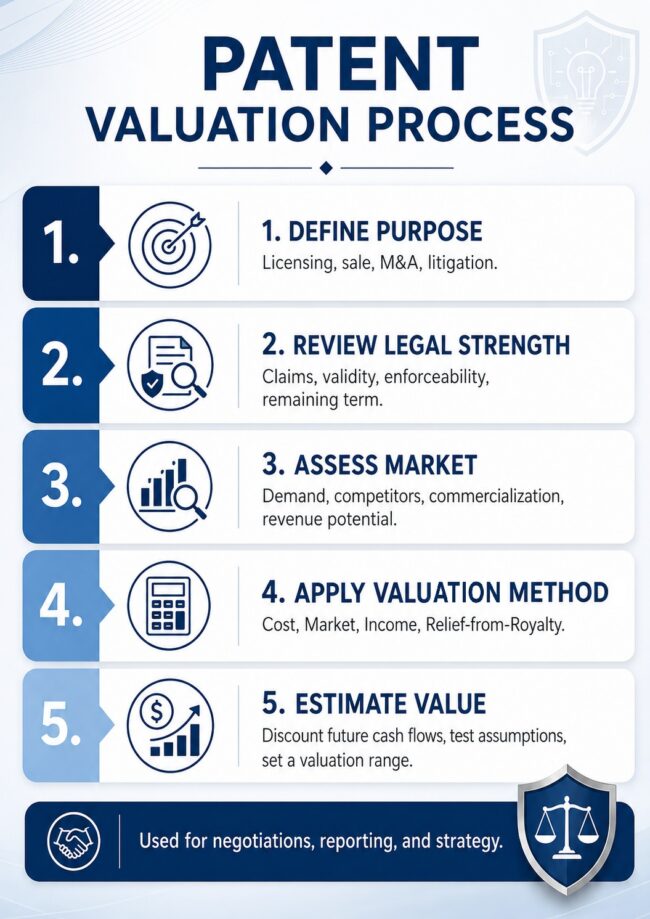
The income-based method is one of the most common approaches to patent valuation because it focuses on the economic benefits the patent is expected to produce. The income approach values a patent based on the present value of expected future cash flows that the patent will generate. Instead of asking only what the patented invention cost to develop, this method evaluates the future cash flows attributable to the patent, including expected licensing revenue, cost savings, premium pricing, increased market share, or additional sales of patented products.
A Discounted Cash Flow (DCF) analysis estimates patent value by projecting the specific cash flows that the patent is expected to generate during its remaining useful life. These cash flows may come from royalty income, increased sales of patented products, premium pricing, cost savings, or avoided licensing payments. The forecast should account for expected market adoption, commercialization timing, remaining patent term, potential design-arounds, and the likelihood that the patent can be enforced if infringement occurs. After the projected cash flows are identified, they are discounted to present value using a risk-adjusted discount rate. That discount rate should reflect commercial uncertainty, technology risk, litigation risk, competitive alternatives, regulatory or manufacturing barriers, and the legal strength of the patent rights. Because small changes in revenue assumptions, growth rates, or the discount rate can materially change the valuation, DCF analysis is usually tested through sensitivity scenarios to produce a more reliable valuation range.
The income approach values intellectual property based on expected future cash flows discounted to present value, but the analysis is highly sensitive to assumptions about revenues, timing, risks, market adoption, and remaining useful life. For that reason, companies should carefully separate income caused by the patent from income caused by branding, distribution, manufacturing capacity, or other business assets. When performed carefully, the income based method can provide a practical estimate of patent value for licensing, acquisition, investment, and strategic decision-making.
Relief-from-Royalty is an income based method of patent valuation that calculates the royalty payments a company avoids by owning the patent instead of licensing it from another owner. The basic valuation calculation starts by identifying the patented products, services, or technology that generate income, estimating expected revenue over the remaining protection period, and applying a supportable royalty rate. That rate is usually informed by comparable royalty data, similar licenses, industry norms, bargaining strength, exclusivity, territory, field of use, and the legal strength of the patent. After estimating the avoided royalty stream, the analysis typically adjusts for taxes or expenses and discounts the projected cash flows to present value using an appropriate discount rate.
This method is especially useful when the patented invention is already commercialized or can be tied to specific income. For example, if a patented component drives sales of a product, the analysis must determine how much of the revenue is actually attributable to the patent rather than branding, distribution, manufacturing quality, or other assets. Relief-from-Royalty can provide a practical estimate of patent value, but it depends heavily on accurate revenue forecasts, reliable comparable royalty data, and careful apportionment to avoid overstating the monetary value of the patent.
The market approach determines a patent’s value by comparing it to similar patents, comparable patents, similar property, patent prices, licenses, or sale transactions in an active market. In practice, this method asks what real buyers, licensees, or investors have paid for intellectual property rights with comparable legal, technological, and commercial characteristics. It is strongest when transactions involve similar patents, similar territories, similar fields of use, similar remaining lives, and comparable levels of commercialization. For example, a licensed patent covering a validated medical device in the United States may be a more reliable benchmark for another U.S. medical device patent than a software patent licensed in a different country or industry.
Market comparables can be powerful because they are grounded in actual transactions rather than purely theoretical assumptions. However, they can also be difficult to apply because IP is unique, deal terms are often confidential, and sufficiently similar comparables may be scarce. Reported patent prices may also reflect bundled assets, cross-licenses, litigation settlements, technical know-how, or strategic motivations that are not visible from the headline number. As a result, the market approach usually requires careful adjustments for patent strength, scope, enforceability, remaining protection time, revenue potential, and competitive advantage.
Qualitative methods are useful when patent valuation cannot rely solely on historical cash flows, comparable transactions, or patent prices. These methods typically involve scoring legal strength, technology readiness, market demand, competitive advantage, commercialization status, freedom-to-operate risk, and the remaining protection period. For example, a patent with broad, enforceable claims, strong technological validation, and clear market potential may receive a higher qualitative rating than a patent covering an unproven technology in a crowded field. However, qualitative methods depend heavily on subjective assumptions, so companies should document the factors, weighting, and evidence used in the analysis.
Option-based methods are often used when the patented invention is early-stage or when future business outcomes remain uncertain. An option-based method for patent valuation applies financial option pricing models to assess the value of the rights associated with a patent. Models such as Black-Scholes-style approaches, commonly used for stock options, treat patent rights like a call option: the patent owner has the right, but not the obligation, to invest later if the market improves or development milestones are met. In patent valuation, this approach may capture value that traditional income based method calculations miss, especially where future cash flows are speculative. Real options analysis is a way to measure strategic flexibility in uncertain technology development, making it helpful for startups, investors, and companies evaluating emerging innovation.
Patent valuation provides a financial basis for claiming damages in infringement litigation and for assessing the business risk of a patent conflict before filing suit or negotiating settlement. Under 35 U.S.C. § 284, damages must be adequate to compensate for infringement and cannot be less than a reasonable royalty for the infringing use. Under 35 U.S.C. § 285, courts may award legal fees in exceptional cases, which can materially affect the economic analysis of litigation.
Patent damages often fall into two categories: lost profits, where the patent owner proves it would have made sales or profits but for infringement, and reasonable royalty, where damages are measured by a hypothetical license between willing parties. In Panduit Corp. v. Stahlin Bros. Fibre Works, Inc., 575 F.2d 1152 (6th Cir. 1978), the 6th Circuit Court of Appeals articulated the familiar lost-profits framework: demand for the patented product, absence of acceptable non-infringing substitutes, capacity to meet demand, and the amount of profit the patentee would have made. Rite-Hite Corp. v. Kelley Co., 56 F.3d 1538 (Fed. Cir. 1995) further confirmed that lost profits require “but-for” causation and may account for market realities where infringement diverts sales.
For reasonable royalty, Georgia-Pacific Corp. v. U.S. Plywood Corp., 318 F. Supp. 1116 (S.D.N.Y. 1970) provides the traditional factors for reconstructing a hypothetical negotiation. Later Federal Circuit cases delineated evidentiary standards that require a disciplined approach to assigning royalty value. Lucent Techs., Inc. v. Gateway, Inc., 580 F.3d 1301 (Fed. Cir. 2009) vacated a royalty award where licenses and the royalty base were not sufficiently tied to the patented feature. Uniloc USA, Inc. v. Microsoft Corp., 632 F.3d 1292 (Fed. Cir. 2011) rejected the 25-percent rule and cautioned against using the entire market value of accused products unless the patented feature drives demand. A defensible valuation must take into account market demand, non-infringing alternatives, accused-product revenue, and the patented invention’s incremental contribution.
Strategic IP portfolio management uses valuation to identify patents for abandonment, sale, or non-renewal, directing investment toward those patents with the greatest return and potential. Patent valuation can also reveal where a company’s assets are concentrated, which patents support key products, and which intellectual property rights may create leverage in licensing, patent acquisition, fundraising, or a joint venture. For accounting purposes, patent valuation supports financial reporting for identifiable intangible assets, including purchase price allocation after mergers and acquisitions and impairment analysis when projected cash flows decline. In tax planning, valuation is important for transfer pricing regulations governing controlled transfers of intangibles, including patents, between related companies. Because accounting, tax, litigation, and transaction value may each require different approaches, companies should define the valuation purpose before selecting methods. This helps investors, companies, and inventors compare estimated outcomes and avoid overvaluing patents based on inconsistent assumptions.
Valuing patents is not a single formula; it is a process that combines law, technology, market evidence, income forecasts, development costs, and subjective assumptions. The best analysis uses different methods, cost, income, market, and qualitative or option-based methods, to determine true worth for the specific business purpose. Understanding patent valuation establishes intellectual property as a strategic asset that can support protection, commercialization, financing, transactions, and competitive advantage.
© 2026 Sierra IP Law, PC. The information provided herein does not constitute legal advice, but merely conveys general information that may be beneficial to the public, and should not be viewed as a substitute for legal consultation in a particular case.
This page explains trademark consent agreements, their role in trademark registration, and how they differ from coexistence agreements. A trademark consent agreement can be especially important when an examining attorney refuses an application based on a likelihood of confusion with a previously registered mark.
A trademark consent agreement is a contract where a trademark owner allows another party to use and register a similar trademark. Businesses often use a consent agreement when the United States Patent and Trademark Office (USPTO) refuses an applied-for mark because it resembles a previously registered mark. Under Lanham Act § 2(d), the USPTO may refuse trademark registration where a mark is likely to cause mistake, deception, or consumer confusion. See 15 U.S.C. § 1052(d).
A consent agreement can be useful when an examining attorney issues a likelihood of confusion refusal under Lanham Act § 2(d) because the applied-for mark appears too similar to a previously registered mark for related goods or services. In that situation, the applicant may submit a trademark consent agreement to support registration by showing that the applicant and the other party to the agreement (the owner of the cited trademark) have assessed the marketplace and believe confusion is unlikely despite concurrent use of the marks by the parties. The Trademark Manual of Examining Procedure (TMEP) recognizes that an applicant may submit a consent agreement either after a refusal or in anticipation of a refusal. See TMEP § 1207.01(d)(viii). To be persuasive, the agreement should do more than grant permission. It should explain the parties’ respective marks, goods and services, trade channels, customer bases, and any restrictions designed to prevent confusion. Evidence that the parties have coexisted without actual confusion can further strengthen the applicant’s response.
A trademark coexistence agreement is a more comprehensive arrangement that provides greater protection than a simple consent agreement, often including limitations on locations, industries, and marketing methods. A simple consent agreement typically focuses on one narrow issue: the senior user consents to the junior user’s trademark use and registration, usually to help overcome a USPTO likelihood-of-confusion refusal. It may confirm that the parties believe confusion is unlikely, but if it contains few operational limits, the Trademark Office may give it less weight.
A trademark coexistence agreement is a comprehensive agreement between the parties that defines the parties' uses of the respective marks in a way that allows the parties to peacefully coexist in the marketplace without consumer confusion. It establishes rules for long-term coexistence, such as who may use particular domain names, social media handles, advertising formats, geographic market restrictions, restrictions on particular goods or services, and restrictions on trade channels. These coexistence agreements are common when two businesses operate in related but distinct sectors and both want federal protection without disrupting legitimate brand growth. A well-drafted agreement may also address future expansion, trademark enforcement, customer inquiries, and procedures for resolving actual confusion. In practice, coexistence agreements usually provide stronger business certainty than a bare consent.
Coexistence and consent agreements should do more than record permission. They should identify the respective marks, the goods and services covered, each party’s ownership position, any additional marks, and the scope of permitted trademark use. The agreement should also state whether the parties agree not to challenge each other’s rights, oppose future applications, or interfere with registration, subject to defined limits. A well-drafted trademark coexistence agreement typically addresses territories, domain names, advertising, social media handles, trade channels, customer bases, and procedures for handling actual confusion if it arises. These provisions can create legal certainty for expansion, particularly where one party has greater bargaining power or the senior user wants to preserve priority. Still, the agreement must protect the public interest in avoiding confusion. The USPTO and courts may discount private consent if the arrangement leaves consumers exposed to materially similar marks in the same channels.
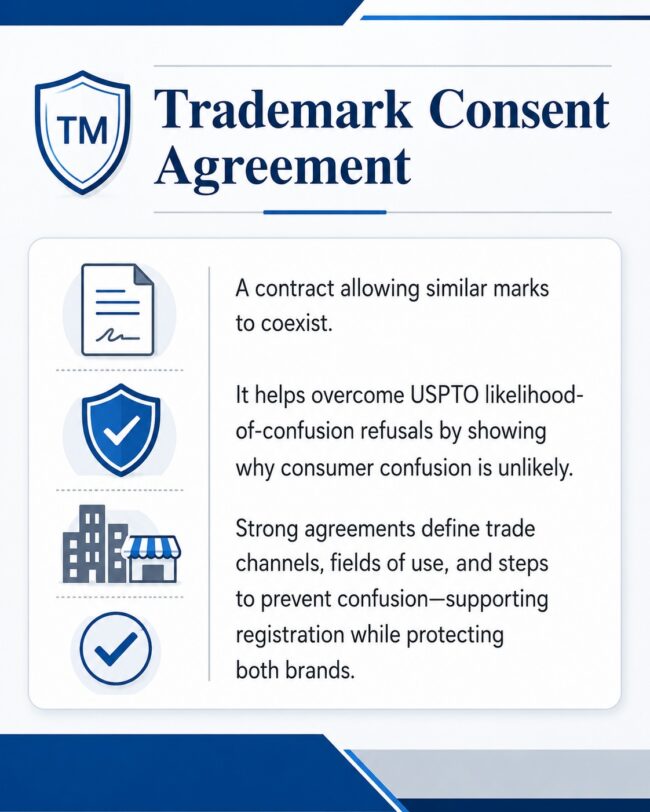
The USPTO gives meaningful weight to consent agreements because the parties typically understand their markets, customers, trade channels, pricing, branding, and day-to-day commercial realities better than the USPTO can from an application record alone. The Federal Circuit has said that consent agreements may carry great weight because the parties are often in the best position to evaluate whether simultaneous use of their respective marks is likely to cause consumer confusion. In In re Four Seasons Hotels Ltd., 987 F.2d 1565 (Fed. Cir. 1993), the court credited a consent agreement that included detailed restrictions on use, location, and cooperation to address confusion.
That said, the USPTO does not automatically accept every consent agreement. The agreement is more persuasive when it contains a reasoned assessment of the relevant factors, such as differences in the parties’ services, separate trade channels, distinct customers, and the absence of actual confusion. It should also include practical provisions requiring the parties to take commercially reasonable steps to avoid confusion if problems arise. A detailed agreement with real evidentiary support is more likely to overcome a likelihood of confusion refusal than a short, naked consent that merely states that one party consents to trademark registration.
The USPTO gives more weight to agreements that contain a reasoned assessment of why confusion is unlikely, rather than a bare statement that the parties consent. A persuasive trademark consent agreement should explain the marketplace facts that reduce the likelihood of confusion, including how the respective marks are used, the nature of the goods and services, and whether customers are likely to encounter the brands in the same channels. Strong provisions include a clear indication of separate trade channels, restrictions on the parties’ fields of use, different marketing methods, limitations on geography or customer types, and procedures for handling mistaken inquiries.
Evidence can also matter. The parties can identify any period of simultaneous use, explain whether there has been actual confusion, and provide factual support for their conclusion that confusion is unlikely. The agreement should also require the parties to take commercially reasonable steps to prevent confusion and avoid confusion if problems arise, such as modifying packaging, clarifying website language, training sales staff, or redirecting misdirected communications. The more detailed and practical the restrictions are, the more likely an examining attorney will view the agreement as meaningful evidence rather than a naked consent.
A naked consent, a consent agreement that merely grants permission, or simply states that confusion is unlikely, is usually given little weight in a likelihood of confusion analysis. The USPTO does not reject consent agreements because they are private contracts. The USPTO must still protect consumers, so the agreement should “show the work.” In In re E.I. du Pont de Nemours & Co., 476 F.2d 1357 (C.C.P.A. 1973), the court distinguished bare consent from more detailed agreements, which may receive substantial weight. In In re Mastic Inc., 829 F.2d 1114 (Fed. Cir. 1987), the Federal Circuit held that a consent is stronger when “clothed” with specific arrangements to avoid confusion, such as limits on products, marketing, or trade channels. In In re Donnay Int’l, S.A., 31 USPQ2d 1953, 1956 (TTAB 1994), the TTAB explained that more evidentiary support for such conclusions produces more weight.
That rule drove In re Ye Mystic Krewe of Gasparilla, 2025 USPQ2d 1291 (TTAB 2025). The TTAB found multiple failings: the marks were highly similar, the goods overlapped, and the agreement did not require separate trade channels or restrict fields of use. Its actual confusion provision required only commercially reasonable steps after confusion arose, so the consent helped only slightly and did not overcome the refusal.
A strong agreement should do more than state that the parties consent to simultaneous use of their marks. It should address how the brands will appear in packaging, websites, invoices, apps, advertising, customer portals, and customer-facing support pages. The agreement should also define permitted goods and services, territories, trade channels, domain names, social media handles, logo usage, and any required disclaimers or house marks. If customer confusion occurs, the agreement should require commercially reasonable steps to investigate and resolve it. A detailed agreement gives the USPTO stronger evidence that confusion is unlikely.
If a likelihood of confusion refusal continues after the applicant submits a trademark consent agreement, the applicant may appeal to the Trademark Trial and Appeal Board (TTAB), the USPTO’s appeal board for ex parte trademark refusals after a final examining attorney decision. 15 U.S.C. § 1070 authorizes trademark appeals from final examiner decisions. Importantly, the appeal record should generally be complete before appeal, so consent evidence should be developed early, not saved for later TTAB proceedings.
In appeal practice, a consent agreement is powerful evidence, but not an automatic win. In In re Four Seasons Hotels Ltd., the Federal Circuit reversed a refusal involving FOUR SEASONS BILTMORE and THE BILTMORE LOS ANGELES because the parties had long coexisted and adopted concrete restrictions, including location-specific use and cooperation if confusion arose. By contrast, in Gasparilla, the TTAB gave little weight to a consent agreement involving highly similar GASPARILLA marks because it lacked meaningful limits on trade channels, fields of use, and evidence of no actual confusion.
A trademark consent strategy can reduce a potential risk and help a business register a mark, but permission alone is not enough. The best agreement explains why the parties’ marks can coexist, restricts use where needed, includes evidence, and gives the USPTO and any court practical reasons to trust the parties’ assessment of likelihood and confusion.
If you need assistance with a potential trademark consent situation or other intellectual property matter, please contact our office for a consultation with one of our experienced trademark attorneys.
© 2026 Sierra IP Law, PC. The information provided herein does not constitute legal advice, but merely conveys general information that may be beneficial to the public, and should not be viewed as a substitute for legal consultation in a particular case.

Sierra IP Law, PC - Patents, Trademarks & Copyrights
FRESNO
7030 N. Fruit Ave.
Suite 110
Fresno, CA 93711
(559) 436-3800 | phone
BAKERSFIELD
1925 G. Street
Bakersfield, CA 93301
(661) 200-7724 | phone
SAN LUIS OBISPO
956 Walnut Street, 2nd Floor
San Luis Obispo, CA 93401
(805) 275-0943 | phone

SACRAMENTO
180 Promenade Circle, Suite 300
Sacramento, CA 95834
(916) 209-8525 | phone
MODESTO
1300 10th St., Suite F.
Modesto, CA 95345
(209) 286-0069 | phone
SANTA BARBARA
414 Olive Street
Santa Barbara, CA 93101
(805) 275-0943 | phone
SAN MATEO
1650 Borel Place, Suite 216
San Mateo, CA, CA 94402
(650) 398-1644. | phone
STOCKTON
110 N. San Joaquin St., 2nd Floor
Stockton, CA 95202
(209) 286-0069 | phone
PORTLAND
425 NW 10th Ave., Suite 200
Portland, OR 97209
(503) 343-9983 | phone
TACOMA
1201 Pacific Avenue, Suite 600
Tacoma, WA 98402
(253) 345-1545 | phone
KENNEWICK
1030 N Center Pkwy Suite N196
Kennewick, WA 99336
(509) 255-3442 | phone
2023 Sierra IP Law, PC - Patents, Trademarks & Copyrights - All Rights Reserved - Sitemap Privacy Lawyer Fresno, CA - Trademark Lawyer Modesto CA - Patent Lawyer Bakersfield, CA - Trademark Lawyer Bakersfield, CA - Patent Lawyer San Luis Obispo, CA - Trademark Lawyer San Luis Obispo, CA - Trademark Infringement Lawyer Tacoma WA - Internet Lawyer Bakersfield, CA - Trademark Lawyer Sacramento, CA - Patent Lawyer Sacramento, CA - Trademark Infringement Lawyer Sacrament CA - Patent Lawyer Tacoma WA - Intellectual Property Lawyer Tacoma WA - Trademark lawyer Tacoma WA - Portland Patent Attorney - Santa Barbara Patent Attorney - Santa Barbara Trademark Attorney
