A patent abstract provides a concise, technical summary of the content of the patent application. It gives readers a snapshot of the invention and its core technical contributions, helping them decide whether it is relevant to them and whether to read the full document. This article explains the basic principles, requirements, and purposes of a patent abstract for non-attorneys navigating the patent application process.
Abstracts support classification, indexing, and prior art searches for a patent application, letting examiners and researchers scan database results. The United States Patent and Trademark Office (USPTO) requires abstracts for nonprovisional utility patent and plant patent applications. See 37 C.F.R. §§ 1.51, 1.163(c)(5). Provisional and design patent applications are excepted from the abstract requirement. See 37 C.F.R. §§ 1.51(c), 1.154.
A missing abstract generally triggers a correction requirement, sometimes in a notice to file missing parts or an office action, rather than substantive claim rejection. Failure to respond can result in abandonment under 35 U.S.C. § 133.
An abstract should be one paragraph on a separate sheet following the claims section of the patent application. USPTO guidelines favor a single paragraph of 50 to 150 words and no more than 15 lines. The disclosure permitted by 150 words is very limited. But, the USPTO rules require a concise explanation of the invention providing the reader with a brief synopsis of the claimed invention. See 37 C.F.R. § 1.72(b).
The patent abstract should identify the technical field to which the invention pertains, the technical problem, the core solution provided by the invention, and principal use. The patent abstract should provide a clear understanding of the technical disclosure to the extent possible in 150 words. The content of the abstract should be purely factual. Filler phrases such as “disclosure concerns,” “disclosure describes,” and “disclosure defined by this invention” should be avoided, as they waste your word budget and add no information. Including promotional statements or legal phraseology such as “means” or “said” should also be avoided. International applications (Patent Cooperation Treaty [PCT] applications) have similar guidelines and rules for PCT abstracts. See PCT Rule 8.
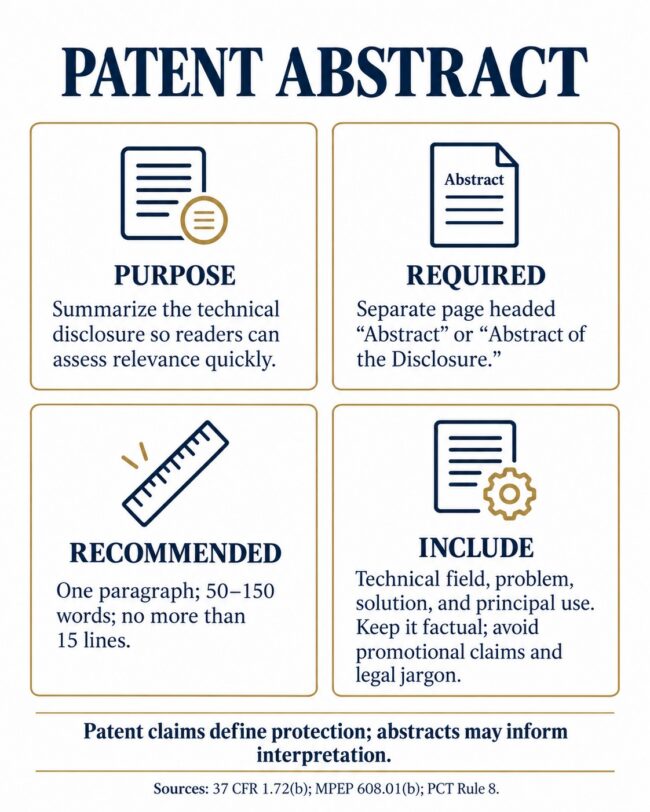
The following is an effective patent abstract adapted from the USPTO’s heart valve example:
The specification, including its detailed description, must sufficiently describe and enable the claimed invention. See 35 U.S.C. § 112. The Abstract is a brief of the invention: a synopsis of the detailed specification.
Patent claims define patent protection. The abstract does not independently establish the scope of the invention, and thus does not affect the patent claims in most instances. However, abstracts can inform claim interpretation in limited situations. In Hill-Rom Co. v. Kinetic Concepts, Inc., 209 F.3d 1337 (2000), the Federal Circuit considered the abstract as intrinsic evidence when interpreting “cushion” in claims covering a hospital bed. The abstract described inflatable layers providing patient support and comfort, reinforcing the term’s ordinary meaning and the specification’s description. This interpretation excluded the accused bladders, which served only to rotate patients, supporting noninfringement. The court explained that the then-existing USPTO rule restricting reliance on abstracts governed patent examination, not judicial claim interpretation.
The discussion of patent abstracts should not be confused with the abstract idea category of judicial exceptions to patent eligibility under 35 U.S.C. § 101. U.S. patent law treats mathematical concepts, mental processes, and certain methods of organizing human activity as judicial exceptions to the categories of patentable subject matter. When the elements of the claims amount to an abstract idea, such as mathematical formulae, the claims may be unpatentable. See MPEP § 2106.
The patent applicant is responsible for preparing and submitting a patent abstract with every utility patent application. A well-written abstract communicates the inventive concept efficiently and effectively. It is important to observe the formal requirements for the patent abstract.
A patent attorney can assist with and ensure that the application, including the specification, drawings, claims, and abstract, are properly drafted and prepared, observing the applicable requirements. If you need assistance with a patent application or other intellectual property matter, please contact our office for a consultation.
© 2026 Sierra IP Law, PC. The information provided herein does not constitute legal advice, but merely conveys general information that may be beneficial to the public, and should not be viewed as a substitute for legal consultation in a particular case.
Trademark monitoring is the ongoing process of tracking unauthorized or confusingly similar uses of your brand. It alerts trademark owners to potential conflicts involving trademark filings and marketplace activity. Early detection supports brand protection by enabling quicker, potentially less costly responses before customer confusion between your brand and the infringer.
Registration alone does not automatically prevent others from using similar marks. The trademark office examines applications. Owners remain responsible for monitoring and enforcing trademark rights. Active trademark protection helps prevent competitors from establishing confusingly similar brand names.
A trademark watch tracks new trademark filings, domain registrations, online sales, advertisements, and other uses that may conflict with your business name, logos, or product names. Searches should cover the USPTO database, relevant foreign registers, search engines, social media platforms, and marketplaces.
Monitoring must extend beyond registered trademarks because unauthorized use may occur without any filing. Effective searches identify spelling variations, similar sounds, and related goods or services, not merely identical marks.
Trademark owners should start trademark monitoring activities early in their branding. There are several trademark activities that can be monitored to provide high awareness of similar filings in the USPTO and similar branding activity and trademark usage in the the markets that are relevant to your business:
Automated systems regularly scan trademark databases for newly filed and registered trademarks, generating monitoring alerts. Many companies use specialized trademark monitoring services because manual checks are complicated and time consuming.
Effective monitoring services combine automated professional services, manual searches for applied-for and registered marks, and attorney review, and provide alerts promptly. A trademark watch service can provide broad global coverage, but confirm the countries, databases, online sources, and update frequency included. No monitoring service guarantees detection everywhere.
Compare cost, access to reports, and whether additional services include legal guidance or trademark enforcement action. Also, it is easy to lose focus on this function, and thus someone should be designated within your organization to review monitoring service alerts promptly.
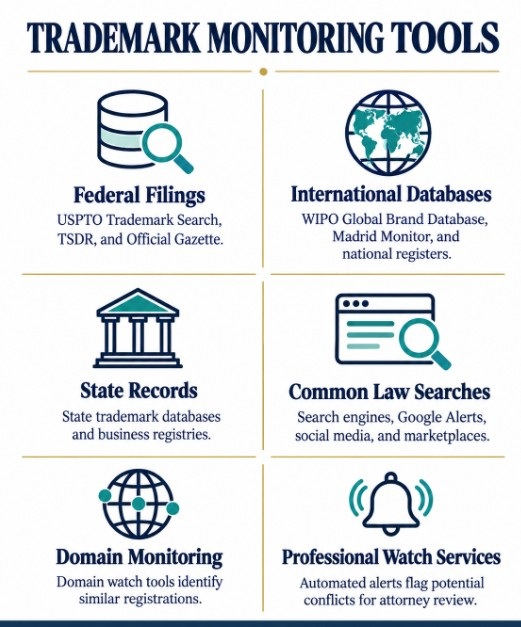
An alert identifies concerns, not proven trademark infringement. An attorney should be consulted to assess the marks, the products and services offered under the mark, the likelihood of customer confusion, and whether you have a good position to enforce your rights against the potential infringer. Evaluation of trademark infringement under the applicable federal case law and statutes 15 U.S.C. § 1114; § 1125(a) is a complex analysis. To illustrate, the determination of trademark infringement is guided by a factor analysis provided by cases like AMF Inc. v. Sleekcraft Boats, 599 F.2d 341 (9th Cir. 1979), in which the court identified multiple factors for analyzing the likelihood of confusion between two marks, including the sound, appearance, and meaning of the marks, the relatedness of the goods and services, the channels of trade, the distinctiveness and strength of your mark, whether there is any evidence of actual consumer confusion, and other factors. Thus, it is highly recommended that you seek the assistance of an experienced trademark attorney if you are seriously considering pursuing enforcement of your trademark rights against a potential infringement.
If pursuing the potential infringer is legally supported and advisable, a cease and desist letter is typically the first step in the process. A cease and desist letter can often lead to resolution of trademark conflicts without litigation. If the exchange of letters and negotiations do not resolve the conflict, you may need to pursue trademark litigation to resolve the issue.
Failure to monitor and act can weaken your trademark protection and legal position. Failing to enforce your rights can result in an erosion of your brand and trademark strength. In Pinkette Clothing, Inc. v. Cosmetic Warriors Ltd., 894 F.3d 1015 (9th Cir. 2018), the plaintiff sought declaratory relief that it did violate Cosmetic Warriors' trademark rights. Cosmetic Warriors counterclaimed infringement and sought invalidation of Pinkette's trademark registration. A trademark watch service had notified Cosmetic Warriors’ outside counsel of Pinkette’s application, yet no opposition was filed. Pinkette’s registration subsequently supplied constructive notice, and Cosmetic Warriors waited nearly five years after registration to seek infringement claims and to petition for cancellation. Because Cosmetic Warriors had failed to promptly enforce its claim against Pinkette, Cosmetic Warriors' claims were barred by the doctrine of laches due to their unreasonable, prejudicial delay.
Another consequence of failing to enforce your trademarks is that the market becomes crowded with confusingly similar marks, thereby weakening the distinctiveness and strength of your trademarks. Missing enforcement against one infringer does not necessarily eliminate or significantly weaken your trademarks. Under 15 U.S.C. § 1127, a trademark may be abandoned through acts or omissions that result in the mark becoming generic or otherwise lose its significance as a mark. A consistent failure to take enforcement action can result in the evisceration of your rights. Monitoring followed by appropriate action also reduces the risk of brand dilution and consumer confusion.
Trademark monitoring should be conducted early on when adopting your brand, and should be continued as your business grows to protect the value in the brand and reputation that you are building. USPTO filings and marketplace activity should be regularly reviewed and analyzed. Staying informed is critical to protecting your valuable brands and goodwill. It is well worth devoting resources to monitoring potentially conflicting trademark use and providing timely responses. A consistent process helps your company protect its valuable intellectual property and preserve its trademarks.
© 2026 Sierra IP Law, PC. The information provided herein does not constitute legal advice, but merely conveys general information that may be beneficial to the public, and should not be viewed as a substitute for legal consultation in a particular case.
Patent pending means a patent application has been filed and remains pending (e.g., it hasn't lapsed or issued as a patent). It indicates the invention described in the patent application and/or marked "patent pending" is in the patent application process. However, it does not establish that the invention or design is patented or patentable, and it does not provide any enforceable patent rights.
This article explains the legal effect and business value of "patent pending" status for the benefit of non-attorney entrepreneurs, and also what it does not provide.
Patent pending status begins once a qualifying patent application is filed with the United States Patent and Trademark Office (USPTO). The phrase “patent pending” means patent protection is being sought. A patent search, prototype, or consultation with a patent attorney does not establish pending status. The patent pending designation does not begin until the patent application is actually filed with the United States Patent and Trademark Office (USPTO). A US patent application can only be filed with the USPTO. There are no state agencies or other federal agencies that can grant patent pending status.
Any patent application filing with the USPTO can establish patent pending status. A provisional patent application, a non-provisional utility patent application, a design patent application, and/or a plant patent application can establish patent pending status for the claimed invention, design, or plant variety.
It should be noted that, in any of these scenarios, the patent pending status does not establish or promise approval by the USPTO or any enforceable patent rights.
Provisional patent applications are available for utility patent applications and plant patent applications, but are not available for design patents. Provisional applications act as placeholder applications that do not get examined by the patent office, but can still establish patent pending status. A provisional application can establish an early effective filing date, or "priority date", for the subject matter disclosed in the provisional application. The provisional application pends for a 12-month provisional pendency period and then lapses. A non-provisional patent application claiming priority to the provisional application must be filed within the provisional period in order to preserve the priority filing date and have the claimed invention examined by the patent office. The non-provisional application must include a claim for the benefit of the filing date of the provisional application in order to benefit from the provisional application filing. See 35 U.S.C. § 119(e). An early filing date is important under U.S. patent law’s first-to-file system established by the America Invents Act, which took effect in 2013.
The provisional patent application provides up to one year for the patent applicant to evaluate commercialization, seek investors, further develop the invention, and conduct due diligence, such as patent searches, patentability analyses, and freedom to operate analyses. Continuing patent pending status requires a further pending application. Provisional filings may be less expensive than non-provisional patent filings (current basic fees are $325, $130 for qualifying small entities, and $65 for qualifying micro entities), but the non-provisional application must be filed within the 12-month period and must go through the patent examination process in order for a patent to be issued. Thus, a provisional application ultimately results in additional costs to the applicant. That said, provisional patent applications can create patent pending status and provide a useful evaluation period for the claimed invention.
Additionally, in practical terms, patent pending status can be established by a foreign or international patent filing. A Patent Cooperation Treaty (PCT) application is an international patent application that allows for a national stage patent filing in the U.S. Thus, an invention is practically patent-pending in the U.S. by virtue of the PCT application up until the deadline for filing the national stage application passes. Also, a U.S. patent application can claim priority to a foreign patent application if it is filed within one year of the foreign filing date. Thus, a foreign patent application filing provides practical patent pending status for the claimed invention for up to 12 months in the U.S. The same is true for international design applications through the Hague System, which allows for a design registration in the U.S. through the international design registration process. However, the distinction between the status of a pending U.S. patent application and a foreign filing is that you cannot lawfully use the "patent pending" notice based on a foreign application. There must be a pending U.S. patent application to lawfully use the "patent pending" notice.
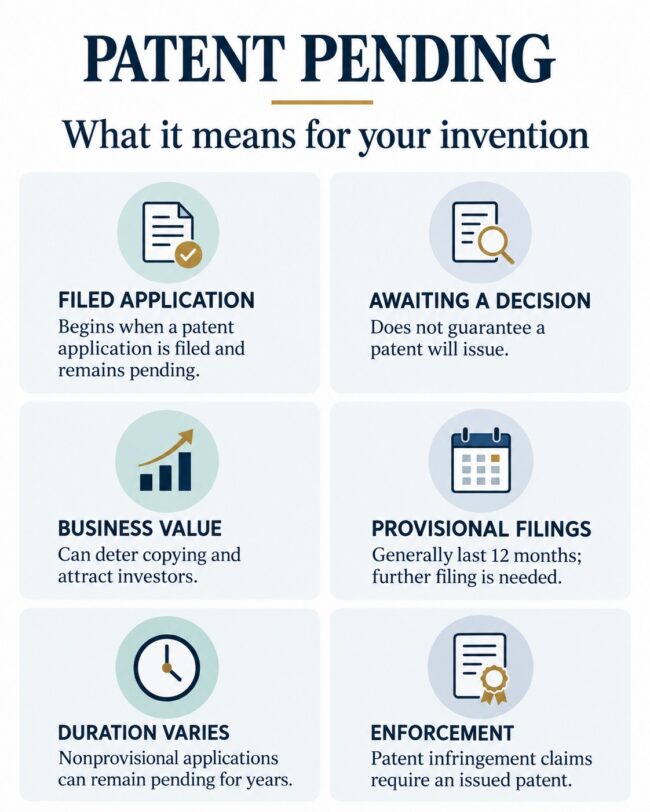
Patent applications are processed in the order they are filed, and there is a significant backlog at the patent office. Non-provisional patent applications undergo USPTO examination, which can take around 1-4 years, depending on the particular technology and art unit handling that technology, the number of office actions issued by the patent examiner, and how promptly the applicant responds to the office actions. See 35 U.S.C. § 131; MPEP § 708. The USPTO has stated that there is around a 22-month average, but the time taken for the patent process is highly variable and the final decision in a particular application is unpredictable. The examination time in some cases can exceed five years. Applicants must respond to each office action issued by the patent office in order to advance the pending application by amending claims and making factual and legal arguments against the prior art rejections in the office action. Non-provisional pending patent applications remain pending until issuance or abandonment, rather than automatically expiring after 12 months.
Most non-provisional utility applications publish approximately 18 months after the earliest claimed priority date, which may precede the actual patent application date due to a provisional application or foreign patent application filing. Publication does not complete the approval process or create immediately enforceable rights. See 35 U.S.C. § 122(b). If the applicant is not pursuing any foreign patent rights, they may submit a nonpublication request with the patent application, which will prevent publication of the application unless and until a patent issues from the pending application.
Provisional applications are not published, but may become publicly accessible if a later non-provisional application that claims priority to the provisional patent application is published or becomes a granted patent. In such circumstances, the provisional application is accessible through the patent office's Patent Center electronic filing and application management system. Design patent applications are not published, unless and until a design patent issues from the application.
You cannot sue for patent infringement based on patent pending status. Patent pending status provides no presently enforceable legal rights to sue for patent infringement. There must be a granted patent in order to bring an infringement claim. A granted patent gives the patent holder exclusive rights defined by its issued patent claims. 35 U.S.C. § 154(a).
After issuance legal action can taken against an infringing party, and a patent owner may seek a remedy for "patent pending infringement" that occurred during the period after the pending application was published and the date the patent was issued, if certain requirements are met. A patentee may seek reasonable royalties for post-publication, pre-grant infringement activity by a competitor if the accused party had actual notice of the published application and the issued claims are substantially identical to the claims that were published in the patent application publication. Recovery does not reach back to the filing date of the application. See 35 U.S.C. § 154(d). The infringing party may be put on actual notice of the patent application publication by a letter providing a copy of the patent application publication and explaining the risk of liability that they are facing.
A patent pending notice can deter competitors from copying your claimed technology, strengthen business credibility, attract investor interest, and support licensing agreements at an early stage. Marketing materials alert potential competitors to future infringement issues, but provide no assurance of the full legal protection of a patent. The patent application may ultimately be fatally rejected by the patent office due to prior art rejections or other patentability issues.
For a granted patent, virtual patent marking under 35 U.S.C. § 287(a) permits marking the product, or packaging when permitted, with a website address instead of a serial number on the product. The freely accessible webpage must associate the product with applicable patent numbers or may include patent applications that are pending approval. Virtual patent marking can provide a more easily managed central listing of patents and patents pending to better manage false marking issues that could result from abandoned applications, patents that have lapsed due to a failure to pay maintenance fees, or expired patents.
Falsely claiming patent pending without filing a patent application or after the relevant patent application has become abandoned is a risky act. If such false marking is done with intent to deceive, it is considered false marking under 35 U.S.C. § 292 and triggers civil liability. Legal consequences include fines up to $500 per offense and compensatory damages for competitive injury. Such conduct may be costly and can damage business reputation.
The Patent Cooperation Treaty (PCT) is an international treaty that gave rise to the Patent Cooperation Treaty filing system provided by the World Intellectual Property Organization (WIPO). The PCT system facilitates the filing and handling of international PCT applications. A PCT application provides patent pending status in 159 contracting states. See the WIPO contracting states list. There are countries that do not participate in the PCT system, such as Argentina, but nearly all major economies in the world participate in the PCT system. Thus, a PCT application provides broad international patent pending status. A U.S. provisional patent application or non-provisional patent application can serve as a priority application for a PCT application and any direct foreign patent application filing. The PCT application must be filed within 12 months of the U.S. patent application in order to have the benefit of the priority date of the U.S. application. Thus, a U.S. patent filing serves to practically provide patent pending status throughout the world for a 12-month period.
It should be noted that neither a U.S. patent application, nor a PCT application can create international patent rights without further filings. A PCT application must be followed by later national stage patent applications in each jurisdiction for which enforceable rights are desired (e.g., Europe, Canada, Japan, etc.), each of which must claim priority to the PCT application.
For foreign sales, tailor notices to local law and audience. The Munich Higher Regional Court found “patent pending” misleading to German consumers who could interpret it as a granted patent. In the United Kingdom, false patent-pending claims on goods sold when no qualifying application exists or it has been refused or withdrawn are penalized, subject to a reasonable period for correcting notices and a due-diligence defense. Businesses should identify the jurisdiction in which their patent pending goods or services are offered and observe the local rules on patent markings.
Filing a patent application initiates the patent process and provides patent pending status. Products and marketing materials can be marked as "patent pending" once a patent application is filed to deter potential competitors from copying the invention. Patent pending status can also support commercialization, investor discussions, and licensing agreements, even though patent protection is not yet established. However, the ultimate goal is securing an enforceable patent, and patent pending does not itself achieve a patent.
A skilled patent attorney can evaluate your patent filing strategy, prepare and guide the patent application through examination, and ensure patent status is properly identified on products and marketing materials. After grant, accurate patent number marking should be substituted for the patent pending marking. Treat patent pending as the beginning of a coordinated strategy for securing, maintaining, and enforcing valuable legal rights.
If you need assistance with a patent application or other intellectual property matter, please contact our office for a consultation with an experienced intellectual property attorney.
© 2026 Sierra IP Law, PC. The information provided herein does not constitute legal advice, but merely conveys general information that may be beneficial to the public, and should not be viewed as a substitute for legal consultation in a particular case.
An information disclosure statement (IDS) brings prior art and other material information to the attention of the United States Patent and Trademark Office (USPTO) during the patent application process. Every patent applicant and all people associated with a patent application process, including patent attorneys, have a duty of disclosure to the USPTO. All persons owing a duty of disclosure must provide all prior art that is material to the patentability of the invention claimed in the patent application. An information disclosure statement is the form that is used to submit the material prior art. Providing complete information disclosure statements avoids potential accusations of inequitable conduct (e.g., by hiding relevant prior art) and strengthens any patent issuing from the patent application.
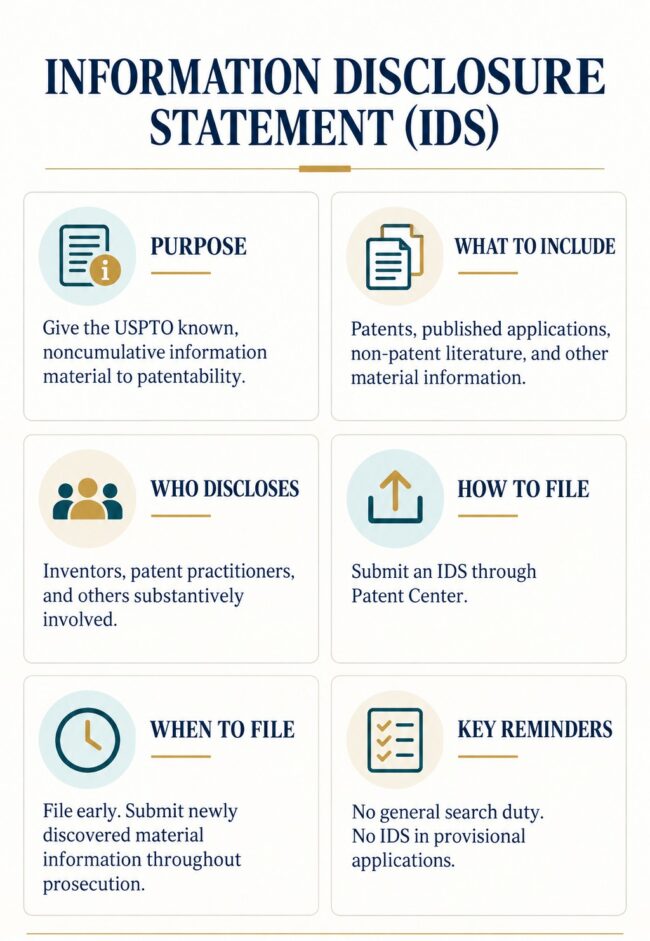
Patent applicants must disclose known, noncumulative information material to patentability when filing a non-provisional patent application. The information disclosure statement requirement applies to utility patent applications, design patent applications, and plant patent applications. However, IDSs are not submitted in provisional patent applications.
The IDS must include all known information that is material to patentability, even if the information undermines the claimed invention’s novelty or nonobviousness under 35 U.S.C. §§ 102 and 103, or contradicts patentability arguments made by the applicant or their patent attorney.
The duty of disclosure applies to inventors, patent attorneys, and other persons substantively involved in preparation or prosecution of the patent application who are associated with the applicant. Each of these persons has an ongoing duty of disclosure to the USPTO and any material prior art information they newly discover must be submitted in an updated information disclosure statement. There is no general duty to conduct a patent search prior to filing a patent application, and filing an information disclosure statement does not imply that a search occurred. See 37 C.F.R. § 1.56.
Submitting an information disclosure statement requires following the applicable provisions of 37 C.F.R. § 1.98. Each IDS must list all prior art information submitted for consideration, including all relevant patents, patent application publications, and non-patent literature. Prior art specifically includes the categories of U.S. Patents, U.S. Patent Application Publications, Foreign Patent Documents, and Non-Patent Literature (NPL), which may be any non-patent, public information that is relevant to the invention and has sufficiently detailed information to allow a person having ordinary skill in the art (PHOSITA) to understand that the NPL discloses some or all of the elements of the claimed invention.
The USPTO provides an IDS form (PTO/SB/08a) as a separate paper to be signed and submitted with the patent application specification, drawings, claims, abstract, and patent application forms, at the time of filing. See MPEP § 609.04(a). However, an information disclosure statement can be filed at any time during the patent examination process. Updated IDS forms should be submitted as anyone having a duty of disclosure for the patent application learns of additional material prior art.
The IDS form includes an IDS cover sheet where the eight-digit application number and filing date are entered to associate the information disclosure statement with the proper application, the prior art listing, and a certification and signature page. The prior art listing includes several segregated, categorized sections for different kinds of prior art citations, including US patents, US patent publications, foreign patent documents, and non-patent literature.
Each IDS must include a list of all relevant patents and publications. Under § 1.98(b), the IDS should properly identify:
Legible copies of each foreign patent document and non-patent literature must be provided with the information disclosure statement. U.S. patents and published U.S. applications do not need to be provided to the USPTO, as they are the USPTO's own publications. If two or more patent documents are substantively cumulative, identifying that duplication permits the applicant to provide a copy of only one of the cumulative references. See 37 C.F.R. § 1.98(c). In some cases, the applicant may be aware of an unpublished patent application that will become published prior art at some point. The applicant has the option to cite pending unpublished patent applications in an information disclosure statement to address the potential prior art issue of the unpublished patent application at an early point. However, it should be understood that the unpublished patent application does not qualify as prior art until it is published.
A cited pending application’s specification, claims, and drawings need not be copied when available in the image file wrapper.
If an IDS includes a non-English language document the applicant must provide a concise explanation of relevance unless a written English language translation is supplied. Oftentimes foreign language patent documents come to the attention of the patent applicant as a result of being cited in a foreign counterpart patent application being examined contemporaneously with a U.S. patent application. If a complete translation is not available, he explanation of relevance for the foreign language document may be supplied by an English international search report or foreign patent office search report in the counterpart foreign application. See 37 C.F.R. § 1.98(a)(3).
For an ordinary nonprovisional application, the initial submission avoids timing fees if filed within three months after filing or before mailing the first substantive office action, whichever is later. Thereafter, before a final office action, allowance, or other closure of prosecution, either a qualifying timing statement or fee is required; afterward, both ordinarily are required by issue-fee payment. The statement certifies compliance with three-month requirements governing first foreign citation or newly known information. Ordinary extensions of time are unavailable. 37 C.F.R. § 1.97(b)–(e).
If prior art that appears to be critical to patentability is discovered after a notice of allowance has been mailed and the issue fee has been paid, but before patent issuance, the applicant can submit the prior art through the Quick Path Information Disclosure Statement (QPIDS) process. QPIDS requires a petition to withdraw from issue, an IDS with a qualifying 37 C.F.R. § 1.97(e) timing statement, a conditional request for continued examination (RCE), and required fees. If information in the IDS necessitates reopening prosecution, the RCE is processed. Otherwise, the USPTO issues a corrected notice of allowability and refunds the RCE fee. It should be noted that QPIDS is only available for utility patent applications.
Every information disclosure statement requires a size-fee assertion stating that the appropriate fee accompanies the submission or that no fee is due. Size fees are separate from timing fees and apply when cumulative applicant-provided items across all IDS filings in the application exceed 50, 100, or 200, crediting previously paid size fees. The USPTO provides an explanation and guidance pamphlet on how the size fees are implemented.
For a subsequent application (e.g., a continuation application or divisional application) claiming an earlier filing date under 35 U.S.C. § 120, copies of previously cited information may be omitted if the prior application relied upon is identified properly and the information disclosure statement in that earlier application complies with 37 C.F.R. § 1.98(a)–(c). See 37 C.F.R. § 1.98(d).
Applicants submit application documents and information disclosure statements through the USPTO’s Patent Center electronic filing system. An IDS form should be carefully filled with the proper information in the form fields in order to promote proper treatment in the application record. Quality copies of the prior art documents should be submitted with the IDS form. Quality downloaded or scanned copies facilitate examination, allowing for optical character recognition of electronic downloaded or scanned documents.
Examiners evaluate information submitted in the information disclosure statement in the same manner as references in patent office search files. However, if the references are of low quality, the examiner may not consider the prior art reference. The applicant should check the examiner's consideration record for the prior art. If a prior art document's quality is too poor to allow for proper reading and analysis, the examiner will mark the prior art reference as unconsidered. The prior art reference may be resubmitted in a higher quality for consideration. Also, if a prior art reference was inadvertently omitted despite a bona fide attempt to submit it, the examiner may issue a form paragraph granting time to complete compliance pursuant to 37 C.F.R. § 1.97(f).
In U.S. patent applications, the documents cited in an information disclosure statement can guide examination and facilitate searching for additional relevant information. Any patent, patent application publication, or non-patent literature reference listed in the information disclosure statement may be used to support a rejection of the patent claims as anticipated if it discloses every limitation as claimed. See 35 U.S.C. § 102. The examiner may also combine the references cited in the information disclosure statement with other teachings to reject patent claims as obvious. See 35 U.S.C. § 103. However, filing an information disclosure statement also does not admit that the cited information is material to patentability. See MPEP § 609.06; 37 C.F.R. § 1.97(h). Moreover, consideration by the patent examiner does not mean that every reference supports a rejection.
All of the prior art cited in information disclosure statements submitted to the USPTO becomes part of the patent application record. All references cited in a compliant IDS form and considered by the examiner are included in the cited references section of the issued patent.
Submitting information disclosure statements in your patent application is critical to the strength and validity of your patent application. If the patent application file history (file wrapper) shows sparse disclosures of relevant prior art, your patent may be consequently challenged on multiple bases First, the prior art record of your patent application may be incomplete, and an opposing party may be able to find highly relevant prior art that was not considered by the patent examiner during the examination process. This will weaken the presumption of validity of the patent provided by 35 U.S.C. § 282. A court is much more likely to be convinced by a challenge to validity based on prior art that was not considered by the patent examiner than prior art that was considered.
Second, if it looks as though the applicant disclosed very little relevant prior art, an opposing party may pursue a defense of inequitable conduct by the applicant. Material nondisclosure with an intent to deceive the USPTO can make a patent unenforceable for inequitable conduct. However, Therasense, Inc. v. Becton, Dickinson & Co., 649 F.3d 1276 (Fed. Cir. 2011), generally requires but-for materiality (i.e., the claim would not have issued with disclosure) and specific intent to deceive, proven by clear and convincing evidence. An inadvertent omission alone is insufficient to result in a finding of inequitable conduct or unenforceability of the patent.
An Information Disclosure Statement helps ensure that the USPTO evaluates a claimed invention against known material information. Effective information disclosure statements identify the relevant art, provides quality copies of prior art references, and provides accurate application data, such that the prior receives proper treatment and consideration by the patent examiner. It is always recommended that you engage an experienced patent attorney to assist in the patent application process and that you communicate all potentially relevant prior art information to the patent attorney throughout the patent application process. Timely filing and confirmation of examiner consideration help avoid potential inequitable conduct claims and strengthen any patent that issues from the patent application. Although disclosure cannot guarantee validity, a complete examination record can reduce avoidable disputes and support more defensible patent protection. Treat the duty of disclosure and information disclosure statements as ongoing responsibilities within your patent process and strategy.
© 2026 Sierra IP Law, PC. The information provided herein does not constitute legal advice, but merely conveys general information that may be beneficial to the public, and should not be viewed as a substitute for legal consultation in a particular case.
A patent application must be filed with a standardized set of patent application forms provided by the United States Patent and Trademark Office (USPTO). The patent application forms include forms that identify the inventors, provide summary information about the patent application, identify any assignees or owners other than the inventors, and identify representation by a patent attorney, if one has been hired. This article provides a comprehensive guide to the documents that must be submitted with a patent application, how the submission process works, and why the patent application forms should be prepared with care to avoid introducing risk to your patent protection.
The United States Patent and Trademark Office (USPTO), which performs the patent examination process, supplies standardized administrative forms that are submitted with a patent application. However, there is no form for the patent application itself. The applicant or the applicant's patent attorney or patent agent must create the specification, drawings, claims, and abstract that constitute the patent application itself. Every application is unique: its written description and the drawings providing the visual representation of the invention must actually capture the invention in a manner that would allow a person having ordinary skill in the art (PHOSITA) to understand the invention. The patent application must provide a complete and clear disclosure of the invention, and no new matter can be added to the application later. See 35 U.S.C. §§ 111, 112, 113.
There are three types of patents. Utility patents protect new and useful processes, machines, manufactures, and compositions; design patents protect ornamental designs of articles of manufacture; and plant patents protect new varieties of asexually reproduced plants. See 35 U.S.C. §§ 101, 161, 171. You have the option of filing a provisional application, if you are filing a utility patent application or a plant patent application. However, provisional design patent applications are not available for a design patent. So, a design patent must be pursued at the outset through a nonprovisional design application.
A provisional patent application secures an early filing date and provides patent pending status for one year. It is not examined by the USPTO and expires after the 12 months. Fewer patent forms are required for a provisional application filing. A provisional application filing requires a specification, fee, and a provisional cover sheet. Neither claims, nor an inventor declaration is unnecessary. See 35 U.S.C. § 111(b); 37 C.F.R. §§ 1.51(c), 1.53(c). A Patent Cover Sheet, PTO/SB/16, is commonly used to satisfy the cover sheet requirement for provisional applications. However, an application data sheet form, PTO/AIA/14, may serve to satisfy the cover sheet requirement.
Nonprovisional applications require more detailed documentation. The patent application itself must include a specification explaining how to make and use the invention, at least one claim, and proper drawings when they are necessary for understanding the subject matter sought to be patented. The patent application forms must include a patent application data sheet providing the inventor information (including proper name, address, identification of the patent applicant, any claims for priority to prior-filed domestic or foreign patent applications, and identification of any patent assignees), inventor’s oath or declaration, an applicant statement of entitlement to apply for the patent, PTO/AIA/96, under 37 C.F.R. § 3.73(c), and a power of attorney, if a patent attorney has been engaged.
The application data sheet captures bibliographic data entered for inventors’ names, applicants, priority claims, and the correspondence address. Each inventor is required to sign a declaration stating that the filing was authorized and that the signer believes he or she is an original inventor of the claimed subject matter. A substitute statement may apply if an inventor is deceased, legally incapacitated, unavailable after diligent effort, or refuses to sign. See 35 U.S.C. § 115.
Declaration documents must be signed by the inventor, either by wet signature or e-signature in the form of a slash or “S-signature” under 37 C.F.R. § 1.4(d)(2). Almost all patent applications and patent application forms are now submitted electronically through the USPTO Patent Center electronic filing system, and so e-signatures are acceptable and convenient.
The application data sheet (ADS), generally prepared on USPTO Form PTO/AIA/14, places the application’s bibliographic information into the USPTO record and filing receipt. The applicant or patent attorney completes the applicable fields, verifies the data entered, and signs the ADS under 37 C.F.R. §§ 1.33(b) and 1.76(e). The signed document is normally submitted electronically with the application through Patent Center. If the ADS is incorrectly filled or must be changed due to other circumstances, the applicant must identify additions by underlining and deletions by strike-through or brackets. Special requirements apply to changes involving inventorship, priority, domestic benefit, or the correspondence address. See 37 C.F.R. § 1.76(c).
When an assignee that was not the inventor or original applicant seeks to act in a patent application, it must establish ownership through an Applicant Statement Under 37 C.F.R. § 3.73(c), PTO/AIA/96. The form identifies the assignee, application, and ownership basis, and provides either recorded assignment information, such as reel and frame numbers, or evidence of the chain of title submitted for recordation. Partial ownership interests must collectively account for the entire right, title, and interest. An authorized assignee representative or practitioner of record signs the form, which is submitted electronically through Patent Center. See 37 C.F.R. §§ 3.71(c), 3.73(c)–(d).
A power of attorney authorizes a registered patent attorney or patent agent to represent the applicant before the patent office. The power of attorney form (Form PTO/AIA/82) identifies the patent application and appoints either specifically named practitioners or practitioners associated with a Customer Number. See 37 C.F.R. § 1.32. The form is signed by the applicant, or an assignee that has established its authority to act in the application, and may be submitted electronically through Patent Center with the application or later in the examination process. A power of attorney does not automatically change the correspondence address, which may be the applicant's or representative's address.
Depending on the application and later events, applicants may need additional USPTO forms, including an Information Disclosure Statement, entity-status certification, fee transmittal, petition to make special, or request for prioritized examination. Each form should identify the application, supply the requested data, and include any required statement, signature, supporting document, and filing fees. Applicants should use the current form and follow its instructions because modified forms may omit required information. Most forms are fillable PDFs submitted electronically through Patent Center under the applicable document description.
Non-English nonprovisional applications additionally require an English translation, accuracy statement, and processing fee. Special rules govern non-English provisional applications. See 37 C.F.R. § 1.52(d).
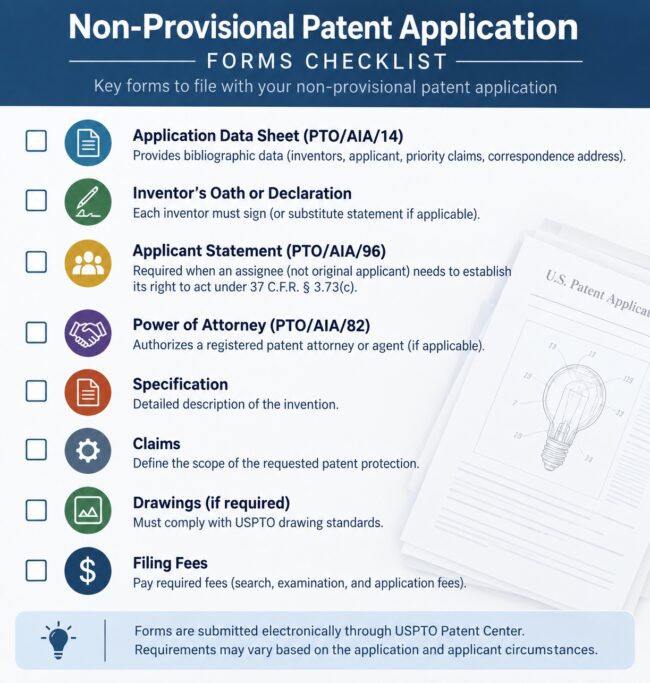
Most applications filed today are submitted electronically from a computer through Patent Center. All of the patent application forms and the patent application are submitted together in a single electronic submission. The electronic filing system immediately generates a filing acknowledgement receipt providing a list of the submitted documents, a timestamp for the filing, and a patent application serial number verifying a completed filing. The patent application can subsequently be accessed and tracked through the Patent Center system and the applicant can access and download notices and correspondence therefrom. The applicant can also download application documents.
The applicant is prompted to pay the application filing fees once the patent application forms and patent application are submitted. The patent application fees include a basic filing fee, a search fee, and an examination fee. The amount of the fees varies by entity size and application type. Small entities generally receive a 60% discount and micro entities an 80% discount on many fees. See 35 U.S.C. § 41(h).
The ownership of a patent application or patent can be transferred by a written agreement that includes a patent assignment of some or all of the patent rights. In order for the assignee to become an applicant in the patent application, the assignment terms must be submitted to the USPTO either as an attachment to an Applicant Statement Under 37 C.F.R. § 3.73(c) or through the assignment division (by assignment recordation) and then referenced in the Applicant Statement Under 37 C.F.R. § 3.73(c) by reel and frame numbers. Assignments are often recorded at the same time the patent application is filed. However, they may be filed at a later time. It is highly preferred that a patent assignment be recorded within three months of its execution in order to preserve all applicable legal rights. If it is filed within three months of its execution, it is deemed to be known and effective against all later assignees. So, if there is a mistaken or fraudulent later transaction purporting to assign rights in the patent a second time, a timely filed original assignment will control and define the ownership of the patent. The later mistaken assignment will be ineffective.
If a nonprovisional patent application is filed, the patent office will examine the application for compliance with all legal requirements. A patent examiner performs a prior art search, analyzes the application for patentability, and review the application for formal compliance. The analysis includes whether patent claims are adequately supported by the detailed description provided in the patent specification and drawings, and whether the patent claims are novel and non-obvious in view of the relevant prior art. See 35 U.S.C. §§ 102–103. The patent examiner may also raise objections to patent application forms that are improperly prepared or include inaccurate or faulty information. Such objections are typically handled by the Office of Initial Patent Examination (OIPE), but they may also be raised in an office action issued by the patent examiner. For example, the title of the invention provided in the application data sheet may not match the title provided in the specification document, or the inventor declaration submissions may not match the inventors listed in the application data sheet. Applicants are required to submit corrections, amendments, a petition, or other required response in order to advance the patent application.
In some cases, the USPTO does not catch errors in the patent application forms or errors may become evident at a later date. For example, it may be discovered that an inventor was inadvertently omitted from the original patent application. In such cases, the correction may be made in any still pending divisional or continuation applications, and in an already issued patent by filing a reissue application. A reissue application may be filed to address certain errors in an issued patent.
Providing patent application forms to the USPTO is a critical task in the patent filing process. All the forms must be accurately filled and submitted. Common mistakes involving inventor data, fees, signatures, or the asserted priority filing date can delay examination or affect the applicant's patent rights. Careful preparation and guidance from a patent attorney can help with proper preparation and filing of the patent application so that the applicant's patent rights can be fully established.
If you need assistance with a patent application or other intellectual property matter, please contact our offices for a free consultation.
© 2026 Sierra IP Law, PC. The information provided herein does not constitute legal advice, but merely conveys general information that may be beneficial to the public, and should not be viewed as a substitute for legal consultation in a particular case.
A business can complete a trademark application and submit the required forms, pay the filing fee, use the trademark properly in commerce, receive a trademark registration, and at the end of the process still have an invalid registration. The legal phrase "void ab initio" means legally invalid from the outset. This is a relatively common problem in trademark applications, particularly those that are filed without the assistance of an experienced trademark attorney. It is important to have someone that understands legal ownership, actual use, and filing requirements when filing a trademark application. The validity of the resulting registration is dependent on proper filing of the application.
The Latin term ab initio means “from the beginning.” Void ab initio therefore means legally invalid from the outset. For a trademark application, the phrase concerns whether a valid application was created on the filing date, not simply whether registration is ultimately refused. An application can satisfy the USPTO’s minimum submission requirements yet lack an essential legal qualification that must exist when filed. See 37 C.F.R. § 2.21. Receiving a filing date does not establish that those substantive requirements were satisfied. Unlike a correctable paperwork error, a defect rendering a trademark application void ab initio undermines the legal foundation of the original filing. See 37 C.F.R. § 2.71.
A trademark application claiming actual use of the trademark is filed under Trademark Act Section 1(a). This type of use-based application requires proper use of the trademark in commerce before the application filing date. Use in commerce requires the provision of the listed goods or services in commerce under 15 U.S.C. § 1127. A registration issuing from an underlying application filed under Section 1(a) is deemed void ab initio if use in commerce was not established as of the filing date. Use in commerce established after the filing date cannot retroactively satisfy the current use requirement of a trademark application filed under Section 1(a).
Every application filed under Section 1(a) is submitted with a sworn statement that the applied-for mark is in use in commerce on all of the goods and services listed in the application as of the filing date. Failure to meet this requirement cannot be cured by later use or any other curative filing after a registration is issued. However, the application may be converted into an intent-to-use based application prior to registration under proper circumstances, as discussed below.
It is important to understand that the legal effect of failing to make current use of the mark prior to the filing date concerns only the validity of a trademark application or trademark registration issuing therefrom. It does not affect any common law trademark rights that the applicant has established from making use of the mark and consumer recognition of the mark as a source identifier of the applicant's goods or services.
“Use in commerce” requires genuine trademark use in ordinary trade within commerce Congress may regulate, not merely public exposure. See 15 U.S.C. § 1127. Thus, use in commerce is defined by the extent of Congress's power to regulate commerce under the Commerce Clause of the U.S. Constitution. Commerce includes interstate trade, U.S. trade with foreign countries, and qualifying local activity affecting interstate commerce. Transactions need not involve goods physically crossing state lines: an in-state sale to an out-of-state customer can qualify without proof that the goods left the state. The nature of the activity, not simply its location, matters.
In Christian Faith Fellowship Church v. Adidas AG, an Illinois church had a trademark registration for the mark “ADD A ZERO” for use on clothing. 841 F.3d 986 (Fed. Cir. 2016). The church had sold two hats for $38.34 under the ADD A ZERO mark at its Illinois bookstore to an out-of-state customer from Wisconsin before it filed its application for the mark. The church successfully registered the mark, but it was later challenged in a cancellation proceeding before the Trademark Trial and Appeal Board. The Board cancelled the registration, finding the in-state sale as inadequate to qualify as genuine use in commerce satisfying 15 U.S.C. § 1127. The Federal Circuit reversed and remanded, holding that such transactions, considered together, substantially affect interstate commerce. No proof of goods physically crossing state lines or a specific interstate effect from that sale was required. The nature of the activity, not simply its location, was determinative.
Advertising promotes availability; it does not establish that services were actually performed. A proper service specimen, such as a website directly associating the mark with the services identified, is acceptable only when those services have actually been rendered in commerce. See 37 C.F.R. § 2.56(b)(2). In Couture v. Playdom, Inc., 778 F.3d 1379 (Fed. Cir. 2015), the applicant filed a use-based application for the mark PLAYDOM in 2008 using a website advertising writing and production services as a specimen. However, the applicant did not provide the applied-for services to clients until 2010. The court affirmed cancellation of the registration as void ab initio, holding that offering services without providing them did not establish use in commerce when filed. Advertising alone is not sufficient to satisfy the use in commerce requirement of Section 1(a). An inexperienced entrepreneur assuming that the promotion of their brand and trademark is sufficient to support an application under Section 1(a) may face the same result as Couture.
For goods, use in commerce requires qualifying sales or transportation in the ordinary course of trade, not token transactions merely to reserve trademark rights. See 15 U.S.C. § 1127. A proper specimen of use documents actual trademark display as customers encounter it, for example, photographs showing the mark on products, attached labels, packaging, or a point-of-sale display. An online store page can qualify when it directly associates the mark with pictured or described goods and provides ordering information. Ordinary advertising is generally insufficient, and mockups depicting intended rather than actual use are unacceptable. See 37 C.F.R. § 2.56(b)(1), (c).
Section 1(b) of the Lanham Act permits filing before actual use, but the named applicant must have a bona fide intent supported by objective evidence at the time of filing. See 15 U.S.C. § 1051(b). This is an intent-to-use application rather than an application based on current use. A bona fide intent is a firm, good faith intention to use the mark commercially. Objective evidence, such as development records or supplier discussions, must support that intent for each listed item. Merely wishing to reserve a mark is insufficient. If the applicant does not have a bona fide intent at the time of filing or cannot demonstrate a bona fide intent by actions that show efforts to offer the applied-for goods or services in commerce, the application and any registration issuing therefrom are void ab initio.
If an applicant files an intent-to-use application, the applicant must establish use through an amendment to allege use before publication approval, or a statement of use after a notice of allowance, including specimens and a verified declaration. See 37 C.F.R. §§ 2.76, 2.88. Thus, no registrations are available under Section 1 of the Trademark Act for marks that are not used in commerce. It should be noted that there are application bases under Section 44(e) or an extension of protection under Section 66(a) that do not require pre-registration use in U.S. commerce. However, those applications are based on claims for priority to foreign applications and are beyond the scope of this article.
In M.Z. Berger & Co. v. Swatch AG, 787 F.3d 1368 (Fed. Cir. 2015), M.Z. Berger sought to register the mark “iWatch” for use on watches, clocks, and accessories. Swatch opposed the registration. During the opposition proceeding, M.Z. Berger presented conflicting testimony and images created only to advance the application. The court found that M.Z. Berger's evidence failed to prove a bona fide commercial intent to use the mark. The Federal Circuit upheld the opposition, holding that an asserted bona fide intent must be supported by some objective evidence that, under the totality of the relevant circumstances, demonstrates that there was real intent to use the mark in commerce at the time of filing the application. The evidentiary threshold is low, but there must be something to demonstrate the intention.
An application must identify the actual owner on the filing date. Generally, the owner is the person or legal entity, such as a corporation, LLC, or partnership, that uses the mark and controls the nature and quality of the goods or services, directly or through controlled licensees. For example, an application that names a person (e.g., the founder) rather than the company that owns the mark as the owner can be considered void ab initio. Permissible errors in the named owner, such as a misspelling or a mistaken identification of the owner as an LLC when it is actually a corporation, are correctable by amendment. Amendments replacing the original applicant with another entity to cure nonownership are not permissible. See 37 C.F.R. § 2.71(d).
It is imperative to verify the ownership before signing the applicant declaration attesting that the applicant believes it owns the applied-for mark. Attempting to correct mistakenly identified ownership by replacing the original applicant with the proper owner is not allowed.
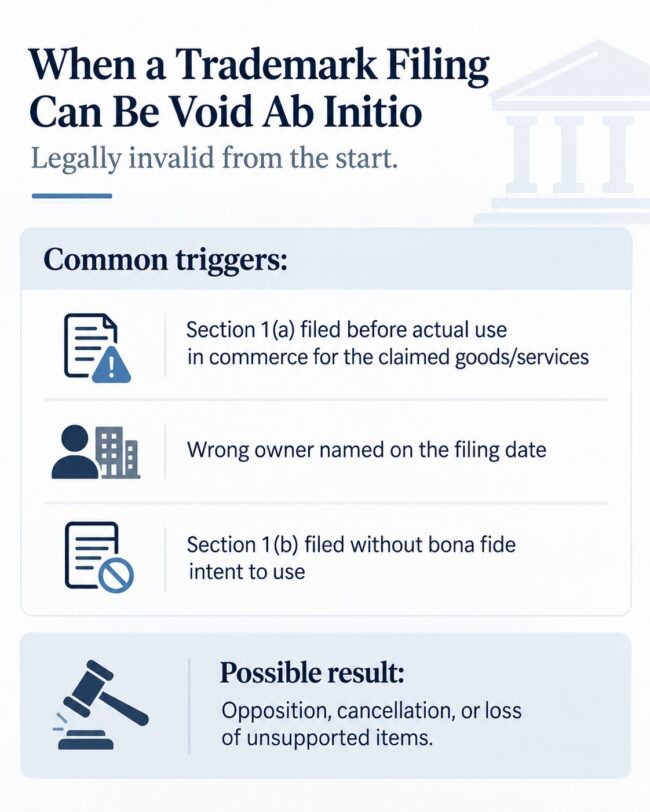
Failure to use a mark for certain goods need not invalidate all the goods listed. In Grand Canyon West Ranch, LLC v. Hualapai Tribe, 78 USPQ2d 1696 (TTAB 2006), the Tribe listed unused rail, tram, bicycle, and animal transportation services. With no fraud pleaded, the Board permitted deleting those services and entered only partial summary judgment, preserving the remaining claims. Deletion did not prevent the registration of the mark in connection with the services that were in use at the time of filing. However, if the inclusion of the services that were not provided in commerce in the application at the time of the filing date was done with the knowledge that the inclusion was improper, and with intent to defraud the USPTO, the entire application may be rendered void ab initio.
Fraud requires a knowingly false, material statement intended to deceive the USPTO, not merely an innocent mistake. Materiality concerns whether the statement affects entitlement to registration or renewal. Deceptive intent may be inferred from circumstances, but falsity alone is insufficient. In In re Bose Corp., 580 F.3d 1240 (Fed. Cir. 2009), Bose’s renewal declaration claimed continued use of WAVE for tape recorders and players despite discontinued sales. Its general counsel believed repairing and returning previously sold products constituted use in commerce. The Federal Circuit reversed the fraud-based cancellation, rejecting the Board’s “should have known” standard as improperly equating negligence with fraud. An honest misunderstanding did not establish deceptive intent, even though the declaration was materially inaccurate. Nevertheless, the court remanded to restrict the registration by removing the unused goods.
During the application process, an applicant may request an amendment from Section 1(a) current use basis to Section 1(b) intent-to-use basis when acceptable specimens of use are unavailable or to remedy non-use at the time of filing. A verified declaration must confirm bona fide intent to use the mark in commerce for the affected goods or services both when filed and currently. The conversion cannot create intent that did not exist as of the filing date. TMEP §806.03(c).
Before publication, the examining attorney can consider the amendment and implement the conversion to a Section 1(b) intent-to-use application. After publication, procedural requirements include petitioning the Director of the USPTO for permission, submitting a proposed amendment and supporting declaration, and paying a petition fee. An approved petition reopens examination and allows the trademark examiner to consider the conversion to a Section 1(b) basis. If accepted, the application is republished as an intent-to-use application. See 37 C.F.R. § 2.35(b)(2).
If an application has been opposed by a third party during the publication period, the applicant must instead submit a motion requesting the conversion to the Trademark Trial and Appeal Board within the opposition proceeding. The motion may be filed either with the opposing parties’ consent or unilaterally without consent. See 37 C.F.R. §2.133(a). A proper conversion preserves the original filing date per 37 C.F.R. §2.35(b)(3). Conversion is unavailable either after registration or to withdraw a timely filed statement of use.
An affected party may file a notice of opposition before the Trademark Trial and Appeal Board asserting that a pending trademark application is void ab initio during the publication period for the application. The pleading must explain the threatened harm and the specific filing defect that renders the application void ab initio. See 15 U.S.C. § 1063.
After a trademark is registered, the registration may be challenged through a petition to cancel the registration as void ab initio based on non-use, incorrect identification of ownership, or a lack of bona fide intent to use the mark in commerce at the time of filing. This kind of challenge must be pursued within five years of the issuance of the registration. These bases are barred after five years and are no longer available. See 15 U.S.C. § 1064(1).
However, other grounds for cancellation may be asserted after five years. Fraud in obtaining registration can be asserted at any time, and a claim that the mark has never been used in commerce can be pursued after three years from the date of registration. See 15 U.S.C. § 1064(3), (6). Proof of fraud is unnecessary for a nonuse claim.
A contract may be void ab initio when its sole purpose is unlawful (such as contracting to commit a crime), performance is inherently impossible from inception, or a party entirely lacks the capacity to understand the transaction. Cal. Civ. Code §§ 38, 1598. A contract void ab initio is treated as never legally existing. In such cases, the contract never comes to be and no enforceable contractual rights or duties are created. The putative contract supports no demand for performance and cannot be ratified. A contract void ab initio also cannot support any third-party claims allegedly derived from it. In such cases, restitution may be sought to restore any benefits provided pursuant to the contract void ab initio to prevent unjust enrichment.
Some contracts are not automatically void, but can be rescinded if there was fraudulent inducement, duress, undue influence, or qualifying mistakes in the formation of the contract. See Cal. Civ. Code § 1689. Such contracts are said to be voidable. Voidable contracts remain effective unless challenged and rescinded by one of the parties and may be ratified (i.e., knowingly affirmed despite the defect(s) in the contract). Unlike a contract void ab initio, a voidable contract creates enforceable obligations until voided. Separately, an otherwise valid contract may contain an invalid clause that can be severed without invalidating the entire contract. See Cal. Civ. Code § 1599.
A court may declare a statute unconstitutional and deem it void ab initio when it violates the Constitution. As a result, the statute is invalid from enactment, rather than merely from the judgment date. However, that description does not automatically erase prior legal consequences. In Chicot County Drainage Dist. v. Baxter State Bank, 308 U.S. 371 (1940), the Supreme Court preserved a final debt-adjustment judgment despite the statute’s subsequent invalidation because the affected parties had an opportunity to challenge constitutionality of the statute in the original proceeding but failed to do so.
An annulment based on bigamy generally recognizes a marriage as void ab initio because one spouse was already legally married to someone still living. Statutory exceptions cover certain missing or presumed-dead spouses. Cal. Fam. Code § 2201.
Protecting your business requires more than submitting a trademark application and paying a filing fee. Before seeking to obtain registration, you need to take care to confirm the correct applicant, ownership, and filing basis. Preserve evidence supporting actual use or bona fide intent and verify every statement in the declaration. Some defects can be corrected during the application process. Others may render a trademark application void ab initio and jeopardize the resulting registration. Having an experienced trademark attorney review the filing before submission, and address problems while corrective options remain available, can help protect your investment in the mark.
© 2026 Sierra IP Law, PC. The information provided herein does not constitute legal advice, but merely conveys general information that may be beneficial to the public, and should not be viewed as a substitute for legal consultation in a particular case.
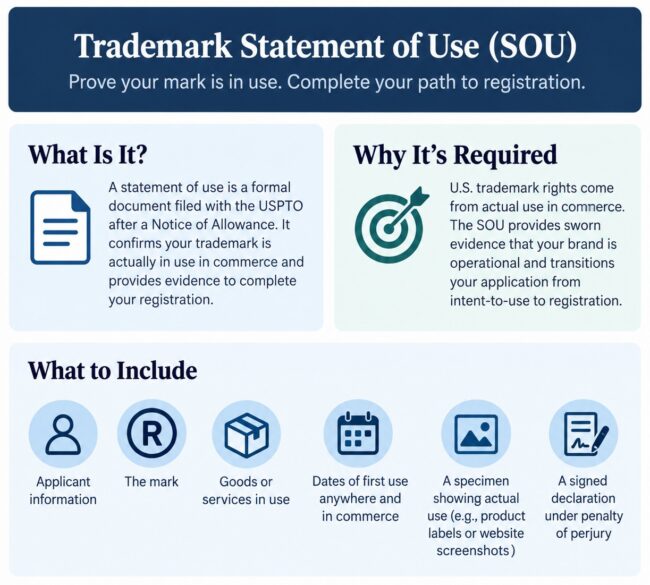
A statement of use is a filing made in a trademark application submitted with an intent-to-use filing basis under Lanham Act Section 1(b). A statement of use demonstrates that the applicant is actually using the trademark in commerce and changes the filing basis of a trademark application from an intent-to-use to an actual use application. The intent-to-use filing basis allows businesses to file a trademark application before they begin using the trademark if they have a bona fide intention to use the mark in commerce. The United States Patent and Trademark Office (USPTO) cannot issue a trademark registration from a Section 1(b) application until the applicant demonstrates use in commerce under 15 U.S.C. § 1051(d) by filing a statement of use.
A trademark statement of use (SOU) is a verified, formal legal document filed with the U.S. Patent and Trademark Office after a notice of allowance (i.e., approval of the application by the trademark examiner). The statement of use identifies the specific goods or services listed in the application for which the trademark is actually being used and creates an evidentiary record supporting that claim. The filing must identify the applicant and the mark, state the date of first use anywhere and the date of first use in commerce, include a specimen showing the mark as encountered by customers, provide a declaration attesting to the accuracy of the use allegations, and include the required filing fee. See 37 C.F.R. § 2.88.
U.S. trademark rights generally arise from real marketplace use. “Use in commerce” requires bona fide use in the ordinary course of trade, not token use merely to reserve a mark. Goods generally must bear the mark on products, packaging, or associated displays and be sold or transported in federally regulated commerce. For services, the mark must appear in sales or advertising, and services must actually be rendered in commerce. See 15 U.S.C. § 1127.
In Couture v. Playdom, Inc., 778 F.3d 1379 (Fed. Cir. 2015), Couture’s 2008 use-based application relied on a website advertising writing and production services, but he provided no entertainment services until 2010. The court affirmed cancellation of Couture's trademark registration because the applied-for services were not yet rendered at the time he asserted use of the service mark, and thus there was no established use in commerce at the time he asserted commercial use.
A statement of use provides sworn evidence that a brand is operational through qualifying use in commerce, and mere promotional activity does not qualify as use in commerce under 15 U.S.C. § 1127.
An intent-to-use trademark application filed under Lanham Act Section 1(b) permits the applicant to establish trademark rights before the trademark is actually used in commerce. An application filed under an intent-to-use basis requires the applicant’s good-faith bona fide intention to use the mark in commerce for each identified good or service listed in the application at the time of filing. The Lanham Act prohibits any attempt to reserve a right in a mark without a bona fide intent to use the mark in commerce. A mere hope or desire to use the mark in commerce is insufficient. A bona fide intent is judged based on concrete facts and actions, not solely upon subjective intent of the applicant. Objective evidence may include dated product-development records, market research, correspondence with manufacturers, suppliers and distributors, product prototypes, domain name registrations and website development, and branding and marketing development.
In M.Z. Berger & Co. v. Swatch AG, 787 F.3d 1368 (Fed. Cir. 2015), the Federal Circuit affirmed denial of “iWatch” registration for lack of a bona fide intent at the time of filing. M.Z. Berger could not demonstrate any firm decision to commercialize the watch. Conflicting testimony about prototypes and buyer discussions further undermined M.Z. Berger's attempt to show any bona fide intention. The court found that the objective evidence did not show a firm intention to use the mark in commerce, and the trademark registration was denied.
The applicant can establish use in commerce during the trademark application process before the examiner approves the mark for publication by submitting an amendment to allege use or after a notice of allowance by submission of a statement of use. Regardless of which type of use filing is submitted, legitimate use in commerce is required in order to lawfully advance the application to a trademark registration.
Once the trademark registration issues from the intent-to-use application, constructive-use priority generally reaches back to the original filing date. Thus, a successfully submitted statement of use establishes nationwide priority over competitors who begin using conflicting marks after the filing date of the intent-to-use application, but before the applicant’s use of the applied-for goods and services in commerce. However, the applicant's rights do not supersede the rights of owners of confusingly similar marks that were in use prior to the application filing date, earlier-filed trademark applications, and earlier qualifying foreign-priority claims.
A complete statement of use filing must identify the goods or services that have been used in commerce; identify the first-use-anywhere and first-use-in-commerce dates for such goods or services; provide proof of the use in commerce by providing an acceptable specimen of use for each class of goods or services; pay the USPTO fee for submitting a statement of use; and include a signed declaration under penalty of perjury that attests to the use in commerce of the goods or services identified in the statement of use and that the applicant believes that they are the owner of the mark. See 15 U.S.C. § 1051(d). Under the USPTO rules, the sworn statement may be signed by the owner, someone with legal authority, a person with firsthand knowledge and actual or implied authority, or an authorized qualified practitioner. See 37 C.F.R. § 2.193(e)(1).
A specimen is essentially an image of an example of the applied-for goods or services being used in actual commerce. The image is submitted electronically with the statement of use through the USPTO's Trademark Electronic Application System (TEAS) filing system available through the USPTO's website. For goods, acceptable specimens include product labels, tags, packaging, and qualifying point-of-sale displays, which may be a store endcap, a sales booth, a website screenshot of an online storefront or other point of sale featuring the mark. Service specimens may include advertising or webpages directly associating the mark with services actually rendered. A specimen must clearly show actual trademark commercial use. Webpage specimens need to be submitted with the relevant URL and access date. Mockups and digitally altered specimens are unacceptable. See 37 C.F.R. § 2.56.
The SOU must be filed within six months from the date a notice of allowance issued. If additional time is needed to file a statement of use, applicant can request extension of the SOU deadline by six months. Applicants may take up to five six-month extension requests, allowing up to three years from the allowance date to begin using the mark in commerce and file a statement of use. Extension requests require a verified statement of continuing intent to use the mark in commerce and, after the first extension request, the applicant's ongoing efforts to begin using the mark in commerce. See 37 C.F.R. § 2.89.
Failure to file a statement of use or an extension of time before the SOU deadline results in abandonment of the trademark application. Revival may be available for unintentional delay under 37 C.F.R. § 2.66, but note that an SOU will not be accepted more than 36 months after allowance.
As of August 2026, the current USPTO filing fee for a statement of use is $150 per class when filed electronically and $250 per class when filed on paper. Each request for an extension of time costs $125 per class when filed electronically and $225 per class when filed on paper. Each class has a separate fee, so one-class costs exceed $100 before attorney review or additional fees.
After the filing is submitted, the USPTO reviews the declaration, use dates, specimen, and remaining goods or services. If the examining attorney finds that the statement of use fails to meet all of the requirements, they may issue an office action. For example, the examiner may find that the specimen does not properly show use of the applied-for goods or services in commerce. The applicant will then have three months (extendable to six months for a fee) to respond to the office action to correct the defect in the statement of use (e.g., by filing a proper specimen). If the statement of use is accepted, the application will proceed to a trademark registration within a few weeks.
If the applicant can demonstrate use of some, but not all of the goods or services listed in the trademark application, the applicant may delete unused goods or services, or request a division of the application under 37 C.F.R. § 2.87. If a division of the application is made, a registration will issue for the goods or services for which the statement of use was submitted in a second divisional application, and the original application will remain pending for the goods or services that were not covered by the statement of use. The divisional application is separate from the original application and has its own trademark application serial number. The applicant has to pay separate application filing fees and additional division fees for the second trademark application.
Turning a trademark application based on intent to use the applied-for trademark into a registered mark requires a proper statement of use. This is the final substantive step in the registration process. However, it must be understood that acceptance of the statement of use depends on careful of observance of the requirements. Accurate dates, an acceptable specimen, a valid declaration, and timely filing are required to move the trademark registration process to completion.
A trademark attorney can determine the appropriate filing type, review evidence of use in commerce, and address any office actions that the may USPTO issue. Assistance of trademark counsel and careful preparation helps prevent avoidable delays, submit a timely and proper statement of use, and protect the opportunity to secure a trademark registration.
© 2026 Sierra IP Law, PC. The information provided herein does not constitute legal advice, but merely conveys general information that may be beneficial to the public, and should not be viewed as a substitute for legal consultation in a particular case.
Trademark prosecution is the legal process of seeking trademark registration, from trademark selection and searching, to filing and application, trademark examination, publication, and registration. For a business, company, or product team, understanding what prosecution means makes it easier to evaluate risks, anticipate challenges, and craft a filing strategy that protects the brand without wasting time or money.
This article will break the process into practical stages so readers can learn how applications are prepared, examined, registered, and maintained. Effective prosecution supports strong trademark protection by ensuring that the applicant selects a protectable mark, accurately identifies its goods or services, and responds appropriately to the application requirements of the United States Patent and Trademark Office (USPTO). Although registration can strengthen a company’s rights, help consumers recognize the source of its products or services, and support sales, it should be understood that it does not guarantee success in later enforcement disputes.
Trademark prosecution involves administrative legal proceedings for trademark registration. In the United States jurisdiction, the Lanham Act governs domestic trademark usage and registration. Foreign jurisdictions each follow its own trademark law, commonly called a Trade Marks Act. “Trademark” includes a service mark, which identifies services. Trademark prosecution differs from trademark litigation in court.
Trademark prosecution includes several steps that need to be observed to sucessfuly navigate the entire process, including trademark selection, trademark search, application submission, examination, publication, registration, and maintenance.
Strong trademarks are distinctive from pre-existing trademark usage and are ideally unique. An effective trademark may be suggestive, arbitrary, or fanciful, but should not be generic or merely descriptive of the goods or services. The USPTO reviews trademark applications for distinctiveness and compliance with formal requirements. In USPTO v. Booking.com B.V., 591 U.S. 549 (2020), the examining attorney and TTAB deemed BOOKING.COM generic for online travel-reservation services, reasoning that “booking” named the services and “.com” denoted a commercial website. On de novo district-court review, Booking.com introduced consumer-perception evidence showing that the public understood BOOKING.COM as identifying one source rather than the class of reservation services. The court found the mark descriptive, not generic, and found acquired distinctiveness for hotel-reservation services. The Supreme Court affirmed and rejected a categorical rule that adding “.com” to a generic term necessarily yields a generic mark. Instead, compound marks must be considered as a whole, and genericness turns on the term’s primary significance to consumers in the relevant trademark usage situation.
Distinctiveness depends on how consumers understand the mark as a whole, and each trademark usage situation must be evaluated based on the relevant facts. There is no black-and-white rule with respect to whether a trademark is distinctive.
Prior to initiating the trademark prosecution process, the applicant should conduct a trademark search with the assistance of an experienced trademark lawyer. A trademark lawyer should check federal and state records and common-law use. The search results should then be compared to the proposed mark, looking for similarities between the sound, appearance, and meaning of the marks; the goods and services on which the prior marks are used; and the trade channels in which the prior marks are used. The mark must not be too similar to existing trademarks, because likelihood of confusion may cause refusal under 15 U.S.C. § 1052(d). See also In re E.I. du Pont de Nemours & Co., 476 F.2d 1357 (C.C.P.A. 1973).
Trademark applications must identify the correct owner, filing basis, mark, and goods or services and include the required verification and drawing. Precise descriptions of the goods or services are important because indefinite wording may trigger an objection, while the identification generally cannot be broadened after filing. See 15 U.S.C. § 1051. An applicant may file based on existing use in commerce under Section 1(a) or a bona fide intent to use the mark under Section 1(b). The applicant of an intent-to-use application must later establish qualifying use through submitting a statement of use before a trademark registration is issued.
For a use-based application, the applicant must provide dates of first use and a specimen of use for each class. Specimens must clearly show how the mark is used in commerce for the identified goods or services. A product specimen may include the goods, packaging, tags, labels, or an acceptable point-of-sale display. A service mark specimen may include advertising, website pages, or signage that creates a direct association between the mark and the services. See 37 C.F.R. §§ 2.34(a)(1), 2.56.
After filing, a USPTO examining attorney reviews the application for statutory and procedural compliance. The examiner evaluates conflicts, distinctiveness, other grounds for refusal, and formal requirements. Office actions are official letters from the trademark examiner identifying substantive “refusals” and procedural “requirements.” Minor issues may be resolved through an examiner’s amendment or direct communication, but significant refusals and objections generally require a written response.
A non-final office action allows the applicant to cure requirements or contest refusals. Trademark prosecution can include responding to office actions by revising descriptions, replacing specimens, disclaiming wording, submitting evidence, and presenting legal arguments. A complete response must address every outstanding issue. If the examiner remains unpersuaded, a final office action may issue. Depending on the issue, the applicant may request reconsideration, appeal to the Trademark Trial and Appeal Board to address substantive refusals, or petition the Director to address procedural issues. A reconsideration request does not extend the appeal or petition deadline. See 15 U.S.C. § 1070.
For most Section 1 and Section 44 applications, the office action response deadline is three months, with one paid three-month extension. Section 66(a) applications generally receive six months without extension. Failure to respond timely and completely can result in abandonment of the trademark application. A trademark attorney can protect your trademark rights by applying their skill and knowledge in the trademark process, and handle the trademark prosecution process, including preparing and submitting effective responses to USPTO office actions, communicating directly with the examiner, properly observing filing deadlines, and generally helping clients navigate the trademark registration process. Trademark attorneys use practical tools and strategies to avoid costly registration mistakes.
After approval by the examining attorney, the application enters the publication stage under 15 U.S.C. § 1062(a). Publication opens a 30-day period in which third parties who believe registration would damage them may oppose a trademark before the Trademark Trial and Appeal Board (TTAB) or request an extension. An opposition is an adversarial proceeding before the TTAB, with pleadings, discovery, evidence, and briefing. The Board decides registrability, not infringement liability, damages, or injunctions. See 15 U.S.C. § 1063.
After a final refusal, the applicant may appeal to the TTAB under 15 U.S.C. § 1070 and 37 C.F.R. §§ 2.141–2.145. Judicial review of the TTAB's decision by the U.S. Court of Appeals for the Federal Circuit is available under 15 U.S.C. § 1071. It may be critical to appeal TTAB decisions to the Federal Circuit because of the impact the Board's decision can have on the applicant's future trademark usage and potential disputes with third parties. To illustrate, in B&B Hardware, Inc. v. Hargis Industries, Inc., 575 U.S. 138 (2015) the TTAB sustained B&B’s opposition to a trademark application to register SEALTITE based on likely confusion with its SEALTIGHT mark. The Supreme Court held that the TTAB's ruling could preclude relitigation of the likelihood of confusion issue in a later court case when the issue-preclusion requirements were met and the trademark usages adjudicated were materially the same. Thus, a TTAB decision could be the final word on whether a mark is confusingly similar to a prior trademark filing, and that preclusion decision may then be leveraged in trademark litigation to establish trademark infringement.
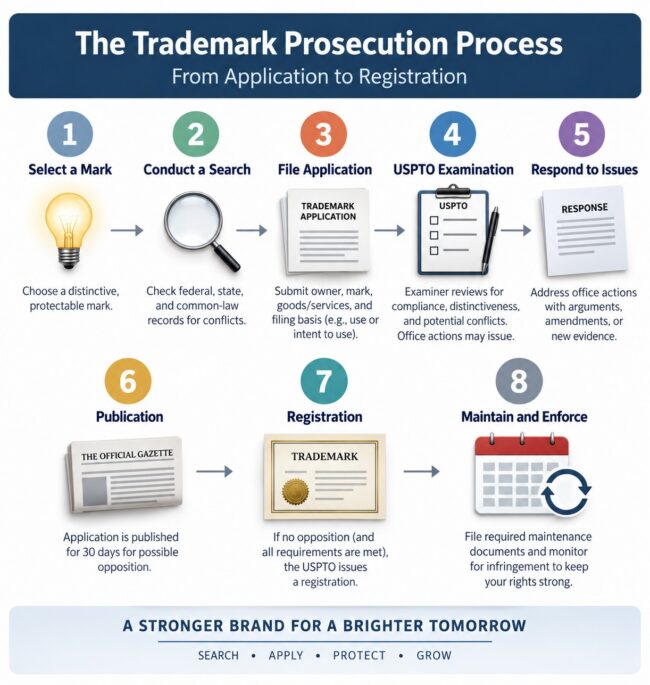
Federal registration on the Principal Register provides nationwide constructive notice of the registrant’s claim and prima facie evidence of validity, ownership, and the exclusive right to use the mark for the listed goods or services. See 15 U.S.C. § 1057(b). Registration may establish nationwide priority from filing, support federal-court remedies, and provide a basis for protection abroad. These benefits make registered trademarks easier to license, police, and value. However, a successful trademark prosecution does not guarantee success in trademark enforcement. Trademark infringement remains dependent on priority, defenses, and likelihood of confusion. It nevertheless helps secure trademark protection against similar marks and discourages confusingly similar marks.
Maintaining a trademark requires continued use and timely submissions of trademark renewals. Owners generally file an affidavit of use under Lanham Act Section 8 between the fifth and sixth anniversaries, then a renewal application including affidavits under Lanham Act Sections 8 and 9 must be filed between the ninth and tenth anniversaries and every ten years thereafter. See 15 U.S.C. §§ 1058–1059. Eligible owners may seek incontestability between the fifth and sixth years by filing a declaration of incontestability under Lanham Act Section 15. Attorneys can advise on the renewal requirements, including proper use, ownership changes, licensing controls, specimens, and renewal filings.
Trademark portfolio management includes monitoring competitors’ applications, marketplace conduct, deadlines, ownership changes, licenses, and trademark news. Watch services and audits help a business identify conflicts early and confirm that its trademark portfolios match its products, services, territories, and objectives.
Trademark rights are territorial, so portfolios should be built in the business’s relevant markets in the United States and abroad. A U.S. registration does not create rights in other countries. Every business has different markets, objectives, and situations. Counsel should prioritize countries based on sales, manufacturing, licensing, expansion plans, counterfeiting risk, and budget.
For protection across countries and the world, counsel should coordinate domestic and foreign strategies, deadlines, evidence, and ownership records. Depending on the brand, a long-term plan may combine national and international trademark filings.
Trademark prosecution involves much more than filing a few forms. It means making coordinated decisions about trademark selection, clearance, filing, responding to USPTO office actions, registration, maintenance, and enforcement. An expert lawyer can analyze the company’s objectives, break down legal and procedural challenges, craft practical strategies, and offer advice that helps secure, maintain, and enforce rights while avoiding preventable mistakes. Early guidance is especially valuable for ensuring that the application identifies the correct owner, mark, filing basis, and goods or services and that deadlines and objections are handled properly. Business owners who learn how the process works are better positioned to select a protectable mark, protect their brand, and decide whether domestic and international registration will provide benefits.
Contact our offices to connect with qualified trademark counsel to shape an effective trademark strategy before avoidable problems become costly.
© 2026 Sierra IP Law, PC. The information provided herein does not constitute legal advice, but merely conveys general information that may be beneficial to the public, and should not be viewed as a substitute for legal consultation in a particular case.
A patent application publication provides the public with access to a pending patent application to notify the public of the patent-pending status of new applications and make it aware of new innovations and technologies. It lets the public see the invention, drawings, and pending patent claims before the patent office decides whether to grant protection. Note that the publication does not establish that the invention is patentable or immediately provide enforceable patent rights.
This article is for non-attorneys and informs them of the reasons for and the effects of patent application publication. The reader will gain an understanding of what a patent application publication is and how it affects patent rights.
Most U.S. utility patent and plant patent applications are published by the USPTO 18 months after the earliest claimed filing date. A patent application is not published if it is provisional, design patent application, international design, or reissue; no longer pending; classified, under national security review, or subject to a secrecy order; issued early enough to stop publication; or covered by a valid non-publication request certifying no foreign or international filing requiring 18-month publication.
The published patent application is a patent document containing front-page data (i.e., title, inventors, publication and filing information, priority claims, classifications, and sometimes assignee information), an abstract, specification, patent claims, and drawings, generally as they were filed and sometimes reflecting timely amendments. A published application is not an issued patent and may later be granted, rejected, or abandoned. Publication establishes neither patentability nor an enforceable right to exclude, which are provided only by a granted patent. The invention is not protected against third-party use until a patent issues from the application.
U.S. patent applications generally publish 18 months after the earliest filing date for which priority is claimed. See 35 U.S.C. § 122(b)(1)–(2). A non-provisional application claiming the benefit of a provisional application normally publishes 18 months from the provisional filing date. Most applications publish before examination is completed, as patent examination may continue for years. Provisional patent applications themselves are not published or examined, but do become publicly accessible once a non-provisional application claiming priority to the provisional application is published.
An applicant may request earlier publication under 35 U.S.C. § 122(b)(1)(A). An applicant may also request non-publication of the application, which prevents the application from being published. See 35 U.S.C. § 122(b)(2)(B). This is a useful tool for maintaining the secrecy of an invention during the patent application process. With a non-publication request, the patent documents only become published if the application advances to a granted patent. Thus, the application may be maintained as a trade secret until a patent issues. However, the non-publication request can only be submitted if the applicant does not intend to seek foreign patent rights.
The USPTO publishes patent applications because Congress generally requires pregrant publication under 35 U.S.C. § 122(b). The requirement, adopted through the American Inventors Protection Act of 1999, replaced the former practice under which most U.S. applications remained confidential until a patent issued. Subject to statutory exceptions, nonprovisional utility and plant applications are published promptly after 18 months from the earliest filing date.
Publication serves several related purposes. It gives the public notice of technology for which patent protection is being applied, makes technical disclosures available earlier, facilitates prior-art searching, and allows businesses and researchers to evaluate potentially relevant pending claims before a patent issues. The USPTO identifies public notice, improved prior-art searching, and broader access to technical disclosures that promote innovation as principal policy goals of pregrant publication.
The system also brings U.S. practice closer to the 18-month publication systems used internationally. Publication balances public disclosure against the applicant’s interests by potentially allowing a reasonable royalty for certain post-publication conduct if substantially identical claims later issue and the statutory provisional-rights requirements are satisfied.
After the publication date, anyone can search USPTO databases and review the specification, drawings, abstract, and published claims. Publication informs others in the industry and publicly confirms that the application is patent pending. Patent-pending status begins when the application is filed. However, a patent publication grants no patent rights.
Claims may change during patent examination. Prior art and examiner objections often require amendments, so claims in issued patents are usually narrower or otherwise different than those in the published application. A patent application can therefore be published but never granted.
Published applications can serve as prior art against future patent applications even if they never mature into patents. Under 35 U.S.C. § 102(a)(1), a publication may be prior art beginning on its publication date and may anticipate a claim or support an obviousness rejection based on information made available to the public. A U.S. patent or published application naming another inventor also may qualify under 35 U.S.C. § 102(a)(2) as of its effective filing date, including an adequately supported priority date determined under 35 U.S.C. § 102(d), subject to statutory exceptions for certain inventor-originated disclosures, commonly owned subject matter, and joint research agreements.
The relevant inquiry is not whether the disclosed invention was ultimately patentable or whether the publication’s claims were allowed. A published patent application may be prior art for all that it discloses to a person of ordinary skill, including ideas, embodiments, drawings, examples, and technical teachings outside its claims. Conducting a thorough patentability search should therefore include searching published applications, patents granted, foreign patent databases throughout the world, and non-patent literature resources, not just U.S. patents.
A published application grants no immediate patent enforcement rights. Publication may nevertheless create potential provisional rights under 35 U.S.C. § 154(d) if a patent later issues with claims substantially identical to the published claims. Provisional rights allow applicants to seek royalties from infringers after publication. The owner may seek a reasonable royalty, but not an injunction or ordinary patent infringement damages, for qualifying acts between publication and issuance. However, the infringer must have had actual notice of the published patent application.
In Rosebud LMS Inc. v. Adobe Systems Inc., 812 F.3d 1070 (Fed. Cir. 2016), Rosebud relied on Adobe’s knowledge of a related grandparent patent, previous patent litigation proceedings involving the grandparent patent, alleged monitoring of Rosebud’s product, and the contention that Adobe’s counsel would have searched for related applications. The Federal Circuit held that this established, at most, constructive notice, and it was not shown that Adobe received notice of Rosebud's application publication. Actual notice may result from direct notification or independently acquired actual knowledge, but it cannot be imputed merely because an application is publicly searchable or the accused party should have discovered it. Because Adobe stopped using the accused technology before becoming aware of the patent application publication, Rosebud could not recover a pre-issuance reasonable royalty.
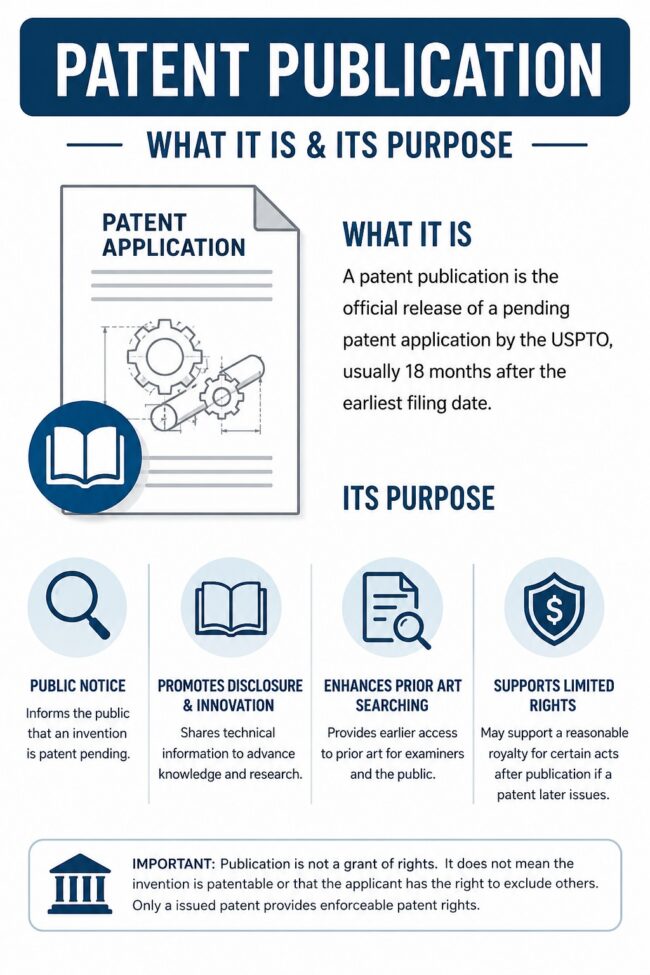
An applicant can request non-publication when filing a U.S. application. The non-publication request must accompany the application and certify that the invention has not been, and will not be, filed in another country or under an agreement requiring 18-month publication. See 35 U.S.C. § 122(b)(2)(B).
If the applicant later files a foreign or Patent Cooperation Treaty (PCT) application requiring publication, the applicant must rescind the request or notify the USPTO within 45 days. Failure to do so may cause abandonment. Applicants intending foreign protection therefore generally cannot prevent publication.
Other jurisdictions have similar patent publication rules that are required by international treaties (including the Patent Cooperation Treaty) to which nearly all foreign jurisdictions are parties. For example, the European Patent Office (EPO), the executive arm of the European Patent Organization, publishes a European patent application 18 months after filing or the earliest priority date. Earlier publication is available on request. PCT applications likewise publish 18 months from the priority date under PCT Article 21. Foreign patent publications also qualify as prior art under U.S. patent law, and thus must be searched as part of an effective patent search. European publications and patent application status can be searched and determined through the European Patent Register and Espacenet.
Patent application publication places an invention’s disclosure into the public record, alerts competitors, and may establish prior art against later patent applications. Although publication does not create an enforceable patent, it may support a later reasonable-royalty claim if a patent issues and the statutory requirements for provisional rights are satisfied. Applicants deciding whether to request or prevent publication should evaluate their foreign-filing plans, disclosure risks, likely claim changes, and competitive factors before filing. A valid nonpublication request may preserve confidentiality in appropriate cases, but it can restrict foreign-patent strategy and requires careful compliance if those plans change. Consulting a patent attorney early in the application process can help a business coordinate publication decisions with its broader patent rights, trade-secret protection, and commercialization objectives.
© 2026 Sierra IP Law, PC. The information provided herein does not constitute legal advice, but merely conveys general information that may be beneficial to the public, and should not be viewed as a substitute for legal consultation in a particular case.
How much does a trademark cost? U.S. government filing fees are $350 per class, if you apply for a single class of goods or services and utilize the pre-approved descriptions provided in the Trademark ID Manual. However, there are additional costs that may be incurred in your application, such as additional fees for more than one class of goods or services, a statement of use if you file under an intent-to-use filing basis, attorney costs if you hire a trademark attorney, trademark search fees, and maintenance costs. There are also renewal fee requirements after five years of registration and renewal applications after every 10 years post-registration.
A properly prepared one-class trademark application may require only the base application filing fee, while multiple classes, custom descriptions, intent-to-use, or an office action can increase total costs. A good estimate of the cost of a simple trademark application (a mark in current use on a single class of goods or services), including fees for attorney services, is around $2,000 to $3,500.
This article provides basic cost information for non-attorneys, allowing them to understand the process before they commit to the trademark registration process.
The United States Patent and Trademark Office (USPTO) charges a $350 base filing fee per class for electronic applications under Trademark Act Sections 1 and 44. In 2025, the trademark office replaced the previous two-tier system, TEAS Plus and TEAS Standard, with one base application fee of $350. New applications are filed through Trademark Center, the USPTO's updated electronic filing system launched in 2025. The legacy Trademark Electronic Application System is still used for filing statements of use, extensions of time, responses to office actions, and other filings. The electronic filing system is generally accessible through a MyUSPTO account that can be set up by anyone and fee payments can be set up via electronic funds transfers. The USPTO also accepts credit card payments. However, it must be understood that a MyUSPTO account may only be used to file trademark applications on behalf of the account holder. Only licensed attorneys are authorized to file trademark applications on behalf of others.
Goods and services are divided into separate international classes in related categories. A trademark application that includes one class requires a single USPTO filing fee of $350 and each additional class adds another $350 filing fee. Thus, how many classes determines the amount of USPTO fees required to submit the application for examination. One trademark application may list multiple classes, but including multiple trademark classes in one application does not reduce the USPTO filing fees. In fact, including a wide array of goods and services in a single application can overly complicate the application process.
Having a complicated single application with multiple classes of goods or services can result in a complicated examination process. Often it is simpler and more organized to file a separate application for each class. This approach cabins the different goods and services categories and avoids the entire application from being rejected based on the similarity of one of the classes with a third-party trademark filing, or the potential need to later divide the application because some of the goods or services are being used in commerce and others are not. Careful consideration of planned goods or services can prevent unnecessary complications and costs while preserving trademark protection for all the relevant goods and services.
The application form submitted to the USPTO has formal requirements that must be met before the application will be examined. Detailed information must be included in the application regarding the applicant, the legal basis for the application, the nature of the mark (including whether and when it has been used in commerce), and the specific goods and services and their respective classes. An incomplete application can trigger processing fees of an additional $100 per class. Also, if the descriptions of the goods and services are not taken from the pre-approved descriptions provided in the Trademark ID Manual, and are instead free-form custom descriptions, the applicant will pay additional fees of $200 per class. There are also size fees for goods and services descriptions. Each additional 1,000 characters beyond the first 1,000 characters adds $200 for the affected class. These additional fees are in place to promote examination efficiency. It is highly advisable to use the pre-approved descriptions in the Trademark ID Manual whenever possible. However, the use of an inaccurate description of goods or services merely to avoid additional USPTO fees is never advisable.
A comprehensive trademark search should be performed prior to filing a federal trademark application. The USPTO provides a search tool for its internal trademark database, but it does not provide guidance to the applicant as to registrability of the applicant's trademark. A professional search may cost between about $300 and $1000. However, the more important service is the analysis of the search results and the guidance provided by an experienced attorney with regard to the likelihood that the mark can be registered and potential trademark infringement and dispute issues that may arise from the use of the proposed trademark. An effective trademark search and analysis includes related prior trademark filings in the federal trademark registers, state trademark registrations, active business names, internet domains, and unregistered, common-law use. DIY filing or self-filing can avoid attorney fees but create costly mistakes arising from filing trademarks that have little chance of success, misidentifying the ownership of the mark, misclassifying goods and services, submitting improper specimens, and various other matters. Applications filed by attorneys have a far higher success rate than DIY filings.
A trademark attorney does increase the cost of the application, but greatly increases the chances of success in a trademark application and can keep the applicant out of potential trademark infringement situations. Trademark attorneys handle billing for such services in different ways. Some may charge a flat-fee, hourly attorney fees, or separate fees for attorney services such as an initial consultation, search, preparation, and monitoring. Trying to save a few hundred dollars by pursuing a trademark application without experienced trademark counsel often leads to failure and can result in weakened brand protection. In fact, the USPTO recommends hiring a trademark attorney to conduct a clearance search and prepare the application, respond to correspondence, and help maintain trademark rights.
The trademark application process requires a valid filing basis. Under Section 1(a), the mark must be used in commerce at the time the application is filed. Under Section 1(b), the applicant must have a bona fide intent to use the mark in commerce. Intent-to-use applications incur later additional trademark costs, including a statement of use in which the applicant declares under penalty of perjury that the mark has been used in commerce in connection with the applied-for goods or services. The applicant must also provide a valid specimen of use for each class to which the statement of use relates. There are USPTO fees associated with each class for which the statement of use is filed: $150 per class. These filing options allow a business owner to file for trademark registration regardless of their current stage of trademark implementation.
The applicant can file an amendment to allege use during the examination process for the intent-to-use application. If no amendment to allege use is filed, there is a six-month period after a notice of allowance for the application is issued by the USPTO. If the applicant cannot establish use of the mark and submit a statement of use in that timeframe, the applicant can extend the time to file the statement of use another six months by filing an extension request and paying a fee of $125 per class. The applicant can extend the time to file the statement of use up to five times.
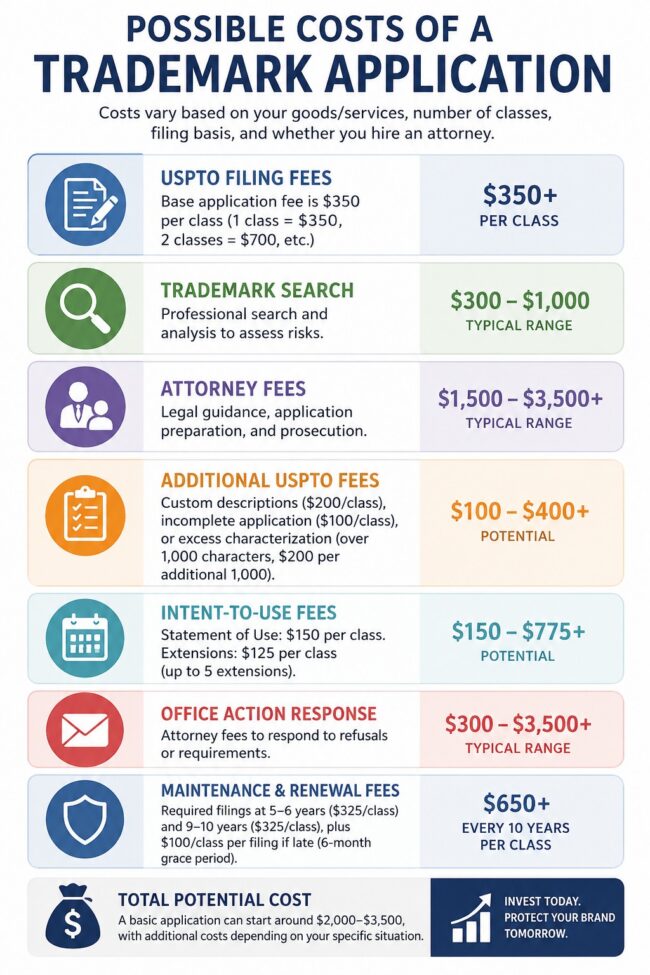
During the examination process, a USPTO examining attorney reviews the trademark filing for legal and procedural issues. An office action may be issued if the examiner finds likelihood of confusion issues with prior trademark filings under Section 2(d), descriptiveness issues under Section 2(e), or formal issues with the application, such as faulty classifications or descriptions of the goods and services. There is ordinarily no government fee required to file a response to the office action, but it is advisable to seek the assistance of a trademark attorney to analyze and respond to the issues in the office action. This legal work, of course, incurs attorney fees. For an office action that raises formal matters and/or descriptiveness issues, an attorney may bill a few hundred dollars. If the office action raises complicated refusals based on alleged confusion with prior-filed applications, responding to the office action can cost, e.g., $1,500 to $3,500.
The USPTO provides a three-month response window for an office action. The time to respond can be extended for a three-month period for a $125 electronic fee. If the applicant fails to timely respond to an office action and the applicant did not intend to abandon the application, the application can be revived. The petition to revive an unintentionally abandoned application carries a USPTO fee of $250. These additional costs involved in extending the timeline of examination are intended to promote efficient prosecution of trademark applications. It is recommended that applicants seek the assistance of trademark counsel in order to avoid costly mistakes in the application process.
Trademark rights can arise through use, but federal trademark registration offers important benefits. A Principal Register certificate is prima facie evidence of validity, ownership, and exclusive rights for the listed goods or services, and registration supplies nationwide constructive notice. See 15 U.S.C. § 1057(b).
The Supreme Court detailed registration’s legal benefits in Matal v. Tam, 582 U.S. 218 (2017). Although unregistered marks may receive protection, Tam explained that Principal Register registration provides nationwide constructive notice, prima facie evidence of validity, ownership, and exclusive use, potential incontestability after five years, and assistance against infringing imports. In B&B Hardware, Inc. v. Hargis Industries, Inc., 575 U.S. 138 (2015), B&B opposed Hargis’s SEALTITE application based on its registered SEALTIGHT mark. After the TTAB found a likelihood of confusion, the Court held that the determination could preclude relitigation in later infringement litigation when ordinary preclusion requirements are met and the usages adjudicated are materially the same. B&B Hardware thus shows that the USPTO provides not merely a registration process, but also an administrative court whose findings regarding trademark registrations may have a determinative effect on trademark enforcement. These statutory, evidentiary, and procedural advantages can make trademark registration central to comprehensive protection.
After the registration process, there are still actions that must be periodically taken to preserve the registration and the registrant's trademark rights. There are trademark renewal and maintenance requirements at 5 years and every 10 years after the registration is issued. A Section 8 declaration of continued use of the registered mark is due between the fifth and sixth anniversaries. The Section 8 affidavit of use carries a USPTO fee of $325 per class. The registrant may also file a declaration of incontestability under Section 15, which removes many of the bases for challenging the validity of a registration, including prior trademark use. The USPTO fee for the Section 15 filing is $250 per class. At the tenth anniversary, and every ten years thereafter, the Section 8 affidavit of use and Section 9 renewal application must be filed at a renewal fee of $650 per class. These additional trademark fees should be considered when estimating the cost of the entire process.
A six-month grace period is available for these trademark renewal filings, but USPTO surcharges of $100 per class are required.
Protection in multiple countries can be sought through an international treaty system called the Madrid System. An owner of a U.S. trademark registration may seek foreign registrations that claim priority to the U.S. application through the World Intellectual Property Organization (WIPO). If an international trademark registration application through the Madrid System is filed within six months from the filing date of the U.S. application, the international trademark registration application will have the same effective filing date as the U.S. application. The application is filed with WIPO, which charges a basic fee in Swiss francs plus country and class-based charges. Government fees vary by the countries selected and whether one or multiple basic applications or registrations are used. The filing fees for an application through the Madrid System vary based on the selected countries in the range of about $1,000 to about $3,000.
So, how much does a trademark cost? The total costs may include a comprehensive trademark search, filing fees, attorney fees, intent-to-use filings, custom descriptions, responses to an office action, maintenance filings, and international protection. Almost all trademark fees are nonrefundable, and the USPTO generally will not refund fees merely because registration is refused or an application is abandoned. The most reliable cost estimate therefore begins with careful consideration of the mark, owner, goods or services, number of classes, countries, and filing basis. A targeted trademark search and informed filing strategy can control trademark costs, strengthen federal registration, secure meaningful brand protection, and help avoid costly mistakes throughout the application and registration process.
© 2026 Sierra IP Law, PC. The information provided herein does not constitute legal advice, but merely conveys general information that may be beneficial to the public, and should not be viewed as a substitute for legal consultation in a particular case.

Sierra IP Law, PC - Patents, Trademarks & Copyrights
FRESNO
7030 N. Fruit Ave.
Suite 110
Fresno, CA 93711
(559) 436-3800 | phone
BAKERSFIELD
1925 G. Street
Bakersfield, CA 93301
(661) 200-7724 | phone
SAN LUIS OBISPO
956 Walnut Street, 2nd Floor
San Luis Obispo, CA 93401
(805) 275-0943 | phone

SACRAMENTO
180 Promenade Circle, Suite 300
Sacramento, CA 95834
(916) 209-8525 | phone
MODESTO
1300 10th St., Suite F.
Modesto, CA 95345
(209) 286-0069 | phone
SANTA BARBARA
414 Olive Street
Santa Barbara, CA 93101
(805) 275-0943 | phone
SAN MATEO
1650 Borel Place, Suite 216
San Mateo, CA, CA 94402
(650) 398-1644. | phone
STOCKTON
110 N. San Joaquin St., 2nd Floor
Stockton, CA 95202
(209) 286-0069 | phone
PORTLAND
425 NW 10th Ave., Suite 200
Portland, OR 97209
(503) 343-9983 | phone
TACOMA
1201 Pacific Avenue, Suite 600
Tacoma, WA 98402
(253) 345-1545 | phone
KENNEWICK
1030 N Center Pkwy Suite N196
Kennewick, WA 99336
(509) 255-3442 | phone
2023 Sierra IP Law, PC - Patents, Trademarks & Copyrights - All Rights Reserved - Sitemap Privacy Lawyer Fresno, CA - Trademark Lawyer Modesto CA - Patent Lawyer Bakersfield, CA - Trademark Lawyer Bakersfield, CA - Patent Lawyer San Luis Obispo, CA - Trademark Lawyer San Luis Obispo, CA - Trademark Infringement Lawyer Tacoma WA - Internet Lawyer Bakersfield, CA - Trademark Lawyer Sacramento, CA - Patent Lawyer Sacramento, CA - Trademark Infringement Lawyer Sacrament CA - Patent Lawyer Tacoma WA - Intellectual Property Lawyer Tacoma WA - Trademark lawyer Tacoma WA - Portland Patent Attorney - Santa Barbara Patent Attorney - Santa Barbara Trademark Attorney
